 by Tom Gurney
Tom Gurney BSc (Hons) is an art history expert with over 20 years experience
Email: tomgurney1@gmail.com / Phone: +44 7429 011000
Kindred Spirits by Asher Brown Durand: Introduction
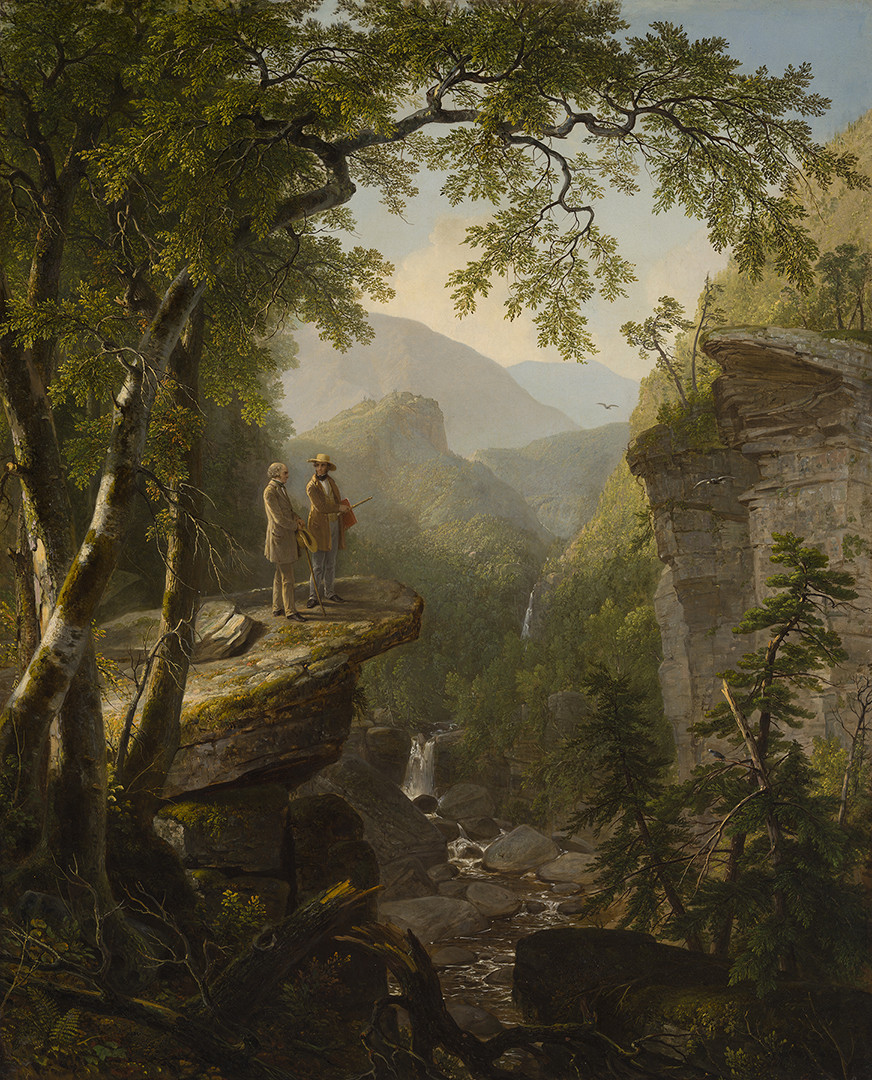
Asher Brown Durand’s Kindred Spirits brings the painter Thomas Cole and the poet William Cullen Bryant together on a rock ledge above a forest stream. The landscape surrounds them with enormous trees, layered cliffs and mountains fading into a bright distance. Painted in 1849, a year after Cole’s death, it was commissioned by Jonathan Sturges as a gift to Bryant. Its combination of portraiture and landscape makes friendship, poetry and remembrance part of the experience of looking at nature.[1][2]
At a Glance
- ArtistAsher Brown Durand (1796–1886)
- TitleKindred Spirits
- Date1849
- MediumOil on canvas
- Painting dimensions111.8 × 91.4 cm
- CollectionCrystal Bridges Museum of American Art, Bentonville, Arkansas
- Accession2010.106
- People depictedThomas Cole and William Cullen Bryant
- CommissionerJonathan Sturges
- Original recipientWilliam Cullen Bryant
This work across Asher Brown Durand’s career
The Beeches
1845God’s Judgment Upon Gog
ca.1851–52River Scene
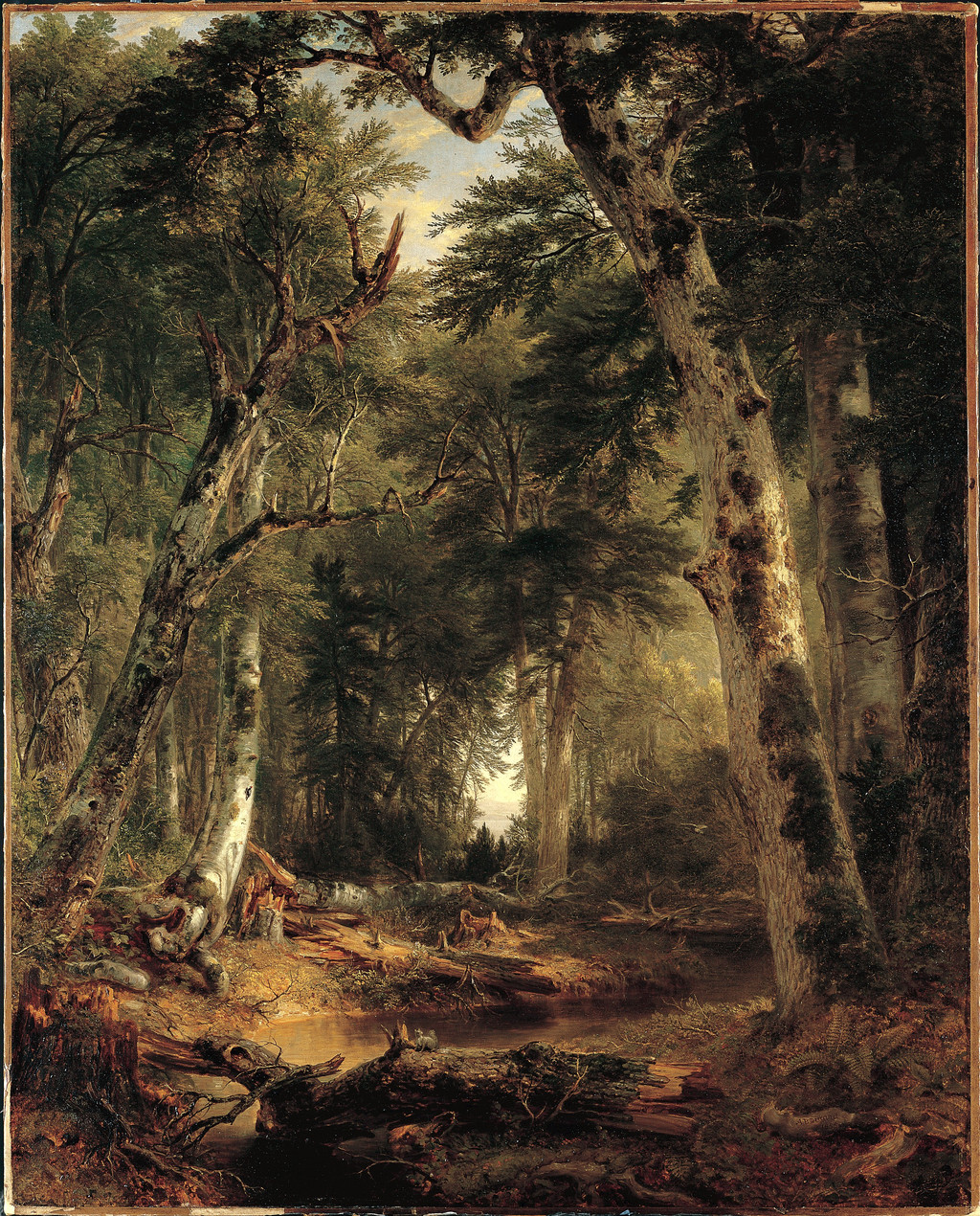
1854In the Woods
1855The Catskills
1859Sunday Morning
1860Summer Afternoon
1865Contents
- Two figures on the ledge
- Trees, water and the opening distance
- Cole, Bryant and the 1849 gift
- A composite Catskill landscape
- Names written into the landscape
- Poetry and remembrance
- From Bryant’s family to Crystal Bridges
- A comparison with The Beeches
- Annotated details
Two figures on the ledge
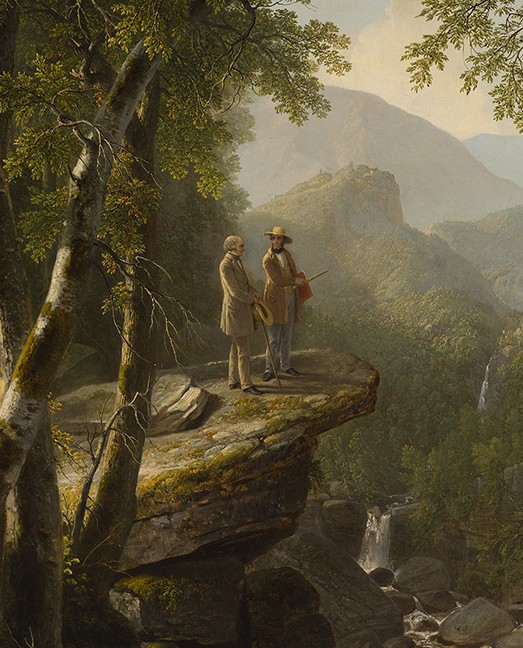
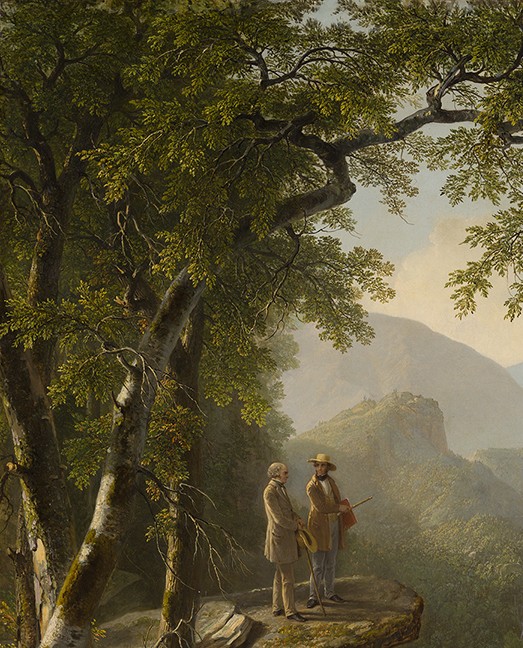
The two men occupy a small but conspicuous clearing in the lower left half of the painting. Bryant stands nearer the tree; Cole, wearing a broad-brimmed hat, stands closer to the projecting edge. Their pale and brown clothing separates them from the foliage behind. We see enough of their bodies to recognise a meeting, while the landscape retains most of the canvas.
Crystal Bridges identifies the objects Cole carries as a sketchbook and a flute or recorder. These associate him with artistic activity even in a picture made after his death. His companion belongs to another art: Bryant’s poetry repeatedly considers nature, human life and mortality. The museum presents their encounter as an expression of interests shared by artists, writers and their patrons.[2]
Their position makes the ledge a viewing place inside the painting. Beyond it, a gorge drops sharply to water and boulders. The rock therefore gives the men a firm standing ground while opening the scene around them. A viewer can follow their outward attention and also look down into space that they overlook.
The figures’ small scale changes the kind of portrait offered here. Much of their identity comes through place, companionship and associated objects. Their faces provide one part of the recognition; the forest supplies the larger setting through which Durand asks us to understand them. The men are close to each other, yet surrounded by forms that greatly exceed their size.
Annotated Details from Kindred Spirits
The numbered points identify visible features discussed in this article. Return from each detail to the whole composition. Asher Brown Durand, Kindred Spirits, 1849. Crystal Bridges Museum of American Art, 2010.106. Commissioned by Jonathan Sturges as a memorial to Thomas Cole and given to William Cullen Bryant. Broad composition shown at its available native resolution. Crystal Bridges Museum of American Art; museum-uploaded open-access reproduction. Image source. CC0 / Public domain. Resized only; native appearance, complete carrier and margins preserved.
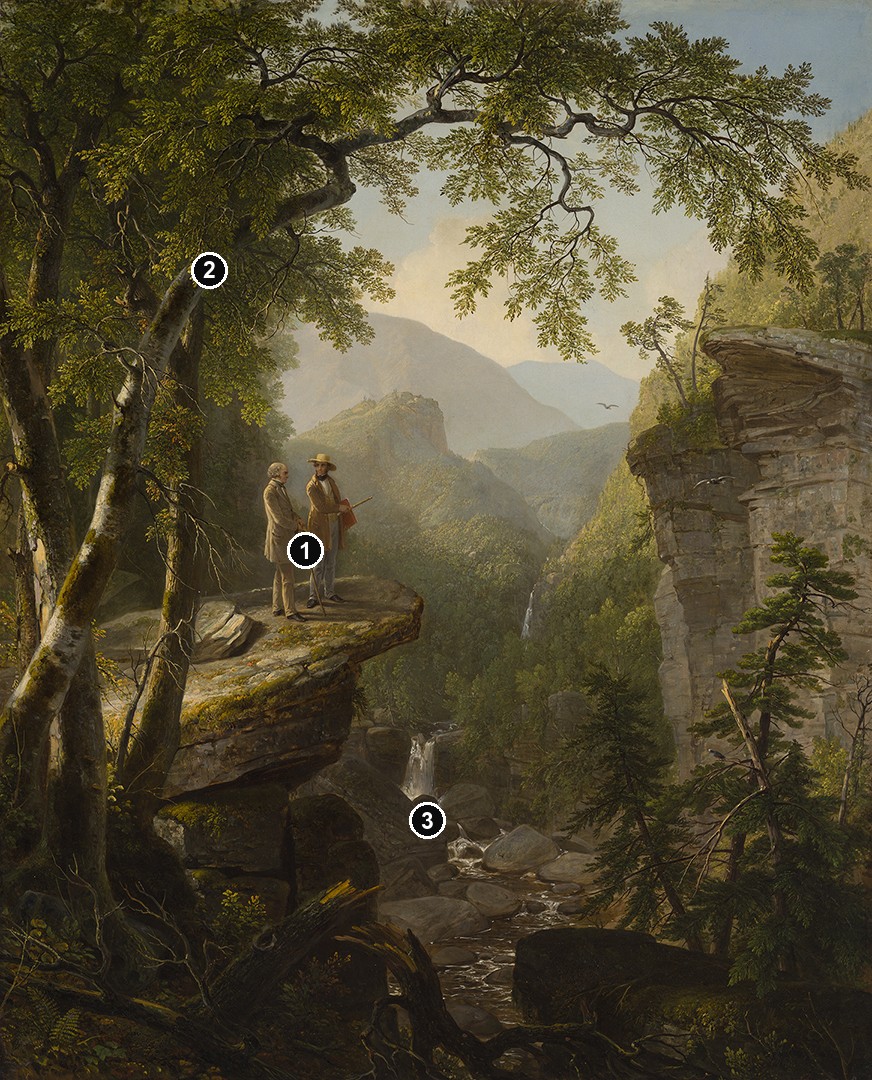
Details from KINDRED SPIRITS
Compare the cropped details with the complete images above. Notice how their colours, shapes and positions contribute to the larger compositions.
Two men on the ledge
Two small standing figures occupy an open rock ledge above the gorge. The broad crop retains their relationship with the surrounding landscape; tiny facial details are not inferred.
Enclosing tree and branches
A large near trunk and spreading branches enclose the figures’ space. Their darker forms frame the brighter distant opening.
Water descending through the gorge
A pale fall and rocky watercourse continue below the ledge. The broad view connects water with the depth of the gorge.
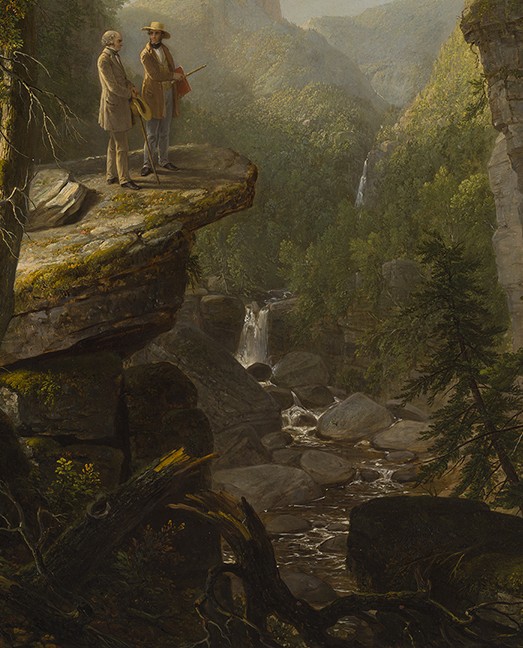
Trees, water and the opening distance
A large tree rises along the left edge and extends branches across the upper canvas. Its dark mass encloses the figures beneath it. Smaller branches and leaves reach into the sky, creating irregular openings through which the brighter distance can be seen. The canopy feels extensive because its structure continues beyond the painted boundary.
Opposite the men stands an exposed rock face. Its horizontal layers give the right side a different rhythm from the branching tree. Small plants cling to the ledges, linking the cliff to the surrounding vegetation without concealing its solid shape. Rock and tree make the gorge feel both enclosed and deep.
Below, a narrow waterfall empties into the stream. Pale water reappears between boulders and runs toward the lower edge, giving the eye a route through the foreground. Its small bright passages interrupt the dark forest floor. The stream connects several levels of the picture: the distant gorge, the fall, the nearer stones and the water nearest the viewer.
Distance is built through successive changes in emphasis. Near bark, roots and rock retain firm outlines. The middle valley is densely wooded, while farther mountains become paler and less distinct. The sky provides an opening beyond those mountains, so the scene expands upward as well as inward.
Crystal Bridges reads this movement from the darker valley toward the open sky in relation to cycles of life and remembrance. Its account also draws attention to the damaged trees in the foreground. Such a reading arises from the way living foliage, exposed wood, water and distant light share the landscape; individual details gain force through their place within the whole.[2]
Cole, Bryant and the 1849 gift
The painting grew from a specific loss within a circle of friends. Cole died in 1848. Bryant commemorated him, and Sturges commissioned Durand’s landscape as a gift to the poet. Crystal Bridges’s provenance records its transfer to Bryant in 1849, the same year inscribed beside Durand’s signature.[1]
Durand knew Cole as an artistic companion. The Smithsonian’s biography identifies their 1837 sketching journey to the Adirondacks as a formative episode in Durand’s growing commitment to landscape. The friendship gives the memorial a personal history extending beyond the commission itself. It also connects the figures’ shared attention in the painting with an established practice of artists travelling and studying scenery together.[3]
Sturges’s role makes patronage part of that history. A merchant could commission a work whose central purpose was to honour artistic and literary relationships. The picture’s first destination was Bryant’s own collection, giving it the character of a personal gift before its later public life.
The three roles remain distinct: Durand made the painting, Sturges commissioned it and Bryant received it. Cole appears as the friend being remembered. Following those relationships helps explain why a landscape could carry the weight of a commemorative portrait without using a tomb, a ceremonial room or a public monument.
The scene makes continued companionship imaginable after death. Cole stands within an active landscape, carrying the things of his work, beside a living friend. The memorial operates through a meeting that the painting makes present. Its calm arrangement lets remembrance take the form of shared attention rather than an overtly dramatic event.
A composite Catskill landscape
The setting belongs to the Catskills through its ravines, rock ledges, wooded slopes and waterfalls. Its apparent specificity can encourage the search for a single standing place. Margaret Stenz’s Brooklyn Museum guide explains that Durand assembled characteristic features of the region into a composition. She treats the waterfall’s identification with Kaaterskill Falls as uncertain.[4]
That distinction helps make sense of the painting’s unusually complete arrangement. A strong tree shelters the portraits, an opposing cliff establishes depth, a waterfall supplies movement and a succession of mountains opens the distance. Each contributes to a scene suited to the memorial. The geography serves the picture through selection and combination.
Stenz proposes more specific sources for parts of this arrangement: Church’s Ledge for the foreground rock formation and Fawn’s Leap for the smaller waterfall. Her suggestions concern individual features within the assembled scene. They give the viewer a way to compare the painting with regional landforms while preserving the distinction between a possible source for one passage and a complete location for the canvas.[4]
Stenz also discusses a study of windblown pines made on North Mountain during Durand’s 1848 stay in the region. She proposes a possible connection with preparations for Kindred Spirits. The proposal links the public painting to a practice of outdoor study while retaining the uncertainty of the individual study’s purpose.[4]
There is a useful difference between recognising regional features and reconstructing an exact viewpoint. The first allows us to understand the kind of country Durand knew. The second would require a precise correspondence that the composed scene does not establish. The trees and rocks can feel closely observed even when the landscape brings separate observations together.
For more on the real regions behind these paintings, see Durand in the Catskills and American landscape. His repeated visits supplied material that could enter both broad valley pictures and enclosed forest scenes, with the finished canvas determining how that material was organised.
Watch: Asher Brown Durand
Choose a film to explore the artist’s work, its interpretation and its wider setting.
Friendship and landscape, Asher B Durand's Kindred Spirits
Smarthistory and Crystal Bridges discuss friendship, memory and landscape in Kindred Spirits.
Watch on YouTubeNames written into the landscape
The museum records the names BRYANT and COLE at the centre-left and Durand’s signature with the year 1849 at the lower left. These inscriptions give the painting two kinds of identity: the names of the people honoured and the authorship of the object itself.[1]
Writing the men’s names into the rocky setting connects remembrance to the landscape. Their identities have a visible place among the ledges and vegetation. The effect differs from a separate caption outside the image: a name becomes part of the imagined place in which its bearer stands.
The title similarly places the emphasis on affinity. Crystal Bridges relates the friendship among Cole, Bryant, Durand and Sturges to their shared interest in nature. Although only two men appear, the painting belongs to a wider network of making, writing and collecting. The title can therefore be understood through both the represented encounter and the relationships that produced the canvas.[2]
Details of this kind reward a second look. The first encounter may be with the gorge and its scale. Once the people and inscriptions are identified, the same natural forms become the setting of a particular act of remembrance. Recognition changes the meaning of the view without changing its visible arrangement.
Poetry and remembrance
Bryant’s Thanatopsis is an important point of reference in Crystal Bridges’s current interpretation. The museum connects its attention to nature and mortality with the commemorative purpose of Kindred Spirits. The poem offers a context for considering Cole’s place in a living landscape after death.[1]
The painting’s connection with poetry is carried through its organisation as well as through Bryant’s presence. The route from a dark ravine toward a lighter distance makes looking an unfolding experience. Near wood and stone demand close attention; distant hills draw the eye beyond them. The viewer moves between material particulars and an expansive space.
Durand addressed Bryant’s poem more directly in Landscape—Scene from Thanatopsis, painted in 1850. That picture brings a funeral, agricultural work and ruins into one broad landscape. The Met interprets those elements in relation to death and the continuing life of the earth. It provides a separate example of how literary ideas could be translated into painted relationships.[5]
Here the two portraits keep the meaning attached to particular people. Nature becomes a shared setting for the painter and the poet, with Cole’s death supplying the reason for bringing them together. The work’s emotional force depends on the relation between the familiar encounter and the larger landscape in which it has been placed.
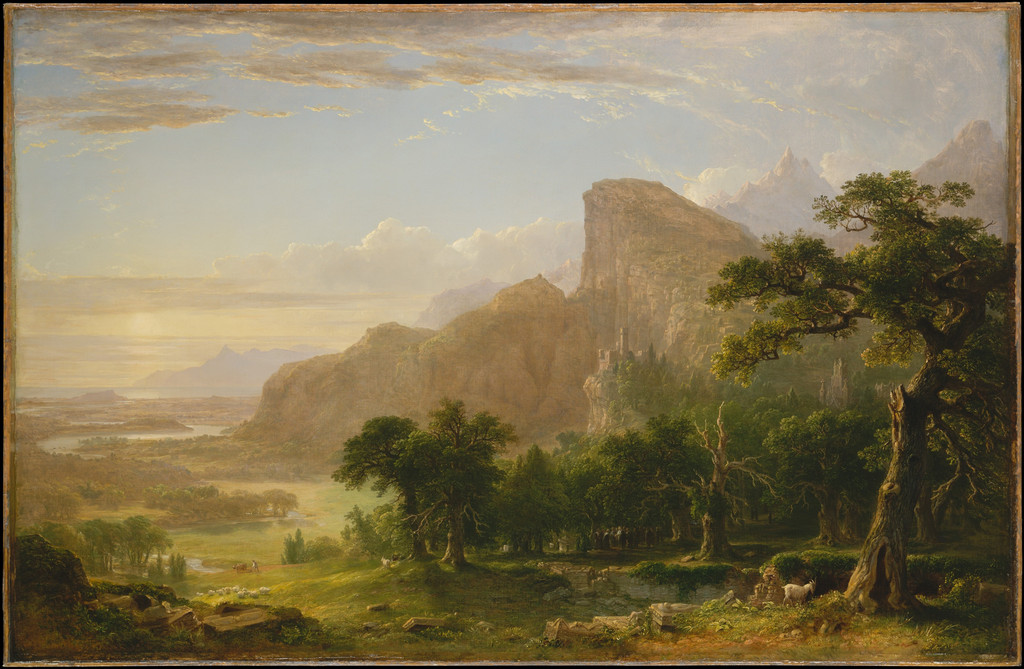
Asher Brown Durand, Landscape—Scene from Thanatopsis, 1850. Oil on canvas. Metropolitan Museum of Art, 11.156. A separate response to Bryant's poem. The Metropolitan Museum of Art. Image source. CC0 / Public domain. Resized only; native appearance, complete carrier and margins preserved.
From Bryant’s family to Crystal Bridges
The museum’s provenance follows the painting beyond its original recipient. After Bryant’s death in 1878, it descended to his daughter Julia Sands Bryant. She gave it to the New York Public Library in 1904. It later appeared at Sotheby’s on 12 May 2005 and was purchased by a private foundation for Crystal Bridges.[1]
This history changes the conditions under which the work is encountered. A commissioned gift entered a family collection, then a public library and eventually an art museum. Its capacity to express a private friendship has remained available as it has acquired a larger public audience.
The current accession, 2010.106, identifies the museum object. Its year should be distinguished from both the painting’s date, 1849, and the 2005 purchase recorded in the provenance. Likewise, painting dimensions and framed dimensions describe different physical measurements: the painted canvas is approximately 111.8 by 91.4 centimetres.[1][2]
A comparison with The Beeches
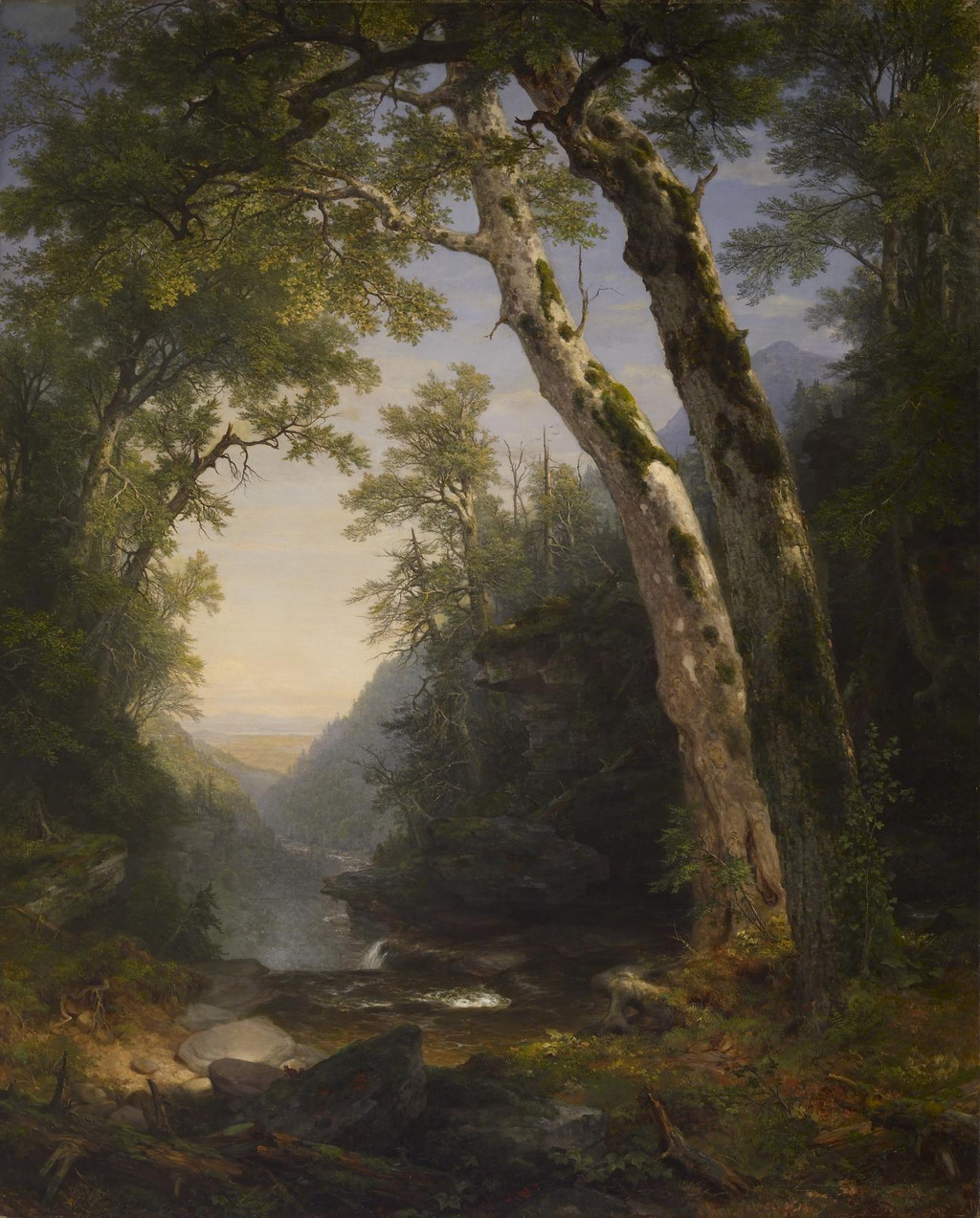
Durand’s earlier The Beeches also places small figures beneath substantial trees. The Met’s catalogue connects that 1845 canvas with outdoor study and with a European pastoral model, Constable’s The Cornfield. Its shepherd and flock inhabit a winding road within an opening wooded landscape.[6]
The comparison helps isolate the work performed by the portraits in Kindred Spirits. Both paintings give trees a commanding presence and use small people to establish scale. Here, named companions and a commemorative commission add a particular history to that relationship. The ledge becomes a meeting place, and the landscape becomes a means of keeping a friendship visible.
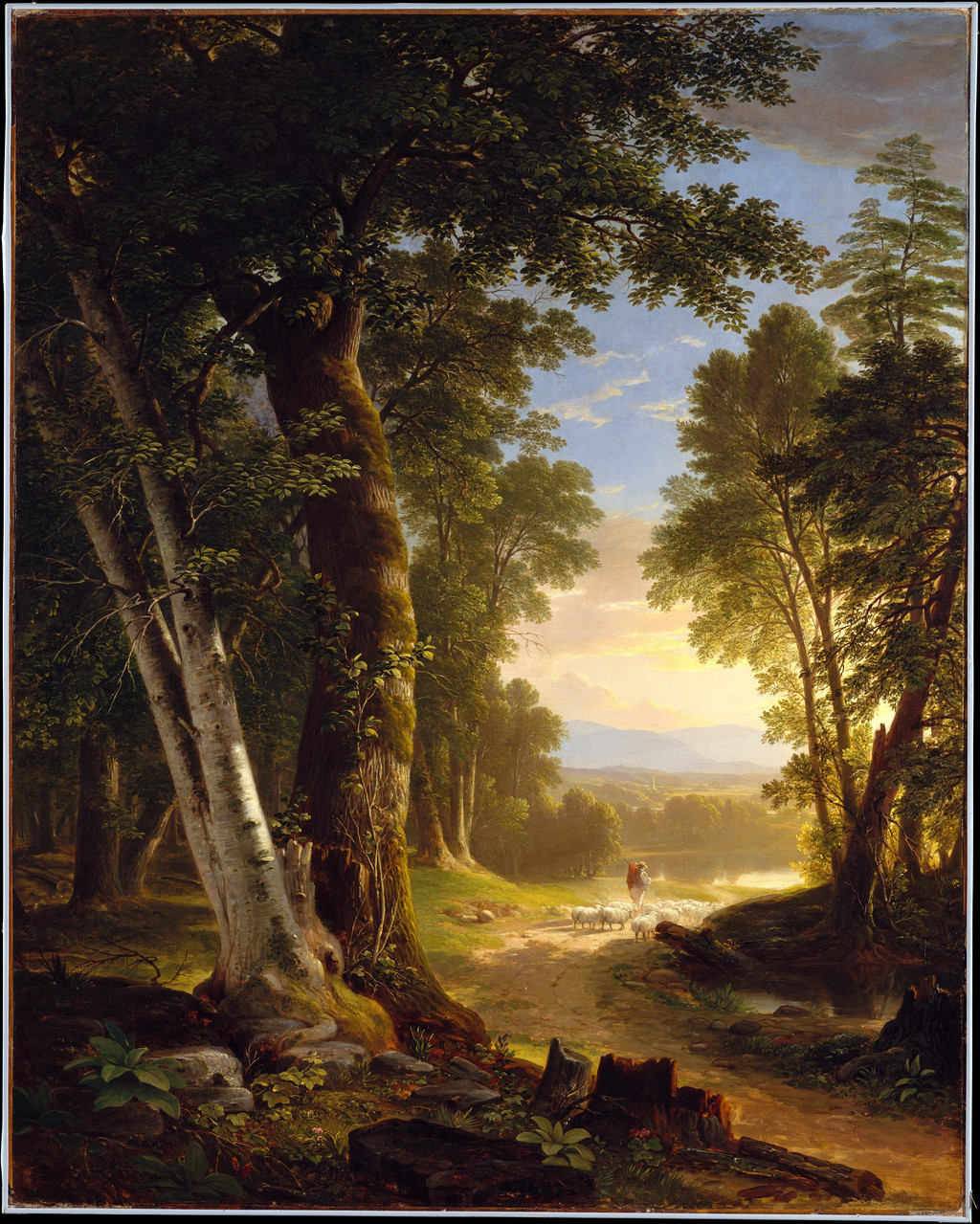
Asher Brown Durand, The Beeches, 1845. Oil on canvas. Metropolitan Museum of Art, 15.30.59. The Metropolitan Museum of Art. Image source. CC0 / Public domain. Resized only; native appearance, complete carrier and margins preserved.
Artworks directory
A collected selection of 19 individually identified paintings, prints and a graphite study, including fifteen dedicated artwork articles. This directory is not a complete catalogue raisonné. Links lead to a companion article where available, otherwise the consulted institutional record. Progress is identified by title, date and museum; an unverified accession is omitted. Unillustrated objects remain searchable.
Frequently Asked Questions
They are the painter Thomas Cole and the poet William Cullen Bryant. Cole wears the broad-brimmed hat and carries artistic objects; Bryant stands beside him nearer the tree.[2]
The landscape combines characteristic Catskill features. The Brooklyn Museum’s guide treats the waterfall’s precise identification as uncertain, so the canvas should be understood as a composed setting.[4]
Jonathan Sturges commissioned it as a memorial to Cole, who died in 1848, and gave it to Bryant in 1849.[1]
Discussion
Look again at the images and ideas explored in Kindred Spirits by Asher Brown Durand. These editorial prompts invite your observations.
Reader Insights
Which feature first directs your attention from the two men into the landscape?
How does knowing that the work is a memorial change your experience of its calm setting?
What does the comparison with *The Beeches* reveal about the role of named figures?
Join the Conversation
Share a detail, comparison or question about Kindred Spirits by Asher Brown Durand below.
References
- Crystal Bridges Museum of American Art, Kindred Spirits, accession 2010.106. Current object record, inscriptions and provenance. Painting and framed dimensions distinguished; Bryant’s death year follows the provenance, 1878. View source
- Crystal Bridges, Kindred Spirits, museum-authored Google Arts & Culture entry. Narrative, figure identification, painting dimensions and provenance. View source
- Smithsonian American Art Museum, Asher B. Durand biography. Complete accessible biography consulted; the 1837 Adirondack journey with Cole. View source
- Margaret Stenz, Following in the Footsteps of Asher B. Durand: A Walker’s Guide, Brooklyn Museum (2007). All five pages’ text consulted; composed Catskill setting and possible 1848 study connection. Historical guide rather than current walking instructions. View source
- Metropolitan Museum of Art, Landscape—Scene from Thanatopsis, accession 11.156. Current object narrative consulted through its indexed primary text. View source
- Metropolitan Museum of Art, The Beeches, American Paintings in The Metropolitan Museum of Art, volume I, printed pp.414,416. Both one-page scans actually consulted; outdoor-study and Constable comparison. View source
- Splash image source.
Asher Brown Durand, Kindred Spirits, 1849. Oil on canvas, 111.8 × 91.4 cm. Crystal Bridges Museum of American Art, 2010.106. Crystal Bridges Museum of American Art; museum-uploaded open-access reproduction. CC0 / Public domain. Resized only; native appearance, complete carrier and margins preserved.
View source