 by Tom Gurney
Tom Gurney BSc (Hons) is an art history expert with over 20 years experience
Email: tomgurney1@gmail.com / Phone: +44 7429 011000
Landscape—Scene from Thanatopsis by Asher Brown Durand: Introduction
Asher Brown Durand’s Landscape—Scene from Thanatopsis brings a funeral, agricultural work and ruins into a broad, sunlit landscape. The painting responds to William Cullen Bryant’s poem about mortality and the natural world. Made in 1850 and first exhibited at the National Academy of Design, it subsequently entered the American Art-Union’s distribution system. Its small human activities ask to be discovered within a much larger scene of woods, water and mountains.[1]
At a Glance
- ArtistAsher Brown Durand (1796–1886)
- TitleLandscape—Scene from Thanatopsis
- Date1850
- MediumOil on canvas
- Dimensions100.3 × 154.9 cm
- CollectionMetropolitan Museum of Art, New York
- Accession11.156
- Museum creditGift of J. Pierpont Morgan, 1911
- Literary sourceWilliam Cullen Bryant’s Thanatopsis
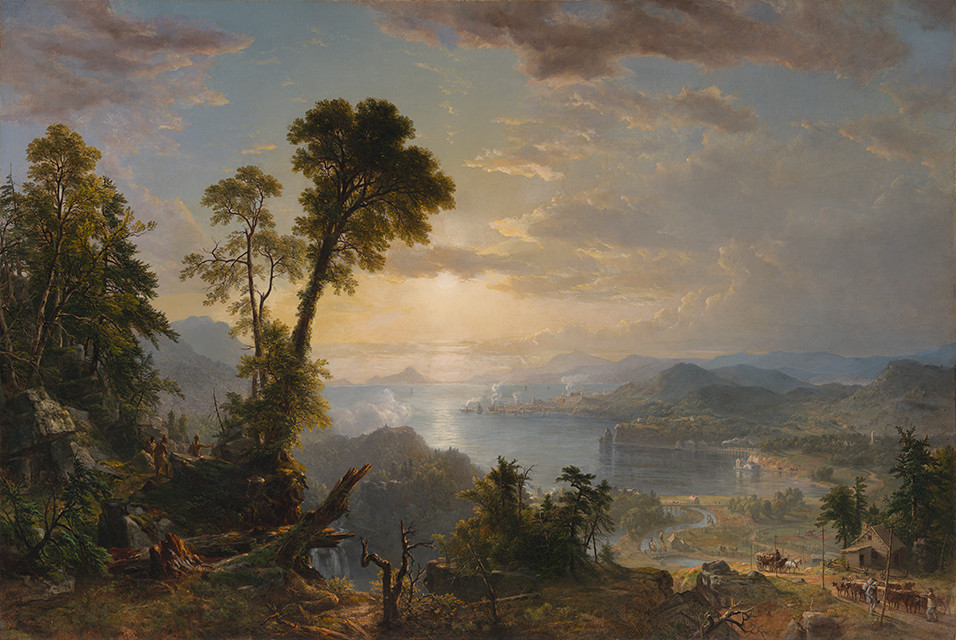
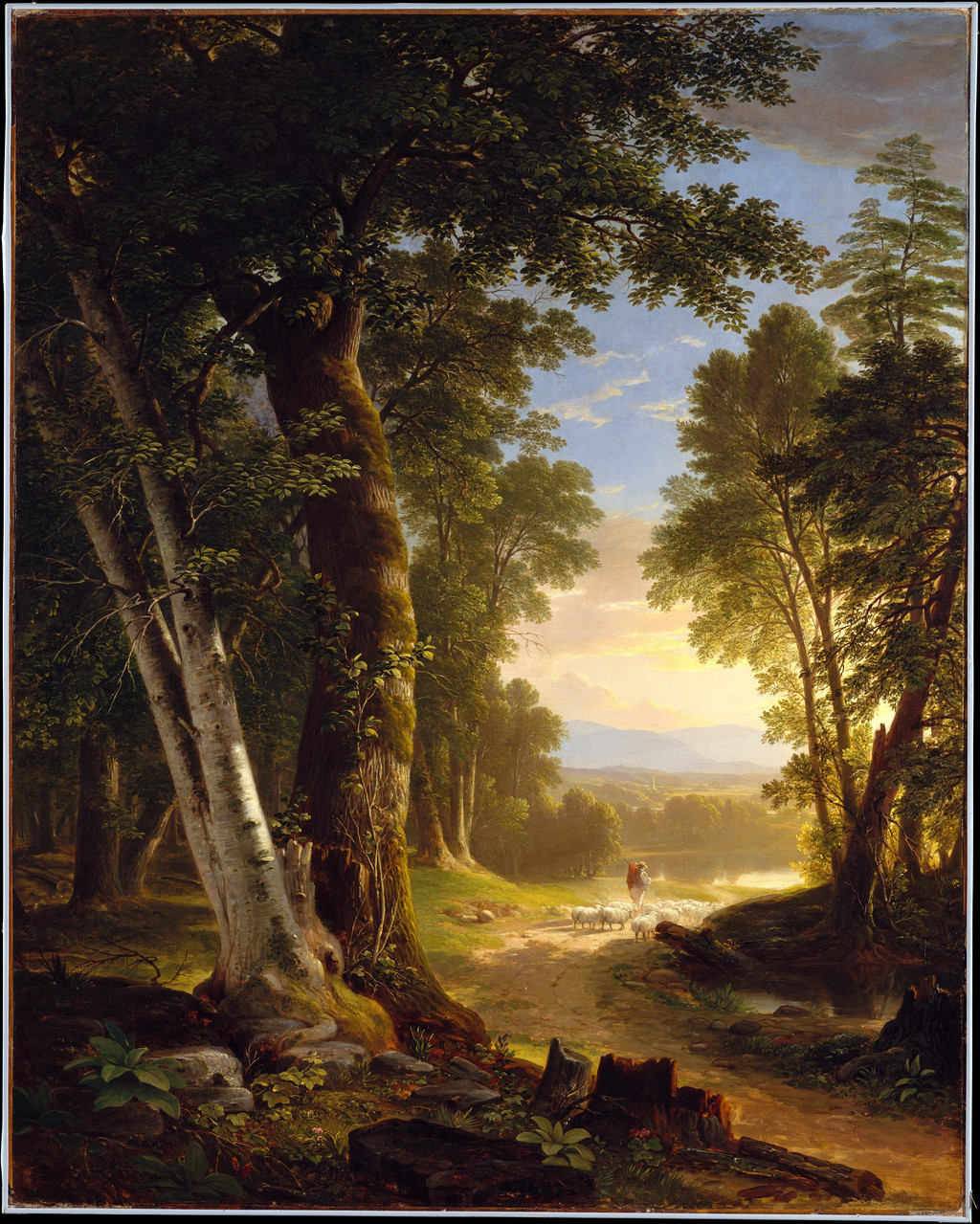
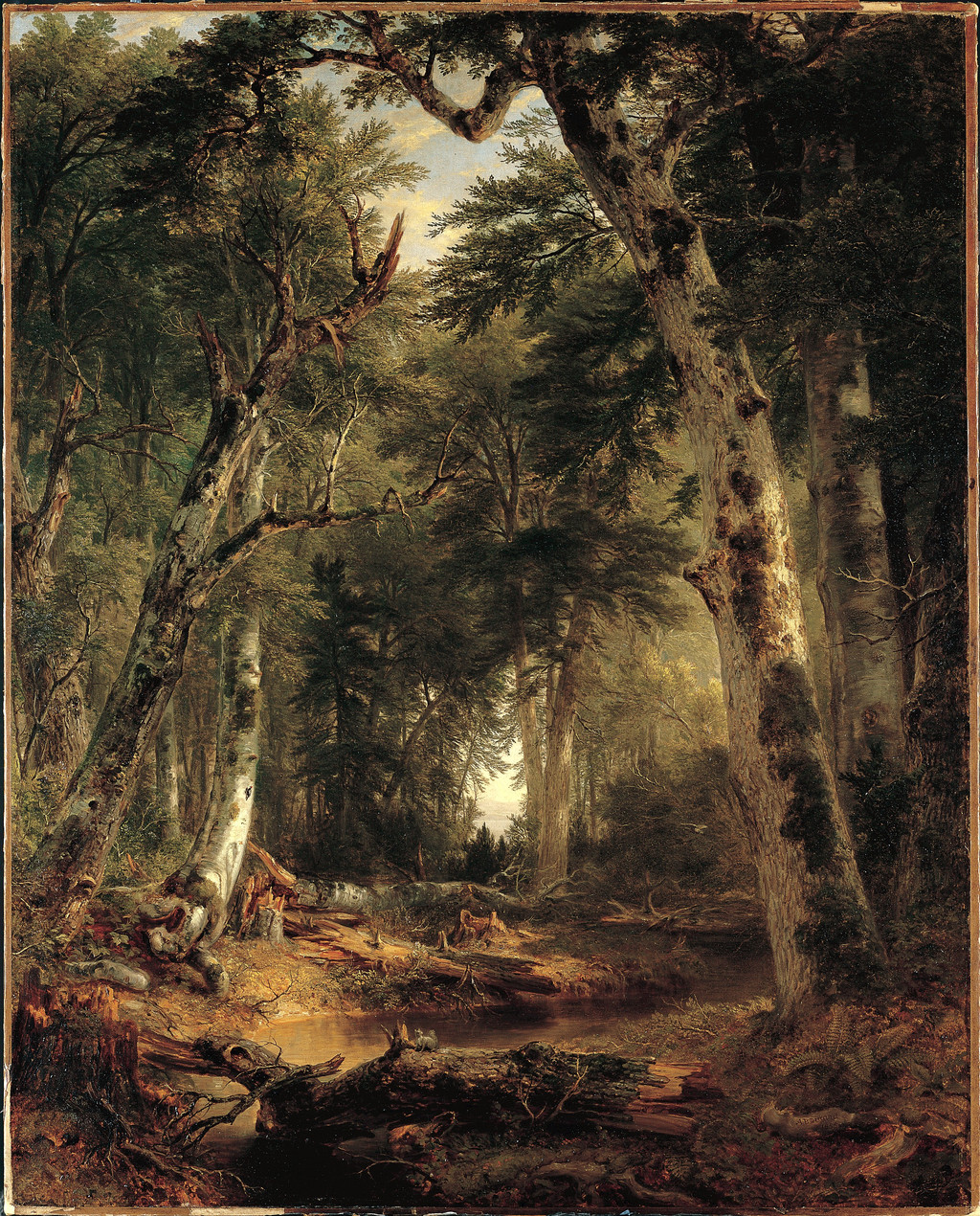
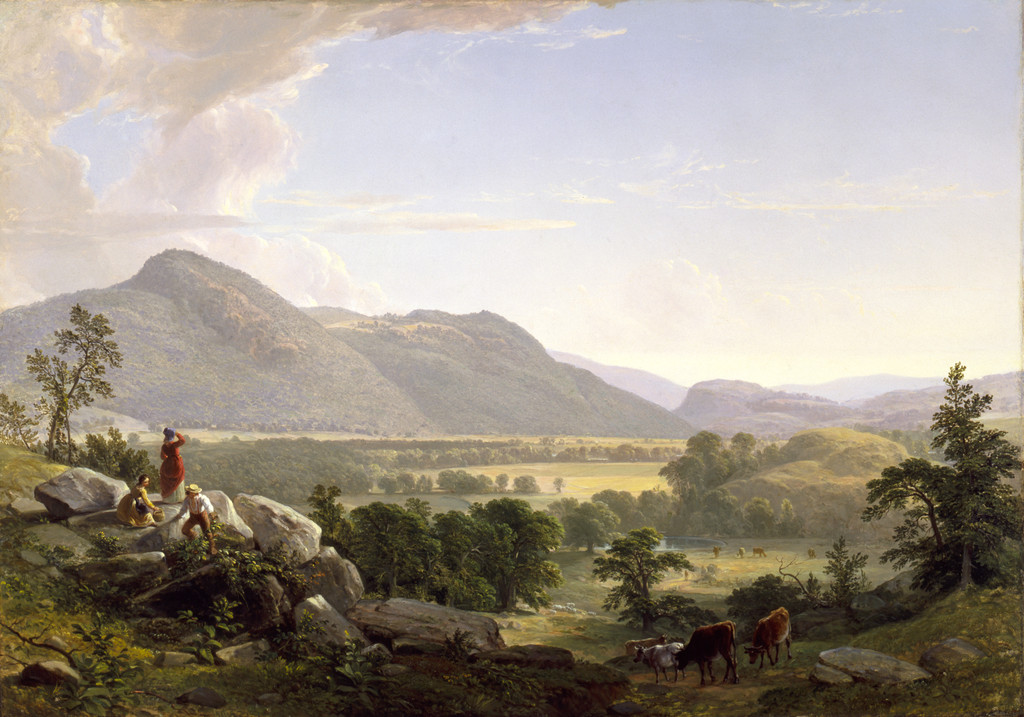
This work across Asher Brown Durand’s career
The Beeches
1845Kindred Spirits
1849God’s Judgment Upon Gog
ca.1851–52River Scene
1854In the Woods
1855The Catskills
1859Sunday Morning
1860Summer Afternoon
1865Contents
- A wide landscape with several kinds of time
- The funeral and the working farmer
- Ruins across the country scene
- Bryant’s poem and the painted selection
- Exhibition, distribution and later ownership
- Another relationship with Bryant: Kindred Spirits
- A comparison with Sunday Morning
- Annotated details
A wide landscape with several kinds of time
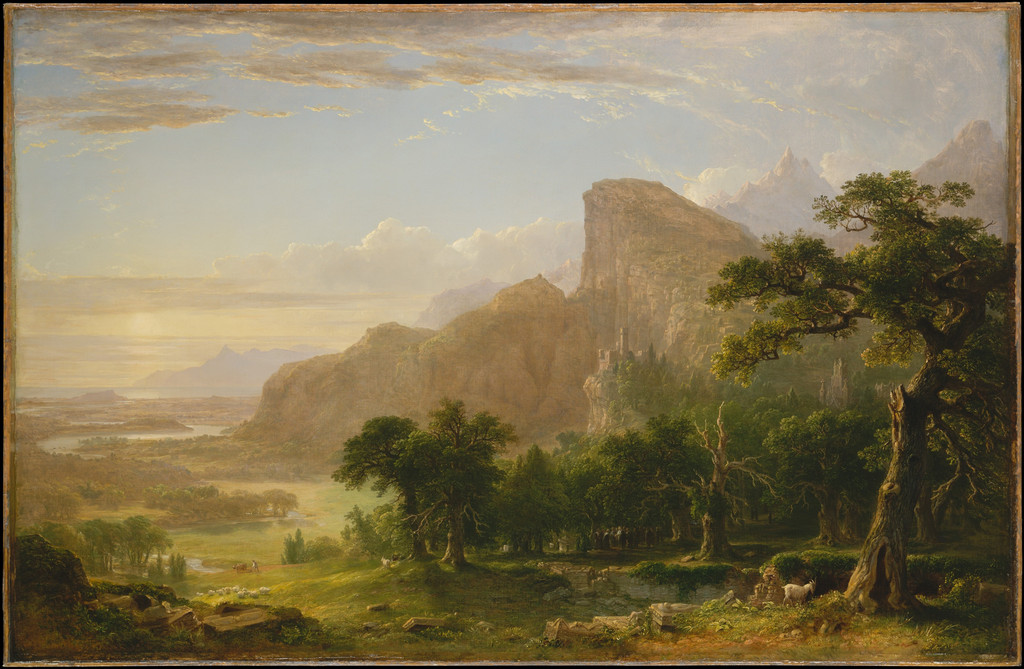
The canvas opens toward distant water on the left and rises into mountains on the right. Near trees cast shade over a lower pool, while fields occupy a brighter stretch beside them. The arrangement gives the viewer both a wide prospect and a more intimate ground from which to consider it.
The difference between the two sides is gradual. At the far left, open sky and water make the horizon appear extensive. Toward the right, slopes, trees and rock accumulate into a more enclosed space. The large tree nearest that edge connects the dark foreground with growth higher on the hillside.
Several distances can be followed at once. The closest stones and fallen fragments establish a near plane. Beyond them, the pool and its surrounding trees form a middle interval. Farther fields, buildings, mountains and water spread across a much larger area. Human activity enters these levels at different scales.
Light also changes through the view. The field at the left is open and warm; the funeral group stands in deeper shade among trees. Higher mountains receive a paler atmosphere, while the sky remains broad above them. These changes organise attention without isolating each episode into a separate panel.
The landscape consequently holds more than one sense of time. Farm work belongs to a recurring daily activity, a funeral marks the end of an individual life and ruins introduce the remains of earlier human construction. The picture’s continuing natural forms allow these different experiences to share one space.
Annotated Details from Landscape—Scene from Thanatopsis
The numbered points identify visible features discussed in this article. Return from each detail to the whole composition. Asher Brown Durand, Landscape—Scene from Thanatopsis, 1850. Metropolitan Museum of Art, 11.156. Gift of J. Pierpont Morgan, 1911. Its literary relationship with Bryant is conveyed through the landscape’s activities and ruins. The Metropolitan Museum of Art. Image source. CC0 / Public domain. Resized only; native appearance, complete carrier and margins preserved.
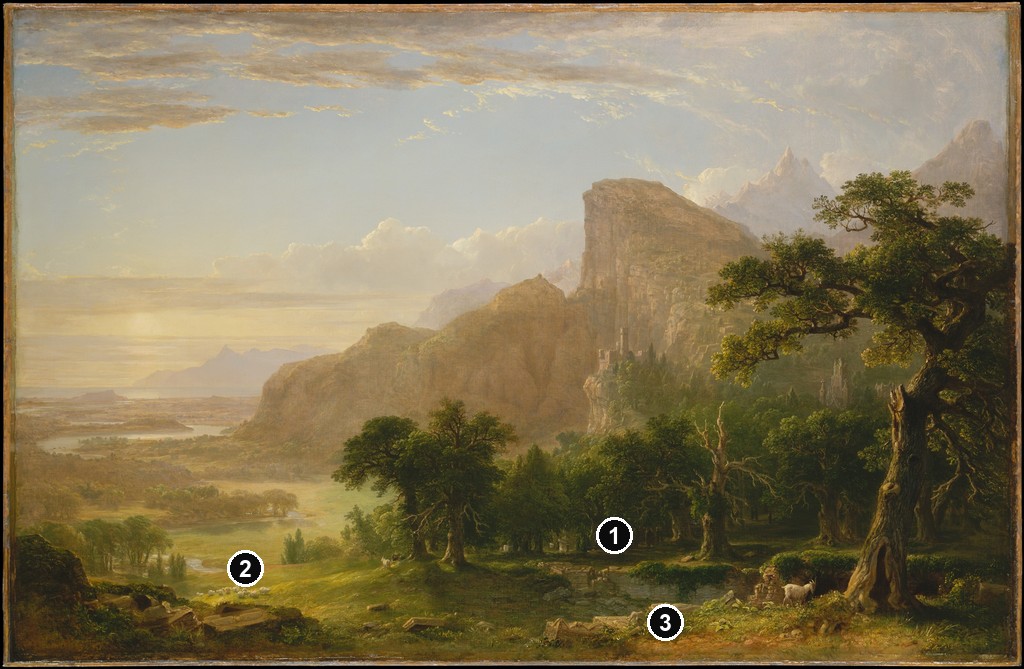
Details from LANDSCAPE—SCENE FROM THANATOPSIS
Compare the cropped details with the complete images above. Notice how their colours, shapes and positions contribute to the larger compositions.
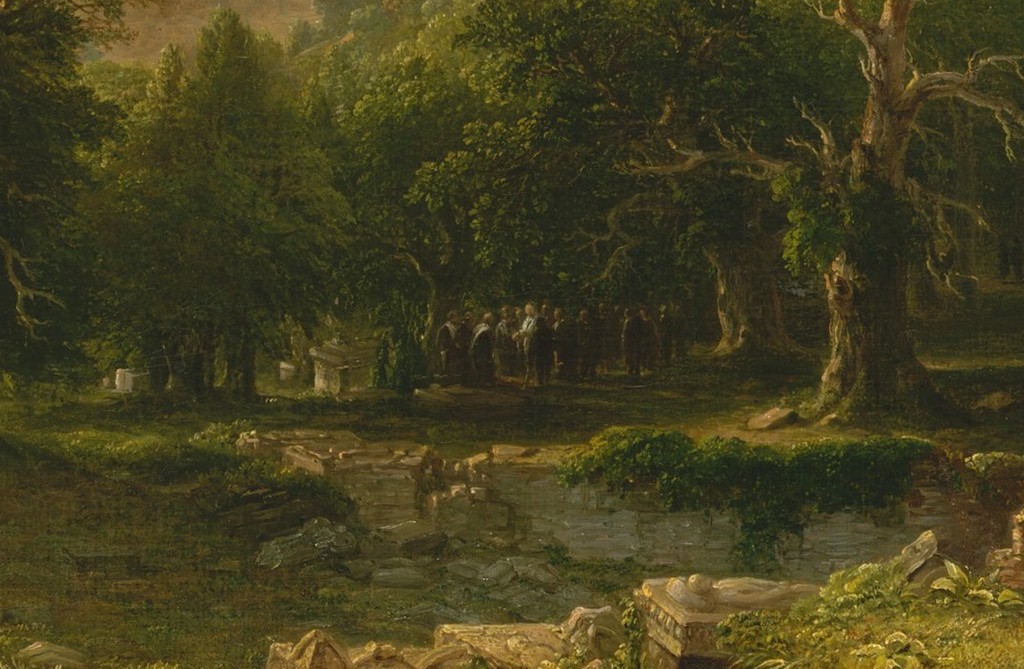
Funeral beneath the trees
A small group proceeds beside a pale monument beneath the trees. The Met identifies the funeral within the painting’s literary subject.
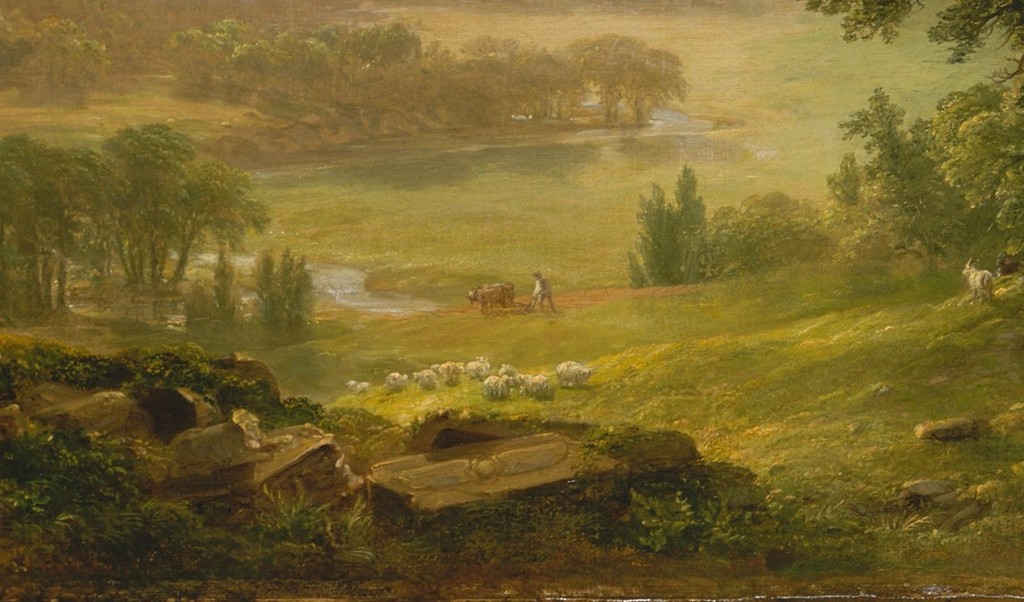
Farmer and working oxen
A small worker and oxen occupy the open agricultural ground. Their activity appears within the same landscape as the funeral.
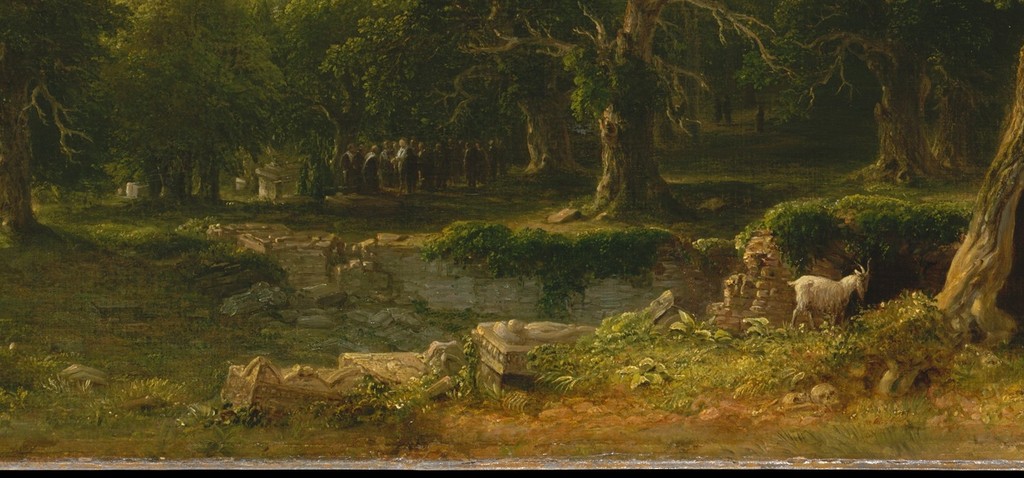
Ruins in the foreground
Broken architectural forms lie across the near ground. Their shapes introduce another measure of human time within the continuous landscape.
The funeral and the working farmer
The funeral group is relatively small, standing within the wooded middle ground toward the right. Dark clothing and pale highlights make the people visible once the viewer attends to that area. They gather near monuments beside the pool, where the trees create a shaded setting for the event.
On the brighter left, a farmer works with cattle. The cultivated strip and nearby animals make this part of the landscape a place of ordinary use. The activity takes place at some distance from the foreground, so it belongs to the larger country scene rather than filling the canvas as a close narrative.
The Met identifies the funeral and daily farm work as key elements in the painting’s response to Bryant. Their coexistence connects individual death with continuing activity in the world. Neither episode needs to dominate the landscape for the relationship to become apparent.[1]
The contrast is also visible in the surrounding light. The farmer occupies an open stretch; the mourners stand beneath enclosing foliage. These different settings give their activities separate character while allowing the eye to move between them across the same lower country.
Small animals provide further signs of occupation. A flock rests on the lit slope, and a pale animal stands near the large right-hand tree. Their presence fills the intervals between human episodes and the surrounding vegetation. The landscape continues to contain ordinary life even in the portion nearest the funeral.
Ruins across the country scene
Broken stone occupies the foreground, where fragments and a fallen architectural form lie among grass and rock. These objects have sharper edges than some of the natural stones around them. Their remains establish human construction as something that can change, fall and become part of the ground.
The Met describes Egyptian, classical and medieval ruins within the landscape. These references bring different historical cultures into a scene whose overall setting is composed rather than a record of one geographical location. The painting gives the passage of human time a wider range than the funeral alone.[1]
The fragments nearest the viewer are especially immediate. We encounter them before looking toward the people and distant buildings. That order of attention makes earlier construction part of the ground through which the present scene is viewed. Its remains are close, while more intact human activity appears farther away.
Trees and plants surround these forms. Their uneven growth interrupts the lines of worked stone, joining natural processes to historical remains. The viewer can attend to the distinction between stone shaped for a building and stone returned to a landscape without needing a precise archaeological identity for each fragment.
The combination also changes the meaning of scale. Mountains exceed human structures, but the structures retain enough definition to be recognised as historical signs. Large natural forms and small built remains can therefore be considered together. The composition makes room for individual lives and longer histories within the same extensive world.
Bryant’s poem and the painted selection
Bryant’s Thanatopsis begins by describing the changing language nature offers to someone who attends to it. In the consulted 1821 text, thoughts of death lead the speaker outward toward earth, water and sky. The poem then considers the body’s return to the elements and the company of earlier generations within the earth.[2]
Its account includes both agricultural and wooded forms. A labourer turns the soil, an oak sends roots into it and hills, rivers and woods become part of a vast resting place. These images give the poem a material language for thinking about death. Nature is encountered through particular actions and forms as well as through the expanse of the world.[2]
The poem also makes continuing activity significant. People laugh, work and pursue their concerns after another person has died, although they share the same eventual fate. Durand’s farmer and funeral group offer a painted relationship through which this aspect of the poem can be considered.[1][2]
The landscape does not need to illustrate every line in sequence. It selects activities and historical signs that can be brought into view together. A poem unfolds through successive words; the painting gives the viewer a field in which the order of attention can change. We may find the farmer first, then the shaded gathering, or notice the near ruins before either.
The consulted poem appears in Bryant’s 1821 Poems. That establishes an early published text for considering the literary relationship; it does not identify the exact edition Durand used. The comparison rests on the poem’s visible themes and the museum’s identification of the painting’s source.[2]
Watch: Asher Brown Durand
Choose a film to explore the artist’s work, its interpretation and its wider setting.
Friendship and landscape, Asher B Durand's Kindred Spirits
Smarthistory and Crystal Bridges discuss friendship, memory and landscape in Kindred Spirits.
Watch on YouTubeExhibition, distribution and later ownership
The Met records the painting’s first exhibition at the National Academy of Design in 1850. Afterward, the American Art-Union purchased it and distributed it to one of its subscribers. The institution helped bring contemporary landscapes into the homes of people who sought affordable access to art.[1]
That history connects the literary landscape with a particular public audience. The work could move from an exhibition into a subscriber’s collection, carrying its relation to a familiar poem into a domestic setting. Its broad scenery offered an immediate experience of landscape alongside the smaller activities through which its subject could be explored.
John Durand’s 1894 memoir also records the Art-Union distribution. He says that his father later partially repainted the canvas and that it passed through B. F. Gardner’s ownership before entering J. Pierpont Morgan’s collection. These details belong to the family’s retrospective account.[3]
The reported repainting should be kept distinct from what the reproduction demonstrates. A colour image shows the surviving arrangement; it does not identify every earlier form or establish the precise extent of a change. John’s testimony supplies a historical statement about the work’s making without becoming a modern technical examination.
Morgan gave the painting to the Met in 1911. Its accession, 11.156, anchors the identity of the canvas discussed here, while the 1850 date remains the date of the work itself.[1]
Another relationship with Bryant: Kindred Spirits
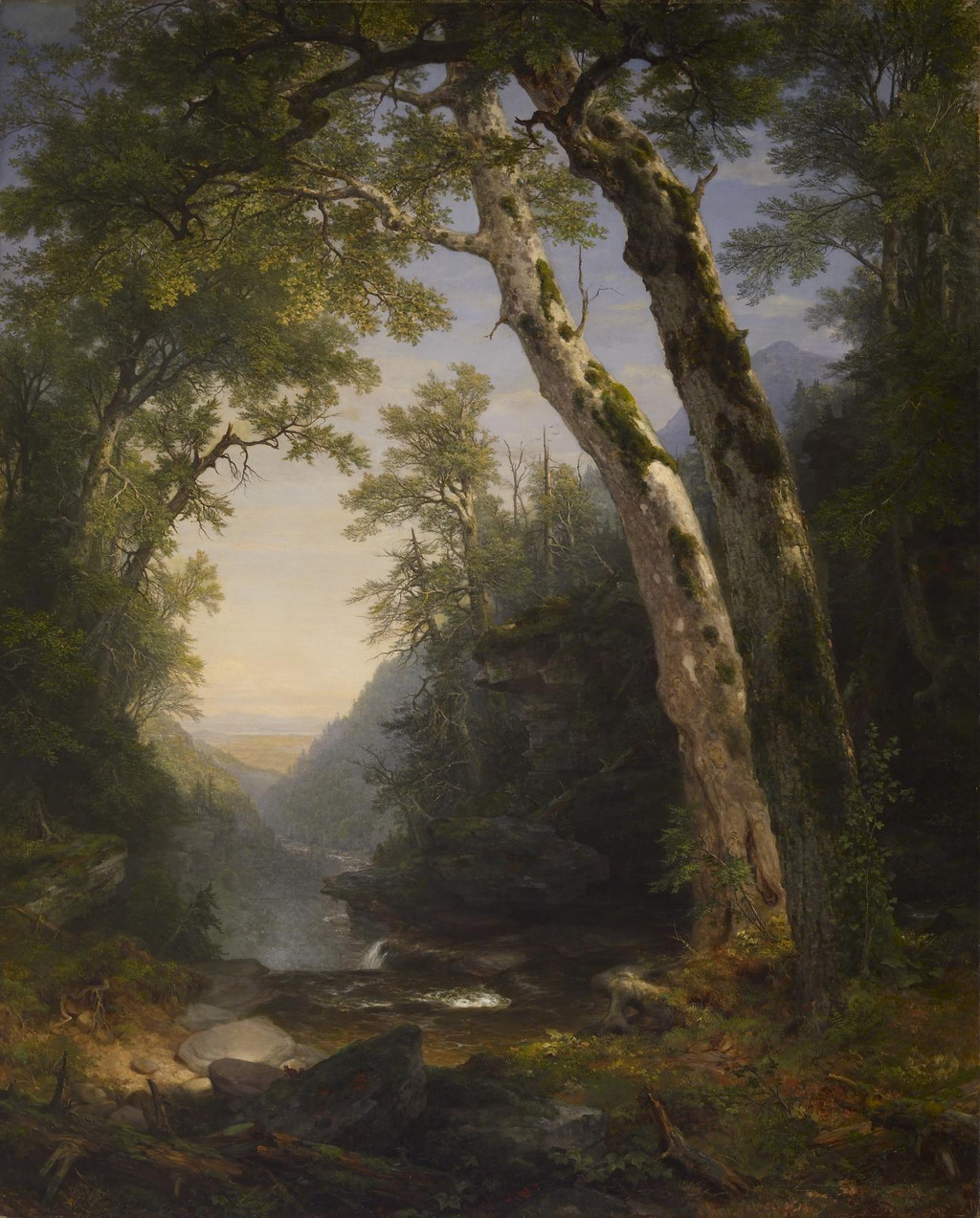
Durand’s Kindred Spirits, painted in 1849, places Bryant beside Thomas Cole within a wooded gorge. Crystal Bridges identifies it as Sturges’s memorial commission following Cole’s death, given to Bryant that year. The poem and the poet therefore entered Durand’s landscape art through related but distinct subjects.[4]
In Kindred Spirits, two named friends give the landscape a personal commemorative purpose. Here, the people are defined primarily through their activities: a funeral, work and life within a large country scene. The shift expands the literary relationship from a specific friendship toward a broader reflection on human mortality.
The formats also change the encounter. The upright gorge in Kindred Spirits brings trees close around the portraits; the wide Thanatopsis landscape distributes its episodes across a more extensive setting. In each, the natural world carries much of the work’s meaning through the arrangement of near forms and farther light.
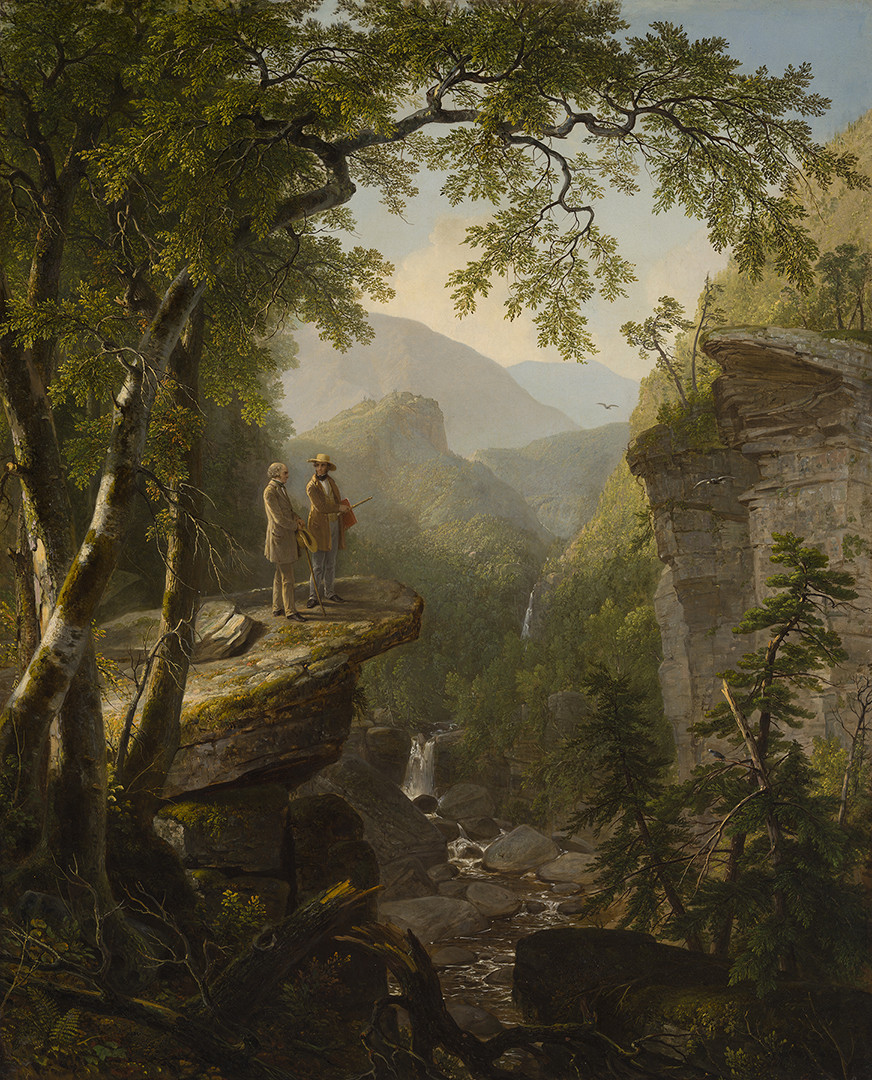
Asher Brown Durand, Kindred Spirits, 1849. Oil on canvas. Crystal Bridges Museum of American Art, 2010.106. Cole and Bryant within a composed memorial landscape. Crystal Bridges Museum of American Art; museum-uploaded open-access reproduction. Image source. CC0 / Public domain. Resized only; native appearance, complete carrier and margins preserved.
A comparison with Sunday Morning
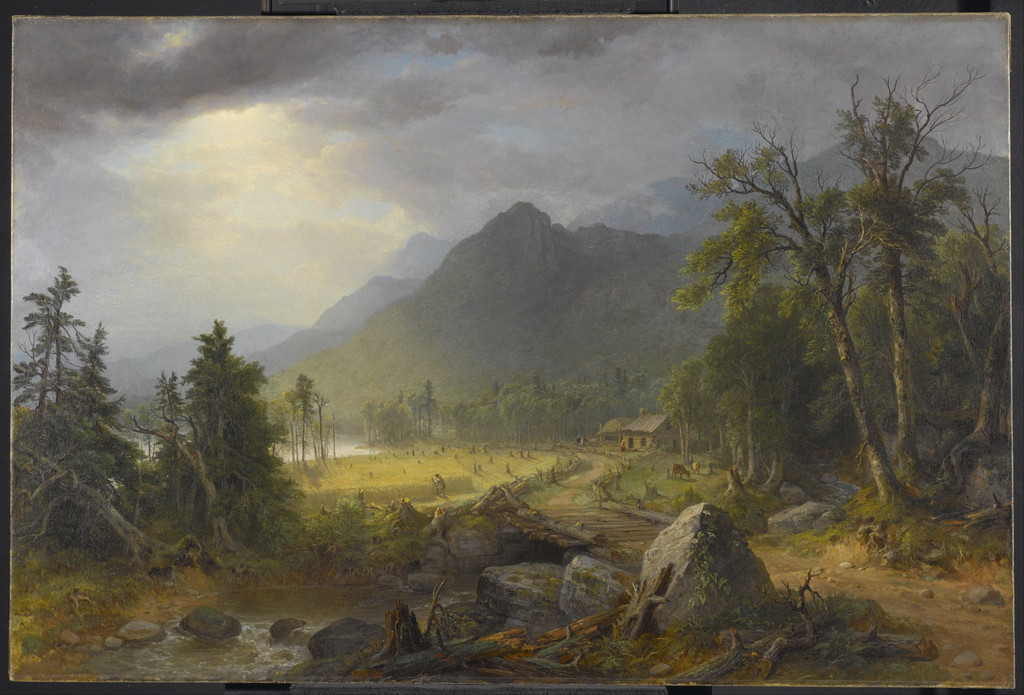
Sunday Morning, 1860, gathers rest, churchgoing, water and rural life within another broad pastoral composition. The New Britain Museum’s essay discusses its church, idle plough and figures in relation to Sunday observance and attention to nature.[5]
The two paintings share an interest in placing several kinds of human activity within a calm landscape. Their particular events give that calm different purposes. Sunday Morning centres on a day of rest and devotion; Thanatopsis places continuing work beside the burial of an individual.
The comparison helps explain how tranquillity can contain substantial thought. A quiet sky, green fields and water provide space in which small episodes can be related. Durand’s 1850 canvas uses that space to make death one event within a world that continues to hold work, growth, memory and the traces of earlier lives.
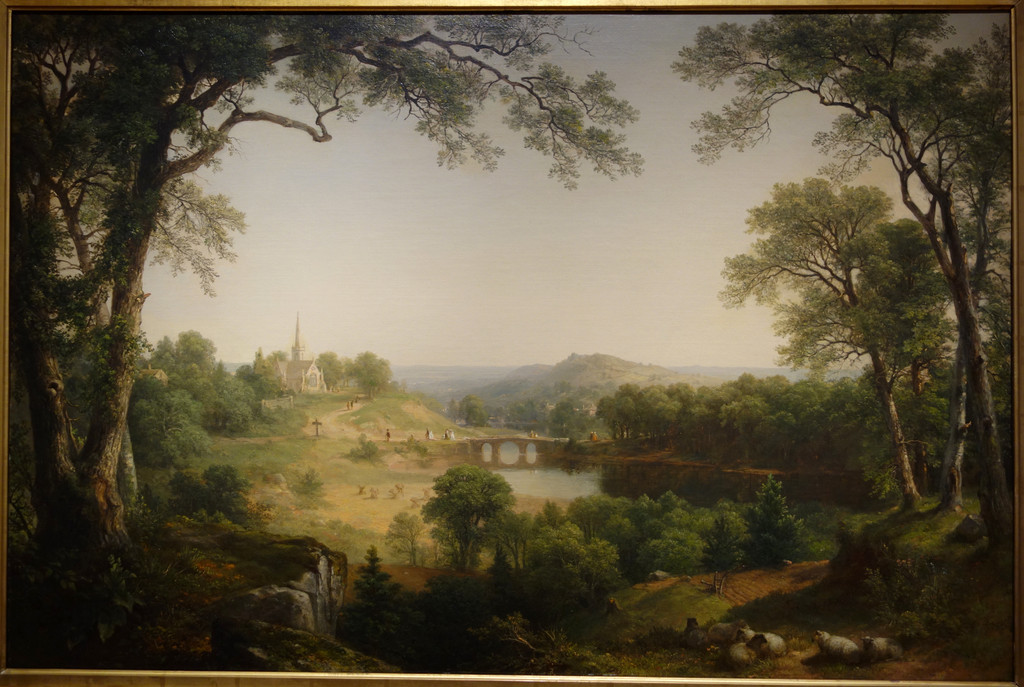
Asher Brown Durand, Sunday Morning, 1860. Oil on canvas. New Britain Museum of American Art, 1963.4. Gallery photograph by Daderot; complete supplied frame retained. New Britain Museum of American Art; gallery photograph by Daderot, released to the public domain. Image source. Public domain. Resized only; native appearance, complete carrier and margins preserved.
Artworks directory
A collected selection of 19 individually identified paintings, prints and a graphite study, including fifteen dedicated artwork articles. This directory is not a complete catalogue raisonné. Links lead to a companion article where available, otherwise the consulted institutional record. Progress is identified by title, date and museum; an unverified accession is omitted. Unillustrated objects remain searchable.
Frequently Asked Questions
It is the title of William Cullen Bryant’s poem about mortality and nature. The Met translates the title as a view of death and identifies the poem as the painting’s inspiration.[1]
Its combination of scenery and ruins from different historical cultures serves a literary composition. The consulted sources do not establish a single exact geographical viewpoint.[1]
John Durand’s memoir says his father partially repainted the canvas. The ordinary colour reproduction does not independently establish the extent or sequence of that work.[3]
Discussion
Look again at the images and ideas explored in Landscape—Scene from Thanatopsis by Asher Brown Durand. These editorial prompts invite your observations.
Reader Insights
Which do you discover first: the near ruins, the farmer or the shaded funeral group?
How does reading Bryant’s poem change the relationship you see between the painting’s activities?
What does the wide format make possible that differs from the upright *Kindred Spirits*?
Join the Conversation
Share a detail, comparison or question about Landscape—Scene from Thanatopsis by Asher Brown Durand below.
References
- Metropolitan Museum of Art, Landscape—Scene from Thanatopsis, accession 11.156. Complete current indexed primary record and narrative consulted: poem, funeral/work/ruins, 1850 exhibition, Art-Union distribution, dimensions and Morgan’s 1911 gift. View source
- William Cullen Bryant, Thanatopsis, in Poems (Cambridge: Hilliard and Metcalf,1821), consulted Wikisource transcription. Complete primary poem transcription and book title/advertisement consulted. Yale source-copy viewer unavailable; no original-scan consultation or exact Durand edition claimed. Original nineteenth-century text paraphrased here. View source
- John Durand, The Life and Times of A. B. Durand (1894). Selected chapters actually consulted; printed p.174 records distribution, partial repainting, Gardner and Morgan. Retrospective family testimony. View source
- Crystal Bridges Museum of American Art, Kindred Spirits, accession 2010.106. Complete current 1849 record, commemorative narrative and provenance consulted. View source
- New Britain Museum of American Art, Asher Brown Durand and Sunday Morning, accession 1963.4. Full biography, 1860 painting essay and notes consulted. Separate 1839 and 1850 versions not conflated. View source
- Splash image source.
Asher Brown Durand, Landscape—Scene from Thanatopsis, 1850. Oil on canvas, 100.3 × 154.9 cm. Metropolitan Museum of Art, 11.156. Gift of J. Pierpont Morgan, 1911. The Metropolitan Museum of Art. CC0 / Public domain. Resized only; native appearance, complete carrier and margins preserved.
View source