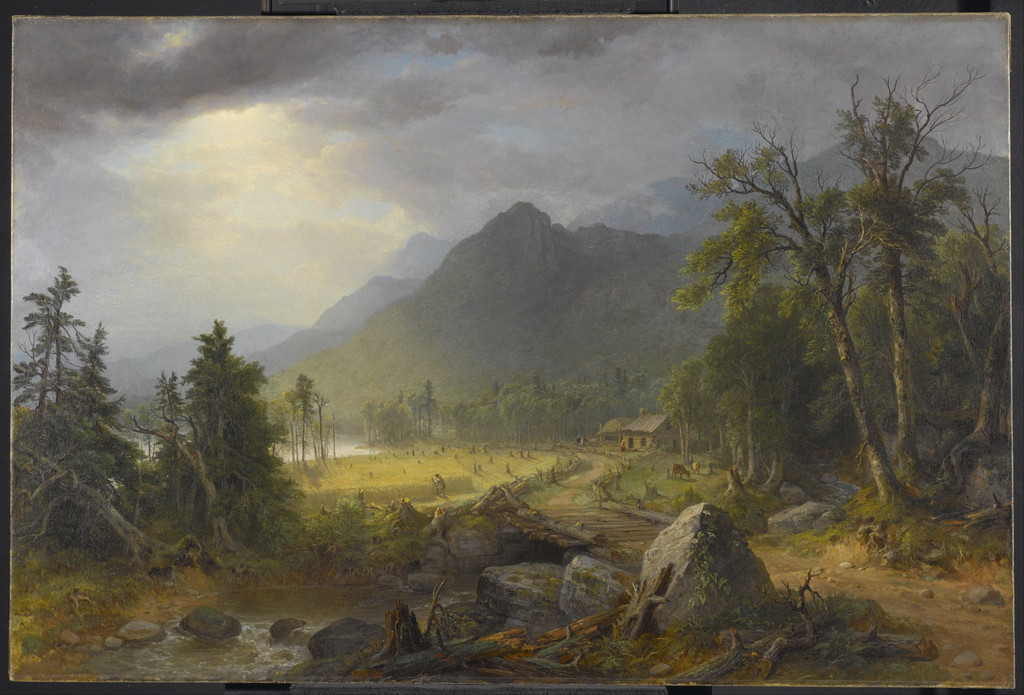
 by Tom Gurney
Tom Gurney BSc (Hons) is an art history expert with over 20 years experience
Email: tomgurney1@gmail.com / Phone: +44 7429 011000
Durand’s Letters on Landscape Painting: Introduction
Asher Brown Durand’s Letters on Landscape Painting joined practical advice to a larger account of what art should communicate. Published in The Crayon during 1855, the series asks a student to learn from the forms of nature, develop an independent way of seeing and judge painting by more than impressive colour or skilful handling.[3]
The letters also address viewers. A landscape could recall a place, awaken memories and offer an imagined encounter with country beyond the room in which it hung. This connection between making a picture and living with it gives Durand’s advice a reach beyond the artist’s studio.[1]
At a Glance
- AuthorAsher Brown Durand (1796–1886)
- SeriesNine Letters on Landscape Painting
- PublicationThe Crayon, January 3–July 11, 1855
- FormatAdvice addressed to an aspiring landscape painter
- Central concernsObservation, drawing, selection, independence, motive and the viewer
- Primary text consulted hereComplete Letter IV in facsimile reprint; selected extracts in John Durand’s 1894 memoir
- Scholarly contextBarbara Dayer Gallati’s study of the letters and their publication
Contents
- Nine letters in a new art journal
- A pupil and the problem of imitation
- Form before the palette
- Close study and the experience of the painter
- Truth and the freedom to select
- Letter IV on money, ambition and perception
- The viewer’s imagined journey
- Paint handling and the larger purpose
- European comparisons and American possibilities
- Annotated details
Nine letters in a new art journal
The New Britain Museum’s bibliography records nine letters appearing between January 3 and July 11, 1855. The first eight belonged to the first volume of The Crayon; the ninth appeared in its second volume. Letter IV was published on February 14, on pages 97–98 of the original journal.[4]
The series began in the journal’s introductory issue. Gallati places it within the increasing importance of the press for circulating artistic ideas. A published letter could reach readers who had no opportunity to enter Durand’s studio or hear him speak in person.[3]
The texts also belonged to an artist’s public role. Durand was serving as president of the National Academy of Design. His advice appeared alongside the paintings through which contemporary viewers already knew his landscape practice.
The primary readings used here have different extents. Letter IV was consulted complete in a modern facsimile reprint. John Durand’s memoir supplies selected extracts from the series in Appendix I. Those extracts preserve substantial advice, but should not be treated as a complete reprint of all nine letters.
Annotated Details from Durand’s Letters on Landscape Painting
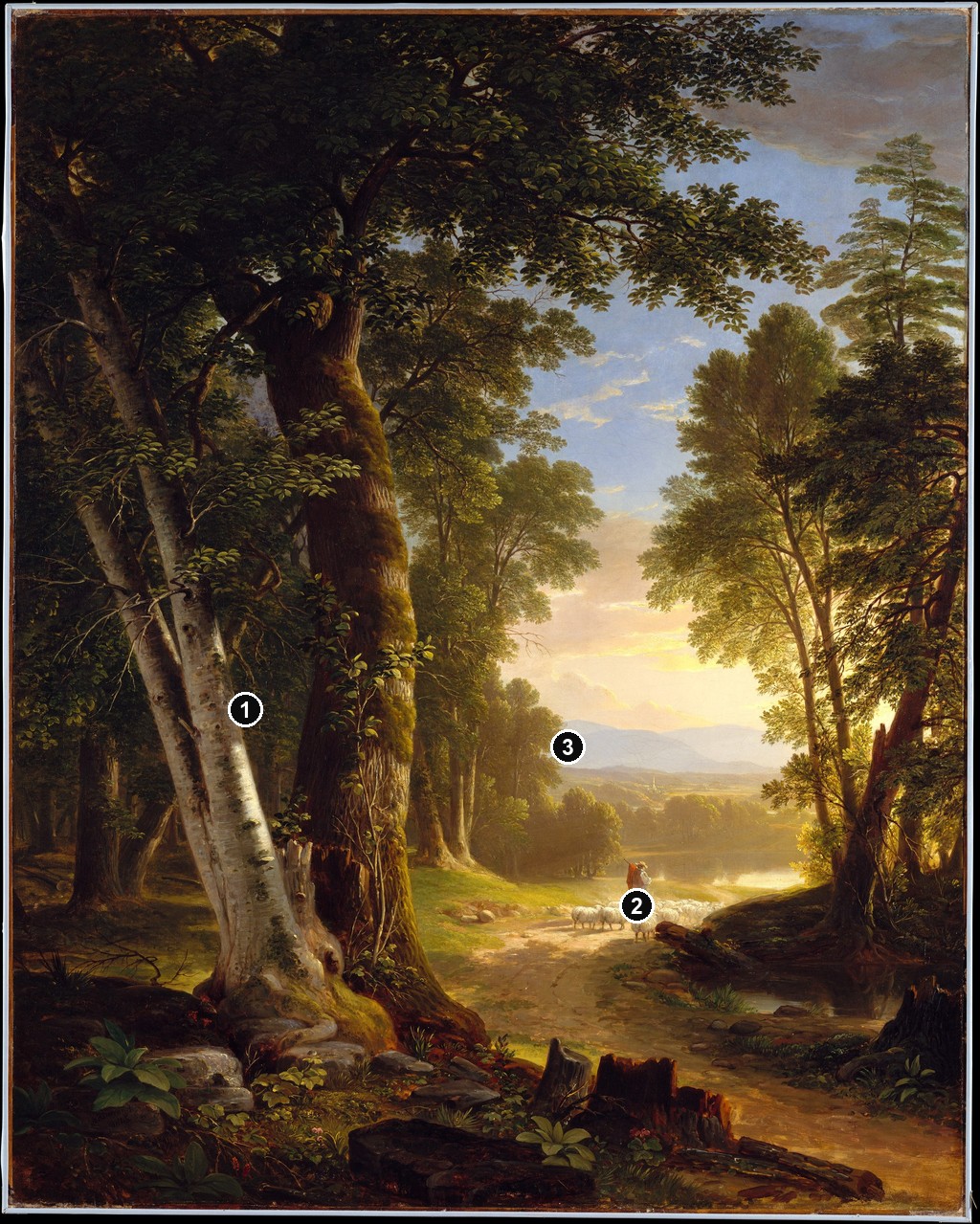
The numbered points identify visible features discussed in this article. Return from each detail to the whole composition. The captions keep each work’s identity, date and medium separate.
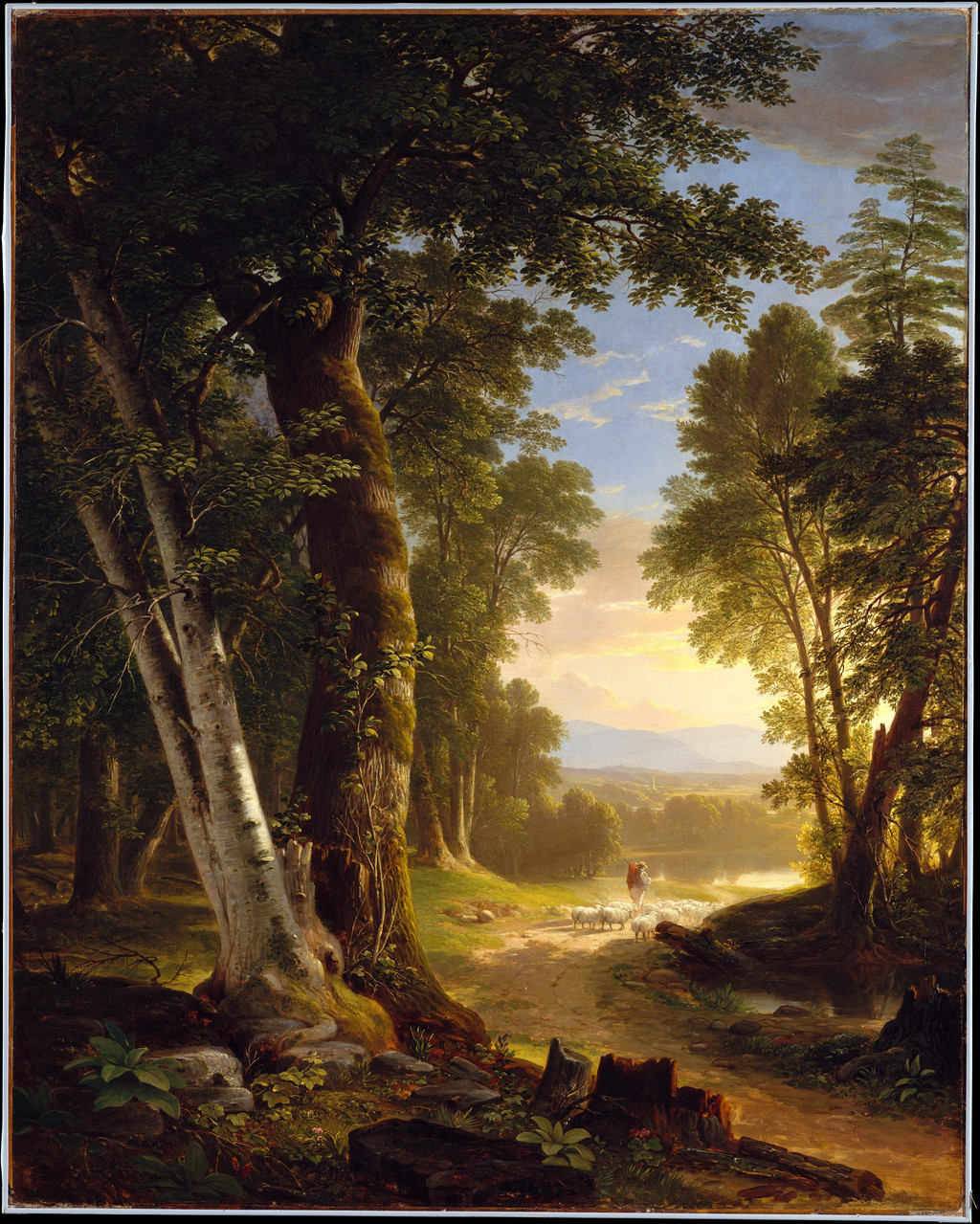
The Beeches
Asher Brown Durand, The Beeches, 1845. Oil on canvas, 153.4 × 122.2 cm. Metropolitan Museum of Art, 15.30.59. The Metropolitan Museum of Art. Image source. CC0 / Public domain. Resized only; native appearance, complete carrier and margins preserved.
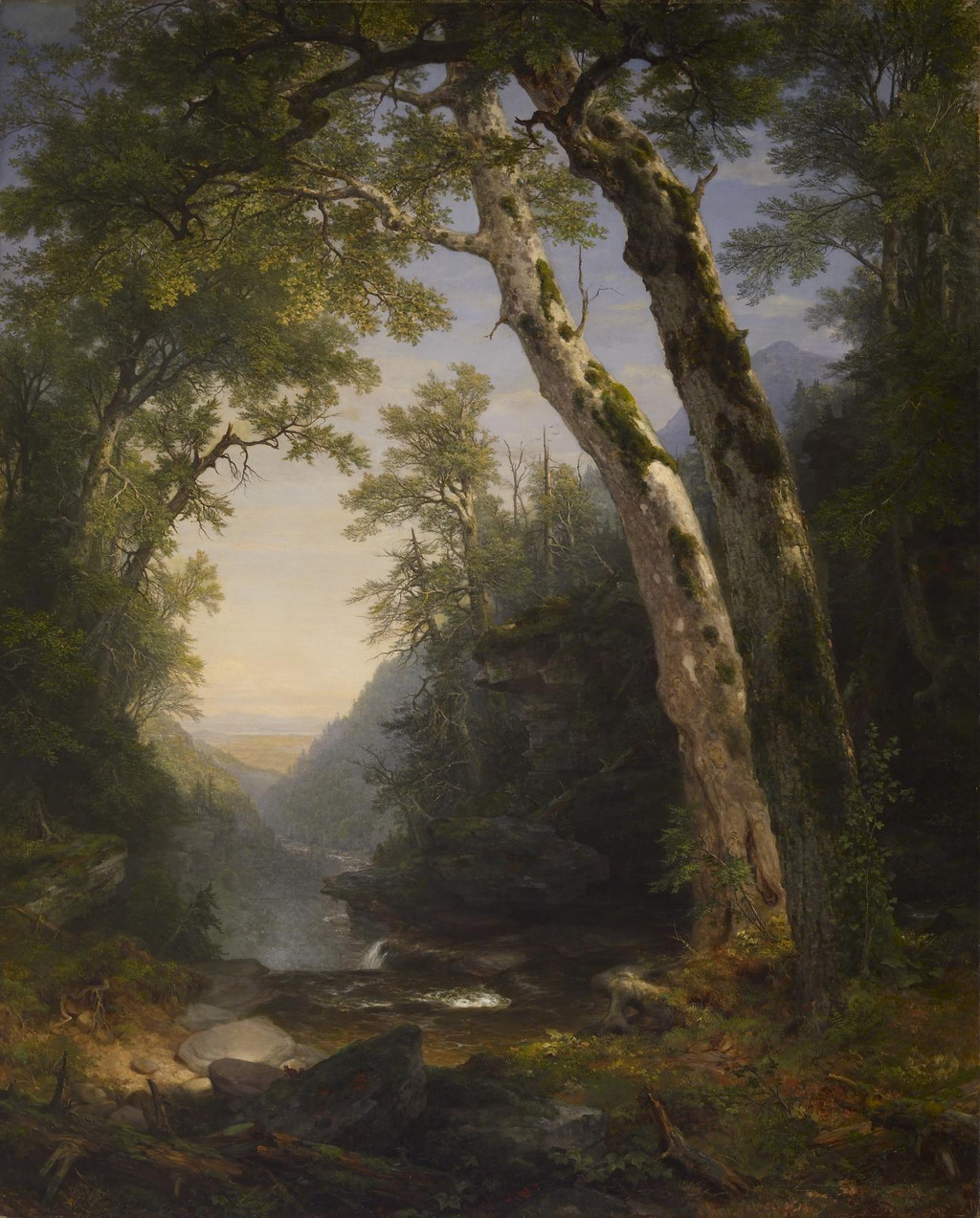
In the Woods
Asher Brown Durand, In the Woods, 1855. Metropolitan Museum of Art, 95.13.1. Gift in memory of Jonathan Sturges by his children, 1895. The Metropolitan Museum of Art. Image source. CC0 / Public domain. Resized only; native appearance, complete carrier and margins preserved.
Details from DURAND’S LETTERS ON LANDSCAPE PAINTING
Compare the cropped details with the complete images above. Notice how their colours, shapes and positions contribute to the larger compositions.
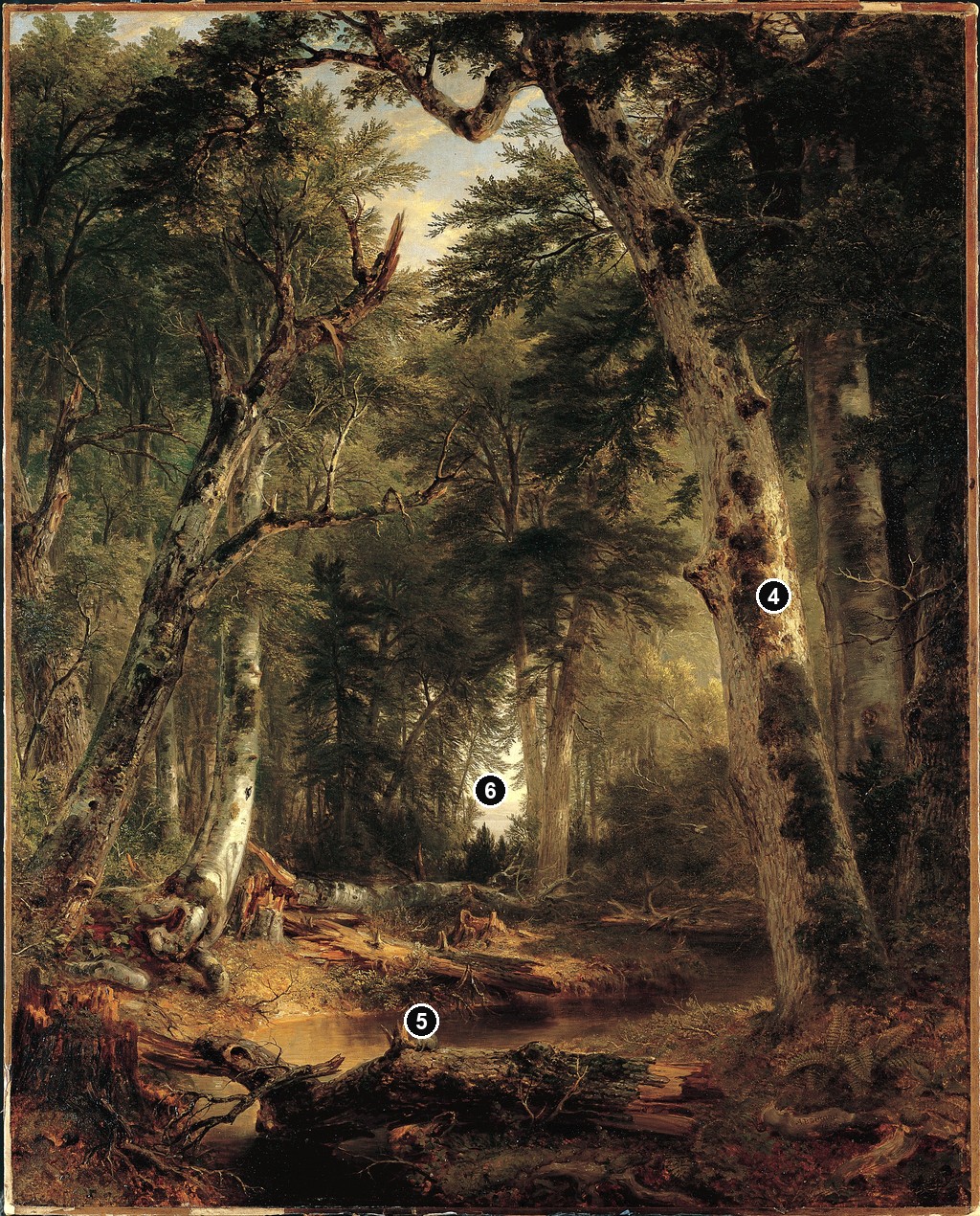
The Beeches
Pale slanting trunk
A pale trunk slopes across the darker group at the left. Bark marks and neighbouring foliage make its particular form readable.
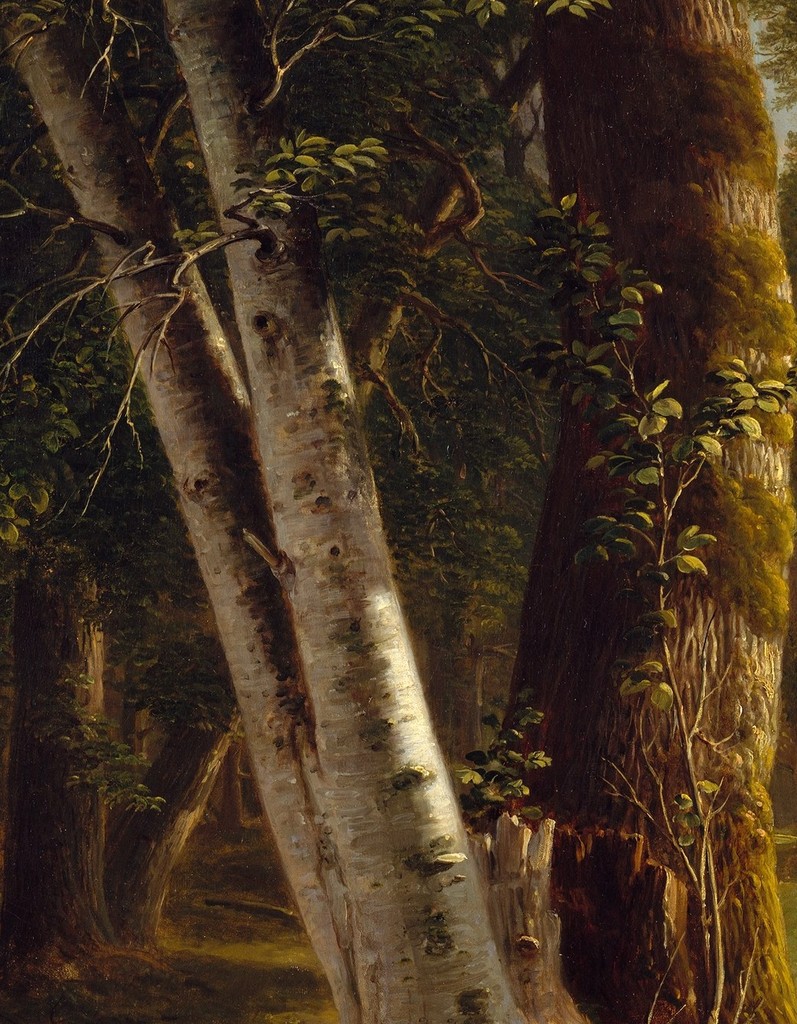
Shepherd and flock on the path
A shepherd and pale sheep occupy the winding path. Their scale provides a comparison with the large trees.
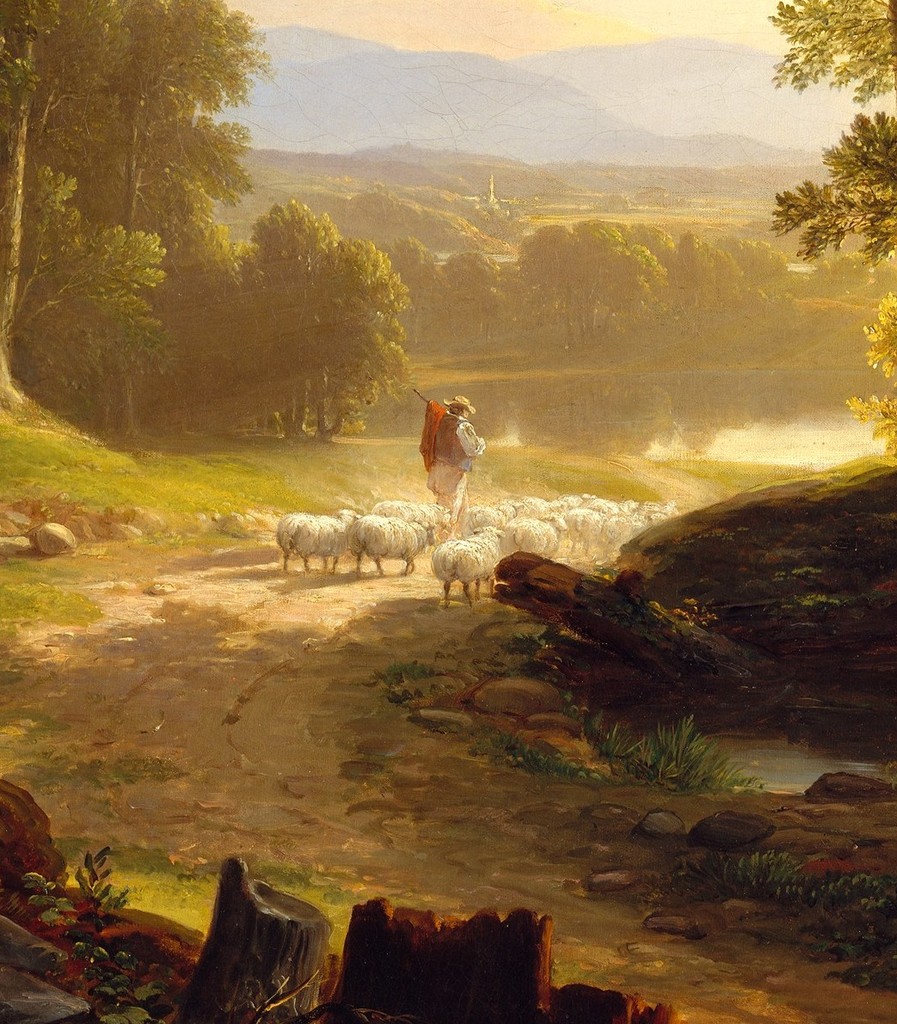
Opening towards the distant valley
The brighter opening leads past the nearby trunks towards water and a distant valley. Trees control the passage between near and far space.
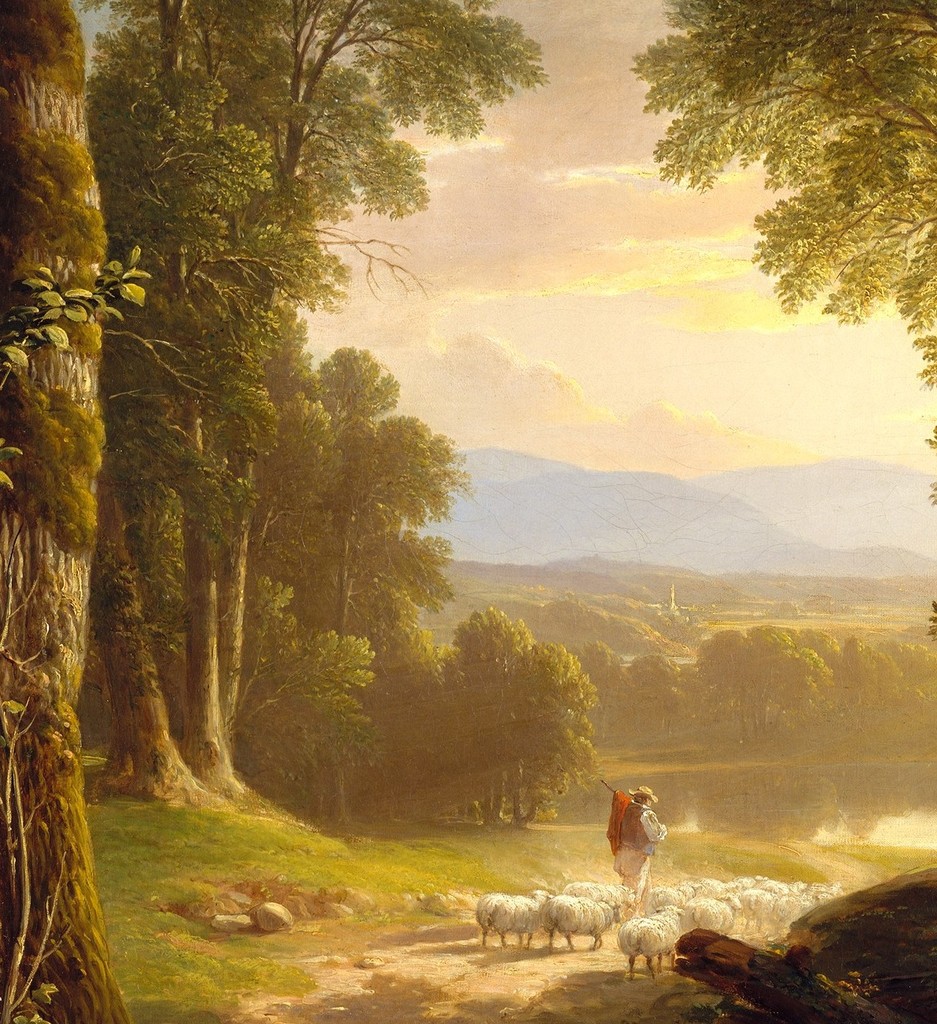
In the Woods
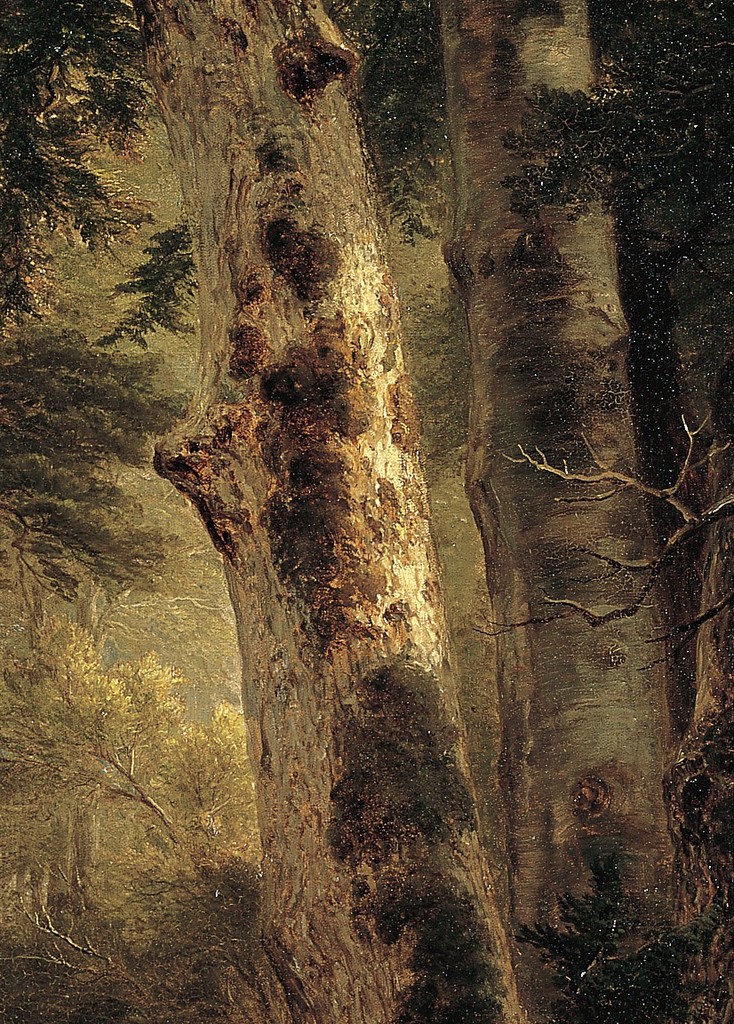
Large right-hand trunk
The prominent right-hand trunk carries irregular bark and branching forms. Its scale helps enclose the forest interior.
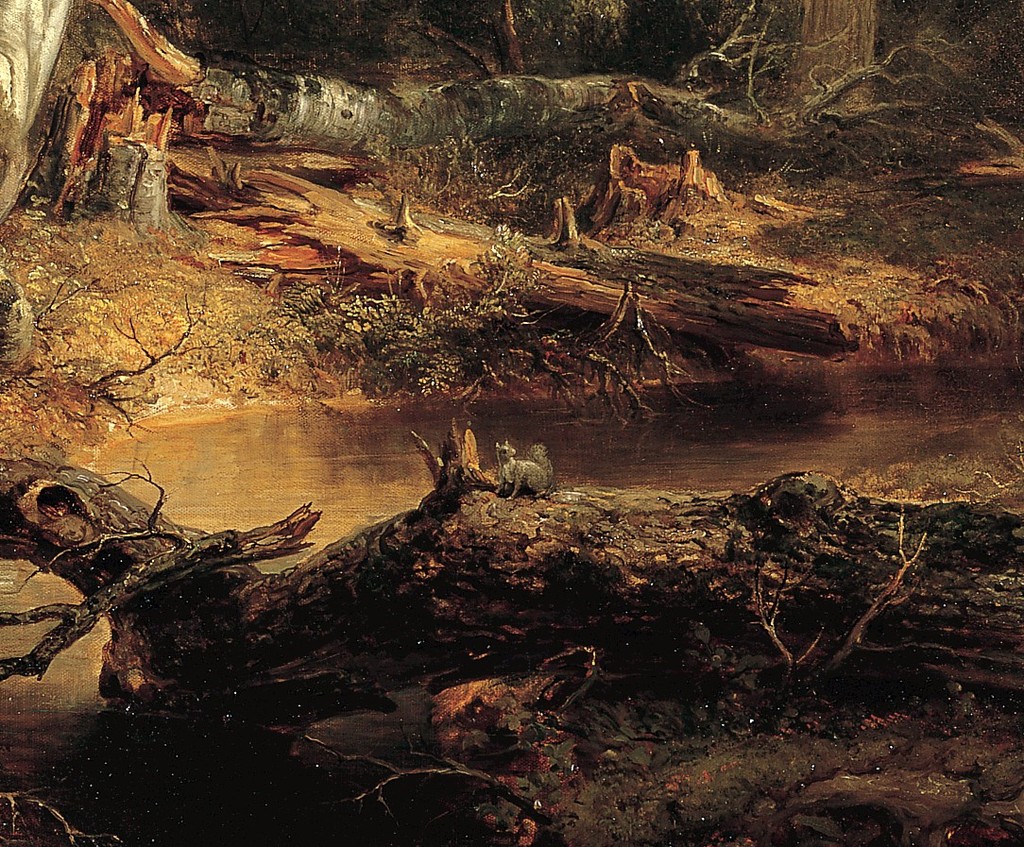
Fallen wood and near water
Fallen timber and broken stumps lie beside the foreground water. Their irregular forms contrast with the upright trunks.
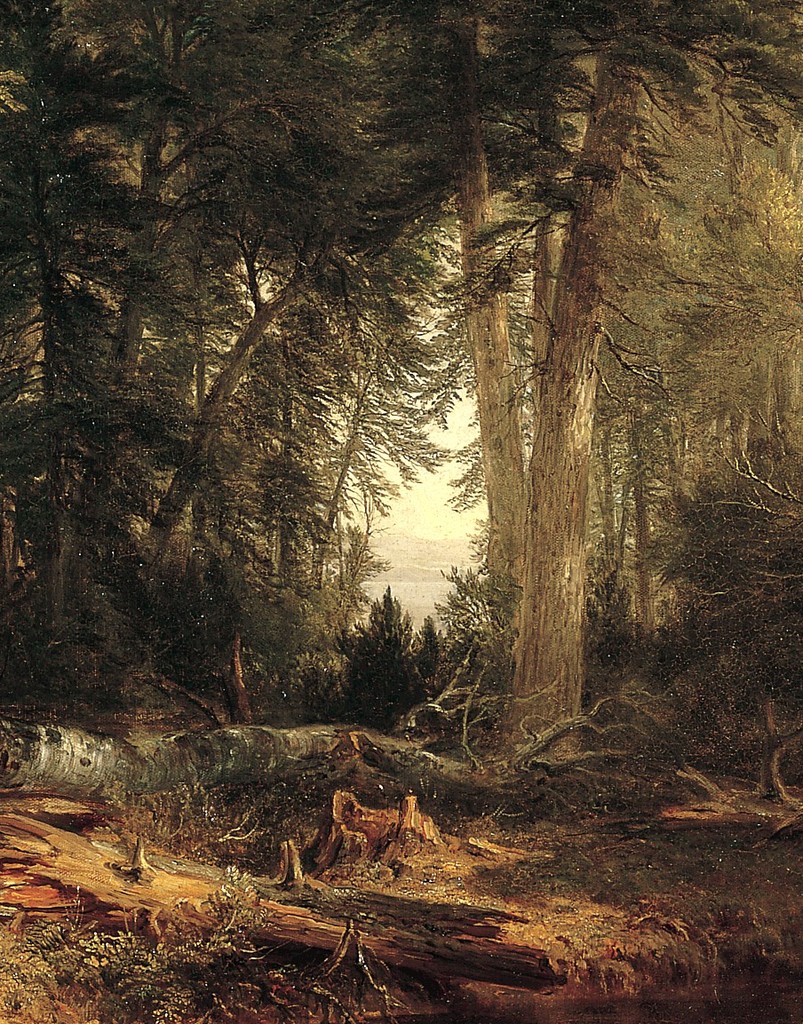
A pale opening among the trees
A narrow pale opening appears beyond the nearer trunks and foliage. It draws attention into a forest that otherwise remains densely enclosed.
A pupil and the problem of imitation
The first excerpt begins with a refusal to admit an aspiring painter as a studio pupil. Durand softens the disappointment by explaining why close dependence on a master can carry disadvantages. Technical instruction may save time, yet also encourage a student to see through someone else’s habits.[2]
His concern is the loss of individuality. A student can reproduce a teacher’s manner before acquiring enough understanding to make independent decisions. Durand directs attention instead toward the forms available outside, where the learner can examine subjects directly.
The advice does not make other artists useless. The extracts allow a place for studying their pictures after the student has developed knowledge from nature. A sequence of learning is proposed: first establish a capacity to observe, then learn from how accomplished artists organise what they have understood.
Gallati considers whether the unnamed pupil was an imagined figure and whether an editorial invitation helped prompt the series. These remain possibilities within her study, rather than established identities for a correspondent or a surviving commission for the texts.[3]
The uncertainty does not remove the letters’ instructional value. Their direct address makes a broad argument feel like advice to one person. A reader is invited to test the proposals against the objects and paintings that can actually be examined.
Form before the palette
Durand’s practical advice begins with drawing. He asks the learner to study contours and the features that distinguish one kind of object from another. In the case of trees, he points to foliage outlined against the sky and to the direction, curve and angle of branches.[2]
These observations concern structure as well as description. The artist needs to know how a branch joins the trunk and how a mass of leaves terminates. Such knowledge can prevent a painting from filling its wooded areas with repeated, interchangeable forms.
The small Leaf and Tree Study reproduced here offers a visual comparison. A leaf outline occupies one part of the sheet, while light graphite describes a leaning trunk elsewhere. The page concentrates attention on forms that a finished landscape might bring into a much larger arrangement.
The comparison does not establish that Durand made this undated sheet to illustrate the letters. It shows a surviving practice beside written advice about observation. The drawing’s own faint marks remain available to inspect without assigning an unrecorded instructional purpose to it.
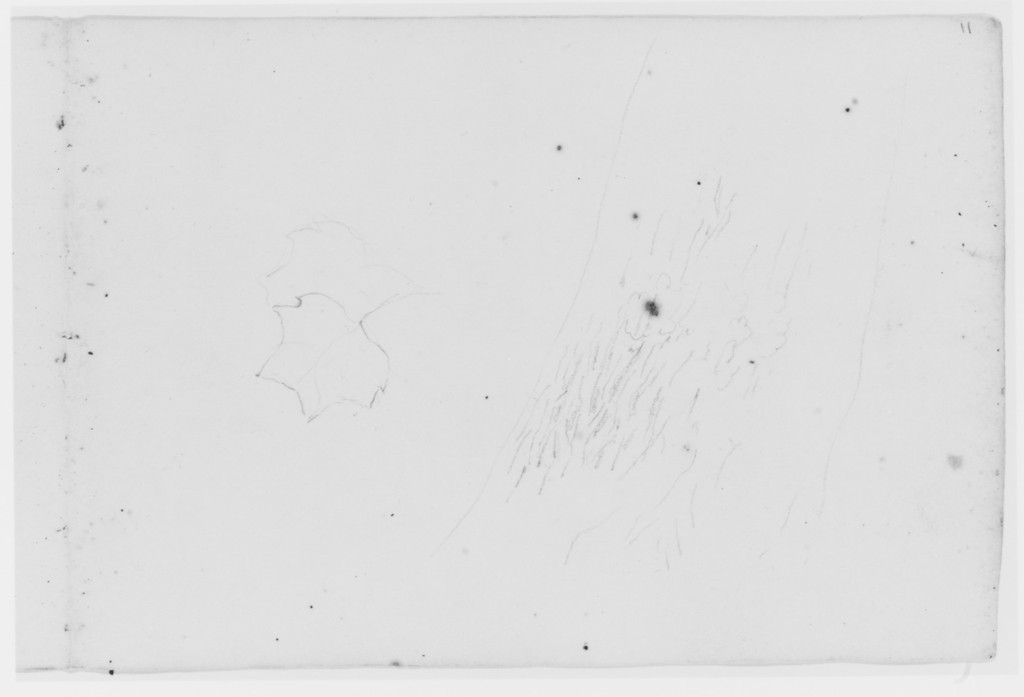
Asher Brown Durand, Leaf and Tree Study (from Sketchbook), undated. Metropolitan Museum of Art, 33.176.11 recto. Gift of Mrs. Frederic F. Durand, 1933. Shown beside the form-first advice; no documented role as an illustration to the letters. The Metropolitan Museum of Art; gift of Mrs. Frederic F. Durand,1933. Image source. CC0 / Public domain. Resized only; native appearance, complete carrier and margins preserved.
Close study and the experience of the painter
The excerpts warn the beginner against depending too soon on broad colour sketches. Durand nevertheless recognises that such studies can be useful to an experienced artist as reminders of an effect. The distinction concerns what the painter already knows and what a particular study must accomplish.[2]
A shorthand image can prompt a mature painter to recall a form or atmosphere. A beginner may need more sustained description in order to understand it at all. Durand’s advice therefore cannot be reduced to a prohibition on every loosely handled outdoor study.
He also distinguishes subjects that permit close description from those that demand another approach. Rocks, tree trunks and substantial leaves can be examined differently from flowing water or large masses of foliage. The marks appropriate to one subject may fail to communicate another.
This is an education in judgement rather than a single formula for making every painting. The artist learns enough about particular things to decide how they can contribute to the representation of a scene. Detail is valuable partly because of the knowledge gained through studying it.
Truth and the freedom to select
The letters’ emphasis on nature includes the artist’s power to choose. In the excerpts, Durand allows the more experienced painter to select and reject parts of the available material. Observation supplies a range of possibilities from which a composition can be made.[2]
He distinguishes close imitation from representation. A painting’s success depends on communicating the meaning of a scene, rather than reproducing every visible feature with the same degree of minuteness. The distinction joins careful study to a larger artistic purpose.
Selection is consequently part of his conception of truth. A painter who notices forms accurately still needs to decide which ones belong together and what should hold the viewer’s attention. The letters’ argument leaves room for composition, emphasis and the organisation of space.
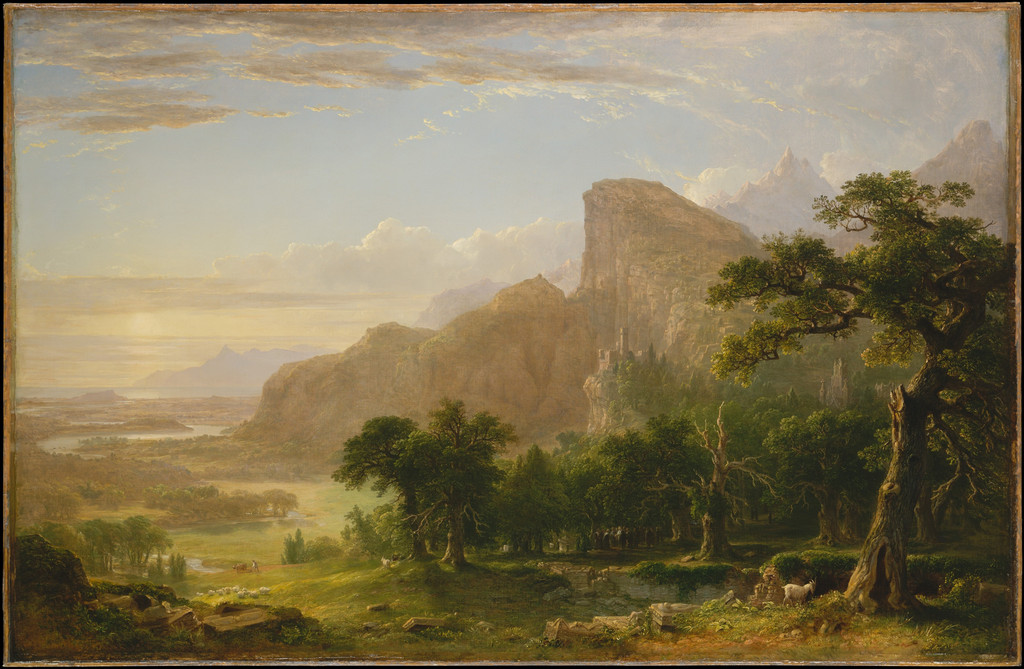
The Beeches makes these questions visible. Its large foreground trees, road and lighter distance establish a designed route through the landscape. The Met’s catalogue also identifies an outdoor oil study and Constable’s The Cornfield among the work’s sources.[5]
The finished painting therefore shows how attention to nature and attention to other art could meet. Durand’s written advice should not make this composition seem like an accidental collection of facts found outdoors.
Watch: Asher Brown Durand
Choose a film to explore the artist’s work, its interpretation and its wider setting.
Friendship and landscape, Asher B Durand's Kindred Spirits
Smarthistory and Crystal Bridges discuss friendship, memory and landscape in Kindred Spirits.
Watch on YouTubeLetter IV on money, ambition and perception
Letter IV begins with a remembered encounter in which Trumbull discouraged a young person from pursuing painting as a profession. Durand initially found the warning harsh, but reconsidered its possible kindness. The passage leads into a distinction between earning a livelihood and treating financial gain as the governing purpose of art.[1]
Durand’s language is moral and religious. He opposes ambition ruled by money or fame to a more devoted attention to beauty. These convictions belong to his nineteenth-century argument about art’s higher purposes; they need not be turned into a claim that working artists never required payment.
The letter also questions effects pursued only to gratify the eye. Strong colour and conspicuous manipulation can become ends in themselves. Durand wants the material beauty of a picture to communicate a fuller significance.
His discussion of perception helps explain that significance. Two people may see the same drapery on a statue while understanding it differently: one notices attractive folds, another understands how the cloth expresses the form beneath. The difference lies in the completeness of attention.
For landscape, the implication is practical. Looking at nature requires cultivation, even when the objects are already familiar. A painter’s task begins with learning to perceive what is present, rather than assuming that familiarity alone supplies understanding.
The viewer’s imagined journey
Letter IV moves from the artist’s motives to the experience of a person living with a landscape painting. Durand imagines someone returning from the day’s work and settling before a picture. The viewer’s memories and imagination gradually animate the represented country.[1]
The imagined scene can recall childhood places, rural labour, streams or the grounds around a schoolhouse. Such memories make a landscape personally meaningful without requiring that the canvas be a literal portrait of the viewer’s own home.
Durand even brings sensations from the room into this encounter. Air and sound entering through a window can be absorbed into the imagined outdoor experience. The passage gives painting a role in shaping attention rather than presenting it solely as an object of possession.
This is Durand’s proposed experience, not proof that every viewer responded alike. Its importance lies in the connection he draws between credible landscape forms and the possibility of emotional recollection. The painting gives imagination something to inhabit.
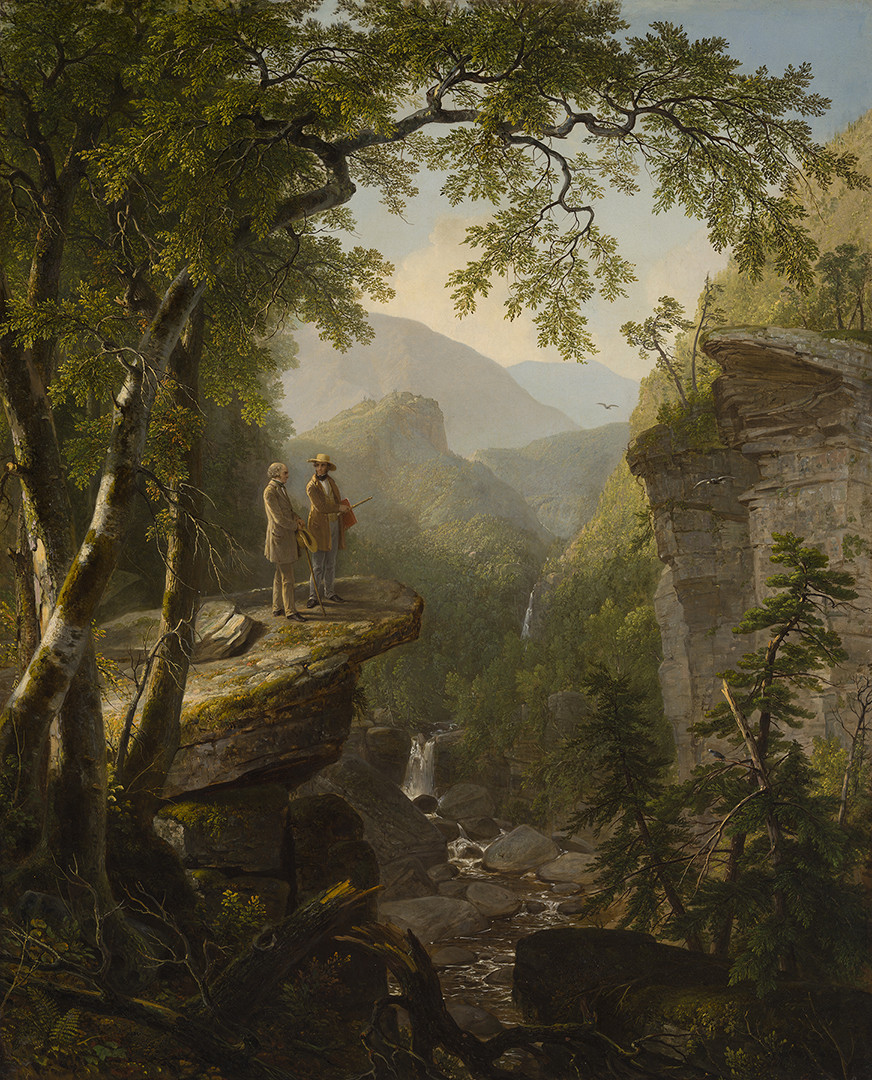
In the Woods provides a useful comparison. Its enclosing trees and stream offer several places for attention to linger. The canvas can be considered beside the letter’s imagined absorption, while retaining its own subject and history.
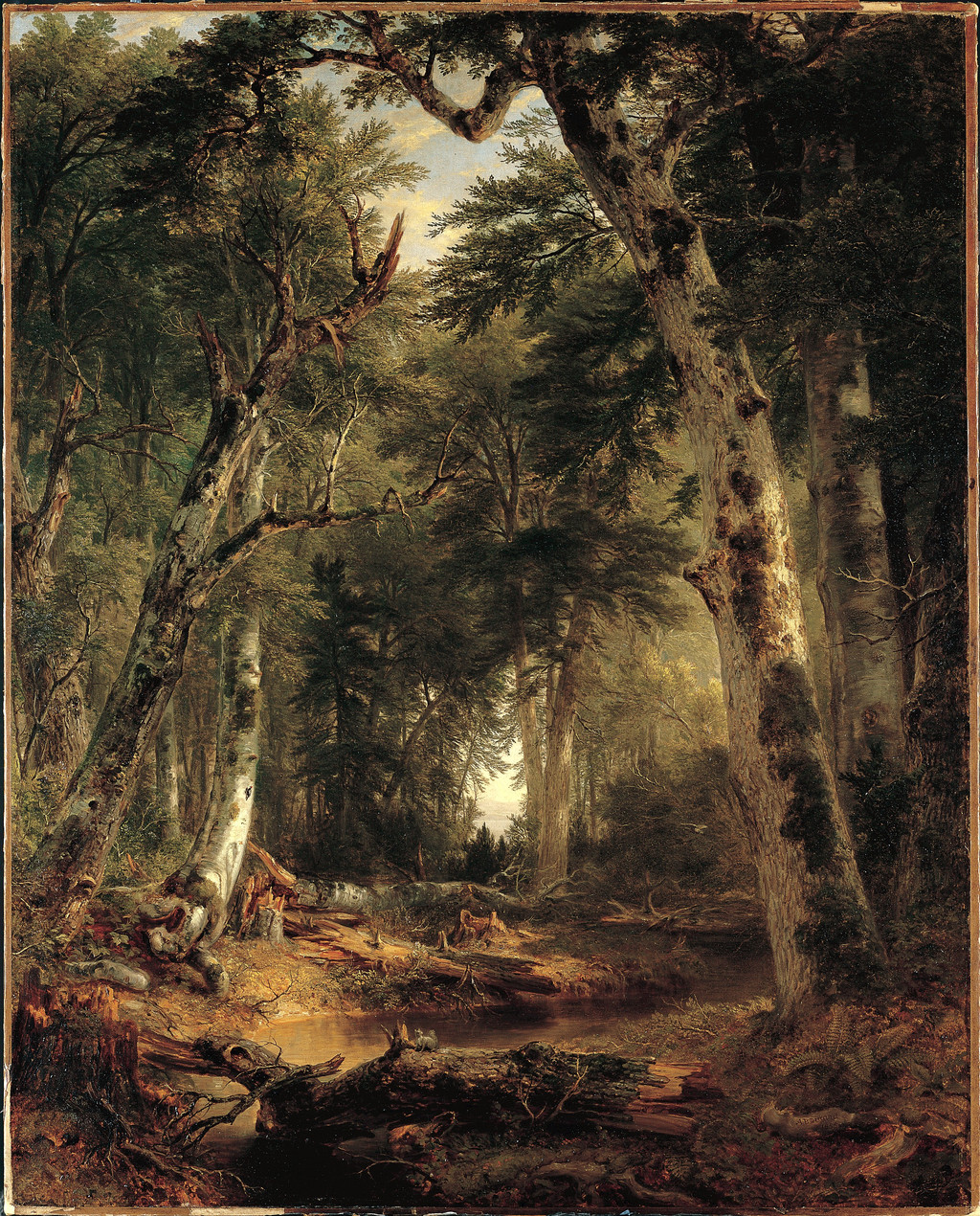
Asher Brown Durand, In the Woods, 1855. Metropolitan Museum of Art, 95.13.1. Its enclosing trunks and stream invite comparison with Durand’s discussion of the viewer’s absorption in a landscape. The Metropolitan Museum of Art. Image source. CC0 / Public domain. Resized only; native appearance, complete carrier and margins preserved.
Paint handling and the larger purpose
In the selected extracts, Durand argues that skilful application of paint should support drawing, knowledge and feeling. He is wary of a conspicuous manner that distracts from a picture’s design or character. The means should help the viewer encounter what the picture communicates.[2]
This advice concerns priorities. It does not supply a universal sequence of layers, a fixed palette or measurements for brushes. Nor does it prove that every stroke in every surviving canvas was intended to be invisible.
The written account instead asks how technique serves the whole. A passage of colour may be accomplished yet draw attention away from the composition. Durand’s argument connects the painter’s choices to the viewer’s experience of the represented scene.
European comparisons and American possibilities
Gallati places the letters beside wider nineteenth-century discussions of landscape, including those of Carl Gustav Carus and John Ruskin. Her comparison with Carus concerns affinities of form and thought; it does not establish direct reading or influence.[3]
Durand’s own closing advice in the memoir’s extracts encourages an independent landscape art based on the resources available to American painters. It also explicitly resists requiring that every artistic choice be sacrificed to patriotism.[2]
These positions can coexist. Nature provides local subjects and particular forms, while the artist remains free to learn from works made elsewhere. The letters ask for independence of judgement, cultivated through study and exercised in the creation of pictures capable of holding another person’s attention.
Artworks directory
A collected selection of 19 individually identified paintings, prints and a graphite study, including fifteen dedicated artwork articles. This directory is not a complete catalogue raisonné. Links lead to a companion article where available, otherwise the consulted institutional record. Progress is identified by title, date and museum; an unverified accession is omitted. Unillustrated objects remain searchable.
Frequently Asked Questions
No. The extracts recommend learning from nature first, then studying accomplished artists with the benefit of that knowledge.[2]
Artistic motive, cultivated perception and the experience of a viewer absorbed in a landscape. Its argument extends beyond practical instructions for applying paint.[1]
Discussion
Look again at the images and ideas explored in Durand’s Letters on Landscape Painting. These editorial prompts invite your observations.
Reader Insights
What differences between trees become clear when you study their branching patterns?
Can a landscape painting recall a place without representing that place exactly?
Which passages of a picture invite you to remain within its imagined space?
Join the Conversation
Share a detail, comparison or question about Durand’s Letters on Landscape Painting below.
References
- Asher B. Durand, Letter IV (1855), facsimile reprint. Complete primary text consulted in the modern reprint, printed pp.238–239; original The Crayon 1 (February 14, 1855), pp.97–98. View source
- John Durand, The Life and Times of A. B. Durand (1894). Appendix I, printed pp.211–217, selected extracts from the letters. View source
- Barbara Dayer Gallati, Durand’s “Letters on Landscape Painting”: A Modern Spirit in Context (2010). Printed pp.205–210 and notes: publication, the addressed pupil and wider landscape discourse. View source
- New Britain Museum of American Art, Asher Brown Durand. Institutional essay and bibliography with the nine original publication dates and pages. View source
- Metropolitan Museum of Art, The Beeches, American Paintings in The Metropolitan Museum of Art, volume I. Actually consulted printed pp.414 and 416: outdoor study and European compositional source. View source
- Splash image source.
Asher Brown Durand, The Beeches, 1845. Metropolitan Museum of Art, 15.30.59. The museum catalogue connects outdoor study with a composition drawing on Constable; the canvas precedes the 1855 letters. The Metropolitan Museum of Art. CC0 / Public domain. Resized only; native appearance, complete carrier and margins preserved.
View source