 by Tom Gurney
Tom Gurney BSc (Hons) is an art history expert with over 20 years experience
Email: tomgurney1@gmail.com / Phone: +44 7429 011000
The Catskills by Asher Brown Durand: Introduction
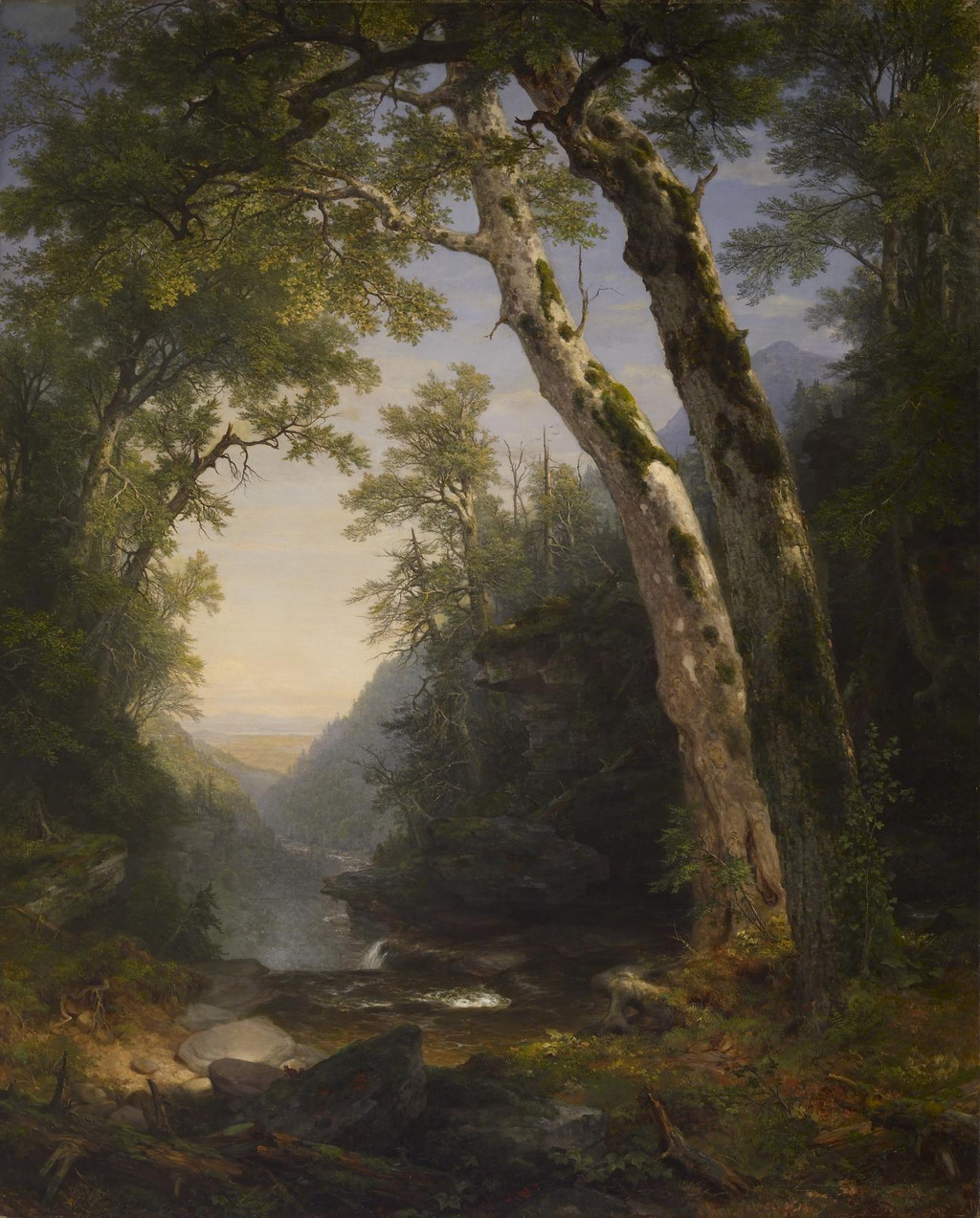
Two large pale trunks rise above a rocky stream in Asher Brown Durand’s The Catskills, opening onto a distant valley. Painted in 1859, the canvas belongs to the Walters Art Museum, which identifies the subject with Plattekill Clove in New York’s Catskill Mountains. The work combines close attention to trees and water with a much more extensive view beyond them.[1]
At a Glance
- ArtistAsher Brown Durand (1796–1886)
- TitleThe Catskills
- Date1859
- MediumOil on canvas
- Dimensions158.8 × 128.3 cm
- CollectionWalters Art Museum, Baltimore
- Accession37.122
- Museum creditCommissioned by William T. Walters, 1858
This work across Asher Brown Durand’s career
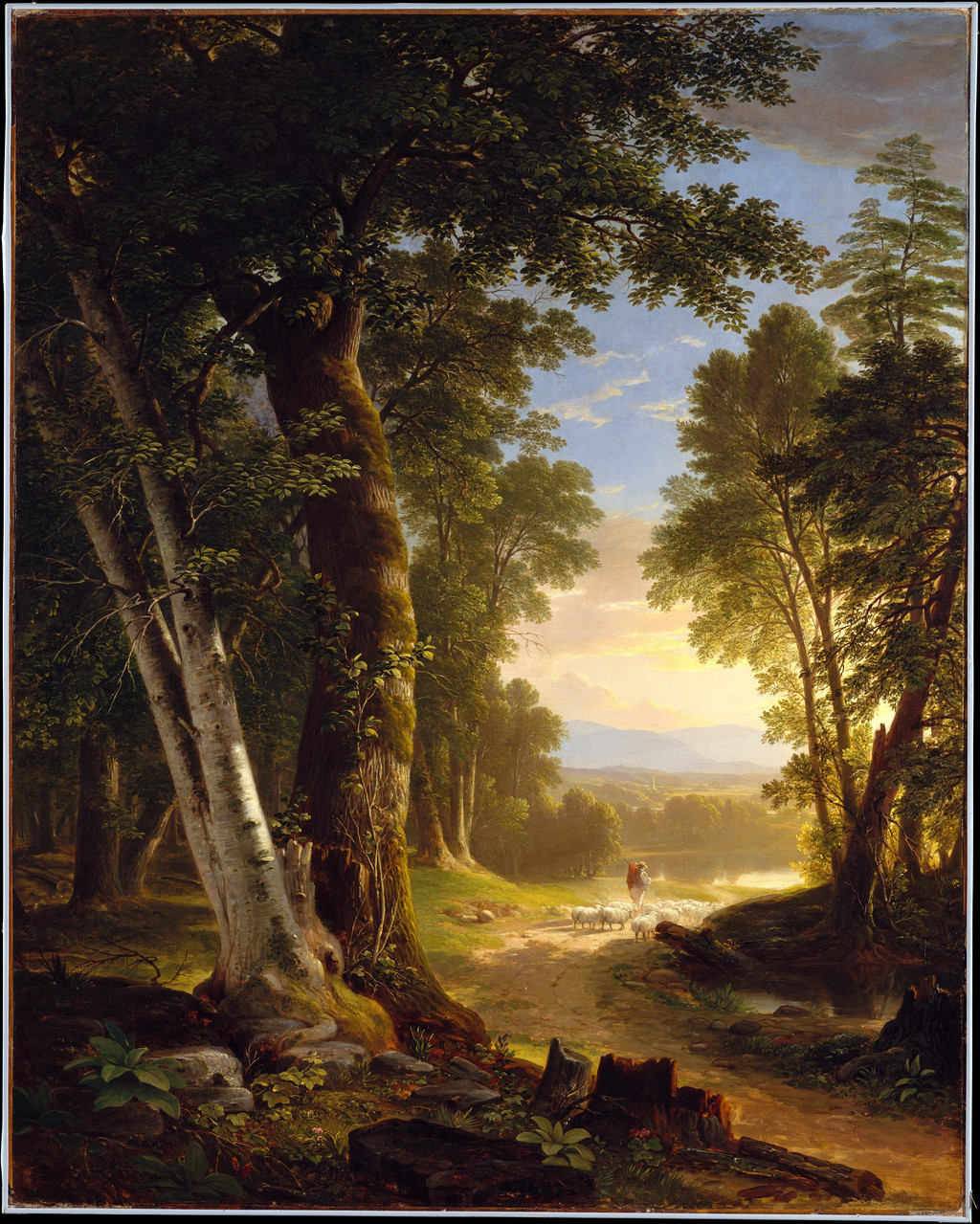
The Beeches
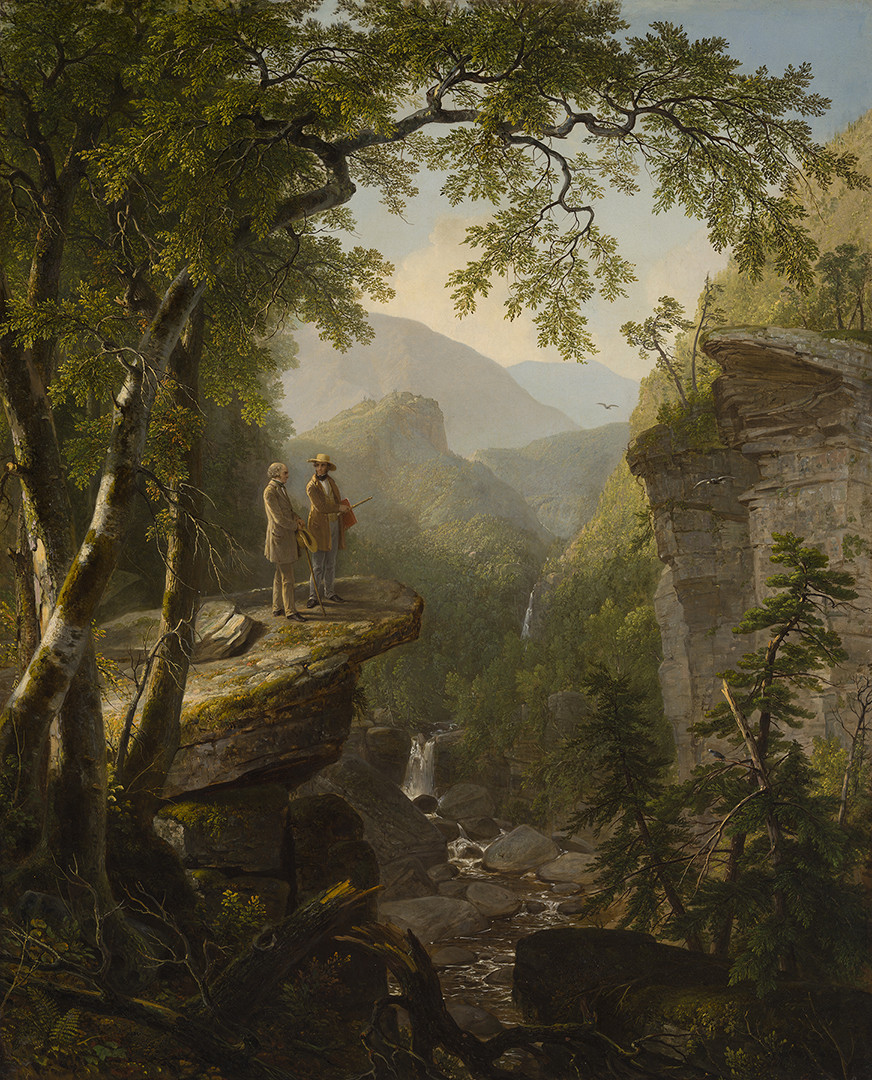
1845Kindred Spirits
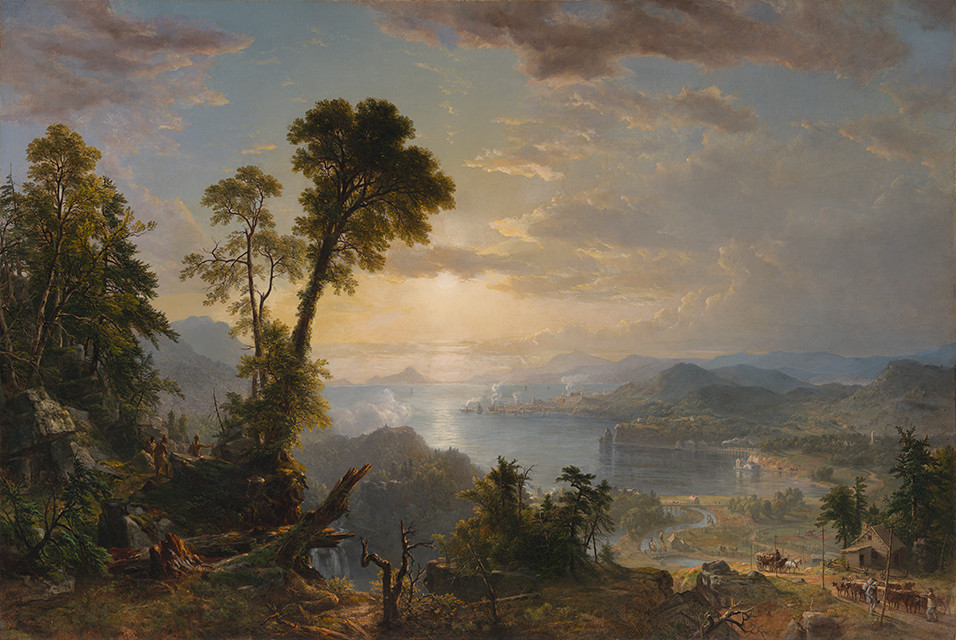
1849God’s Judgment Upon Gog
ca.1851–52River Scene
1854In the Woods
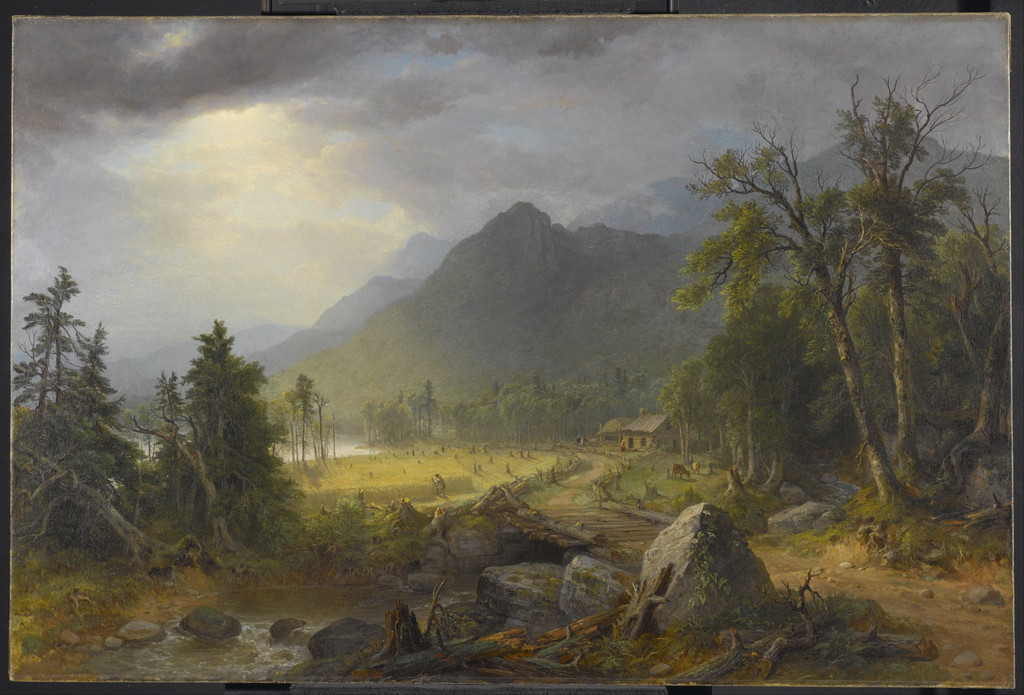
1855Sunday Morning
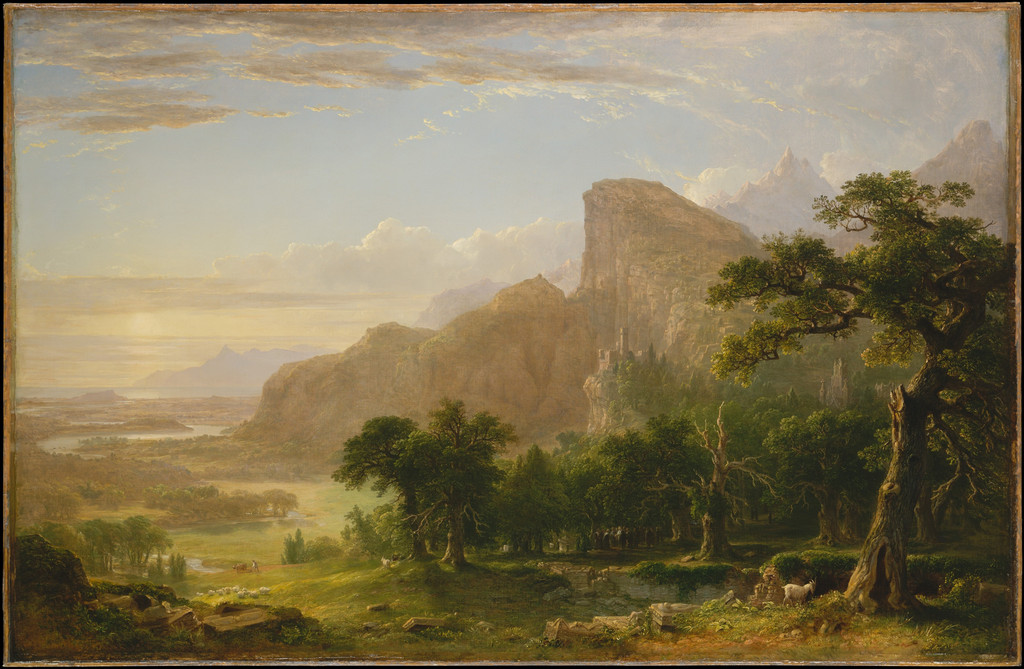
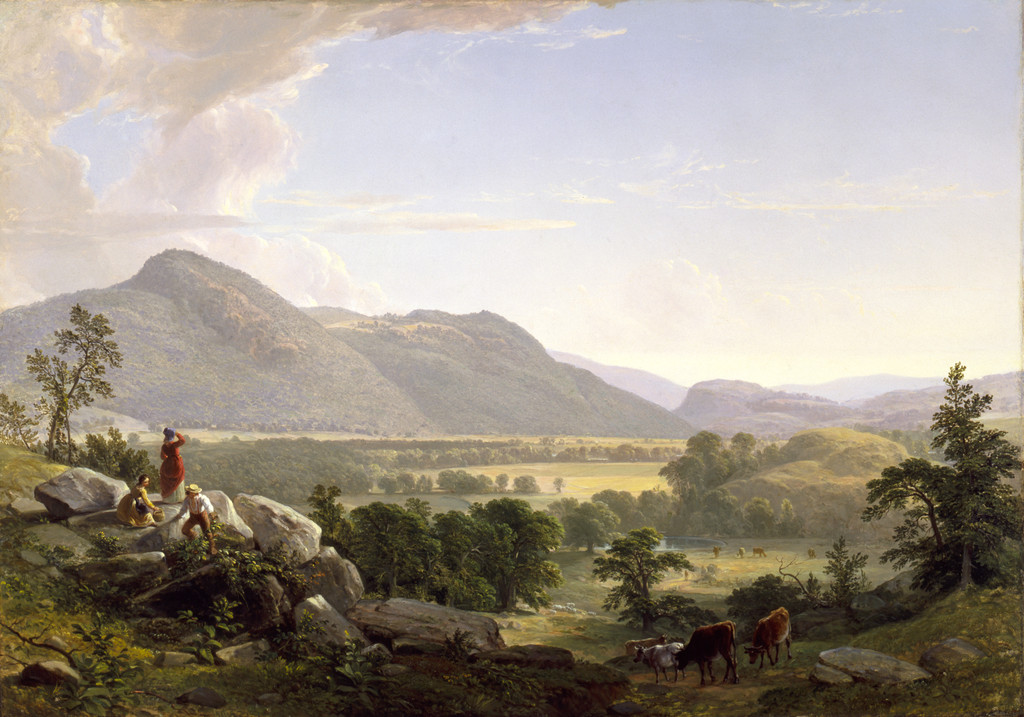
1860Summer Afternoon
1865Contents
- Two trunks that shape the view
- Water and rock at the viewer’s feet
- The distant valley opening
- Plattekill and outdoor study
- A commission in 1858, a painting dated 1859
- Woodland and the spiritual life of looking
- Comparisons with In the Woods and The Beeches
- Annotated details
Two trunks that shape the view
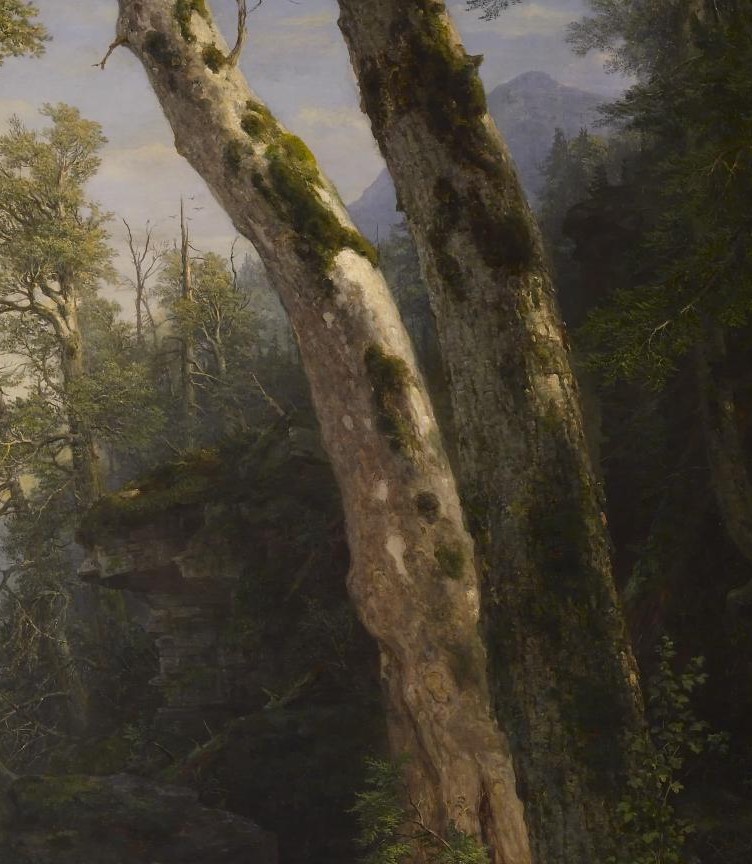
The most conspicuous trees rise at the right of centre. One pale trunk bends leftward as it climbs, while the adjacent trunk is darker and straighter. Their different directions give the pair a strong presence without making them symmetrical supports.
Their surfaces contain light patches, dark irregularities and green growth. Branches extend through the surrounding foliage, sometimes emerging clearly against the sky and sometimes merging with the canopy. The trees remain internally varied even where they function together as a large compositional form.
At the top, heavy branches cross the canvas. They link the principal trunks with trees on the left, creating an overhead structure. Beneath it, the opening toward the valley becomes more apparent, as though the viewer were looking out from within a wooded place.
The Walters identifies these prominent trees as sycamores. That institutional identification belongs alongside their visible role: their pale bark makes them especially legible against the darker wooded ground.[1]
The nearer trunk is substantial enough to occupy much of the canvas’s height. Its root area remains close to the streamside foreground, allowing the eye to connect the tree’s base with its branches above. This continuity gives the picture a strong vertical scale.
The trunks also interrupt the distant scenery. The valley cannot be taken in as an uninterrupted panorama; the viewer repeatedly encounters trees between the near position and the far land. The painting makes that obstruction productive, giving close forms their own importance within an extensive landscape.
Annotated Details from The Catskills
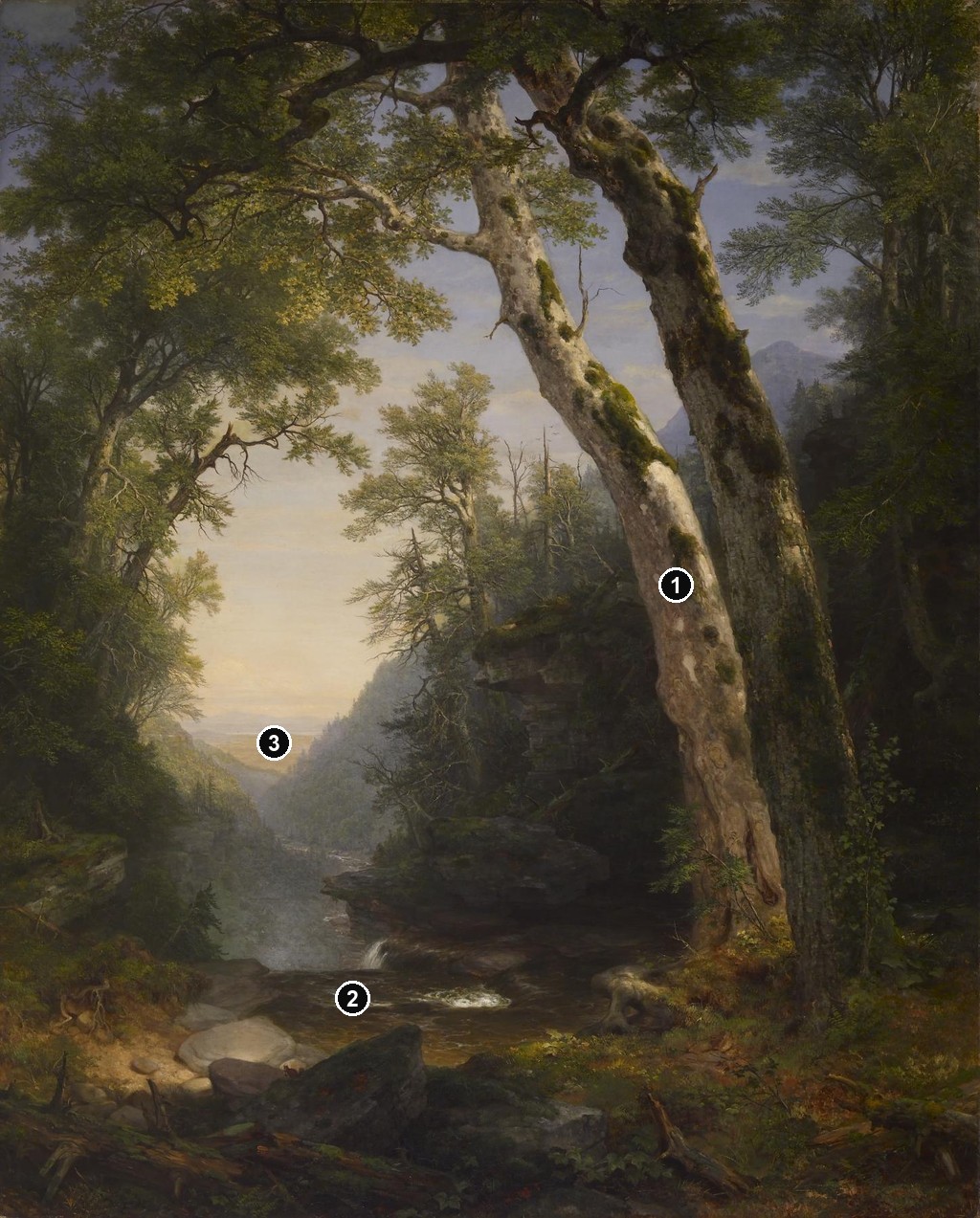
The numbered points identify visible features discussed in this article. Return from each detail to the whole composition. Asher Brown Durand, The Catskills, 1859. Oil on canvas, 158.8 × 128.3 cm. Walters Art Museum, 37.122. Commissioned by William T. Walters, 1858. Image source. Public domain. Resized only; native appearance, complete carrier and margins preserved.
Details from THE CATSKILLS
Compare the cropped details with the complete images above. Notice how their colours, shapes and positions contribute to the larger compositions.
Two prominent pale trunks
Two large trunks rise through the near right side, with irregular pale bark and darker patches. Their scale shapes the enclosed view.
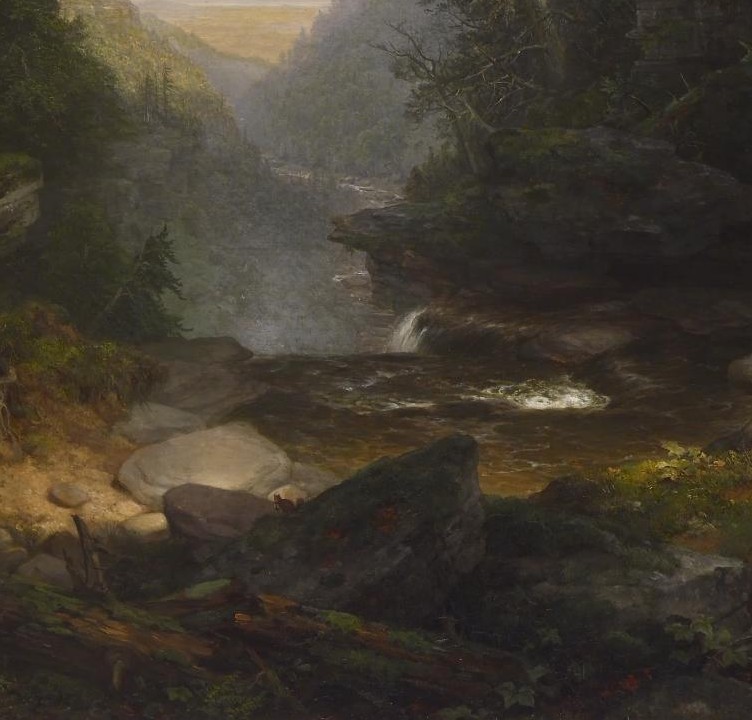
Rocky near stream
Water passes between rocks near the viewer. Its pale movement creates a passage through the shaded lower composition.
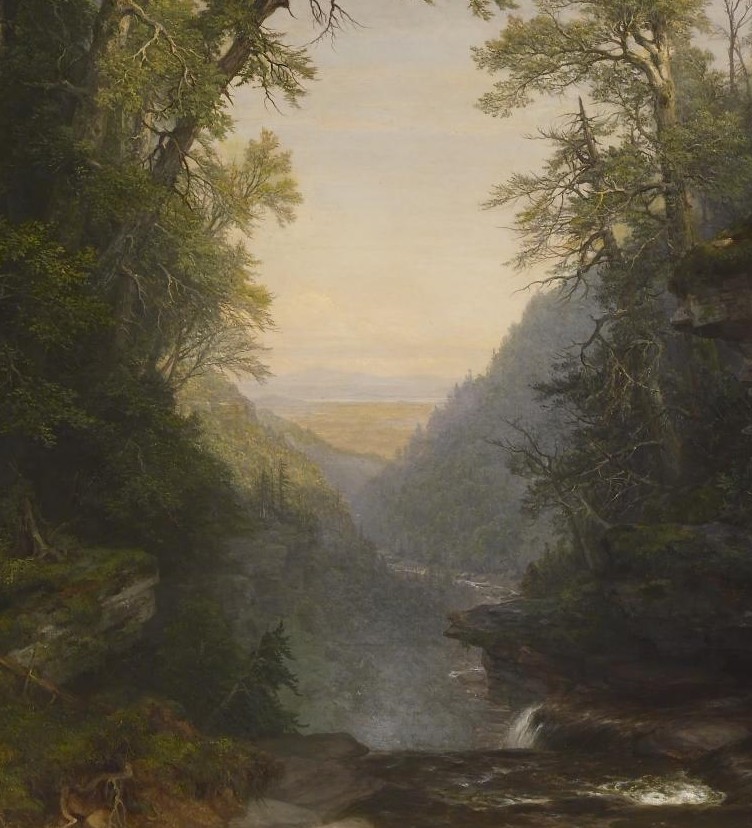
Distant valley opening
A lighter opening appears between the enclosing trees and slopes. It extends the scene beyond the nearer trunks and stream.
Water and rock at the viewer’s feet
The stream occupies a relatively narrow passage beneath the trees. A small cascade breaks over rock in the middle distance, and water spreads through the nearer channel. Light catches parts of its surface while other stretches remain dark.
These changes help the viewer follow the water through a densely wooded setting. A bright edge or foam-like passage becomes noticeable against surrounding stone and shadow. The stream’s movement provides a route through forms whose scale and texture otherwise encourage still, close inspection.
Large rocks lie along the lower edge. Their angular shapes contrast with the bending trunks and finer foliage. Some present pale surfaces to the light, while others appear almost black. The differences make the foreground a sequence of distinct objects rather than a uniform dark border.
A fallen branch and smaller plants complicate the near ground. They make this area irregular and tangible. The viewer’s imagined place is among stones and vegetation, close to the stream, rather than at a smooth scenic platform above it.
Farther back, layered rock rises beside the channel. Its ledges repeat the horizontal intervals made by water and valley, while the trees provide a contrasting upward movement. The composition develops through these different directions as well as through changes of distance.
The stream connects near and far without dissolving the foreground’s substance. Following its course still requires looking around rocks, trunks and dark masses of foliage. The experience is one of finding an opening through a wooded interior.
The distant valley opening
The brightest distance appears left of centre, beyond the narrowing clove. Pale ground and low horizons contrast with the near woodland. This opening gives the landscape room beyond the immediately surrounding trees and rocks.
Its scale is quite different from that of the trunks. The close trees have weight, irregular surfaces and clearly defined edges; the far country is more lightly stated. That contrast allows the eye to experience a large change of distance within the tall canvas.
The pale sky continues behind the overhead branches. Small areas of sky between leaves keep the canopy from sealing the upper picture entirely. The viewer remains aware of open atmosphere even while standing within the wooded frame.
The valley can appear to draw attention away from the foreground, yet the pale trunks repeatedly bring it back. The composition therefore invites alternating kinds of attention: outward toward extensive country, then inward toward the specific forms surrounding the viewer.
The distant light also makes the nearer shade more legible. Darkness here has shape and depth because the opening provides a clear contrast. The woods feel enclosed, but they remain connected to a landscape beyond their immediate boundaries.
Plattekill and outdoor study
The Walters places the depicted subject in Plattekill Clove. Margaret Stenz’s Brooklyn Museum guide adds that Durand composed the 1859 painting from sketches made around Palenville and nearby Platte Clove in 1858.[1][2]
Stenz also discusses an oil study of a sycamore associated with that regional work. Her account connects the large finished composition with close outdoor observation, while preserving the distinction between a study and the exhibition canvas.
The relationship explains how a particular tree could become central to a larger view. Studying a trunk, branches and surrounding ground provides knowledge of near forms; the finished painting can then arrange those forms with a valley, stream and extensive atmosphere.
Roberta J. M. Olson describes Durand’s tree studies as a sustained part of his artistic practice. Her account stresses attention to contour, movement and the individual character of trees rather than a simple leaf-by-leaf transcription.[3]
That distinction is useful here. The painting gives the main trunks highly particular surfaces and directions, but their value also lies in the relationship they establish with the rest of the scene. Close observation and large-scale arrangement contribute to the same work.
For the wider history of his regional visits, see Durand’s Catskills and landscape travel. The sources establish a study region, while the finished canvas remains a composed encounter with that country.
Watch: Asher Brown Durand
Choose a film to explore the artist’s work, its interpretation and its wider setting.
Friendship and landscape, Asher B Durand's Kindred Spirits
Smarthistory and Crystal Bridges discuss friendship, memory and landscape in Kindred Spirits.
Watch on YouTubeA commission in 1858, a painting dated 1859
William T. Walters commissioned the picture on 8 June 1858. The museum’s provenance records payment on 3 May 1859, and the canvas is signed and dated 1859. The commission date and the painting’s date therefore refer to different stages in its history.[1]
The large dimensions reinforce its presence as a substantial finished work: 158.8 cm high and 128.3 cm wide. The upright format allows the principal trees to rise through the composition while preserving a distant opening beneath their branches.
The image’s nearest rocks and trunk bases can feel close to the viewer, while the valley suggests a far greater extension. This relationship is particularly effective in a tall work, where the upward reach of trees and the recession of scenery share the same field of attention.
The provenance continues through Henry Walters’s inheritance in 1894 and his bequest in 1931. These stages belong to the collecting history of this exact canvas, accession 37.122. They should remain distinct from the history of another Durand painting commissioned by the same family.
Woodland and the spiritual life of looking
Durand’s own Letter IV of 1855 gives landscape painting a spiritual purpose rooted in attentive engagement with nature. He asks the painter to pursue truthful representation rather than making display or financial reward the sole object of work.[4]
That primary text offers a context for the sustained looking invited by The Catskills. Trunks, stones, water and distant air are worth attending to in themselves, while their arrangement can make a landscape more than a collection of separate facts.
Olson likewise connects Durand’s repeated study of trees with his reverence for nature. Her broader argument helps explain why woodland could become an enduring subject rather than simply a background for human action.[3]
The painting’s tree-framed opening can be experienced as a passage from sheltered near ground into extensive country. Such an experience supports reflection without requiring each rock or branch to carry a fixed, individually decipherable symbol.
The Walters connects Durand’s landscape practice with nineteenth-century ideas of nature’s spiritual significance. Those ideas offer a historical context for the attentive encounter invited here, where close observation and the experience of extensive country become parts of the same composition.[1]
Comparisons with In the Woods and The Beeches
In the Woods, 1855, also gives trees and rough foreground forms a large upright canvas. The Met connects it with Durand’s Catskill studies.[5] Its more enclosed setting offers a useful comparison with the extensive valley visible in The Catskills.
The Beeches, 1845, combines imposing trunks with a rural road and small figures. The Met’s catalogue discusses its outdoor study and compositional precedents.[6]
Across these works, trees organise different experiences of space. A road, woodland interior or rocky watercourse can guide attention beneath them. In The Catskills, the particular combination of pale trunks, stream and distant light makes the act of looking through the trees central to the landscape.
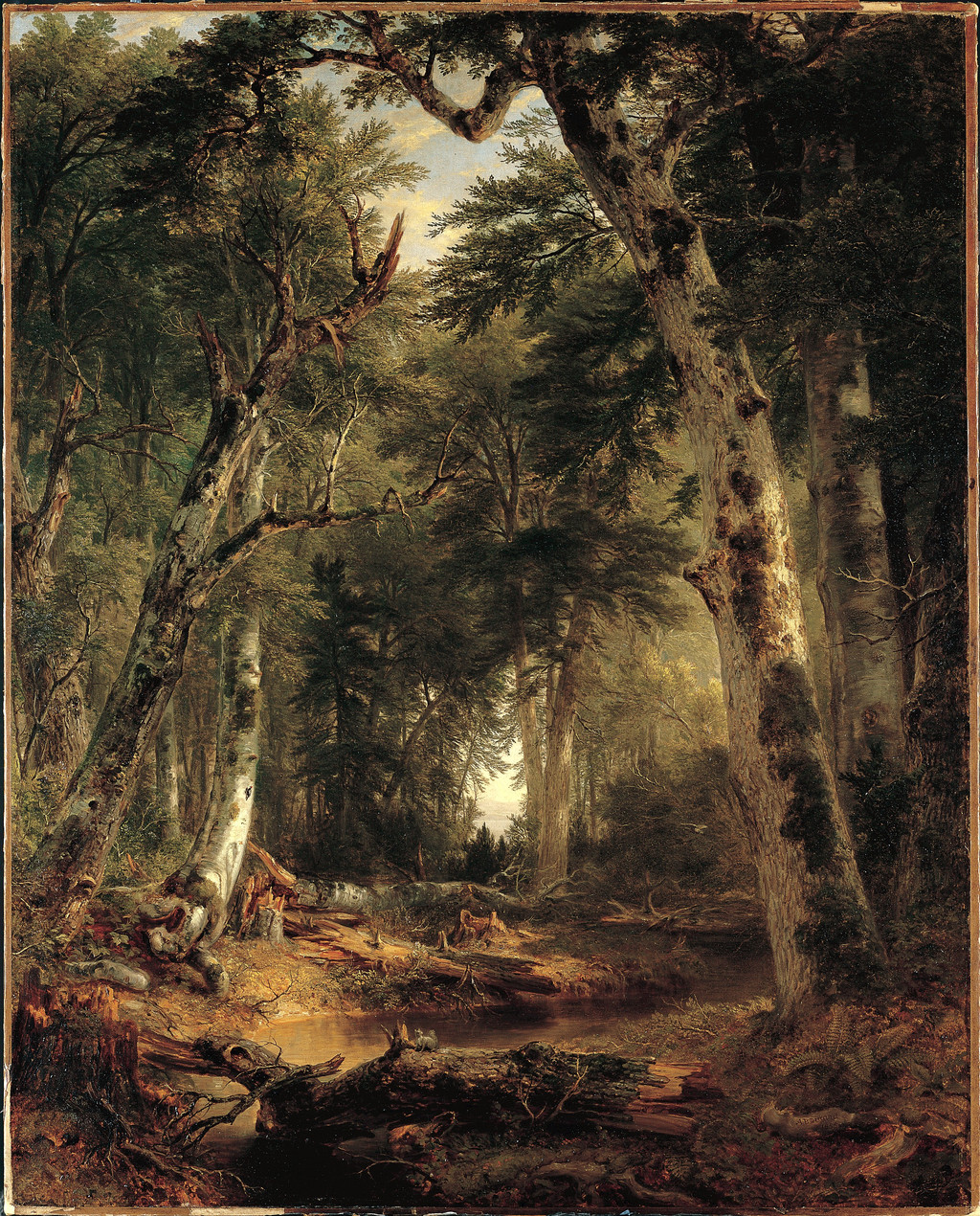
Asher Brown Durand, In the Woods, 1855. Metropolitan Museum of Art, 95.13.1. Gift in memory of Jonathan Sturges by his children, 1895. The Metropolitan Museum of Art. Image source. CC0 / Public domain. Resized only; native appearance, complete carrier and margins preserved.
Artworks directory
A collected selection of 19 individually identified paintings, prints and a graphite study, including fifteen dedicated artwork articles. This directory is not a complete catalogue raisonné. Links lead to a companion article where available, otherwise the consulted institutional record. Progress is identified by title, date and museum; an unverified accession is omitted. Unillustrated objects remain searchable.
Frequently Asked Questions
The Walters records the commission on 8 June 1858 and payment on 3 May 1859. The canvas itself is dated 1859.[1]
The Walters identifies the prominent pale trees as sycamores. They provide the composition’s strong upright forms.[1]
Discussion
Look again at the images and ideas explored in The Catskills by Asher Brown Durand. These editorial prompts invite your observations.
Reader Insights
Do the pale trunks direct your attention upward or toward the valley beyond?
How does the narrow stream help you move through the wooded foreground?
What differs between looking into these trees and looking through them?
Join the Conversation
Share a detail, comparison or question about The Catskills by Asher Brown Durand below.
References
- Walters Art Museum, The Catskills, accession 37.122. Complete current record, commentary and provenance consulted; sycamores, Plattekill, dates, dimensions and collecting history. Treatment list read separately; no pigment analysis inferred. View source
- Margaret Stenz, Following in the Footsteps of Asher B. Durand: A Walker’s Guide, Brooklyn Museum (2007). All five pages’ text consulted; 1858 studies at Palenville and Platte Clove. Historical regional guide, not current route instructions. View source
- Roberta J. M. Olson, “A Magnificent Obsession: Durand’s Trees as Spiritual Sentinels of Nature,” in Asher B. Durand (1796–1886): American Landscapes, Fundación Juan March (2010), printed pp.151–158. Complete selected essay and notes consulted; tree study, individual form and spiritual interpretation. Modern illustrations unused. View source
- Asher B. Durand, Letter IV on Landscape Painting, originally The Crayon, 14 February 1855; consulted modern facsimile reprint, pp.238–239. All four supplied pages actually displayed and read. Original public-domain advice paraphrased; modern layout not reproduced. View source
- Metropolitan Museum of Art, In the Woods, accession 95.13.1. Complete current 1855 record and narrative consulted for the exact comparison. View source
- Metropolitan Museum of Art, The Beeches, in American Paintings in The Metropolitan Museum of Art, volume I, printed pp.414 and 416. Both relevant scans actually displayed and read; study and composition comparison. View source
- Splash image source.
Asher Brown Durand, The Catskills, 1859. Oil on canvas, 158.8 × 128.3 cm. Walters Art Museum, 37.122. Commissioned by William T. Walters, 1858. Public domain. Resized only; native appearance, complete carrier and margins preserved.
View source