 by Tom Gurney
Tom Gurney BSc (Hons) is an art history expert with over 20 years experience
Email: tomgurney1@gmail.com / Phone: +44 7429 011000
In the Woods by Asher Brown Durand: Introduction
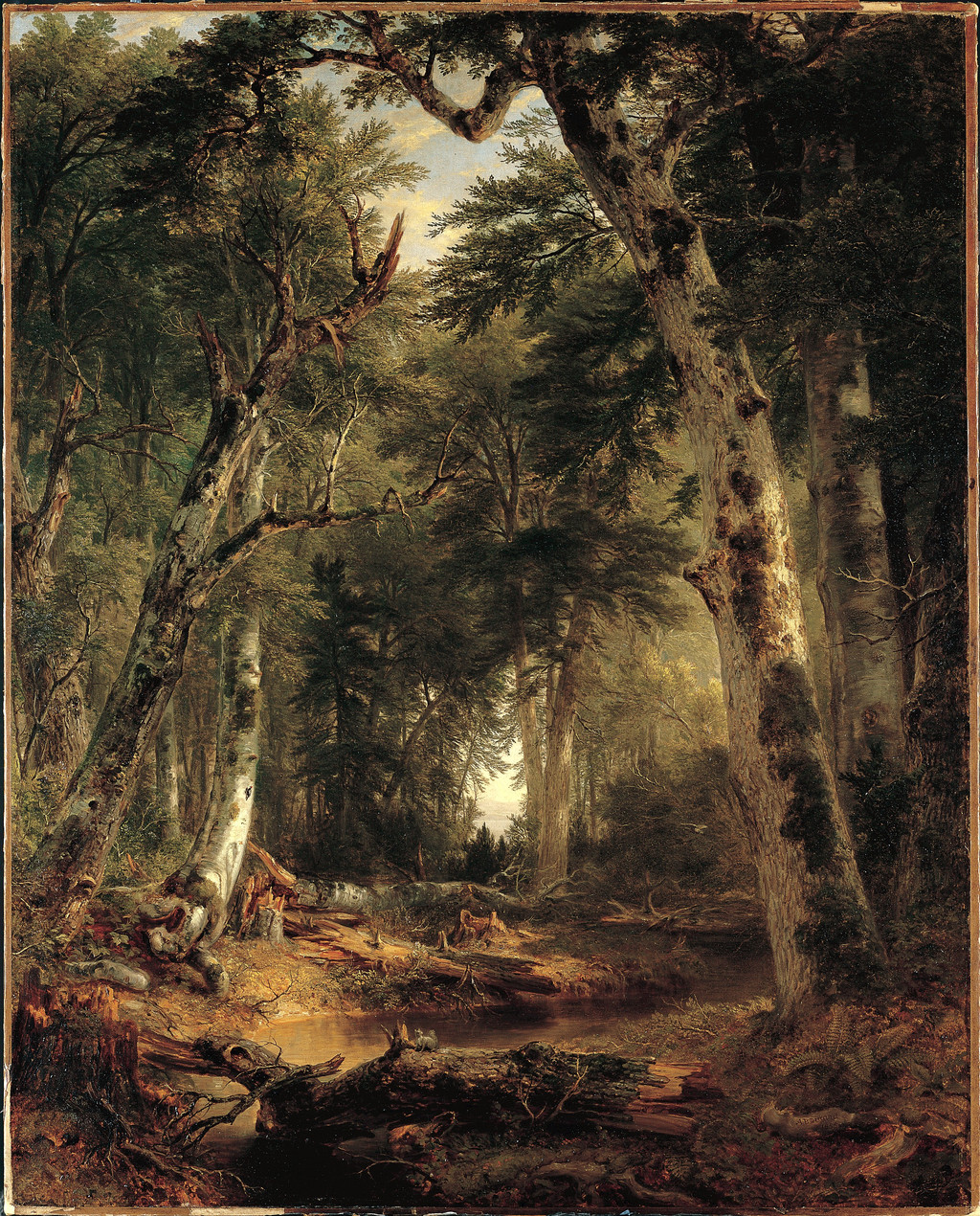
Asher Brown Durand’s In the Woods places the viewer at the edge of a stream beneath an enclosing forest canopy. Large trunks rise close to the foreground, fallen wood interrupts the ground and a small opening of light appears beyond the trees. Painted in 1855, it was based on Catskill sketches from the previous summer. Its substantial scale gives an intimate woodland interior the presence of a major public landscape.[1]
At a Glance
- ArtistAsher Brown Durand (1796–1886)
- TitleIn the Woods
- Date1855
- MediumOil on canvas
- Dimensions154.3 × 121.9 cm
- CollectionMetropolitan Museum of Art, New York
- Accession95.13.1
- PatronJonathan Sturges
- Museum creditGift in memory of Jonathan Sturges by his children, 1895
This work across Asher Brown Durand’s career
The Beeches
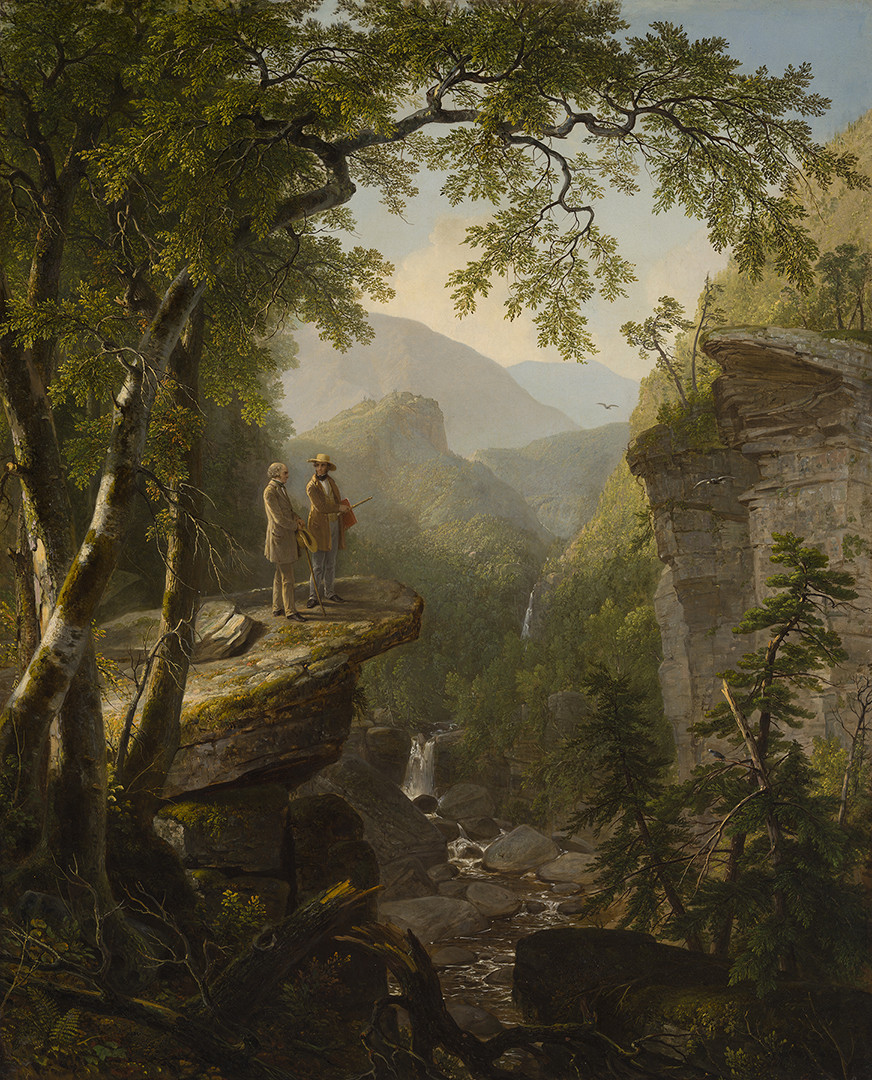
1845Kindred Spirits
1849God’s Judgment Upon Gog
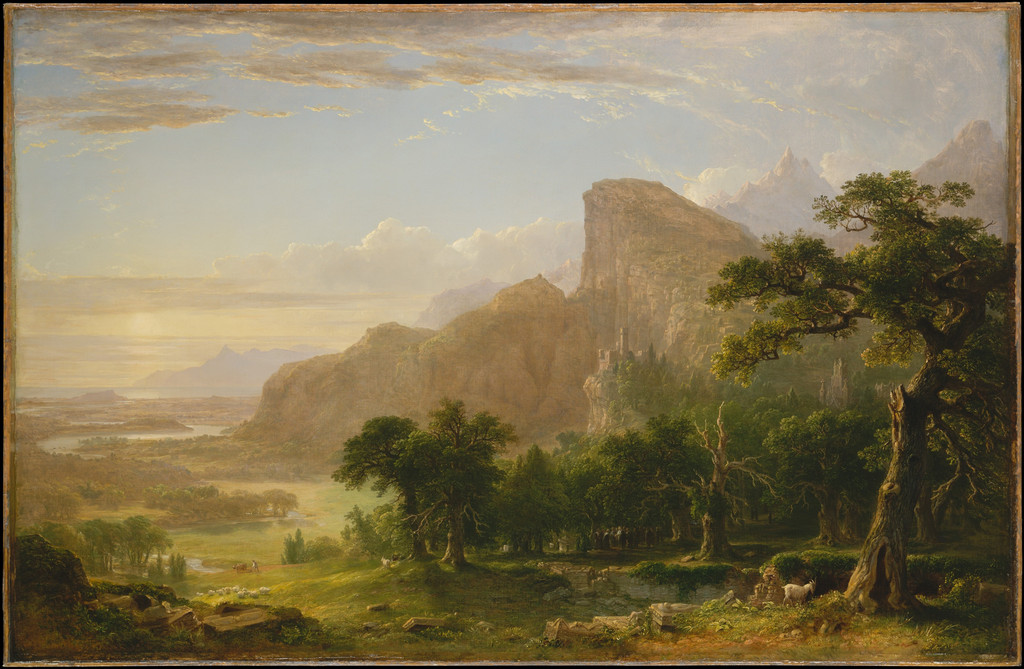
ca.1851–52River Scene
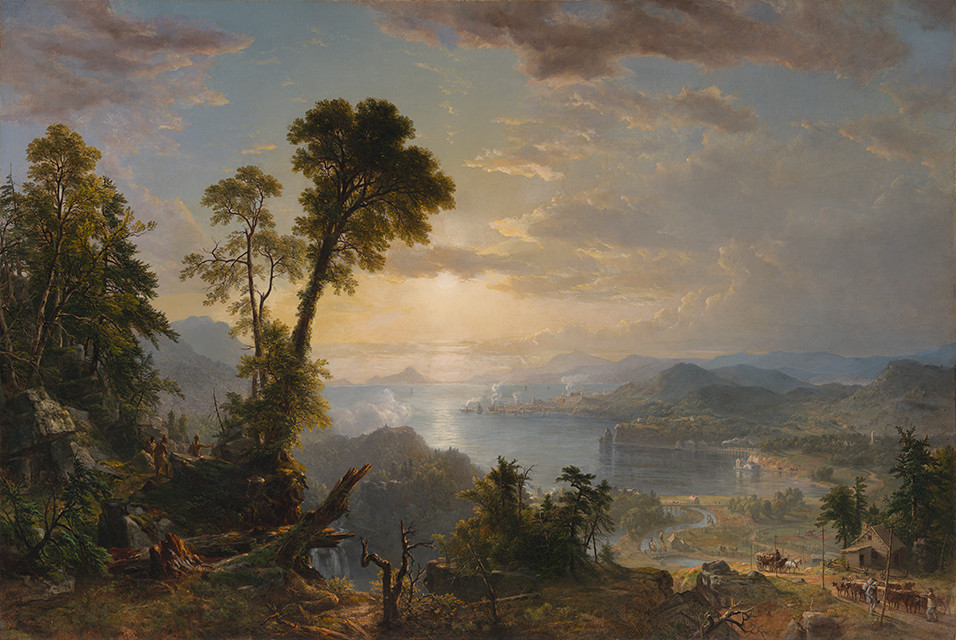
1854The Catskills
1859Sunday Morning
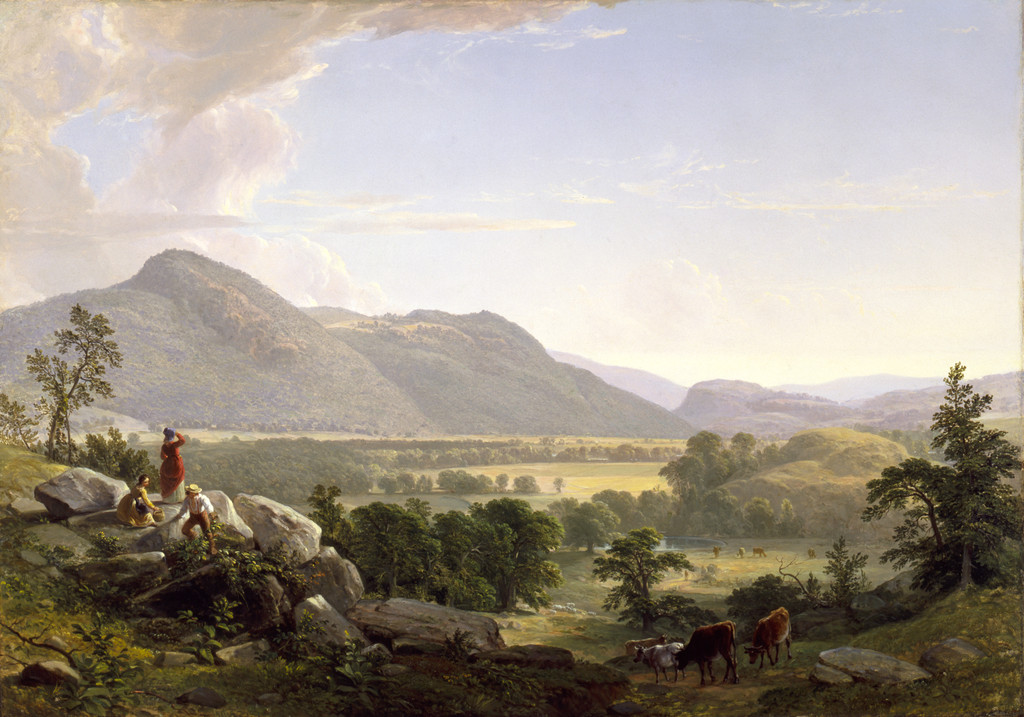
1860Summer Afternoon
1865Contents
- A forest interior built from trunks
- Water, fallen wood and the foreground
- Sketches, the 1855 exhibition and Sturges
- A forest understood as a place of devotion
- The letters and looking into a landscape
- Trees as substantial subjects
- Other woodland paintings with separate histories
- Annotated details
A forest interior built from trunks
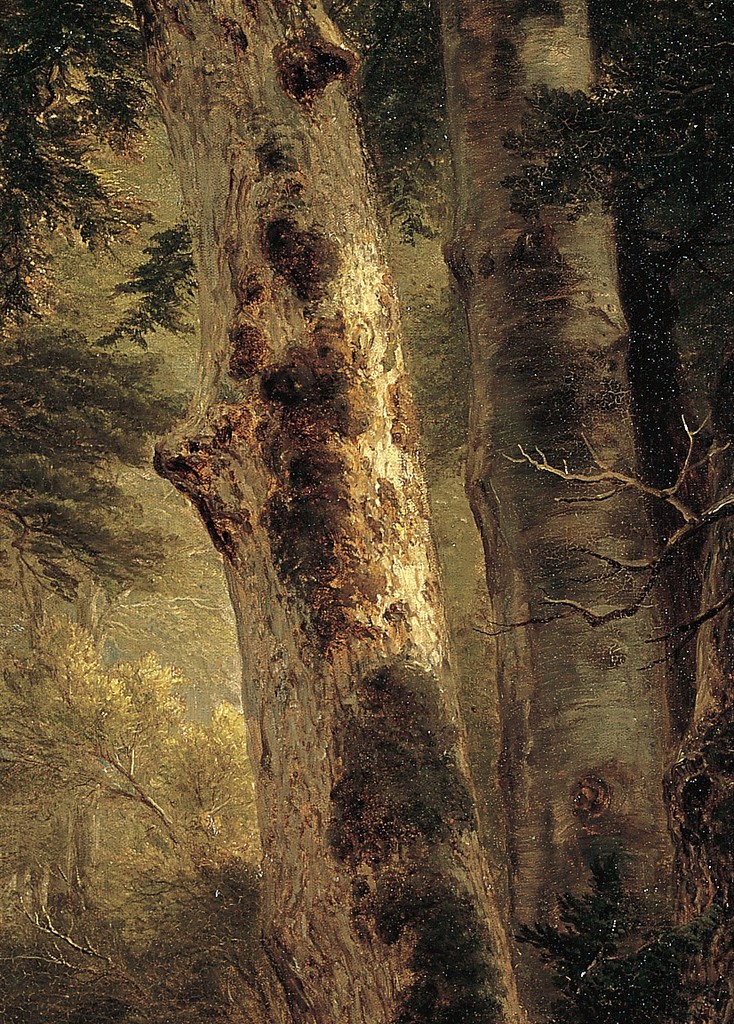
The two most conspicuous trees rise on either side of the foreground. At the left, a pale trunk leans inward, its upper part ending in broken growth. At the right, a thicker tree has a knotted, uneven surface and branches that reach overhead. Their differing shapes give the eye separate ways to travel upward into the canopy.
More trunks appear behind them, some almost vertical and others slanting. Their overlapping positions establish depth before the small distant opening is reached. A viewer sees the forest through intervals between individual trees, each interval leading to another group of forms.
Light is distributed unevenly. It catches part of the left trunk and small passages of foliage, while denser shade fills the upper right. Near surfaces can appear strongly defined, but other trees recede into a softer mass. This variation keeps the forest from becoming a simple row of equally emphatic objects.
The upright canvas supports the encounter with tall growth. At approximately a metre and a half high, it gives the near trunks considerable physical presence. The viewer’s attention can move from roots and fallen wood through branching forms to the small patches of sky that interrupt the canopy.
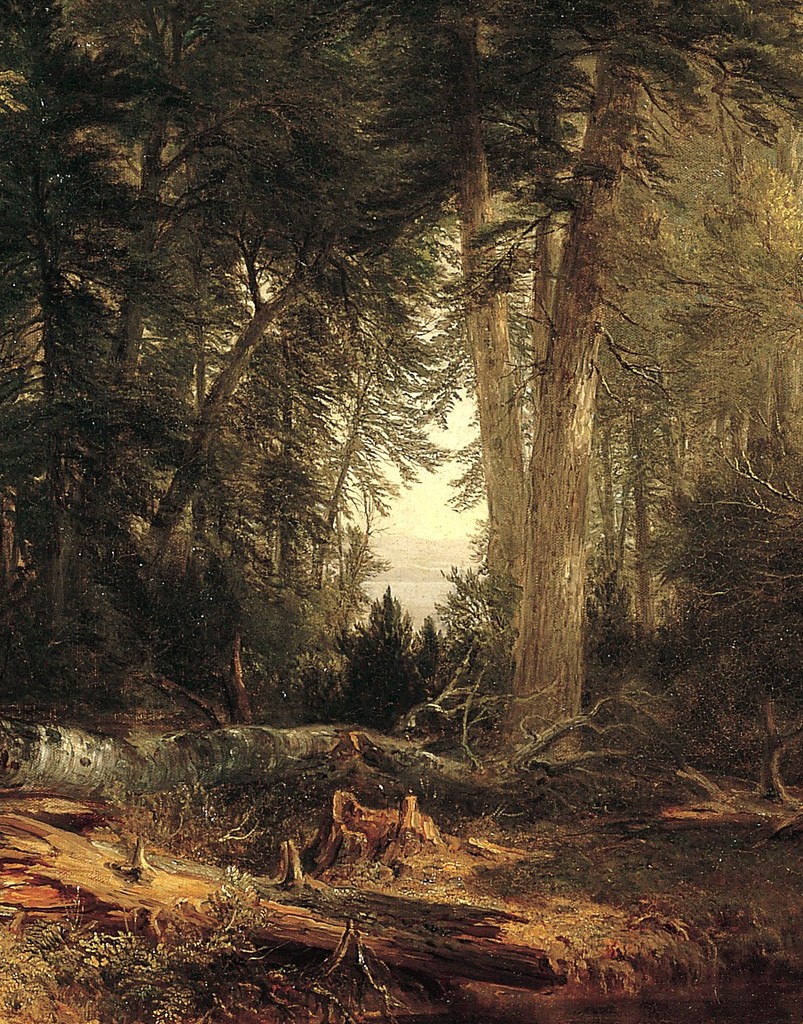
The composition also places an opening deep within this enclosure. Pale distance becomes visible beyond darker trees, giving the forest a direction without turning it into an unobstructed vista. Much of the picture’s interest remains close to the viewer, where bark, leaves, roots and water demand slower looking.
Annotated Details from In the Woods
The numbered points identify visible features discussed in this article. Return from each detail to the whole composition. Asher Brown Durand, In the Woods, 1855. Metropolitan Museum of Art, 95.13.1. Gift in memory of Jonathan Sturges by his children, 1895. The Metropolitan Museum of Art. Image source. CC0 / Public domain. Resized only; native appearance, complete carrier and margins preserved.
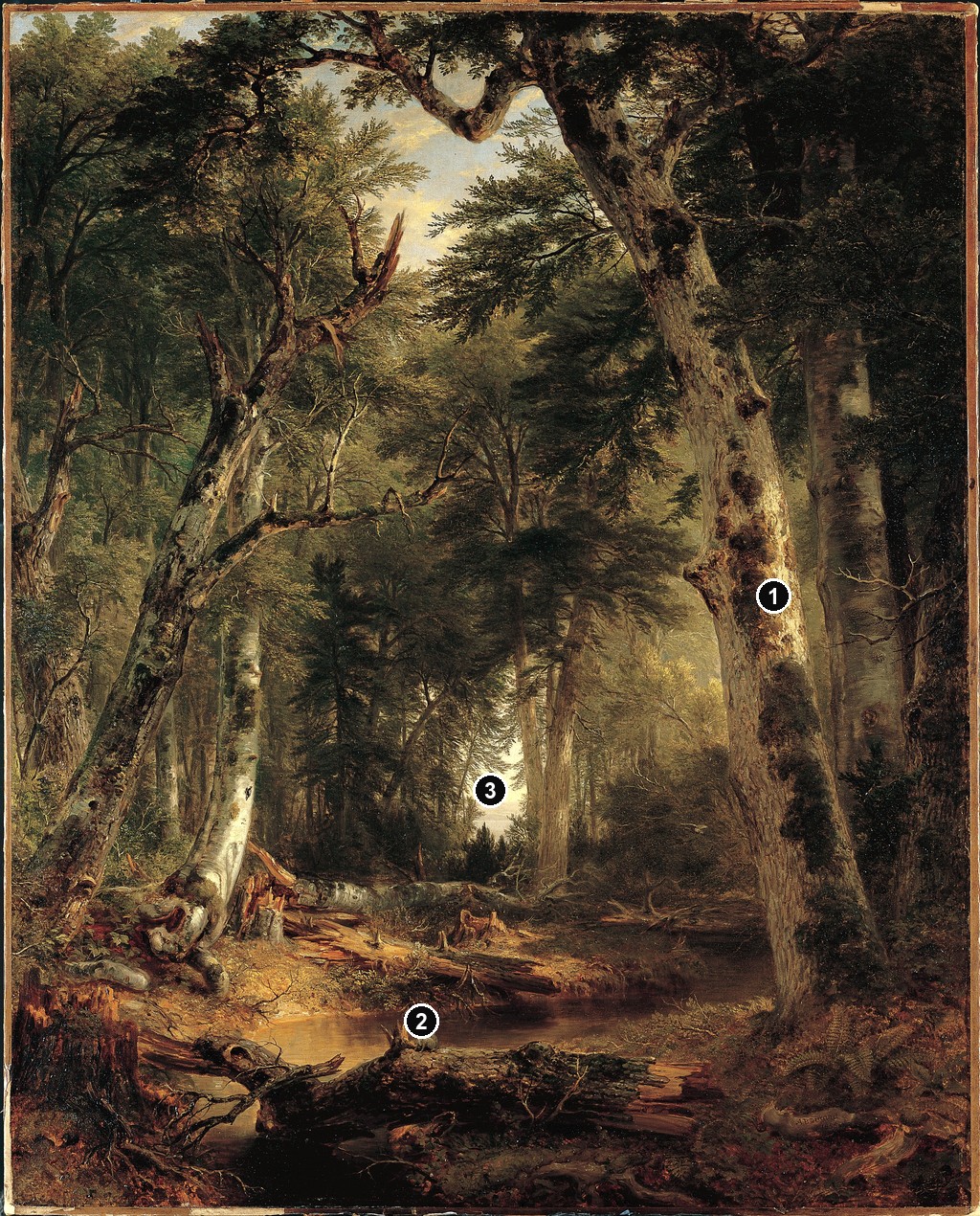
Details from IN THE WOODS
Compare the cropped details with the complete images above. Notice how their colours, shapes and positions contribute to the larger compositions.
Large right-hand trunk
The prominent right-hand trunk carries irregular bark and branching forms. Its scale helps enclose the forest interior.
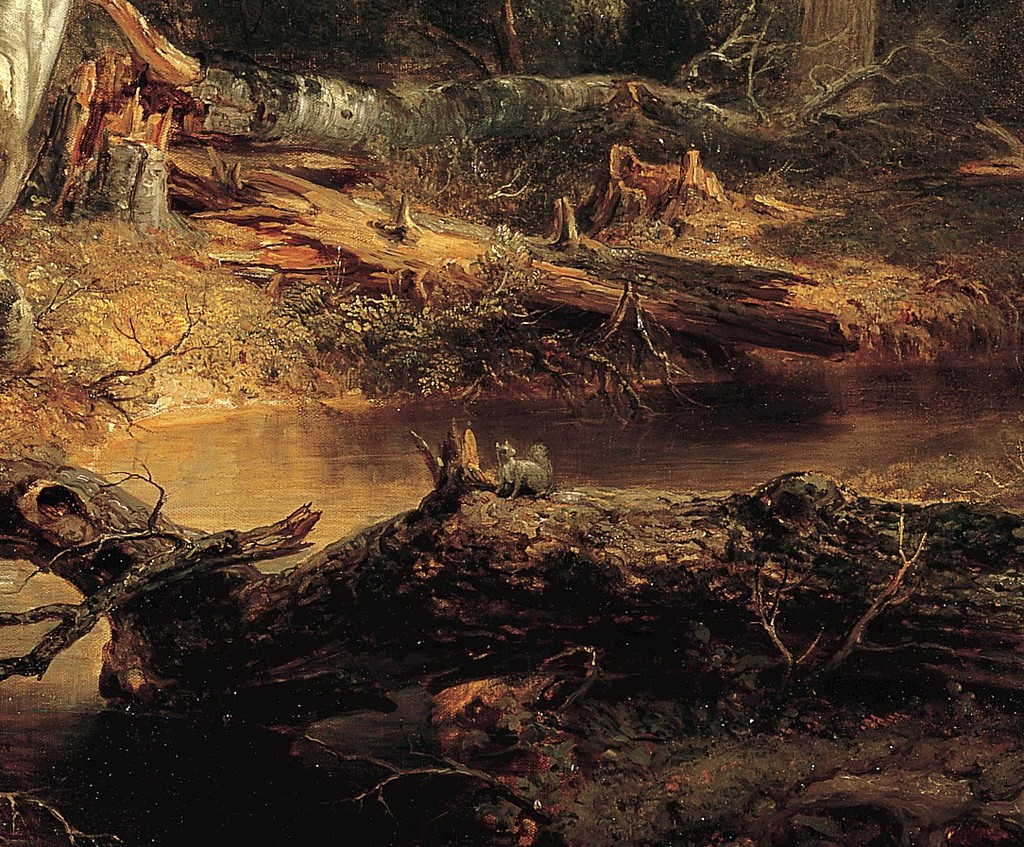
Fallen wood and near water
Fallen timber and broken stumps lie beside the foreground water. Their irregular forms contrast with the upright trunks.
A pale opening among the trees
A narrow pale opening appears beyond the nearer trunks and foliage. It draws attention into a forest that otherwise remains densely enclosed.
Water, fallen wood and the foreground
A shallow stream crosses the lower part of the painting. Its lit surface is broken by darker banks and pieces of wood. At the left, a pale fallen trunk runs across the ground toward the water; nearer the lower edge, another dark, rough form lies partly across the viewer’s route.
These objects affect how the space can be imagined. The forest floor offers interruptions rather than a smooth path. A viewer who mentally enters the scene must attend to where water and timber divide the ground. The encounter is local and gradual, shaped by objects near the feet.
Fallen wood supplies a different set of textures from standing trees. Broken ends, dark hollows and exposed surfaces interrupt the more continuous lines of living trunks. Small plants grow close to this material, joining the larger structures of the forest to the irregular ground beneath them.
The stream gives those near objects a shared place. Reflections and small bright passages connect its different reaches, while the banks allow attention to move from one side of the painting to the other. Looking along the water is a way of navigating the image, even where the ground itself seems difficult to cross.
No human figure directs that movement. The viewer’s own attention takes on the task usually offered by a shepherd, traveller or pair of spectators in other Durand landscapes. Near wood can hold the eye, and the distant light can draw it onward, without an imagined person telling us which route to choose.
Sketches, the 1855 exhibition and Sturges
The Met relates the finished painting to outdoor sketches Durand made in the Catskill Mountains during the summer of 1854. It also records the canvas’s appearance at the National Academy of Design in 1855, the year his Letters on Landscape Painting were published.[1]
The relationship between sketch and canvas is important to its apparent closeness. Outdoor observation could supply the shapes of trees and the character of woodland light, while the large finished picture organised them into an interior with an entrance, near obstacles and a farther opening. The public work gives that close material a sustained arrangement.
Jonathan Sturges was its patron. In his later memoir, John Durand recounts an additional payment of two hundred dollars sent by Sturges two years after the painting was made. The accompanying note joked that the painted trees had grown in value since 1855.[3]
This retrospective account records a continuing relationship between the painter and the owner. It also gives the trees a memorable place in the painting’s reception: they could remain a source of enjoyment after purchase. The anecdote should be understood through John’s published testimony rather than as a newly consulted original letter.
The subsequent museum credit preserves Sturges’s name in a different way. His children gave the painting to the Met in his memory in 1895. The original commission and the later memorial gift are separate stages in the object’s history.[1]
A forest understood as a place of devotion
Rebecca Bedell’s MAVCOR essay interprets the canvas as a temple of nature. She relates the leaning foreground trees and overhead branches to an arched entrance and a cathedral canopy, with the distant light providing a further spiritual association. She also reads living and dead trees, decay and new growth in relation to mortality and renewal.[2]
This reading brings a language of devotion to the physical arrangement of the forest. The opening beyond the trees acquires significance partly because it is seen through an enclosed, interrupted space. Fallen trunks and small plants keep the viewer’s attention on changing material forms at the same time.
The interpretation does not require every visible object to have one fixed symbolic meaning. It offers a way to consider the whole experience: entering shade, pausing at near details and looking toward a brighter distance. The canvas’s organisation can support that experience before a viewer knows the religious language associated with it.
The distinction between image and interpretation remains useful. We can observe the trees, water and far opening directly. Bedell’s account supplies a historically informed way of connecting those relationships with Durand’s devotional understanding of nature. It expands the visual encounter while making its argument available for the reader to assess.
Watch: Asher Brown Durand
Choose a film to explore the artist’s work, its interpretation and its wider setting.
Friendship and landscape, Asher B Durand's Kindred Spirits
Smarthistory and Crystal Bridges discuss friendship, memory and landscape in Kindred Spirits.
Watch on YouTubeThe letters and looking into a landscape
Durand’s fourth Letter on Landscape Painting, published in 1855, imagines a person at home with pictures that bring remembered country life into the room. He asks the viewer to “look into the picture instead of on it.” The phrase turns looking into a mental encounter with a represented place.[4]
The advice is especially suggestive beside In the Woods. Its near trunks and lower stream create an entrance, while overlapping growth prevents an immediate view of everything beyond. Attention proceeds through the space in stages. A viewer can imagine shade, pauses and changing distance through the arrangement of painted forms.
The letter discusses the ends of landscape art as well as its subjects. Durand considers the associations that an image can awaken in someone who remembers country life. The represented place becomes companionable through that person’s experience. His argument extends the significance of landscape beyond the recognition of a particular tree or location.[4]
The painting and the letter belong to the same year, but they perform different tasks. A written account explains the experience Durand valued; the canvas makes a forest available to sustained looking. Their relationship helps clarify his ambitions without proving that every passage of the painting illustrates a specific sentence.
For the wider series, see Durand’s Letters on Landscape Painting. Its advice to an imagined learner brings observation, selection and artistic purpose into a continuing discussion of how landscapes are made and experienced.
Trees as substantial subjects
Roberta J. M. Olson’s study of Durand’s trees examines their importance across drawings and paintings. She considers his detailed attention to individual growth and the spiritual significance he attached to natural forms. This scholarship gives the large trees here a place within a sustained artistic concern.[5]
In the canvas, the trees do much more than mark the edges of a distant view. Their surfaces and branching occupy the central experience. Small differences in angle, bark, light and surrounding growth give the viewer a succession of things to notice within one enclosed setting.
Such attention is compatible with composition. The painting selects a point of entry and distributes its strongest pale accents, darker masses and opening distance. The trees can be individually convincing while their positions help organise the whole. Close observation and larger arrangement work together in directing the viewer’s experience.
Other woodland paintings with separate histories
Bedell discusses the Reverend Elias Magoon’s response to a different forest interior, Through the Woods, dated 1856 and associated with Vassar. His cathedral comparison belongs to that picture. It is useful context for reception of Durand’s woodland scenes, while the Met’s In the Woods remains the separate 1855 canvas.[2]
The distinction matters because a similar title can encourage the transfer of a letter, patron or date from one object to another. Here, the Met accession 95.13.1 and its Sturges family credit identify the painting under discussion. A related response can broaden the context without becoming its own documented reception.
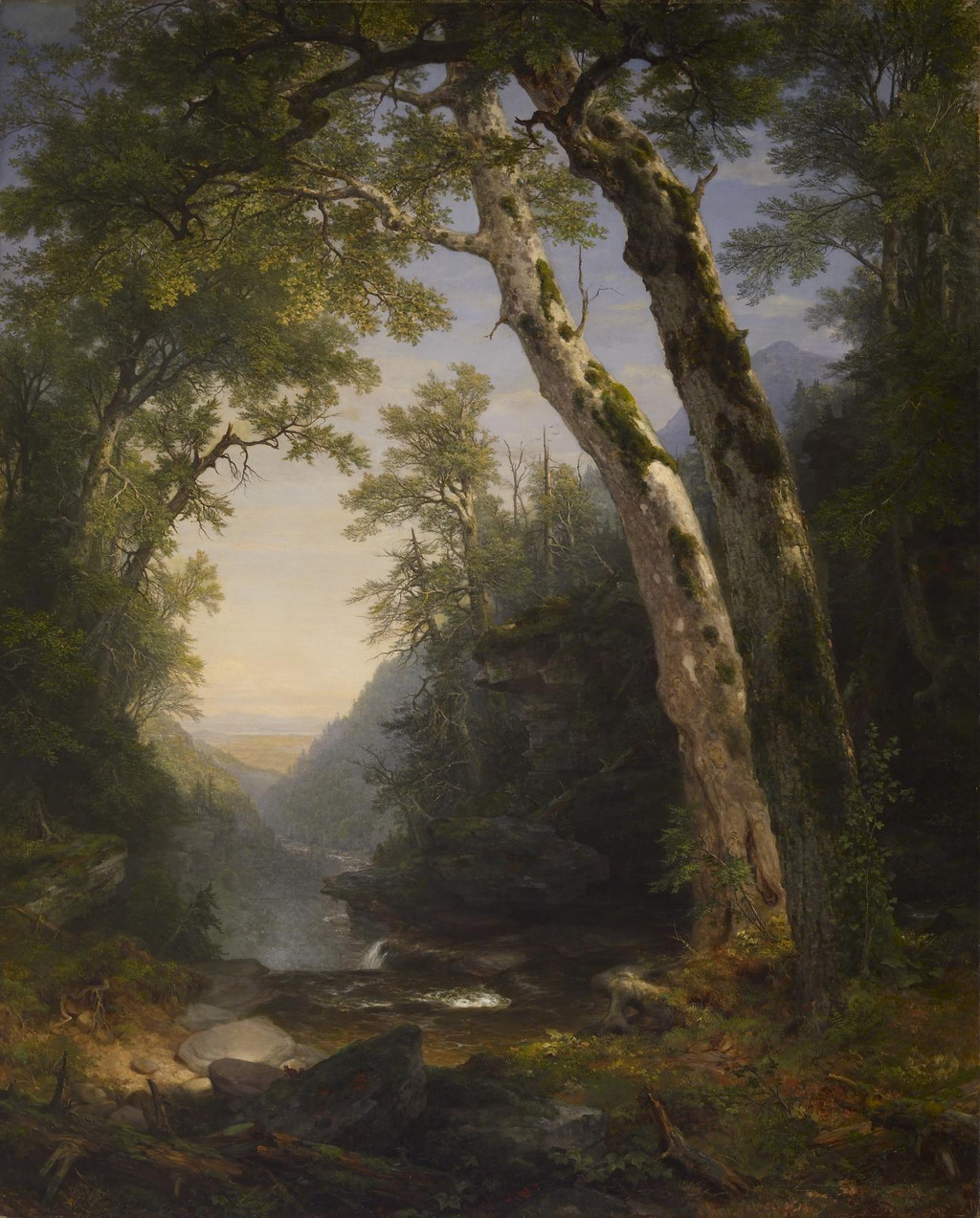
The Beeches, 1845, provides an earlier comparison. The Met catalogue links that work to outdoor study and a Constable model. Its shepherd and flock travel on a road toward a bright pastoral opening, giving human activity a clear route through the trees.[6]
In In the Woods, fallen timber and water make the viewer’s imagined progress less direct. The absence of a shepherd and flock keeps the encounter concentrated on the forest’s own structures. The difference concerns how a person is invited to experience the space, even though both paintings give foreground trees a substantial presence.
The Thyssen Museum’s A Creek in the Woods, 1865, is another distinct object. Its collection essay considers Durand’s wooded landscapes and his relationship to European pastoral models. The later painting offers a further comparison within a career that returned repeatedly to trees and water.[7]
These separate works make a continuing artistic question visible: how can a landscape lead us beyond its surface while retaining the individual character of its near forms? The Met’s 1855 canvas answers through an enclosed space whose fallen wood, leaning trunks and farther light give looking a deliberately gradual course.
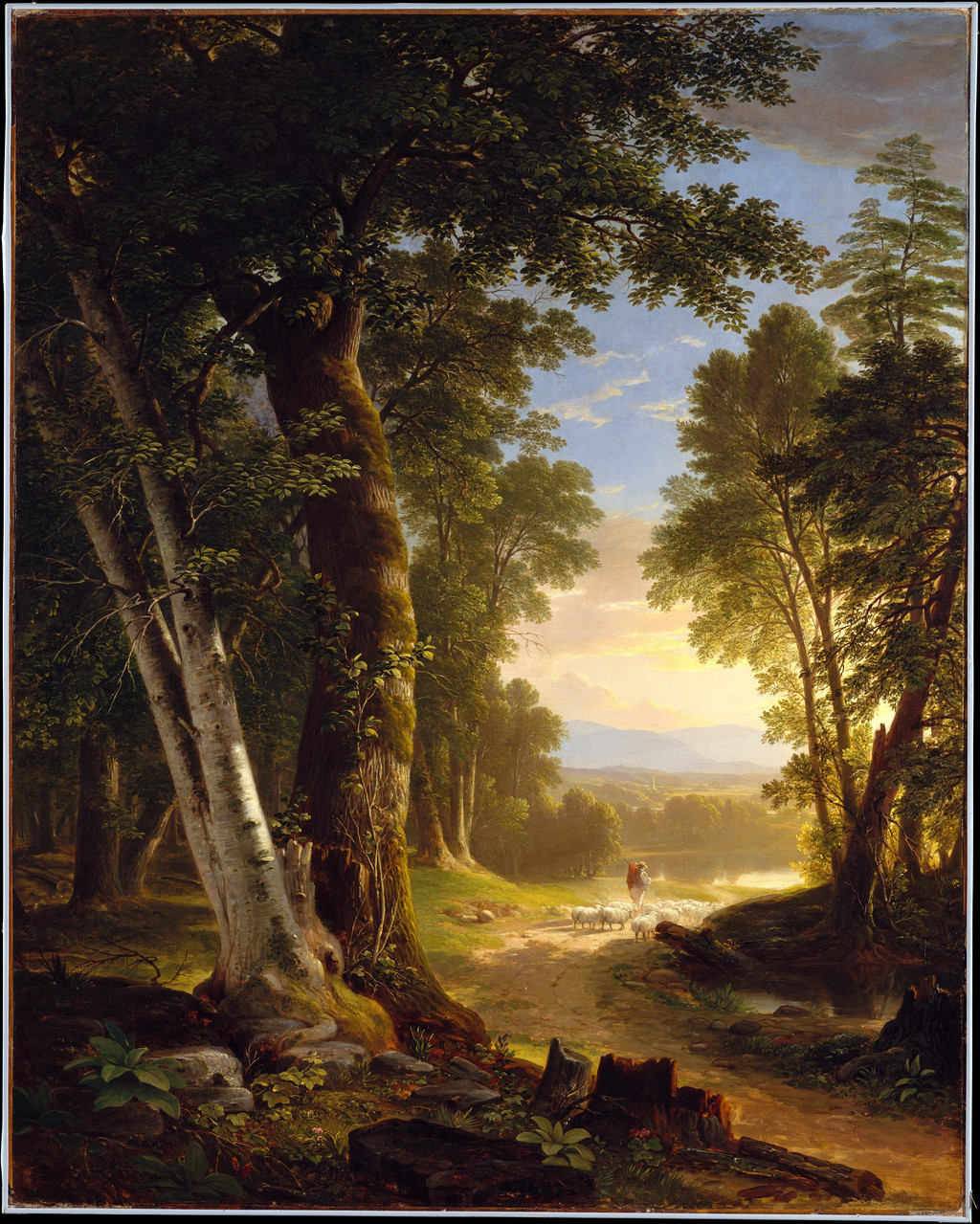
Asher Brown Durand, The Beeches, 1845. Oil on canvas. Metropolitan Museum of Art, 15.30.59. An earlier tree-focused composition with a shepherd and flock. The Metropolitan Museum of Art. Image source. CC0 / Public domain. Resized only; native appearance, complete carrier and margins preserved.
Artworks directory
A collected selection of 19 individually identified paintings, prints and a graphite study, including fifteen dedicated artwork articles. This directory is not a complete catalogue raisonné. Links lead to a companion article where available, otherwise the consulted institutional record. Progress is identified by title, date and museum; an unverified accession is omitted. Unillustrated objects remain searchable.
Frequently Asked Questions
Discussion
Look again at the images and ideas explored in In the Woods by Asher Brown Durand. These editorial prompts invite your observations.
Reader Insights
Where would you pause first if you imagined entering this forest?
How do the fallen trunks change your movement toward the distant light?
What does the comparison with *The Beeches* reveal about the role of human figures?
Join the Conversation
Share a detail, comparison or question about In the Woods by Asher Brown Durand below.
References
- Metropolitan Museum of Art, In the Woods, accession 95.13.1. Complete current record and narrative consulted: 1854 sketches, 1855 date and exhibition, dimensions and 1895 family gift. View source
- Rebecca Bedell, “Asher Durand, In the Woods,” MAVCOR (2014). Full main essay and notes consulted. DOI 10.22332/con.obj.2014.19. Forest-cathedral interpretation and separate Vassar/Magoon context attributed to the scholar. View source
- John Durand, The Life and Times of A. B. Durand (1894). Selected chapters consulted; printed p.175 recounts the Sturges commission and subsequent payment. Original note not separately consulted. View source
- Asher B. Durand, Letters on Landscape Painting, Letter IV, 1855, consulted facsimile reprint, printed pp.238–239. All four scan pages actually displayed and read; quotation confirmed on printed p.239. Original publication: The Crayon 1, 14 February 1855, pp.97–98. Nineteenth-century text quoted; modern layout not reproduced. View source
- Roberta J. M. Olson, “‘A Magnificent Obsession’: Durand’s Trees as Spiritual Sentinels of Nature,” in The American Landscapes of Asher B. Durand (2010). Printed pp.151–158 main essay and notes, with selected captions, actually consulted. Original paraphrase; modern plates not reproduced. View source
- Metropolitan Museum of Art, The Beeches, American Paintings in The Metropolitan Museum of Art, volume I, printed pp.414,416. Both supplied scans actually consulted; exact 1845 comparison, study and compositional model. View source
- Paloma Alarcó, A Creek in the Woods, Museo Nacional Thyssen-Bornemisza. Complete accessible 1865 object entry and essay consulted. Text comparison only; restricted institutional image unused. View source
- Splash image source.
Asher Brown Durand, In the Woods, 1855. Oil on canvas, 154.3 × 121.9 cm. Metropolitan Museum of Art, 95.13.1. Gift in memory of Jonathan Sturges by his children, 1895. The Metropolitan Museum of Art. CC0 / Public domain. Resized only; native appearance, complete carrier and margins preserved.
View source