


 by Tom Gurney
Tom Gurney BSc (Hons) is an art history expert with over 20 years experience
Email: tomgurney1@gmail.com / Phone: +44 7429 011000
Martin Johnson Heade: Introduction
Martin Johnson Heade (1819–1904) painted salt marshes, coastal storms, hummingbirds, orchids and magnolias. These subjects can initially seem to belong to different artists. Their connections become clearer through his attention to light, carefully balanced forms and the meeting of close detail with broad space. A long life of travel and changing residence supplied new material, while earlier subjects remained active. His career is best explored through those overlaps rather than a simple progression from landscape to flowers.[1][2]
At a Glance
- Life1819–1904; born in Lumberville, Pennsylvania
- Early professionPortrait painting, followed by expanding landscape and still-life interests
- New York circleFriendship with Frederic Edwin Church
- Brazil1863–64; intended The Gems of Brazil publication
- Later tropical journeysNicaragua, Colombia, Panama and Jamaica
- FloridaSt. Augustine residence and marriage to Elizabeth Smith in 1883
- PatronHenry Morrison Flagler
- Writing identityDidymus, in Forest and Stream
- Principal subjects hereMarshes, weather, tropical compositions and cut flowers
Martin Johnson Heade in context
Bars show approximate historical periods. c. means circa (about).
Notes and sources
Hudson River School. Cole’s New York arrival and the Centennial frame this broad comparison. Kevin J. Avery, Metropolitan Museum of Art.
Luminism. c.1850–1875; later critical term. A later category for selected light and surface effects, rather than an organisation Heade joined. The period follows the American Light study cited by Porter. Charlotte M. Porter, Florida Museum.
Each bar runs from the artist’s birth to their death.
Asher Brown Durand
1796–1886 · Birth–death [21]Thomas Cole
1801–1848 · Birth–death [22]Martin Johnson Heade
1819–1904 · Birth–death [23]Frederic Edwin Church
1826–1900 · Birth–death [24]Notes and sources
Asher Brown Durand. Calendar comparison; separate documented relationships are described in the connections cards. Metropolitan Museum of Art.
Sudden Shower, Newbury Marshes
c.1865–75View of Marshfield
c.1866–76Hummingbird and Passionflowers
c.1875–85Newburyport Meadows
c.1876–81Magnolias on Light Blue Velvet Cloth
c.1885–95Contents
- Several centres of attention
- Marshes as working coastal landscapes
- Storm, light and the edge of the sea
- Birds, flowers and tropical travel
- Close subjects within broad space
- Scale and the red passionflowers
- Flowers before and after Florida
- Florida residence, patronage and writing
- Friendship, observation and individual choices
- Annotated details
Several centres of attention
Heade’s broad interests developed within one working life. Early portraits led into landscape experimentation by the mid-1850s. Still lifes appeared by the early 1860s, before the first Brazilian journey and long before permanent Florida residence. Landscapes, birds and flowers subsequently continued beside one another.[1][3]
This overlap helps explain why one label can feel incomplete. Heade knew artists associated with the Hudson River School, yet many of his marshes give space to level terrain rather than imposing mountains. His tropical images could be intimate, and cut magnolias belong to an interior world of flowers, fabric and shadow.
Luminism is a later critical term often used to discuss his light and clear surfaces. It can illuminate particular effects, but it does not describe an organisation he formally joined. Nor should the suggestion of stillness erase the variety of brushwork and revision found through technical examination.[8]
The biography follows the changing circumstances behind these interests. The paintings offer another route: begin with their different kinds of space, then consider the decisions that connect them.
Four stages of Martin Johnson Heade’s career
These periods group related developments; painting, travel and local work overlap across their boundaries.
Early training, exhibitions and travel
Qualified instruction in Pennsylvania, portrait exhibitions in 1841 and 1843, European travel and changing residence preceded the expanded landscape practice. [1]
Coastal weather and an intended bird book
New York friendships, coastal painting and the 1863–64 Brazilian journey brought broad marine views beside the small pictures intended for The Gems of Brazil. [1]
Marshes, birds and flowers together
Journeys through Central America and the Caribbean continued alongside marshes, early floral arrangements and later bird-and-orchid compositions. [5]
Residence, patronage and later writing
Marriage to Elizabeth Smith and permanent Florida residence in 1883 introduced greater stability, Flagler’s support, cut magnolias and continuing landscape and tropical subjects. [1]
Annotated Details from Martin Johnson Heade
The numbered points identify visible features discussed in this article. Return from each detail to the whole composition. The captions keep each work’s identity, date and medium separate.
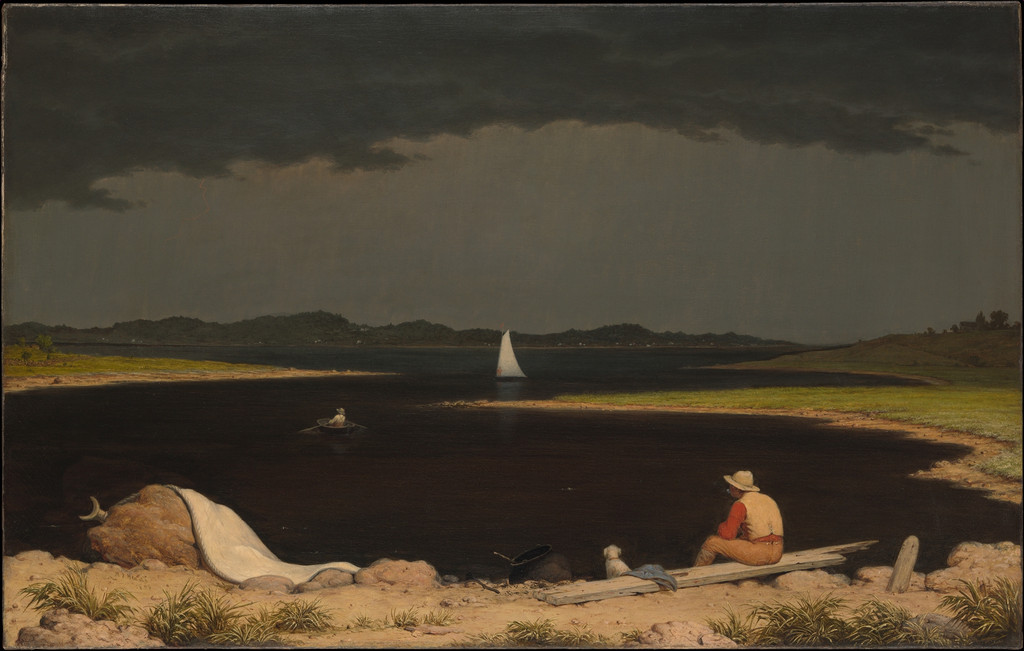
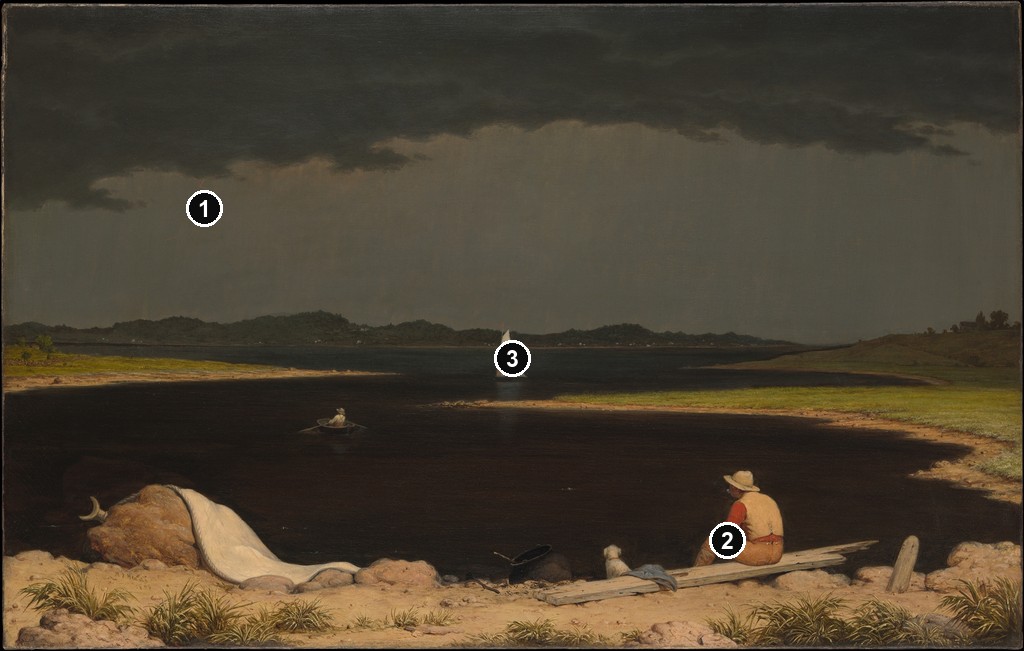
Approaching Thunder Storm
Martin Johnson Heade, Approaching Thunder Storm, 1859. Metropolitan Museum of Art, 1975.160. Image source. CC0 / Public domain. Resized only; native appearance preserved.
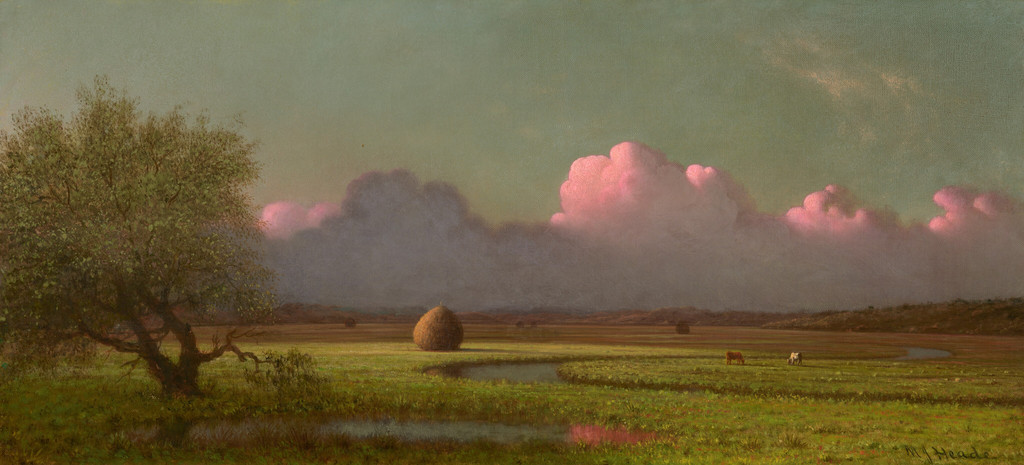
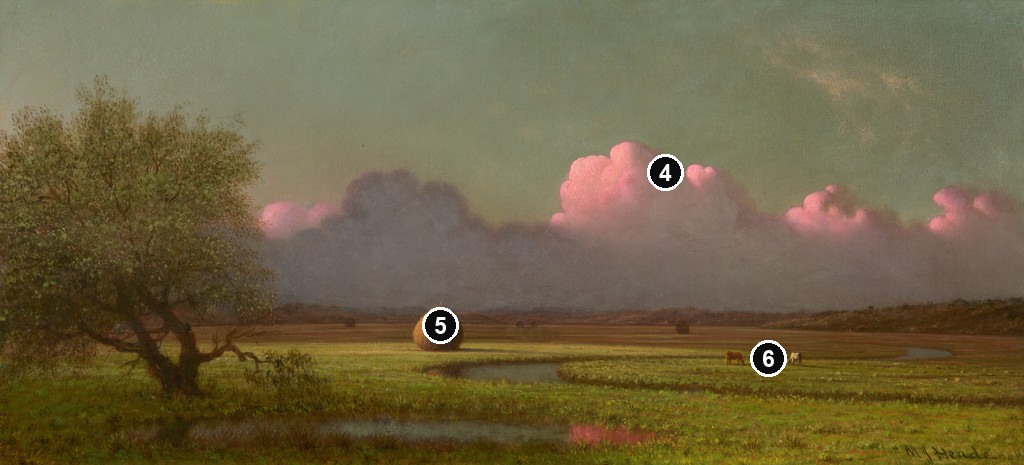
Sunlight and Shadow, The Newbury Marshes
Martin Johnson Heade, Sunlight and Shadow: The Newbury Marshes, c.1871–75. National Gallery of Art, 2010.74.1. John Wilmerding Collection; National Gallery of Art. Image source. CC0 / Public domain. Resized only; native appearance preserved.
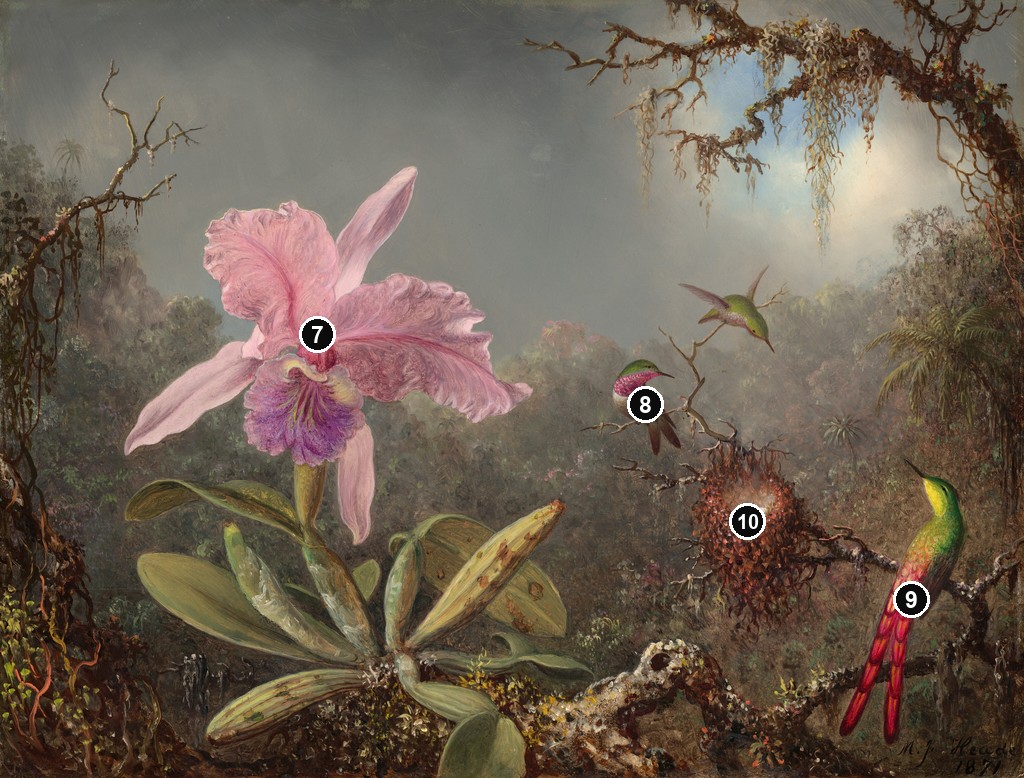
Cattleya Orchid and Three Hummingbirds
Martin Johnson Heade, Cattleya Orchid and Three Hummingbirds, 1871. Oil on wood. National Gallery of Art, 1982.73.1. Image source. CC0 / Public domain. Resized only; native appearance preserved.
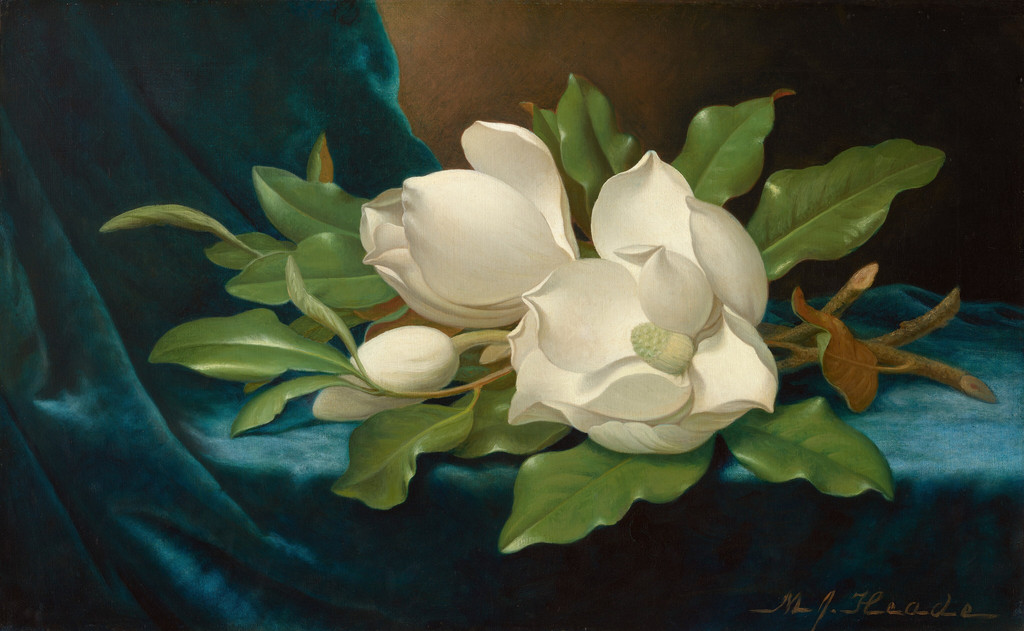
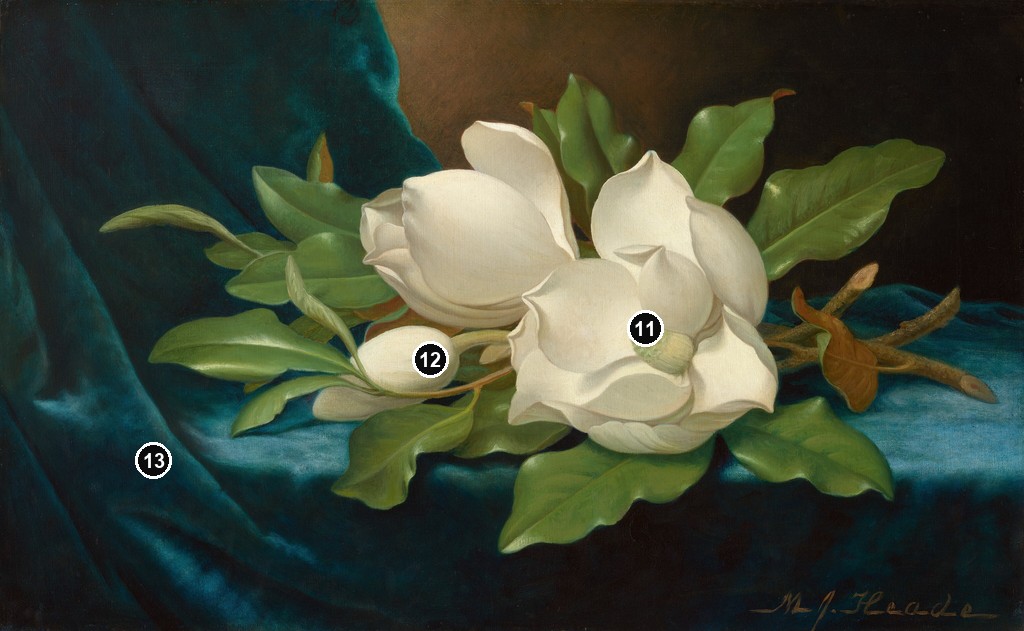
Giant Magnolias on a Blue Velvet Cloth
Martin Johnson Heade, Giant Magnolias on a Blue Velvet Cloth, c.1890. Oil on canvas, 38.4 × 61.5 cm. National Gallery of Art, 1996.14.1. Gift of The Circle of the National Gallery of Art in Commemoration of its 10th Anniversary; National Gallery of Art. Image source. CC0 / Public domain. Resized only; native appearance preserved.
Details from MARTIN JOHNSON HEADE
Compare the cropped details with the complete images above. Notice how their colours, shapes and positions contribute to the larger compositions.
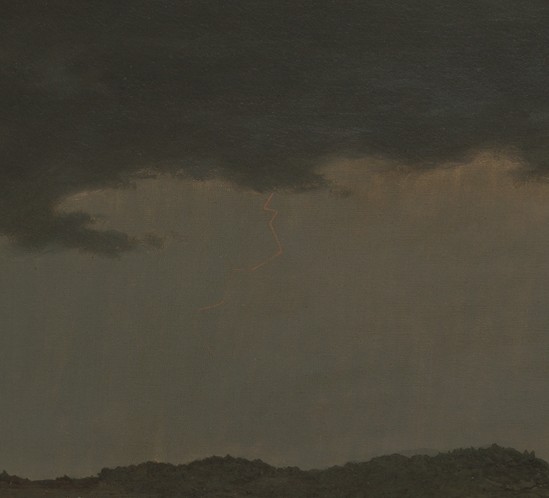
Approaching Thunder Storm
Lightning under the cloud
A narrow reddish zigzag descends beneath the dark cloud. Its slight scale contrasts with the much larger storm canopy.
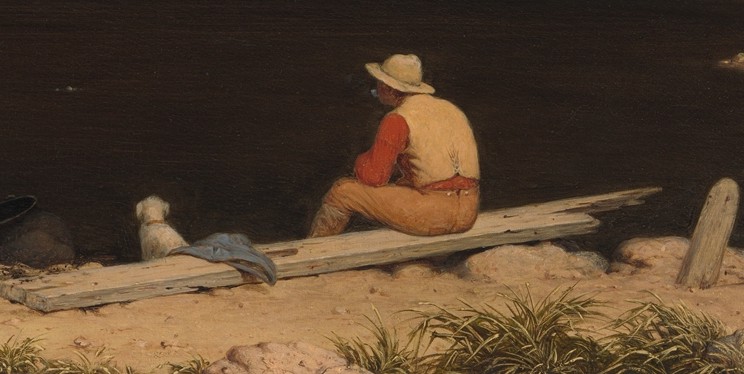
Seated shore figure
A red-sleeved figure sits on timber beside a dog and fishing equipment. These near forms establish a human scale for the broad water.
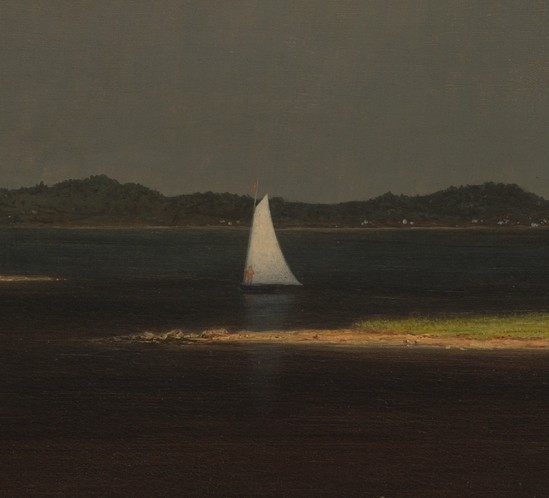
Pale central sail
A pale sail rises from the dark water beneath the distant shore. Its small light shape draws attention into the middle distance.
Sunlight and Shadow, The Newbury Marshes
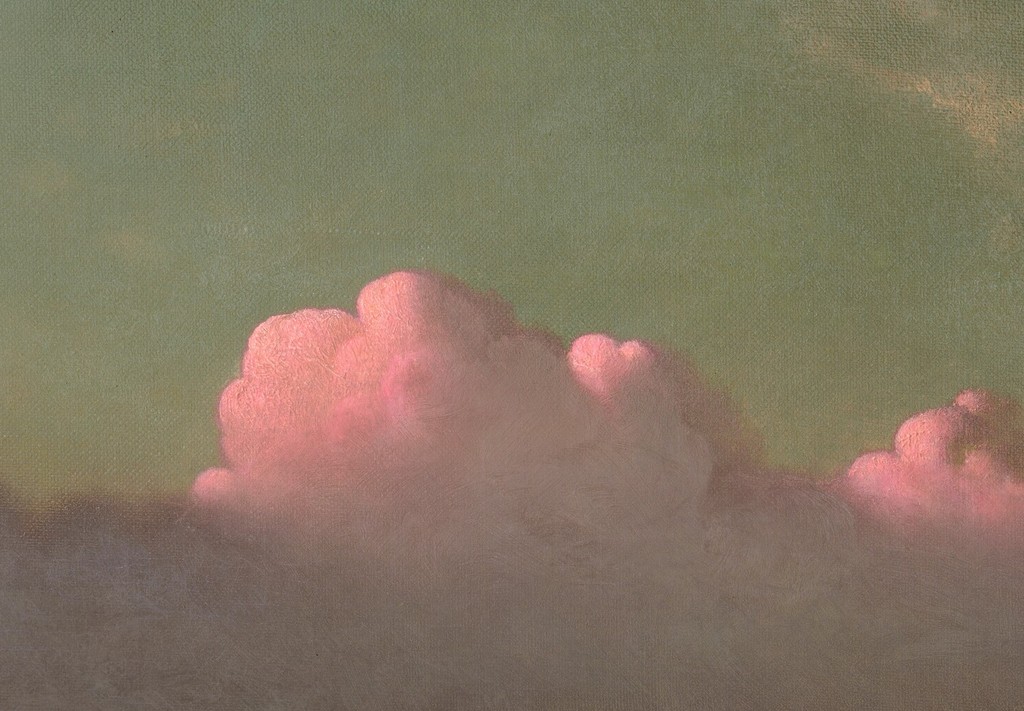
Pink-lit clouds
Pink highlights distinguish the upper cloud edges from the grey masses beneath. Compare their light with the quieter sky above.
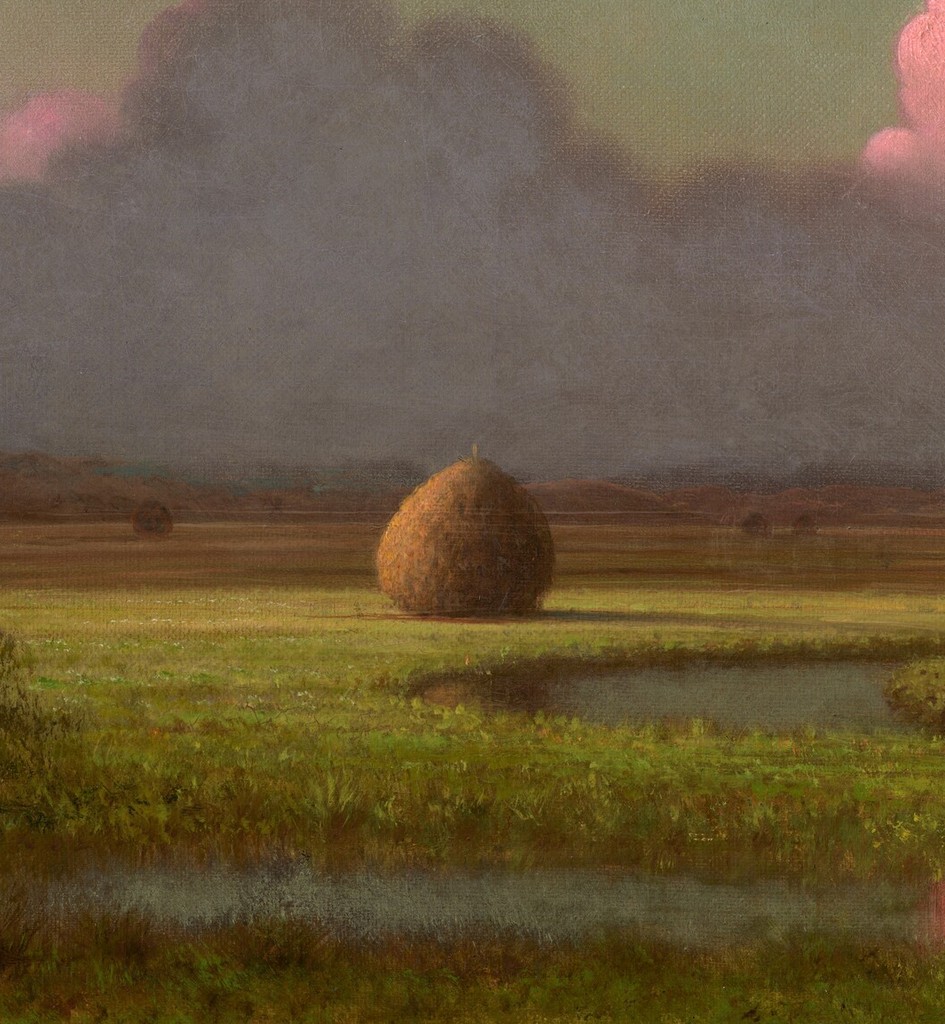
Haystack beside the water
A rounded haystack stands beside a winding water channel. The warm stack and cooler water interrupt the level green marsh.
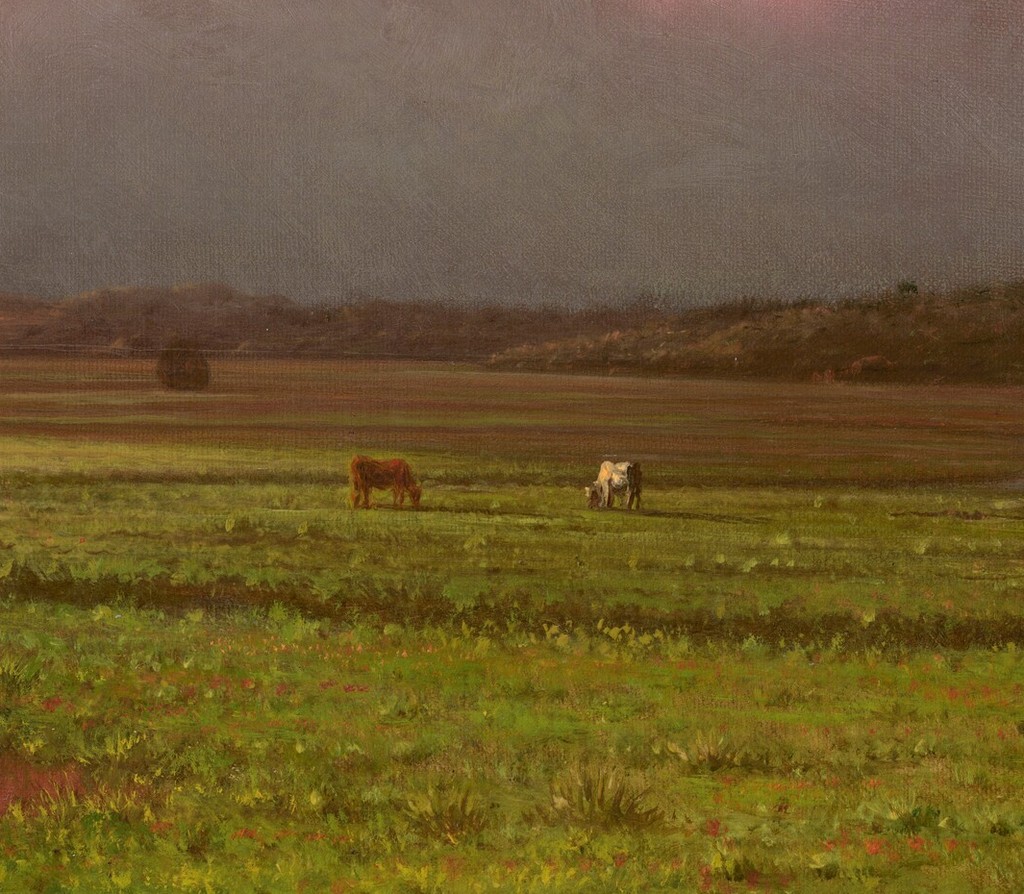
Grazing cattle
Two small cattle occupy the right-hand marsh. Their dark and pale bodies supply points of recognition within the extensive field.
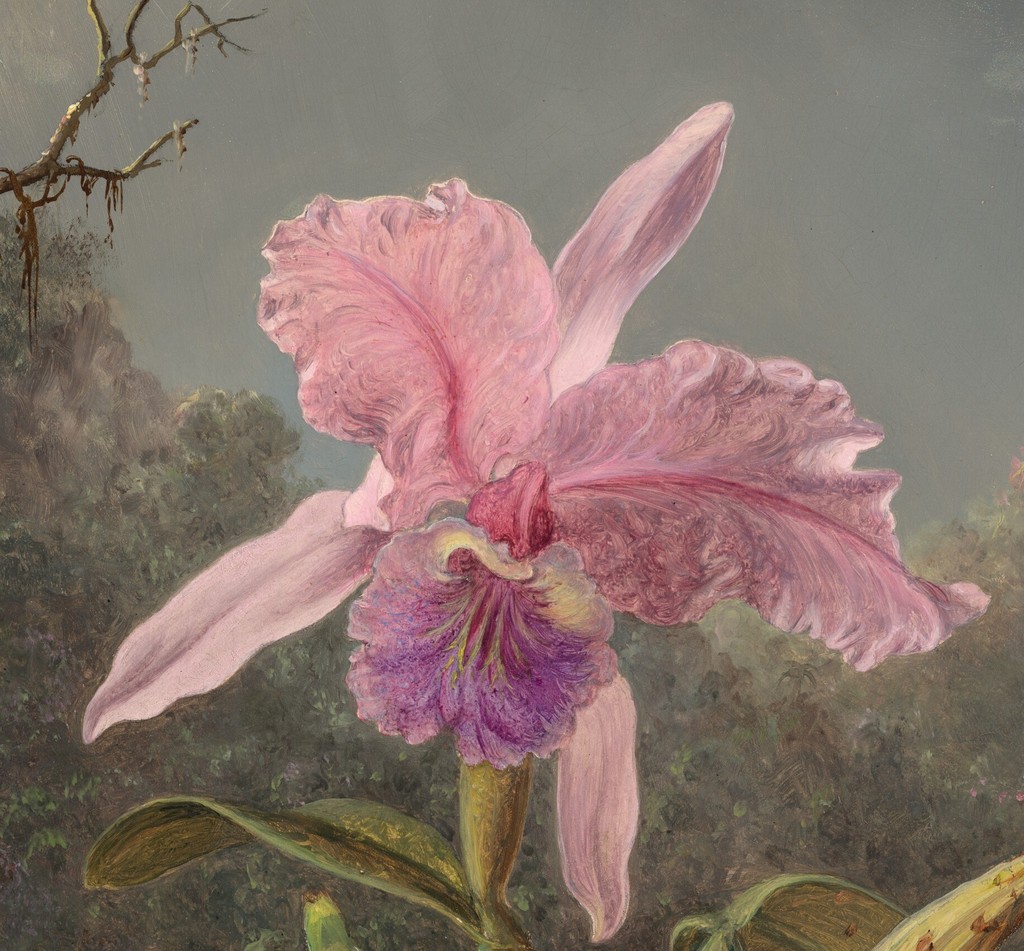
Cattleya Orchid and Three Hummingbirds
Large orchid bloom
Pink and purple folds spread around the orchid’s darker centre. Its large scale establishes a foreground distinct from the hazier woodland.
Perched bird
A green bird with a bright throat sits on a slender branch. Its stationary posture differs from the bird in flight above.
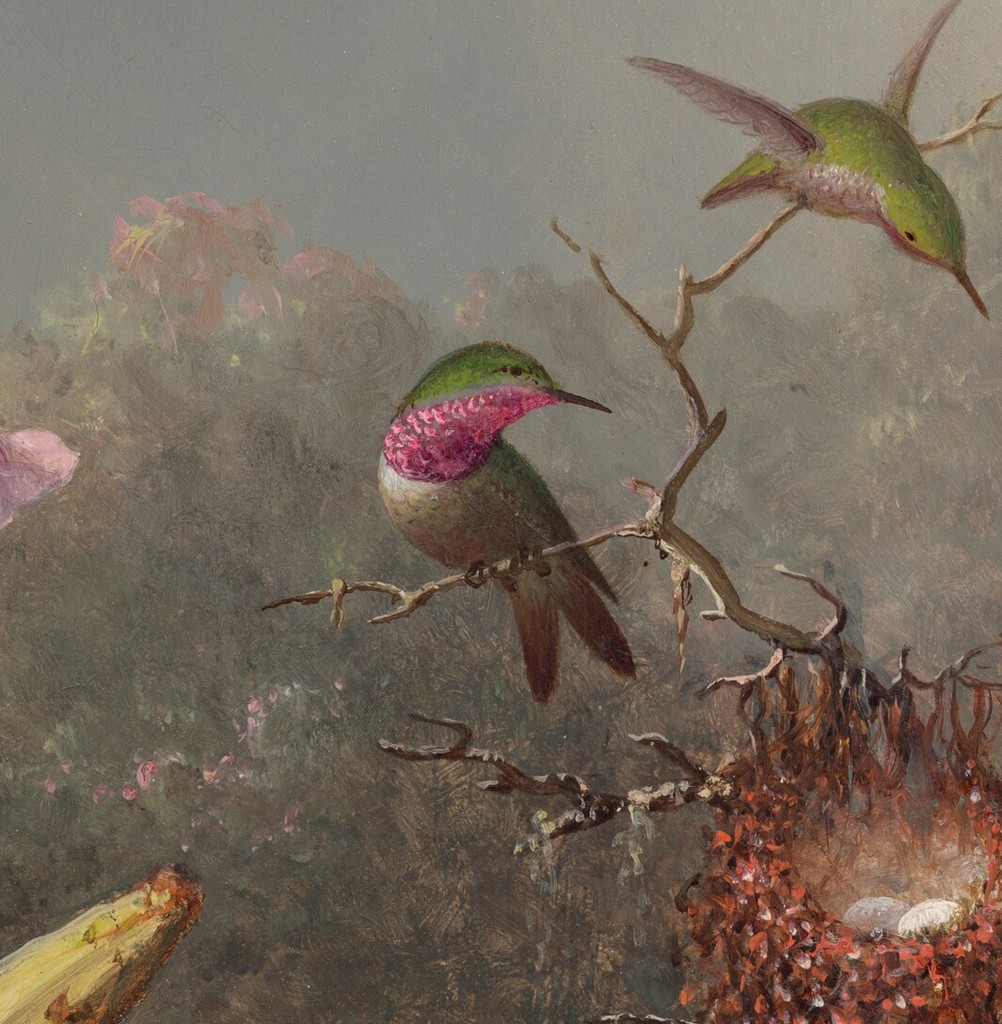
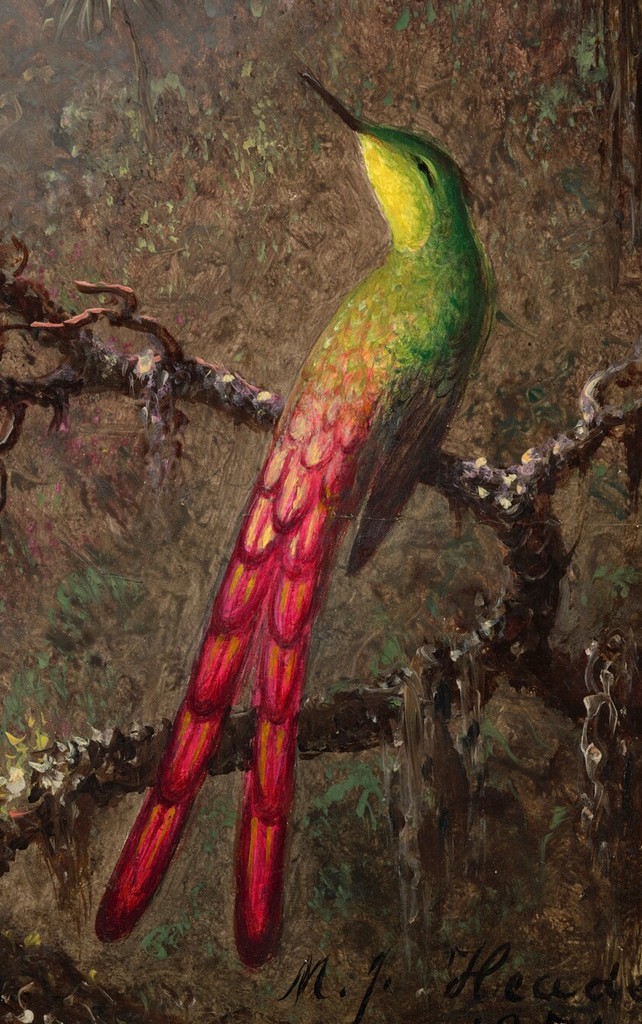
Long-tailed lower bird
The lower bird has a bright green neck and long red tail feathers. Its upright form balances the large orchid at the left.
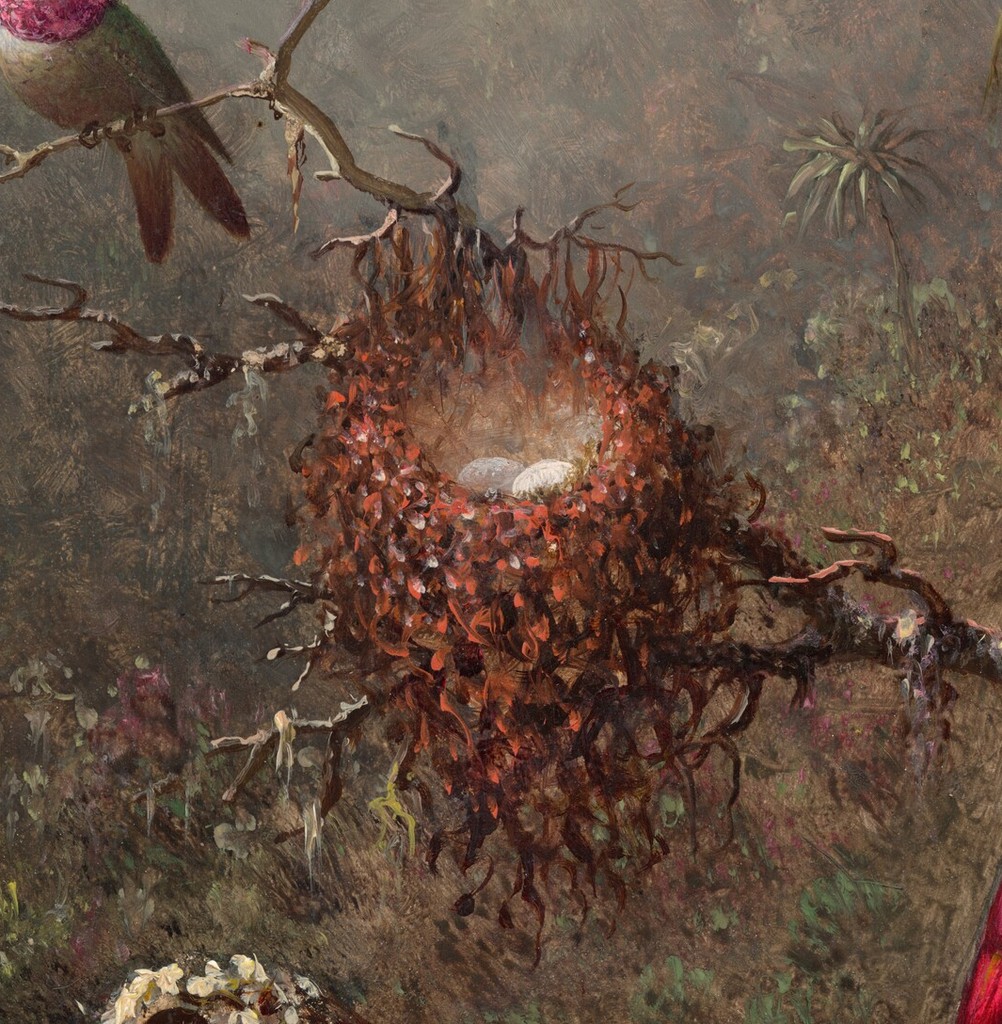
Nest among the branches
A small nest rests amid tangled branching below the perched bird. The pale forms inside remain distinct from the surrounding darker material.
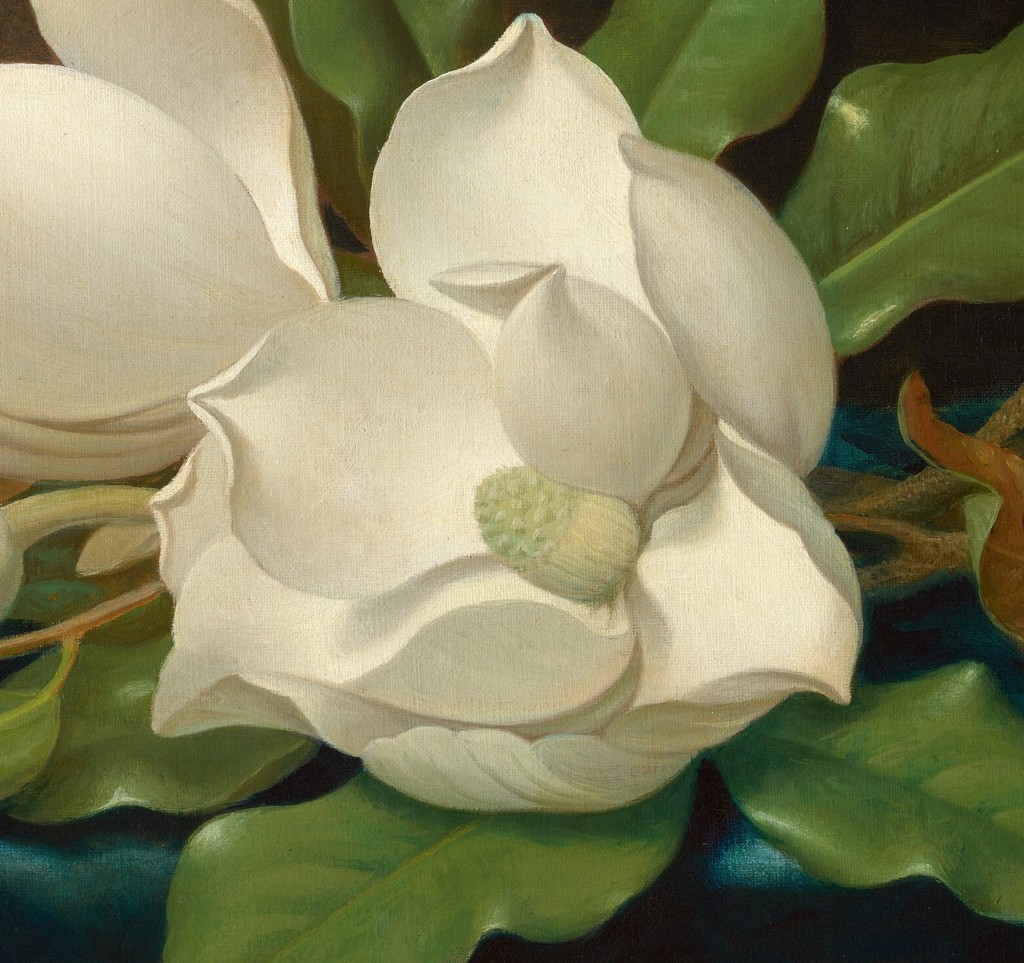
Giant Magnolias on a Blue Velvet Cloth
Open magnolia centre
Pale petals surround the greenish centre of the open foreground magnolia. Their overlapping curves create depth within the bright flower.
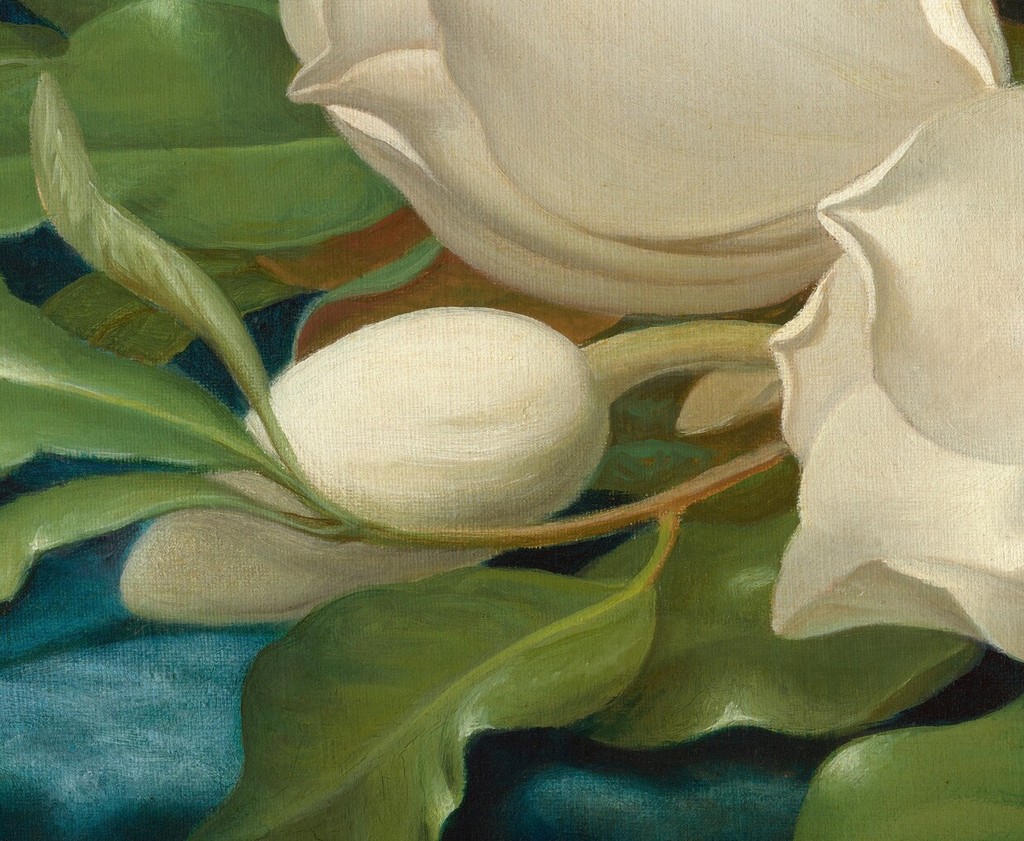
Closed bud and leaves
A closed pale bud lies beside broader green leaves. Its rounded surface contrasts with the more open petals above.
Blue cloth folds
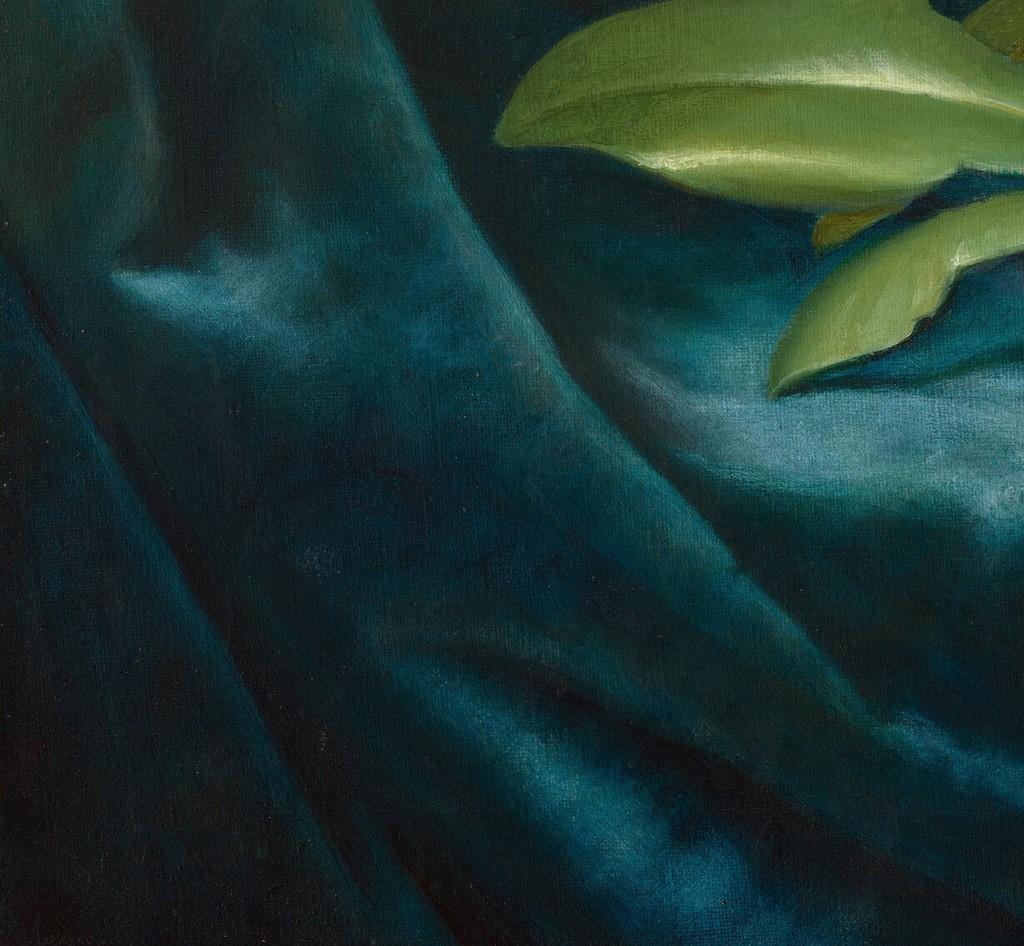
Blue-green folds alternate between shadow and broad light. Their changes in tone support the flowers without becoming a flat background.
Marshes as working coastal landscapes
Heade’s salt marshes are open landscapes shaped by use. Channels wind through grass; stacks hold harvested hay; cattle, workers and carts may occupy the ground. The wide format gives weather room to develop above this low terrain. A calm appearance can coexist with agricultural activity.[4][9]
In Sunlight and Shadow: The Newbury Marshes, bright passages alternate with shade around a tree, haystacks, water and cattle. The arrangement directs attention through changes of illumination. Brock’s account of infrared examination also records a relocated stack, showing that the balanced result involved adjustment.[3]
View of Marshfield invites a more regional reading. Cash discusses coastal haymaking, an associated drawing and a probable place identification. Stacks raised on supports, a shallow boat and distant surf connect composition with practical use of the marsh. The proposed location remains qualified rather than becoming a precise modern viewpoint.[4]
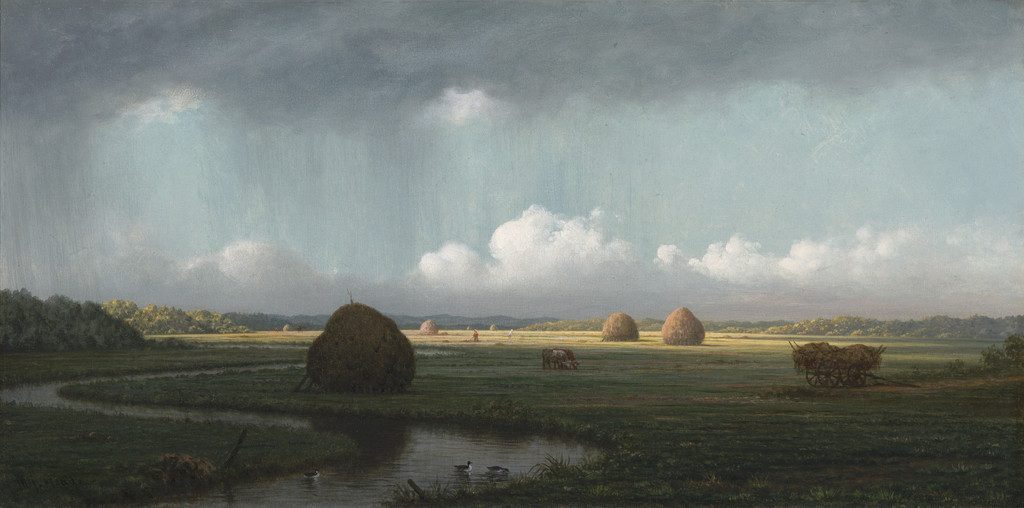
Yale’s Sudden Shower, Newbury Marshes brings a large shadowed stack, rain and sunlit distance together. Barringer considers labour and broader historical pressures alongside meteorology. Those interpretations are possibilities developed through the picture, rather than a single documented symbolic message from Heade.[9]
The marsh overview connects these examples. Look for how channels, stacks and horizons organise depth before comparing their weather. The same recurring motifs can produce very different encounters with a working landscape.
Martin Johnson Heade, Sunlight and Shadow: The Newbury Marshes, c.1871–75. Oil on canvas, 30.5 × 67.3 cm. National Gallery of Art, 2010.74.1. John Wilmerding Collection; National Gallery of Art. Image source. CC0 / Public domain. Resized only; native appearance preserved.
Storm, light and the edge of the sea
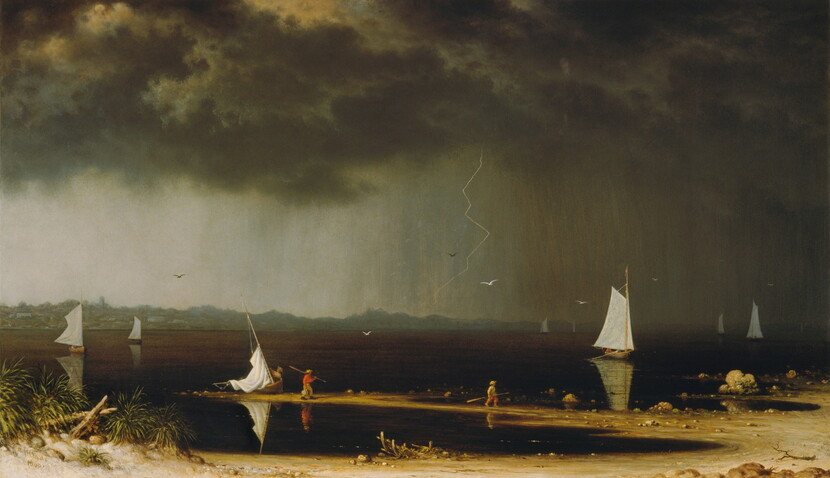
The Met’s Approaching Thunder Storm, dated 1859, gives an immense dark cloud presence over relatively quiet water. A pale sail and small shore figures establish another scale beneath it. Weather dominates the scene while the human activity remains comparatively restrained.[10]
The Carter’s Thunder Storm on Narragansett Bay, 1868, is a separate canvas. Its sailors and boats occupy a coast threatened by gathering weather. Comparing it with the Met picture makes repeated interest in storms visible without treating similar titles as the same object.[11]
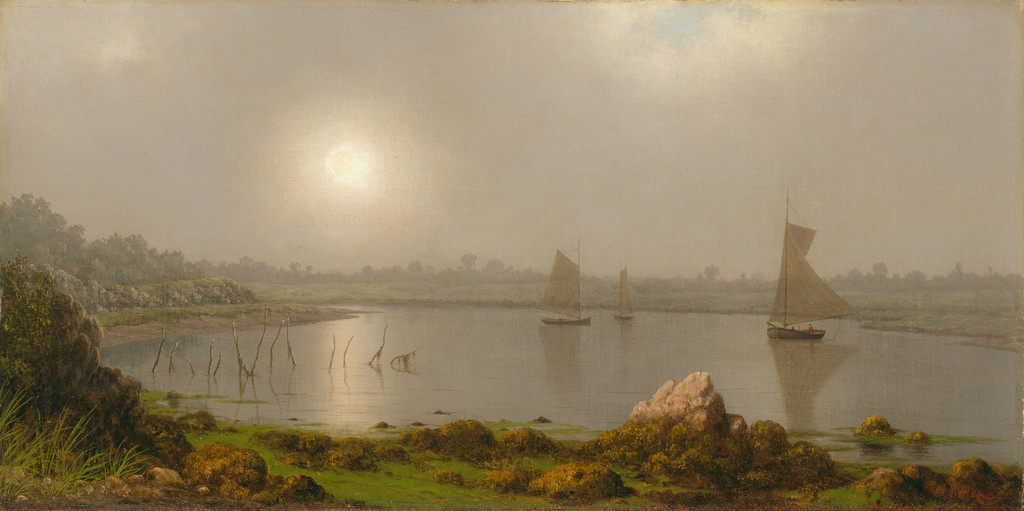
York Harbor, Coast of Maine presents a quieter alternative. Three sailboats and their reflections shape a nearly still inlet beneath a hazy sky. The different boat sizes connect the near bank with distance. The calm surface deserves attention alongside the more immediately dramatic cloud scenes.[12]
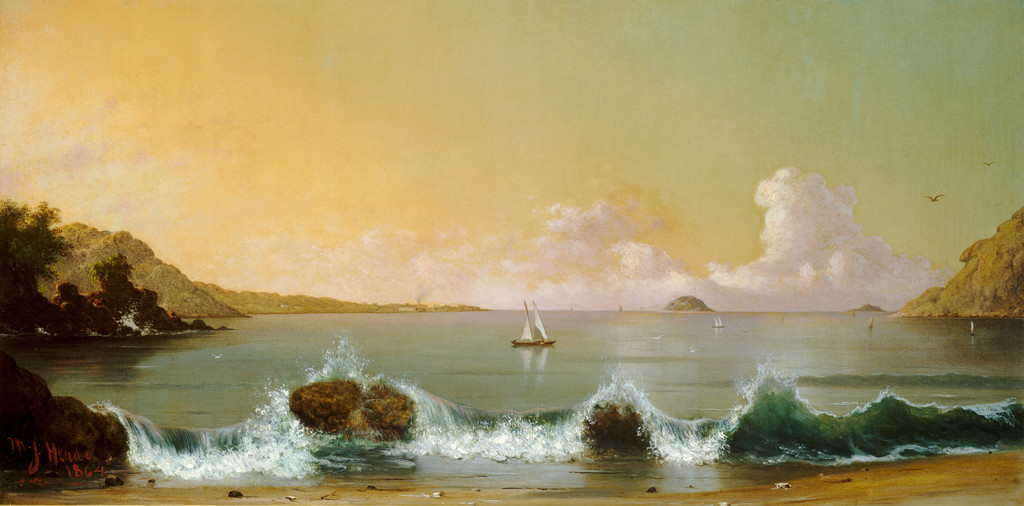
The Brazilian Rio de Janeiro Bay, signed and dated 1864, combines breaking foreground surf with quieter water beyond. Its warm sky and mountainous banks carry the coastal interest into another geography. A journey could supply both small bird pictures and a broad marine view.[1]
Birds, flowers and tropical travel
Heade travelled to Brazil in 1863–64, then to other Central American and Caribbean locations. Porter distinguishes Nicaragua and Colombia in 1866 from Colombia, Panama and Jamaica in 1870. These routes should not be compressed into three visits to Brazil.[5]
The first Brazilian visit was closely connected with the intended Gems of Brazil publication. Small paintings of hummingbirds were to be reproduced in colour beside his text. Pedro II’s support and a twelve-picture display formed part of that episode, as the Carter Museum’s essay explains.[1][6]
The book remained unfinished, but printed experiments survive. Veloric’s study examines four trial compositions and the unresolved question of printer attribution. An incomplete publication therefore should not become a claim that no chromolithographs were made.[7]
The Gems article explores that evidence and the later rediscovery of sixteen small pictures in England. It also includes the Crystal Bridges butterfly associated with the series. The original project and later composed bird-and-flower paintings remain related but distinct bodies of work.
Close subjects within broad space
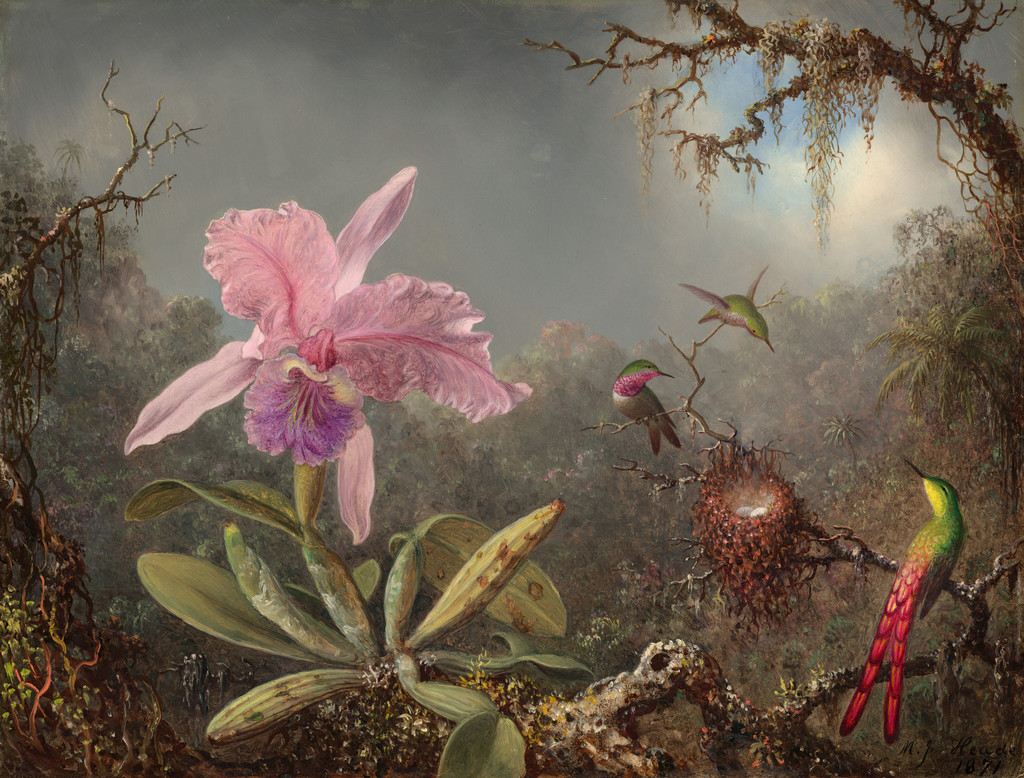
The NGA’s Cattleya Orchid and Three Hummingbirds, 1871, combines a large pink orchid with birds, a nest and two eggs. Hanging vegetation and misty distance create a setting around these close subjects. Its small mahogany panel makes a different use of tropical space from the harbour canvas.[1]
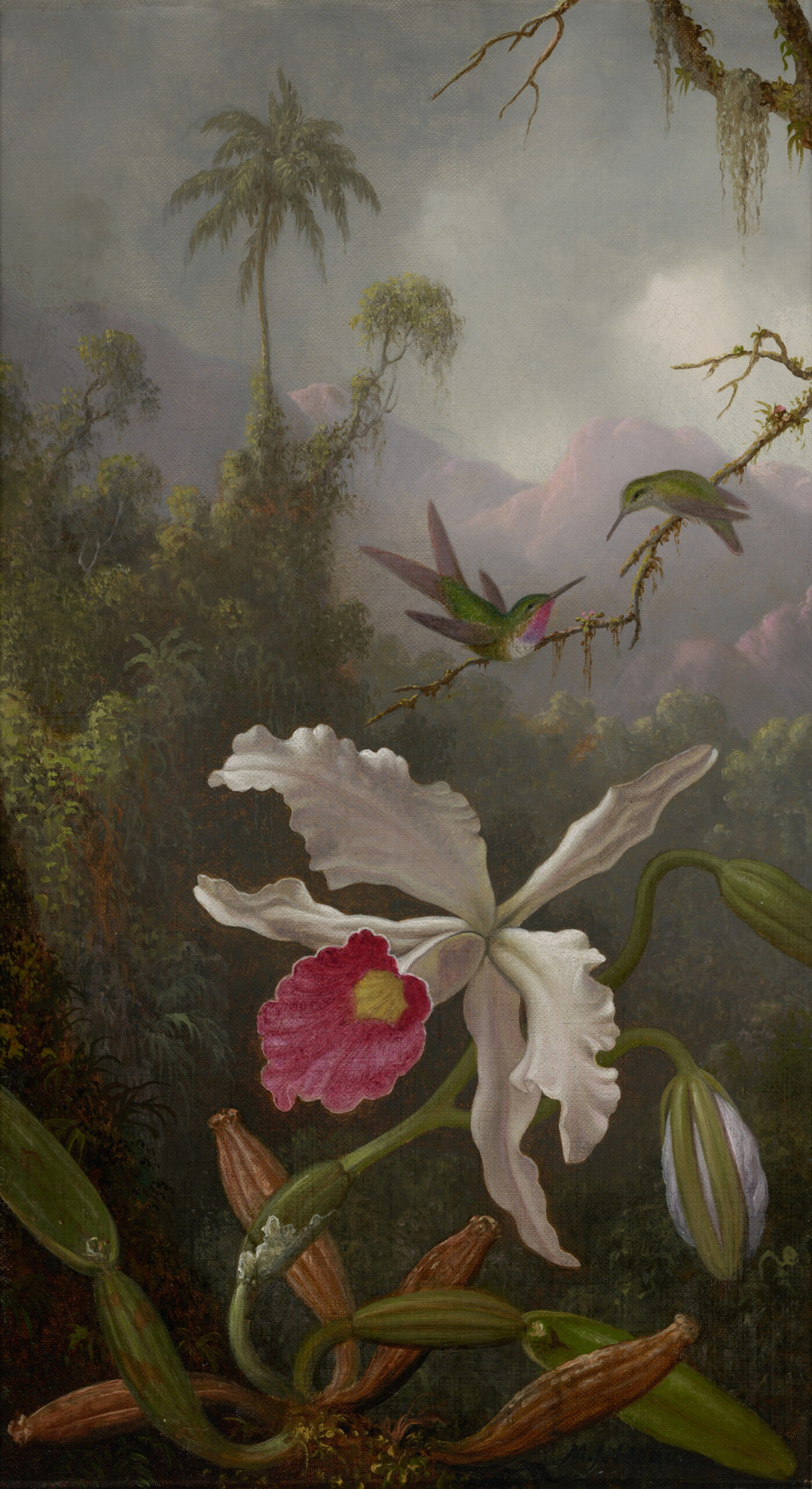
The Carter’s Two Hummingbirds above a White Orchid, c.1875–90, uses a tall arrangement. Upper branches and birds lead down towards the flower and lower plants. The complete shape of the painting matters because the spaces above and below the orchid organise the relationship between its subjects.[13]
The hummingbirds and orchids overview considers observation alongside composed habitats. Heade’s natural-history interests included living birds, specimens and writing. Detailed forms can be grounded in those interests while their final arrangement remains a pictorial construction.[5][8]
Proximity also does not settle biological relationships. A bird beside a flower need not be shown feeding or pollinating it. Looking carefully at pose, scale and placement allows the image to be discussed without forcing every composition into an exact scientific encounter.
Martin Johnson Heade, Cattleya Orchid and Three Hummingbirds, 1871. Oil on wood, 34.8 × 45.6 cm. National Gallery of Art, 1982.73.1. Gift of The Morris and Gwendolyn Cafritz Foundation; National Gallery of Art. Image source. CC0 / Public domain. Resized only; native appearance preserved.
Scale and the red passionflowers
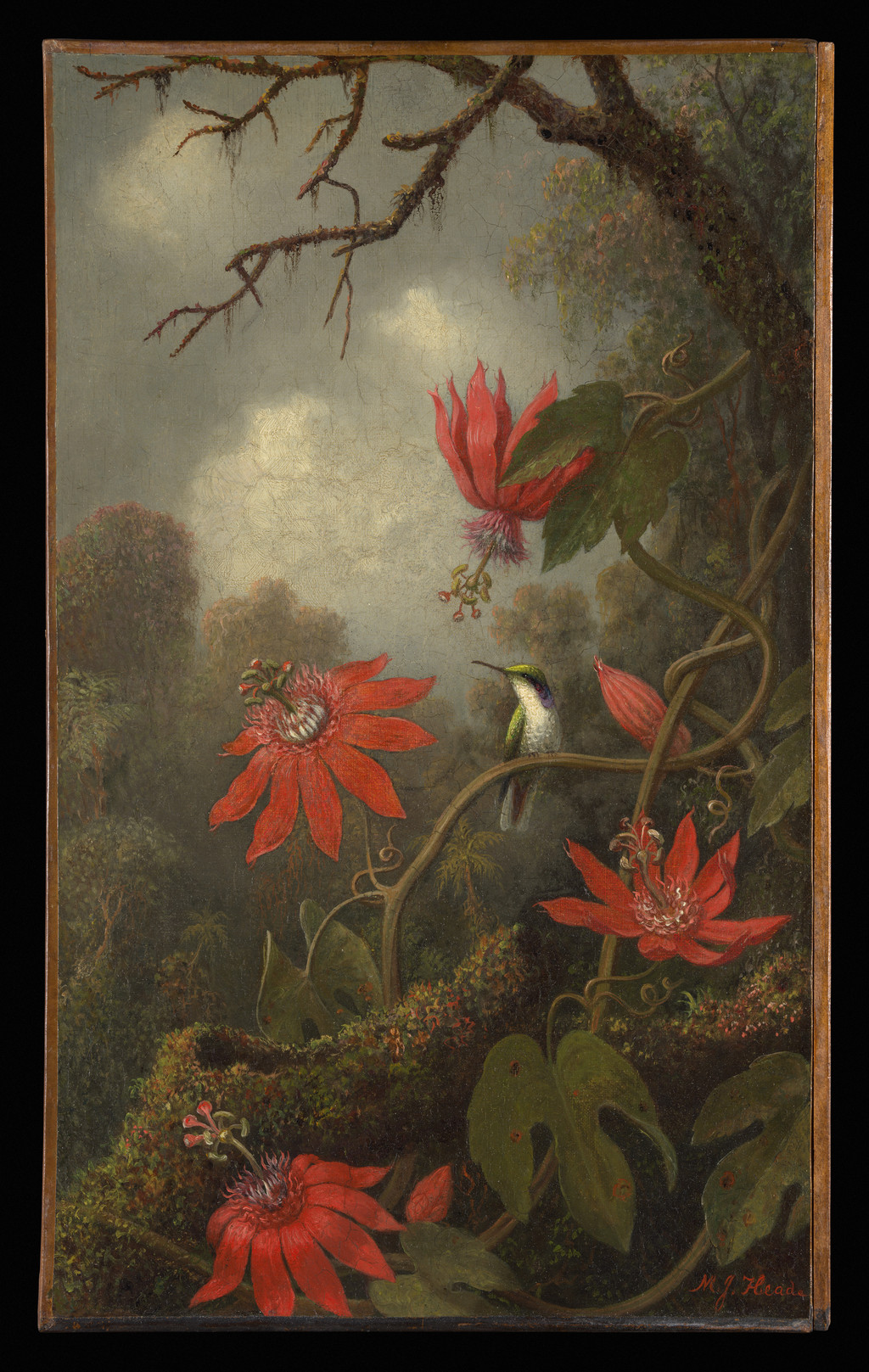
The Met’s Hummingbird and Passionflowers, c.1875–85, supplies a different close encounter. One perched bird occupies a narrow vertical composition among red blossoms, buds and looping stems. The bright forms appear against more distant, quieter space, bringing attention to the relationship between the foreground and its setting.[17]
Compare its organisation with the broad marshes. A channel can guide attention across low terrain, while a vine leads the eye through a narrower arrangement. In each, small forms establish a route within larger space. The comparison concerns visible structure rather than claiming that a marsh and a tropical flower carry the same symbolic meaning.
Scale also changes the viewer’s encounter. A tiny worker belongs within a broad working landscape; a bird close to large blossoms can become a principal subject. Those choices help connect Heade’s groups while preserving what is distinctive about each. The full paintings, with their different proportions, are more useful for this comparison than isolated details alone.
Watch: Martin Johnson Heade
Choose a film to explore the artist’s work, its interpretation and its wider setting.
Museum Minute: Heade Hummingbirds
A brief Shelburne Museum introduction to Heade’s hummingbird paintings.
Watch on YouTubeFlowers before and after Florida
Floral still lifes were established well before the Florida years. Brock’s NGA study follows a wine-glass arrangement dated 1860, flowers in a vase from 1862, apple blossoms from 1867 and a mixed bouquet from 1869. Their variety prevents the later magnolias from becoming the sole beginning of Heade’s interest in flowers.[3]
Magnolias on velvet became especially prominent within the later career. The NGA’s Giant Magnolias on a Blue Velvet Cloth, c.1890, has two open blossoms and a bud, with leaves, stems and deep folds. The pale flowers occupy an interior arrangement, detached from a flowering tree.[1]
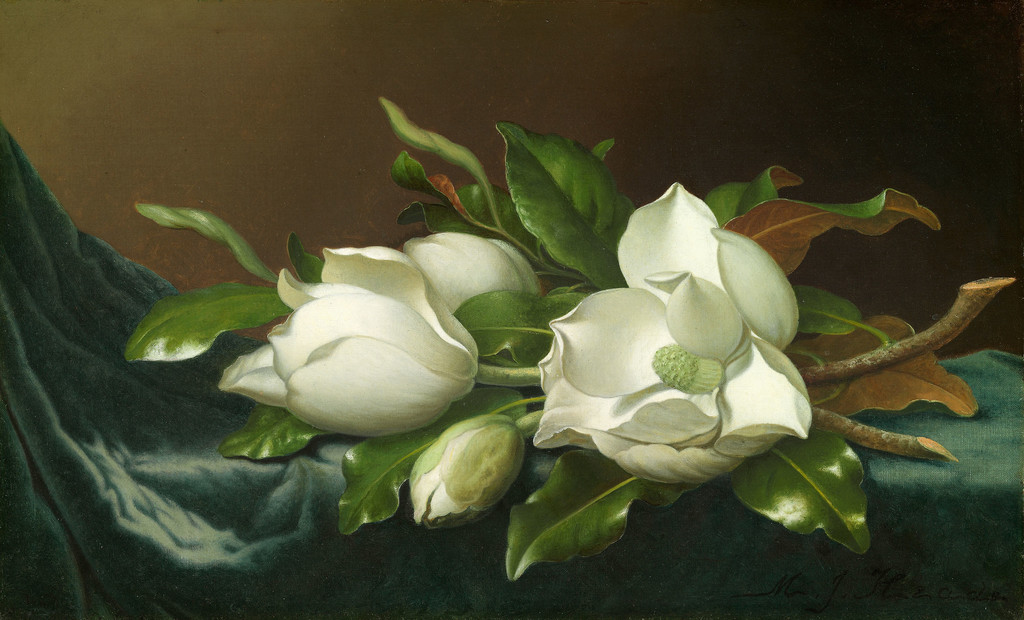
The Chicago Magnolias on Light Blue Velvet Cloth, c.1885–95, is another object, containing four floral forms. Its partly concealed blossom and lower bud distinguish it from the NGA picture. Similar titles invite comparison while the full arrangement and accession identify each canvas.[14]
The flower paintings overview connects these works with earlier bouquets and scholarly interpretations. Read the modelling of petals, leaf shadows and cloth folds first; symbolic readings can then be considered as interpretations rather than automatic meanings attached to every blossom.
Martin Johnson Heade, Giant Magnolias on a Blue Velvet Cloth, c.1890. Oil on canvas, 38.4 × 61.5 cm. National Gallery of Art, 1996.14.1. Gift of The Circle of the National Gallery of Art in Commemoration of its 10th Anniversary; National Gallery of Art. Image source. CC0 / Public domain. Resized only; native appearance preserved.
Florida residence, patronage and writing
Heade settled permanently in St. Augustine and married Elizabeth Smith in 1883. Henry Morrison Flagler became an important patron. The hotel environment supplied opportunities to exhibit, teach and meet visitors, linking artistic activity with the growth of a resort economy.[1][15]
The later subjects continued to overlap. Florida marshes and swamps joined cut flowers and tropical compositions. Greater domestic and professional stability supplied a new setting, rather than making earlier interests disappear. Exact dates and collecting histories still belong to individual paintings.
His writing as Didymus adds a less comfortable side to this world. Porter describes criticism of sporting excess, private monopoly, market shooting and the plume trade. Heade remained involved in outdoor sport while arguing about its consequences and management.[16]
The Florida article considers those tensions beside patronage and the historical hotel image. Paintings and arguments about wildlife share a regional life, without requiring every still life to become a policy statement.
Friendship, observation and individual choices
Church’s friendship supplies an important connection with the larger landscape tradition. His celebrated panoramas and encouragement helped place tropical travel within Heade’s artistic world. Heade nevertheless chose subjects and scales that could centre a tiny bird or a single flower.[1]
Edward Hicks belongs to the qualified early training account, while Porter identifies F. O. C. Darley as another friend. Flagler supplied a later patronage relationship. These different connections concern instruction, companionship and professional support; none alone explains all the paintings.[1][5]
Close observation and composition worked together. A flower could carry carefully studied form while its placement against velvet served another purpose. A marsh could record real practices while its stacks and trees were rearranged. The particular evidence determines how far either claim can be taken.
Making light and revising the image
Conservation research reveals varied supports, light grounds, drawing materials and paint handling. The MFA study examined fifty paintings and analysed pigments in twenty-one. Its findings include glazes over reflective white paint, different brushmarks and changes to motifs during execution.[8]
The style and technique article follows these findings through specific objects. It distinguishes a covered stack detected by infrared from the visible colour image and keeps the technical history of each magnolia or storm separate. A luminous effect can be shared while its exact construction differs.
Looking between surface and composition is particularly rewarding here. The folds beneath a blossom, light around a stack or pale sail against a cloud help explain what the material decisions achieve. Technical evidence extends that looking; it does not replace attention to the whole picture.
Reputation and choosing a route
Heade died in St. Augustine in 1904, with wider attention diminished. Kelly describes a recovery of interest from the 1940s as American painting was reassessed. Later collecting, the rediscovered hummingbird group and technical study continued to reshape understanding of the career.[1][7]
Begin with one contrast: rain and sunlight, harbour and surf, close orchid and distant landscape, or pale petals and blue cloth. Then follow the related individual studies. Comparisons become more useful when dates, supports and collection identities remain visible alongside the repeated subjects.
The paintings guide provides the broadest browsing route. The biography follows circumstances, and the topic pages follow recurring interests. Together they present an artist whose long career continued to bring different forms of nature into carefully constructed images.
Essential Martin Johnson Heade works
Approaching Thunder Storm
1859 · An immense dark cloud above still water, a pale sail and a seated man with a dog.
Thunder Storm on Narragansett Bay
1868 · The separate 1868 Carter storm with sailors, boats and gathering weather.
Sudden Shower, Newbury Marshes
c.1865–75 · Rain, a large raised stack and bright distance within a cultivated marsh.
Sunlight and Shadow: The Newbury Marshes
c.1871–75 · Tree, stacks, cattle and reflected colour; published infrared evidence records a revision.
Cattleya Orchid and Three Hummingbirds
1871 · A pink orchid, three birds, a nest and two eggs on a mahogany panel.
Two Hummingbirds Above a White Orchid
c.1875–90 · A complete tall arrangement of upper birds, white petals and lower plants.
Giant Magnolias on a Blue Velvet Cloth
c.1890 · Two open flowers and a bud on deep folds of blue velvet.
York Harbor, Coast of Maine
1877 · Three sailboats and reflections within a nearly still inlet.
Rio de Janeiro Bay
1864 · Breaking foreground surf and quieter Brazilian harbour water, dated 1864.
Hummingbird and Passionflowers
c.1875–85 · A perched bird among red flowers and looping stems in narrow vertical space.
Artworks directory
A collected selection of 26 individually identified museum paintings, including thirteen extended artwork studies. This is a bounded directory, rather than a complete catalogue raisonné. Two Boston entries retain dates from the 2002 conservation study. Links open a companion article where available, otherwise the cited institutional record or publication; unillustrated objects remain included.
Frequently Asked Questions
His principal recognised groups include salt marshes, coastal weather, hummingbirds with orchids and cut magnolias.[1]
The intended book was not completed, though trial chromolithographs were made.[7]
No. Landscapes continued beside floral and tropical subjects during the later career.[1]
Discussion
Look again at the images and ideas explored in Martin Johnson Heade. These editorial prompts invite your observations.
Reader Insights
Which comparison connects a broad marsh with a close tropical subject?
What changes between threatening coastal weather and the quiet York inlet?
Which recurring subject would you follow through the biography?
Join the Conversation
Share a detail, comparison or question about Martin Johnson Heade below.
Explore the wider art history
Explore the wider history of American artists, with portraits, landscapes and changing approaches to modern art.
Luminism is a retrospective term useful for comparing some of Heade’s landscapes, alongside his varied flower and bird paintings.
References
- Franklin Kelly, American Paintings of the Nineteenth Century, Part I, NGA, 1996, printed pp.287–298. Career, friendships and Rio, Cattleya and magnolia studies. View source
- Diana J. Strazdes, Heade entries, American Paradise, Met, 1987, printed pp.163–178. Landscape development and subject overlap. View source
- Charles M. Brock, American Masters from Bingham to Eakins: The John Wilmerding Collection, NGA, 2004, printed pp.67–74. Early flowers, Sunlight and Shadow and its infrared revision. View source
- Sarah Cash, Corcoran Collection: American Paintings to 1945, printed pp.130–131 and notes p.266. Marshfield, regional practices and qualified location. View source
- Charlotte M. Porter, Florida Museum, “Visual Interests”. Tropical routes, Darley and observation; conjectural claims kept qualified. View source
- Elizabeth Neely, Amon Carter Museum, An Orchid, an Emperor and Hummingbirds. Brazil, imperial patronage and twelve-picture display. View source
- Cynthia Haveson Veloric, “Hummingbirds, Emperors, and Railway Barons,” Nineteenth Century 36(2), 2016, printed pp.17–23. Gems, trial compositions and sixteen-picture rediscovery. View source
- Fulton, Newman, Woodward and Wright, “The Methods and Materials of Martin Johnson Heade,” JAIC, 2002. Later style terminology, observation and bounded technical study. View source
- Tim Barringer, Object Lessons: American Painting at Yale, printed pp.1–17. Sudden Shower, labour and attributed interpretations. View source
- Met, Approaching Thunder Storm, 1975.160. Exact 1859 object. View source
- Amon Carter Museum, Thunder Storm on Narragansett Bay, 1977.17. Separate 1868 canvas. View source
- Art Institute of Chicago, York Harbor, Coast of Maine, 1999.291. Three boats and quiet harbour identity. View source
- Amon Carter Museum, Two Hummingbirds above a White Orchid, 1981.33. Complete vertical composition and approximate date. View source
- Art Institute of Chicago, Magnolias on Light Blue Velvet Cloth, 1983.791. Exact Chicago object and four-form arrangement. View source
- Porter, “Florida Interests”. Elizabeth Smith, local residence and studio audiences; hotel chronology corrected in the Florida article. View source
- Porter, Didymus / Forest and Stream essay. Historical sporting and conservation arguments through later museum transcription. View source
- Met, Hummingbird and Passionflowers, 46.17. Exact narrow composition and c.1875–85 date. View source
- Splash image source.
Martin Johnson Heade, Approaching Thunder Storm, 1859. Oil on canvas, 71.1 × 111.8 cm. Metropolitan Museum of Art, 1975.160. The Metropolitan Museum of Art. CC0 / Public domain. Resized only; native appearance preserved.
View source - Kevin J. Avery, “The Hudson River School”, Metropolitan Museum of Art (2004). Origins in 1825 and decline in the 1870s–1880s; c. 1825–1880 is an approximate comparative range. View source
- John Wilmerding et al., American Light: The Luminist Movement, 1850–1875 (National Gallery of Art, 1980). A retrospective historical category. View source
- Smithsonian American Art Museum, Asher Brown Durand: 1796–1886. Artist life dates. View source
- Smithsonian American Art Museum, Thomas Cole: 1801–1848. Artist life dates. View source
- National Gallery of Art, Martin Johnson Heade: 1819–1904. Artist life dates. View source
- Amon Carter Museum of American Art, Frederic Edwin Church: 1826–1900. Artist life dates. View source