


 by Tom Gurney
Tom Gurney BSc (Hons) is an art history expert with over 20 years experience
Email: tomgurney1@gmail.com / Phone: +44 7429 011000
Martin Johnson Heade Paintings: Introduction
Martin Johnson Heade’s paintings range from broad salt marshes and storm-darkened coasts to small tropical compositions and cut flowers on velvet. Several subjects recur in different versions, so a title alone may not identify a particular work. This guide introduces the main groups and the distinctions that make comparison useful: subject, date, support, arrangement and collection identity.[1][4]
Selected Martin Johnson Heade paintings
At a Glance
- Landscape groupsMarshes, coastal storms, quieter harbours and tropical views
- Bird picturesEarly Gems project and later hummingbird-and-flower compositions
- Floral subjectsVase arrangements, apple blossoms, orchids and cut magnolias
- Useful identifiersFull title, date, museum and accession number
- Illustrated selectionThirteen individual artwork studies
- Directory scopeA bounded selection of institutionally documented works
- DatesApproximate ranges retained where supplied by the collection
Contents
- Marshes and the work of the coast
- Storms and quieter seascapes
- Small tropical pictures and The Gems of Brazil
- Orchids, birds and hybrid spaces
- Wider tropical landscapes and later signatures
- Cut flowers and changing still-life settings
- Titles, dates and collection identities
- Choosing an illustrated route
- Annotated details
Marshes and the work of the coast
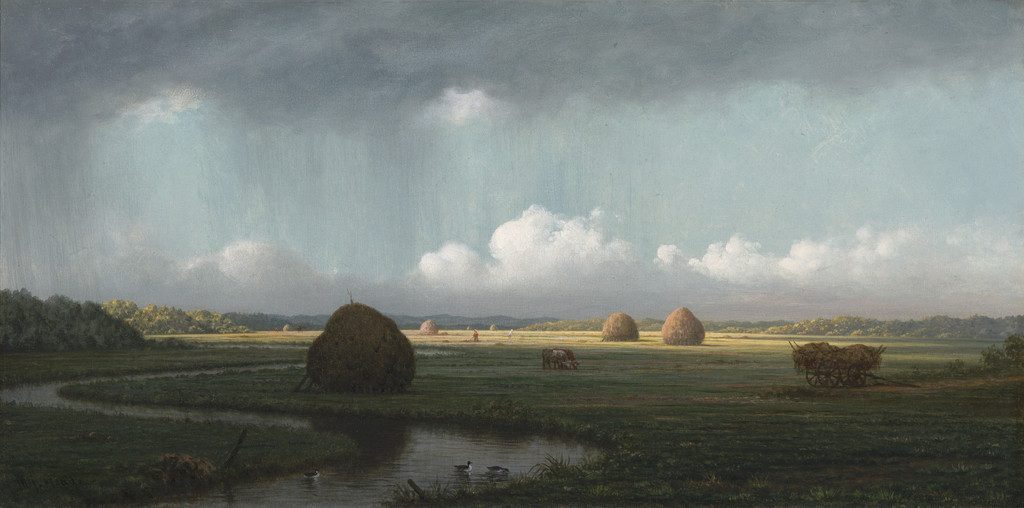
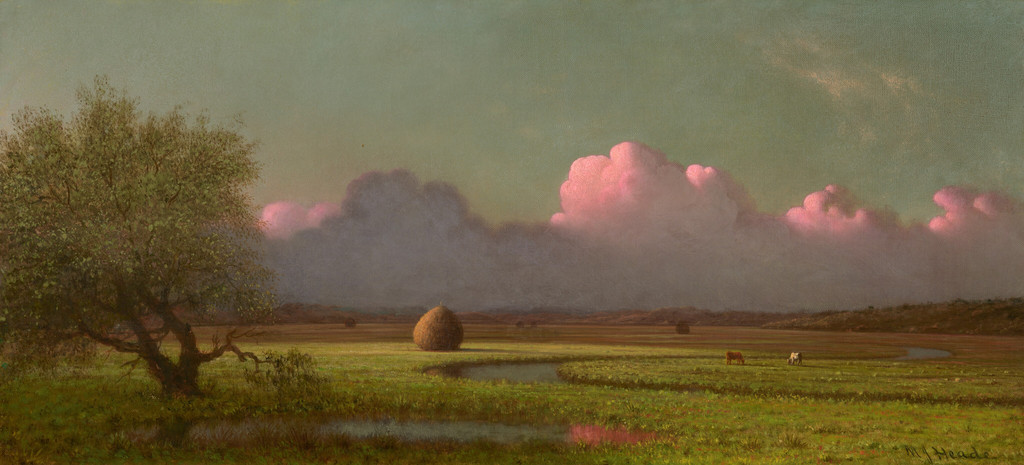
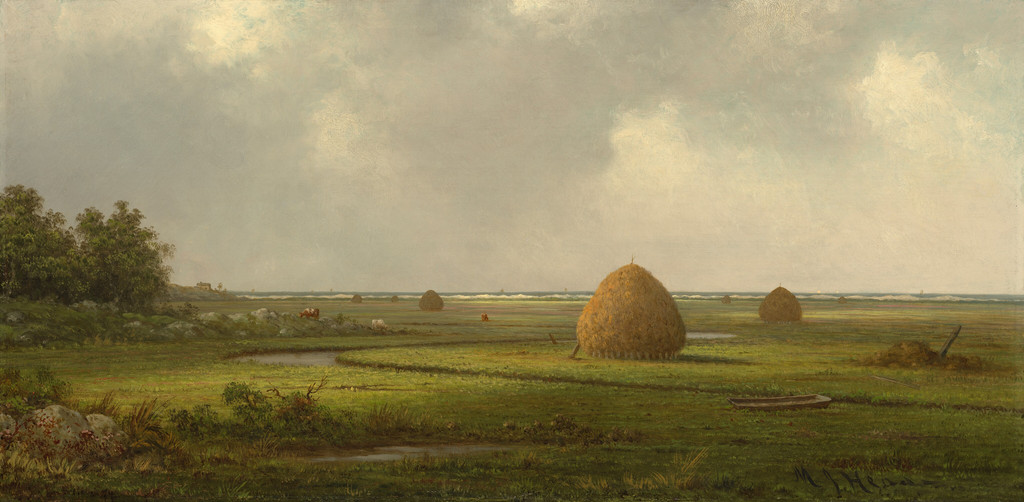
Heade’s marsh pictures combine open space with evidence of use. Haystacks, cattle, harvesters, loaded carts and waterways can appear together. The broad horizontal format gives the sky considerable room while stacks and channels establish distances across the comparatively level ground.[3][4]
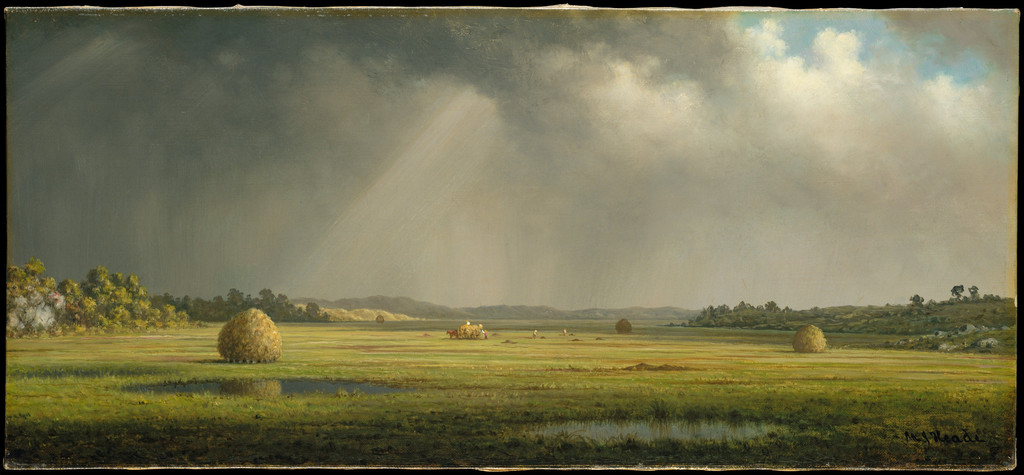
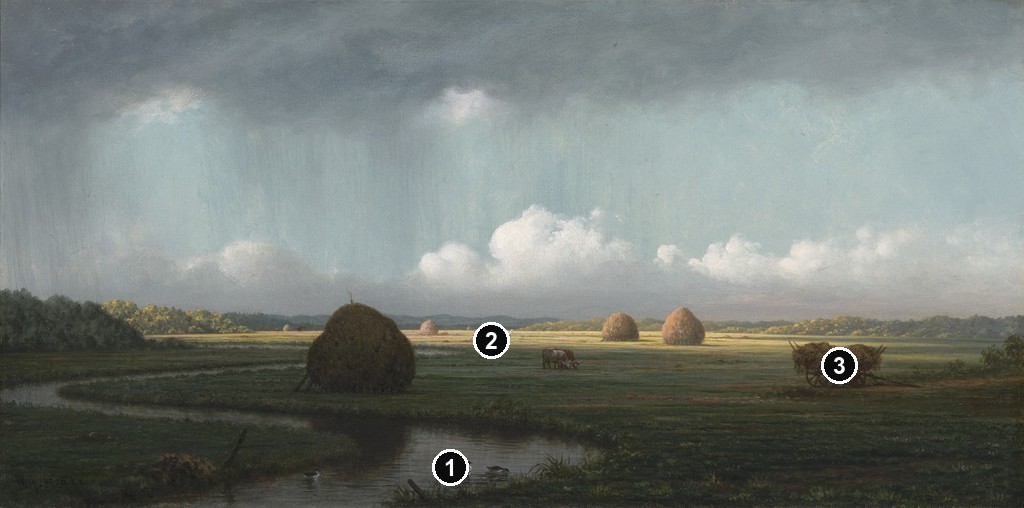
The marsh paintings overview provides a route into the regional setting and recurring motifs. Individual examples then show differences in weather and arrangement. Sunlight and Shadow: The Newbury Marshes is organised around bright and shaded passages; Yale’s Sudden Shower, Newbury Marshes brings rain and sunlit distance into one scene.[2][10]
View of Marshfield, in the NGA, should be distinguished from the Carter’s Marshfield Meadows, Massachusetts. Their related place-names do not make them the same object. The NGA canvas also has an associated preparatory drawing discussed by Sarah Cash, giving that work a particular composition history.[3][12]
The Met’s Newburyport Meadows supplies another distinction. Its current date is c.1876–81, and its harvesting figures and wagon remain part of the landscape. An older date range in a catalogue can be useful historical evidence while the current collection record supplies the date used for identifying the work here.[9]
Annotated Details from Martin Johnson Heade Paintings
The numbered points identify visible features discussed in this article. Return from each detail to the whole composition. The captions keep each work’s identity, date and medium separate.
Sudden Shower, Newbury Marshes
Martin Johnson Heade, Sudden Shower, Newbury Marshes, c.1865–75. Oil on canvas. Yale University Art Gallery, 1989.51.1. Image source. Public domain / PD-Art. Resized only; native appearance preserved.
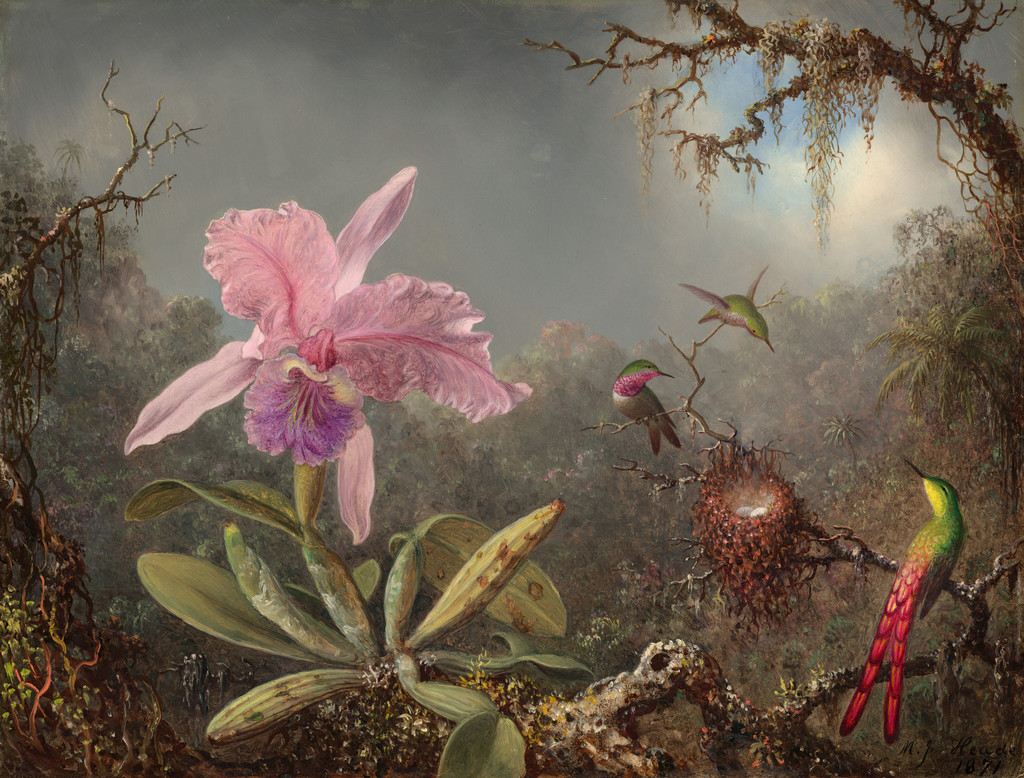
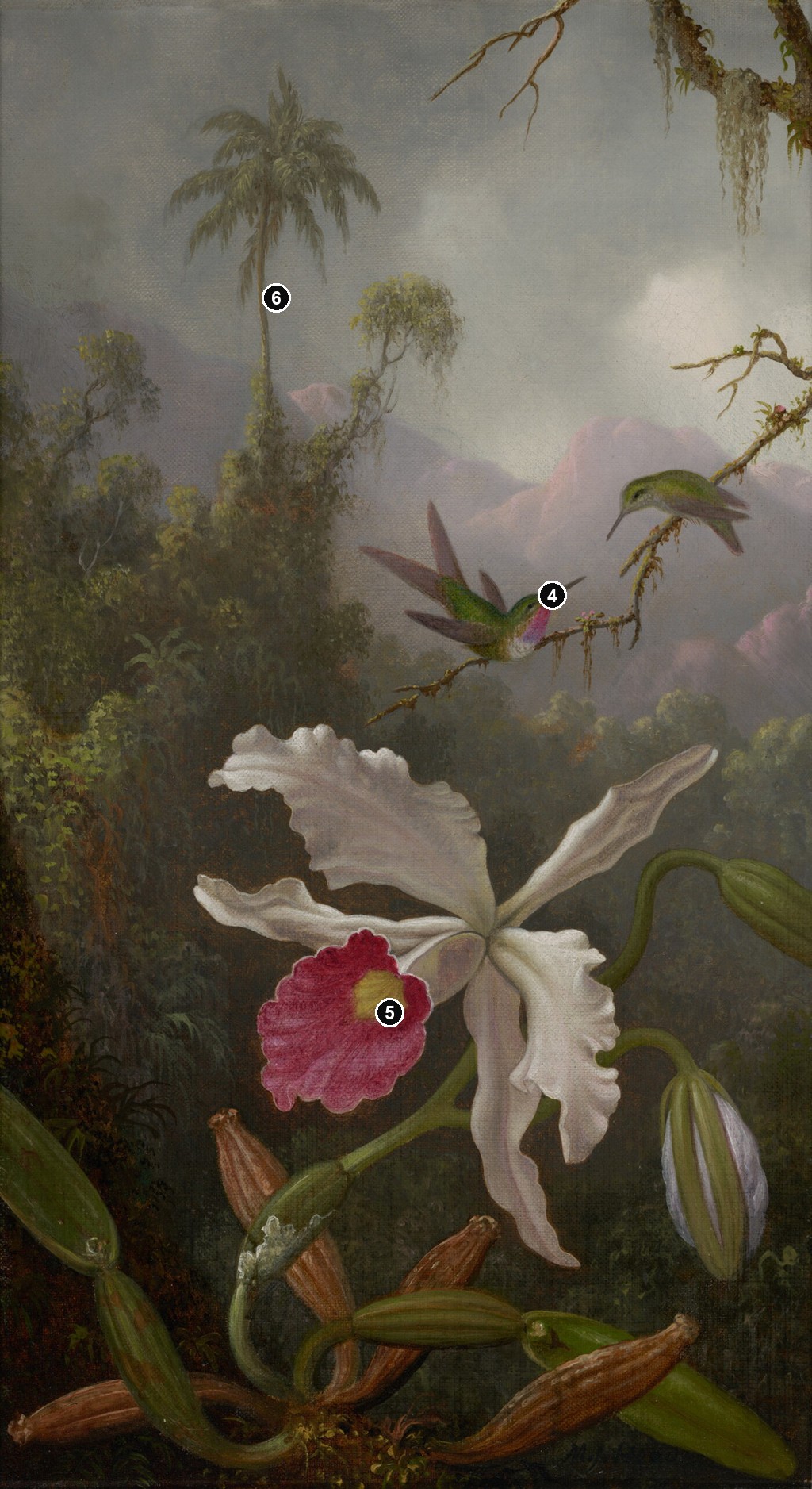
Two Hummingbirds above a White Orchid
Martin Johnson Heade, Two Hummingbirds Above a White Orchid, c.1875–90. Oil on canvas, 18 1/8 × 10 1/8 inches. Amon Carter Museum of American Art, Fort Worth, 1981.33. Image source. Public domain. Resized only; native appearance preserved.
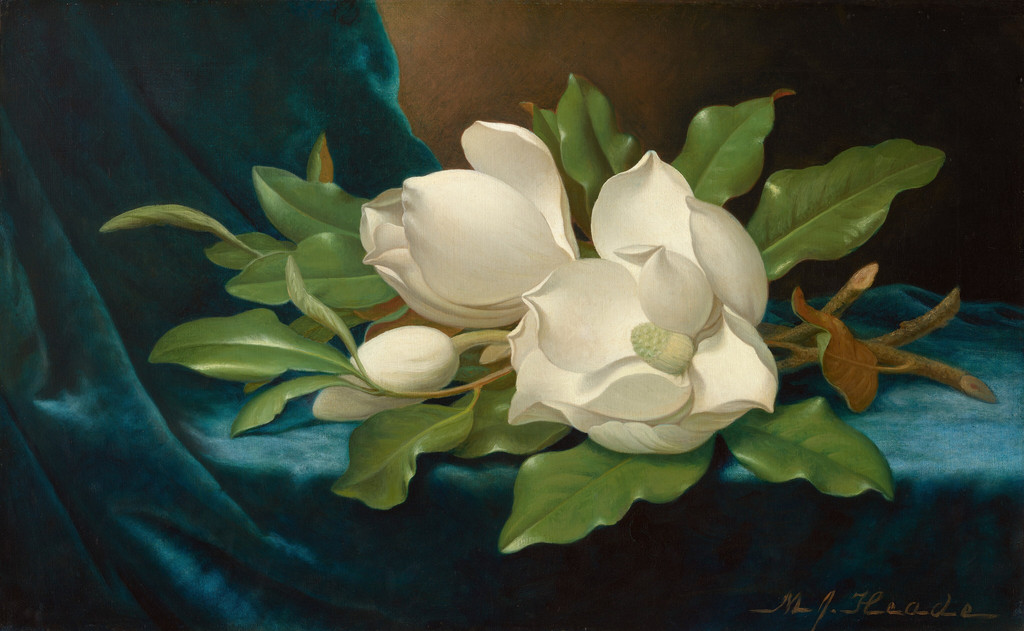
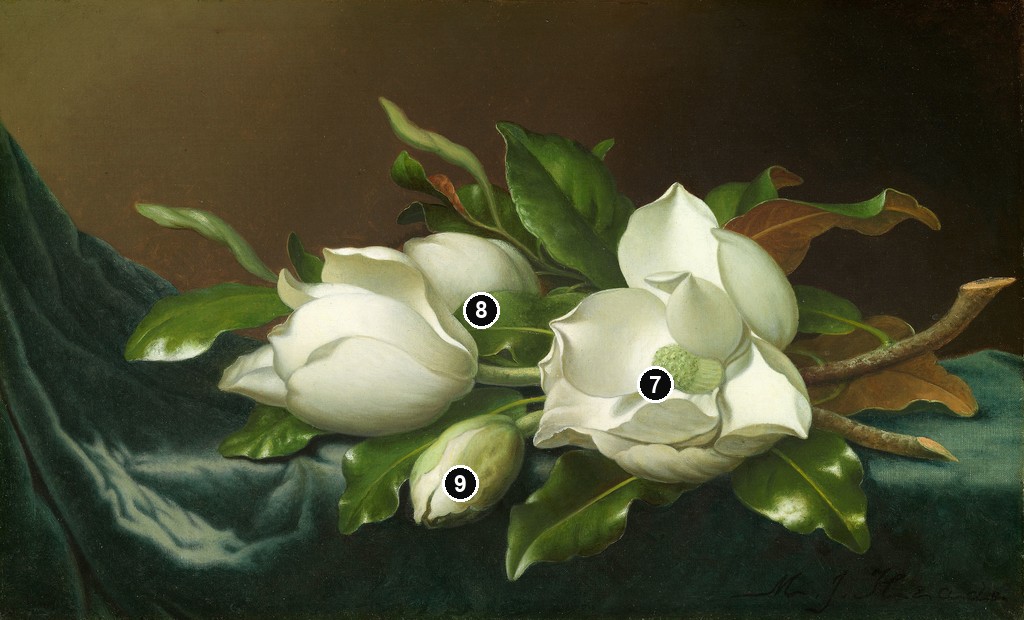
Magnolias on Light Blue Velvet Cloth
Martin Johnson Heade, Magnolias on Light Blue Velvet Cloth, c.1885–95. Oil on canvas, 38.6 × 61.8 cm. Art Institute of Chicago, 1983.791. Purchased with funds provided by Gloria and Richard Manney; Harold L. Stuart Endowment Fund; Art Institute of Chicago. Image source. CC0 / Public domain. Resized only; native appearance preserved.
Details from MARTIN JOHNSON HEADE PAINTINGS
Compare the cropped details with the complete images above. Notice how their colours, shapes and positions contribute to the larger compositions.
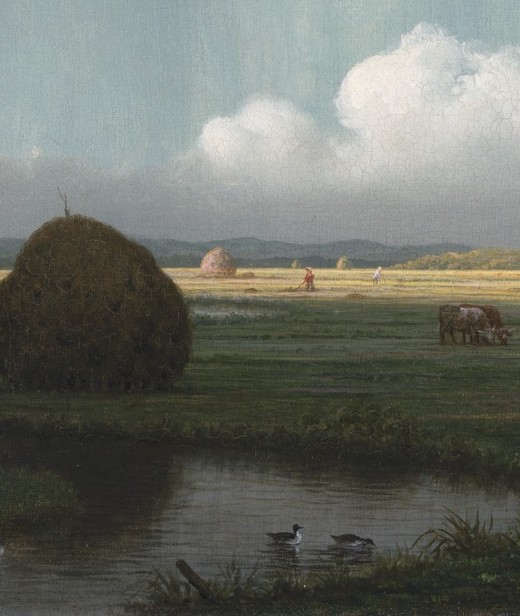
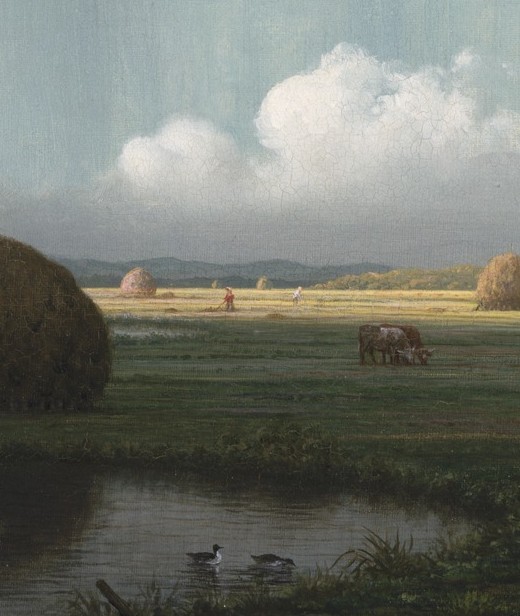
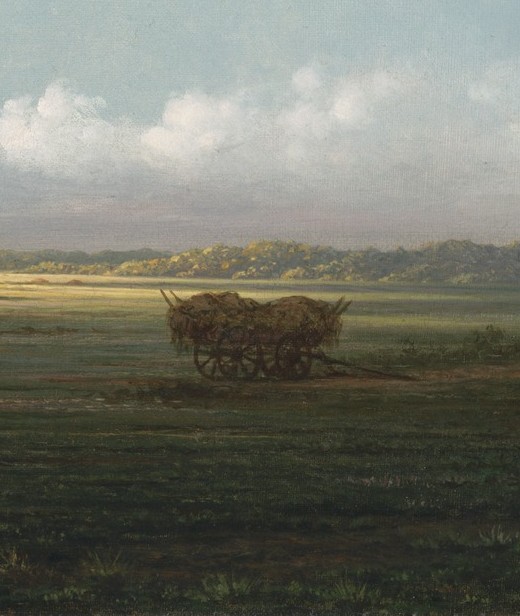
Sudden Shower, Newbury Marshes
Waterfowl in the near channel
Small dark waterfowl occupy the nearer channel. Their silhouettes become easier to recognise in the cropped view than in the broad landscape.
Distant harvest workers
Two small figures stand in the lighter field beyond the near haystack. The surrounding stacks and level ground establish their distance.
Loaded cart
A cart laden with hay crosses the right-hand field. Its wheel forms distinguish it from the stationary stacks nearby.
Two Hummingbirds above a White Orchid
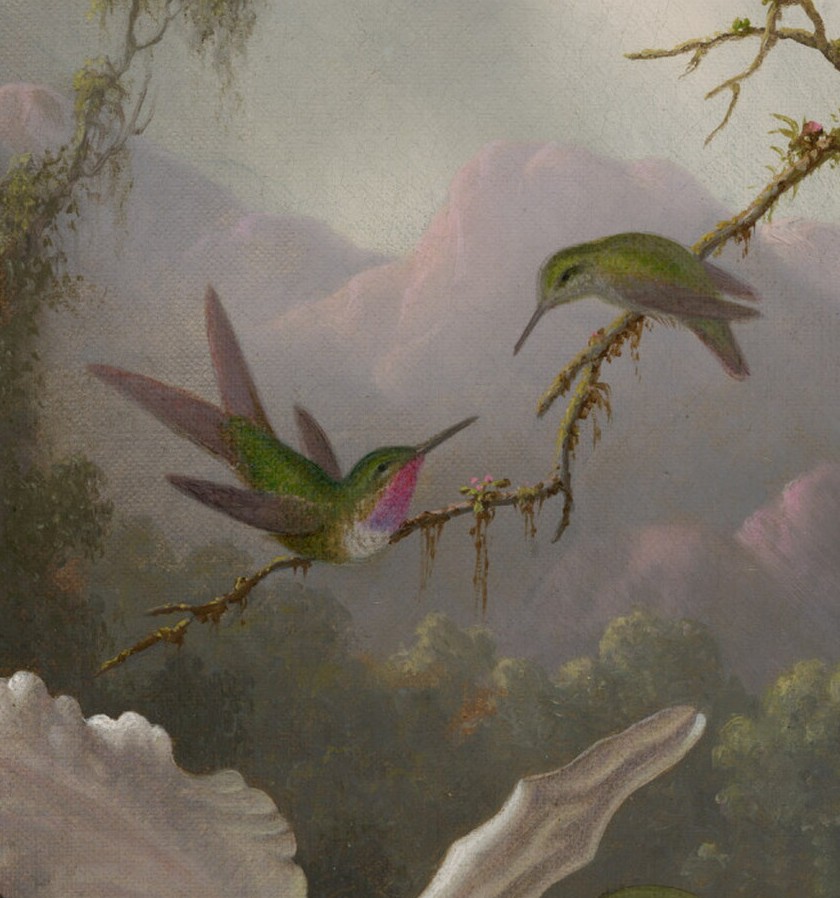
Two birds above the orchid
One bird hovers below another perched on a branch. Their different poses occupy the open air above the flower.
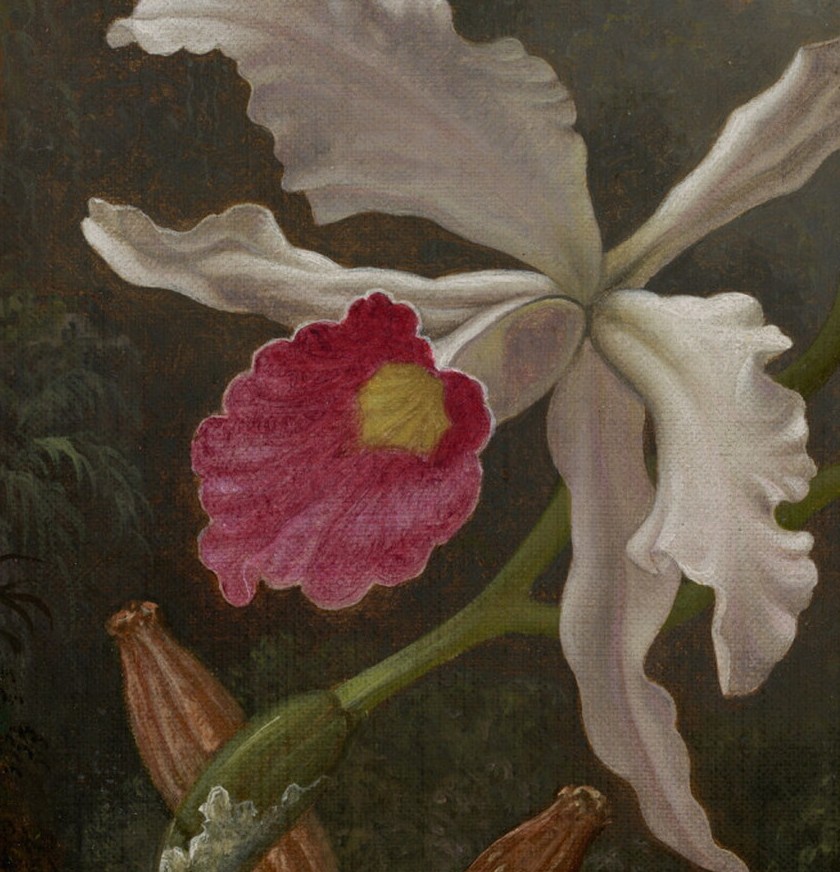
White orchid and coloured lip
Large pale petals surround a crimson lip with a yellow centre. The contrast makes the flower conspicuous against the darker woodland.
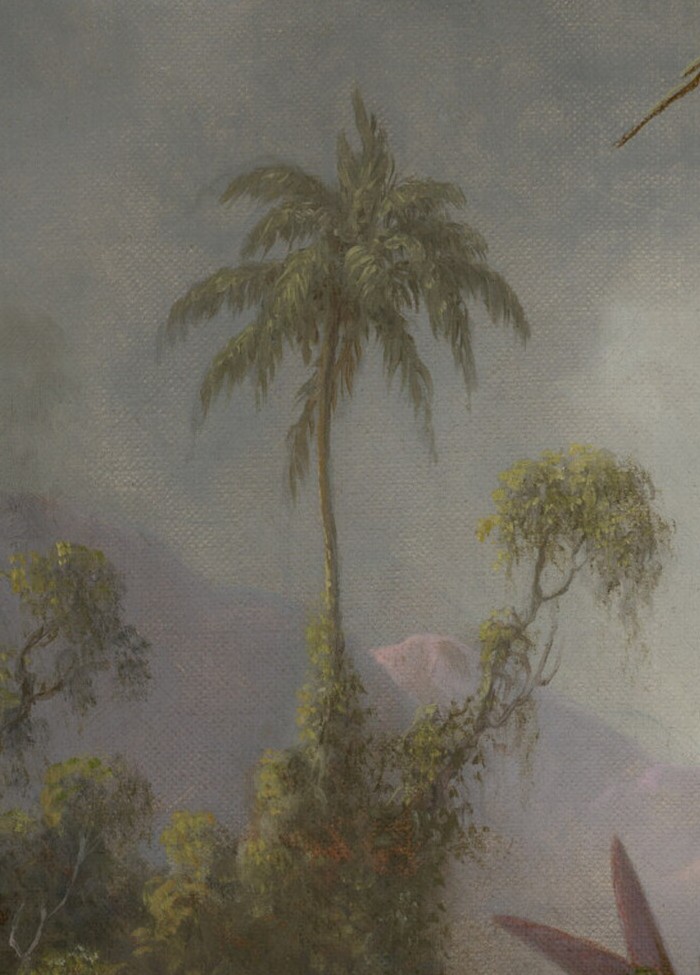
Tall background palm
A slender palm rises behind the foreground subjects. Its height contributes to the deep, upright forest setting.
Magnolias on Light Blue Velvet Cloth
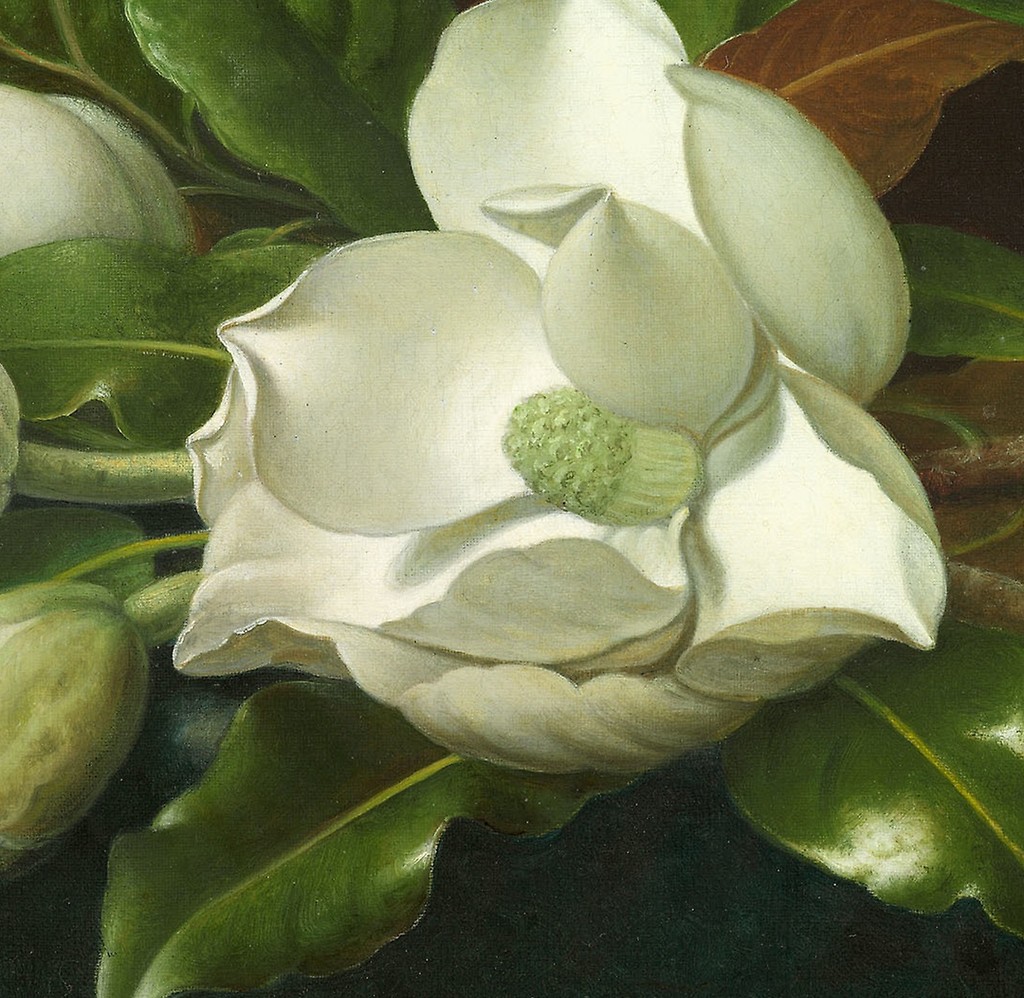
Open right-hand flower
The open right-hand magnolia exposes its greenish centre amid curved pale petals. The flower projects over the darker foliage.
Partly concealed blossom
A rounded pale blossom appears behind the prominent left-hand flower and foliage. Its partly concealed form contributes to the layered arrangement.
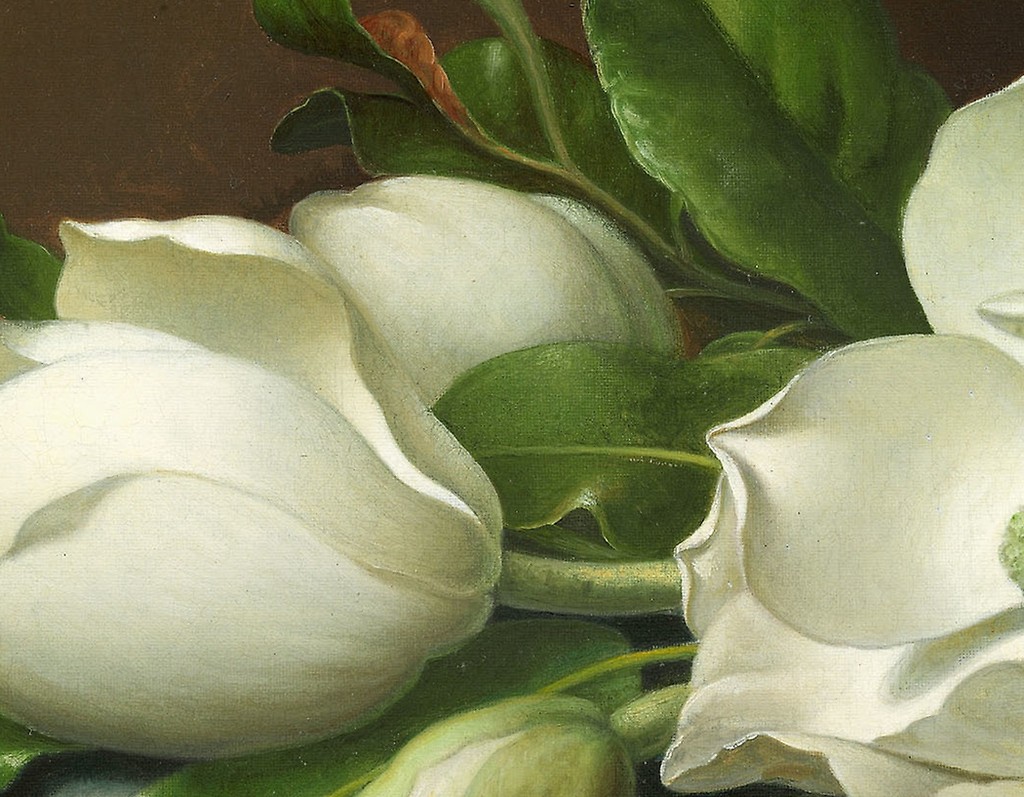
Closed lower bud
A closed bud lies low in the arrangement beside the cloth. Its compact form differs from the open flowers.
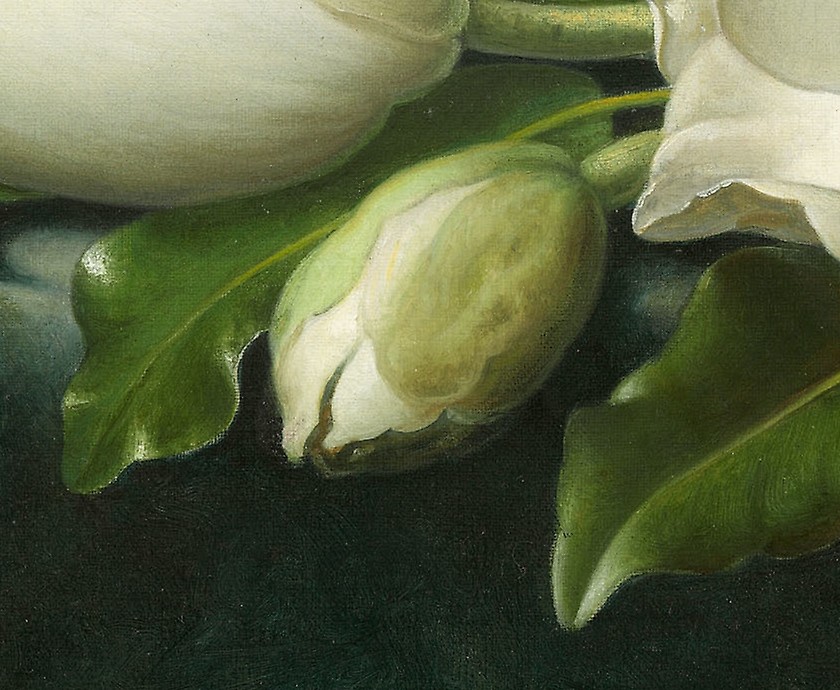
Storms and quieter seascapes
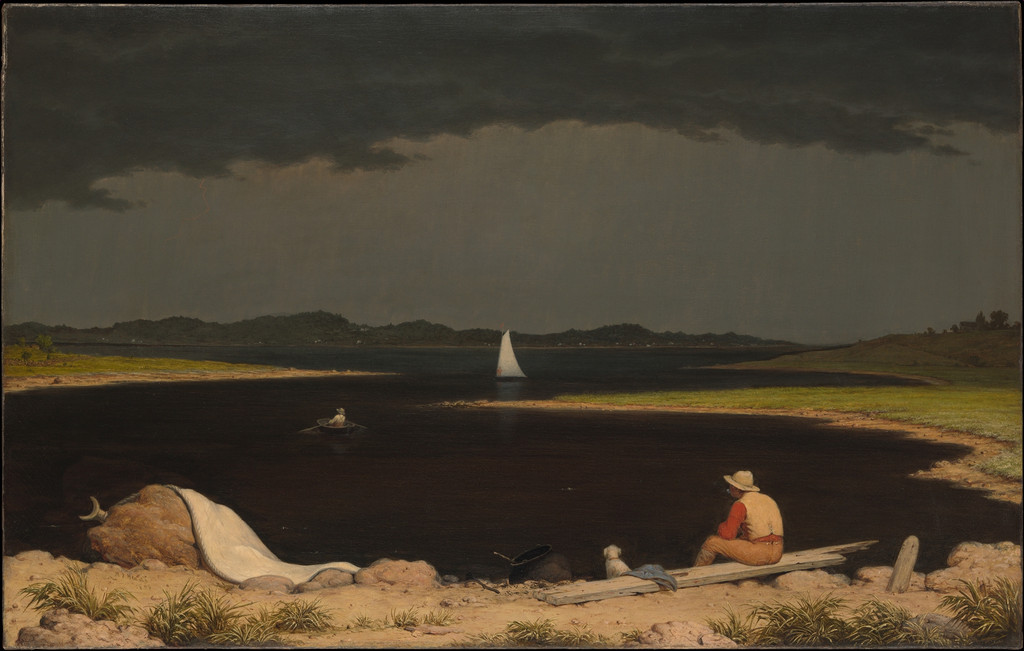
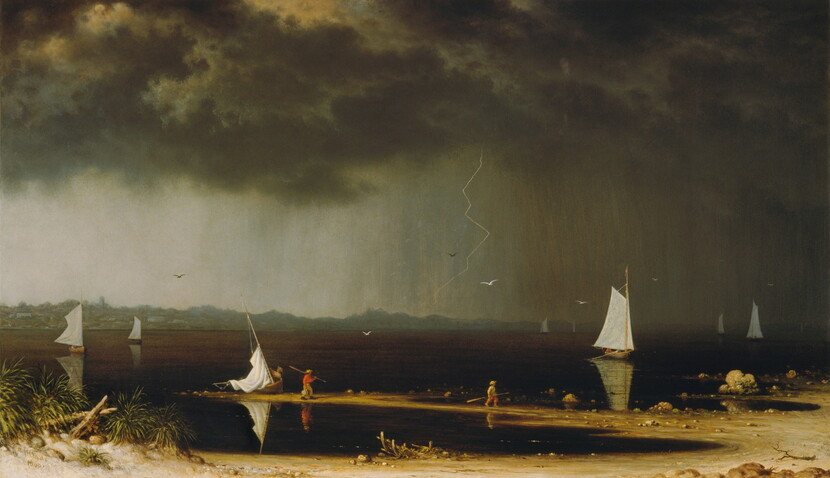
Storm paintings often contrast threatening skies with water that is still comparatively calm. The Met’s Approaching Thunder Storm, 1859, places a seated man and dog near shore beneath a vast cloud. The Carter’s Thunder Storm on Narragansett Bay, 1868, instead includes sailors and boats within a different composition.[7][11]
Another similarly named storm belongs to the MFA, Boston. The conservation study identifies Approaching Storm: Beach near Newport as accession 45.889. Its examination findings should not be transferred to the Met’s accession 1975.160 simply because both titles describe approaching weather.[13]
For a quieter contrast, York Harbor, Coast of Maine sets three sailboats in reflective water beneath a hazy sky. Their different scales and reflections organise the inlet. This painting shows why Heade’s coast cannot be understood solely through ominous storm scenes.[6]
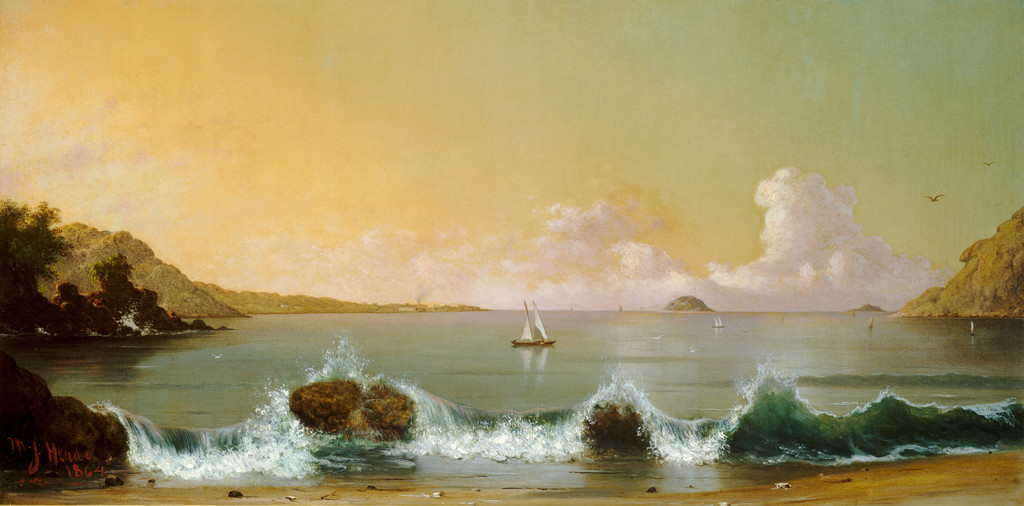
Rio de Janeiro Bay, signed and dated 1864, connects marine painting with the Brazilian journey. Near foam and rocks differ from the stiller bay beyond. Its location is discussed in Kelly’s catalogue as a probable view from near Botafogo, with the geographic identification kept qualified.[1]
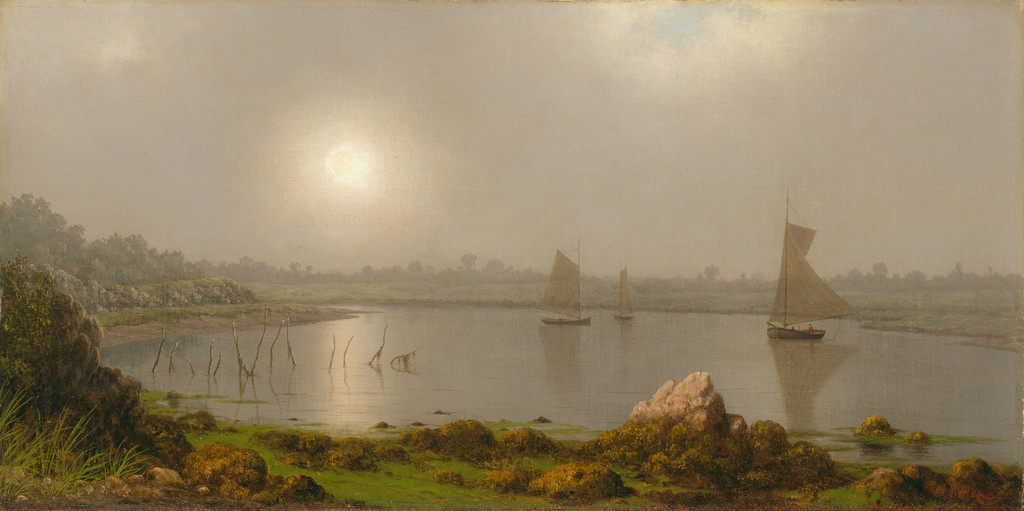
Martin Johnson Heade, York Harbor, Coast of Maine, 1877. Oil on canvas, 38.7 × 76.8 cm. Art Institute of Chicago, 1999.291. Image source. CC0 / Public domain. Resized only; native appearance preserved.
Small tropical pictures and The Gems of Brazil
The intended Gems of Brazil publication began with small paintings of hummingbirds in tropical settings. Its paintings, proposed text and printed trials belong to different parts of the project. The finished book remained unpublished, while trial chromolithographs demonstrate that reproduction was attempted.[1][14]
The project is chiefly associated with birds, but Crystal Bridges identifies Blue Morpho Butterfly, accession 2006.92, with the series. Its perched butterfly adds another form of close attention within a tropical setting. The museum’s exact record and supplied image establish its place in this selection.[15]
Later hummingbird-and-orchid compositions continue related interests without all becoming original Gems illustrations. Their dates, combinations of subjects and formats supply different questions. The Gems article discusses the intended publication and its surviving evidence separately from these later pictures.
Orchids, birds and hybrid spaces
The NGA’s Cattleya Orchid and Three Hummingbirds, 1871, is painted on wood. A large pink flower occupies the left, while birds and a nest concentrate detail at the right. The panel differs in support and arrangement from similarly titled canvases and two-bird versions discussed in Kelly’s catalogue.[1]
The Carter’s Two Hummingbirds above a White Orchid, c.1875–90, uses a tall format. Upper birds and hanging branches lead down to the large white flower and lower greenery. Its complete composition is important: a shortened reproduction would change the relationship between the birds, blossom and lower plants.[16]
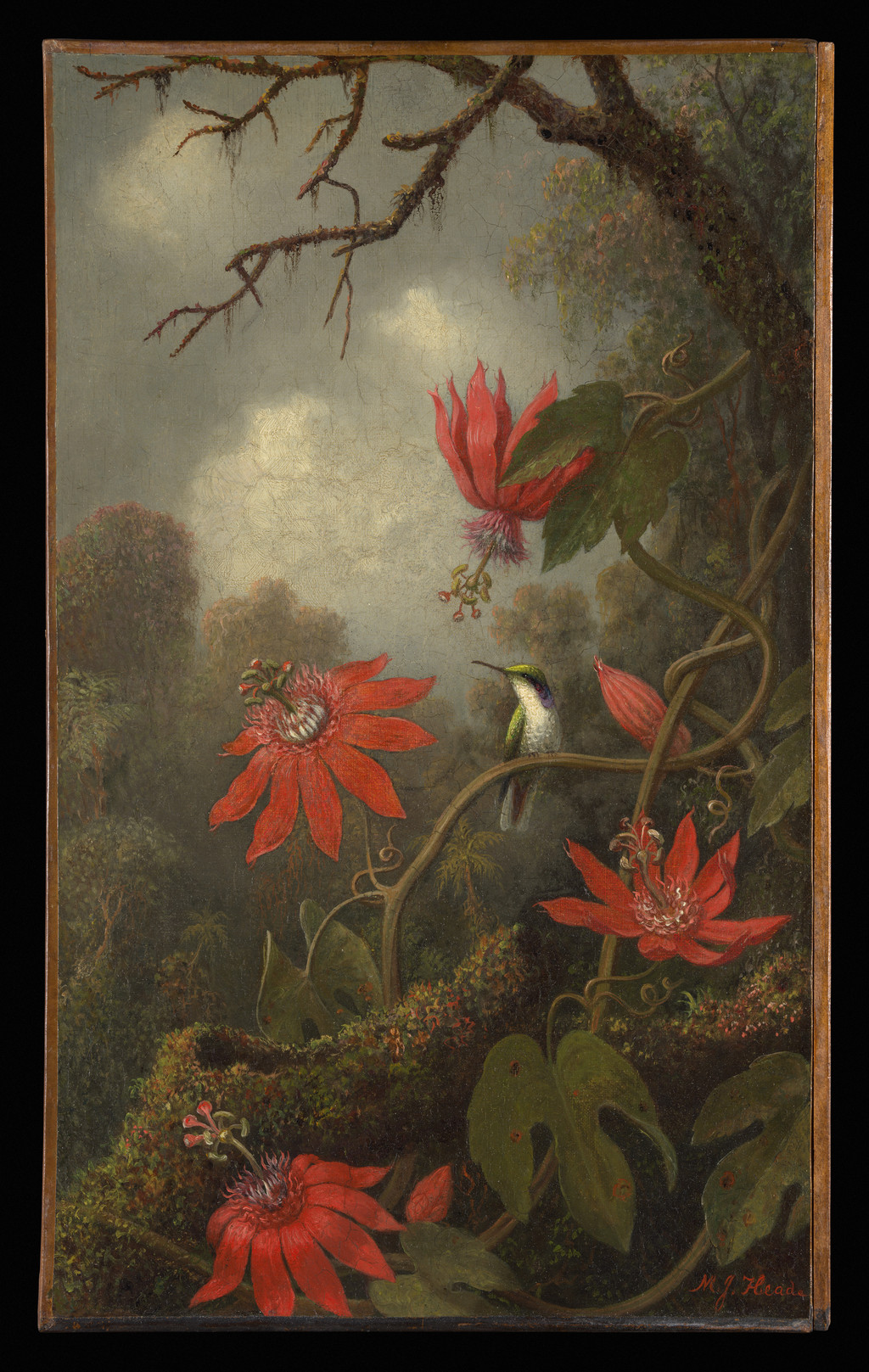
The Met’s Hummingbird and Passionflowers, c.1875–85, provides another vertical comparison. A perched bird sits among red blossoms, buds and tendrils. The arrangement supports discussion of its forms without requiring an unsupported species identification or a claim that the bird is feeding.[8]
Together these works show different ways to combine close subjects with receding space. They are neither interchangeable bird portraits nor purely tabletop still lifes. The hummingbirds and orchids overview considers the composed habitats and the limits of interpreting them as botanical records.
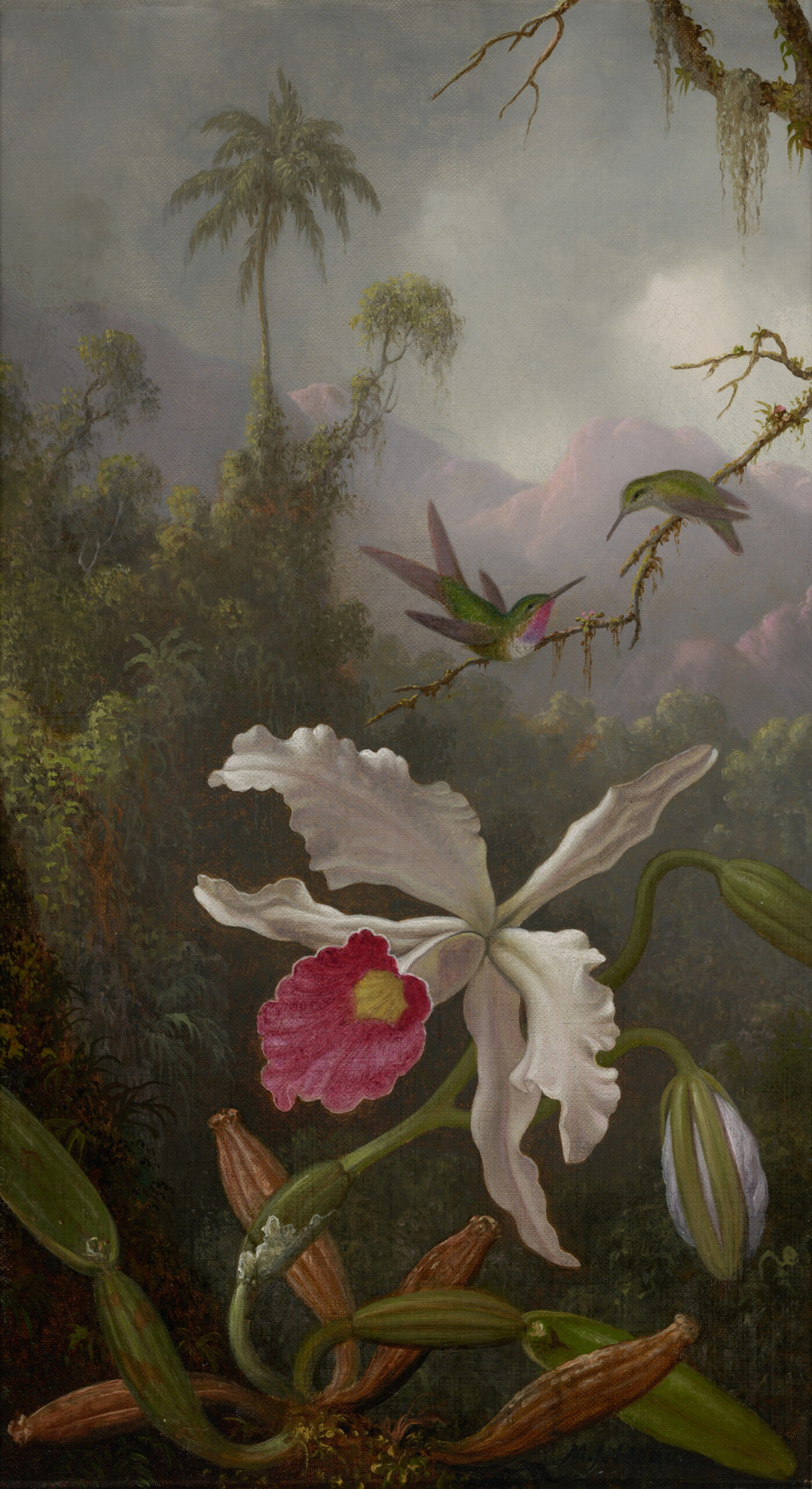
Martin Johnson Heade, Two Hummingbirds Above a White Orchid, c.1875–90. Oil on canvas, 18 1/8 × 10 1/8 inches. Amon Carter Museum of American Art, Fort Worth, 1981.33. Image source. Public domain. Resized only; native appearance preserved.
Wider tropical landscapes and later signatures
The tropical work also includes pictures whose main subject is a landscape. RISD’s Brazilian Forest, dated 1864 and accessioned as 68.052, provides one example. The museum’s published label identifies a work completed in London after the Brazilian visit. Its execution place therefore differs from the country represented.[17]
The Thyssen’s Sunrise in Nicaragua, 1869, offers another. Kenneth W. Maddox’s entry connects its subdued view with material from Heade’s 1866 journey. The interval between travel and the painting date allows comparison with later studio arrangements without assuming that every dated canvas was painted on the spot.[18]
Maddox also discusses Mark Twain’s criticism of an earlier Lagoon in Nicaragua. That review belongs to the earlier picture, not automatically to Sunrise. Keeping the two titles distinct prevents reception evidence from being assigned to the wrong canvas.
These landscapes broaden the route through the tropical material. Compare a forest, a harbour and a distant sunrise before turning to the much closer scale of birds and flowers. The travel article connects these examples with the separate journeys and later work.
Watch: Martin Johnson Heade
Choose a film to explore the artist’s work, its interpretation and its wider setting.
Museum Minute: Heade Hummingbirds
A brief Shelburne Museum introduction to Heade’s hummingbird paintings.
Watch on YouTubeCut flowers and changing still-life settings
Floral painting began well before permanent Florida residence. Brock’s study follows early vase arrangements and apple blossoms, including works dated from 1860 through 1869. Pale flowers, containers, tabletop edges and dark backgrounds provided a range of compact pictorial relationships.[2]
Later magnolias frequently lie on folded velvet. The NGA’s Giant Magnolias on a Blue Velvet Cloth, c.1890, includes two open flowers and a closed bud. The Chicago Magnolias on Light Blue Velvet Cloth, c.1885–95, contains four floral forms: two prominent open flowers, a partly concealed pale blossom and a lower bud.[1][5]
These are separate canvases with different arrangements and collecting histories. Blue cloth in both titles does not identify a single painting. Comparing the positions of flowers, stems and folds makes the distinction visible before moving to the individual records.
The flowers and magnolias article connects these later arrangements with the earlier still lifes. It also distinguishes scholarly interpretations, such as the analogy with reclining figures, from a fixed meaning declared by the artist.
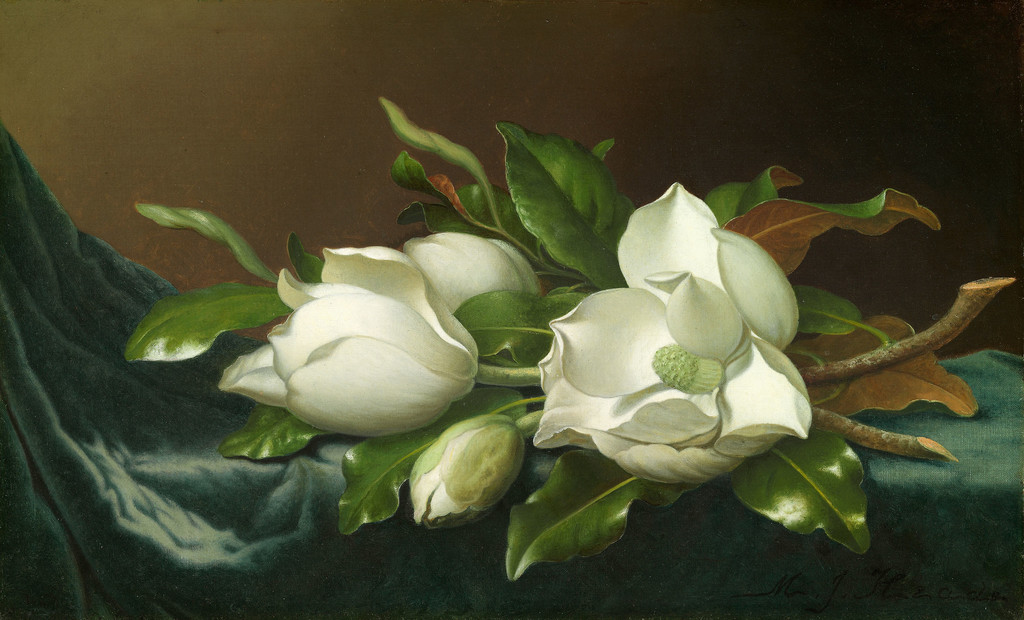
Martin Johnson Heade, Magnolias on Light Blue Velvet Cloth, c.1885–95. Oil on canvas, 38.6 × 61.8 cm. Art Institute of Chicago, 1983.791. Purchased with funds provided by Gloria and Richard Manney; Harold L. Stuart Endowment Fund; Art Institute of Chicago. Image source. CC0 / Public domain. Resized only; native appearance preserved.
Titles, dates and collection identities
Approximate dates are part of the evidence. A range such as c.1875–90 cannot establish an exact journey, studio location or commission year. Subjects could remain productive long after the observation or travel that first contributed to them.[1][4]
Titles can also change. The Met storm appears under Coming Storm in older literature, while the NGA Cattleya’s historical title includes the word Brazilian. The collection, accession and corresponding composition help reconcile such variations. Similar wording without those identifiers leaves room for confusion.[1][4][7]
Current records should be read alongside older scholarship. An exhibition catalogue may explain a painting in depth yet use a former owner or earlier dating. Those historical details remain valuable when dated and attributed; they should not silently replace a later institutional identity.
Choosing an illustrated route
Begin with a subject that offers a clear comparison. Marshes connect working activity with weather; the coast places threatening skies beside calmer harbours. Tropical pictures contrast broad views with closely arranged birds and flowers, while magnolias turn attention to cut forms, fabric and interior space.
The thirteen artwork articles supply extended studies of exact works. The collected-object directory adds a bounded group of institutionally documented comparisons, including some without a dedicated illustrated article. It is a browsing selection rather than a complete catalogue raisonné.
For questions about making, the style and technique article connects published conservation findings with particular objects. For changes across the life, the biography separates travel, residence and later execution. Together these routes make it possible to compare recurring motifs while preserving the identity of each painting.
Artworks directory
A collected selection of 26 individually identified museum paintings, including thirteen extended artwork studies. This is a bounded directory, rather than a complete catalogue raisonné. Two Boston entries retain dates from the 2002 conservation study. Links open a companion article where available, otherwise the cited institutional record or publication; unillustrated objects remain included.
Frequently Asked Questions
It is a bounded selection of verified institutional records, designed to support comparison and further reading.
Discussion
Look again at the images and ideas explored in Martin Johnson Heade Paintings. These editorial prompts invite your observations.
Reader Insights
Which two works make the difference between a title and an exact object clearest?
What changes between the broad coastal views and narrow bird pictures?
Which institutional comparison would you explore beyond the illustrated selection?
Join the Conversation
Share a detail, comparison or question about Martin Johnson Heade Paintings below.
References
- Franklin Kelly, American Paintings of the Nineteenth Century, Part I, NGA, 1996, printed pp.287–298. Career breadth, Rio, Cattleya, magnolia and publication project. View source
- Charles M. Brock, American Masters from Bingham to Eakins: The John Wilmerding Collection, NGA, 2004, printed pp.67–74. Early flowers and Sunlight and Shadow. View source
- Sarah Cash, Corcoran Collection: American Paintings to 1945, printed pp.130–131 and notes p.266. Exact Marshfield, drawing and regional practices. View source
- Diana J. Strazdes, Heade entries, American Paradise, Met, 1987, printed pp.163–178. Historical titles, subject groups and studio compositions. View source
- Art Institute of Chicago, Magnolias on Light Blue Velvet Cloth, 1983.791. Current identity, date and four-form arrangement. View source
- Art Institute of Chicago, York Harbor, Coast of Maine, 1999.291. Quiet harbour and exact collection record. View source
- Met, Approaching Thunder Storm, 1975.160. Exact 1859 work. View source
- Met, Hummingbird and Passionflowers, 46.17. Exact c.1875–85 composition. View source
- Met, Newburyport Meadows, 1985.117. Current c.1876–81 dating. View source
- Tim Barringer, Object Lessons: American Painting at Yale, printed pp.1–17. Sudden Shower and working marsh. View source
- Amon Carter Museum, Thunder Storm on Narragansett Bay, 1977.17. Separate 1868 storm. View source
- Amon Carter Museum, Marshfield Meadows, Massachusetts, 1971.4. Separate marsh picture. View source
- Fulton, Newman, Woodward and Wright, “The Methods and Materials of Martin Johnson Heade,” JAIC, 2002. Exact MFA storm and object-specific technical evidence. View source
- Cynthia Haveson Veloric, “Hummingbirds, Emperors, and Railway Barons,” Nineteenth Century 36(2), 2016, printed pp.17–23. Publication, rediscovery and trial compositions. View source
- Crystal Bridges Museum, Blue Morpho Butterfly, 2006.92. Exact related work and collection identity. View source
- Amon Carter Museum, Two Hummingbirds above a White Orchid, 1981.33. Tall composition and c.1875–90 date. View source
- RISD Museum, published label for Brazilian Forest, 68.052, printed pp.100–101. London completion and exact collection identity. View source
- Kenneth W. Maddox, Thyssen, Sunrise in Nicaragua, CTB.1997.6. Exact 1869 work and the distinct earlier Lagoon review. View source
- Splash image source.
Martin Johnson Heade, Sudden Shower, Newbury Marshes, c.1865–75. Oil on canvas. Yale University Art Gallery, 1989.51.1. Public domain / PD-Art. Resized only; native appearance preserved.
View source