 by Tom Gurney
Tom Gurney BSc (Hons) is an art history expert with over 20 years experience
Email: tomgurney1@gmail.com / Phone: +44 7429 011000
Martin Johnson Heade’s Flowers and Magnolias: Introduction
Martin Johnson Heade painted flowers in several kinds of setting: bouquets in vases, smaller studies of blossom patterns, tropical flowers with birds, and cut magnolias spread across velvet. The changes involve more than a choice of plant. Containers, tabletops, cloth, scale and background all help organise the pictures. His still lifes developed alongside landscape painting, and scholarship identifies exchanges between the two practices. The early bouquets and later magnolias consequently offer a useful way to follow a long, overlapping interest in natural forms.[1][2]
At a Glance
- Early examplesStill Life with Wine Glass (1860), roses and heliotrope (1862), apple blossoms (1867), mixed bouquet (1869)
- Later subjectsMagnolias, roses and other flowers in interior arrangements
- Important settingHeade’s St. Augustine years, beginning in 1883
- Illustrated comparisonsNGA Giant Magnolias and Chicago Magnolias on Light Blue Velvet Cloth
- Technical evidenceSpecific examinations, with findings attached to individual canvases
- InterpretationFloral symbolism and reclining-figure analogies remain scholarly readings
Contents
- Early bouquets and the tabletop
- White flowers and white sails
- Current identities of the early group
- Apple blossoms and repeated motifs
- The cut magnolia and the cloth
- Similar titles, different canvases
- Technical evidence belongs to particular works
- Flowers, interiors and natural history
- Symbolism and the limits of intention
- Annotated details
Early bouquets and the tabletop
Charles M. Brock’s NGA catalogue study brings together four still lifes from 1860–69. They show flowers held in different vessels and set against carefully organised backgrounds. The group demonstrates how Heade could reconsider a familiar domestic subject through light, scale and the relationship between natural and manufactured forms.[1]
In Brock’s account of Still Life with Wine Glass, organic flower shapes contrast with the tall vessel’s symmetry and the tabletop’s horizontal lines. He considers the table’s distant-looking edge as a source of uncertain scale, allowing the blossoms to seem unusually large within their setting.[1]
His discussion of Roses and Heliotrope in a Vase on a Marble Tabletop turns to a different solution. Light defines the vessel, while a pulled-back curtain establishes a threshold into the arrangement. Flower, container, shadow and tabletop are made to occupy a more clearly articulated space.[1]
The two later bouquets vary the problem again. Apple Blossoms in a Vase enlarges the floral arrangement against a dark background, while Still Life with Roses, Lilies, and Forget-Me-Nots in a Glass Vase spreads twisting flowers towards the canvas’s edges. These descriptions come from Brock’s work-specific analyses.[1]
The vessels are not neutral accessories. Their shape, colour and reflection can oppose or reinforce the flowers’ more irregular forms. A tabletop gives the bouquet a physical position while also introducing a horizontal line that can behave almost like a small landscape horizon.
Annotated Details from Martin Johnson Heade’s Flowers and Magnolias
The numbered points identify visible features discussed in this article. Return from each detail to the whole composition. The captions keep each work’s identity, date and medium separate.
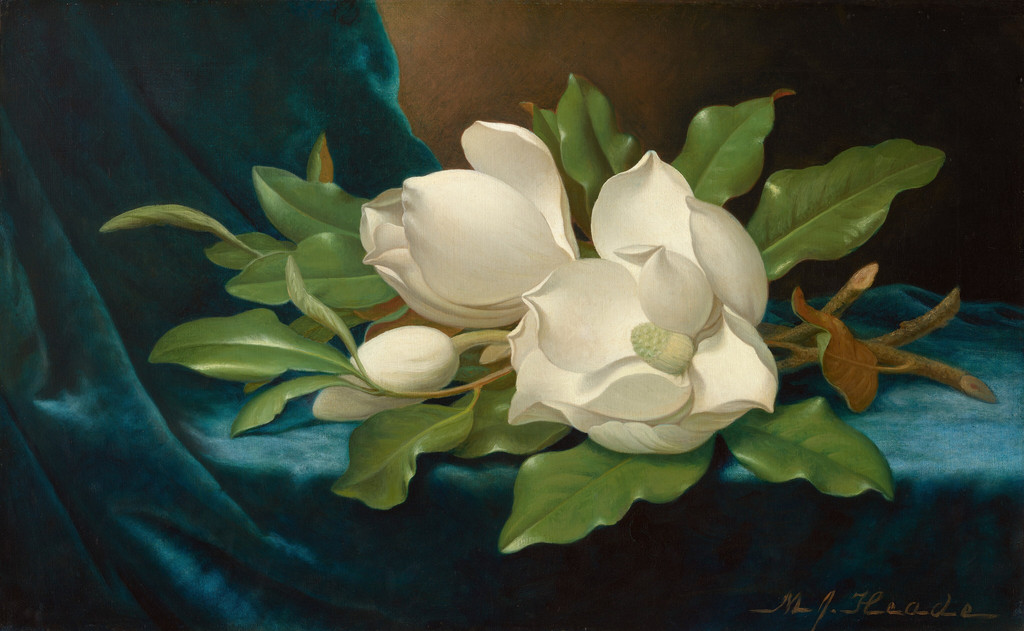
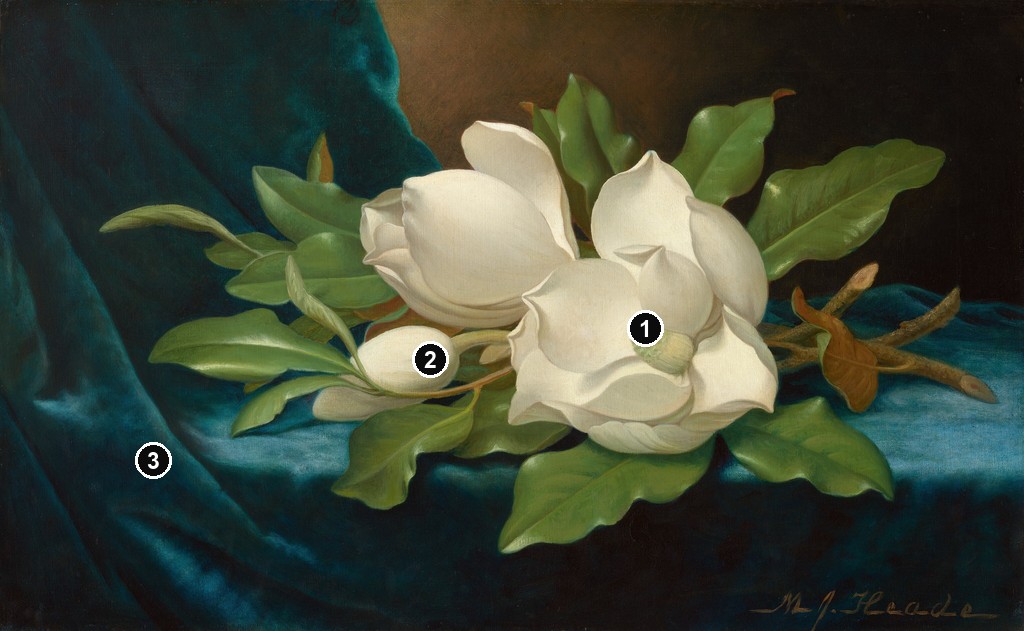
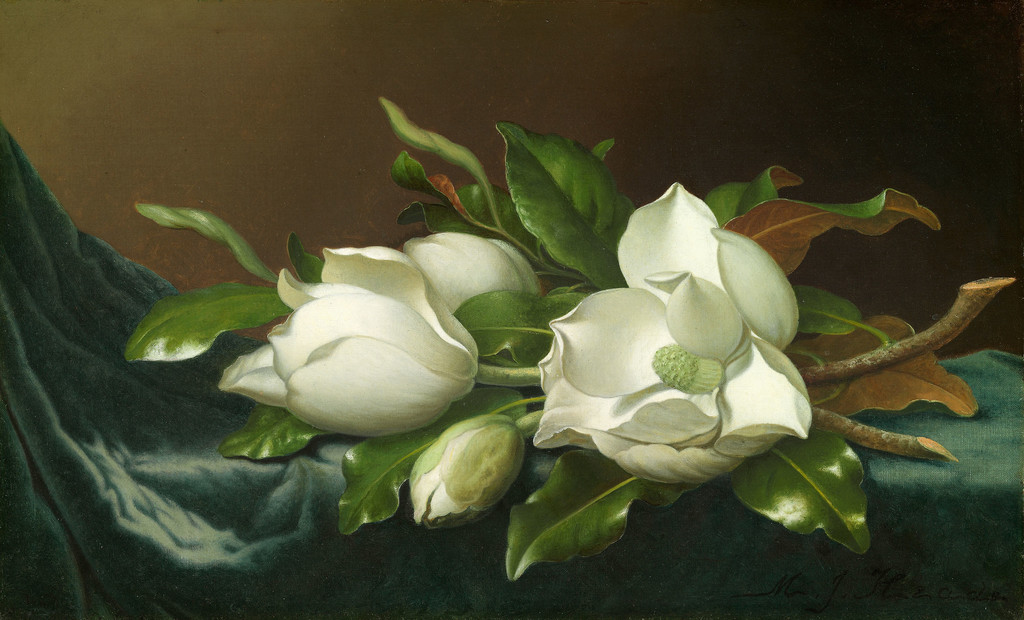
Giant Magnolias on a Blue Velvet Cloth
Martin Johnson Heade, Giant Magnolias on a Blue Velvet Cloth, c.1890. Oil on canvas, 38.4 × 61.5 cm. National Gallery of Art, 1996.14.1. Gift of The Circle of the National Gallery of Art in Commemoration of its 10th Anniversary; National Gallery of Art. Image source. CC0 / Public domain. Resized only; native appearance preserved.
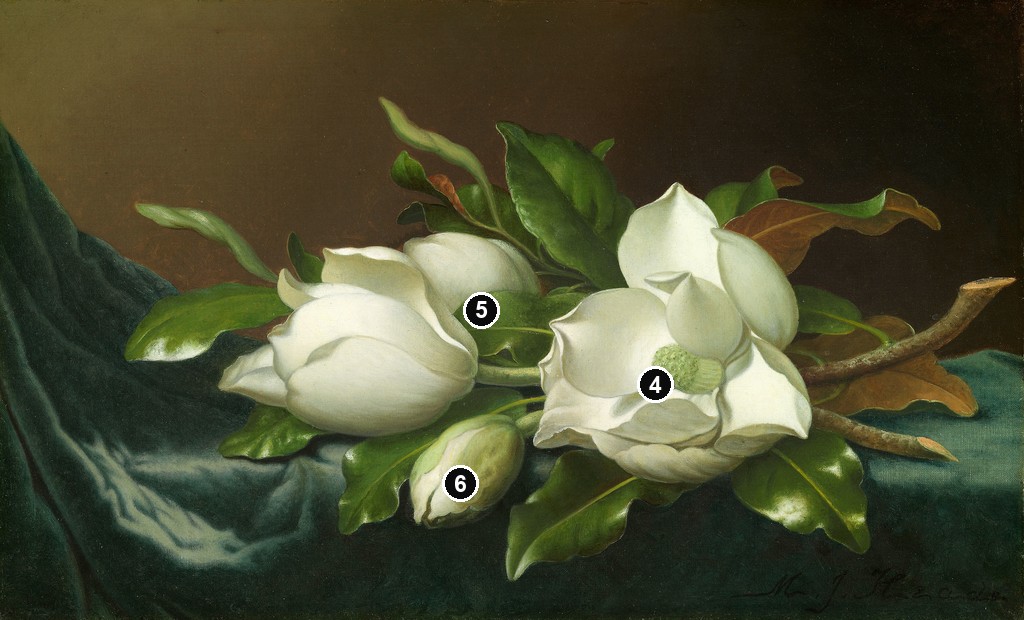
Magnolias on Light Blue Velvet Cloth
Martin Johnson Heade, Magnolias on Light Blue Velvet Cloth, c.1885–95. Oil on canvas, 38.6 × 61.8 cm. Art Institute of Chicago, 1983.791. Purchased with funds provided by Gloria and Richard Manney; Harold L. Stuart Endowment Fund; Art Institute of Chicago. Image source. CC0 / Public domain. Resized only; native appearance preserved.
Details from MARTIN JOHNSON HEADE’S FLOWERS AND MAGNOLIAS
Compare the cropped details with the complete images above. Notice how their colours, shapes and positions contribute to the larger compositions.
Giant Magnolias on a Blue Velvet Cloth
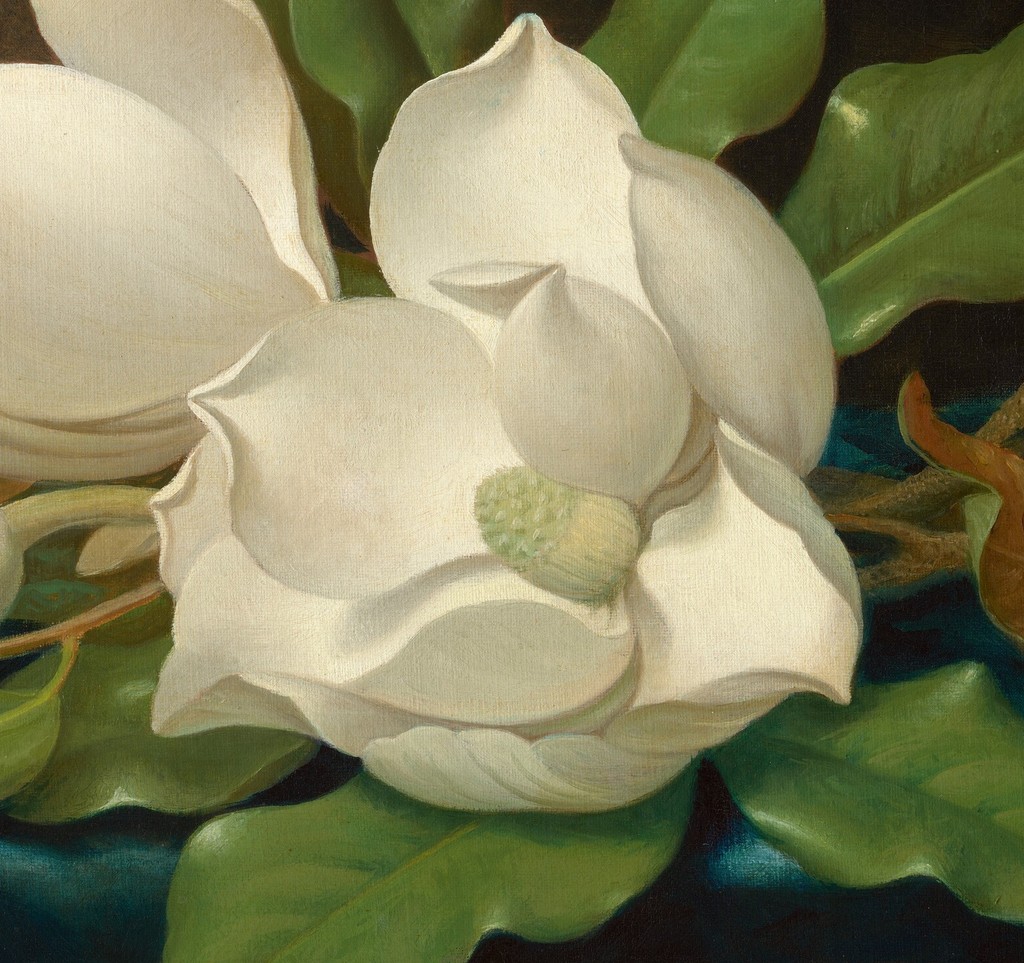
Open magnolia centre
Pale petals surround the greenish centre of the open foreground magnolia. Their overlapping curves create depth within the bright flower.
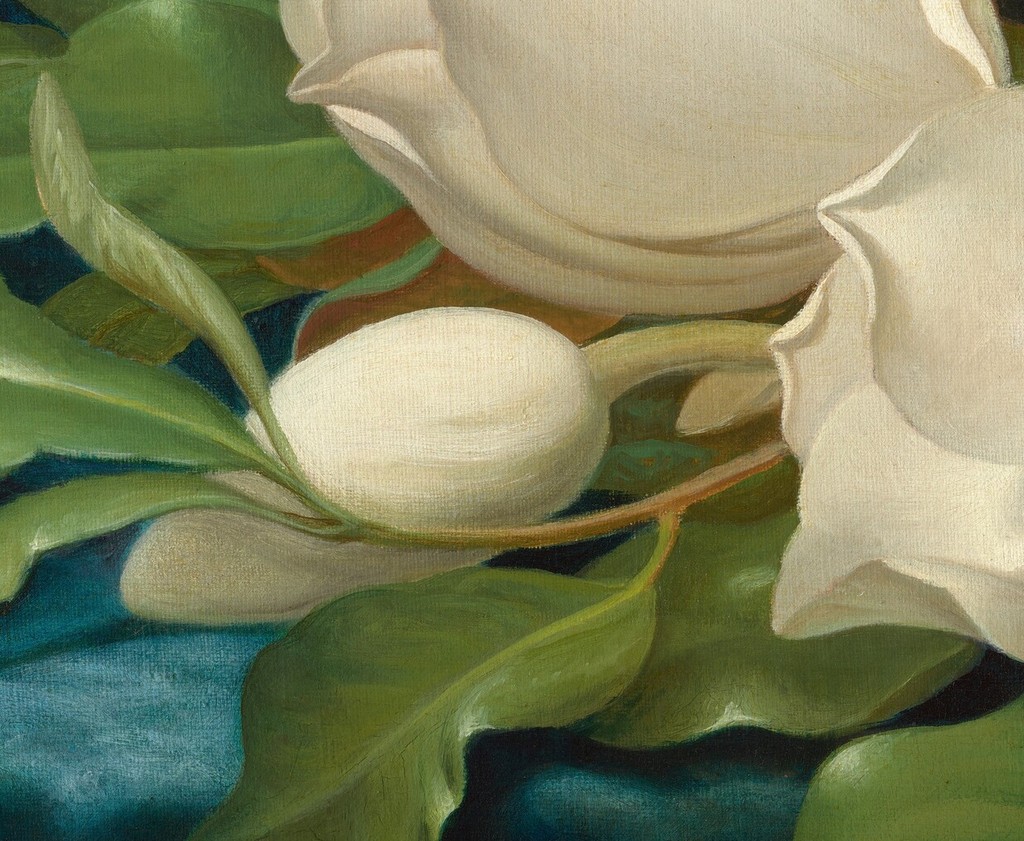
Closed bud and leaves
A closed pale bud lies beside broader green leaves. Its rounded surface contrasts with the more open petals above.
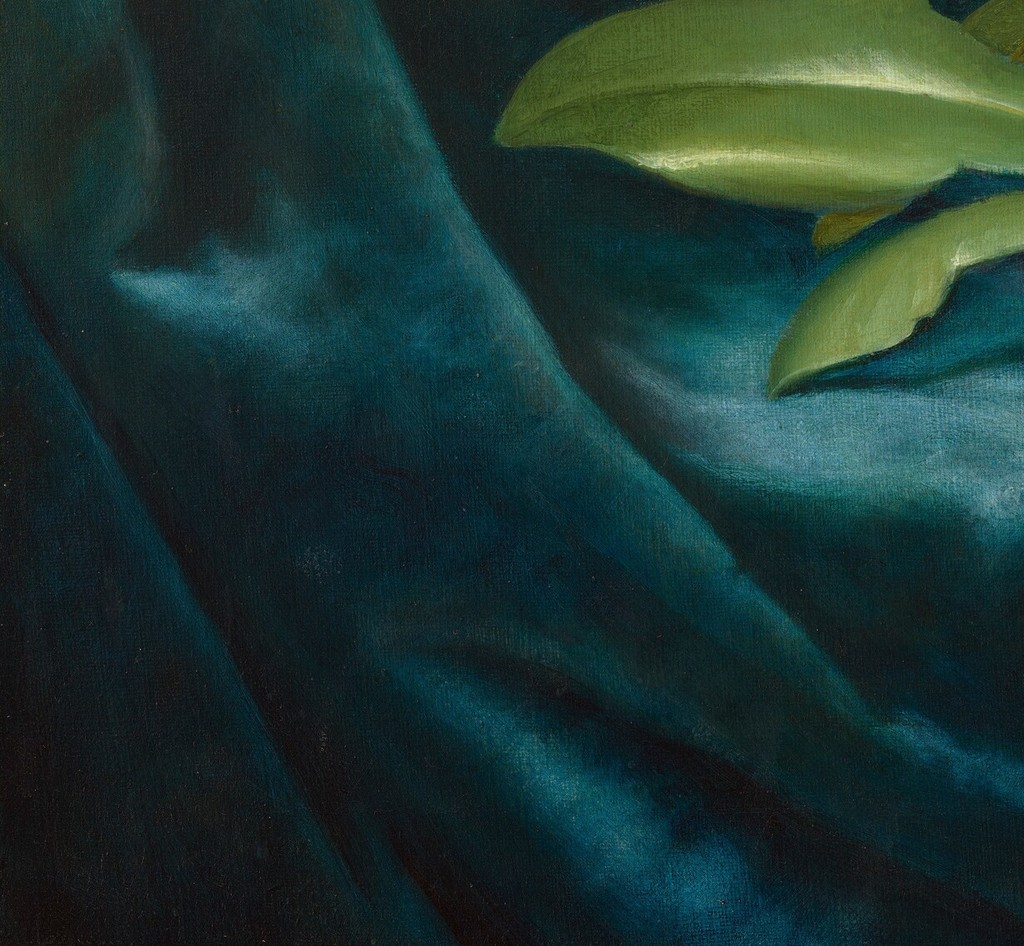
Blue cloth folds
Blue-green folds alternate between shadow and broad light. Their changes in tone support the flowers without becoming a flat background.
Magnolias on Light Blue Velvet Cloth
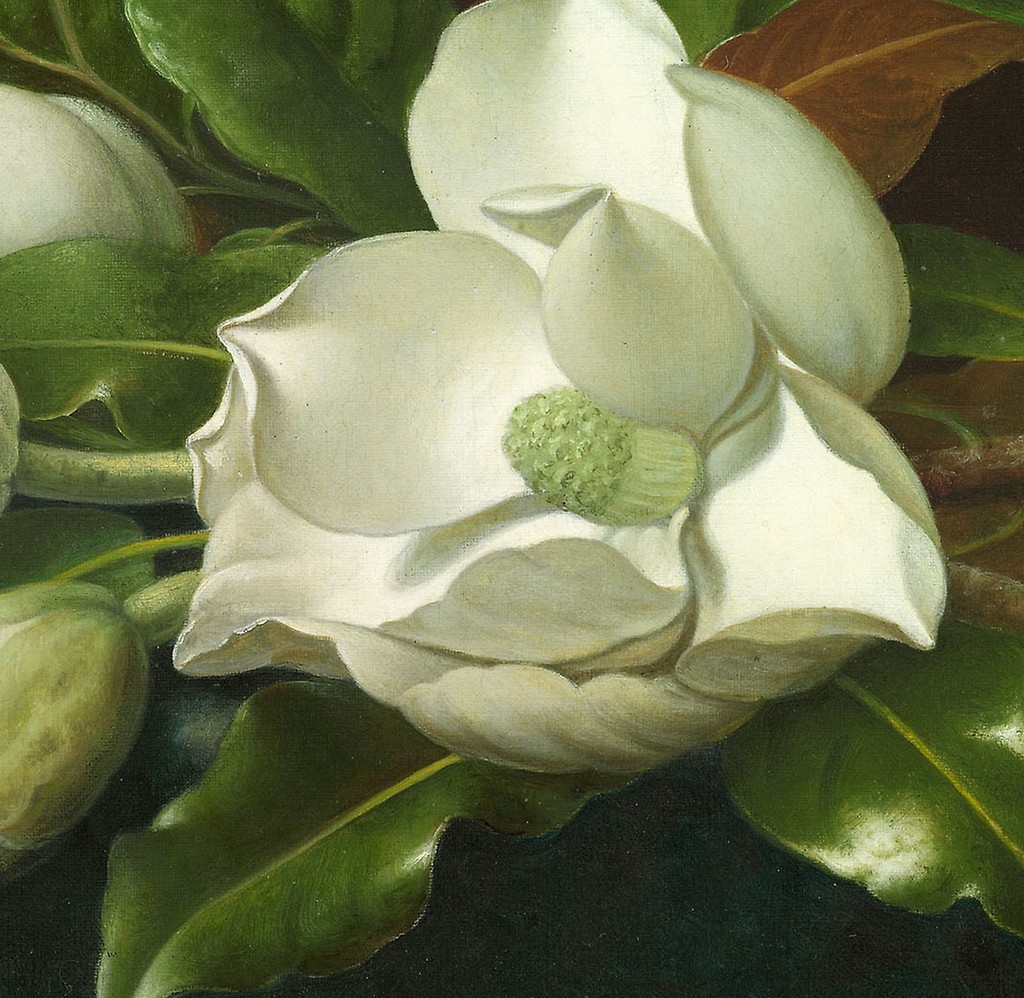
Open right-hand flower
The open right-hand magnolia exposes its greenish centre amid curved pale petals. The flower projects over the darker foliage.
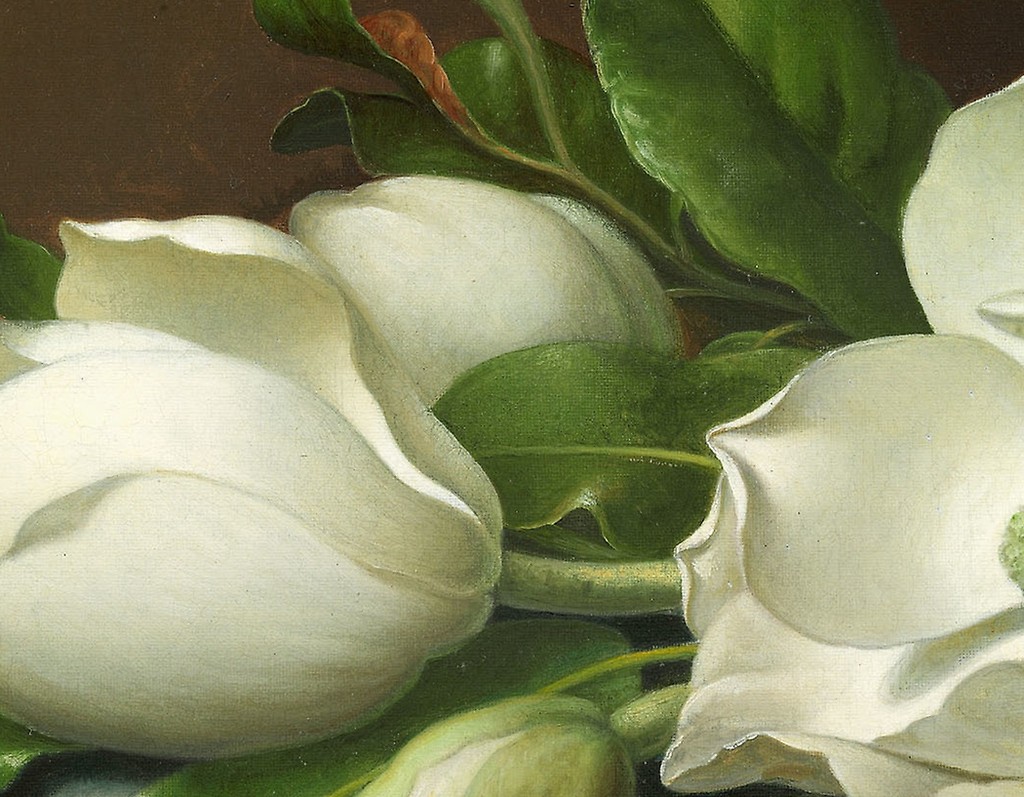
Partly concealed blossom
A rounded pale blossom appears behind the prominent left-hand flower and foliage. Its partly concealed form contributes to the layered arrangement.
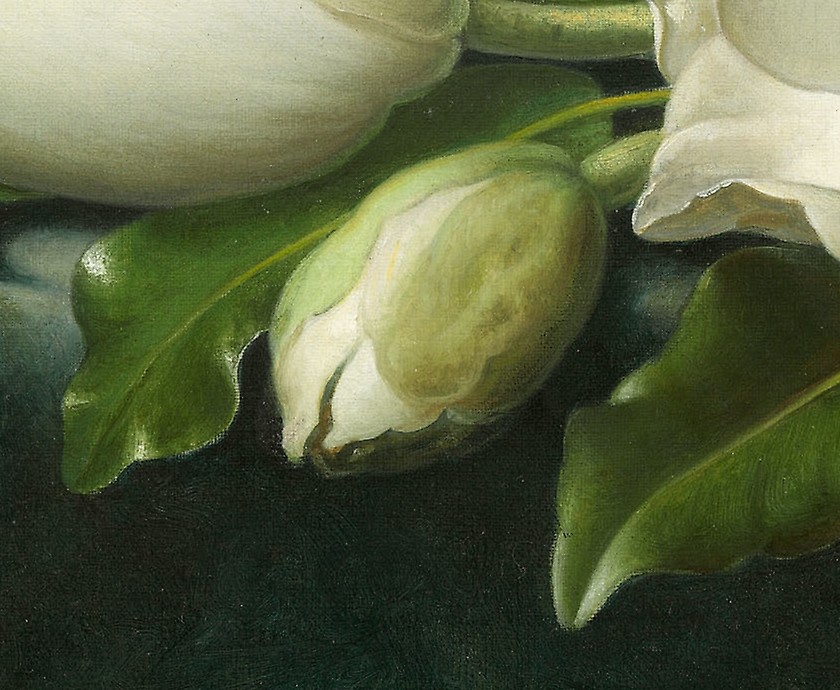
Closed lower bud
A closed bud lies low in the arrangement beside the cloth. Its compact form differs from the open flowers.
White flowers and white sails
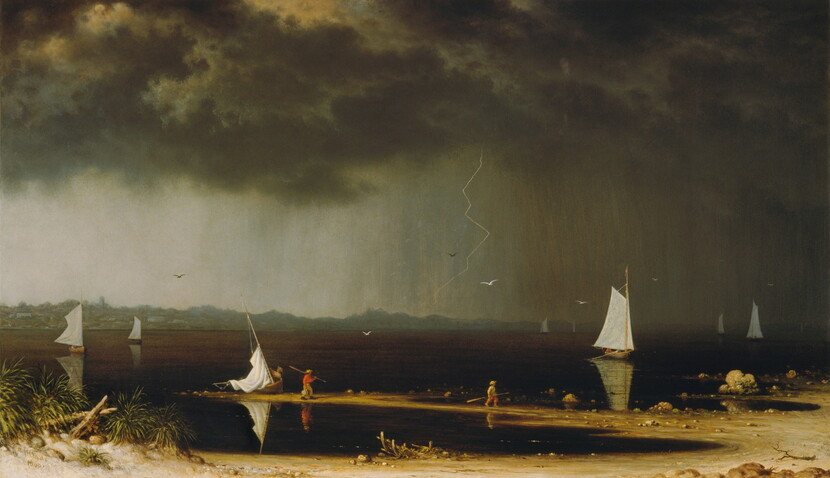
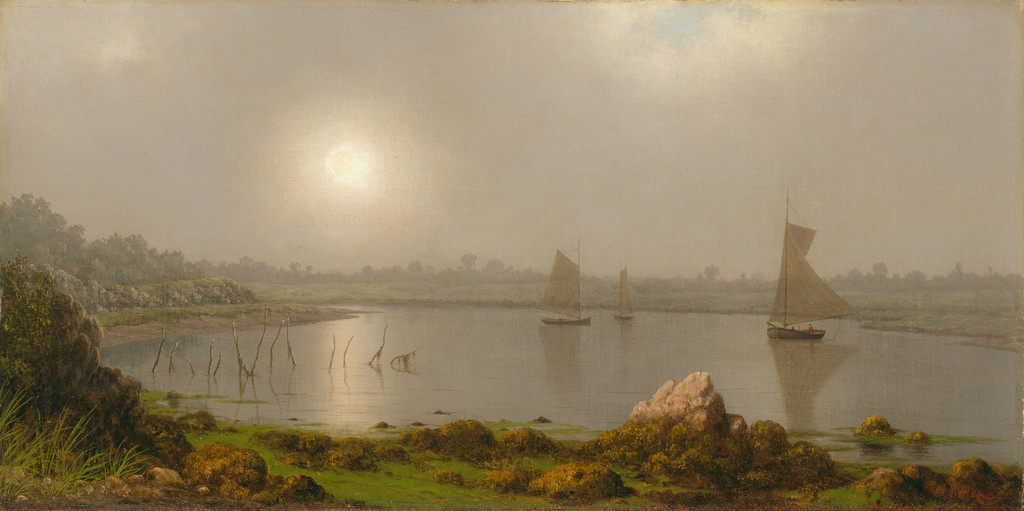
Brock makes a more specific connection between the 1869 bouquet and Heade’s storms. White lilies against a dark background can produce an effect comparable to pale sails against dark water and cloud in Thunder Storm on Narragansett Bay. The subjects differ, but the relationship between light forms and darker surroundings is comparable.[1]
That observation helps readers compare genres without collapsing them. A flower does not become a boat, and an interior does not become a coast. Instead, a painter working across both subjects can reconsider similar problems of contrast, spacing and visual emphasis. Brock’s account presents this as a crosscurrent within Heade’s practice, rather than a claim that one exact picture supplied a tracing for another.[1]
Current identities of the early group
The four paintings appear in the NGA’s current selected-work listing. Still Life with Wine Glass is 2025.89.7; Roses and Heliotrope in a Vase on a Marble Tabletop is 2025.89.9; Apple Blossoms in a Vase is 2025.89.6; and the 1869 mixed bouquet is 2025.89.8.[6]
Those current identities update the collecting context of the 2004 Wilmerding catalogue. The older publication remains useful for analysis, but should not be taken as proof that the works retain their earlier private-collection status. Exact titles and dates allow readers to follow the same objects across those different records.[1][6]
The group also varies in support. Brock records the first three as oil on board and the 1869 bouquet as oil on canvas. The distinction is physical as well as chronological: flower painting did not require Heade to use one support for every arrangement.[1]
Apple blossoms and repeated motifs
Brock’s discussion of apple blossoms shows how a series can develop through small changes. He considers variations involving a vase, a branch, a tabletop and a hummingbird. Related flower patterns could be extended, rotated or combined differently across pictures.[1]
Repetition in this account is a method of exploration. Changing one branch or adding leaves can alter balance, scale and the direction of movement. A familiar motif remains available for comparison while its surrounding space changes.
Some variations also cross the boundary between still life and landscape. A flower close to a hummingbird and open air no longer has the same setting as a bouquet inside a vessel. The shared botanical interest can support more than one pictorial category.[1]
Brock argues that such serial working combines detailed realism with attention to the more abstract qualities of form and arrangement. That interpretation helps explain why a naturalistically described flower can occupy an unfamiliar or slightly indeterminate space.[1]
The cut magnolia and the cloth
The late magnolia paintings often remove the vase from the main arrangement. Detached blossoms, leaves and stems lie across fabric, allowing the group to spread laterally. The botanical material becomes directly related to a soft supporting surface rather than a rigid container.[2]
In the NGA’s Giant Magnolias on a Blue Velvet Cloth, two open flowers and a closed bud occupy different positions among broad leaves. Cut stems extend to the right, while a rising cloth fold holds the left side of the composition.[2]
The pale petals, glossy leaves and darker fabric provide three distinct kinds of surface. Each catches light differently. The arrangement depends on those differences, with bright floral forms becoming more substantial through their relationship to deeper surrounding shadows.
The cloth contributes movement as well as colour. Its folds bend beneath and around the flowers, connecting separate botanical forms through one continuous surface. They provide a different rhythm from the leaves’ pointed tips and the stems’ branching lines.
The flowers’ detached state is also visible. The painting does not present a magnolia tree outdoors; cut ends and the indoor background establish an arranged still life. Natural forms have been selected and placed for a close encounter.
Watch: Martin Johnson Heade
Choose a film to explore the artist’s work, its interpretation and its wider setting.
Museum Minute: Heade Hummingbirds
A brief Shelburne Museum introduction to Heade’s hummingbird paintings.
Watch on YouTubeSimilar titles, different canvases
The Art Institute’s Magnolias on Light Blue Velvet Cloth is a different picture. Two prominent open flowers are joined by a rounded blossom partly concealed behind the left one and a closed foreground bud. Its four-form arrangement differs from the NGA’s two-open-flower-and-bud group.[3]
Chicago’s accession is 1983.791 and its approximate date c.1885–95. The NGA canvas is 1996.14.1, dated c.1890. Similar names and overlapping chronology make careful identification useful, especially when images appear without full captions.[2][3]
The cloth also differs in its arrangement and illumination. Chicago’s folds are shaded towards green-grey, while the NGA work includes particularly vivid blue passages. Neither title requires every part of the velvet to appear equally light or uniformly blue.
Kelly discusses another Giant Magnolias at the Norton gallery in Shreveport, with three open blossoms. He relates it and the NGA painting to a St. Augustine study but cannot establish their order of execution. The changing flower states do not prove that the finished pictures were conceived as pendants.[2]
Martin Johnson Heade, Magnolias on Light Blue Velvet Cloth, c.1885–95. Art Institute of Chicago, 1983.791. Purchased with funds provided by Gloria and Richard Manney; Harold L. Stuart Endowment Fund; Art Institute of Chicago. Image source. CC0 / Public domain. Resized only; native appearance preserved.
Technical evidence belongs to particular works
The NGA’s 1996 examination describes Giant Magnolias as a sequence of differently handled passages. Flowers were painted mainly wet into wet, followed by leaves and stems, deeper shadow glazes, background and adjusted velvet highlights. Probable graphite outlines are also recorded with qualification.[2]
This evidence makes the finished contrasts more intelligible. Bright petals and deep fabric shadows need not be produced by the same method. A visually unified still life can contain several kinds of paint application.
The findings belong to the NGA canvas. They do not establish an identical layer order or pigment mixture for Chicago’s work. Similar subject matter is a reason to compare paintings, rather than a substitute for examining each one.
The Timken Museum’s essay on The Magnolia Blossom, dated 1888, discusses a red edge around the pale flower and its role in creating a spatial effect. That is another work-specific account. Its red-fabric setting differs from the blue-cloth examples illustrated here.[4]
Flowers, interiors and natural history
Heade settled in St. Augustine in 1883 and continued to paint several subjects. Kelly places the late magnolias alongside greater stability and Henry Morrison Flagler’s patronage, while making room for continued landscapes and tropical pictures. The still lifes were part of an overlapping practice.[2]
Charlotte M. Porter’s Florida Museum essay discusses both flower pictures for interiors and Heade’s broader engagement with birds and natural history. The connection helps explain why closely described plants could appear in settings intended for domestic viewing rather than scientific classification alone.[5]
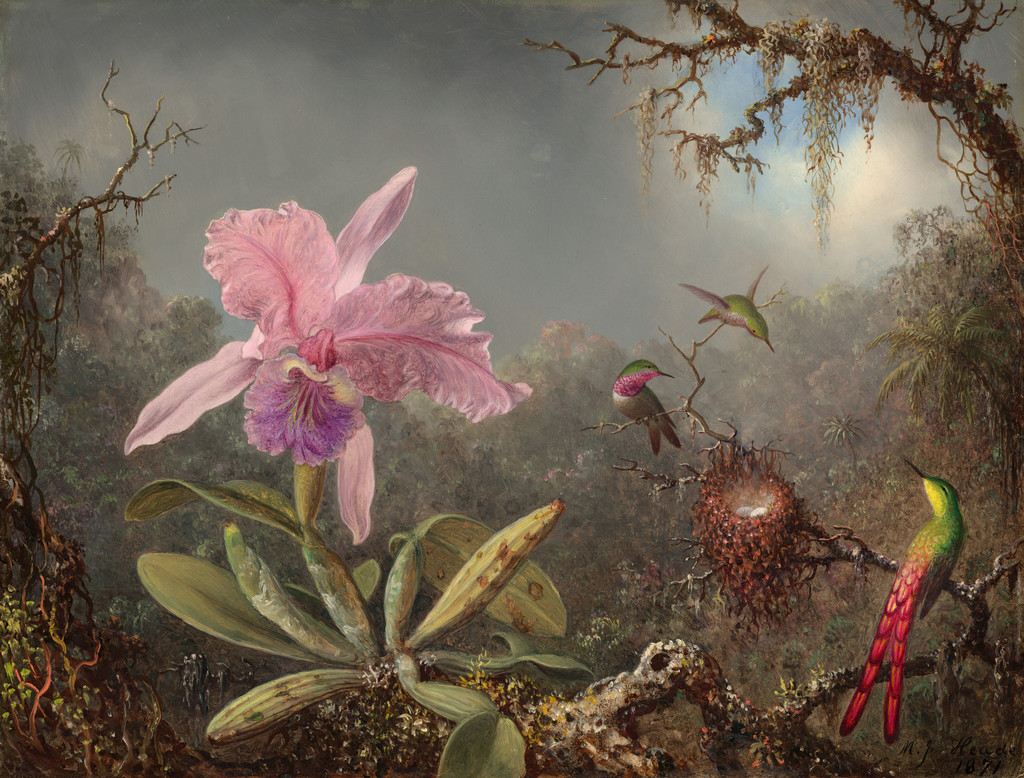
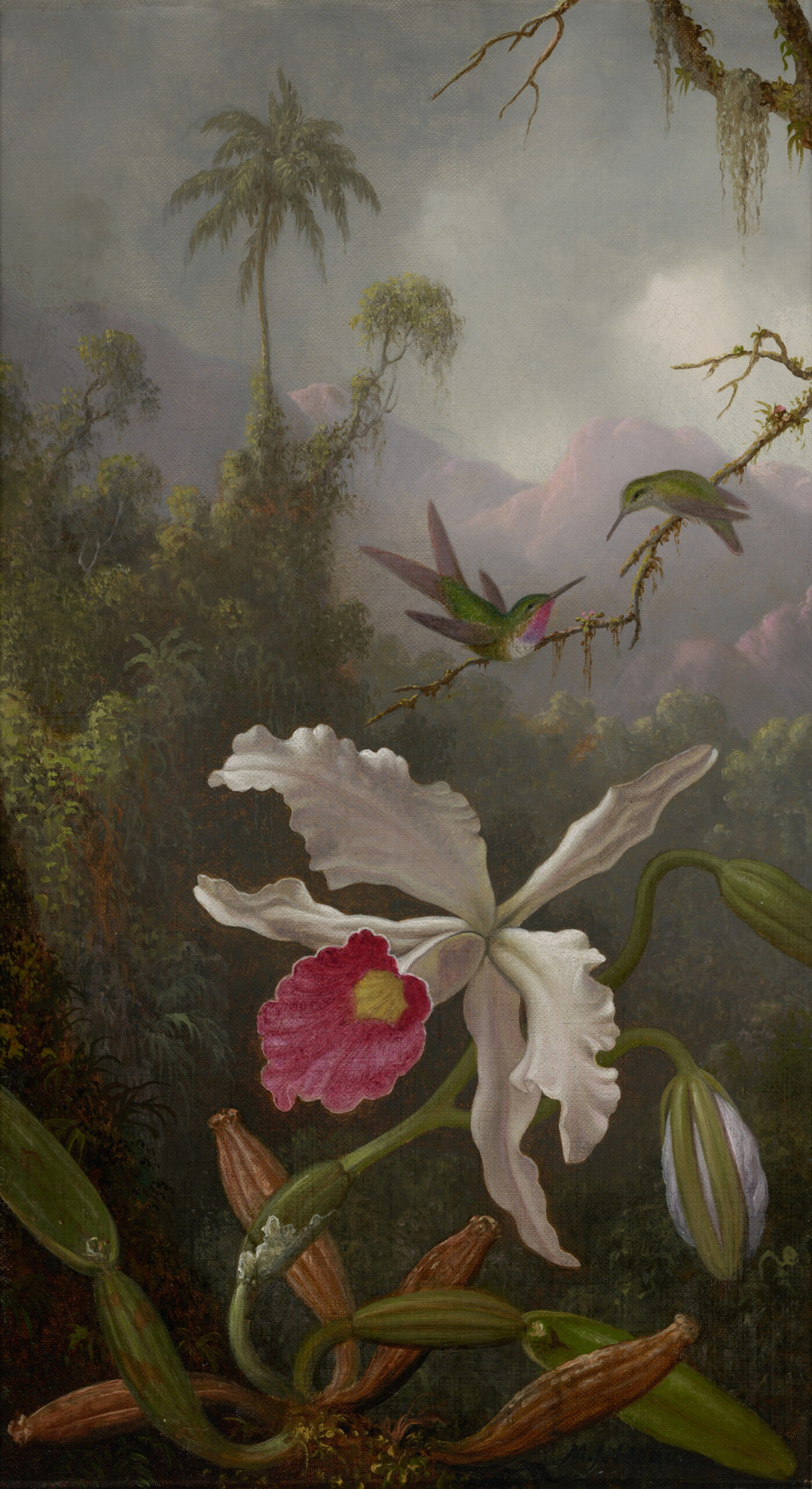
Heade’s hummingbirds and orchids carry that interest into constructed tropical spaces. The flowers remain prominent, but vines, birds, nests and distant vegetation give them relationships different from a cut magnolia lying on cloth.
The range is therefore important: a bouquet, a blossom study and a tropical grouping are related through subject and attention, but answer different compositional questions. Heade did not need to choose permanently between landscape and still life to develop either.
Symbolism and the limits of intention
Brock discusses interpretations drawn from Victorian flower language, but stresses that no universal code securely explains Heade’s choices. Different flowers and fallen blossoms may suggest narratives to later viewers without proving a specific message intended for each bouquet.[1]
Kelly likewise considers the sensuous quality of reclining magnolias and comparisons with figures on a couch. He leaves uncertainty about a specifically sexual intention. The Art Institute also uses an odalisque analogy in its account of the Chicago canvas.[2][3]
These readings can draw attention to curve, light and luxurious materials while remaining interpretations. The visible work also offers a substantial set of relationships without a fixed symbolic code: natural asymmetry against a vase, pale petals against leaves, cut stems across fabric, and repeated motifs in changing arrangements.
Artworks directory
A collected selection of 26 individually identified museum paintings, including thirteen extended artwork studies. This is a bounded directory, rather than a complete catalogue raisonné. Two Boston entries retain dates from the 2002 conservation study. Links open a companion article where available, otherwise the cited institutional record or publication; unillustrated objects remain included.
Frequently Asked Questions
No. Brock’s catalogue includes flower still lifes dated 1860, 1862, 1867 and 1869, well before the 1883 move to St. Augustine.[1]
The consulted scholarship discusses possible associations but does not establish a fixed code of Heade’s intentions for every flower and vessel.[1]
Discussion
Look again at the images and ideas explored in Martin Johnson Heade’s Flowers and Magnolias. These editorial prompts invite your observations.
Reader Insights
Which petal or cloth fold carries the strongest contrast?
What changes between flowers in a vase and cut magnolias on velvet?
How does distinguishing the two blue-cloth canvases affect your comparison?
Join the Conversation
Share a detail, comparison or question about Martin Johnson Heade’s Flowers and Magnolias below.
References
- Charles M. Brock, American Masters from Bingham to Eakins: The John Wilmerding Collection (NGA, 2004), printed pp.67–71. Four early still lifes, apple-blossom variations, landscape connections and interpretive limits. View source
- Franklin Kelly, American Paintings of the Nineteenth Century, Part I (NGA, 1996), printed pp.287–288 and 295–298. Late career, exact NGA magnolia and comparative technical evidence. View source
- Art Institute of Chicago, Magnolias on Light Blue Velvet Cloth, 1983.791. Current exact canvas, date, description and collecting identity. View source
- Timken Museum, “Martin Johnson Heade, The Magnolia Blossom, 1888”. Separate painting and work-specific red-edge discussion. View source
- Charlotte M. Porter, Florida Museum, “Visual Interests”. Interior floral pictures and wider natural-history interests. View source
- National Gallery of Art, current Martin Johnson Heade selected-work listing. Four early still lifes’ current titles, dates, supports and 2025 accessions, checked 8 October 2026. View source
- Splash image source.
Martin Johnson Heade, Giant Magnolias on a Blue Velvet Cloth, c.1890. National Gallery of Art, 1996.14.1. CC0 / Public domain. Resized only; native appearance preserved.
View source