 by Tom Gurney
Tom Gurney BSc (Hons) is an art history expert with over 20 years experience
Email: tomgurney1@gmail.com / Phone: +44 7429 011000
The Gems of Brazil by Martin Johnson Heade: Introduction
The Gems of Brazil was Martin Johnson Heade’s ambitious plan for an illustrated natural-history publication, developed around small tropical paintings during his 1863–64 journey to Brazil. The proposed book was never completed, but some trial colour prints were made. Paintings, proofs and later bird-and-orchid pictures therefore need to be distinguished. The project also has a complicated collecting history: a group rediscovered in London in 1981 has been associated with the original paintings, without every link in that association being certain.[1][3]
At a Glance
- ArtistMartin Johnson Heade (1819–1904)
- ProjectThe Gems of Brazil
- Starting contextBrazilian journey, 1863–64
- Intended formIllustrated publication using colour prints after paintings
- OutcomeBook incomplete; trial chromolithographs executed
- Important distinctionOriginal paintings, print compositions and individual impressions are different things
- Illustrated exampleBlue Morpho Butterfly, Crystal Bridges, 2006.92
Contents
- A publication project rather than a finished book
- Brazil, specimens and small paintings
- Imperial patronage and the twelve-picture display
- Butterflies as well as hummingbirds
- London and the problem of colour reproduction
- Rediscovery and uncertain group provenance
- Later orchid pictures are a different undertaking
- Annotated details
A publication project rather than a finished book
Heade intended the paintings to lead to a publication in which images and natural-history writing would work together. Franklin Kelly’s NGA catalogue account describes plans for chromolithographs after the oils, accompanied by text written by Heade. The paintings were thus more than a group of unrelated small pictures: they had a proposed role within a larger undertaking.[1]
That intention should not be confused with the existence of a completed book. A projected title, painted models and surviving trial prints can all belong to an unfinished publication. Modern reproductions sold under the series name do not establish that the original volume was issued.
There was nevertheless material progress. Kelly explicitly records a few executed chromolithographs. Cynthia Haveson Veloric’s later study identifies four reproduced compositions, now described as Brazilian Hummingbirds I–IV, and discusses working proofs. Saying that the book remained unpublished is accurate; saying that no prints ever existed would not be.[1][3]
Annotated Details from The Gems of Brazil
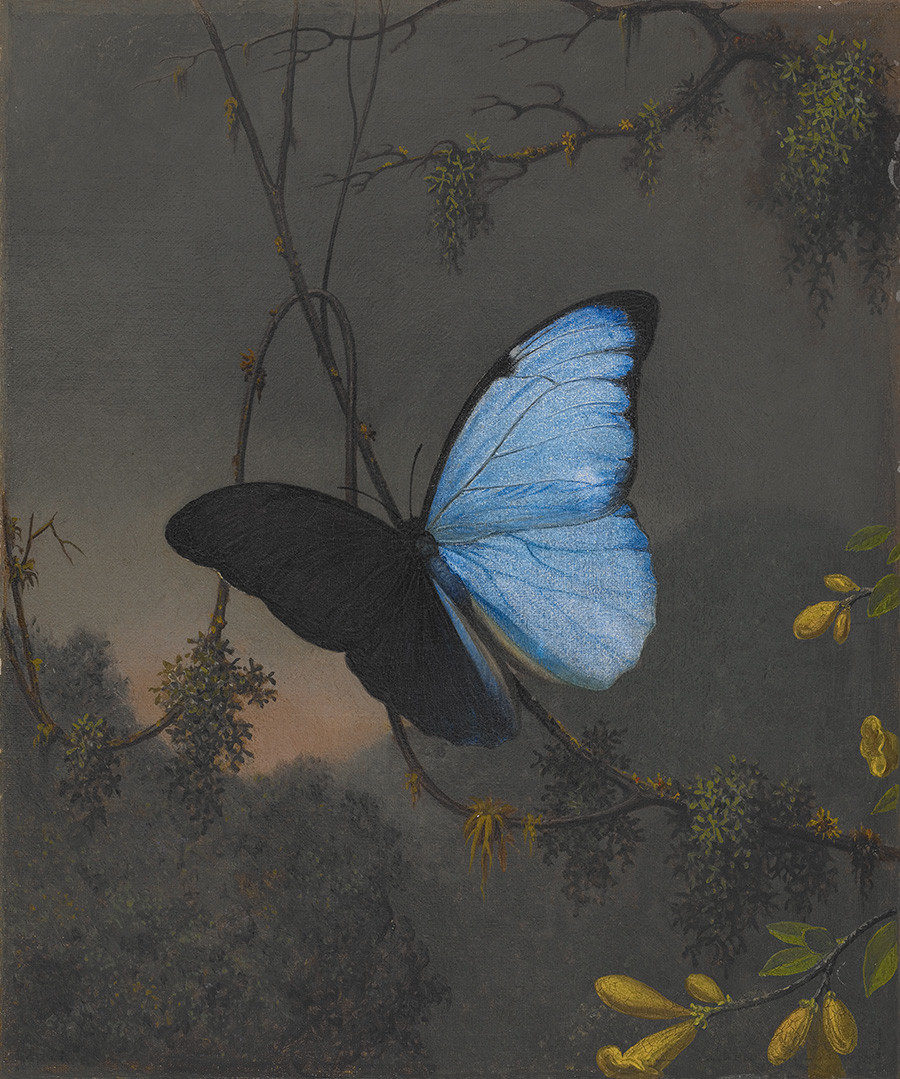
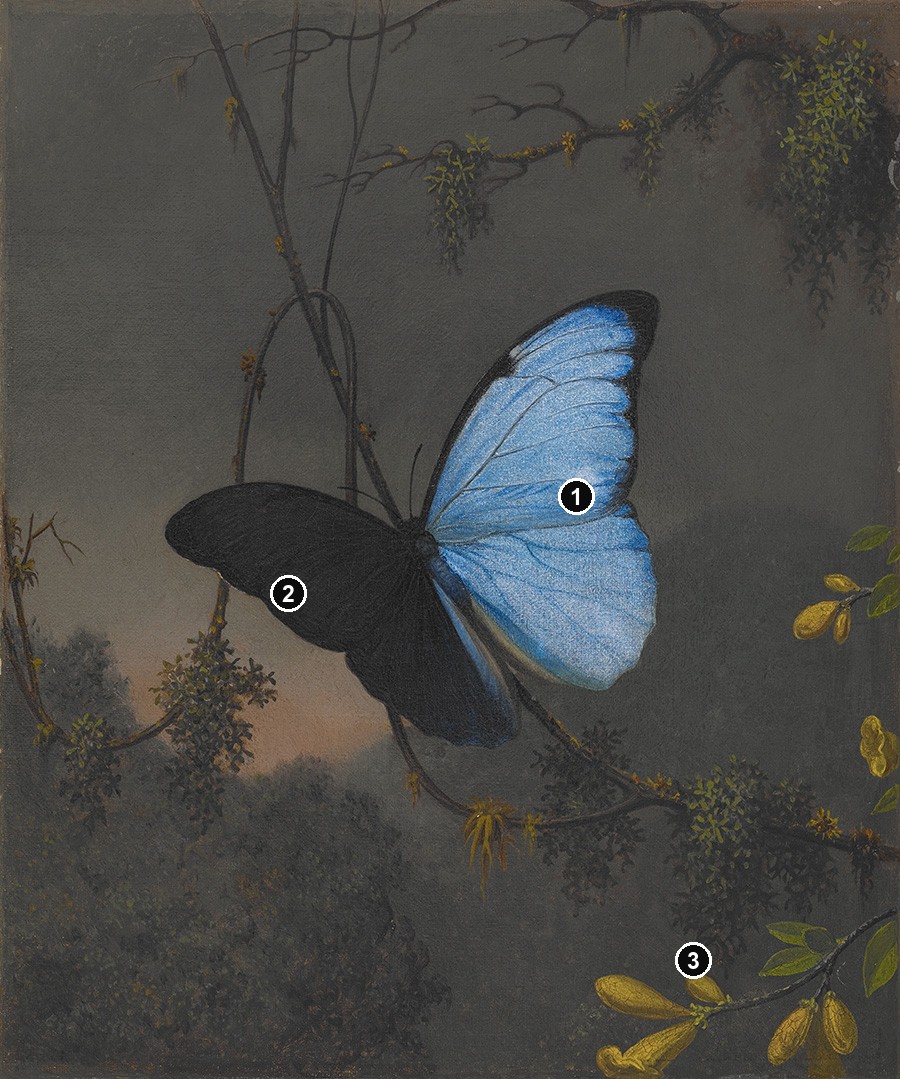
The numbered points identify visible features discussed in this article. Return from each detail to the whole composition. Martin Johnson Heade, Blue Morpho Butterfly, from The Gems of Brazil, c.1863–64. Oil on canvas. Crystal Bridges Museum of American Art, 2006.92. Complete native900-pixel-wide museum image; no enlargement. Crystal Bridges Museum of American Art; photography by Dwight Primiano. Image source. CC0 / Public domain. Resized only; native appearance preserved.
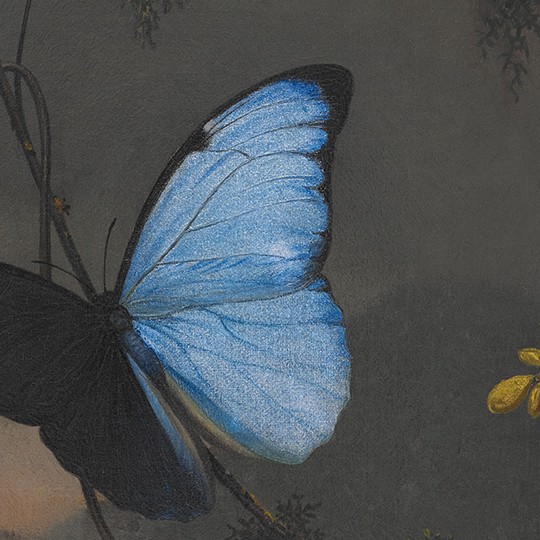
Details from THE GEMS OF BRAZIL
Compare the cropped details with the complete images above. Notice how their colours, shapes and positions contribute to the larger compositions.
Bright blue wing
The exposed blue wing carries narrow dark divisions and a dark outer edge. Its bright surface contrasts strongly with the hazy setting.
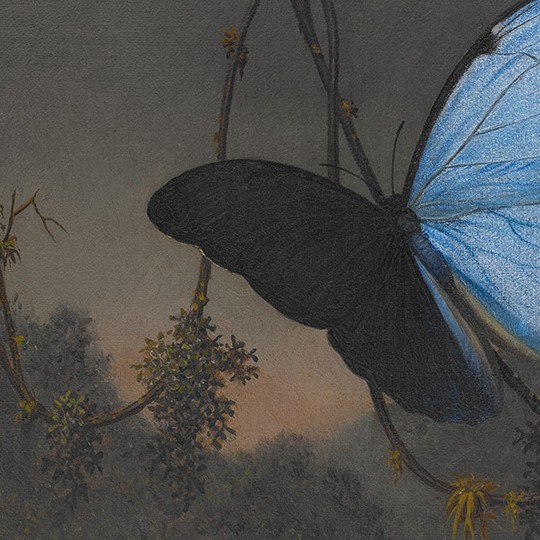
Dark opposing wing
The opposing wing remains largely dark beside the bright blue surface. Read this contrast as part of the painted pose.
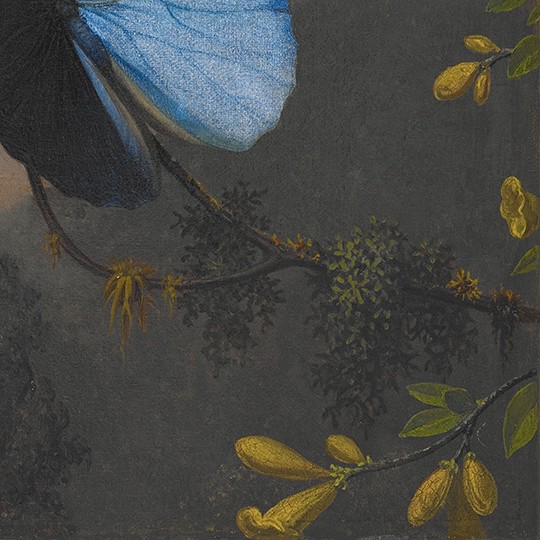
Lower framing foliage
Small yellow-green leaves enter the lower-right foreground. Their nearer colour and contours frame the more subdued woodland.
Brazil, specimens and small paintings
Heade’s interest in hummingbirds provided a reason for the journey. The Carter’s account describes his investigation through travel, specimen collections and naturalists’ texts. The finished pictures brought that accumulated knowledge into small oils rather than simply enlarging the birds into monumental landscape subjects.[2]
Veloric describes the projected group as twenty small paintings, with sharply observed birds, branches and flowers set against softer tropical scenery. Her essay treats this combination as a significant part of Heade’s international artistic ambitions. The number belongs to the historical account of the project, not to a claim that this website supplies a complete twenty-object catalogue.[3]
The relationship between close detail and atmosphere matters to the proposed publication. A bird can be clearly described against a branch while mist and distant scenery supply a setting around it. The image consequently offers both a specimen-like focus and an experience of tropical space.
That does not make every scene a direct record of one outdoor encounter. The sources describe several ways of studying the subjects, including specimens and books. Nor does a landscape background alone demonstrate a particular evolutionary argument. Kelly presents a possible Darwinian relationship as an interpretation, rather than a proved statement of Heade’s intention.[1]
Imperial patronage and the twelve-picture display
The project attracted support in Brazil. Elizabeth Neely’s Carter essay describes Emperor Dom Pedro II’s admiration for Heade’s hummingbird paintings, his partial patronage and the planned dedication of the publication. It also records a display of twelve pictures and the artist’s appointment as a Knight of the Order of the Rose.[2]
Those twelve should not automatically be equated with either the entire projected group or the later rediscovered set. They belong to an episode of presentation and patronage. Numbers can describe different stages of the project without being interchangeable counts of the same surviving objects.
Veloric’s article develops the social context through introductions, subscribers and contacts between Brazil and London. Some proposed motives and personal connections remain speculative in her account. The documented support is enough to establish that the publication was pursued seriously, without inventing a complete collaboration agreement or treating every suggested meeting as certain.[3]
Patronage also needs to remain attached to the right work. The emperor’s involvement in the early bird project does not by itself establish that he commissioned a later orchid canvas. Heade continued to paint tropical subjects after the publication plan had ceased to be an active undertaking.
Butterflies as well as hummingbirds
Crystal Bridges identifies its Blue Morpho Butterfly with The Gems of Brazil. Dated approximately 1863–64, it provides a clear reminder that the series title should not be used as an automatic synonym for every hummingbird painting Heade produced. This is a butterfly subject with its own exact collection identity, accession 2006.92.[4][5]
The supplied painting shows a large insect across slender branches. Its right wings are intensely blue, while the left side is much darker. Around it, thin vines and small leaves define the near setting, with a muted, hazy space beyond.
The blue gives the subject a jewel-like intensity without requiring the entire picture to be bright. Dark and subdued areas make the vivid wing more conspicuous. This relationship is useful for understanding why the project’s title suits the visual effect of individual pictures as well as their natural-history subject matter.
The museum’s current provenance includes a probable early connection with Sir Morton Peto, followed by the Clark family and later galleries and collectors. The word “probably” is material: the record should not be rewritten as an unbroken, fully proved chain simply because the painting is associated with a famous project.[4]
Watch: Martin Johnson Heade
Choose a film to explore the artist’s work, its interpretation and its wider setting.
Museum Minute: Heade Hummingbirds
A brief Shelburne Museum introduction to Heade’s hummingbird paintings.
Watch on YouTubeLondon and the problem of colour reproduction
The proposed album depended on transferring the appearance of the oils into printed colour. Kelly describes technical difficulties in achieving the delicate effects Heade wanted. Veloric adds that the artist was dissatisfied with some results and found it necessary to retouch them by hand.[1][3]
Her account discusses two London firms, Day & Son and M. & N. Hanhart. Crucially, she states that the surviving chromolithographs do not establish which firm printed them. The publishers can be discussed as candidates in the production history; a certain attribution should not be supplied merely to complete a caption.[3]
The four reproduced compositions also generated more than one impression. Four designs are therefore not the same as four physical prints in total. A working proof, a later retouched impression and an oil painting can relate to the same image while remaining distinct objects.
Financial difficulty forms another part of Veloric’s account, which draws on Heade’s correspondence with John Russell Bartlett. The original letters have not been independently inspected for this article, so their wording is not presented as a directly checked quotation. The scholarly account supports a combination of technical dissatisfaction and financial pressure rather than a single simple cause for the project’s failure.[3]
Rediscovery and uncertain group provenance
In a note to her study, Veloric identifies a sixteen-picture group rediscovered in London in 1981 and widely considered to represent part of the original twenty. She immediately cautions that this Manoogian group may not be the group associated with Peto. The qualification is as important as the rediscovery date.[3]
It prevents several stages of the collecting history from being collapsed into one story. A group connected with the original project, a reported early purchase and a much later rediscovery are related questions, but they are not automatically a single uninterrupted chain of ownership.
The individual Crystal Bridges record illustrates this need for care. It supplies a particular provenance with a qualified Peto link and a documented acquisition in 2006. That record concerns one painting. It cannot independently settle the identity or ownership history of every other work associated with The Gems of Brazil.[4]
The recovered paintings nonetheless make the ambition of the project easier to understand. They allow the small oils to be studied as works in their own right, while the proofs preserve evidence of the attempt to move from painted colour to a reproducible publication.
Later orchid pictures are a different undertaking
The unfinished book did not end Heade’s interest in tropical birds. Kelly traces the later development of flower-and-bird compositions, including the 1871 Cattleya Orchid and Three Hummingbirds. That painting adds an enormous close flower, three birds and a nest within a composed tropical space.[1]
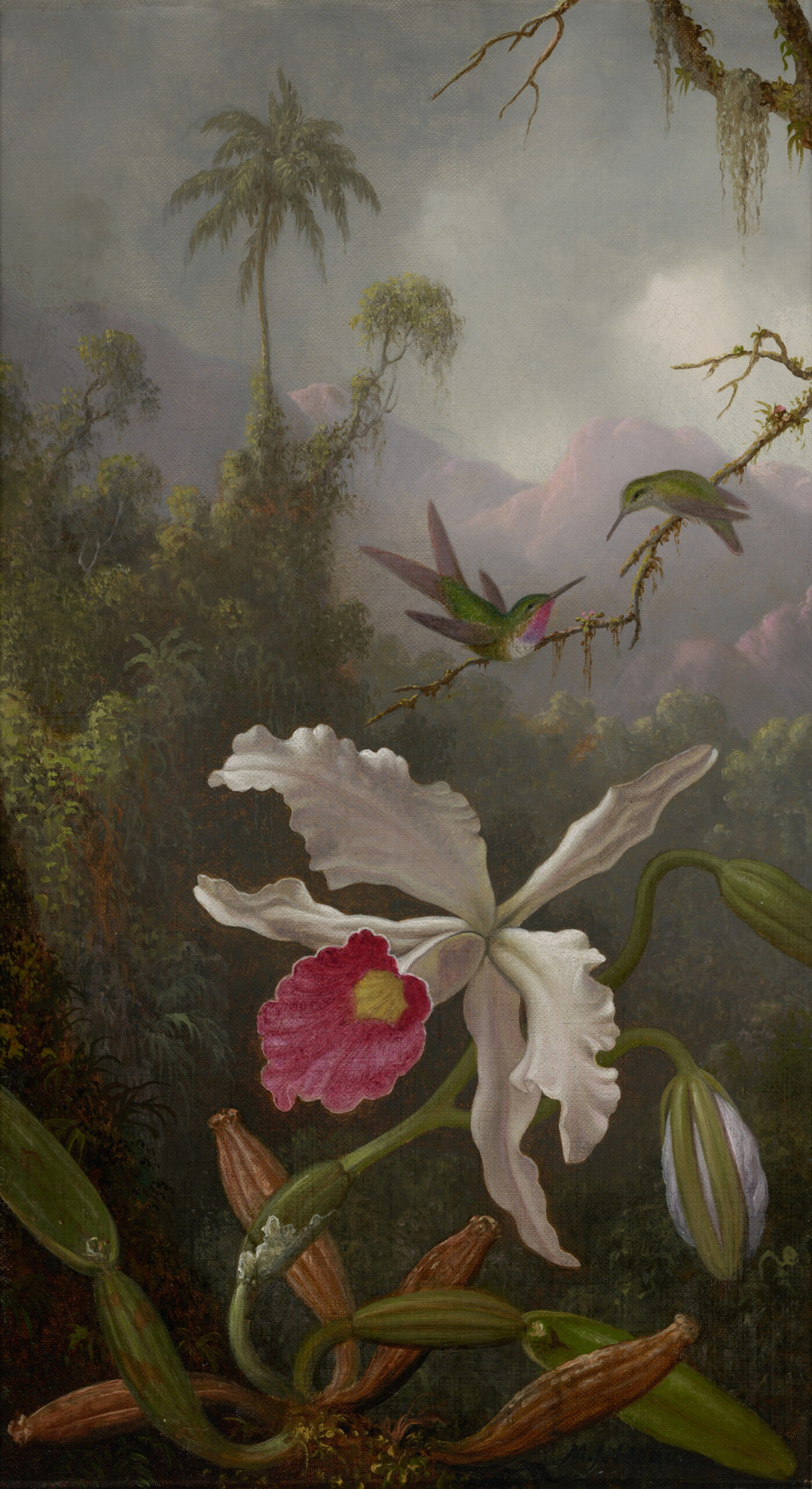
The Carter’s Two Hummingbirds Above a White Orchid dates to approximately 1875–90. Its tall format, paired birds and pale blossom belong to this later continuing development. It should not be assigned to the earlier publication simply because it contains hummingbirds and has Brazilian associations.[2]
Keeping those distinctions makes the larger history clearer. The Gems of Brazil joined travel, natural-history study, patronage, painting and trial printing in one ambitious plan. Its incomplete publication is part of that history, while its surviving oils and prints show that the plan produced substantial visual work before its aims changed.
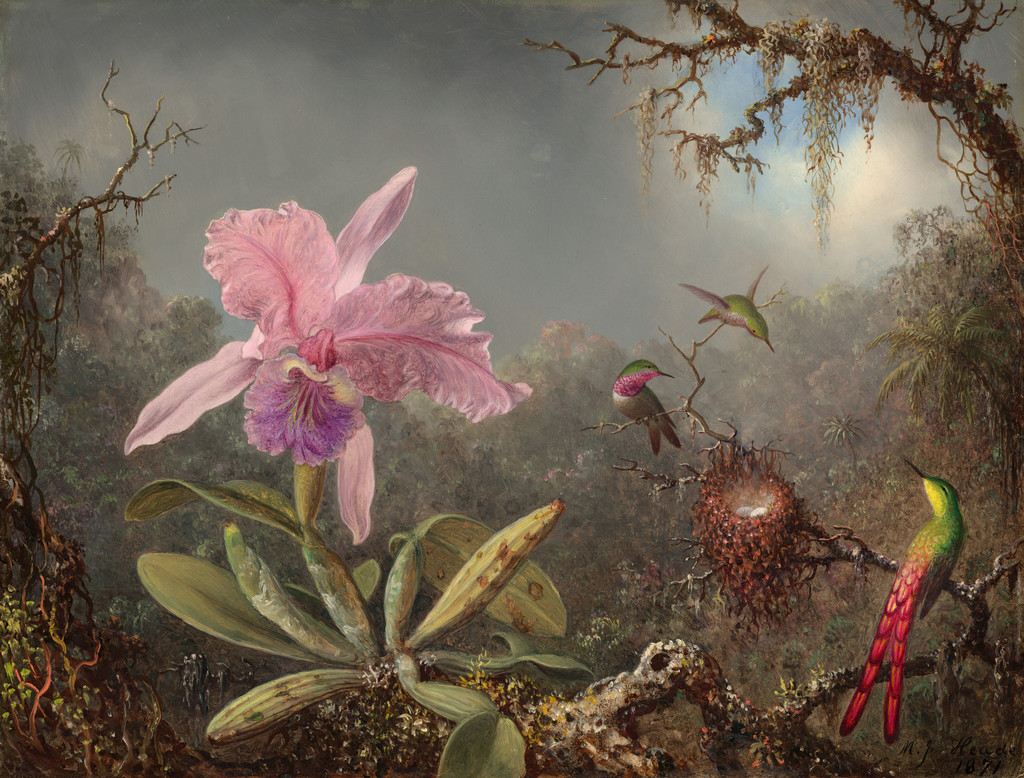
Martin Johnson Heade, Cattleya Orchid and Three Hummingbirds, 1871. Oil on wood. National Gallery of Art, 1982.73.1. A later composition, distinct from the earlier publication project. Image source. CC0 / Public domain. Resized only; native appearance preserved.
Artworks directory
A collected selection of 26 individually identified museum paintings, including thirteen extended artwork studies. This is a bounded directory, rather than a complete catalogue raisonné. Two Boston entries retain dates from the 2002 conservation study. Links open a companion article where available, otherwise the cited institutional record or publication; unillustrated objects remain included.
Frequently Asked Questions
Discussion
Look again at the images and ideas explored in The Gems of Brazil by Martin Johnson Heade. These editorial prompts invite your observations.
Reader Insights
What distinguishes the small butterfly picture from a later orchid composition?
How does a trial print differ as evidence from an unfinished book plan?
What remains uncertain when the twelve-picture display and sixteen-picture rediscovery are kept separate?
Join the Conversation
Share a detail, comparison or question about The Gems of Brazil by Martin Johnson Heade below.
References
- Franklin Kelly, American Paintings of the Nineteenth Century, Part I (NGA, 1996), printed pp.291–294. Planned publication, executed chromolithographs, colour difficulties and later tropical flower pictures. View source
- Elizabeth Neely, “An orchid, an emperor, and hummingbirds: Martin Johnson Heade in Brazil” (Carter, 22 November 2023). Journey, specimens, imperial patronage, twelve-picture display and later White Orchid. View source
- Cynthia Haveson Veloric, “Hummingbirds, Emperors, and Railway Barons: Heade’s Gems and their Journeys,” Nineteenth Century 36(2), Fall 2016, printed pp.17–23, particularly pp.20–21 and note 37. Complete selected article actually read; original journals and letters quoted by the author not independently consulted. View source
- Crystal Bridges Museum of American Art, Blue Morpho Butterfly, 2006.92. Exact current object and qualified provenance. Its displayed dimensions include frame depth and are not used here as painting dimensions. View source
- Crystal Bridges museum-uploaded Commons record, Blue Morpho Butterfly, from The Gems of Brazil. Exact series identification, painting dimensions and CC0 image; actual native supply is 900 × 1079 pixels. View source
- Splash image source.
Martin Johnson Heade, Blue Morpho Butterfly, from The Gems of Brazil, c.1863–64. Oil on canvas. Crystal Bridges Museum of American Art, 2006.92. Complete native900-pixel-wide museum image; no enlargement. Crystal Bridges Museum of American Art; photography by Dwight Primiano. CC0 / Public domain. Resized only; native appearance preserved.
View source