 by Tom Gurney
Tom Gurney BSc (Hons) is an art history expert with over 20 years experience
Email: tomgurney1@gmail.com / Phone: +44 7429 011000
View of Marshfield by Martin Johnson Heade: Introduction
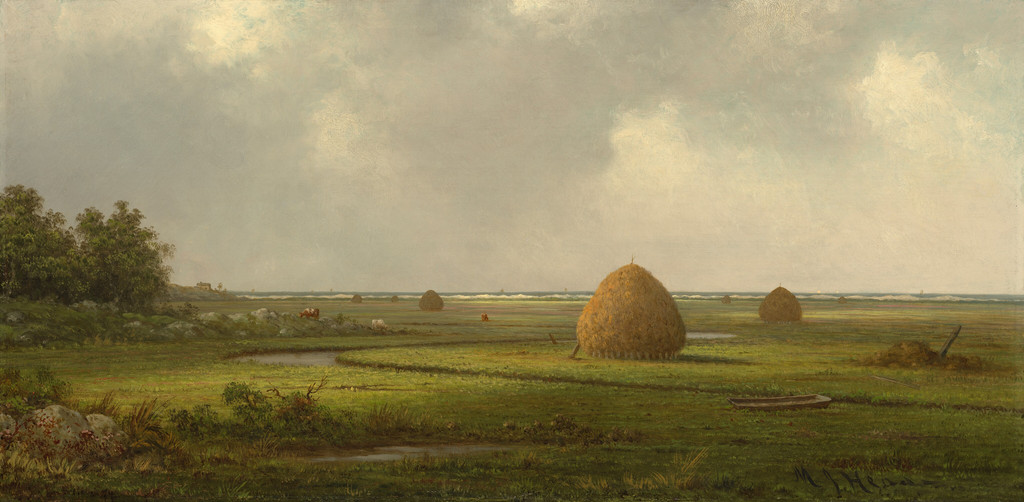
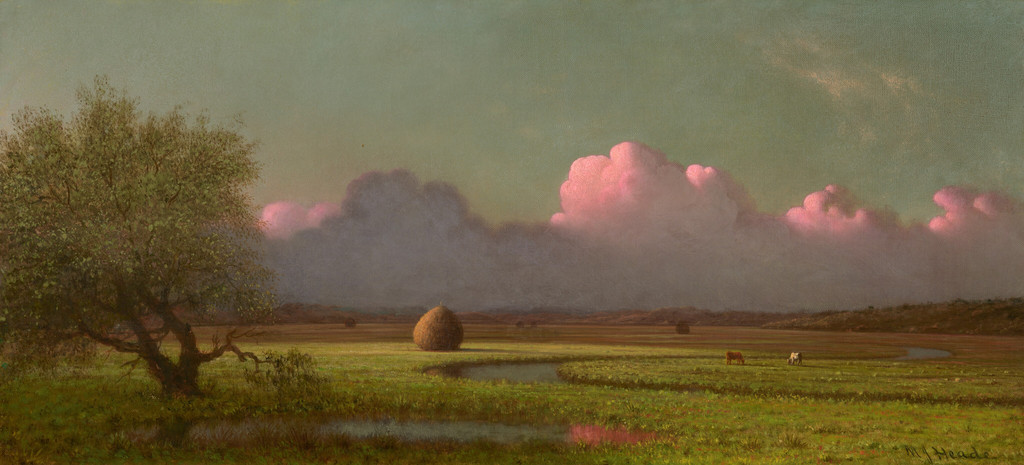
Martin Johnson Heade’s View of Marshfield presents coastal Massachusetts as a working landscape of raised haystacks, grazing cattle and shallow water. A small boat rests near the foreground, while a house and distant sails connect the marsh to the shore beyond. Now in the National Gallery of Art’s Corcoran Collection, the painting is dated approximately 1866–76. A related drawing and Sarah Cash’s detailed catalogue entry help explain how Heade constructed this wide view and how the structures within it served the seasonal harvest.[1][2]
At a Glance
- ArtistMartin Johnson Heade (1819–1904)
- TitleView of Marshfield
- Datec.1866–76
- MediumOil on canvas
- Dimensions39.05 × 76.84 cm
- CollectionNational Gallery of Art, Corcoran Collection
- Accession2015.19.173
- Related drawingMFA Boston, East Marshfield, Massachusetts, 60.1015
This work across Martin Johnson Heade’s career
Sudden Shower, Newbury Marshes
c.1865–75View of Marshfield (current article)
c.1866–76Hummingbird and Passionflowers
c.1875–85Newburyport Meadows
c.1876–81Magnolias on Light Blue Velvet Cloth
c.1885–95Contents
- Raised hay above tidal ground
- A boat, cattle and the open shore
- A probable Green Harbor view
- The drawing and the finished composition
- Harvesting and the passage of time
- From private ownership to the NGA
- Annotated details
Raised hay above tidal ground
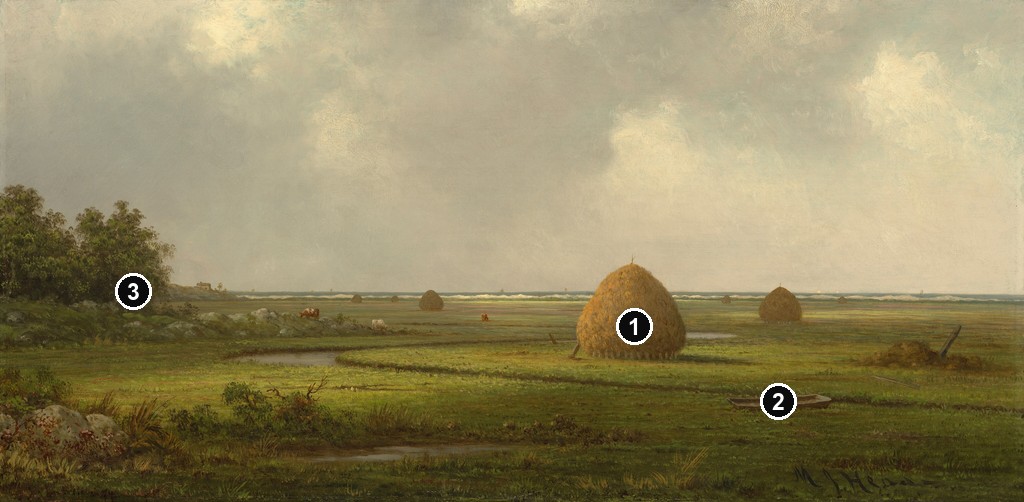
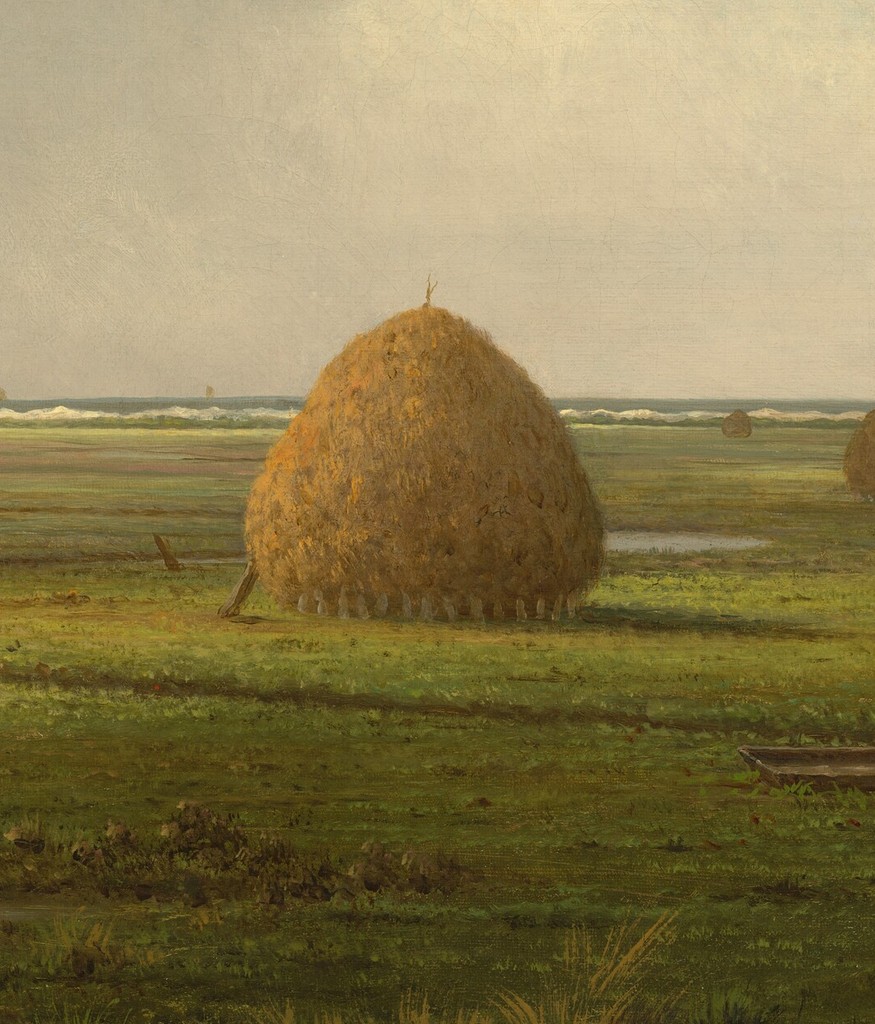
The foremost haystack rises just to the right of the picture’s centre. Its rounded top and sloping sides make a compact mass against the open field. Near its foot, the supporting structure separates the stored hay from the damp surface below.
Cash identifies these raised platforms as staddles. Stakes supported the cut hay while it dried, reducing contact with the wet marsh. The structure is therefore part of the painting’s account of land use, rather than simply a picturesque accessory beneath a mound.[2]
The main stack is followed by smaller ones that lead towards the horizon. Their changing scale gives the flat ground depth without requiring a dramatic mountain or valley. The sequence also makes the near stack part of a larger operation: several areas of harvested hay have been gathered and raised across the field.
Light does not fall evenly over these forms. The near mound carries a broad dark side, while other passages of grass are brighter. Differences between sun and shade divide the marsh into areas that can be read separately even where the ground itself remains almost level.
Three short, diagonal poles elsewhere in the field are less securely identified. Cash’s note suggests either haypoles used in moving the cut material or stakes marking the corners of marsh lots. Their practical setting is clear, but their precise purpose should remain open.[2]
This is a landscape in which small changes have large visual consequences. A stake, a mound or a brighter strip of grass can interrupt the long horizontal field. Heade gives these modest forms enough clarity to organise a view whose physical terrain offers few imposing landmarks.
Annotated Details from View of Marshfield
The numbered points identify visible features discussed in this article. Return from each detail to the whole composition. Martin Johnson Heade, View of Marshfield, c.1866–76. Oil on canvas, 39.05 × 76.84 cm. National Gallery of Art, Corcoran Collection, 2015.19.173. Corcoran Collection (Museum Purchase, 1981); National Gallery of Art. Image source. CC0 / Public domain. Resized only; native appearance preserved.
Details from VIEW OF MARSHFIELD
Compare the cropped details with the complete images above. Notice how their colours, shapes and positions contribute to the larger compositions.
Large near haystack
The large stack rises above the level marsh, with smaller stacks extending behind it. Their different sizes help establish distance.
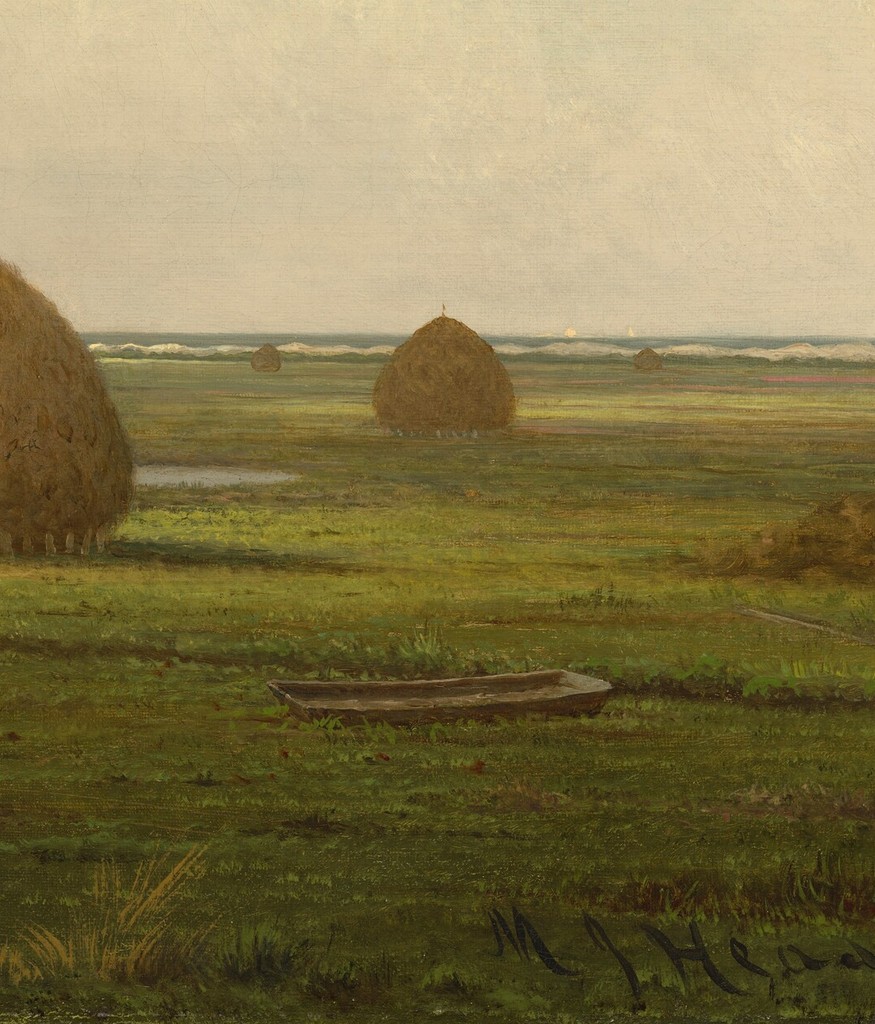
Low marsh boat
A low open boat rests near the narrow foreground channel. Its long horizontal shape differs from the rounded haystacks.
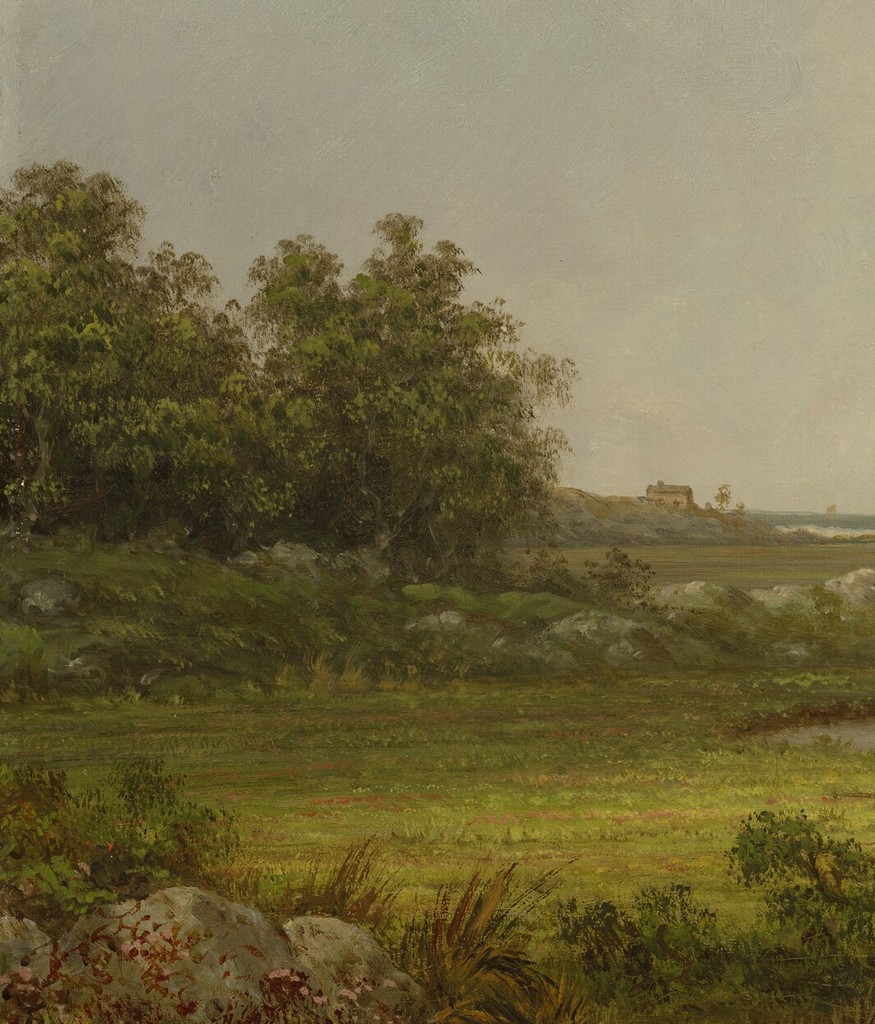
Wooded left margin
Trees and low rocky ground enclose the left side. Their irregular silhouettes contrast with the flatter cultivated marsh.
A boat, cattle and the open shore
The low boat in the foreground is easy to pass over because its profile remains close to the ground. Cash describes it as a gundalow, a flat-bottomed craft suited to shallow water. A small pile of hay nearby reinforces its connection with work in the marsh.[2]
The catalogue relates such boats to farmers who could reach the marsh at high tide to build, inspect or repair their stacks. The vessel consequently gives the water a practical role. A channel that appears to guide the viewer through the painting could also provide access to ground that was difficult to approach overland.[2]
Cattle occupy the grass towards the left. They establish another use of the land without becoming the centre of a narrative scene. Their relatively small scale keeps grazing within the larger pattern of marsh, light and weather.
Farther away, the picture opens towards a narrow shore and the sea. Small marks indicate sailing vessels, which Cash distinguishes from the working boat near the viewer. The contrast between these different craft connects the immediate harvest to a more extensive coastal world.[2]
The house at the left provides a more fixed point within that distance. It is small enough to remain subordinate to the marsh, but recognisable enough to suggest settlement. Together house, boats, cattle and stacks make the landscape inhabited without filling it with conspicuous figures.
The visible water also changes in character as the eye moves through the composition. A winding channel occupies the lower field, while the distant sea forms a more continuous horizontal band. These different shapes help distinguish marshland from open coast within the same wide rectangle.
A probable Green Harbor view
Marshfield lies on the Massachusetts coast southeast of Boston. Cash explains that its salt marshes are associated with the North, South and Green Harbor rivers. She proposes the Green Harbor section in eastern Marshfield as the most likely subject of this painting.[2]
The rocky point supporting the house appears, in her account, to be Blue Fish Rock across the mouth of the Green Harbor River. This identification gives the distant building more significance: it may help connect the composition with a particular stretch of coast.[2]
Cash credits the proposed site identification to Dorothy MacMullen of the Marshfield Historical Society. That local contribution strengthens the regional account while leaving the catalogue’s cautious wording intact.[2]
The wording remains important. The catalogue offers a probable location, supported by the arrangement and the related drawing. It does not supply a surveyed camera position from which every visible feature can be matched to a modern photograph.
The title’s reference to Marshfield is consequently more secure than an exact modern viewpoint. Readers can understand the picture as a coastal Massachusetts marsh and consider Cash’s more specific proposal without converting it into a precise map coordinate.
Nor should the view be treated as a complete inventory of the town. Heade selected a narrow field of water, hay, grass and distant shore. Other parts of Marshfield could have looked very different, while the painting’s arrangement brings these particular elements into a coherent visual relationship.
The drawing and the finished composition
Cash connects the canvas with a two-sheet graphite drawing inscribed E. Marshfield, now in the Museum of Fine Arts, Boston. Its accession is 60.1015. The drawing’s extended shape and placement of the shore help explain the finished painting’s horizontal structure.[2]
The relationship includes changes. According to the catalogue, Heade added haystacks in the painting and eliminated a craggy tree that occupied the drawing’s right middle ground. The finished work therefore develops the study rather than copying every element into paint.[2]
Removing a substantial tree would open that part of the marsh and reduce a competing upright form. Adding stacks would introduce repeated shapes more closely associated with the harvested field. These are compositional implications of the documented differences, rather than a surviving explanation written by the artist.
The comparison also demonstrates why statements that Heade never used preparatory drawings are too broad. This work has a specifically identified graphic relative. The evidence does not establish that every marsh painting followed an identical process, but it makes this particular drawing relevant to this particular canvas.[2]
Cash also prints a transcription of notes on the drawing’s reverse concerning twilight, water, waves and changes in relative darkness. Those observations support her discussion of Heade’s interest in changing light. The original inscription has not been independently transcribed here, so its content is paraphrased through the catalogue.[2]
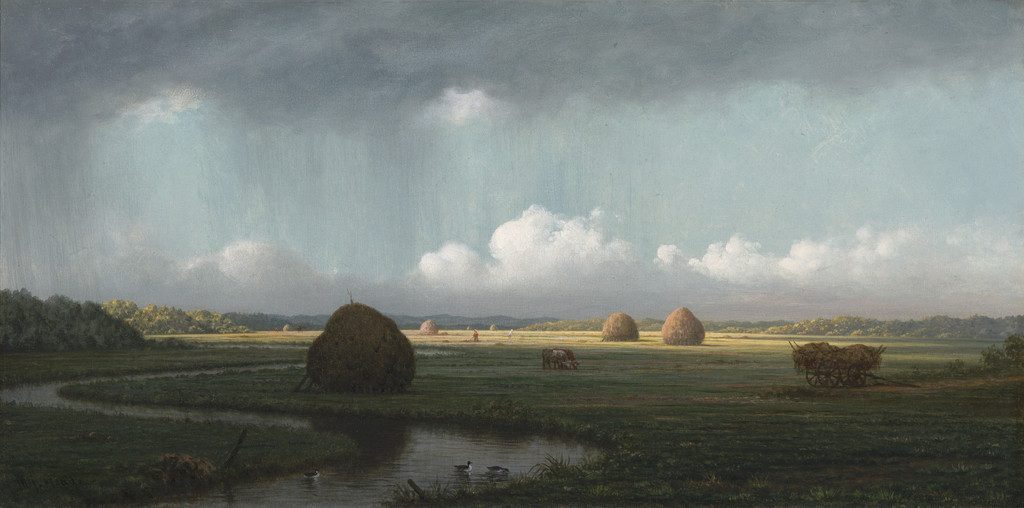
The drawing comparison reveals one kind of revision; examination of another marsh picture reveals a different one. In Sunlight and Shadow: The Newbury Marshes, published infrared findings identify a moved haystack. That separate case concerns changes during painting and should not be transferred to View of Marshfield as evidence of hidden forms beneath its surface.[4]
Watch: Martin Johnson Heade
Choose a film to explore the artist’s work, its interpretation and its wider setting.
Museum Minute: Heade Hummingbirds
A brief Shelburne Museum introduction to Heade’s hummingbird paintings.
Watch on YouTubeHarvesting and the passage of time
Cash places the building and maintenance of stacks in the late-summer harvesting cycle, especially late August and early September. Bundles of salt hay were cut, gathered and left to dry on raised supports. In late winter, the stored hay could be carried away by boat or across ice for use as fodder or straw.[2]
These practices explain why stacks could remain in the landscape beyond the immediate moment of cutting. The painting can suggest work already performed and transport still to come. It does not have to show a crowd of labourers in order to register the seasonal use of the ground.
The account is regional historical context, not a verified date for the depicted afternoon. Neither the presence of hay nor the boat identifies an exact day, tide or weather report. The approximate date of the canvas is a different question from the season suggested by its subjects.
Cash interprets the passage of time as central to the work. She connects seasonal activity with the shifting sunlight and shadow of coastal weather: one form of change develops over months, while another can alter the scene within minutes.[2]
That reading is especially persuasive when the eye moves between the stable stacks and changing bands of brightness. The hay records sustained human effort; the illumination seems less permanent. Each contributes to the experience of a place that is used repeatedly but never appears exactly the same.
Cash also discusses luminism and a broader spiritual reading of nature. These are scholarly ways of interpreting the painting’s horizontal format, atmosphere and contemplative effect. They do not establish a particular religious declaration by Heade or a documented personal relationship with Emerson.[2]
Martin Johnson Heade, Sunlight and Shadow: The Newbury Marshes, c.1871–75. National Gallery of Art, 2010.74.1. John Wilmerding Collection; National Gallery of Art. Image source. CC0 / Public domain. Resized only; native appearance preserved.
From private ownership to the NGA
The collecting history traces the work through Francis family ownership and descendants before its acquisition through Peter Tillou in 1981 for the Corcoran. It later entered the National Gallery of Art with the Corcoran Collection in 2015. The present accession, 2015.19.173, belongs to that museum stage.[1][2]
The NGA’s current measurements are 39.05 by 76.84 centimetres. The earlier Corcoran catalogue gives 38.4 by 76.8 centimetres and accession 1981.61. Current identification and measurements are used here, while the older entry remains valuable for its drawing comparison and historical analysis.[1][2]
Another Heade painting, Marshfield Meadows, Massachusetts, belongs to the Amon Carter Museum of American Art. Its accession is 1971.4, and the museum discusses a title recorded on its original stretcher. The shared place name and approximate dating do not make it the NGA canvas.[3]
The distinction helps readers follow repeated subjects without confusing individual objects. View of Marshfield is identifiable through its raised foreground stack, low boat, distant house and documented relation to the Boston drawing. Those details also make it a particularly useful meeting point between the visible landscape, its working history and Heade’s decisions as a painter.
Artworks directory
A collected selection of 26 individually identified museum paintings, including thirteen extended artwork studies. This is a bounded directory, rather than a complete catalogue raisonné. Two Boston entries retain dates from the 2002 conservation study. Links open a companion article where available, otherwise the cited institutional record or publication; unillustrated objects remain included.
Frequently Asked Questions
Cash identifies the supports as staddles, used to hold cut hay above wet marshland while it dried and remained stored.[2]
Yes. Cash relates the canvas to the two-sheet graphite East Marshfield, Massachusetts at the MFA Boston, 60.1015, while noting changes between drawing and painting.[2]
Discussion
Look again at the images and ideas explored in View of Marshfield by Martin Johnson Heade. These editorial prompts invite your observations.
Reader Insights
How do raised stacks and tidal ground relate visually?
What changes in the tree-and-creek Newbury composition?
How does the associated drawing make studio selection visible?
Join the Conversation
Share a detail, comparison or question about View of Marshfield by Martin Johnson Heade below.
References
- National Gallery of Art, View of Marshfield, 2015.19.173. Current object identity, dimensions and Corcoran Collection. View source
- Sarah Cash, Corcoran Collection: American Paintings to 1945, printed pp.130–131 and notes p.266. Composition, proposed Green Harbor location, related drawing, harvesting practice and collecting history. View source
- Amon Carter Museum of American Art, Marshfield Meadows, Massachusetts, 1971.4. Separate object and original-stretcher title. View source
- Charles M. Brock, American Masters from Bingham to Eakins: The John Wilmerding Collection (NGA, 2004), printed pp.72–74. Separate infrared evidence for Sunlight and Shadow. View source
- Splash image source.
Martin Johnson Heade, View of Marshfield, c.1866–76. Oil on canvas, 39.05 × 76.84 cm. National Gallery of Art, Corcoran Collection, 2015.19.173. Corcoran Collection (Museum Purchase, 1981); National Gallery of Art. CC0 / Public domain. Resized only; native appearance preserved.
View source