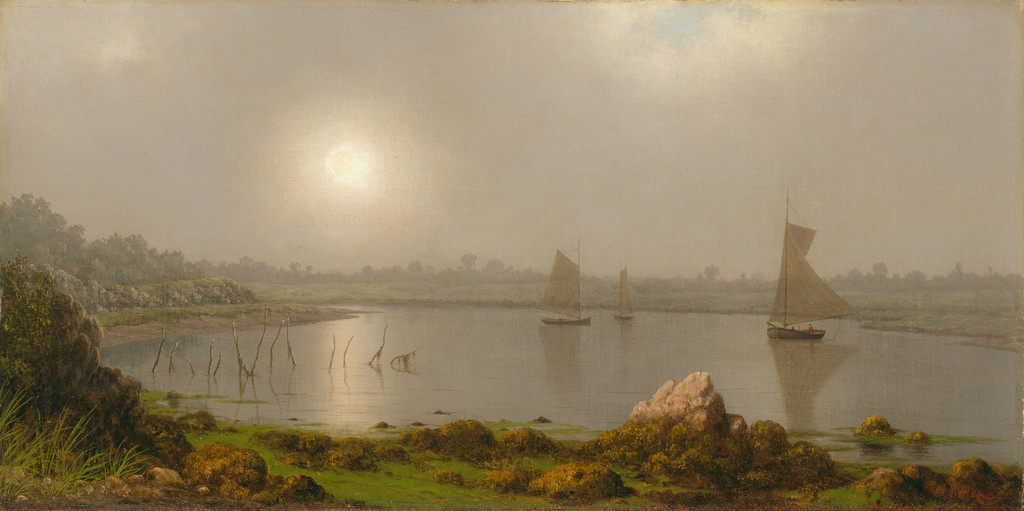
 by Tom Gurney
Tom Gurney BSc (Hons) is an art history expert with over 20 years experience
Email: tomgurney1@gmail.com / Phone: +44 7429 011000
Martin Johnson Heade’s Style and Technique: Introduction
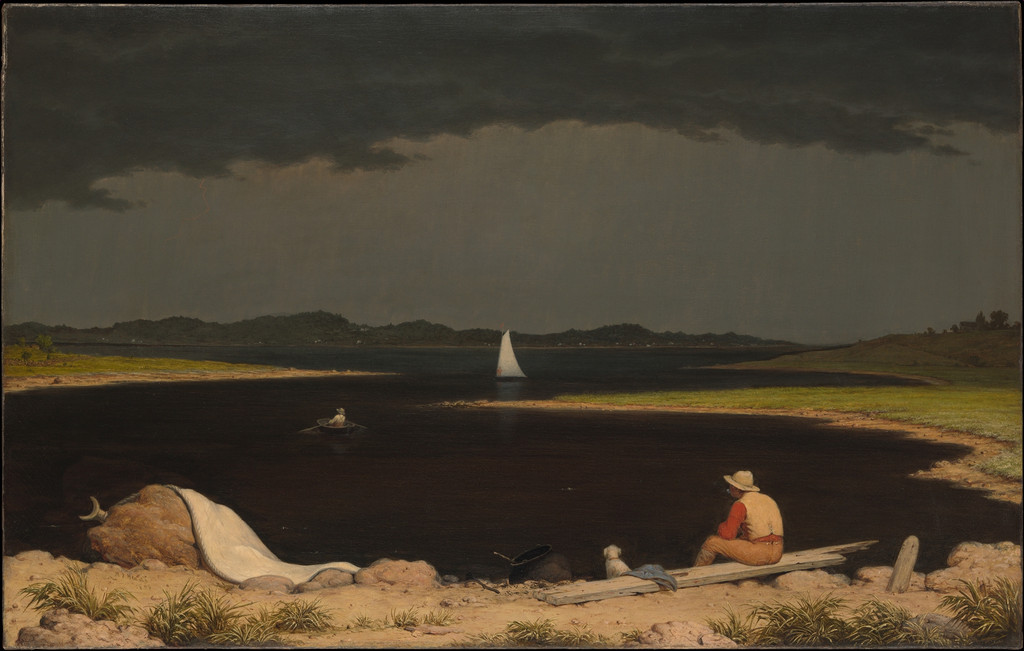
Martin Johnson Heade made luminous skies, iridescent birds and pale flowers through varied combinations of support, ground, drawing and paint. Their apparent clarity can conceal revisions and complicated layers. Conservation research shows an artist who adjusted motifs within a composition, used commercially prepared materials and developed different kinds of brushwork. Comparing specific examined paintings explains this practice more accurately than assigning one recipe to his entire career.[1][3]
At a Glance
- Principal mediumOil paint, on canvas, wood or artist’s board
- Important studyMFA research begun in 1996; analysis phase from 1998; published in 2002
- Study scaleFifty examined paintings; twenty-one selected for pigment analysis
- Recurring effectsReflective light grounds, thin colour, selective impasto and glazes
- CompositionPreliminary drawing, repeated motifs and adjustments within the painting
- Specific examplesNGA Cattleya panel, Sunlight and Shadow, View of Marshfield and Giant Magnolias
- Open questionsMotif transfer, detailed paint-medium composition and original varnishes
Contents
- Looking beyond the luminous surface
- Supports and prepared grounds
- Drawing, repetition and uncertain transfer methods
- Marshes revised during composition
- Thin colour and selective texture
- A magnolia painted in stages
- Birds and botanical detail in composed settings
- Pigment, medium and varnish evidence
- Reading the evidence together
- Annotated details
Looking beyond the luminous surface
Heade is often discussed within luminism, a later category associated with light, clear space and carefully controlled surfaces in nineteenth-century American painting. It helps describe some effects, but it does not name a movement he formally joined or provide a complete account of his work. His pictures range from small portraits and tabletop arrangements to wide coastal scenes and crowded tropical foregrounds.[1][3]
The apparent stillness of a finished image can also obscure its making. A level horizon, balanced haystack or precisely outlined petal may result from changes made during painting. Technical examination follows those decisions where drawing, covered forms or layers remain detectable. It can explain how a composition developed without treating its final balance as something achieved immediately.
Elizabeth Leto Fulton, Richard Newman, Jean Woodward and Jim Wright’s 2002 study examined fifty paintings, mostly from the Museum of Fine Arts, Boston. Twenty-one were selected for pigment analysis. Although the group extended across the career, it concentrated on the 1860s and 1870s. Findings therefore describe a substantial sample rather than every painting attributed to Heade.[1]
The authors’ reference to 630 documented works belongs to the state of research at publication. It should not become a permanent present-day total. Likewise, a material found in one sampled passage does not establish its presence across all the artist’s paintings of the same subject.
Annotated Details from Martin Johnson Heade’s Style and Technique
The numbered points identify visible features discussed in this article. Return from each detail to the whole composition. The captions keep each work’s identity, date and medium separate.
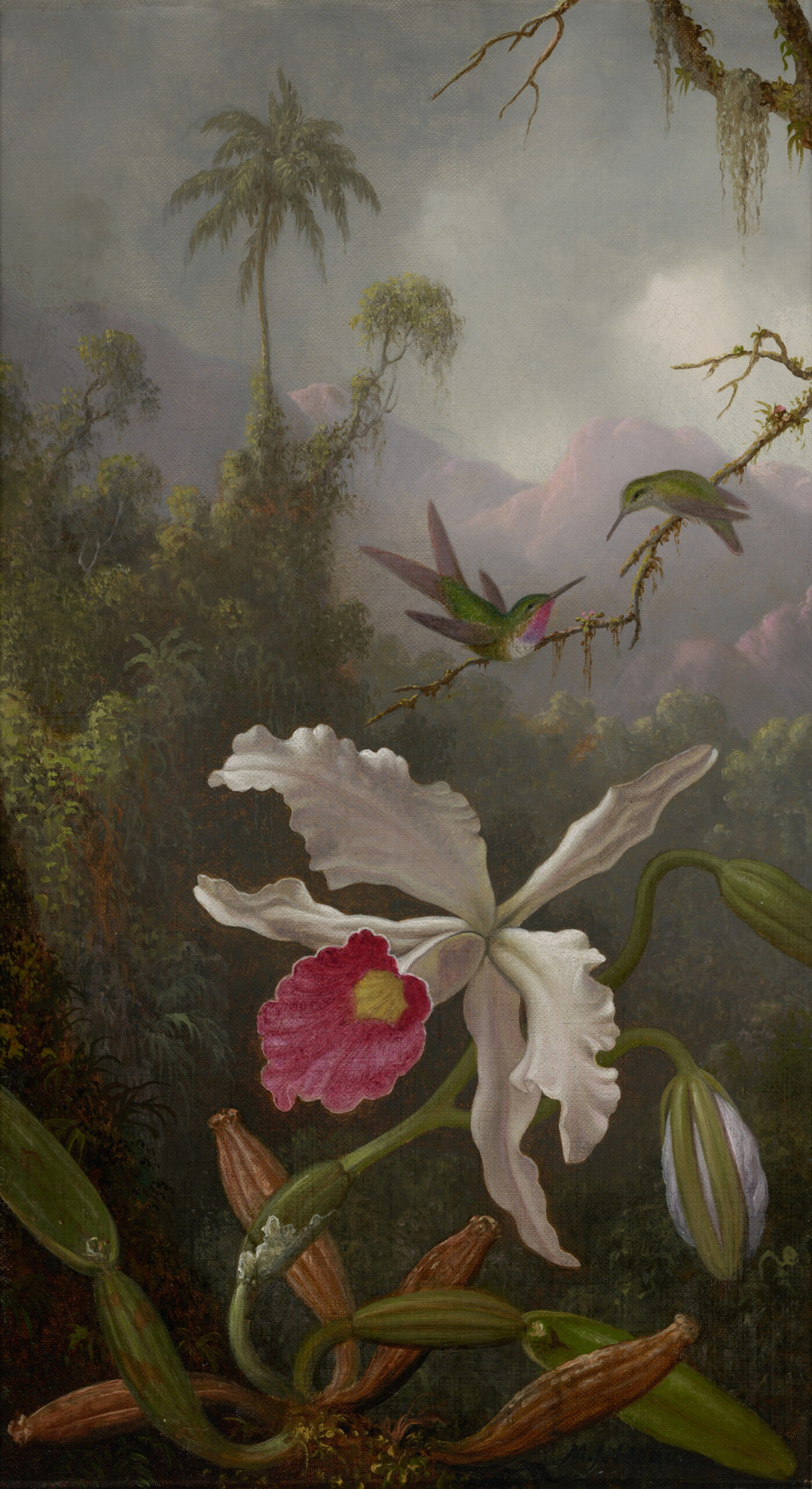
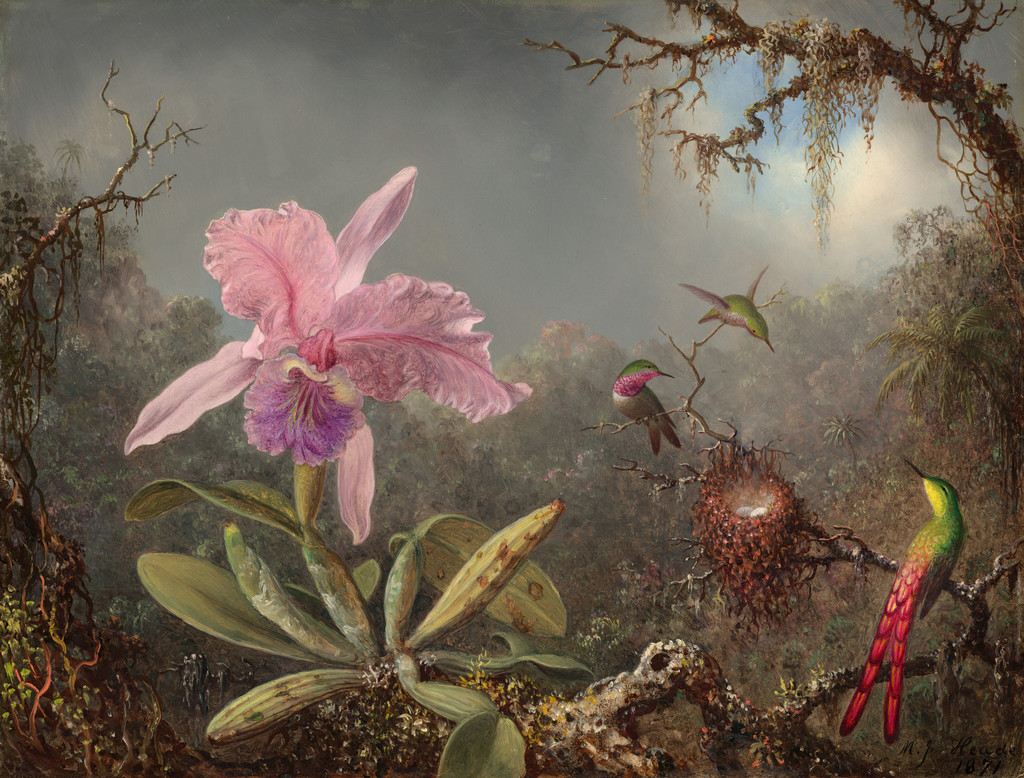
Cattleya Orchid and Three Hummingbirds
Martin Johnson Heade, Cattleya Orchid and Three Hummingbirds, 1871. Oil on wood. National Gallery of Art, 1982.73.1. Image source. CC0 / Public domain. Resized only; native appearance preserved.
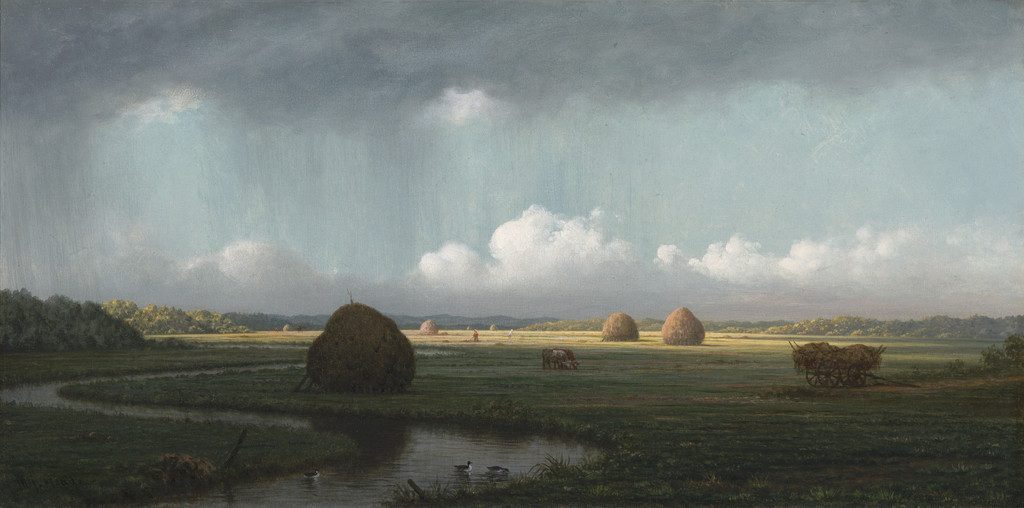
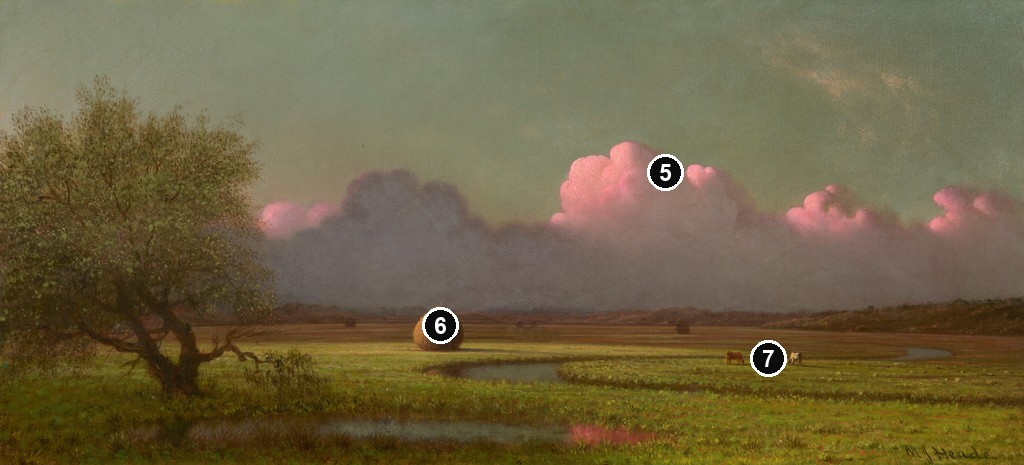
Sunlight and Shadow, The Newbury Marshes
Martin Johnson Heade, Sunlight and Shadow: The Newbury Marshes, c.1871–75. National Gallery of Art, 2010.74.1. John Wilmerding Collection; National Gallery of Art. Image source. CC0 / Public domain. Resized only; native appearance preserved.
Giant Magnolias on a Blue Velvet Cloth
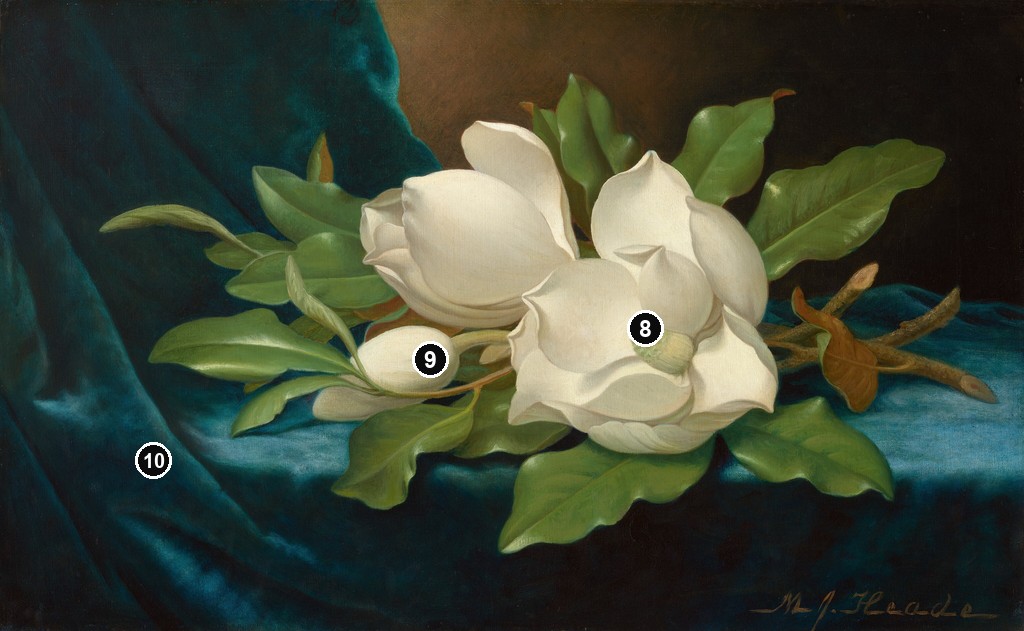
Martin Johnson Heade, Giant Magnolias on a Blue Velvet Cloth, c.1890. Oil on canvas, 38.4 × 61.5 cm. National Gallery of Art, 1996.14.1. Gift of The Circle of the National Gallery of Art in Commemoration of its 10th Anniversary; National Gallery of Art. Image source. CC0 / Public domain. Resized only; native appearance preserved.
Details from MARTIN JOHNSON HEADE’S STYLE AND TECHNIQUE
Compare the cropped details with the complete images above. Notice how their colours, shapes and positions contribute to the larger compositions.
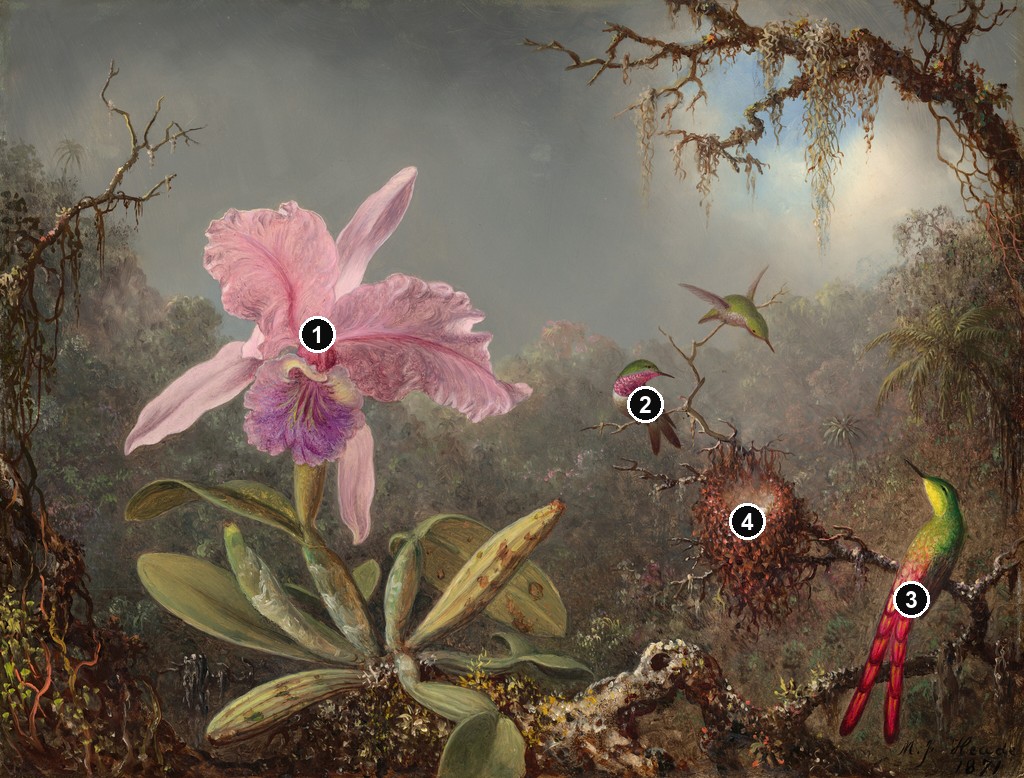
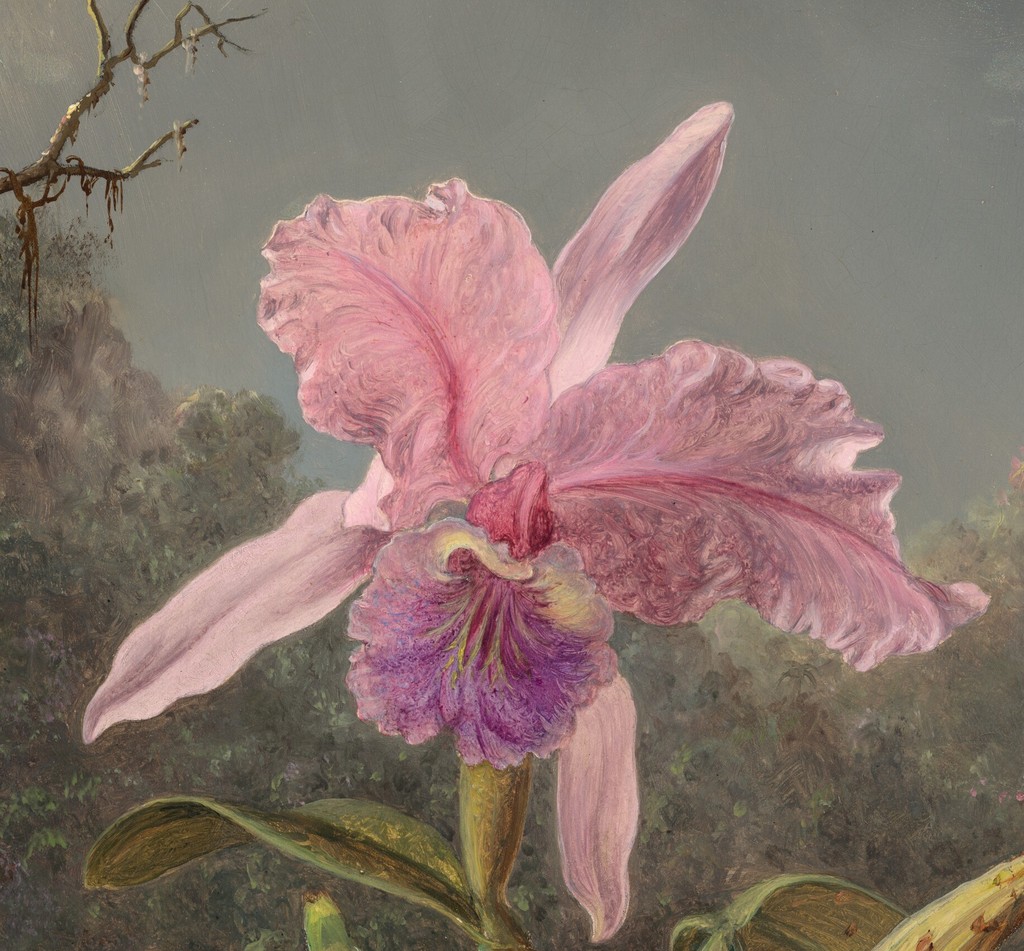
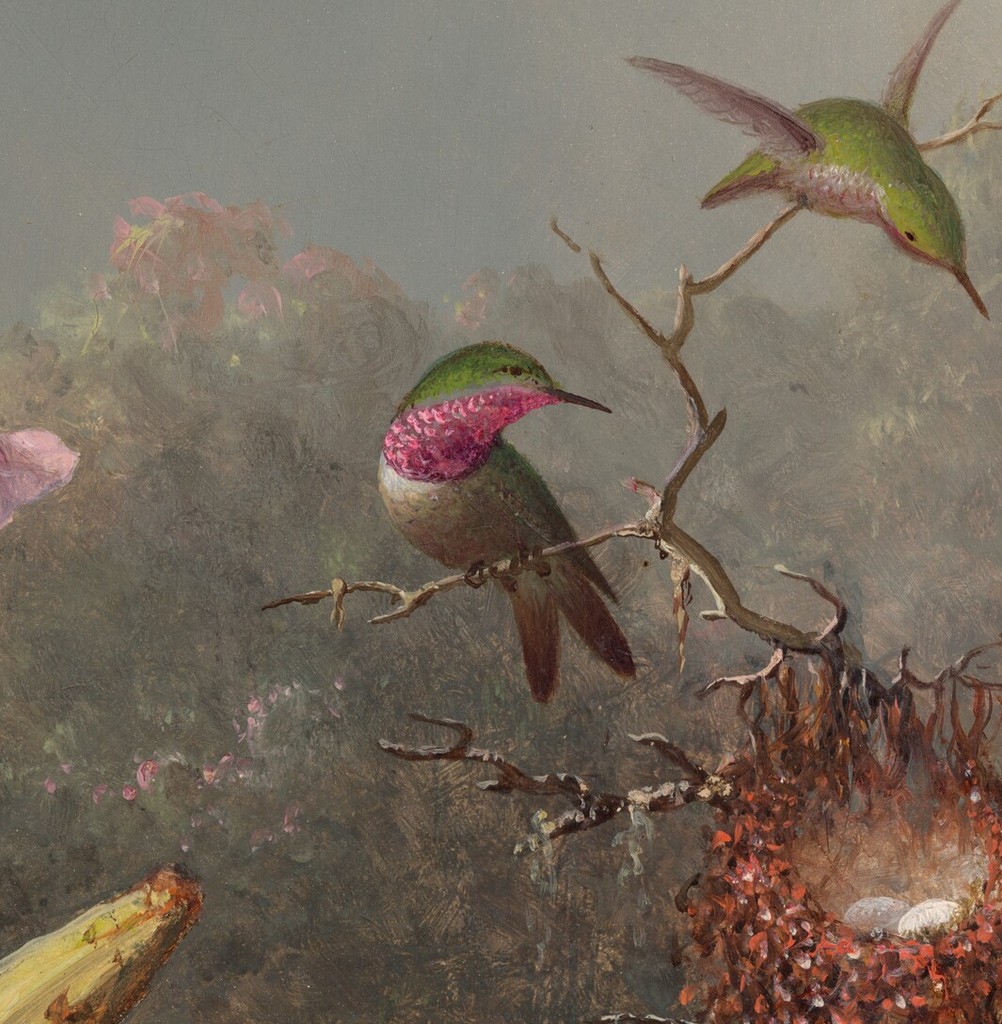
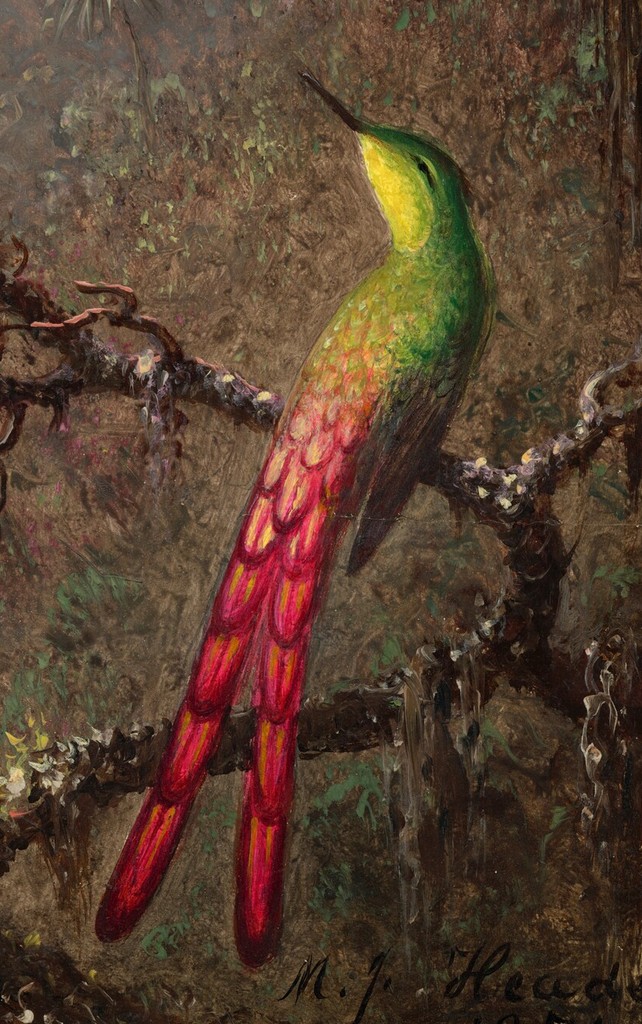
Cattleya Orchid and Three Hummingbirds
Large orchid bloom
Pink and purple folds spread around the orchid’s darker centre. Its large scale establishes a foreground distinct from the hazier woodland.
Perched bird
A green bird with a bright throat sits on a slender branch. Its stationary posture differs from the bird in flight above.
Long-tailed lower bird
The lower bird has a bright green neck and long red tail feathers. Its upright form balances the large orchid at the left.
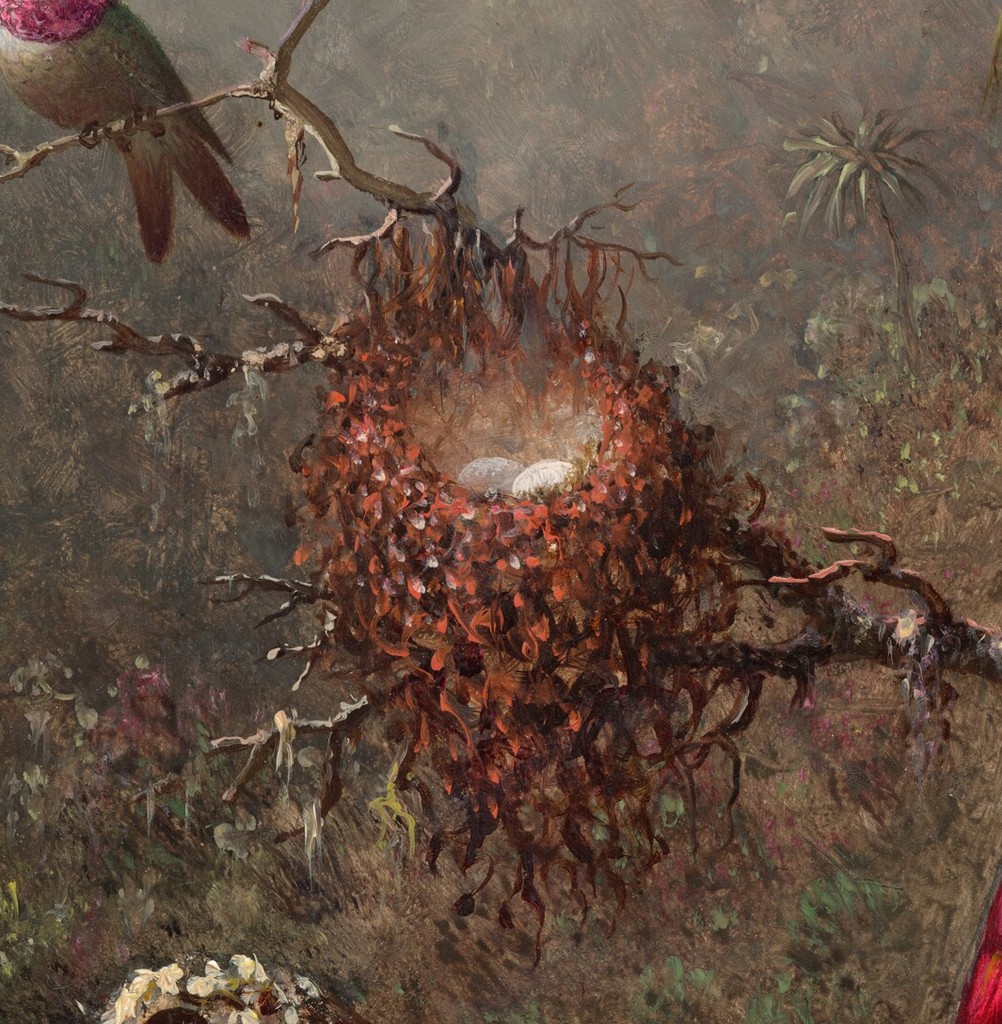
Nest among the branches
A small nest rests amid tangled branching below the perched bird. The pale forms inside remain distinct from the surrounding darker material.
Sunlight and Shadow, The Newbury Marshes
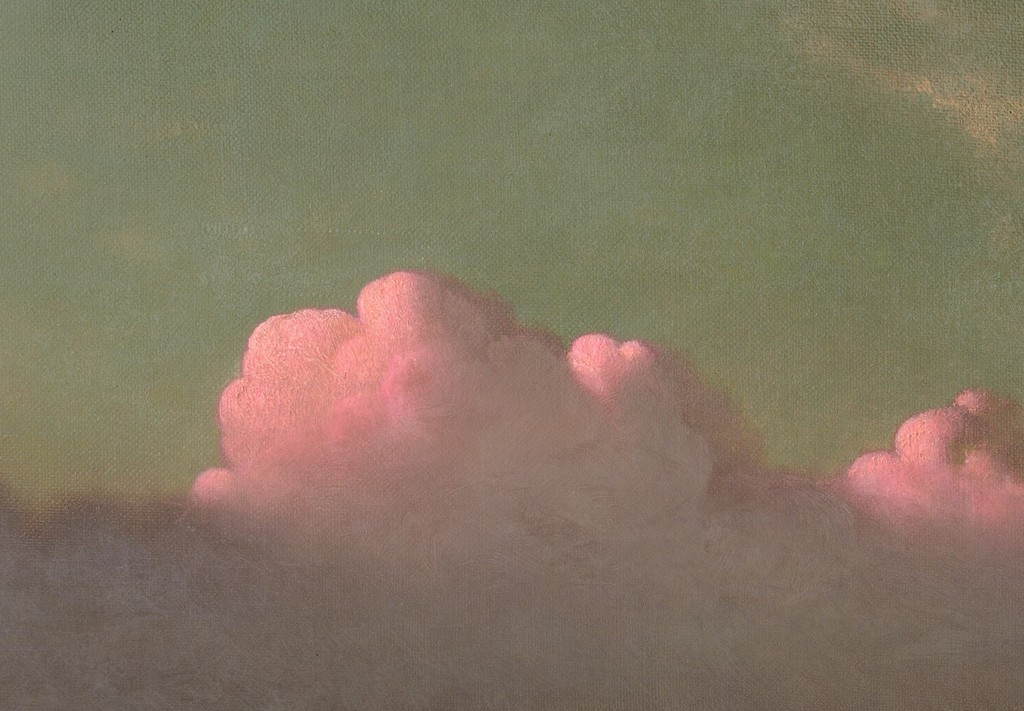
Pink-lit clouds
Pink highlights distinguish the upper cloud edges from the grey masses beneath. Compare their light with the quieter sky above.
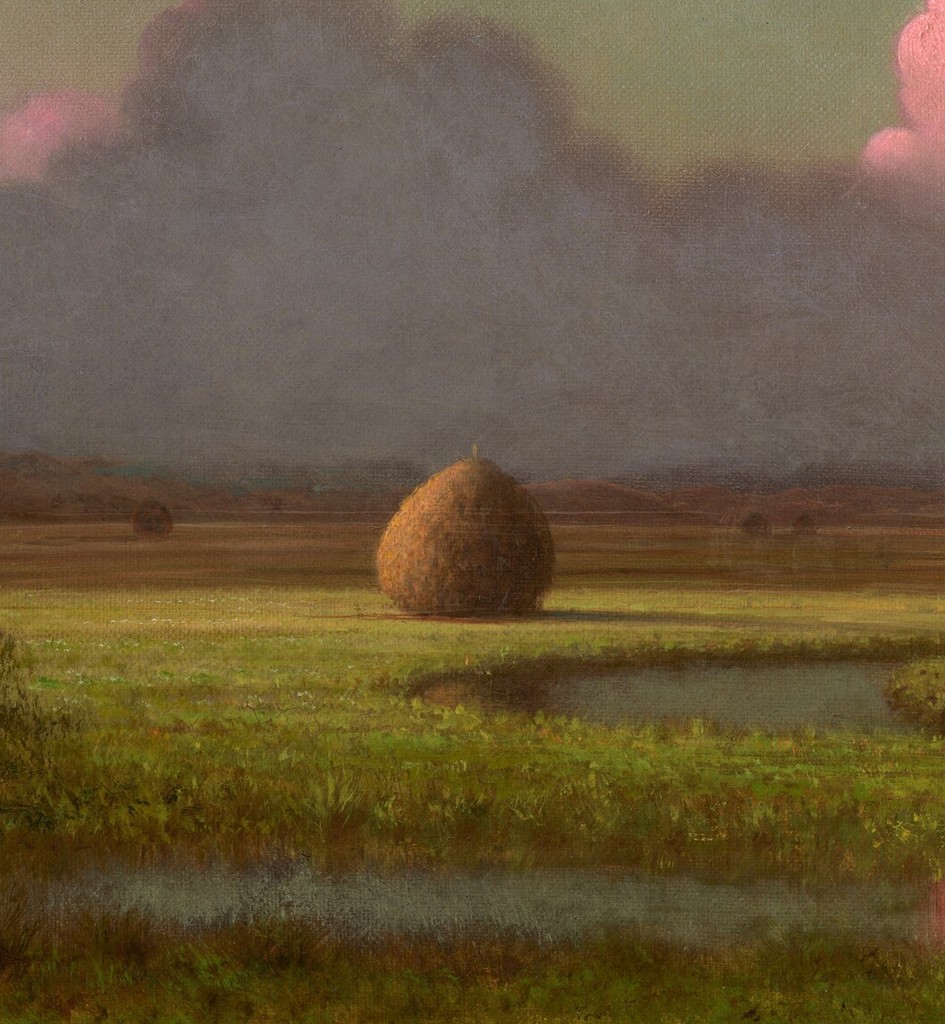
Haystack beside the water
A rounded haystack stands beside a winding water channel. The warm stack and cooler water interrupt the level green marsh.
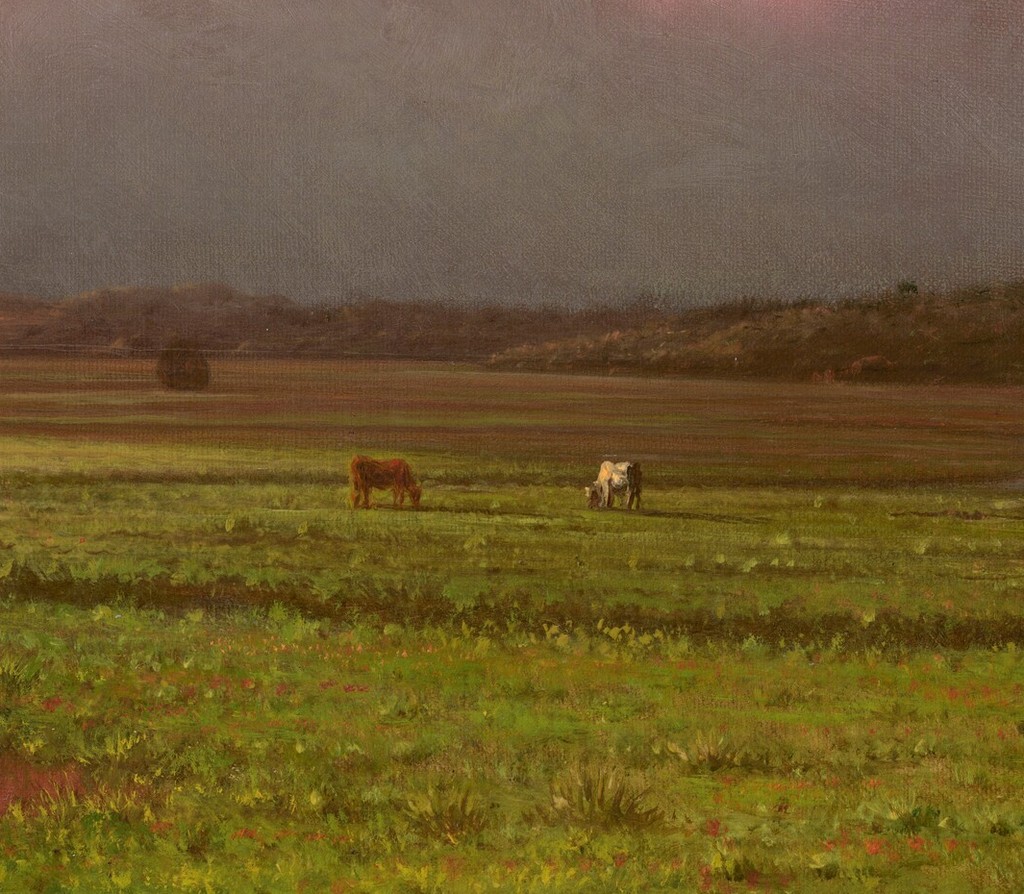
Grazing cattle
Two small cattle occupy the right-hand marsh. Their dark and pale bodies supply points of recognition within the extensive field.
Giant Magnolias on a Blue Velvet Cloth
Open magnolia centre
Pale petals surround the greenish centre of the open foreground magnolia. Their overlapping curves create depth within the bright flower.
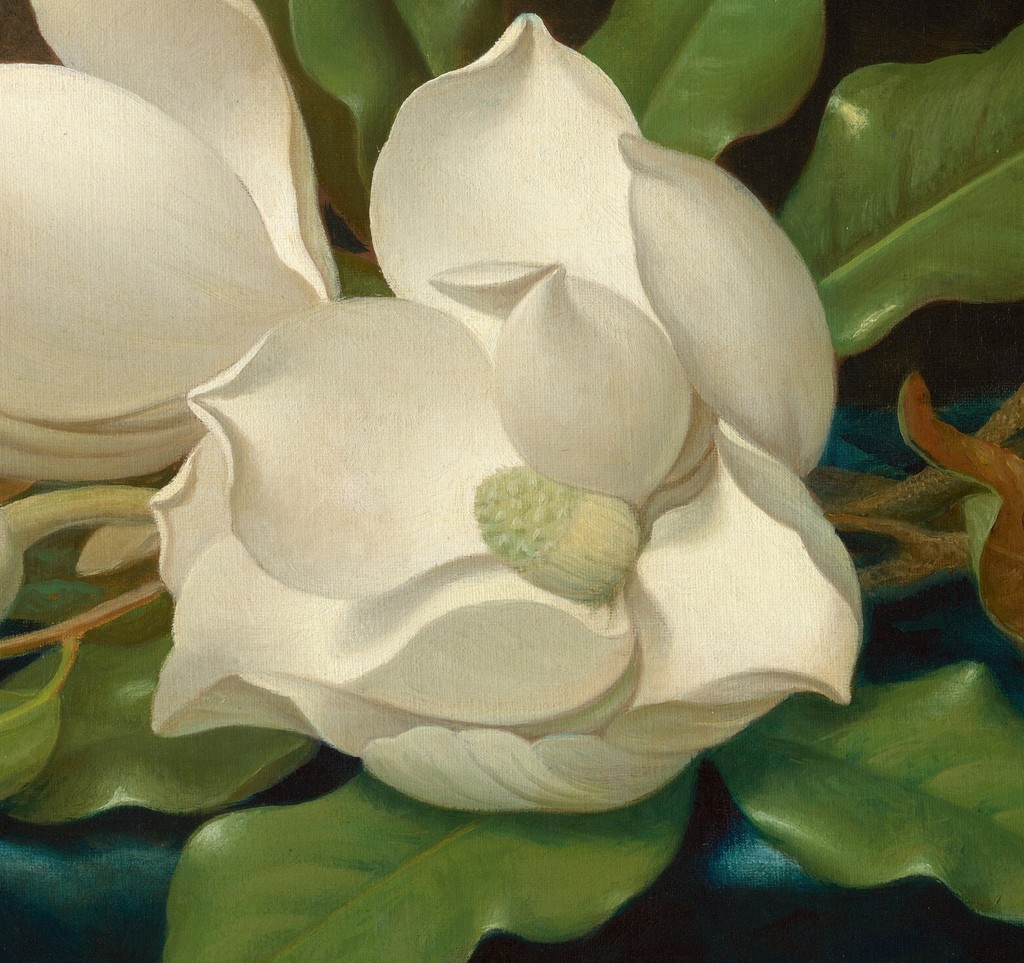
Closed bud and leaves
A closed pale bud lies beside broader green leaves. Its rounded surface contrasts with the more open petals above.
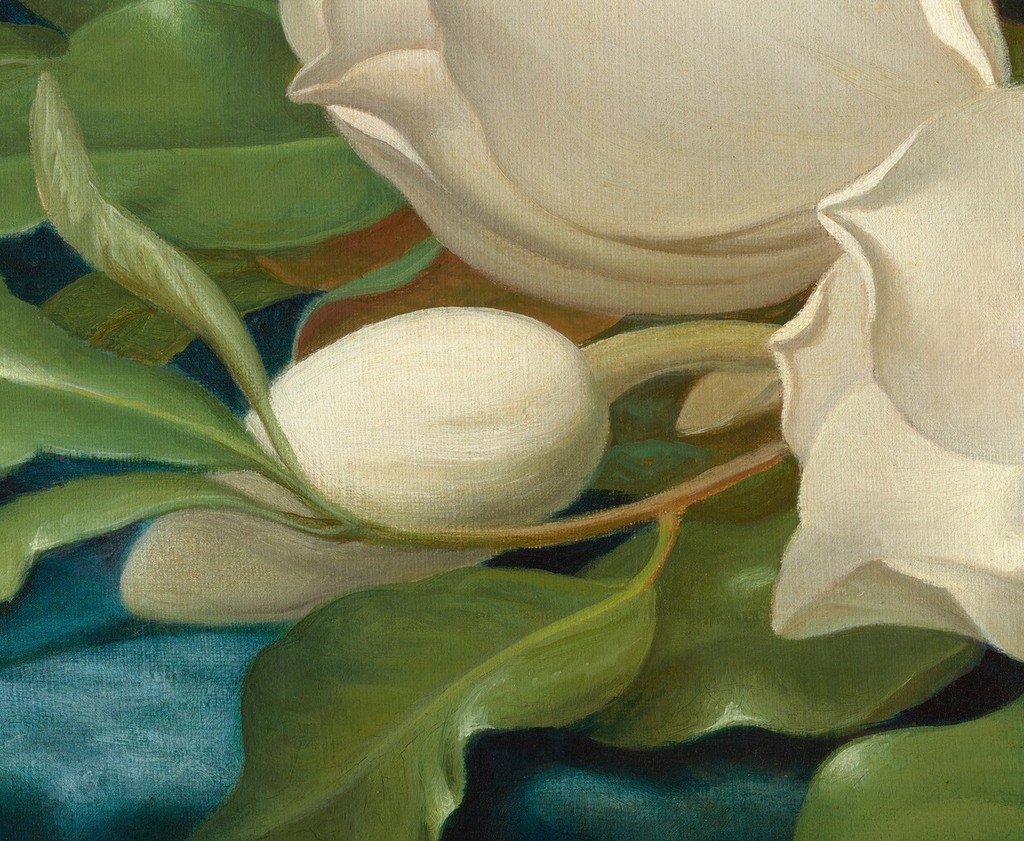
Blue cloth folds
Blue-green folds alternate between shadow and broad light. Their changes in tone support the flowers without becoming a flat background.
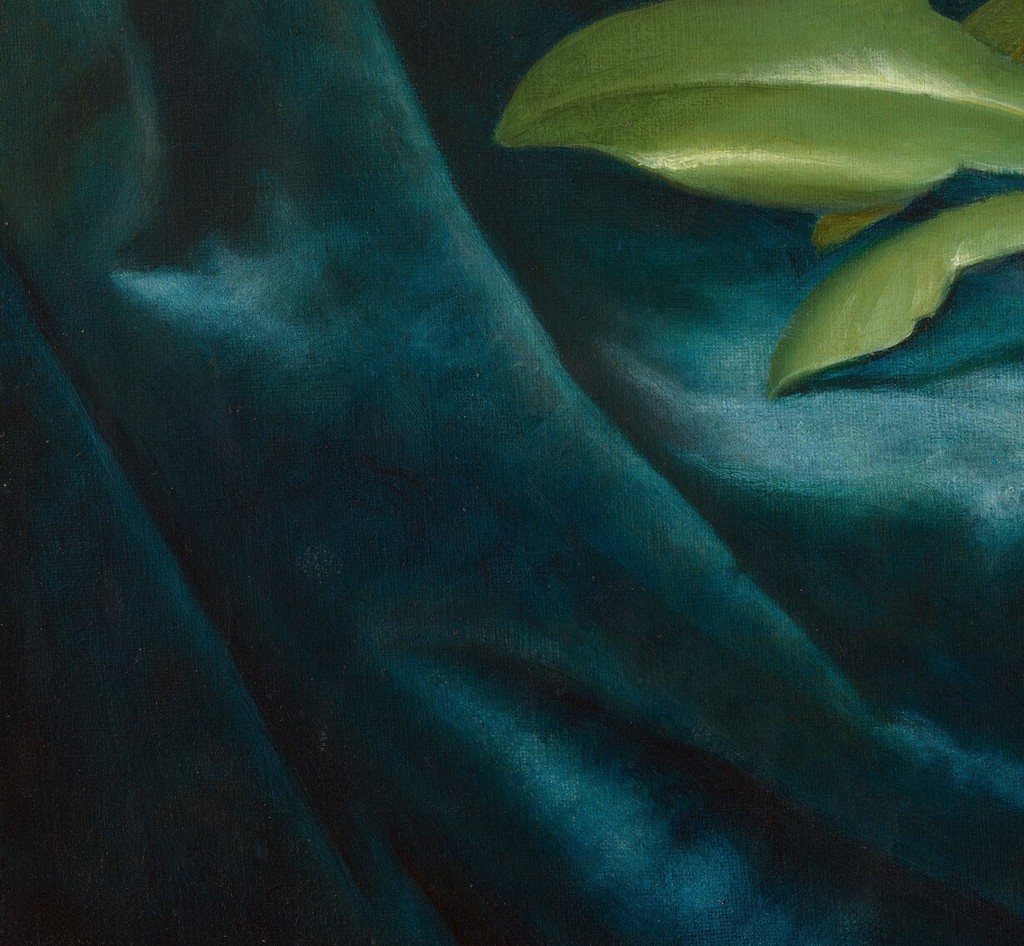
Supports and prepared grounds
The study found that Heade commonly used canvases already stretched and primed for sale. Most examined fabrics were medium-weight, plain-weave materials, with exceptions including differently woven canvases and artist’s board. These commercially available supports place his practice within the expanding nineteenth-century trade in artists’ materials.[1]
Canvas was not universal. The NGA’s Cattleya Orchid and Three Hummingbirds, dated 1871, is painted on a Winsor & Newton mahogany panel. Kelly’s catalogue describes its horizontal grain, an off-white ground and trimming of the right edge before painting. The support information concerns this particular object, whose compact dimensions also distinguish it from Heade’s panoramic coastal canvases.[3]
A ground is the prepared surface beneath the image. Many paintings in the MFA study had smooth, light-coloured commercial grounds applied in two layers, containing calcium carbonate and lead white in differing proportions. The light surface could reflect through thin paint above it, contributing to an impression of brightness.[1]
The researchers also found exceptions, including single-layer grounds in early portraits and textured preparations in selected works. Such differences matter because texture, absorbency and underlying colour can affect the finished surface. A bright digital reproduction alone cannot identify the preparation beneath an unexamined canvas.
Drawing, repetition and uncertain transfer methods
Heade often began with a schematic indication of a horizon or backdrop, sometimes adding more detailed outlines of important forms. The examined works include dry drawing materials and thinner, wet preliminary marks. Their survival and visibility vary with the materials and the paint laid over them.[1]
Few surviving drawings in relation to the paintings do not establish that he never used studies. The same research describes sketches of hummingbirds in his Brazil journal and other landscape motifs. Related drawings and oil studies provide positive evidence where they survive; the absence of a preparatory sheet for another work remains an absence of evidence.
Repeated flowers and birds raise a more particular question. Red, crayon-like marks at the edges of some blossoms, together with recurring shapes, led the authors to consider tracing or mechanical transfer. They also considered freehand drawing. The study left the method unresolved, so similar outlines should not be presented as proof that Heade used one specified copying device.[1]
This uncertainty still leaves an important observation: repeated motifs could be adjusted in new arrangements. A bird, flower or haystack functioned within a larger balance of space, colour and scale. Repetition and invention were compatible parts of his studio practice.
Marshes revised during composition
Sunlight and Shadow: The Newbury Marshes offers a documented example of alteration. Charles M. Brock’s NGA study reports infrared evidence of an earlier haystack position. Heade moved the motif forward and left into the light, changing its relationship with the tree and open marsh.[4]
The accompanying colour image shows the accepted composition, including its bright stack, curved water and cattle. It does not itself reveal the covered earlier form. That distinction allows readers to connect the visible result with the published examination without confusing the reproduction with an infrared image.
View of Marshfield supplies a different kind of evidence. Sarah Cash compares the canvas with an associated two-sheet drawing at the MFA. Haystacks were added and a tree at the right was eliminated as the design developed. These changes demonstrate selection and rearrangement between related works.[5]
They also complicate a simple division between outdoor observation and studio construction. The represented place and harvesting practices could be locally grounded while the final arrangement was edited. The individual Marshfield article considers the regional identification and working landscape without turning a proposed viewpoint into certainty.
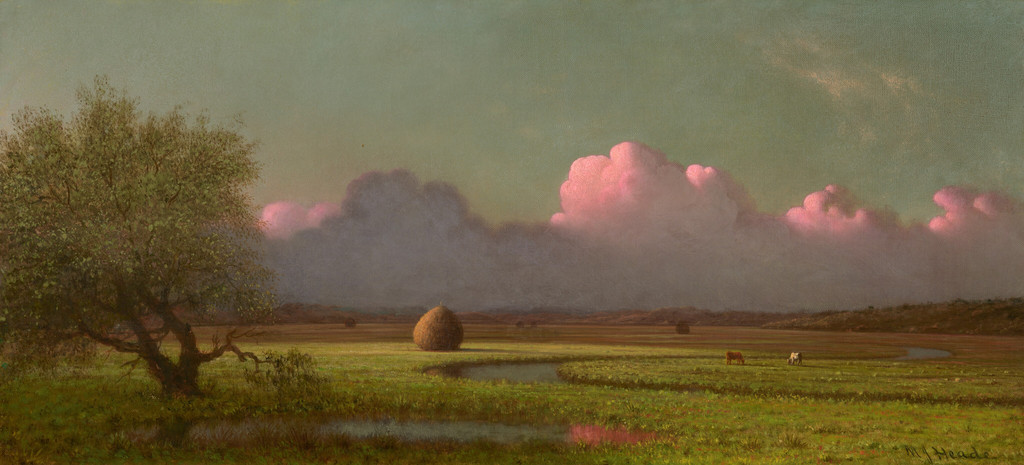
Martin Johnson Heade, Sunlight and Shadow: The Newbury Marshes, c.1871–75. Oil on canvas, 30.5 × 67.3 cm. National Gallery of Art, 2010.74.1. John Wilmerding Collection; National Gallery of Art. Image source. CC0 / Public domain. Resized only; native appearance preserved.
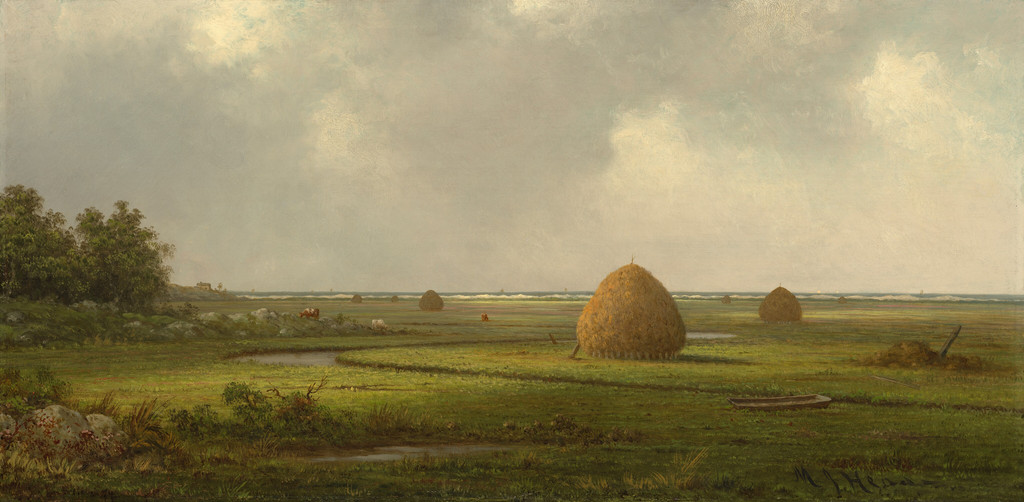
Martin Johnson Heade, View of Marshfield, c.1866–76. Oil on canvas, 39.05 × 76.84 cm. National Gallery of Art, Corcoran Collection, 2015.19.173. Corcoran Collection (Museum Purchase, 1981); National Gallery of Art. Image source. CC0 / Public domain. Resized only; native appearance preserved.
Thin colour and selective texture
Heade’s brushwork was more varied than the idea of a uniformly smooth surface suggests. The MFA researchers describe long horizontal strokes in marshes, stippled vegetation, hooked branches, touches of bright colour and areas of thicker paint. The contrasts help distinguish flat distance from nearer plants or animate relatively subdued passages.[1]
Glazing applies comparatively transparent paint over an existing layer. In several examined works, Heade laid coloured glazes over bright white impasto, allowing the underlying lightness to intensify colour. The researchers discuss this effect in sunsets, orchid throats and hummingbirds. It describes a recurring device within the studied material, rather than a complete sequence for every such subject.[1]
Impasto and glazing could thus serve the same luminous effect. Thickness supplied a reflective base, while thinner colour altered its appearance. The resulting light belongs to the structure of the paint as well as to the depicted sun, cloud or flower.
Kelly’s Rio catalogue entry gives another specific contrast: thin, fluid foreground rocks coexist with thickly painted foam. Its sky includes warm glazes over a grey-green layer. These findings belong to Rio de Janeiro Bay, rather than establishing the construction of every sky in the coastal series.[3]
Watch: Martin Johnson Heade
Choose a film to explore the artist’s work, its interpretation and its wider setting.
Museum Minute: Heade Hummingbirds
A brief Shelburne Museum introduction to Heade’s hummingbird paintings.
Watch on YouTubeA magnolia painted in stages
Kelly’s technical account of Giant Magnolias on a Blue Velvet Cloth reconstructs a staged process. The flowers were worked wet into wet, followed by leaves and stems, deep shadows and background glazes. Highlights added over the initial velvet tones were glazed and reduced as painting progressed. The visible arrangement therefore combines decisions made at different points in its execution.[3]
The catalogue identifies the preliminary drawing material as probably graphite. Retaining that qualification matters: an interpretation based on examination is not always a definitive chemical identification. The pale petals and folded cloth can be studied visually while the catalogue provides the separate evidence about their construction.
The Timken Museum’s The Magnolia Blossom offers a related but distinct observation. Its collection essay discusses the red background appearing along the flower’s edges and the contribution of this colour to the blossom’s modelling. The finding belongs to that red-cloth picture.[6]
It should not be reassigned automatically to the NGA or Chicago blue-cloth paintings. Similar subjects make comparison useful, but accession, support, examination and individual arrangement keep each object’s evidence separate.
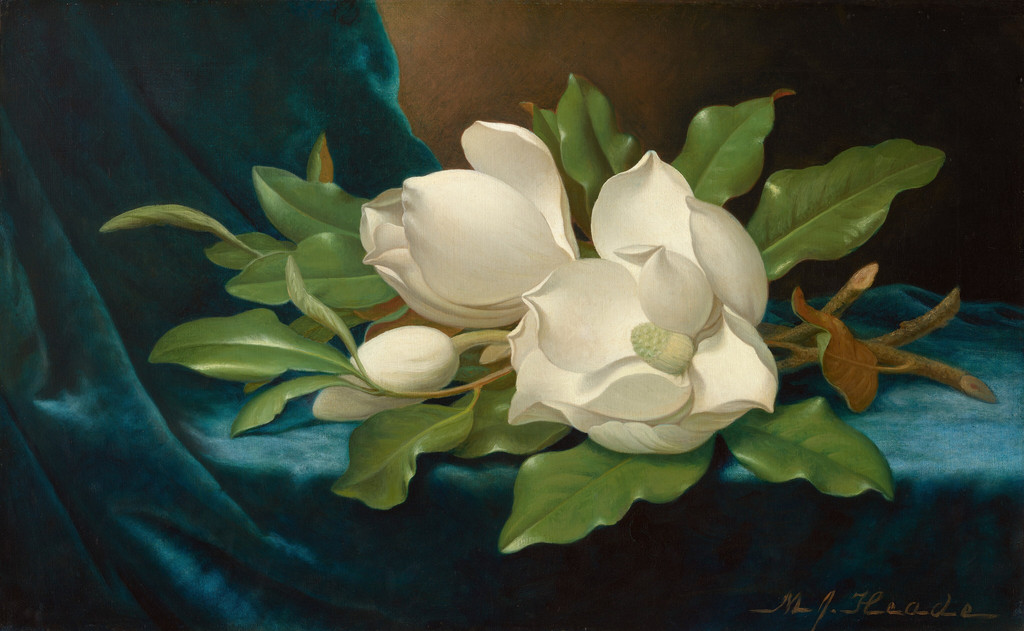
Martin Johnson Heade, Giant Magnolias on a Blue Velvet Cloth, c.1890. Oil on canvas, 38.4 × 61.5 cm. National Gallery of Art, 1996.14.1. Gift of The Circle of the National Gallery of Art in Commemoration of its 10th Anniversary; National Gallery of Art. Image source. CC0 / Public domain. Resized only; native appearance preserved.
Birds and botanical detail in composed settings
The tropical pictures combine close foreground detail with distant, often misty space. Large orchids and comparatively small birds occupy carefully arranged branches, moss or rocks. Such compositions can draw on observation without recording one untouched scene exactly as it appeared outdoors.[7]
The conservation study discusses Heade’s possession of hummingbird skins and the possibility that cursory underdrawing was developed more fully in paint. It also leaves the method of transferring repeated bird motifs open. Observation of living birds, specimens and studio adjustment should therefore be considered together rather than reduced to a single method.[1]
In the NGA Cattleya panel, the thin flower colour contrasts with more substantial white paint in selected passages. Nearby birds, the nest and its two eggs form a different concentration of detail. The panel’s examination can support discussion of these paint effects without identifying every bird-and-orchid composition as technically identical.[3]
Pigment, medium and varnish evidence
The MFA project used several complementary methods to investigate pigments, including microscopy, X-ray fluorescence and infrared spectroscopy. Their strengths differ: detecting an element may suggest several possible pigments, while a sampled particle can provide more particular evidence. The appendix explains why the researchers combined approaches rather than relying on one instrument.[2]
The results document changes from an early, comparatively limited palette to a broader range of colours. They do not make the hue of a reproduction sufficient to name a pigment. Blue cloth or green foliage can contain mixtures, overlapping layers and materials whose identities require examination.[1]
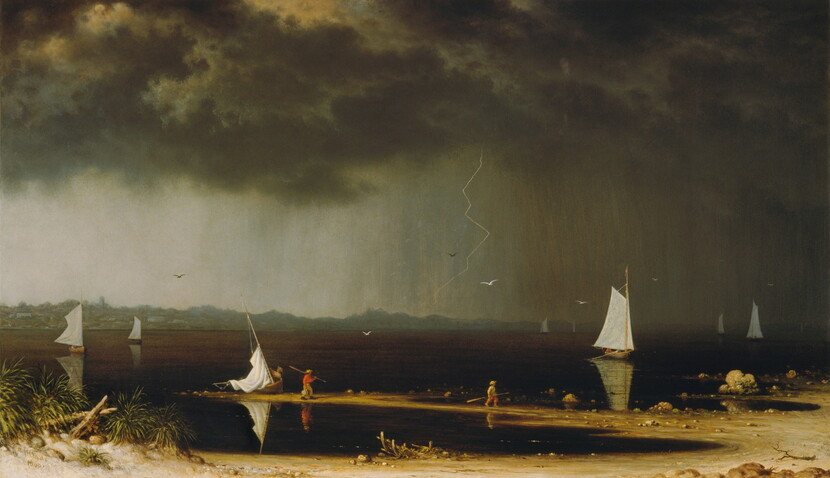
Exact object identity is especially important with similarly titled storms. The JAIC study’s Approaching Storm: Beach near Newport is the MFA painting, accession 45.889. Its sampled greenish-yellow underlayer cannot be assigned to the Met’s 1859 Approaching Thunder Storm, accession 1975.160. Shared atmospheric effects make the works useful comparisons while their separate records determine where technical findings belong.[1]
Infrared spectroscopy indicated oil paint in the analysed material. The authors explicitly state that more detailed study of the oil and possible resin additives would require methods not used in this project. Oil is therefore supported; a universal resin-rich medium formula is not.[2]
Original varnishes also remained a limited field of evidence. Few survived, and analysis did not establish one general preference. Historical cleaning, relining and other interventions further affect what examination can show. A treatment or condition described in an older publication should be dated to that account rather than presented as a present inspection.[1]
Reading the evidence together
The strongest account of Heade’s technique moves between the whole composition and specific examined passages. Visible space explains why a changed stack or bright orchid matters; conservation findings explain aspects of how it was made. Neither kind of evidence needs to answer every question alone.
The paintings show a practice of adjustment across subjects: a marsh horizon could be balanced with a relocated stack, a blossom shaped against velvet, or a tropical foreground organised around repeated motifs. Materials supplied possibilities, and composition directed them. This relationship makes the varied surfaces more revealing than a single label for the artist’s style.
Artworks directory
A collected selection of 26 individually identified museum paintings, including thirteen extended artwork studies. This is a bounded directory, rather than a complete catalogue raisonné. Two Boston entries retain dates from the 2002 conservation study. Links open a companion article where available, otherwise the cited institutional record or publication; unillustrated objects remain included.
Frequently Asked Questions
The article’s reproduction shows the final composition. The earlier position is documented through Brock’s account of infrared examination.[4]
No. The analysed material indicated oil paint; detailed investigation of possible additives was outside the methods used in the MFA project.[2]
Discussion
Look again at the images and ideas explored in Martin Johnson Heade’s Style and Technique. These editorial prompts invite your observations.
Reader Insights
Which visible relationship helps explain a documented revision?
What changes when the wood Cattleya panel is compared with canvas magnolias?
Which question remains open after the bounded conservation study?
Join the Conversation
Share a detail, comparison or question about Martin Johnson Heade’s Style and Technique below.
References
- Elizabeth Leto Fulton, Richard Newman, Jean Woodward and Jim Wright, “The Methods and Materials of Martin Johnson Heade,” JAIC 41(2), 2002. Main article: sample, supports, grounds, drawing, paint, palette and open questions. View source
- Fulton and colleagues, appendices and bibliography. Examined works and analytical-method limitations; pigment-table images are not represented here as a completely read dataset. View source
- Franklin Kelly, American Paintings of the Nineteenth Century, Part I, NGA, 1996, printed pp.287–298. Biography and individual Rio, Cattleya and Giant Magnolias entries. View source
- Charles M. Brock, American Masters: The John Wilmerding Collection, NGA, 2004, printed pp.67–74. Still lifes, Sunlight and Shadow and its infrared revision. View source
- Sarah Cash, Corcoran Collection: American Paintings to 1945, printed pp.130–131 and notes p.266. Marshfield and its associated drawing. View source
- Timken Museum, The Magnolia Blossom, 1888. Separate red-cloth work and edge-colour discussion. View source
- Charlotte M. Porter, Florida Museum, “Visual Interests”. Observation, bird-and-orchid compositions and studio context. View source
- Splash image source.
Martin Johnson Heade, Cattleya Orchid and Three Hummingbirds, 1871. Oil on wood, 34.8 × 45.6 cm. National Gallery of Art, 1982.73.1. Gift of The Morris and Gwendolyn Cafritz Foundation; National Gallery of Art. CC0 / Public domain. Resized only; native appearance preserved.
View source