 by Tom Gurney
Tom Gurney BSc (Hons) is an art history expert with over 20 years experience
Email: tomgurney1@gmail.com / Phone: +44 7429 011000
Hummingbird and Passionflowers by Martin Johnson Heade: Introduction
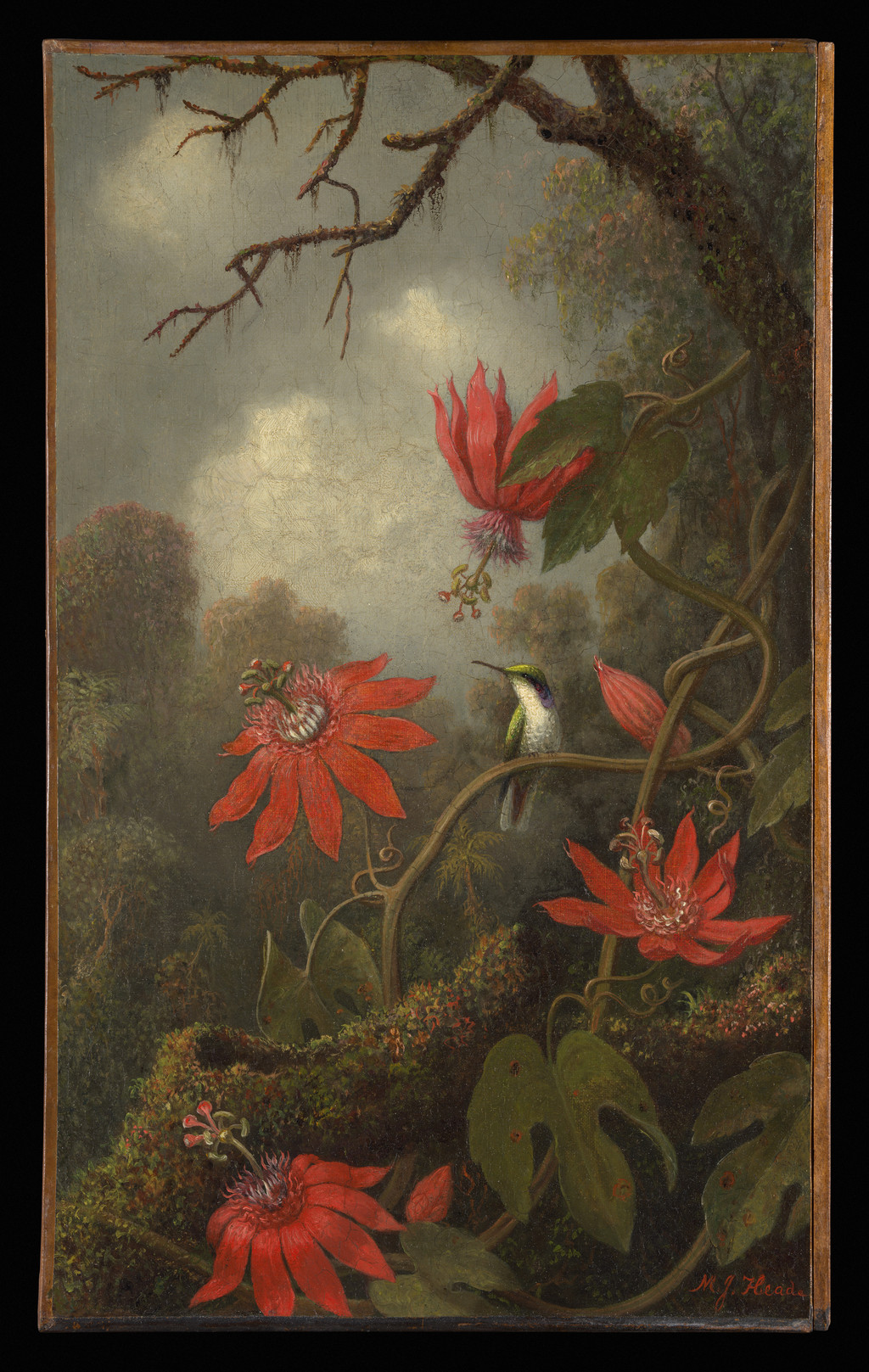
Martin Johnson Heade’s Hummingbird and Passionflowers places a small perched bird among four open red flowers, curling tendrils and interwoven branches. A hazy landscape recedes behind the close botanical forms. The Metropolitan Museum of Art dates this tall canvas approximately 1875–85. Its accession is 46.17, and its vertical arrangement differs from both Heade’s earlier hummingbird studies and his horizontal marsh landscapes.[1]
At a Glance
- ArtistMartin Johnson Heade (1819–1904)
- TitleHummingbird and Passionflowers
- Datec.1875–85
- MediumOil on canvas
- Dimensions50.8 × 30.5 cm
- CollectionMetropolitan Museum of Art, New York
- Accession46.17
- CreditPurchase, Gift of Albert Weatherby, 1946
This work across Martin Johnson Heade’s career
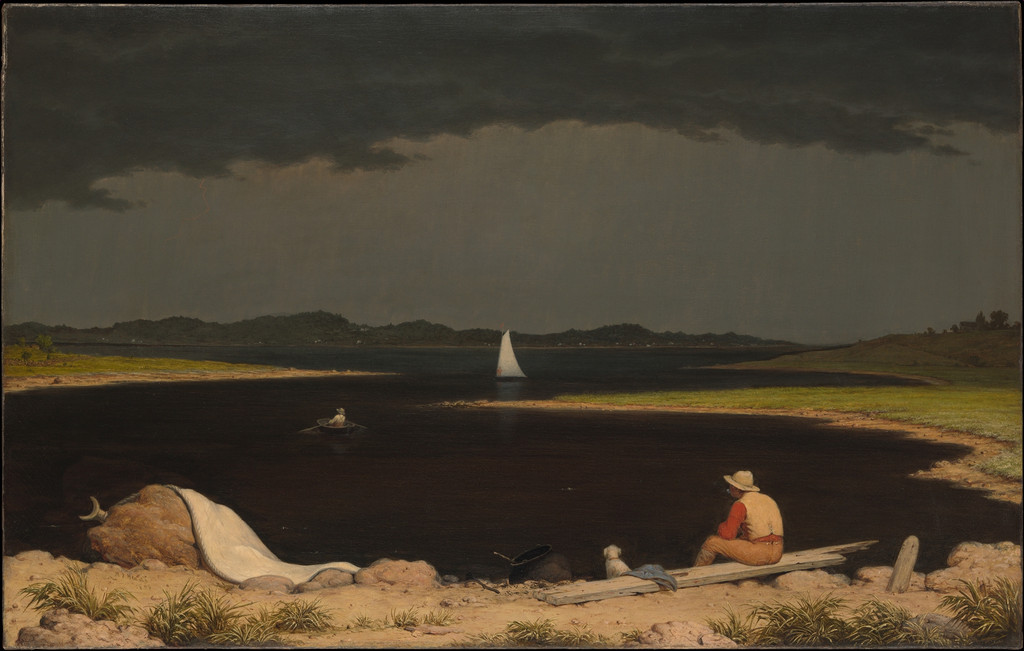
Sudden Shower, Newbury Marshes
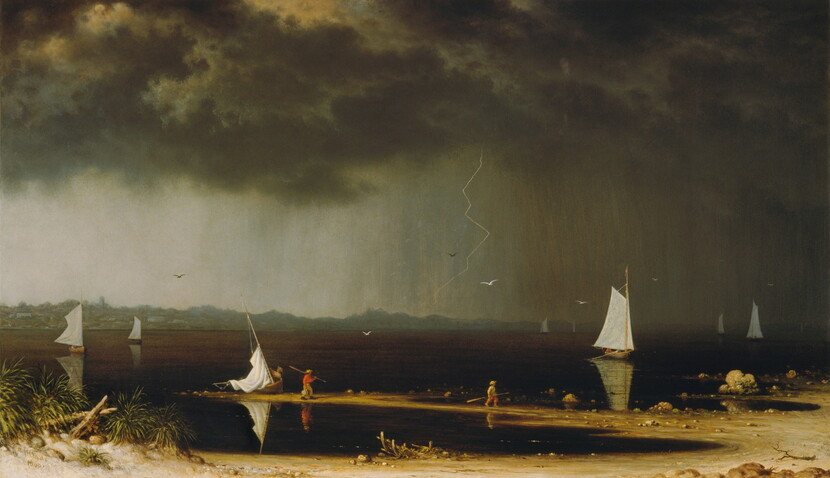
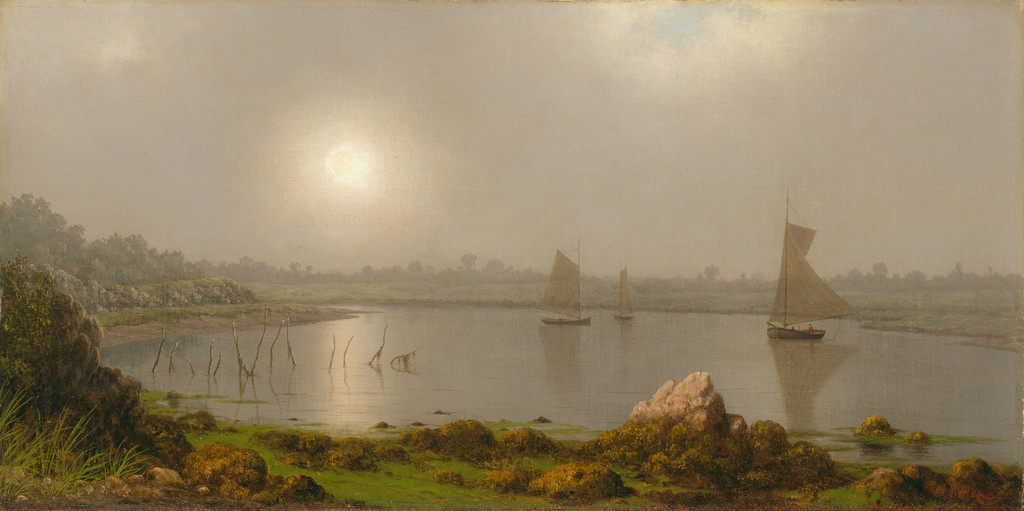
c.1865–75View of Marshfield
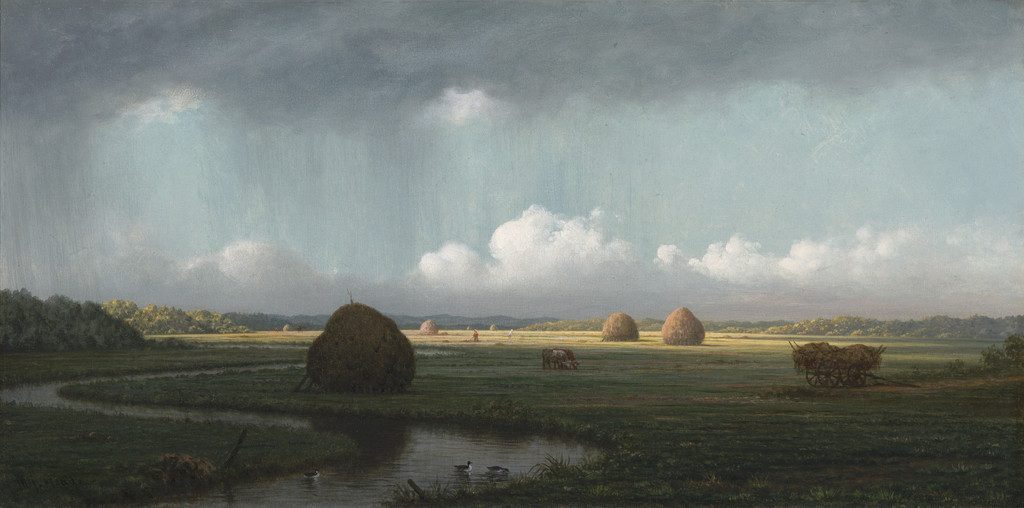
c.1866–76Newburyport Meadows
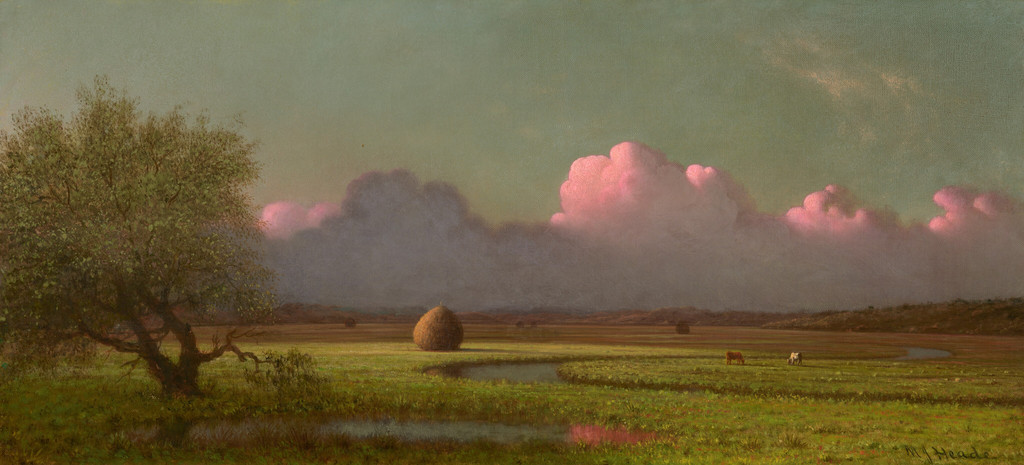
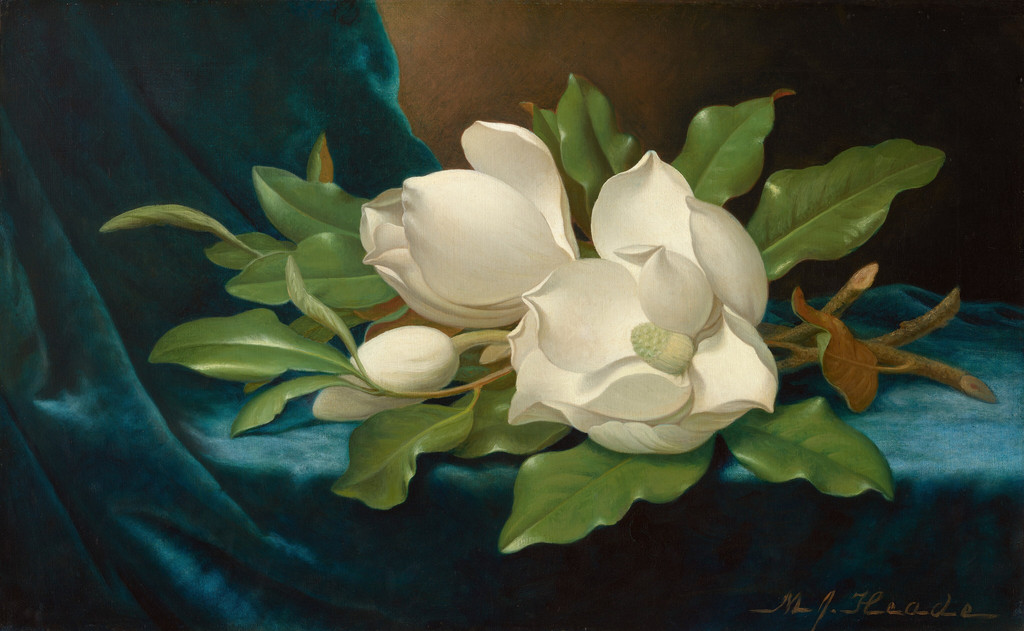
c.1876–81Magnolias on Light Blue Velvet Cloth
c.1885–95Contents
- A vertical web of branches
- One bird and four open red flowers
- Near detail and hazy distance
- Date, canvas and the Met collection
- Orchids and the earlier hummingbird project
- Natural history and pictorial arrangement
- Annotated details
A vertical web of branches
The painting’s height gives Heade room to distribute flowers at several levels. One hangs above the bird, another opens to its left, and two occupy lower parts of the canvas. Their red forms punctuate a largely green, brown and grey setting.
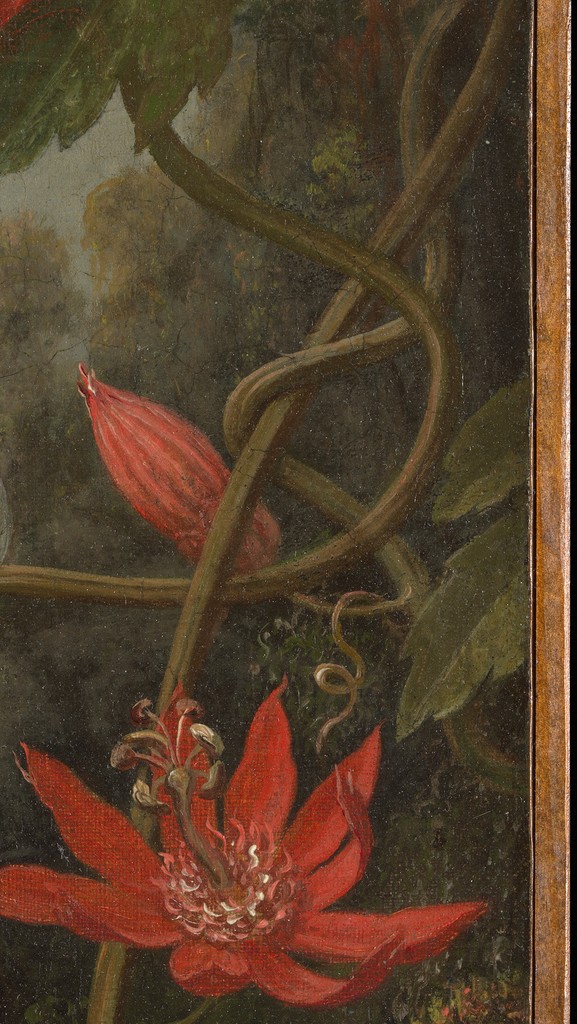
The main vine bends across the lower field and rises along the right. Its curves connect the flowers with one another while giving the bird a perch near the middle. Smaller tendrils coil around the larger stems, introducing repeated loops into the arrangement.
Branches extend across the top from the darker vegetation at the right. Their more angular forms create a partial canopy above the softer floral curves. The open area beneath them allows the sky to remain visible through the botanical structure.
The result is an enclosed foreground with openings into a wider landscape. The viewer looks through and around stems rather than across an unobstructed plain. The vertical format makes the experience notably different from the long horizons of Heade’s marsh paintings.
Annotated Details from Hummingbird and Passionflowers
The numbered points identify visible features discussed in this article. Return from each detail to the whole composition. Martin Johnson Heade, Hummingbird and Passionflowers, c.1875–85. Metropolitan Museum of Art, 46.17. Purchase, Gift of Albert Weatherby, 1946; Metropolitan Museum of Art. Image source. CC0 / Public domain. Resized only; native appearance preserved.
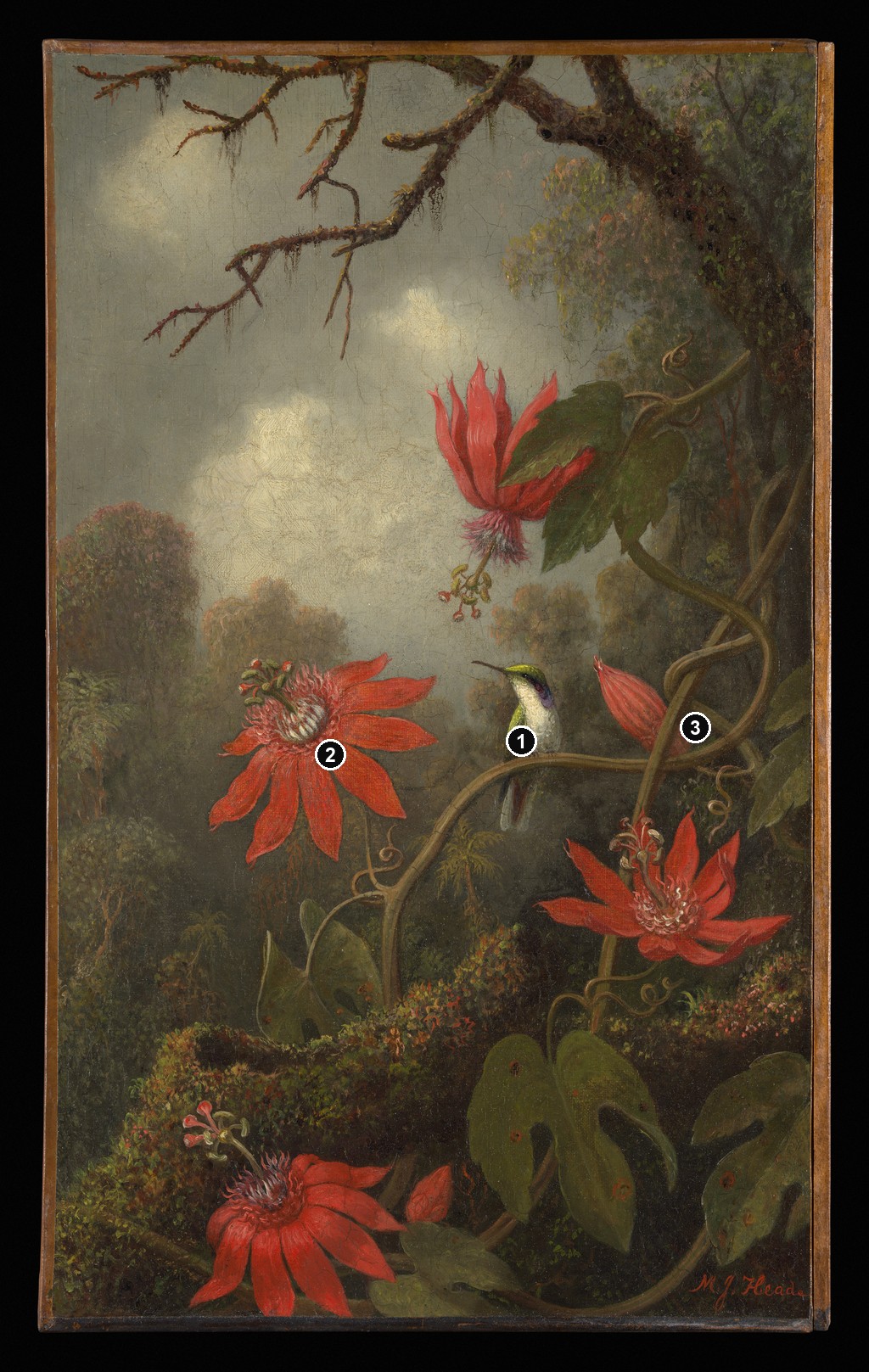
Details from HUMMINGBIRD AND PASSIONFLOWERS
Compare the cropped details with the complete images above. Notice how their colours, shapes and positions contribute to the larger compositions.
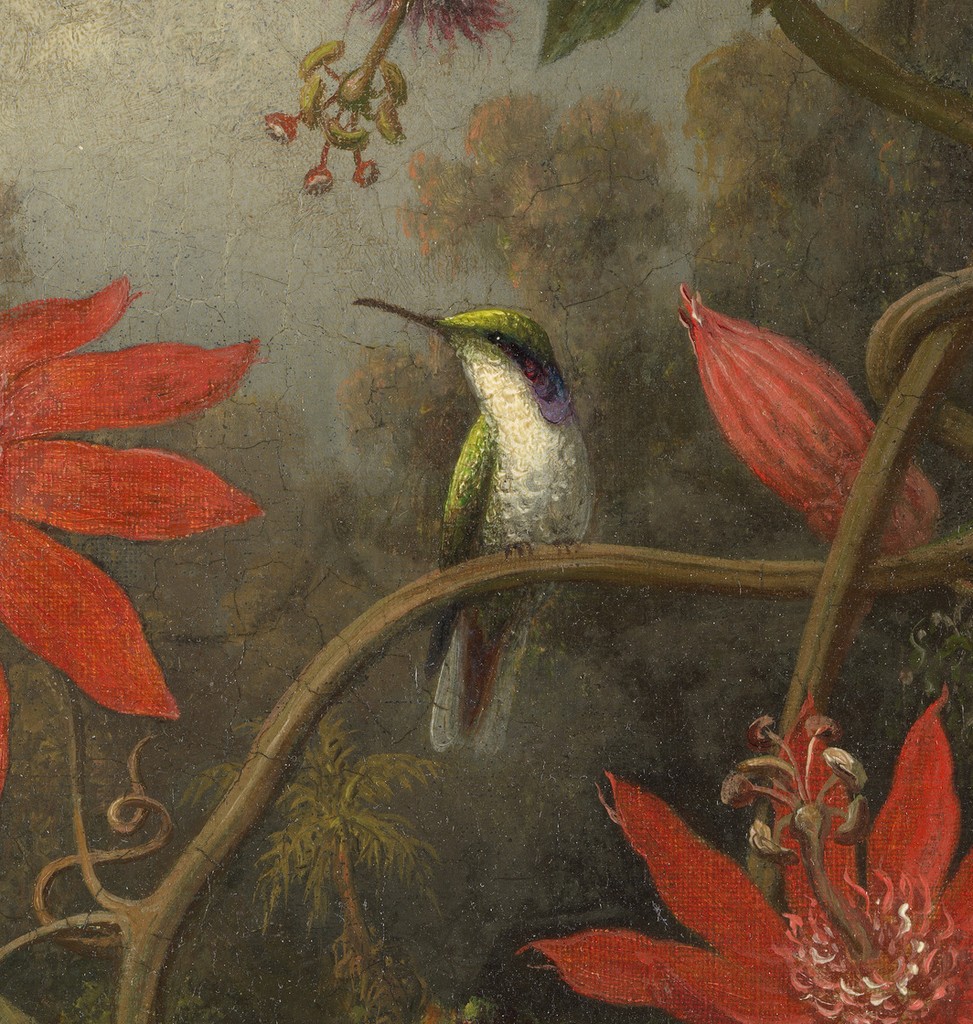
Perched hummingbird
A small green and pale bird rests on a branch near the middle of the upright picture. Its beak points into the open space beside the flowers.
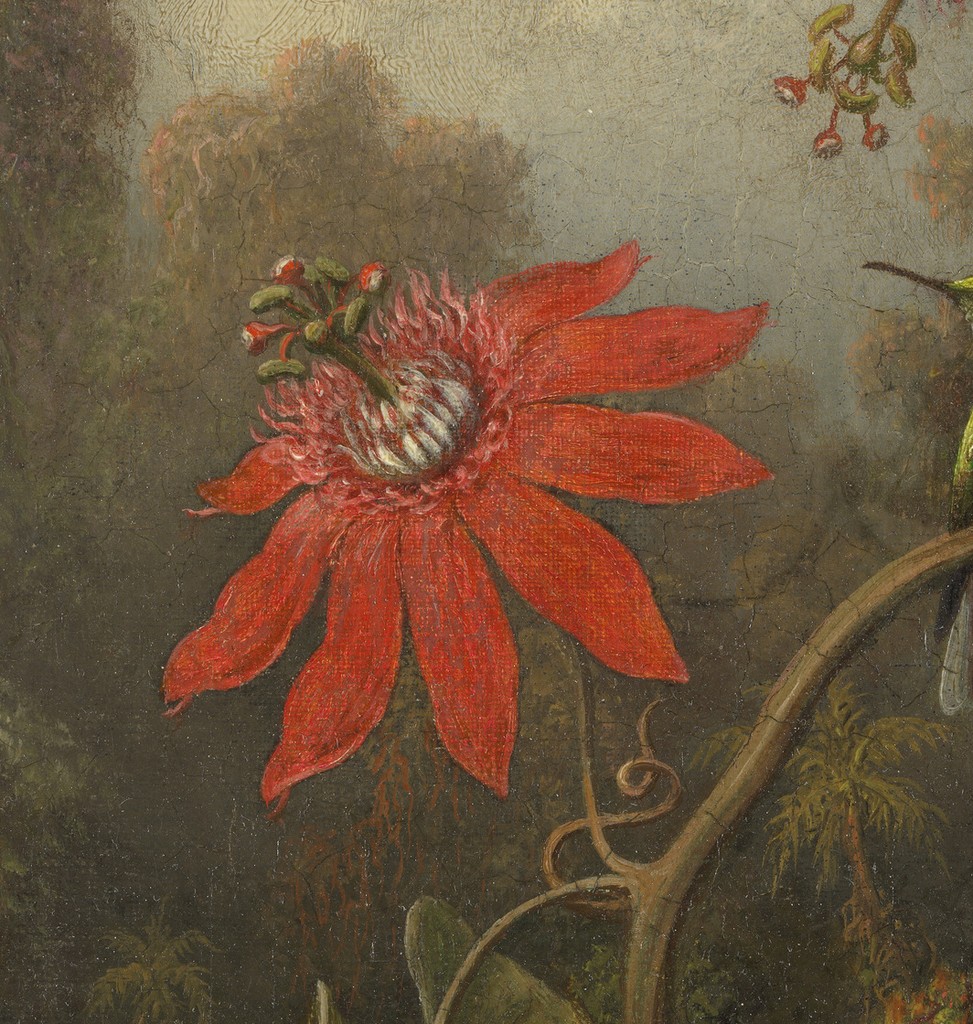
Red flower at the left
Long red petals spread around a detailed pale centre. The bright blossom stands apart from the darker foliage.
Intertwined vine
Curving stems and tendrils run beside the bird and flowers. Their repeated bends connect the separated motifs.
One bird and four open red flowers
The hummingbird sits on a curved stem close to the centre. Its head turns towards the left, with a slender beak projecting into the more open space. A green upper surface contrasts with the paler breast and a darker coloured area near the throat.
The bird’s compact body is much smaller than several nearby flowers. Its long, narrow tail continues below the perch, while its feet anchor it to the stem. These details make it a settled presence within the group rather than a blurred flying shape.
The flowers are shown from different directions. The upper bloom hangs down, while the large flower on the left spreads more openly towards the viewer. Lower flowers introduce other angles, allowing their petals and centres to appear in varied relationships.
Red petals remain the strongest colour accents in the canvas. Their brightness is reinforced by neighbouring darker leaves and by the quieter distant sky. Small pale and darker structures within the flower centres prevent the blossoms from becoming simple red silhouettes.
Buds and tendrils contribute smaller forms between the open flowers. They give the vine continuity beyond the four conspicuous blooms and help connect the botanical group to the lower foreground. The composition depends on this network as much as on the individual flowers.
The bird is perched rather than visibly feeding from a flower. That distinction matters when considering natural history. The proximity of hummingbird and blossom provides a pictorial relationship, but the image alone does not establish a particular pollination event.
Near detail and hazy distance
The foreground vegetation is darker and more closely described than the distant landscape. Leaves, stems and flowers have recognisable boundaries, while more remote trees merge into a grey-green atmosphere. The difference produces depth within a relatively narrow canvas.
A pale opening in the sky appears behind the middle portion of the vine. Its light gives the red flowers and the bird clearer surroundings without isolating them against a completely empty background. The forest continues beyond and around them.
The lower leaves have irregular surfaces and small interruptions of colour. Together with mossy-looking growth along the branches, they make the foreground more varied than a perfect ornamental bouquet. These observations concern depicted forms, rather than a diagnosis of the canvas’s physical condition.
The image’s richness also depends on the relation between broad masses and small details. Dark vegetation holds the right side together; lighter air opens the left and centre. Tendrils, flower parts and the narrow beak then provide closer points of attention within those larger areas.
Date, canvas and the Met collection
The Met identifies the work as oil on canvas, measuring 50.8 by 30.5 centimetres. Its c.1875–85 date is approximate. The painting entered the museum in 1946 through a purchase funded by Albert Weatherby’s gift.[1]
The physical proportions matter to the image. A relatively small width contains substantial height, allowing the vine and flowers to form a rising arrangement. A horizontal crop would remove parts of that structure and alter the balance between upper branches, middle bird and lower blooms.
The museum’s supplied reproduction also retains the support edges and surrounding dark margin. The complete image is used here so that the original vertical field remains visible. The lower-right signature is preserved with the rest of the composition.[1]
Watch: Martin Johnson Heade
Choose a film to explore the artist’s work, its interpretation and its wider setting.
Museum Minute: Heade Hummingbirds
A brief Shelburne Museum introduction to Heade’s hummingbird paintings.
Watch on YouTubeOrchids and the earlier hummingbird project
Franklin Kelly places Heade’s later flower-and-hummingbird pictures after the earlier Brazilian bird project. The planned Gems of Brazil publication remained unfinished, while the artist continued to develop paintings combining birds with flowers and tropical settings.[2]
The distinction keeps this Met canvas from being treated as a plate from a completed book. It belongs to a later pictorial practice in which botanical forms, birds and landscape could be composed together. The approximate date also extends beyond Heade’s first 1863–64 visit to Brazil.[2]
Two Hummingbirds above a White Orchid offers a different vertical arrangement, placing a large pale flower beneath two birds. The contrast in flower colour and bird placement changes the picture’s emphasis, even though both works invite a close encounter with tropical subjects.[6]
The NGA’s Cattleya Orchid and Three Hummingbirds includes a nest and three birds within a wider composition on wood. Kelly’s exact-object entry supplies its material and arrangement; those features belong to a separate painting from the Met’s canvas.[2]
Katherine E. Manthorne’s Thyssen entry for Orchid and Hummingbird near a Mountain Waterfall, dated 1902, shows how long Heade continued related subjects. Her discussion of foreground detail and distant space provides another comparison, rather than an explanation of this picture’s exact place of production.[5]
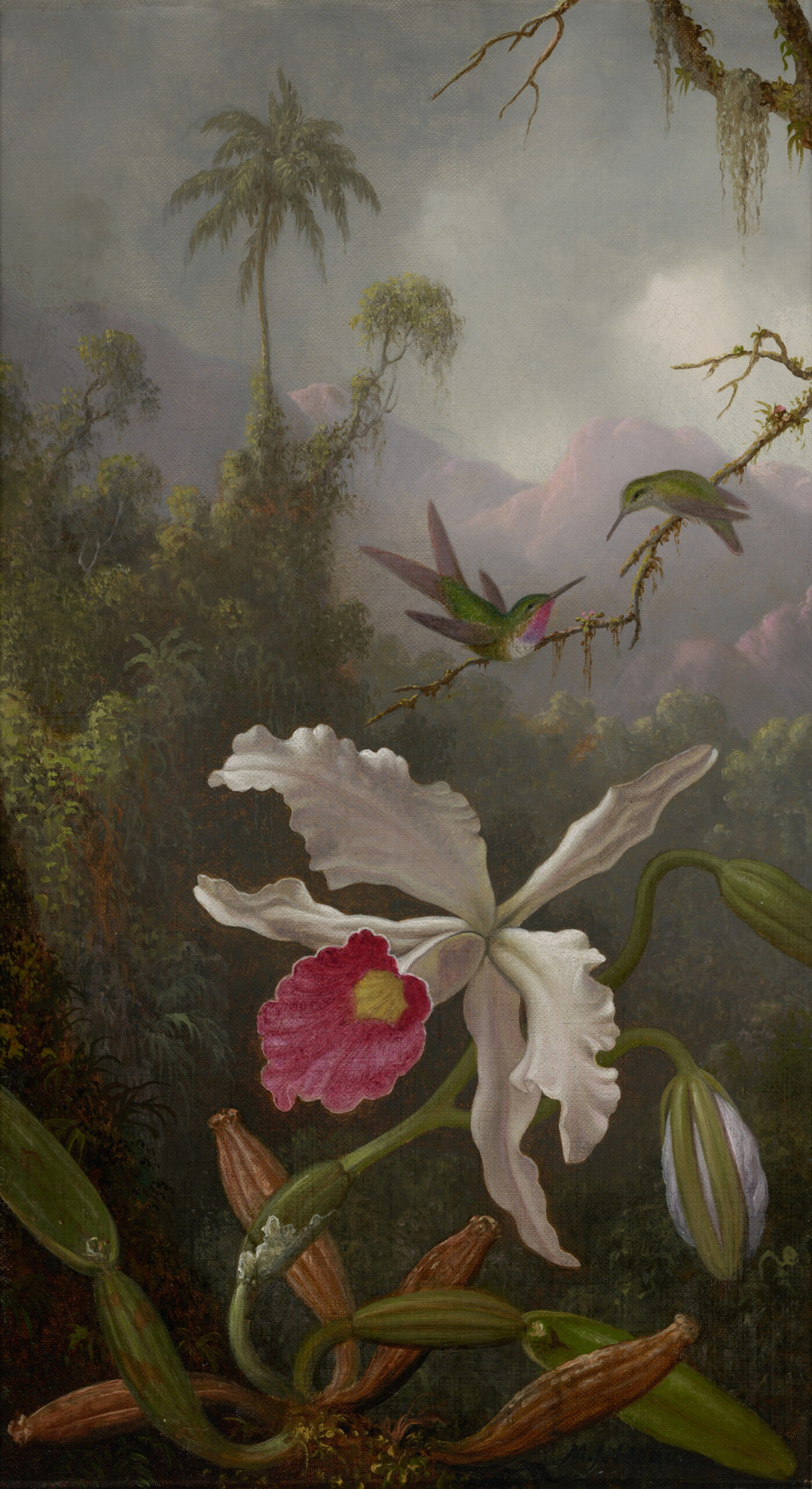
Martin Johnson Heade, Two Hummingbirds above a White Orchid, c.1875–90. Amon Carter Museum of American Art, 1981.33. Image source. Public domain. Resized only; native appearance preserved.
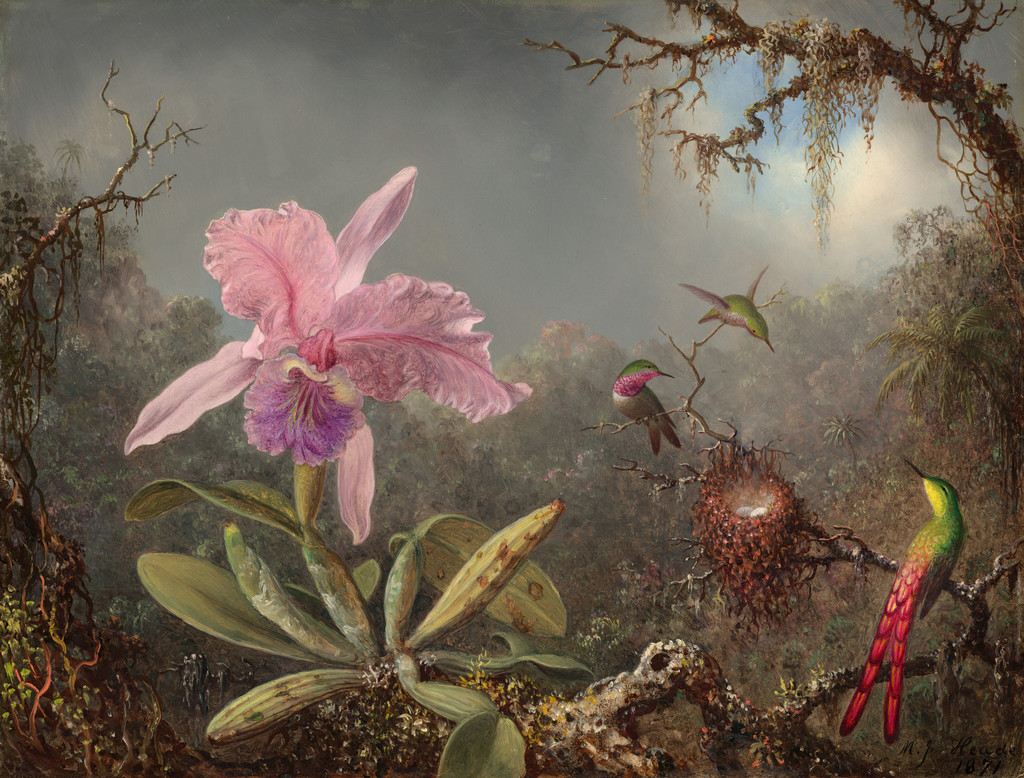
Martin Johnson Heade, Cattleya Orchid and Three Hummingbirds, 1871. National Gallery of Art, 1982.73.1. Image source. CC0 / Public domain. Resized only; native appearance preserved.
Natural history and pictorial arrangement
Charlotte M. Porter’s Florida Museum essays connect Heade’s bird painting with observation, feeding hummingbirds and maintaining study skins. They also discuss his natural-history writing. Those activities give the pictures a context broader than decorative flower painting alone.[3][4]
At the same time, a painted grouping is not automatically a scientific record of several species interacting. Porter raises this distinction when discussing orchids and birds. Her botanical discussion concerns those orchid compositions and should not be transferred into a specific claim about pollination in this passionflower painting.[3]
The consulted sources do not establish an exact bird species or flower species for the present account. The visible beak, perched body, red flowers and vine can be described without inventing a taxonomic identification or a verified forest coordinate.
The picture’s achievement lies partly in bringing these different forms into a coherent space. Four red blooms, one small bird, coiling stems and hazy distance work together within the tall canvas. Their arrangement invites close looking while leaving the relationship between observation and artistic construction open to further study.
Artworks directory
A collected selection of 26 individually identified museum paintings, including thirteen extended artwork studies. This is a bounded directory, rather than a complete catalogue raisonné. Two Boston entries retain dates from the 2002 conservation study. Links open a companion article where available, otherwise the cited institutional record or publication; unillustrated objects remain included.
Frequently Asked Questions
It is perched on a stem. The image does not visibly demonstrate nectar feeding or a specific pollination event.
Four open red flowers are distributed from the upper middle to the bottom of the painting, alongside buds, leaves and tendrils.
No completed book was published. Kelly places the later bird-and-flower pictures within the continuing practice that followed the unfinished project.[2]
Discussion
Look again at the images and ideas explored in Hummingbird and Passionflowers by Martin Johnson Heade. These editorial prompts invite your observations.
Reader Insights
How do looping stems connect the four red blossoms?
What changes beside the large white orchid and two upper birds?
Which observations can be made without deciding the bird’s species or behaviour?
Join the Conversation
Share a detail, comparison or question about Hummingbird and Passionflowers by Martin Johnson Heade below.
References
- Metropolitan Museum of Art, Hummingbird and Passionflowers, 46.17, checked against the object API. Current title, date, material, dimensions, credit and supplied image. View source 1 · View source 2
- Franklin Kelly, American Paintings of the Nineteenth Century, Part I (NGA, 1996), printed pp.287–294. Career context, unfinished publication and separate Cattleya painting. View source
- Charlotte M. Porter, Florida Museum, “Visual Interests”. Flower-and-bird subjects, related orchid compositions and attributed ecological discussion. View source
- Charlotte M. Porter, Florida Museum, “Natural History”. Natural-history context; museum-transcribed primary excerpts are paraphrased rather than independently quoted. View source
- Katherine E. Manthorne, Thyssen, Orchid and Hummingbird near a Mountain Waterfall. Separate 1902 painting and spatial interpretation. View source
- Amon Carter Museum of American Art, Two Hummingbirds above a White Orchid, 1981.33. Exact separate vertical comparison. View source
- Splash image source.
Martin Johnson Heade, Hummingbird and Passionflowers, c.1875–85. Oil on canvas, 50.8 × 30.5 cm. Metropolitan Museum of Art, 46.17. Purchase, Gift of Albert Weatherby, 1946; Metropolitan Museum of Art. CC0 / Public domain. Resized only; native appearance preserved.
View source