 by Tom Gurney
Tom Gurney BSc (Hons) is an art history expert with over 20 years experience
Email: tomgurney1@gmail.com / Phone: +44 7429 011000
Rio de Janeiro Bay by Martin Johnson Heade: Introduction
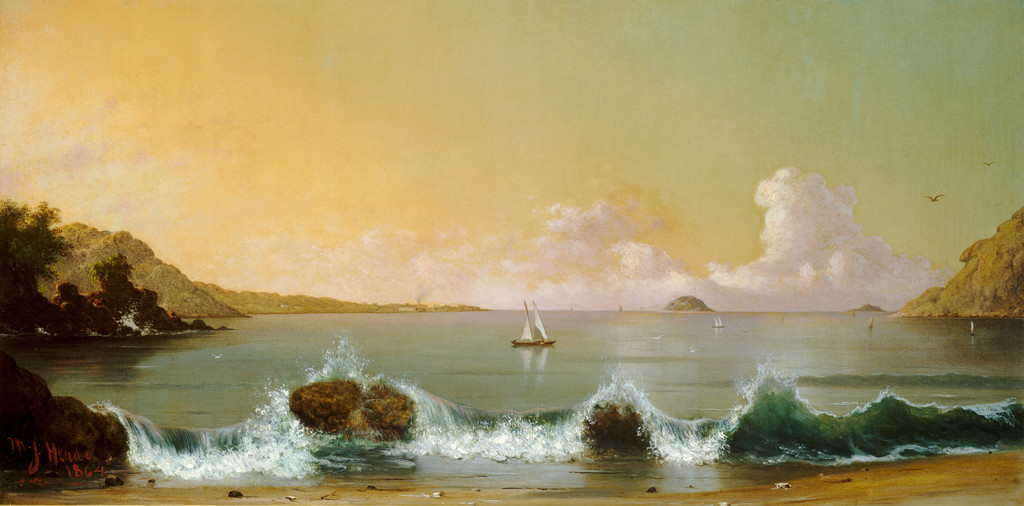
Martin Johnson Heade’s Rio de Janeiro Bay combines a calm tropical harbour with waves breaking sharply across the foreground rocks. A small sailing boat occupies the quieter water beyond, surrounded by mountains and a warm yellow sky. Signed and dated 1864, the canvas belongs to the National Gallery of Art. Franklin Kelly’s catalogue entry links it with Heade’s first journey to Brazil and identifies a probable view from the Botafogo area, while retaining uncertainty about the precise location.[1][2]
At a Glance
- ArtistMartin Johnson Heade (1819–1904)
- TitleRio de Janeiro Bay
- Date1864
- MediumOil on canvas
- Dimensions45.5 × 91.1 cm
- CollectionNational Gallery of Art
- Accession1965.2.1
- CreditGift of the Avalon Foundation
This work across Martin Johnson Heade’s career
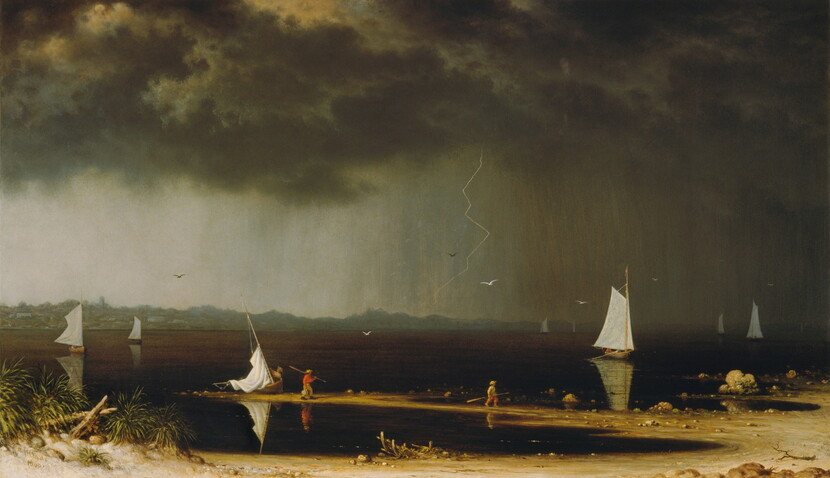
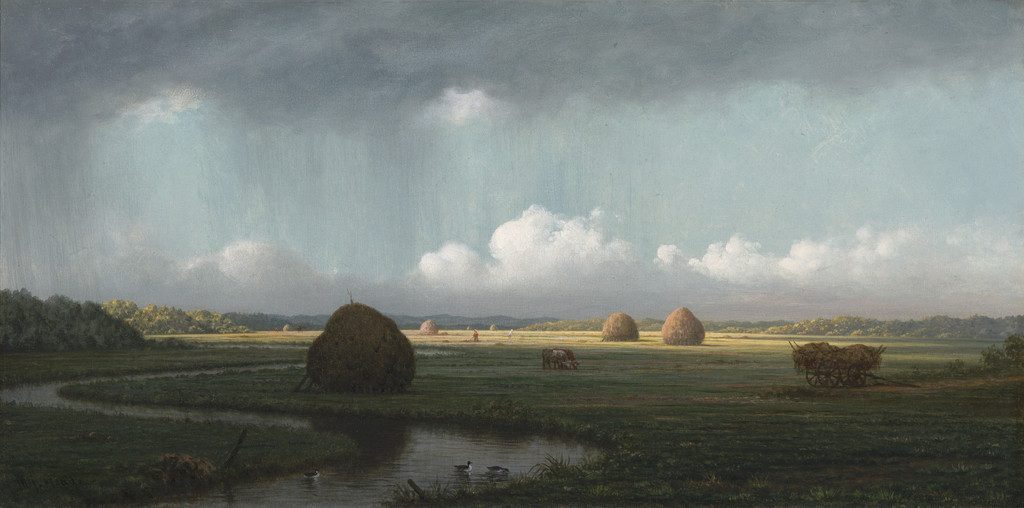
Sudden Shower, Newbury Marshes
c.1865–75View of Marshfield
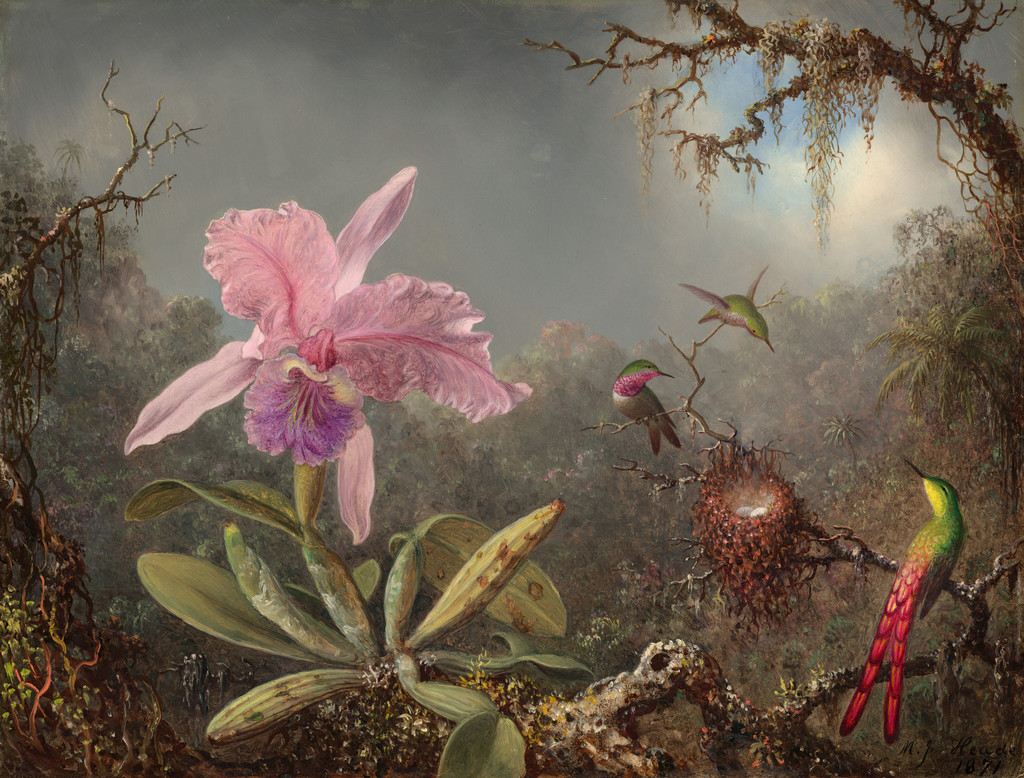
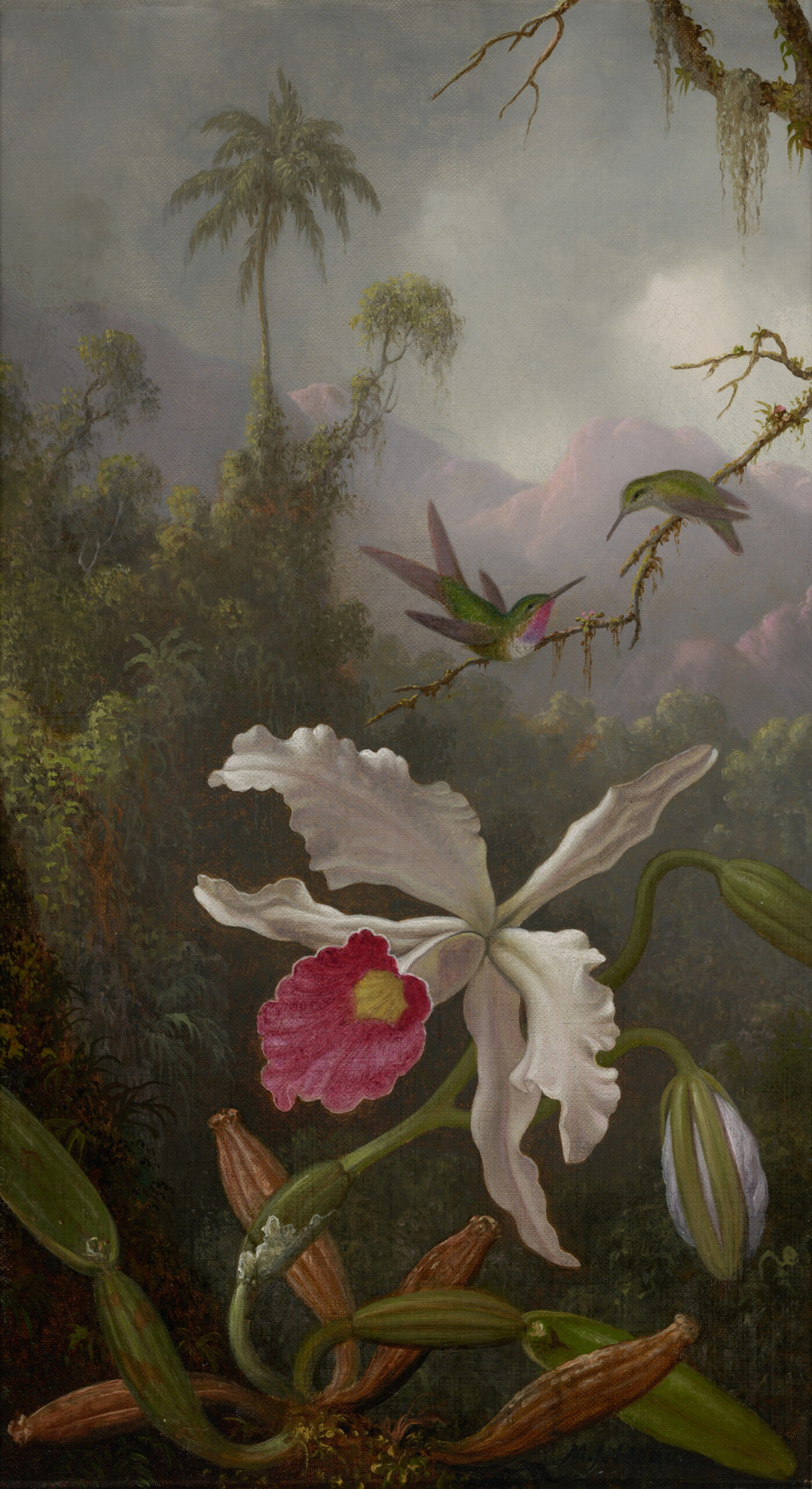
c.1866–76Hummingbird and Passionflowers
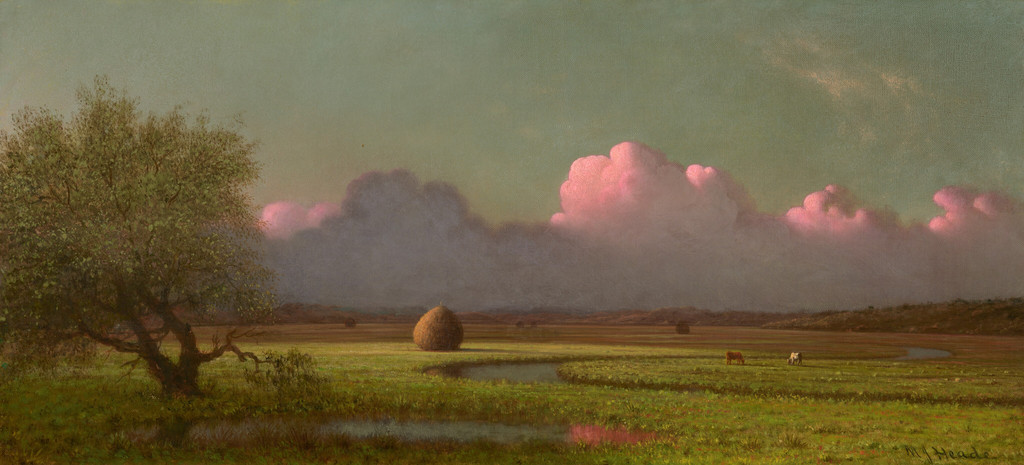
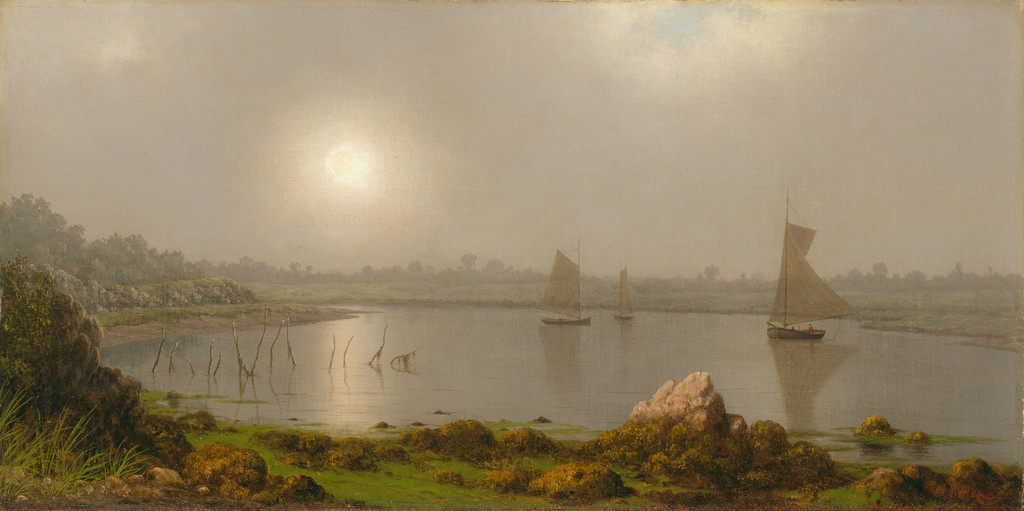
c.1875–85Newburyport Meadows
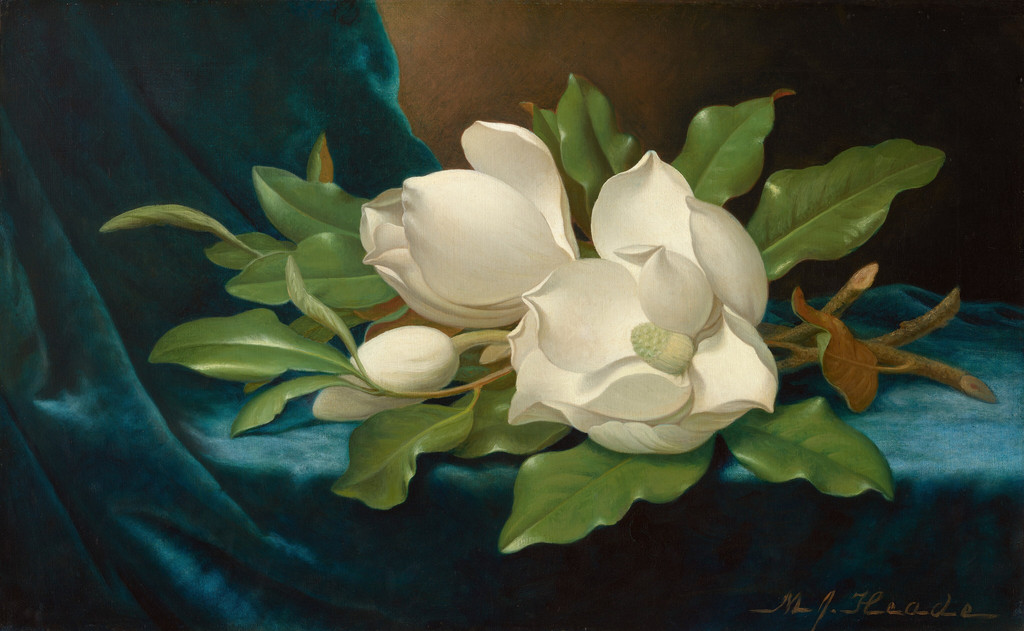
c.1876–81Magnolias on Light Blue Velvet Cloth
c.1885–95Contents
- Near surf and distant stillness
- Sails, mountains and warm air
- A probable view near Botafogo
- The Brazilian journey and related pictures
- Canvas, paint and historical examination
- Acquisition and a different kind of marine picture
- Annotated details
Near surf and distant stillness
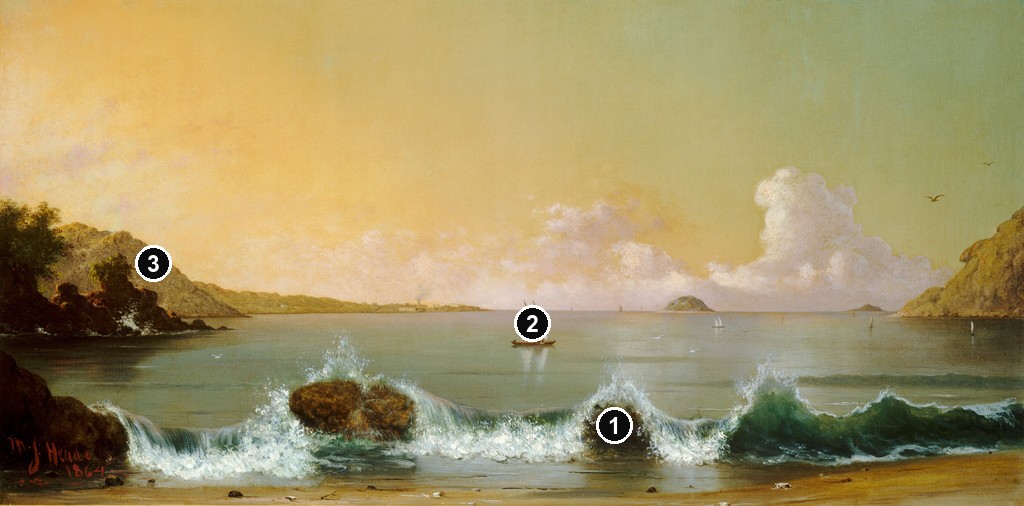
The surf stretches across the lower canvas as a sequence of bright, irregular forms. Water breaks against rocks, rises in small sprays and spreads into foam near the sand. Its sharp white passages interrupt the darker stones and green-blue waves.
The wave on the right is particularly substantial. Its curved body remains dark enough to suggest depth beneath the foam, while the lighter crest describes the point at which the water begins to break. Farther left, smaller bursts of spray rise around exposed rock.
Beyond that activity, the harbour appears remarkably level. The central sailing boat leaves a subdued reflection, and the distant shoreline forms a low boundary between water and sky. The near surf and far stillness belong to the same image but provide different experiences of movement.
Kelly treats the breaking wave as a principal focus of the picture. His account explains that Heade invested considerable attention in a fleeting event at the shoreline, even though mountains, boats and clouds also occupy the canvas.[2]
The contrast is effective because the foreground does not overwhelm the distant space. A band of comparatively quiet water separates the surf from the boat. The viewer can move from the forceful near edge into a much more open area beyond it.
There is also a difference in the kinds of line used across the scene. Foam produces broken, irregular contours, while the harbour introduces longer horizontal ones. Mountain slopes and sails add diagonals, making the calm water a meeting point between several forms of movement.
Annotated Details from Rio de Janeiro Bay
The numbered points identify visible features discussed in this article. Return from each detail to the whole composition. Martin Johnson Heade, Rio de Janeiro Bay, 1864. Oil on canvas. National Gallery of Art, 1965.2.1. Image source. CC0 / Public domain. Resized only; native appearance preserved.
Details from RIO DE JANEIRO BAY
Compare the cropped details with the complete images above. Notice how their colours, shapes and positions contribute to the larger compositions.
Breaking foreground water
Pale foam rises around dark foreground rocks. Its lively contours differ from the calm horizontal water beyond.
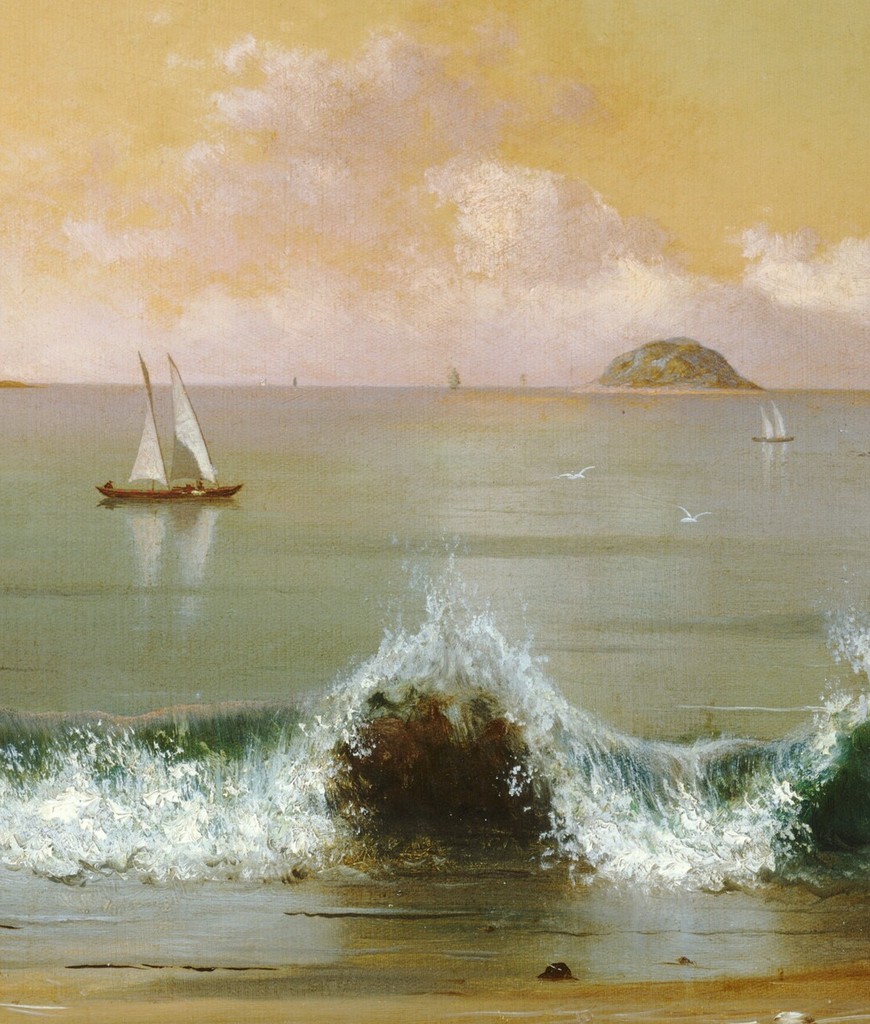
Sailing vessel
A small vessel carries pale sails across the bay. Its reflection links the upright sails to the quieter water.
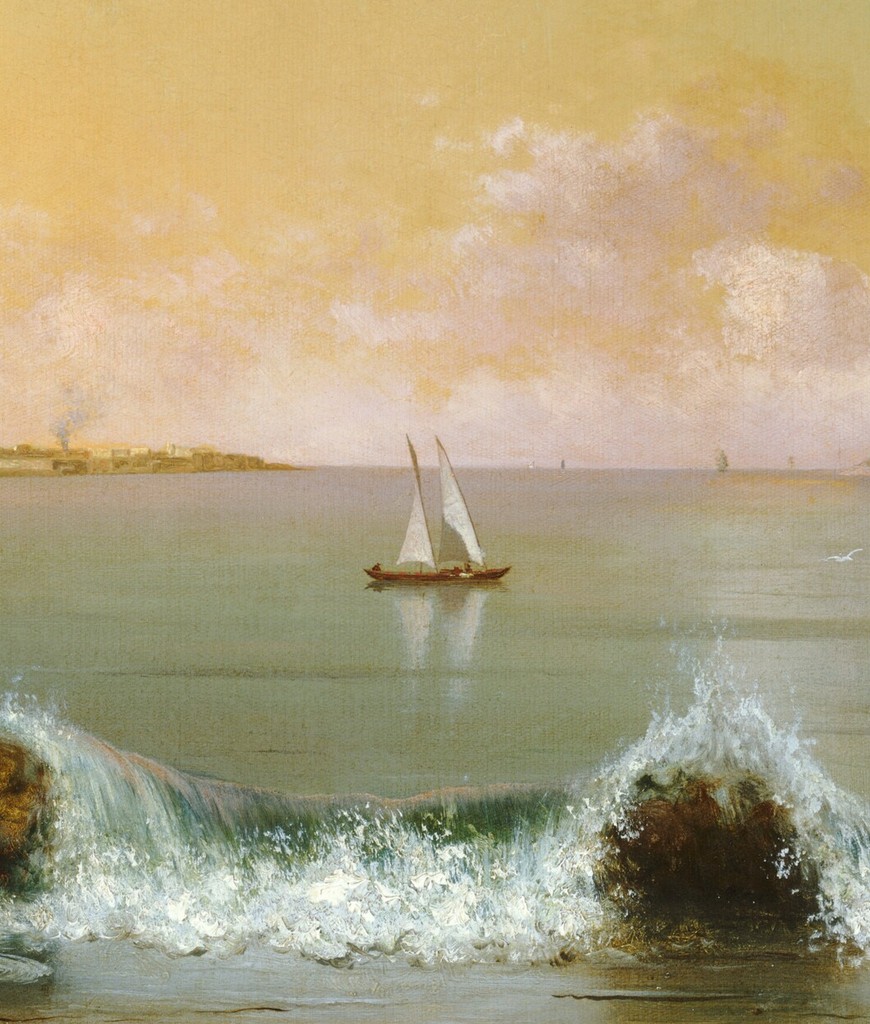
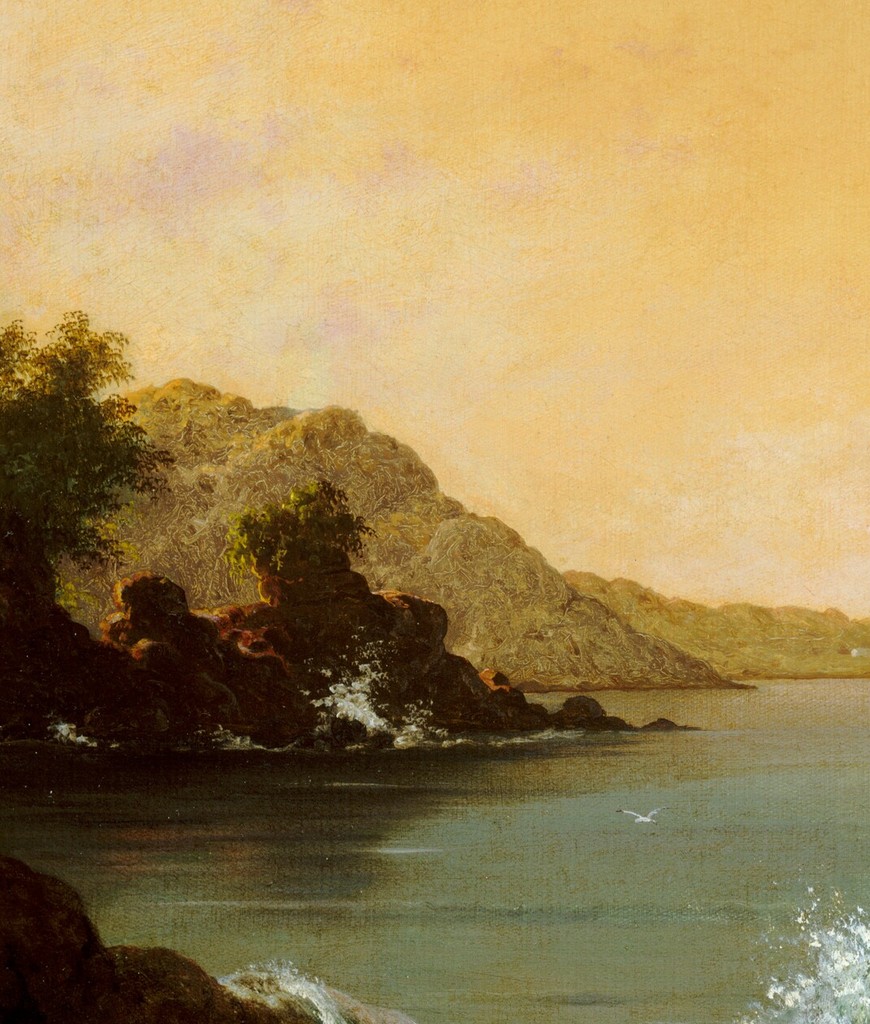
Left-hand rocky shore
Dark near rocks and vegetation overlap paler distant slopes. Changes of tone separate the different distances.
Sails, mountains and warm air
The central boat carries two pale triangular sails. Their relatively clear shapes stand against the darker water and draw attention towards the middle distance. Smaller boats farther away are reduced to thin marks, helping the main vessel establish scale.
The surrounding mountains are not described with the same force as the surf. Their slopes sit within a warmer atmosphere, with more distant forms becoming less distinct. On the right, a large slope descends towards the bay; on the left, rocks and vegetation give the shore a more irregular edge.
The sky shifts from a luminous yellow area on the left towards cooler tones on the right. Pale cloud rises above the water, with a more substantial rounded formation beyond the main boat. The colour makes the atmosphere warm without turning every cloud into a brilliant orange sunset.
Small birds occupy the upper right. Their dark silhouettes are slight enough to remain part of the sky, while their different positions suggest the space above the harbour. They offer another scale of living movement beside the boats below.
The warm sky and cool water are connected through reflection and atmosphere. The harbour carries some of the surrounding colour, while the foaming wave remains markedly brighter. Heade can therefore make different parts of the scene feel related without giving them an identical surface or tone.
The prominent red signature and date at the lower left belong to the painting’s identification. Kelly notes the attention Heade often gave his signatures. Here the lettering occupies the dark foreground near the surf, where its colour separates it from both rock and foam.[2]
A probable view near Botafogo
Kelly divides Heade’s Rio harbour views into two broad groups. Some look west from the Niterói side towards the setting sun. He places the NGA painting in another group, probably looking northeast from near Botafogo towards Guanabara Bay, with the base of Sugar Loaf at the right.[2]
This proposal helps explain the arrangement of land around the water, but the catalogue’s probability should remain visible. A recognised mountain profile is not enough to turn the canvas into a precise survey. The painting’s title and the artist’s Brazilian visit are firmer points than an exact modern coordinate.
The accompanying 1858 Planta da cidade do Rio de Janeiro supplies period geographic context. Produced before Heade’s visit, it records the city and its surrounding spaces through mapped outlines, labels and subsidiary material. It is useful for considering the urban and coastal setting within which the artist travelled.[4]
The map is not marked with a verified Heade viewpoint. Its purpose here is to connect the painting with contemporary geography, rather than claim that a line on the map proves where he placed an easel. Readers who want to study the fine labels can follow the source to the full-resolution map.
The distinction also preserves the different purposes of the two objects. The map organises geographic information for consultation; the painting selects waves, boats, light and mountain forms to produce a visual experience of the bay. Their connection is historical and geographic, while their methods of representation differ.
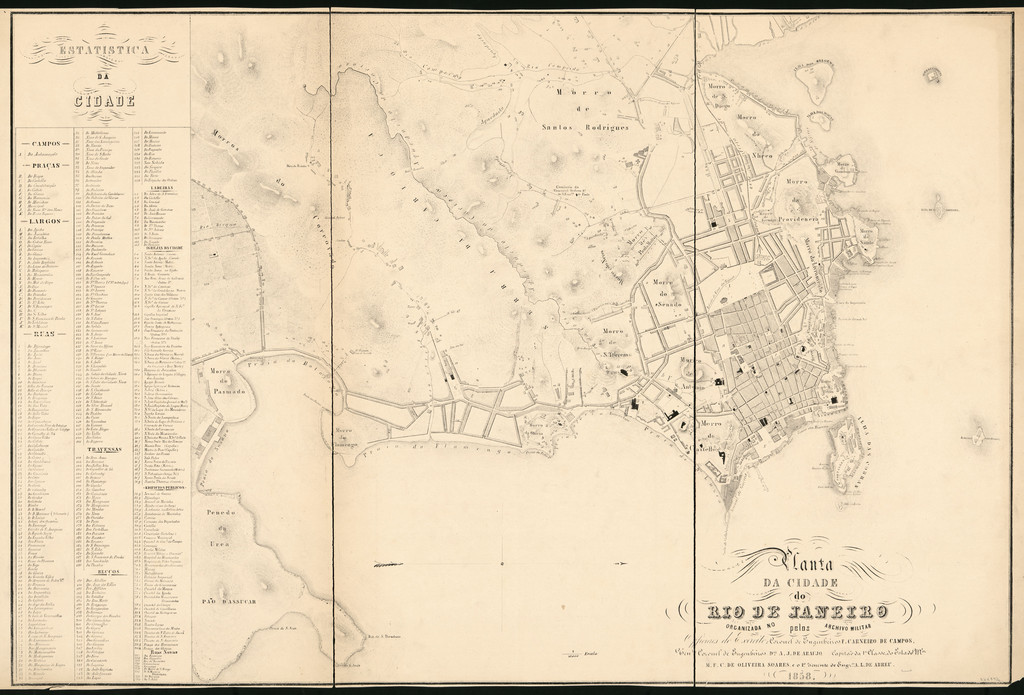
Brazil, Archivo Militar, Planta da cidade do Rio de Janeiro, 1858. Library of Congress, Geography and Map Division. Period geographic context; no verified Heade viewpoint is marked. Brazil. Archivo Militar; Library of Congress, Geography and Map Division. Image source. Public domain / PD-Art. Resized only; no alteration of native appearance.
Watch: Martin Johnson Heade
Choose a film to explore the artist’s work, its interpretation and its wider setting.
Museum Minute: Heade Hummingbirds
A brief Shelburne Museum introduction to Heade’s hummingbird paintings.
Watch on YouTubeThe Brazilian journey and related pictures
Heade visited Brazil in 1863–64 during the first of three Latin American journeys. Charlotte M. Porter’s Florida Museum essay distinguishes this visit from later travel to Nicaragua and Colombia in 1866, and to Colombia, Panama and Jamaica in 1870. The three journeys should not be described as three visits to Brazil.[3]
The 1864 inscription connects Rio de Janeiro Bay with that first period of travel. Kelly identifies two smaller related pictures, Coast of Brazil and Harbor in Brazil, and considers possible relationships between them and the finished canvas. His suggestions about a study and a later derivation remain qualified.[2]
This matters because a similar view does not establish an exact sequence by itself. Size, dates and compositional relationships can support an argument, but incomplete early collecting histories limit how confidently the pictures can be ordered.
Another Brazilian work, Brazilian Forest at the Rhode Island School of Design Museum, develops a more enclosed landscape of trees and vegetation. Strazdes’s Met entry discusses that separate 1864 painting and its London inscription. The contrast shows that Heade’s Brazilian subjects extended beyond open harbour views.[5]
The bay painting also belongs beside his hummingbird studies, but it was not an illustration from a completed Gems of Brazil book. Kelly explains that the planned illustrated publication was never finished. The harbour canvas and the bird project are related through travel and observation, while remaining different works with different purposes.[2]
Canvas, paint and historical examination
The 1996 NGA catalogue describes a plain-weave canvas with double-stranded vertical threads and a thin, even white ground. Its technical notes distinguish fluid paint in the foreground rocks from thicker impasto in the breaking foam. Those findings concern this particular canvas.[2]
The contrast between painted materials helps explain the visible scene. Foam can appear lively and bright beside darker, more thinly painted stone. The distinction is supported by the catalogue examination rather than inferred solely from the normal colour reproduction.
The entry also describes blended passages on the sea and more visible brushwork in some hills. It records warm sky glazes over a pale grey-green base. These observations show that a broad impression of calm light could involve several kinds of handling within the same painting.[2]
The examination and its reference to treatment in 1991 are historical records. They do not establish the canvas’s current condition or justify diagnosing damage from this reproduction. Their useful contribution is the documented relationship between support, ground and differently handled passages.
Kelly considers similarities between Heade’s waves and those of Gustave Courbet, but he also stresses the difficulty of establishing a connection. A richly painted surf passage or a red signature is not independent proof of firsthand influence. The comparison should remain a scholarly possibility.[2]
Acquisition and a different kind of marine picture
The NGA acquired the painting in January 1965 as a gift of the Avalon Foundation. Its accession, 1965.2.1, identifies the museum object independently of other Rio harbour pictures and smaller related studies.[1][2]
Heade’s Approaching Thunder Storm offers a different coastal experience. The Met’s 1859 canvas organises much of its tension through a dark sky above the shore. In the Rio painting, the warm atmosphere and quiet distant bay coexist with forceful water close to the viewer.[5]
The contrast helps explain why the present work should be examined as more than a tranquil tropical souvenir. The surf makes a brief event central to a broad harbour scene. Geographic setting, travelling observation and a carefully differentiated paint surface all contribute to that encounter between near movement and distant calm.
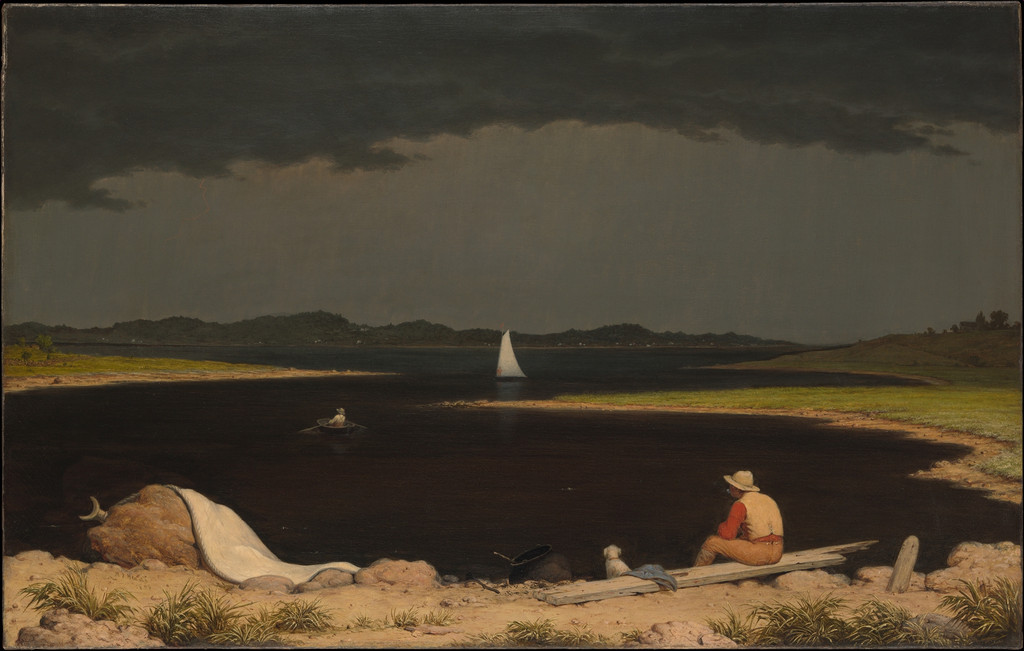
Martin Johnson Heade, Approaching Thunder Storm, 1859. Metropolitan Museum of Art, 1975.160. Image source. CC0 / Public domain. Resized only; native appearance preserved.
Artworks directory
A collected selection of 26 individually identified museum paintings, including thirteen extended artwork studies. This is a bounded directory, rather than a complete catalogue raisonné. Two Boston entries retain dates from the 2002 conservation study. Links open a companion article where available, otherwise the cited institutional record or publication; unillustrated objects remain included.
Frequently Asked Questions
Kelly proposes a view near Botafogo looking northeast over Guanabara Bay, with Sugar Loaf at the right. The identification remains probable rather than a verified modern coordinate.[2]
The foreground waves are visibly more active. The NGA’s historical examination also records thicker impasto in the foam and more blended paint on the sea.[2]
No completed Gems book was published. This is a separate signed 1864 harbour canvas, connected with the Brazilian journey during which Heade also studied hummingbirds.[2]
Discussion
Look again at the images and ideas explored in Rio de Janeiro Bay by Martin Johnson Heade. These editorial prompts invite your observations.
Reader Insights
How do foreground foam and distant sails establish different distances?
What changes beside the Met’s storm-darkened coast?
How does the historical map help while leaving the probable viewpoint qualified?
Join the Conversation
Share a detail, comparison or question about Rio de Janeiro Bay by Martin Johnson Heade below.
References
- National Gallery of Art, Rio de Janeiro Bay, 1965.2.1. Current object identity, date, dimensions and collection. View source
- Franklin Kelly, American Paintings of the Nineteenth Century, Part I (NGA, 1996), printed pp.287–291. Biography and work-specific Rio entry, location proposal, related pictures and historical technical examination. View source
- Charlotte M. Porter, Florida Museum, “Visual Interests”. Distinct Latin American travel routes and related tropical subjects. View source
- Wikimedia Commons / Library of Congress, Planta da cidade do Rio de Janeiro, 1858. Period map and public-domain reproduction record; geographic context rather than a marked artist viewpoint. View source
- Diana J. Strazdes, Heade entries in American Paradise: The World of the Hudson River School (Met, 1987), printed pp.163–178. Separate storm and Brazilian forest comparisons. View source
- Splash image source.
Martin Johnson Heade, Rio de Janeiro Bay, 1864. Oil on canvas, 45.5 × 91.1 cm. National Gallery of Art, 1965.2.1. Gift of the Avalon Foundation; National Gallery of Art. CC0 / Public domain. Resized only; native appearance preserved.
View source