 by Tom Gurney
Tom Gurney BSc (Hons) is an art history expert with over 20 years experience
Email: tomgurney1@gmail.com / Phone: +44 7429 011000
Newburyport Meadows by Martin Johnson Heade: Introduction
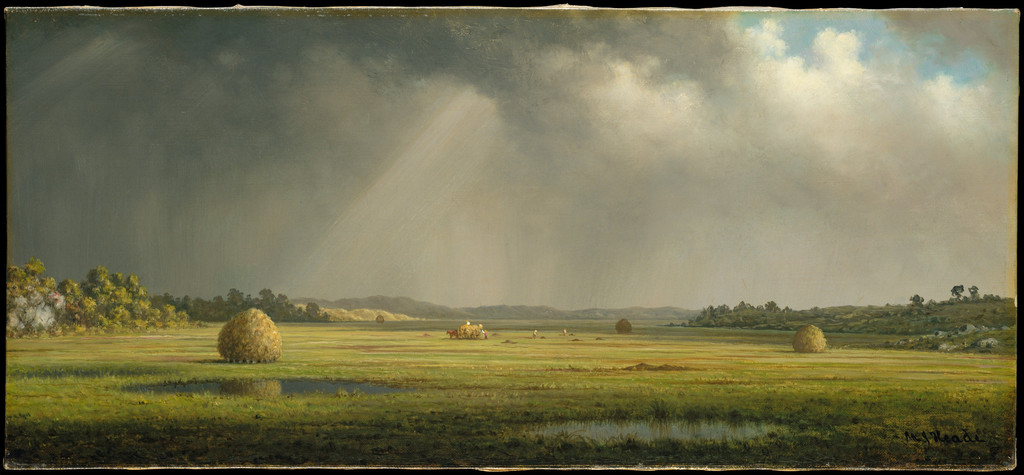
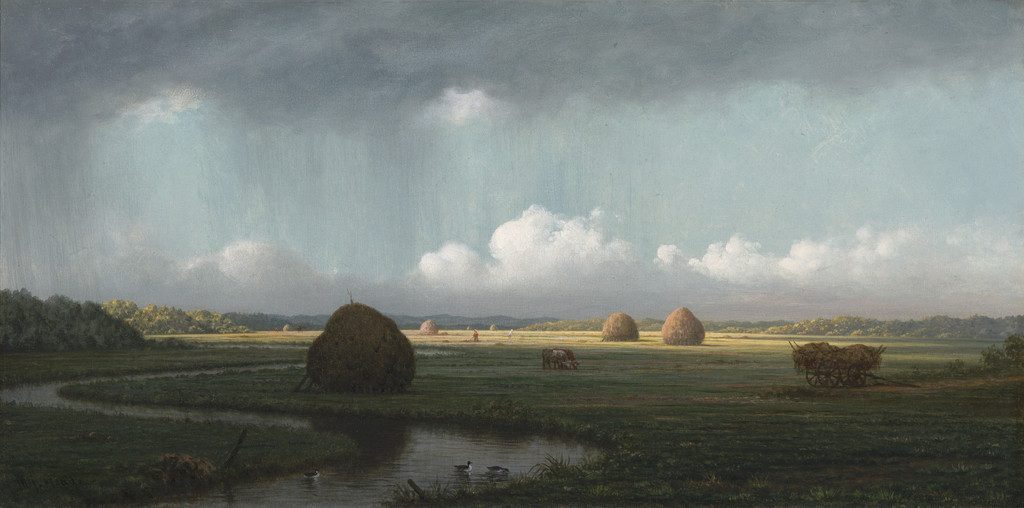
Martin Johnson Heade’s Newburyport Meadows spreads a narrow band of working marsh beneath a large grey sky. Haystacks, small harvesters and a loaded wagon share the field with shallow water and patches of changing light. The Metropolitan Museum of Art dates the canvas approximately 1876–81. Its subdued weather and extended format distinguish it from Heade’s more sharply divided storm scenes and from marsh pictures organised around a large foreground tree.[1]
At a Glance
- ArtistMartin Johnson Heade (1819–1904)
- TitleNewburyport Meadows
- Datec.1876–81
- MediumOil on canvas
- Dimensions26.7 × 55.9 cm
- CollectionMetropolitan Museum of Art, New York
- Accession1985.117
- Earlier catalogue datingc.1872–78, in the Met’s 1987 American Paradise
This work across Martin Johnson Heade’s career
Sudden Shower, Newbury Marshes
c.1865–75View of Marshfield
c.1866–76Hummingbird and Passionflowers
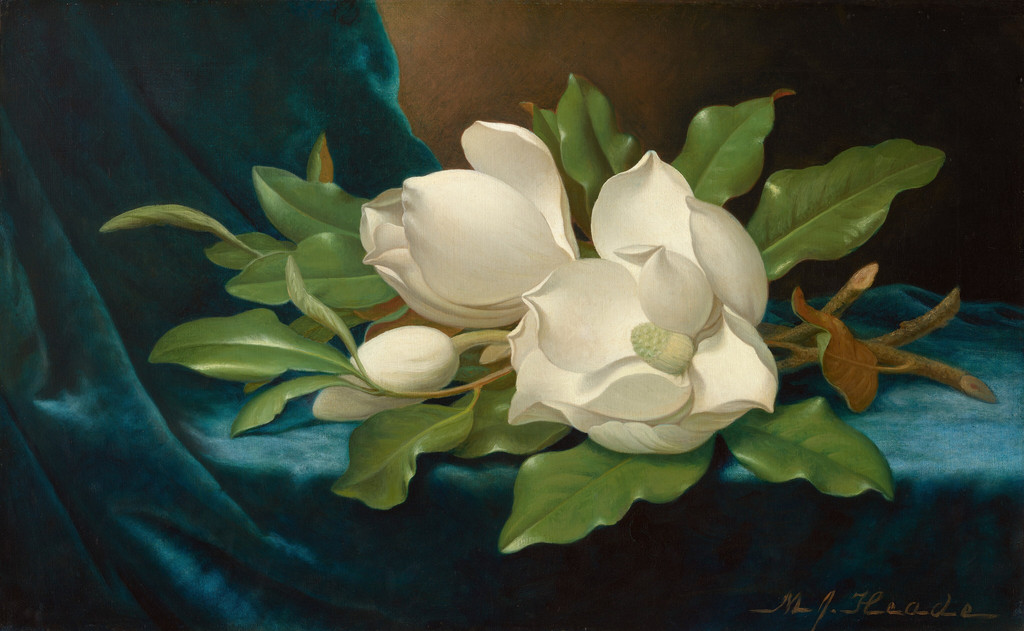
c.1875–85Magnolias on Light Blue Velvet Cloth
c.1885–95Contents
- A shallow strip of land under cloud
- Haystacks and small signs of labour
- Water across the foreground
- Title and changing date ranges
- A possible early owner
- Three different Newbury marsh pictures
- Annotated details
A shallow strip of land under cloud
The marsh occupies a relatively narrow strip across the lower part of the image. Its nearly level horizon gives the sky room to develop, while the foreground contains low grass, rocks and water. No substantial tree frames either edge or blocks the long view.
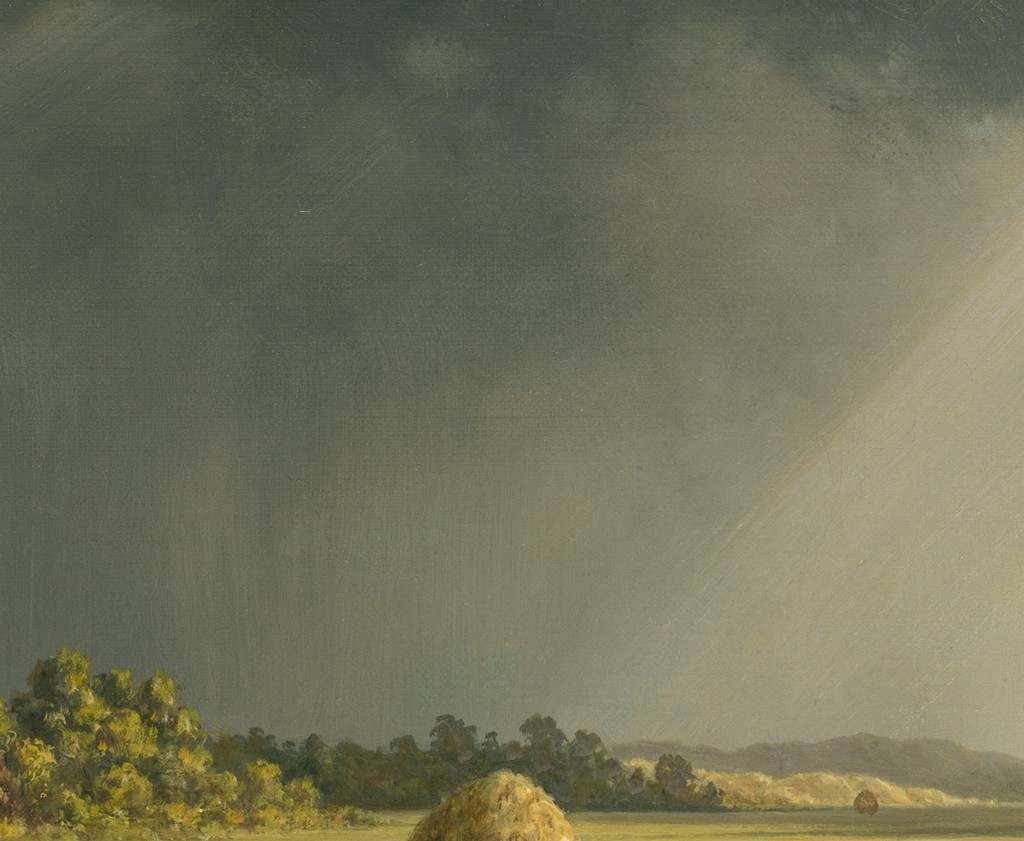
The sky is grey, but it is far from uniform. Lighter passages spread through the cloud while darker areas deepen towards the distance. Some parts appear more translucent than others, producing a sense of air and changing weather rather than a single solid ceiling above the field.
The contrast between land and sky is also less abrupt than a simple dark-ground, light-sky division would suggest. Bright patches within the grass respond to lighter areas overhead, while small changes of colour and tone cross the foreground. The picture invites movement between these areas without making one brilliant sunset its principal attraction.
Diana J. Strazdes’s 1987 Met catalogue entry treats this diffused illumination as a significant part of the work. She describes Heade’s attention to haze, storm and sunshine within a landscape that can initially seem uneventful. Her account encourages a closer examination of the smaller changes distributed across the picture.[2]
The wide format makes those changes particularly effective. The viewer has room to move laterally through the scene instead of following a single deep valley towards a central peak. The marsh’s apparent simplicity therefore becomes a framework for looking at gradual variations in atmosphere.
Annotated Details from Newburyport Meadows
The numbered points identify visible features discussed in this article. Return from each detail to the whole composition. Martin Johnson Heade, Newburyport Meadows, c.1876–81. Oil on canvas. Metropolitan Museum of Art, 1985.117. Image source. CC0 / Public domain. Resized only; native appearance preserved.
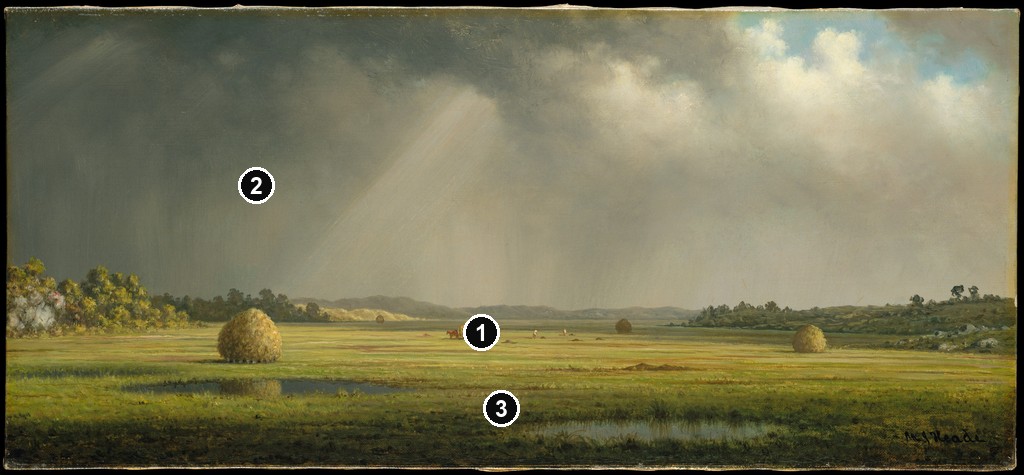
Details from NEWBURYPORT MEADOWS
Compare the cropped details with the complete images above. Notice how their colours, shapes and positions contribute to the larger compositions.
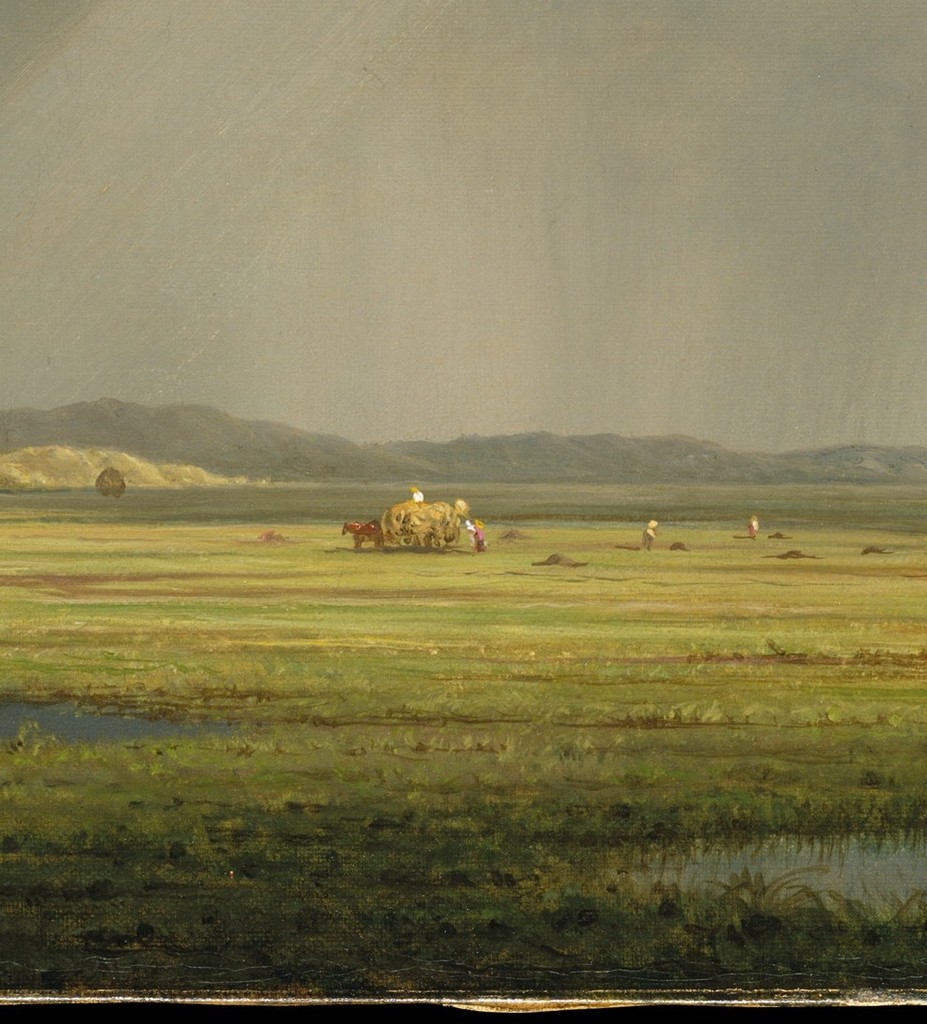
Loaded harvest wagon
A loaded wagon and small figures occupy the central field. Their compressed scale places work within the wide marsh prospect.
Rain and clearing light
A dark cloud and diagonal rain occupy the left sky, while lighter air opens towards the right. The weather changes across a broad horizontal view.
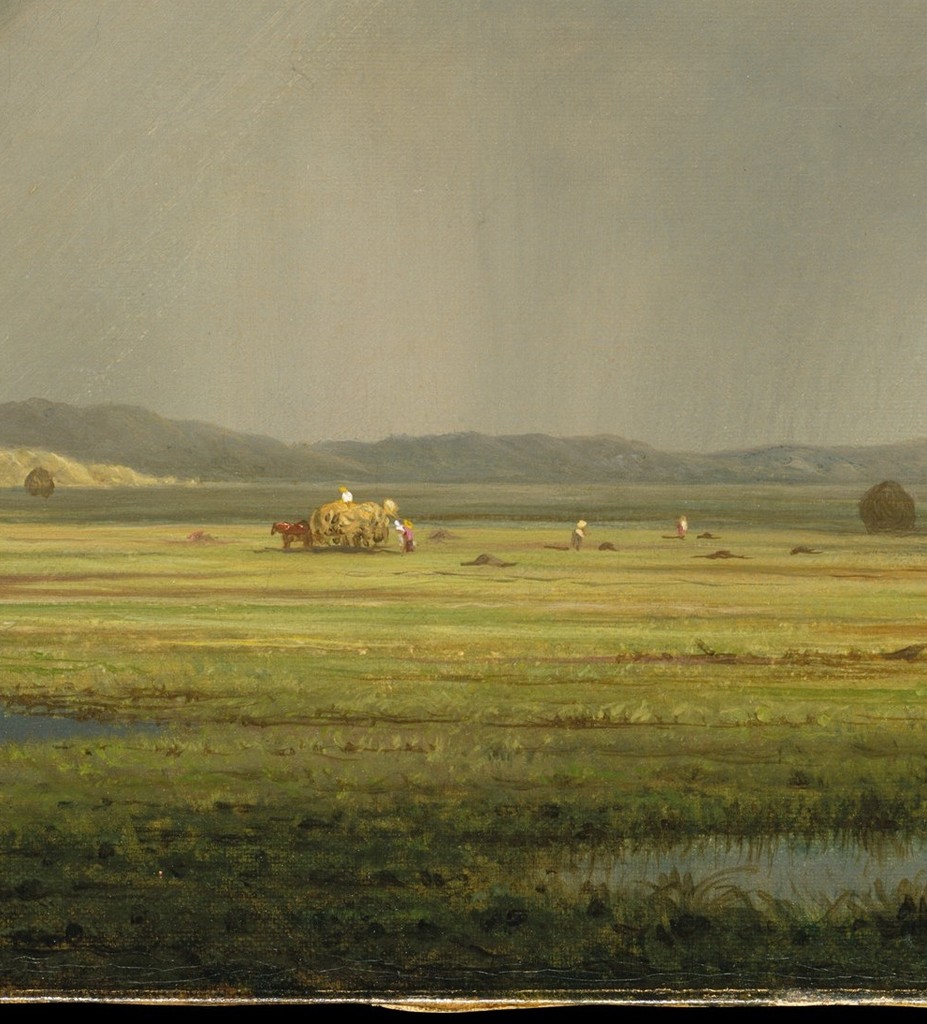
Foreground pools
Low vegetation separates reflective pools near the lower edge. These dark and light bands connect the nearby ground with the harvest field.
Haystacks and small signs of labour
Larger stacks stand towards the left and right, with smaller forms receding between them. Their uneven spacing prevents them from becoming a rigid row. They mark the field as harvested ground while helping the eye judge distance.
The rounded hay is warmer in colour than much of the surrounding grass and sky. That difference gives the stacks a degree of separation without turning each into a brightly lit monument. They remain embedded in the broader distribution of muted greens, browns and greys.
Small workers and a loaded wagon appear near the centre. Their presence matters because this is sometimes described too loosely as an empty landscape. People occupy only a small portion of the canvas, but their work is connected to the visible material gathered across the marsh.
The figures do not provide enough information for a detailed story about individual identities. The useful observation is their relation to the stacks, wagon and field. Their reduced scale makes harvesting part of the landscape’s larger organisation rather than a separate foreground anecdote.
Sarah Cash’s catalogue discussion of the different painting View of Marshfield explains the regional practice of stacking salt hay above wet ground. It also describes seasonal movement of the stored hay by boat or across ice. That account supplies relevant coastal context without proving the precise routine or date depicted in this Newburyport canvas.[3]
The stacks record an alteration of the field by people. Grass has been cut and collected, and the wagon suggests transport. Weather and water continue to shape the scene around that activity, so human use and natural change remain visible together.
Water across the foreground
Shallow water interrupts the grass in the lower part of the painting. The channels and pools divide the immediate ground into irregular areas, introducing bends and open spaces within the otherwise horizontal field.
The nearest water does not form a broad lake. It belongs to the marsh’s uneven surface, where narrow margins of grass and exposed earth create a sequence of small boundaries. Those edges provide a scale different from the large cloud formations above.
Water also helps connect the foreground with the atmosphere. Its lighter passages repeat some of the sky’s cool illumination, while darker portions remain close to the surrounding ground in tone. The reflections are restrained enough to remain part of the overall weather effect.
The rocks on the left and the scattered bushes add other low interruptions. They offer points of closer attention, but none takes over the composition. Their arrangement allows the viewer to move between near detail and the distant field.
Strazdes emphasises this freedom of attention. In her reading, the stacks, bushes, foreground shadows and sky are given a relatively even share of interest. The eye can wander through the scene and gradually understand its relationships rather than being directed immediately towards a single dominant object.[2]
This visual balance is one reason the painting rewards a complete reproduction. Cropping the wide canvas into a square would discard parts of the field and weaken the relationship between the dispersed stacks, shallow water and open sky.
Watch: Martin Johnson Heade
Choose a film to explore the artist’s work, its interpretation and its wider setting.
Museum Minute: Heade Hummingbirds
A brief Shelburne Museum introduction to Heade’s hummingbird paintings.
Watch on YouTubeTitle and changing date ranges
The current Met record identifies the work as Newburyport Meadows, accession 1985.117, and dates it approximately 1876–81. The museum gives its dimensions as 26.7 by 55.9 centimetres and its medium as oil on canvas.[1]
The 1987 American Paradise catalogue used the earlier range c.1872–78. It also recorded the title on the back of the stretcher and a signature at the lower right. The stretcher wording supports the established title, while the differing date ranges show that the painting’s chronology has been reconsidered.[2]
An approximate date should not become an exact year merely because a page needs a short label. The present museum range is used here, with the older range identified as historical. Neither provides a verified day or season of completion.
The place name establishes a regional subject rather than a precise modern viewing position. Haystacks, shallow water and low ground recur across coastal wetlands, so these features alone cannot locate every part of the composition on a present-day map.
The painting entered the Met in 1985. Its accession year belongs to the collecting history, several decades after Heade’s death, and should not be confused with the date of the canvas.[1]
A possible early owner
Strazdes associates the picture with Stephen Wallace Dorsey, a United States senator from Arkansas who later lived in New Mexico. Her account qualifies the proposed acquisition during his Washington years. It is useful historical evidence, but it does not justify a certain purchase date or an invented commission.[2]
The catalogue’s discussion places the marsh picture within a history of collecting beyond coastal Massachusetts. That wider circulation helps explain how a locally specific subject could reach viewers who did not know the land directly. It does not mean those viewers all understood or valued the picture in the same way.
The 1987 entry also comments on the work’s condition at that time. A historical assessment cannot establish its present conservation state. The current reproduction is used to discuss visible composition, rather than to diagnose the canvas or claim that its surface has remained unchanged since the catalogue appeared.
Three different Newbury marsh pictures
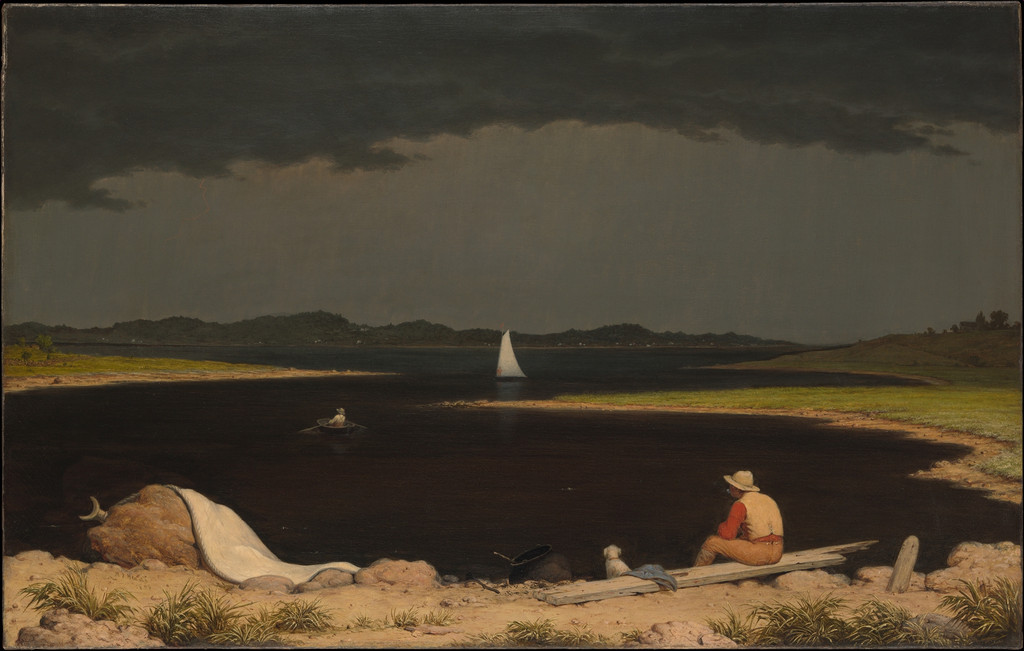
Sunlight and Shadow: The Newbury Marshes provides a useful comparison. Its large apple tree, prominent illuminated stack and pink cloud reflection create a more strongly shaped foreground. Charles M. Brock’s NGA entry also documents a haystack moved during painting, a finding specific to that canvas.[4]
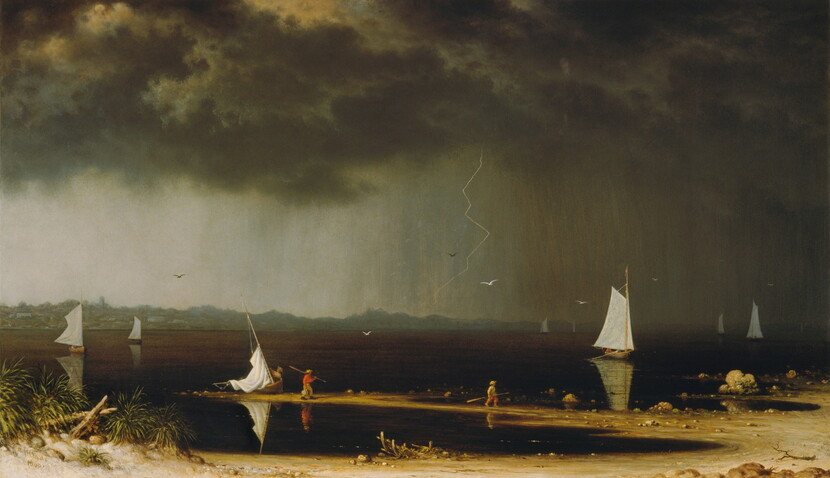
Sudden Shower, Newbury Marshes, at Yale, distributes dark weather and a brighter distant strip around a substantial foreground stack. Tim Barringer’s extended interpretation considers its cultivated ground and the contrast between human activity and approaching rain.[5]
In Newburyport Meadows, the grey illumination is more dispersed and the immediate land occupies a shallower field. The three works share a coastal subject, but they ask the viewer to follow different arrangements of tree, stack, water and cloud.
Repeated marsh painting was consequently more than the repetition of a single view. This canvas develops a particularly low, wide and relatively even field of attention. Its small workers remain present within that field, while changing atmosphere connects their activity to a landscape that continues beyond them.
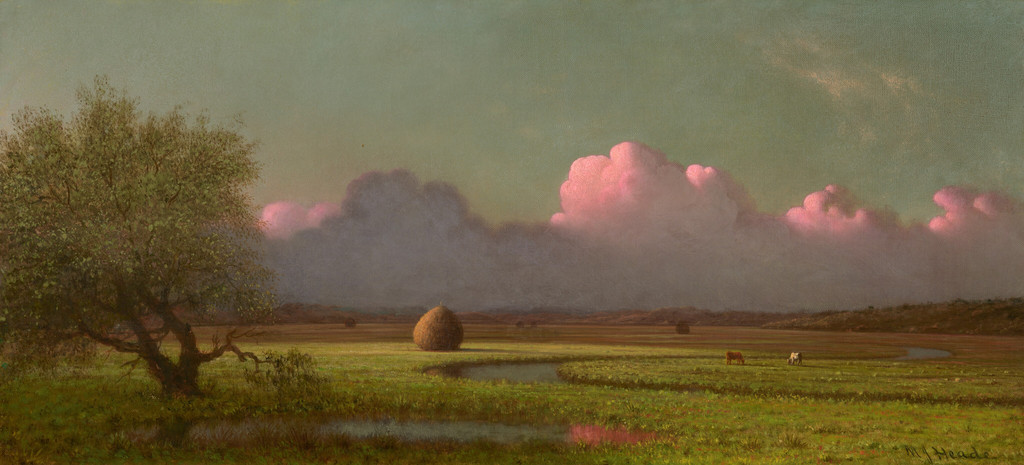
Martin Johnson Heade, Sunlight and Shadow: The Newbury Marshes, c.1871–75. National Gallery of Art, 2010.74.1. John Wilmerding Collection; National Gallery of Art. Image source. CC0 / Public domain. Resized only; native appearance preserved.
Martin Johnson Heade, Sudden Shower, Newbury Marshes, c.1865–75. Yale University Art Gallery, 1989.51.1. Image source. Public domain / PD-Art. Resized only; native appearance preserved.
Artworks directory
A collected selection of 26 individually identified museum paintings, including thirteen extended artwork studies. This is a bounded directory, rather than a complete catalogue raisonné. Two Boston entries retain dates from the 2002 conservation study. Links open a companion article where available, otherwise the cited institutional record or publication; unillustrated objects remain included.
Frequently Asked Questions
No. Small workers and a loaded wagon are visible in the central field, although the sky, grass, stacks and water occupy far more of the image.
The consulted 1987 catalogue qualifies his apparent acquisition during his Washington years. It does not establish an exact purchase date for this account.[2]
Discussion
Look again at the images and ideas explored in Newburyport Meadows by Martin Johnson Heade. These editorial prompts invite your observations.
Reader Insights
How do water and diffuse light divide the broad composition?
What changes in Sunlight and Shadow or the Yale shower?
What does the current date range add to the older catalogue account?
Join the Conversation
Share a detail, comparison or question about Newburyport Meadows by Martin Johnson Heade below.
References
- Metropolitan Museum of Art, Newburyport Meadows, 1985.117, checked against the current object API. Current dating, medium, dimensions and accession. View source 1 · View source 2
- Diana J. Strazdes, Heade entries in American Paradise: The World of the Hudson River School (Met, 1987), printed pp.177–178. Composition, older date range, stretcher title and qualified early ownership. View source
- Sarah Cash, Corcoran Collection: American Paintings to 1945, printed pp.130–131 and notes p.266. Regional harvesting context for the separate View of Marshfield. View source
- Charles M. Brock, American Masters from Bingham to Eakins: The John Wilmerding Collection (NGA, 2004), printed pp.72–74. Separate Sunlight and Shadow comparison. View source
- Tim Barringer, Object Lessons: American Painting at Yale, printed pp.1–17. Separate Sudden Shower comparison and interpretation. View source
- Splash image source.
Martin Johnson Heade, Newburyport Meadows, c.1876–81. Oil on canvas, 26.7 × 55.9 cm. Metropolitan Museum of Art, 1985.117. CC0 / Public domain. Resized only; native appearance preserved.
View source