 by Tom Gurney
Tom Gurney BSc (Hons) is an art history expert with over 20 years experience
Email: tomgurney1@gmail.com / Phone: +44 7429 011000
Sudden Shower, Newbury Marshes by Martin Johnson Heade: Introduction
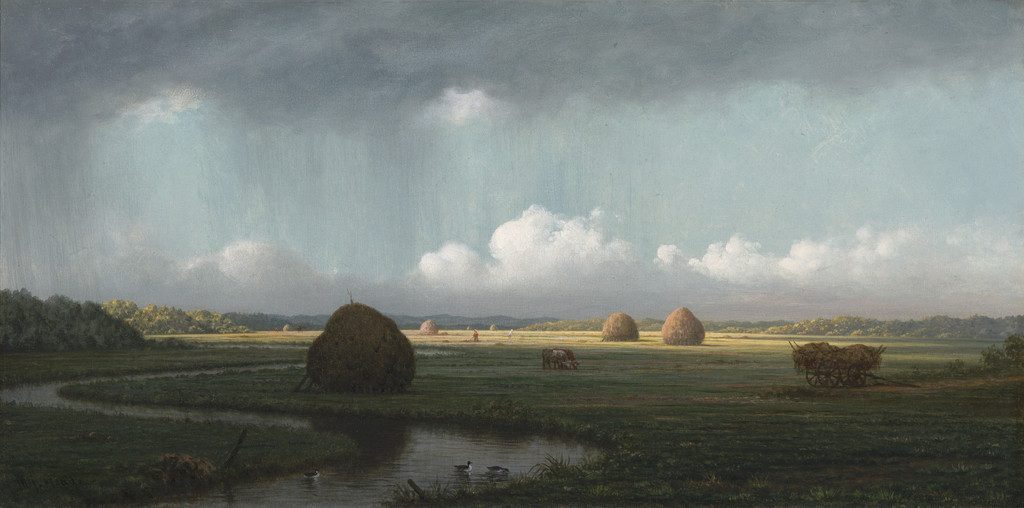
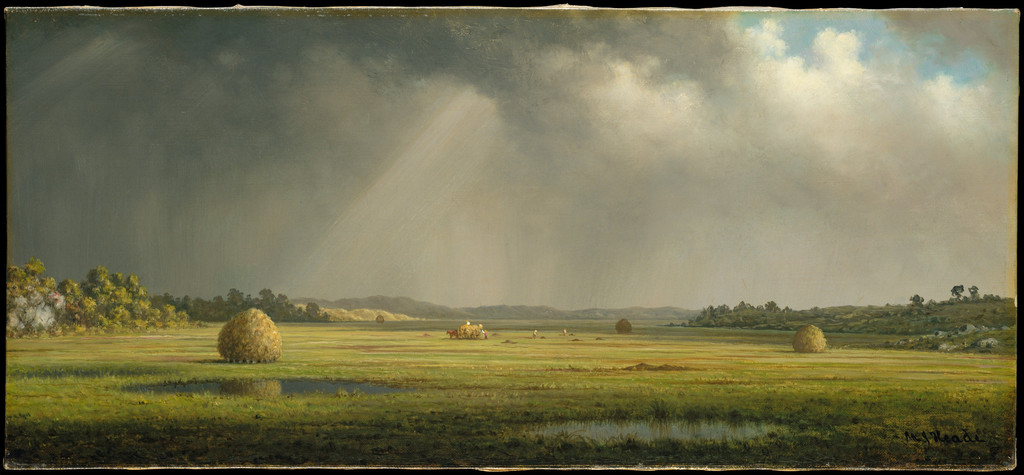
Martin Johnson Heade’s Sudden Shower, Newbury Marshes sets a large shadowed haystack beneath rain and a broad grey cloud. Beyond it, smaller stacks and two harvesters occupy a brighter strip of ground. Ducks cross the foreground water, while cattle and a loaded cart remain within the working field. The Yale University Art Gallery painting, accession 1989.51.1, is usually dated approximately 1865–75. Tim Barringer’s extended study makes it an especially useful work for considering how an apparently simple marsh scene can sustain several kinds of interpretation.[1][5]
At a Glance
- ArtistMartin Johnson Heade (1819–1904)
- TitleSudden Shower, Newbury Marshes
- Datec.1865–75; approximate dating
- MediumOil on canvas
- CollectionYale University Art Gallery
- Accession1989.51.1
- Visible subjectsRain, raised haystacks, harvesters, cattle, cart, ducks and tidal channels
- Important studyTim Barringer’s opening essay in Object Lessons: American Painting at Yale
This work across Martin Johnson Heade’s career
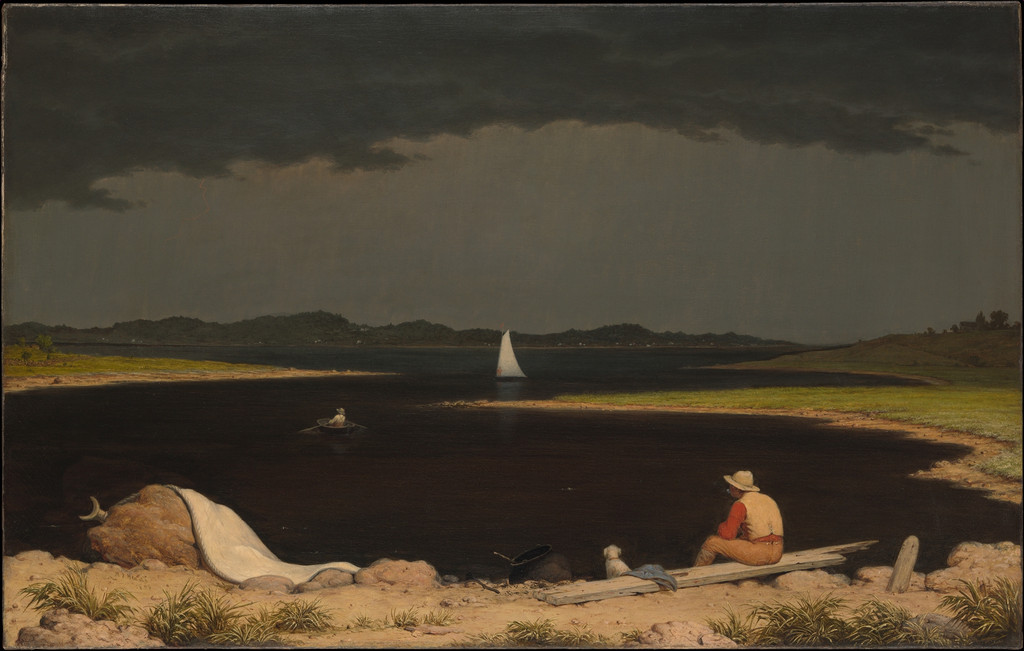
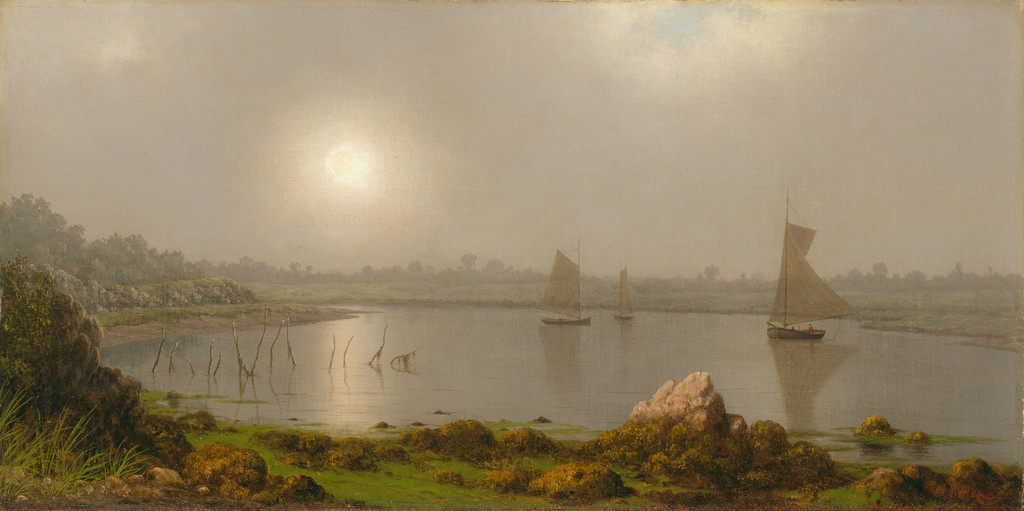
View of Marshfield
c.1866–76Hummingbird and Passionflowers
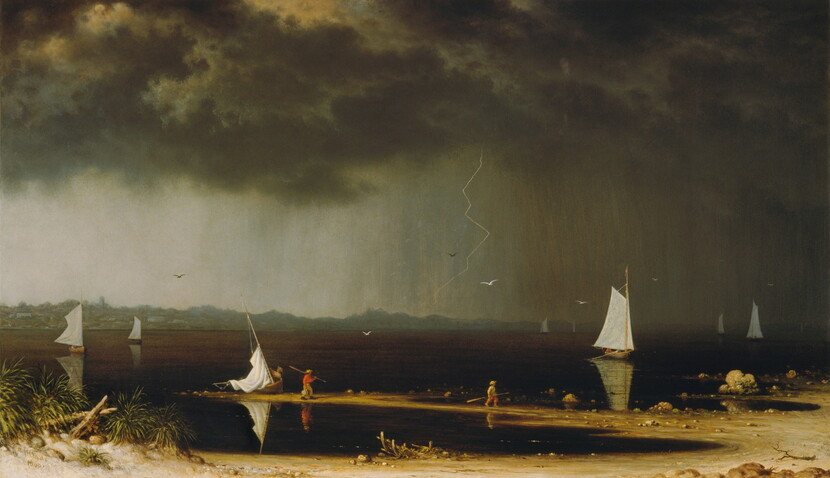
c.1875–85Newburyport Meadows
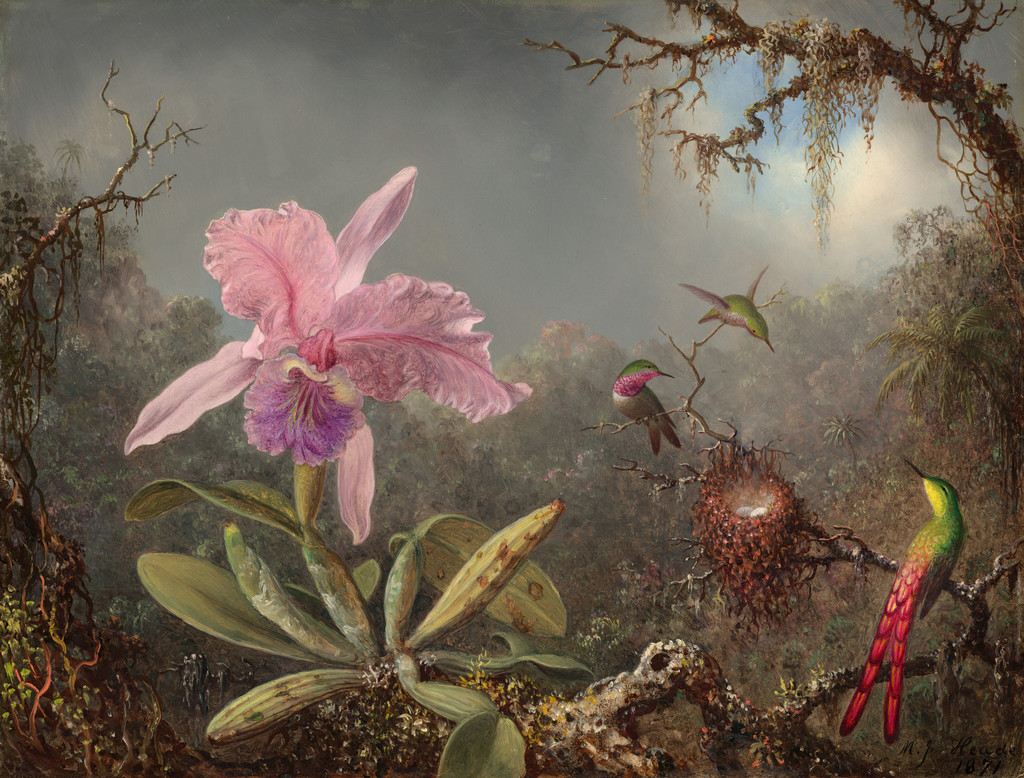
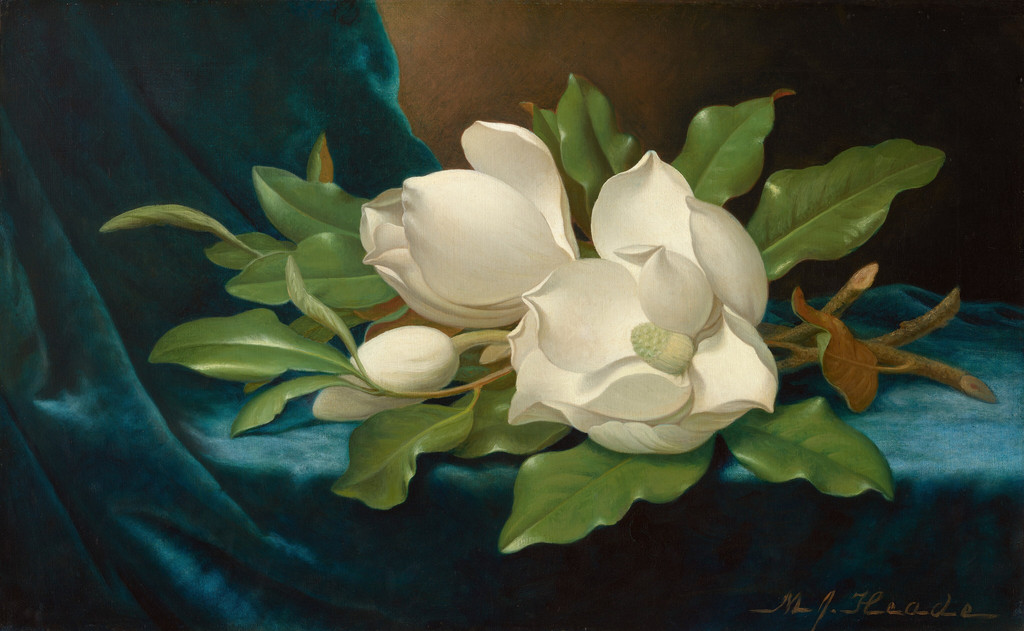
c.1876–81Magnolias on Light Blue Velvet Cloth
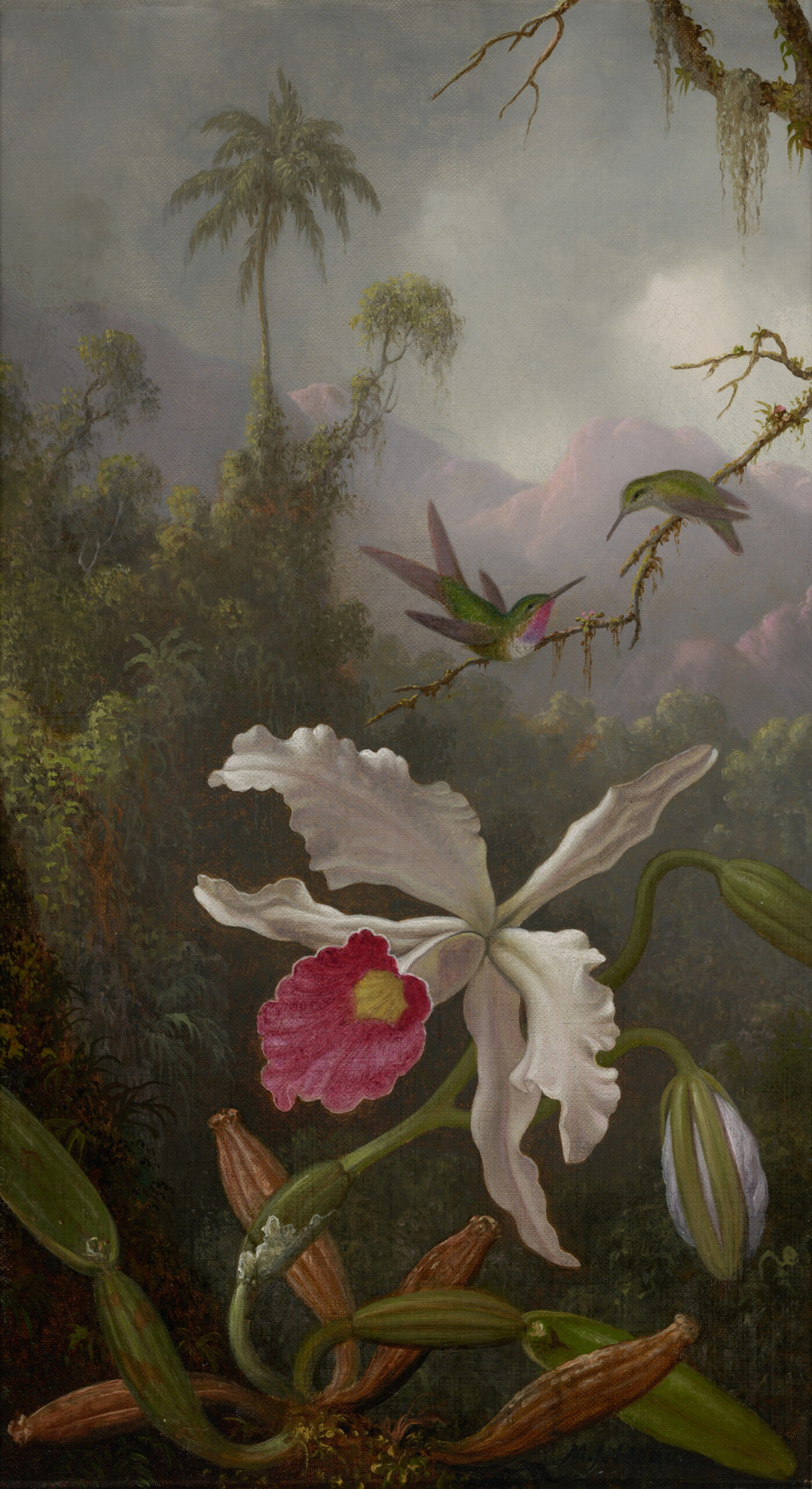
c.1885–95Contents
- A sky that changes across the picture
- Haystacks and a low horizon
- Channels, ducks and the working field
- Barringer’s reading of the cultivated marsh
- Religion, industry and war as possible contexts
- Date, exhibition and comparisons
- Annotated details
A sky that changes across the picture
The dark cloud occupies much of the upper canvas, but its effect is not the same everywhere. On the left, rain descends in pale vertical streaks. Towards the right, lighter cloud and more open blue-grey air offer a different appearance.
The falling rain partly obscures the distance while leaving enough of the field visible to maintain its continuity. The landscape does not stop at the shower. Its low horizon continues beneath weather that changes across the picture.
A bright band of marsh near the middle distance gives the rain a strong visual counterpart. The foreground is much darker, so the viewer encounters the scene through shadow before reaching the illuminated grass. The difference makes the weather seem to act upon a substantial area of land.
Barringer emphasises this organisation of light and darkness. He argues that the dark lower field avoids a more conventional arrangement of framing shadows and a bright foreground centre. His reading connects the composition to the movement of the shower rather than to a fixed theatrical spotlight.[1]
The painting does not require lightning or a damaged building to convey change. Cloud, rain and the contrast between near darkness and distant light provide its weather event. Their effect is pronounced even though the human figures remain small and continue their work.
The sky also contains several kinds of cloud edge. The main grey mass is broad and comparatively continuous, while the lower white forms have more rounded contours. Those differences keep the atmosphere from becoming one undifferentiated dark area above the marsh.
Annotated Details from Sudden Shower, Newbury Marshes
The numbered points identify visible features discussed in this article. Return from each detail to the whole composition. Martin Johnson Heade, Sudden Shower, Newbury Marshes, c.1865–75. Oil on canvas. Yale University Art Gallery, 1989.51.1. Image source. Public domain / PD-Art. Resized only; native appearance preserved.
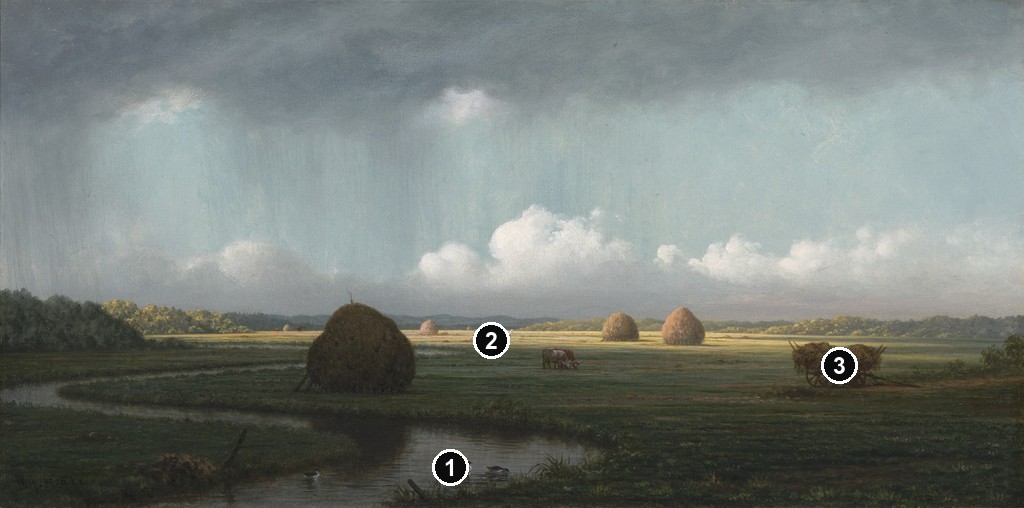
Details from SUDDEN SHOWER, NEWBURY MARSHES
Compare the cropped details with the complete images above. Notice how their colours, shapes and positions contribute to the larger compositions.
Waterfowl in the near channel
Small dark waterfowl occupy the nearer channel. Their silhouettes become easier to recognise in the cropped view than in the broad landscape.
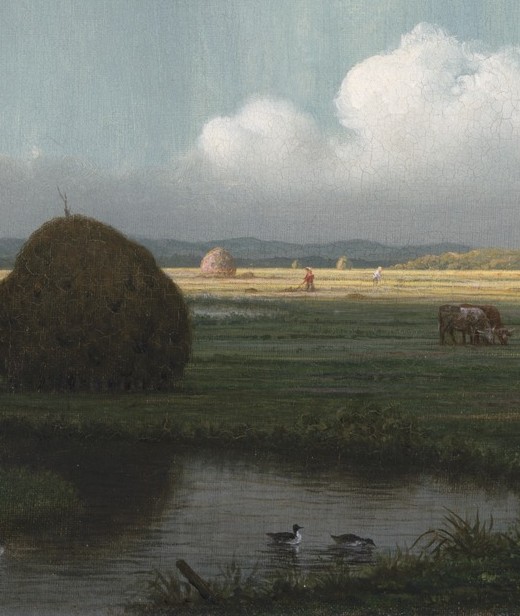
Distant harvest workers
Two small figures stand in the lighter field beyond the near haystack. The surrounding stacks and level ground establish their distance.
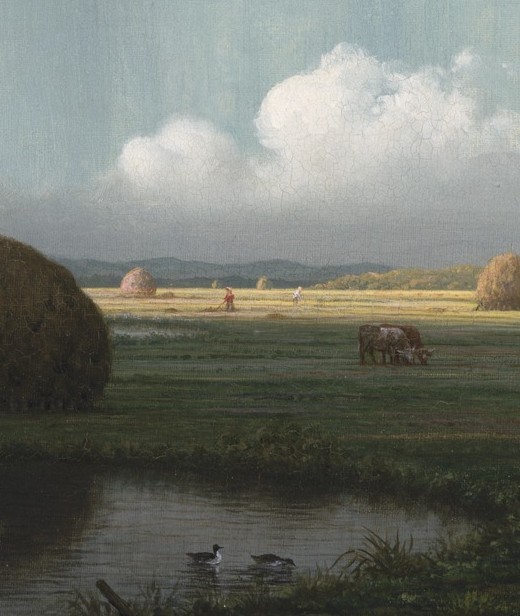
Loaded cart
A cart laden with hay crosses the right-hand field. Its wheel forms distinguish it from the stationary stacks nearby.
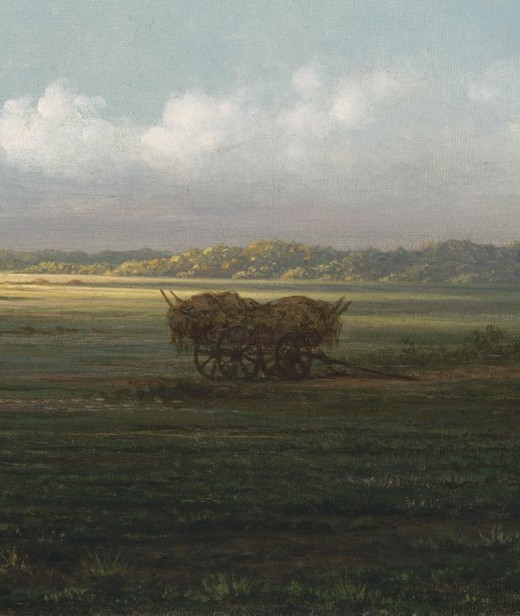
Haystacks and a low horizon
The nearest haystack is a substantial rounded form slightly left of centre. It stands above the water on visible supports and carries a deep shadow. Its size gives the foreground a point of weight without enclosing the view with a tree.
Farther away, stacks become smaller and lighter. Barringer counts seven and discusses their carefully arranged sequence as an additional means of establishing distance. He interprets their changing scale alongside the painting’s broader perspective structure.[1]
The repetition does not erase differences between the stacks. Their positions, colours and degrees of illumination vary. The nearer mound appears heavier and darker, while the more distant forms participate in the bright strip of field.
The raised support has a practical significance as well as a visual one. Sarah Cash’s study of the separate View of Marshfield explains staddles used to keep cut salt hay above wet ground. That regional account helps readers understand why a large mound might stand on a framework in a tidal landscape.[2]
The support protects the hay from contact with the marsh below, but the top remains exposed to weather. Barringer uses this relationship in his discussion of the cultivated landscape’s vulnerability. The apparently solid stack can be read as both a record of work and a form subject to water and rain.[1]
The horizon is low and largely unframed. This gives the sky considerable room, while the stacks offer enough repeated forms to hold the field together. The viewer can sense a wide plain rather than a small enclosure around the nearest mound.
Channels, ducks and the working field
Water bends through the lower part of the composition. Its curves create a route into the marsh, where straight movement over the ground would be difficult. The channel also changes width and direction, encouraging the eye to follow several turns rather than one rigid line.
Barringer describes a double-oxbow arrangement and imagines movement through it. This is his account of the picture’s spatial invitation, not a documented journey taken by a particular farmer on the day shown.[1]
Ducks occupy the foreground water. Their small dark bodies provide points of life close to the viewer and help establish the water’s scale. They are separate from the cattle farther back, which stand on the grass within the larger agricultural scene.
On the right, a cart holds cut hay. Its low wheels and projecting load differ from the rounded stacks, introducing another kind of stored or transported material. The cart connects the field with movement even though the painting fixes it at one moment.
Two tiny harvesters appear in the brighter distance. Barringer treats them as signs of a wider labouring world rather than as a sufficient workforce for all the gathered hay. Their presence establishes activity without supplying the names or biographies of individual workers.[1]
The land is therefore cultivated and inhabited. Its openness depends partly on low vegetation and flat terrain, rather than on an absence of people. Hay has been cut, stacked and loaded, while cattle and water introduce other relationships between the marsh and those who use it.
Barringer’s reading of the cultivated marsh
Barringer argues that Heade’s work demands imaginative participation despite its restrained paint surface and modest subjects. He considers how represented space, weather and finely described objects can invite the viewer to experience a place rather than simply recognise a list of things.[1]
His discussion extends beyond sight to imagined sound, smell and touch. Rainfall, brackish water and the different textures of hay, reeds and cloud become ways of thinking about the painting’s sensory effect. These are responses to the image, not measurements of the actual sound or salinity of a recorded location.
The distinction between painted surface and depicted texture is useful. The hay can appear rough and the water smooth even where the reproduction does not show conspicuous brushstrokes. A painter can describe different materials without giving each a correspondingly thick physical surface.
Barringer discusses thin layers and careful studio work, but this article does not turn his description into an independently established pigment recipe. Broader technical research on Heade and specific examinations of other canvases remain separate kinds of evidence.
The essay also compares Heade with Monet’s haystack paintings. Barringer challenges a simple judgement that visible, assertive brushwork is automatically more modern than restrained surfaces. His preference is a critical argument that helps explain Heade’s reception, rather than a neutral ranking binding every reader.[1]
Watch: Martin Johnson Heade
Choose a film to explore the artist’s work, its interpretation and its wider setting.
Museum Minute: Heade Hummingbirds
A brief Shelburne Museum introduction to Heade’s hummingbird paintings.
Watch on YouTubeReligion, industry and war as possible contexts
Barringer relates the painting’s reserve and attention to light to Quaker and Protestant ideas. He also discusses the influence of Edward Hicks, whose work provides an important background to accounts of Heade’s early artistic development. These connections support a theological reading of the picture.[1]
The essay is interpretive: it does not provide a verified membership record establishing Heade’s own Quaker practice. Its religious language should consequently remain attributed to Barringer, rather than presented as an explanation recorded by the artist for this canvas.
An industrial comparison is more closely connected to another painting. Yale’s Lynn Meadows shows railway activity in a coastal landscape. Barringer sets that work against Sudden Shower, using the contrast to consider rural labour, environmental vulnerability and modernisation.[1]
The comparison does not make the present picture an untouched landscape. The stacks, cart and harvesters demonstrate its use. What differs is the kind and visibility of intervention: agricultural work fills the marsh without the conspicuous railway found in the separate Lynn composition.
Barringer also raises the possibility that approaching weather could evoke the Civil War or disruption more generally. His conclusion leaves room for political, industrial and meteorological readings. The consulted evidence does not establish a single symbolic intention declared by Heade.[1]
Likewise, the essay’s discussion of panoramas and photographic vision provides a cultural context for broad horizons. It does not supply independent proof of attendance at a particular panorama performance. The visible format can be discussed without inventing a documented theatre visit.
Date, exhibition and comparisons
The approximate c.1865–75 range should be retained as a range. Barringer discusses the uncertainty of the work’s dating, and the reproduction record also uses qualified chronology. The title connects the scene with the Newbury marshes, but does not establish an exact harvest date or a precisely surveyed viewpoint.[1][5]
Barringer reports the painting’s inclusion in American Sublime at Tate Britain in 2002, which he curated with Andrew Wilton. He describes its position among smaller paintings and the attention it received. That is historical exhibition evidence, rather than a promise of its present display location.[1]
Sunlight and Shadow: The Newbury Marshes offers a different arrangement: an apple tree, a lit stack, paired cattle and a pink reflection. Brock’s catalogue documents a moved stack in that work through infrared examination. The finding belongs to the NGA painting, rather than to Yale’s Sudden Shower.[3]
The Met’s Newburyport Meadows spreads its grass and small workers beneath more dispersed grey illumination. Strazdes’s entry discusses the subtler changes of weather across its wide field. It provides a quieter comparison with the large near stack and distinct rain curtain here.[4]
These works show how a repeated subject could support different arrangements and experiences. In Sudden Shower, the raised stack, curved water, bright distance and falling rain create a landscape whose use and changing atmosphere can be followed together. Barringer’s interpretations add further questions while leaving the actual forms available for readers to examine.
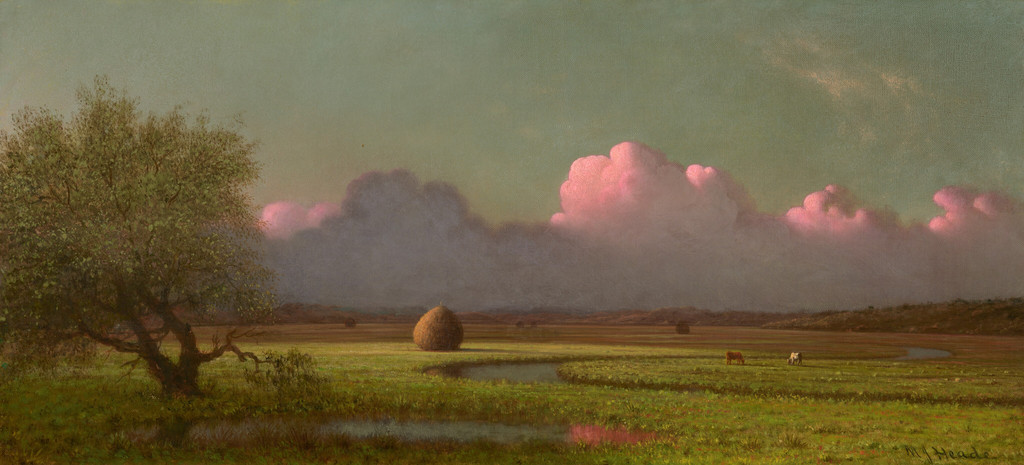
Martin Johnson Heade, Sunlight and Shadow: The Newbury Marshes, c.1871–75. National Gallery of Art, 2010.74.1. John Wilmerding Collection; National Gallery of Art. Image source. CC0 / Public domain. Resized only; native appearance preserved.
Martin Johnson Heade, Newburyport Meadows, c.1876–81. Metropolitan Museum of Art, 1985.117. Image source. CC0 / Public domain. Resized only; native appearance preserved.
Artworks directory
A collected selection of 26 individually identified museum paintings, including thirteen extended artwork studies. This is a bounded directory, rather than a complete catalogue raisonné. Two Boston entries retain dates from the 2002 conservation study. Links open a companion article where available, otherwise the cited institutional record or publication; unillustrated objects remain included.
Frequently Asked Questions
No. Haystacks, a loaded cart, cattle and two harvesters show the marsh being used. Barringer’s interpretation considers that agricultural activity alongside changing weather.[1]
Barringer proposes war and industrial disruption as possible contexts while also allowing a meteorological reading. The consulted evidence does not establish a fixed intention declared by Heade.[1]
It belongs to Yale University Art Gallery, accession 1989.51.1. Barringer also records its loan to the 2002 American Sublime exhibition at Tate Britain.[1]
Discussion
Look again at the images and ideas explored in Sudden Shower, Newbury Marshes by Martin Johnson Heade. These editorial prompts invite your observations.
Reader Insights
Where does the bright strip of marsh emerge behind the stack?
What changes in the NGA tree-and-creek arrangement?
How do harvesters, cattle and ducks affect a reading centred on the weather?
Join the Conversation
Share a detail, comparison or question about Sudden Shower, Newbury Marshes by Martin Johnson Heade below.
References
- Tim Barringer, Object Lessons: American Painting at Yale, printed pp.1–17. Work-specific extended essay, composition, labour, attributed interpretations and 2002 exhibition account. View source
- Sarah Cash, Corcoran Collection: American Paintings to 1945, printed pp.130–131 and notes p.266. Regional staddle and haymaking context for the separate View of Marshfield. View source
- Charles M. Brock, American Masters from Bingham to Eakins: The John Wilmerding Collection (NGA, 2004), printed pp.72–74. Separate NGA marsh comparison and infrared finding. View source
- Diana J. Strazdes, Heade entries in American Paradise: The World of the Hudson River School (Met, 1987), printed pp.177–178. Separate Newburyport Meadows comparison. View source
- Wikimedia Commons, Sudden Shower, Newbury Marshes reproduction record, checked against the Yale scholarly publication. Qualified chronology and public-domain reproduction evidence. View source
- Splash image source.
Martin Johnson Heade, Sudden Shower, Newbury Marshes, c.1865–75. Oil on canvas. Yale University Art Gallery, 1989.51.1. Public domain / PD-Art. Resized only; native appearance preserved.
View source