 by Tom Gurney
Tom Gurney BSc (Hons) is an art history expert with over 20 years experience
Email: tomgurney1@gmail.com / Phone: +44 7429 011000
Cattleya Orchid and Three Hummingbirds by Martin Johnson Heade: Introduction
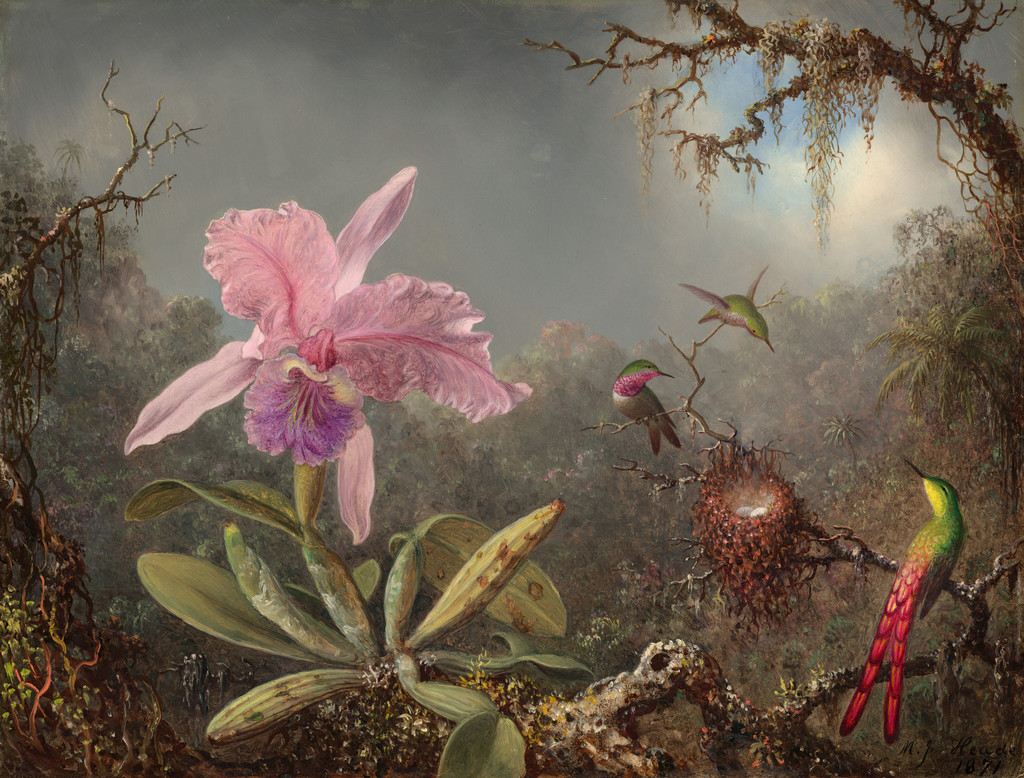
Martin Johnson Heade’s Cattleya Orchid and Three Hummingbirds combines a large pink flower with three small birds, a nest and two eggs. The subjects appear close enough for careful inspection, while a hazy tropical landscape opens behind them. Signed and dated 1871, the painting belongs to the National Gallery of Art. It is an oil on wood rather than canvas, and the museum’s scholarly catalogue supplies unusually specific evidence about its commercially prepared support and the handling of the flower.[1][2]
At a Glance
- ArtistMartin Johnson Heade (1819–1904)
- TitleCattleya Orchid and Three Hummingbirds
- Date1871
- MediumOil on wood
- Dimensions34.8 × 45.6 cm
- CollectionNational Gallery of Art, Washington
- Accession1982.73.1
- Distinctive detailsThree birds; nest with two eggs; prepared mahogany panel
This work across Martin Johnson Heade’s career
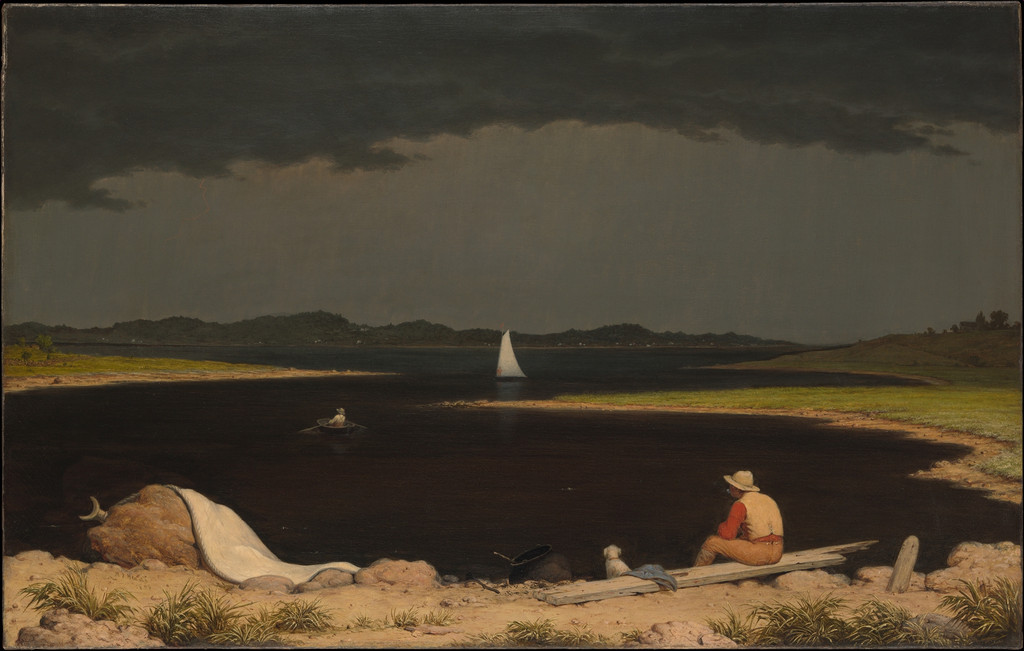
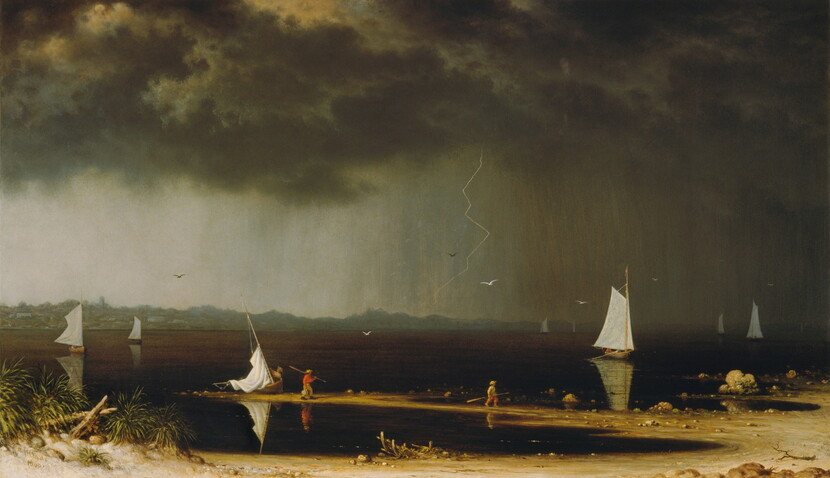
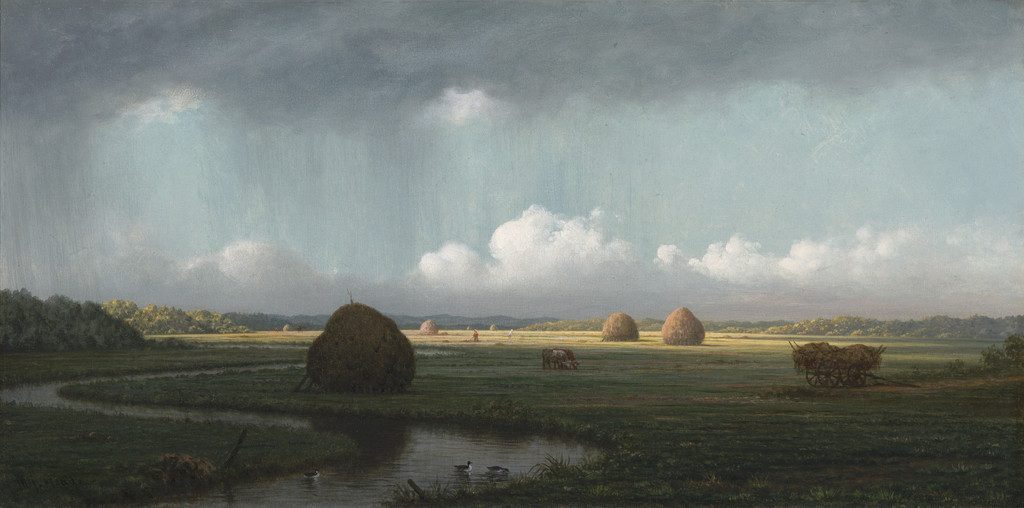
Sudden Shower, Newbury Marshes
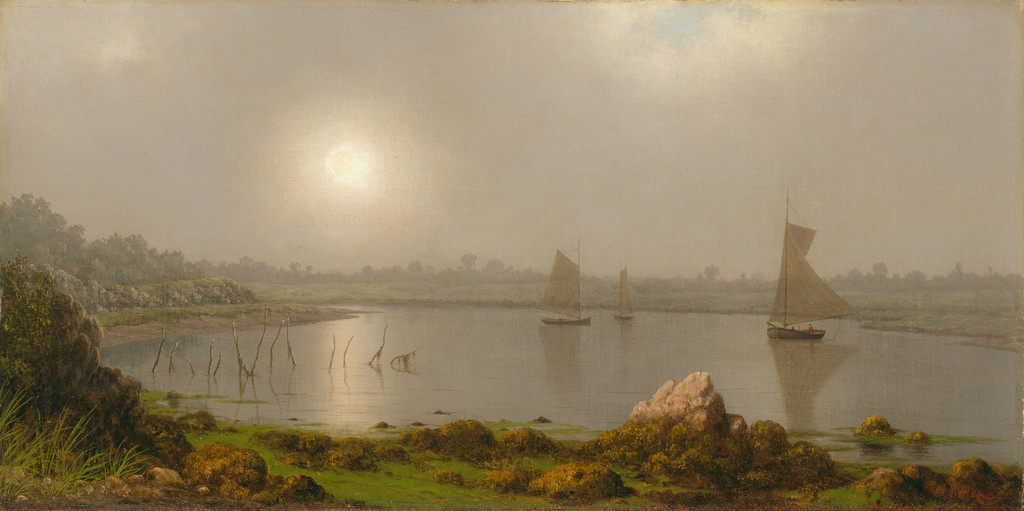
c.1865–75View of Marshfield
c.1866–76Hummingbird and Passionflowers
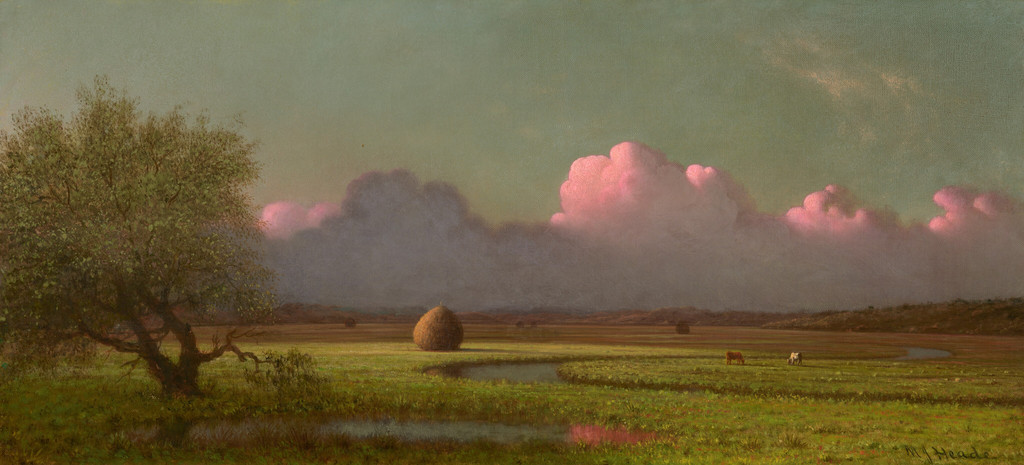
c.1875–85Newburyport Meadows
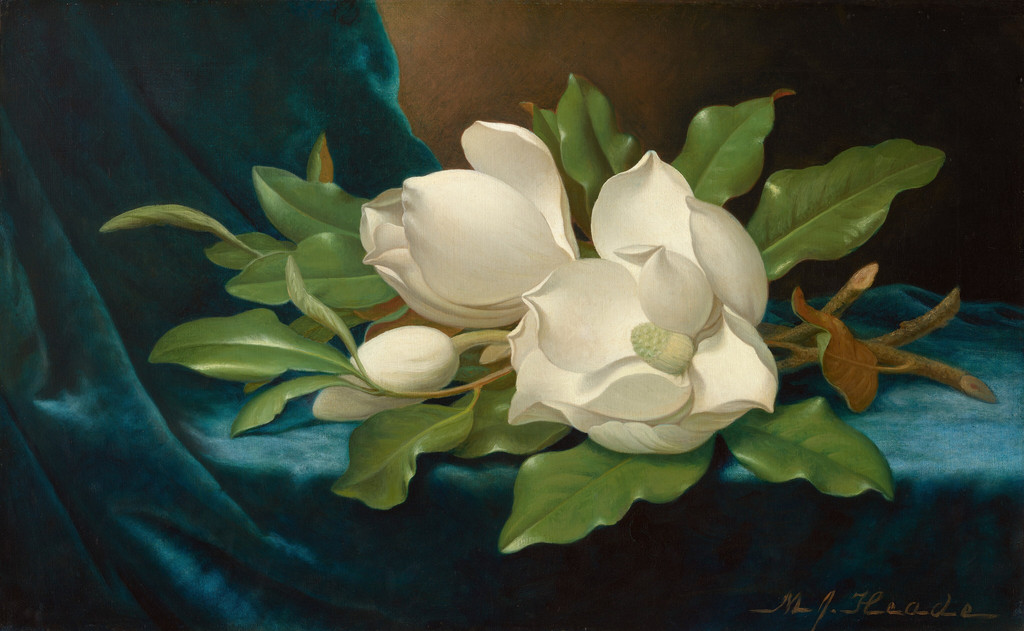
c.1876–81Magnolias on Light Blue Velvet Cloth
c.1885–95Contents
- The flower and the distant landscape
- Three birds, a nest and two eggs
- A commercially prepared mahogany support
- Wet paint, white impasto and the flower
- An older title and the question of ecological unity
- Comparing different bird-and-flower arrangements
- The 1982 acquisition and the object’s identity
- Annotated details
The flower and the distant landscape
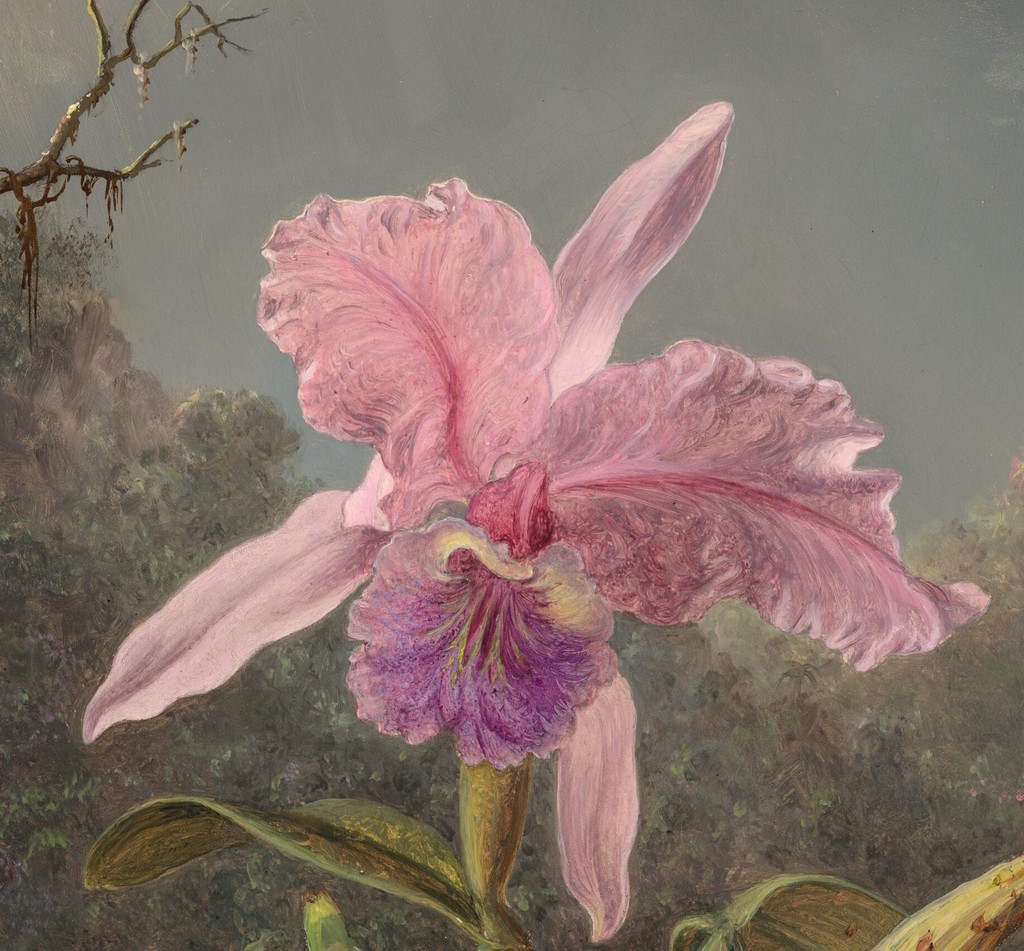
The orchid occupies the left half of the painting. Long pale-pink petals spread out from a darker, intricately folded centre. Its size within the composition makes it the first substantial form the eye encounters, but the open sky prevents it from becoming an isolated botanical specimen.
Below the flower, broad leaves and fleshy plant growth extend across a mossy foreground. They have different kinds of surfaces: some appear smooth and green, others carry brown marks or dry-looking ends. Thin branches enter from the left and hanging growth descends from the top, establishing an uneven frame around the near subjects.
The background is quieter. Blue-grey air separates distant vegetation from the more sharply described plants near the lower edge. A pale opening in the sky lies beyond the upper bird, so the small body remains visible against a relatively simple area. The flower and birds share the foreground without all being placed against equally busy surroundings.
This is a compact painting, measuring 34.8 by 45.6 centimetres. Its sense of a large tropical world emerges within that limited physical field. The close blossom and distant atmosphere work at different scales, making the surrounding space feel more extensive than the small support alone would suggest.[1]
Annotated Details from Cattleya Orchid and Three Hummingbirds
The numbered points identify visible features discussed in this article. Return from each detail to the whole composition. Martin Johnson Heade, Cattleya Orchid and Three Hummingbirds, 1871. Oil on wood. National Gallery of Art, 1982.73.1. Image source. CC0 / Public domain. Resized only; native appearance preserved.
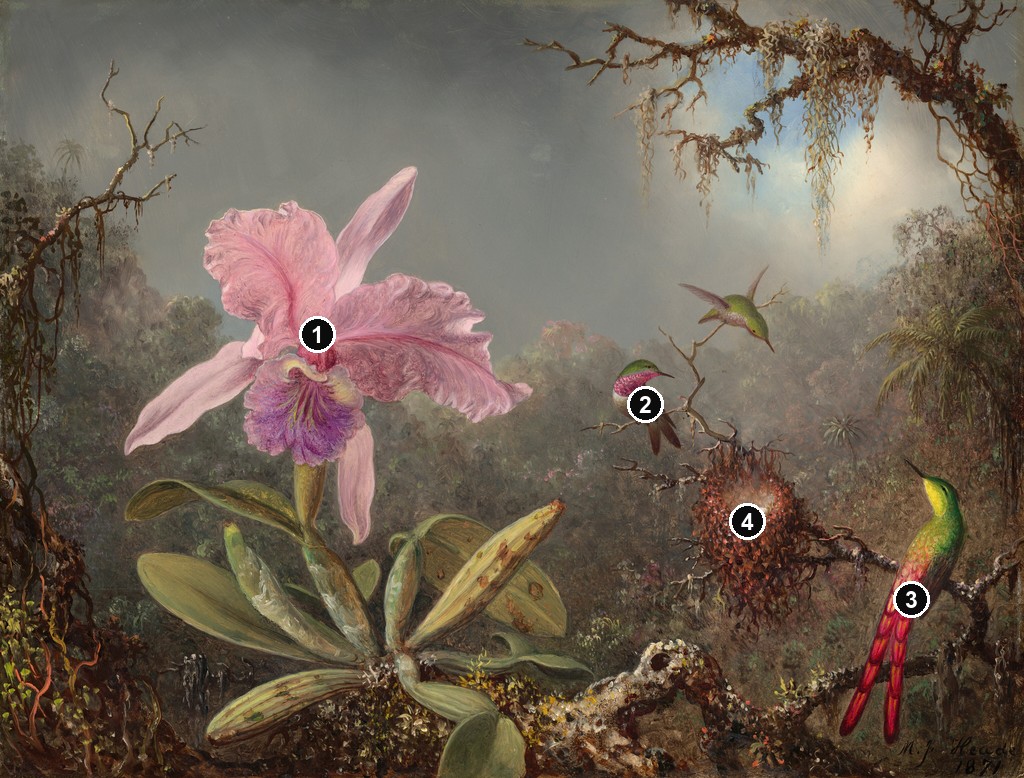
Details from CATTLEYA ORCHID AND THREE HUMMINGBIRDS
Compare the cropped details with the complete images above. Notice how their colours, shapes and positions contribute to the larger compositions.
Large orchid bloom
Pink and purple folds spread around the orchid’s darker centre. Its large scale establishes a foreground distinct from the hazier woodland.
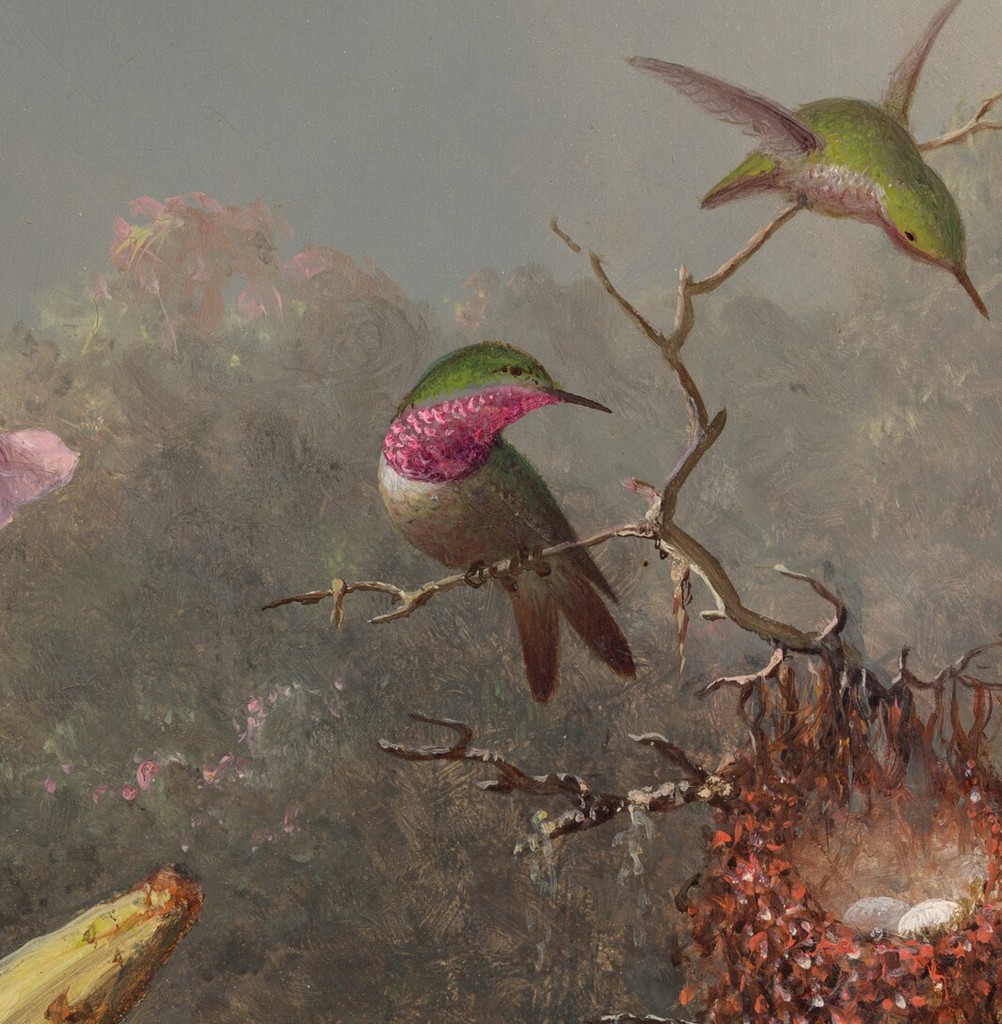
Perched bird
A green bird with a bright throat sits on a slender branch. Its stationary posture differs from the bird in flight above.
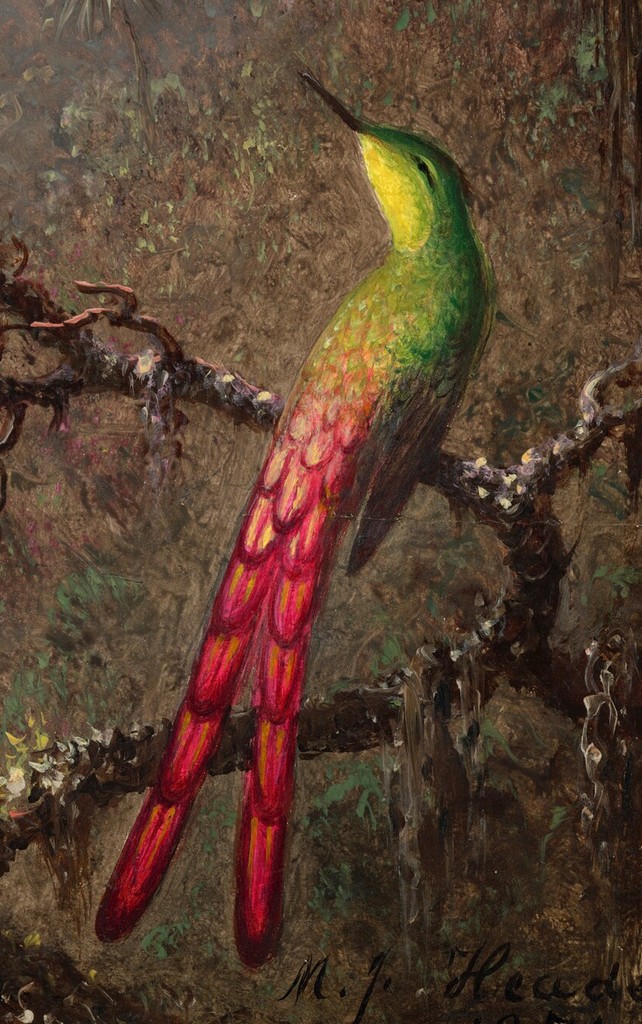
Long-tailed lower bird
The lower bird has a bright green neck and long red tail feathers. Its upright form balances the large orchid at the left.
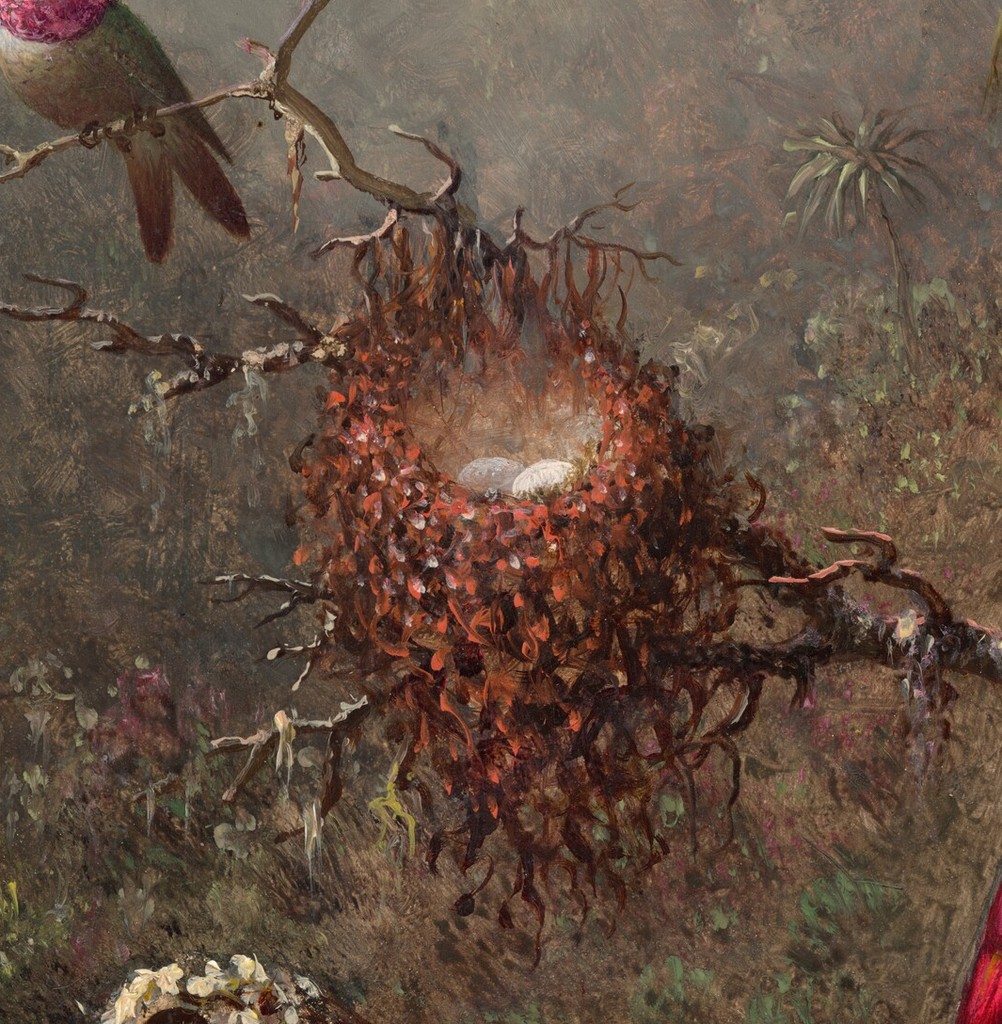
Nest among the branches
A small nest rests amid tangled branching below the perched bird. The pale forms inside remain distinct from the surrounding darker material.
Three birds, a nest and two eggs
The birds occupy the right half in three distinct positions. One perches on a twig just above and left of the nest, its bright throat turned into view. A second leans down from a higher branch. The third, with a much longer red tail, sits at the far right and looks upward into the picture.
Their separation gives the eye several routes through this half of the composition. The upper bird leads towards the pale distance, the perched bird draws attention back to the nest, and the long-tailed bird adds a strong vertical accent near the edge. They balance the orchid without forming one compact, flower-like shape.
The nest lies between them, built as a reddish-brown mass around two pale eggs. The small light forms are noticeable because they interrupt the darker cavity. Below, a branching support connects the nest with the foreground growth and the long-tailed bird’s perch.
Franklin Kelly identifies two birds using the historical common name Brazilian Amethysts and the third as a Sappho Comet. His catalogue discussion treats the combination of three birds and a nest as unusual within Heade’s orchid pictures. These identifications should remain attached to the scholarly source rather than being presented as an independent modern taxonomic assessment.[2]
Kelly also discusses the possibility of tension around the nest. That is an interpretation of the arrangement, rather than a behaviour conclusively demonstrated by the painted moment. The positions, eggs and contrasting bird forms are visible; a precise account of what each bird intends requires more than the reproduction alone.[2]
A commercially prepared mahogany support
The catalogue’s technical notes identify a Winsor and Newton prepared mahogany panel, approximately 1.2 centimetres thick, with horizontal grain. They state that its right edge was trimmed before painting. These are observations about the physical object, not properties established simply by looking at its brown and green colours.[2]
The support gives the painting a material identity quite different from Heade’s canvas-based tropical pictures. A wood panel and a stretched canvas need not receive paint in the same way, even when their subjects are closely related. Here the commercial preparation is part of the documented starting surface.
The fact that the edge was trimmed before painting also distinguishes a change to the support from a later loss of painted composition. The catalogue does not describe Heade cutting away a finished orchid or bird. That distinction is useful when thinking about the painting’s present dimensions and the completeness of its image.
This specific object record should guide the technical account. It does not establish that every orchid painting was made on mahogany or that Heade always bought the same prepared support. Similar-looking pictures can belong to the same developing subject while retaining different material histories.
Wet paint, white impasto and the flower
The technical notes describe a thinly painted orchid through which the off-white ground can show. They also record wet-into-wet application with small brushes and areas of raised paint, especially in the whites. The surface is therefore more varied than a simple description of uniformly smooth painting would suggest.[2]
Thin colour and raised pale passages perform different tasks. A thin area can allow the light ground to participate in the flower’s appearance, while a thicker white accent can give an edge or fold more physical emphasis. The catalogue evidence connects these possibilities with this particular flower, rather than supplying a general recipe for all Heade paintings.
In the image, the petals move between pale surfaces and a more saturated purple-pink centre. Their folds are not described only by outlines: changes of tone establish surfaces turning towards or away from the light. The central lip is especially elaborate, contrasting with the simpler long petals that extend beyond it.
The birds introduce another use of colour. The nearer bird’s bright throat provides a small intense accent, while the long tail at the right repeats a warm red on a much narrower form. The orchid is large and complex, but these smaller passages help distribute attention across the painting.
The 1996 technical account describes an examination at that time. Its comments about condition and coatings should not be treated as a current conservation report. The useful evidence here concerns the documented support, ground and paint handling, with the date and scope of that evidence kept clear.[2]
Watch: Martin Johnson Heade
Choose a film to explore the artist’s work, its interpretation and its wider setting.
Museum Minute: Heade Hummingbirds
A brief Shelburne Museum introduction to Heade’s hummingbird paintings.
Watch on YouTubeAn older title and the question of ecological unity
The current NGA title is Cattleya Orchid and Three Hummingbirds. The 1996 catalogue includes the word “Brazilian” before hummingbirds. The difference is a change in naming around the same accession, 1982.73.1, rather than evidence for a second nearly identical painting.[1][2]
The older geographic wording should not be used to prove that every species shown belongs naturally to one specific Brazilian habitat. Historical common names, modern ranges and the composition’s imagined setting are different kinds of evidence. The picture itself supplies no labelled location at which this exact combination was observed.
Charlotte M. Porter’s Florida Museum essay discusses the relationship between Heade’s close botanical subjects and his interest in natural history. It also points out limits to ecological readings of the bird-and-orchid pictures. A painted bird beside a flower does not automatically establish a pollinating relationship.[3]
Kelly suggests that Heade’s interest in birds and their environments may have been related to Darwinian ideas. The possibility adds historical context, but it remains a scholarly interpretation. The painting does not come with a verified statement declaring that this orchid, nest and group of birds illustrate one particular evolutionary argument.[2]
Comparing different bird-and-flower arrangements
Kelly places the NGA painting among three known pictures signed and dated 1871, made on prepared panels of the same size. One related work is at Reynolda House Museum of American Art; another was in a private collection when the catalogue was published. Their arrangements place flowers and birds differently, indicating that Heade explored more than one solution to the new subject.[2]
The NGA work’s third bird and nest make its arrangement particularly complex. Flower, eggs and birds establish several centres of interest instead of one pair of birds balanced against a blossom. Kelly considers the possibility that it was an early, experimental version, but does not establish a certain order for the three works.[2]
The later Carter Two Hummingbirds Above a White Orchid uses a tall canvas. Its two birds perch above the large pale flower, producing an upward sequence rather than the left-to-right division seen here. The approximate c.1875–90 date belongs to that separate picture.[4]
The Met’s Hummingbird and Passionflowers also uses an upright format, with a single bird among red flowers. Its current c.1875–85 date overlaps the Carter’s broad range. These works demonstrate continuity of interest while keeping the number of birds, kind of flower, support and spatial arrangement distinct.[5]
The relationship with The Gems of Brazil is historical rather than an automatic series identity. Heade’s earlier small bird pictures provided a background to his continuing interest, but the 1871 orchid composition belongs to the later development described by Kelly. It should not be called a plate from a completed published Gems book.[2]
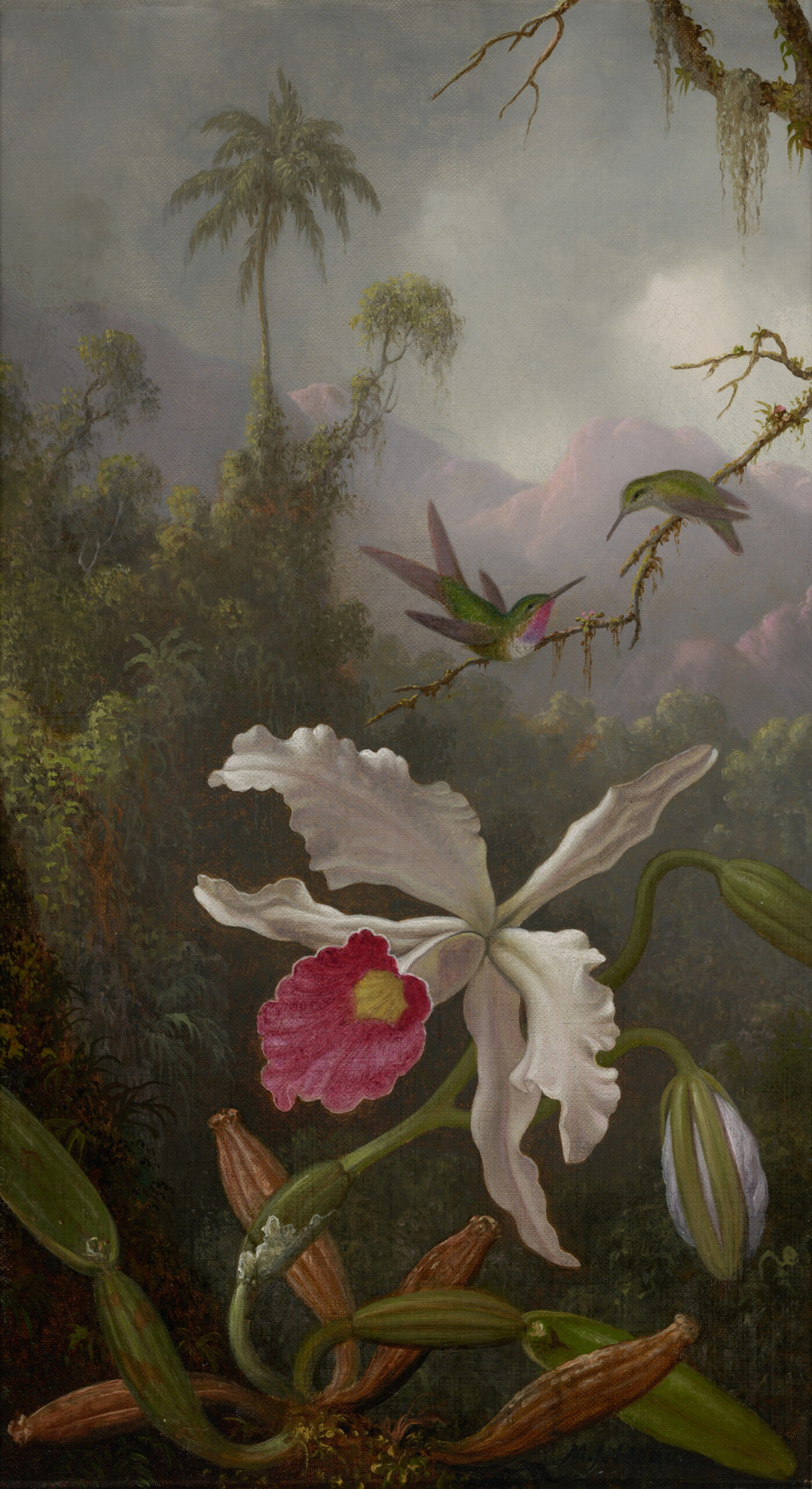
Martin Johnson Heade, Two Hummingbirds Above a White Orchid, c.1875–90. Oil on canvas. Amon Carter Museum of American Art, 1981.33. Image source. Public domain. Resized only; native appearance preserved.
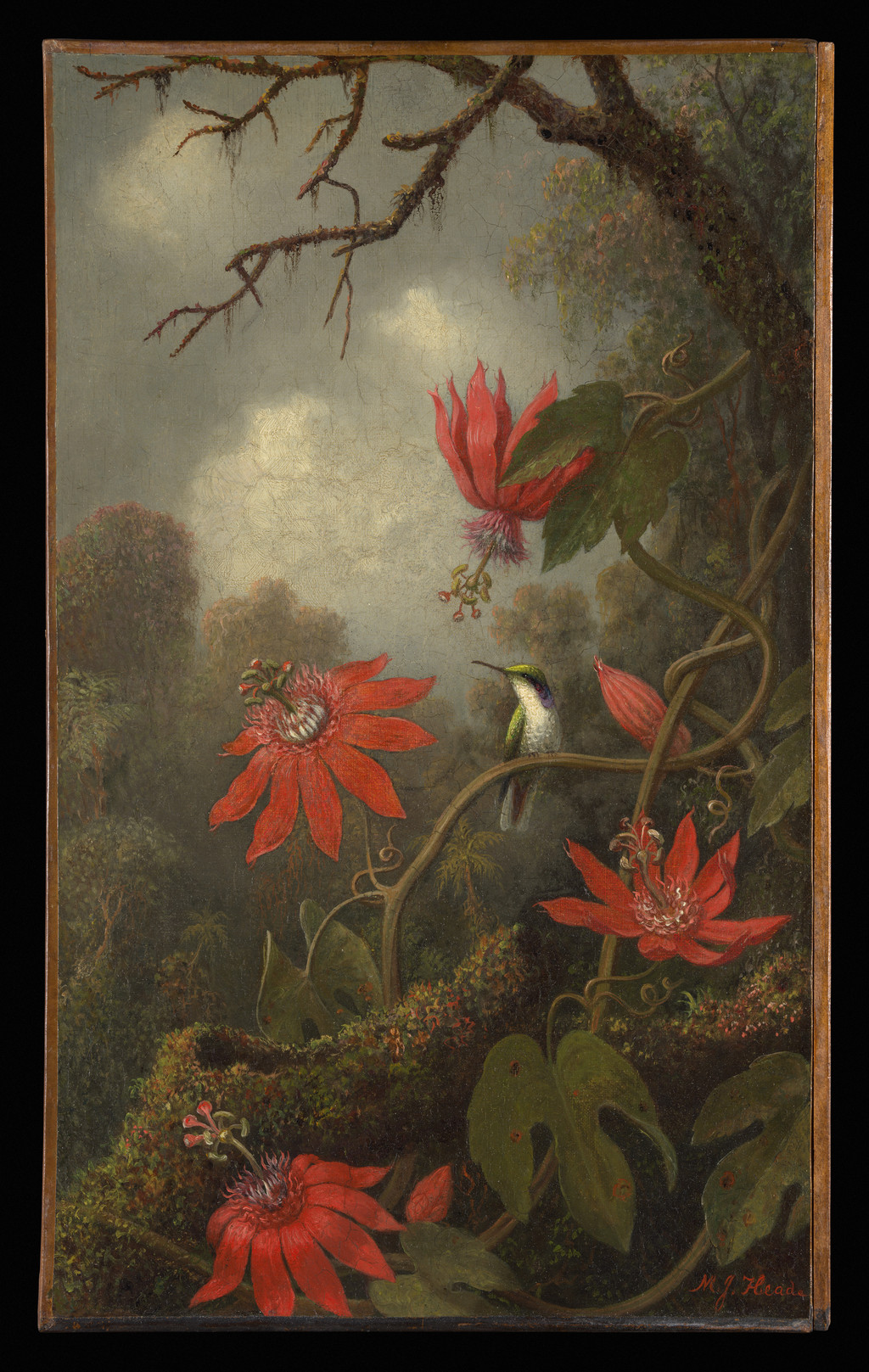
Martin Johnson Heade, Hummingbird and Passionflowers, c.1875–85. Oil on canvas. Metropolitan Museum of Art, 46.17. Image source. CC0 / Public domain. Resized only; native appearance preserved.
The 1982 acquisition and the object’s identity
The NGA received the painting as a gift of the Morris and Gwendolyn Cafritz Foundation in 1982. Its accession records the year of entry into the collection, while the signature and painted date identify its much earlier creation. The two dates perform different roles in the object’s history.[1]
Kelly’s catalogue records a private collection, a Washington sale in May 1982 and Hirschl & Adler Galleries in its earlier provenance. That account supplies documented stages close to the acquisition without identifying every owner from 1871 onwards. Missing stages should remain gaps rather than being supplied from a general story about Heade’s tropical travels.[2]
The surviving painting brings those material and historical facts into a remarkably compact space. A prepared panel carries thin and raised passages of colour; an orchid balances three differently positioned birds; and a tiny nest establishes another focus within a broad atmospheric setting. Its individuality comes from that particular combination, rather than from the tropical subject alone.
Artworks directory
A collected selection of 26 individually identified museum paintings, including thirteen extended artwork studies. This is a bounded directory, rather than a complete catalogue raisonné. Two Boston entries retain dates from the 2002 conservation study. Links open a companion article where available, otherwise the cited institutional record or publication; unillustrated objects remain included.
Frequently Asked Questions
There are three hummingbirds and two pale eggs in the nest. The third, long-tailed bird stands at the far right, separated from the pair nearer the nest.
Kelly discusses it as a possible early experimental version among three pictures dated 1871, but the precise sequence is not established.[2]
Discussion
Look again at the images and ideas explored in Cattleya Orchid and Three Hummingbirds by Martin Johnson Heade. These editorial prompts invite your observations.
Reader Insights
How do the three birds and nest balance the large flower?
What changes in the tall White Orchid composition?
What can the exact panel examination establish about painting the orchid?
Join the Conversation
Share a detail, comparison or question about Cattleya Orchid and Three Hummingbirds by Martin Johnson Heade below.
References
- National Gallery of Art, Cattleya Orchid and Three Hummingbirds, 1982.73.1. Current title, medium, date, dimensions and Cafritz Foundation gift. View source
- Franklin Kelly, American Paintings of the Nineteenth Century, Part I (NGA, 1996), printed pp.291–294. Technical notes, provenance, historical bird names, related 1871 panels and qualified interpretation. View source
- Charlotte M. Porter, Florida Museum, “Visual Interests”. Natural-history context and ecological limits; conjectural activities are not treated as established biography. View source
- Amon Carter Museum of American Art, Two Hummingbirds Above a White Orchid, 1981.33. Exact later canvas, date range and museum commentary. View source
- Metropolitan Museum of Art, Hummingbird and Passionflowers, 46.17. Exact upright comparison and current c.1875–85 dating checked against the museum’s API. View source
- Splash image source.
Martin Johnson Heade, Cattleya Orchid and Three Hummingbirds, 1871. Oil on wood, 34.8 × 45.6 cm. National Gallery of Art, 1982.73.1. Gift of The Morris and Gwendolyn Cafritz Foundation; National Gallery of Art. CC0 / Public domain. Resized only; native appearance preserved.
View source