 by Tom Gurney
Tom Gurney BSc (Hons) is an art history expert with over 20 years experience
Email: tomgurney1@gmail.com / Phone: +44 7429 011000
Martin Johnson Heade’s Marsh Paintings: Introduction
Martin Johnson Heade’s marsh paintings turn low coastal ground into a sustained study of light, water and human use. Haystacks, boats, cattle and small workers appear beneath skies that can be warm, grey or interrupted by rain. Their quietness does not make these landscapes untouched wilderness. Scholarly studies of individual canvases connect the depicted structures with salt-hay farming and reveal deliberate changes in the studio. Looking across the marsh pictures makes their differences as important as their recurring motifs.[1][2][3]
At a Glance
- Main subjectsCoastal marshland, hay, water, cattle, small workers and weather
- Recurring locationsMassachusetts and other parts of the eastern seaboard
- Typical arrangementA broad horizontal field beneath a substantial sky
- Useful objectsNGA View of Marshfield and Sunlight and Shadow, Met Newburyport Meadows, Yale Sudden Shower
- Documented working evidenceA related drawing and an infrared-discovered moved stack
- Modern comparisonParker River habitat photograph, 2011; a different date and view
Contents
- A low horizon with a large sky
- Haystacks, staddles and seasonal labour
- Water, pools and movement
- Newbury, Marshfield and other coastal places
- Marsh painting after the move to Florida
- Cloud, rain and changing visibility
- Pictures built and revised in the studio
- Later interpretations of the cultivated marsh
- Annotated details
A low horizon with a large sky
Many marsh pictures give the sky more space than the land. The terrain is comparatively flat, allowing cloud and light to become major sources of variation. A low horizon can make a small canvas suggest a much more extensive coastal plain.
The absence of dramatic mountains does not leave the composition without structure. Stacks, water margins, bushes, trees and distant buildings provide points of attention at several scales. Their placement can turn a seemingly undistinguished field into an organised experience of space.
In Newburyport Meadows, the grass occupies a narrow strip beneath a large grey sky. Light is dispersed across the field rather than concentrated around one spectacular sunset. Strazdes’s Met catalogue entry connects this arrangement with changing atmosphere and a comparatively free movement of the viewer’s attention.[4]
Sunlight and Shadow: The Newbury Marshes develops a more substantial foreground group. An apple tree and an illuminated stack occupy the left, while water and cattle extend towards the right. Its pink cloud and reflection introduce warm accents within the broad marsh.[2]
The repeated horizontal format therefore supports different balances. A foreground tree can hold one side, or a more open field can distribute attention across several small forms. The recurring subject does not require a single unchanging composition.
Annotated Details from Martin Johnson Heade’s Marsh Paintings
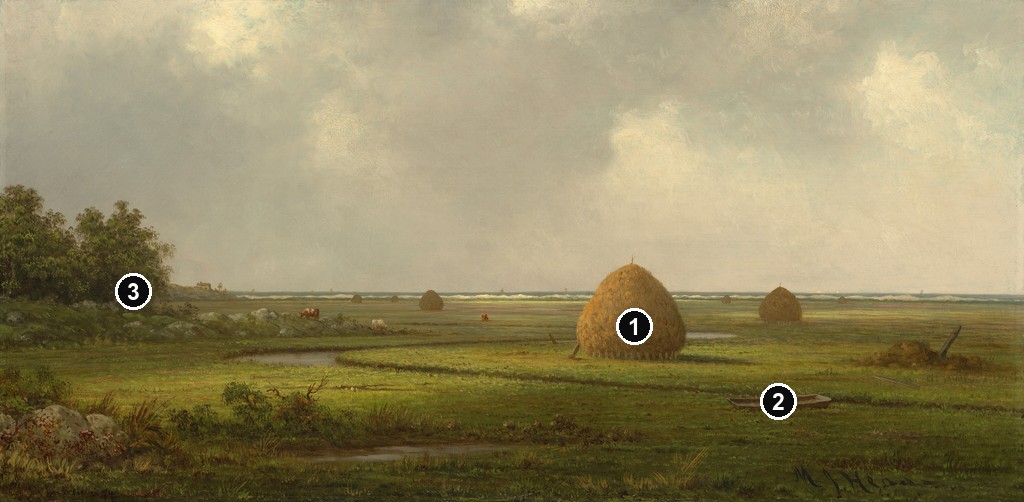
The numbered points identify visible features discussed in this article. Return from each detail to the whole composition. The captions keep each work’s identity, date and medium separate.
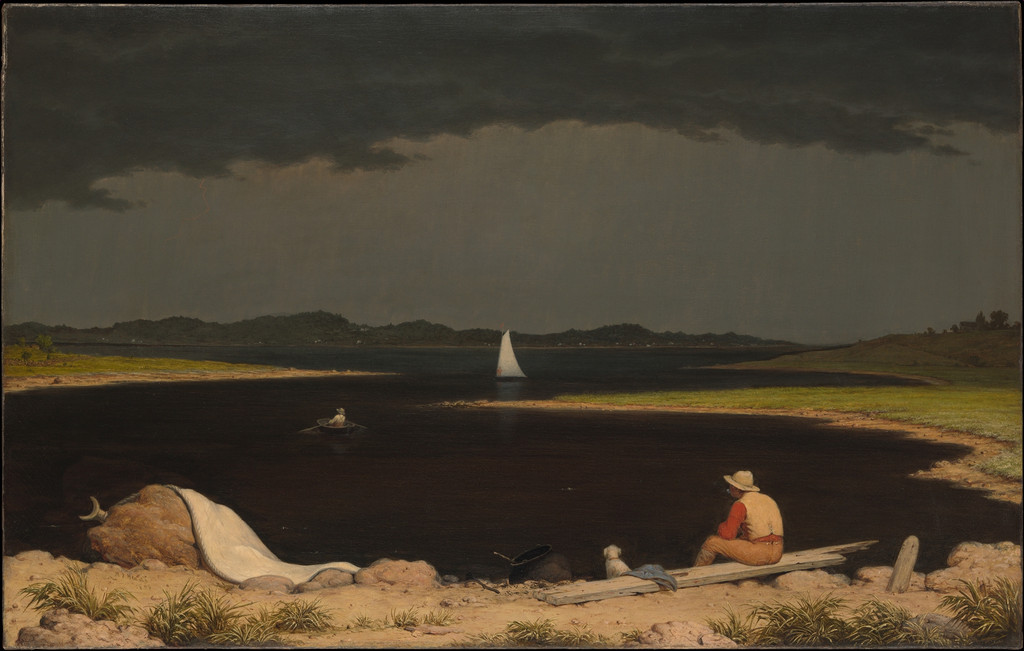
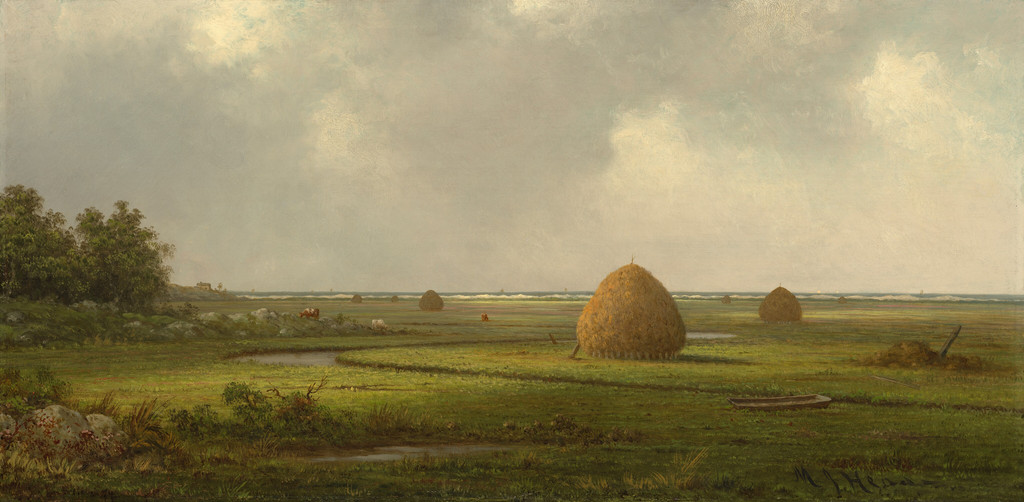
View of Marshfield
Martin Johnson Heade, View of Marshfield, c.1866–76. Oil on canvas, 39.05 × 76.84 cm. National Gallery of Art, Corcoran Collection, 2015.19.173. Corcoran Collection (Museum Purchase, 1981); National Gallery of Art. Image source. CC0 / Public domain. Resized only; native appearance preserved.
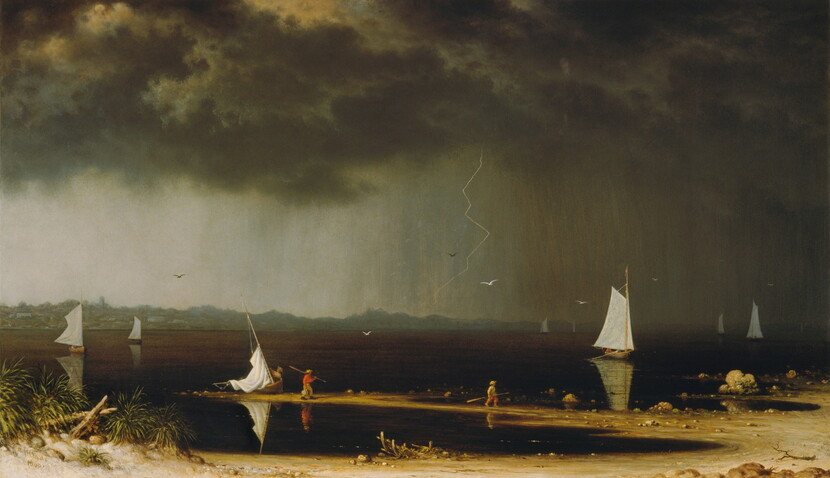
Sudden Shower, Newbury Marshes
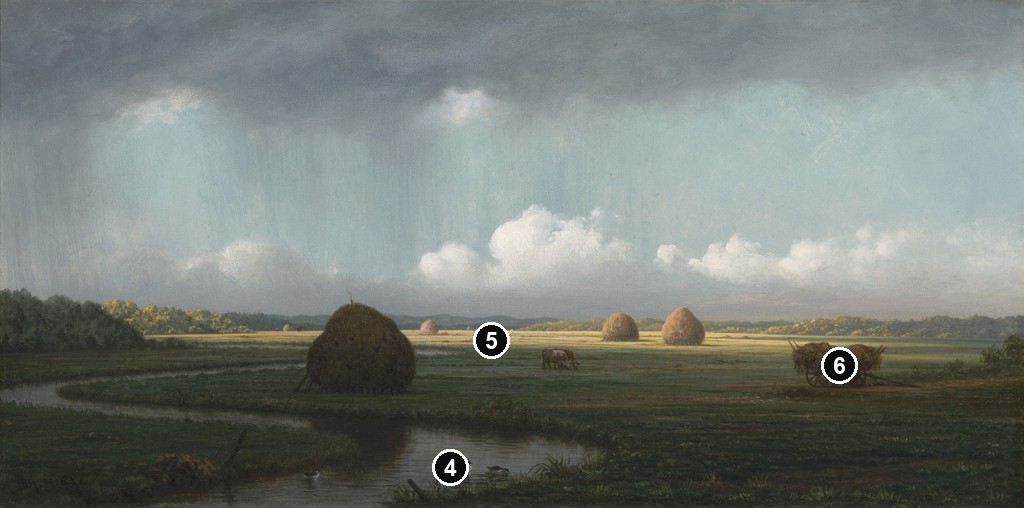
Martin Johnson Heade, Sudden Shower, Newbury Marshes, c.1865–75. Oil on canvas. Yale University Art Gallery, 1989.51.1. Image source. Public domain / PD-Art. Resized only; native appearance preserved.
Details from MARTIN JOHNSON HEADE’S MARSH PAINTINGS
Compare the cropped details with the complete images above. Notice how their colours, shapes and positions contribute to the larger compositions.
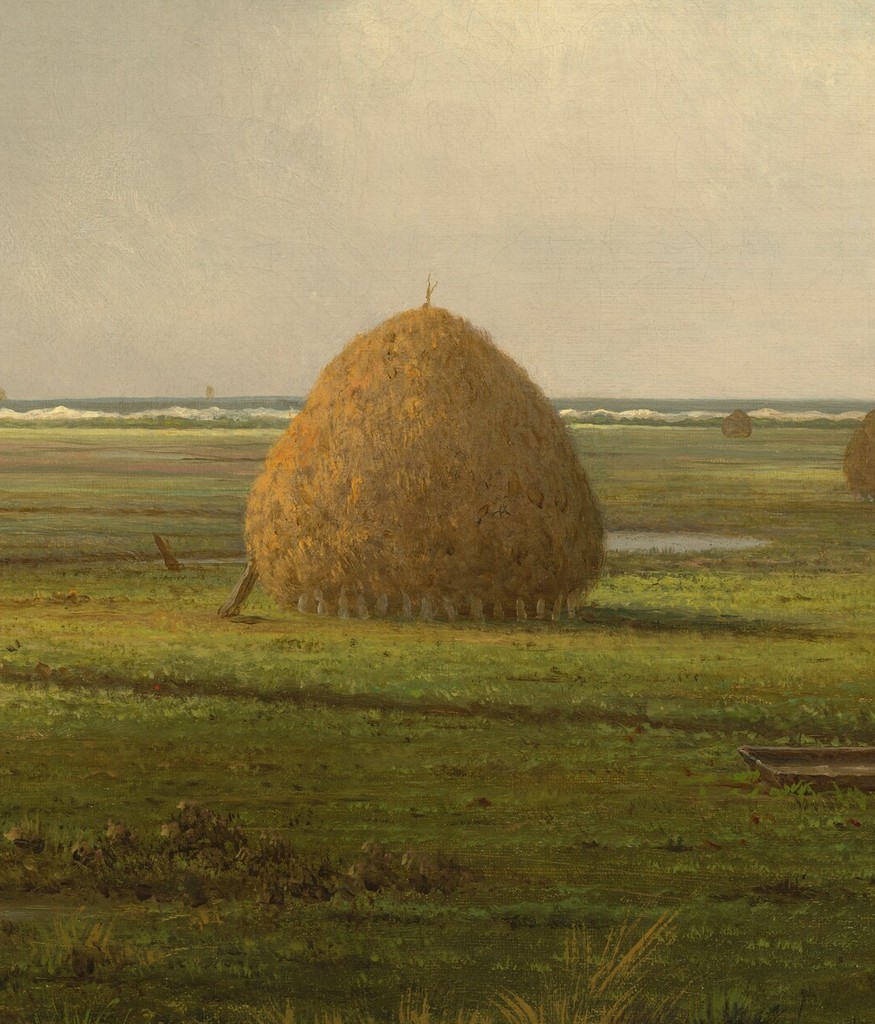
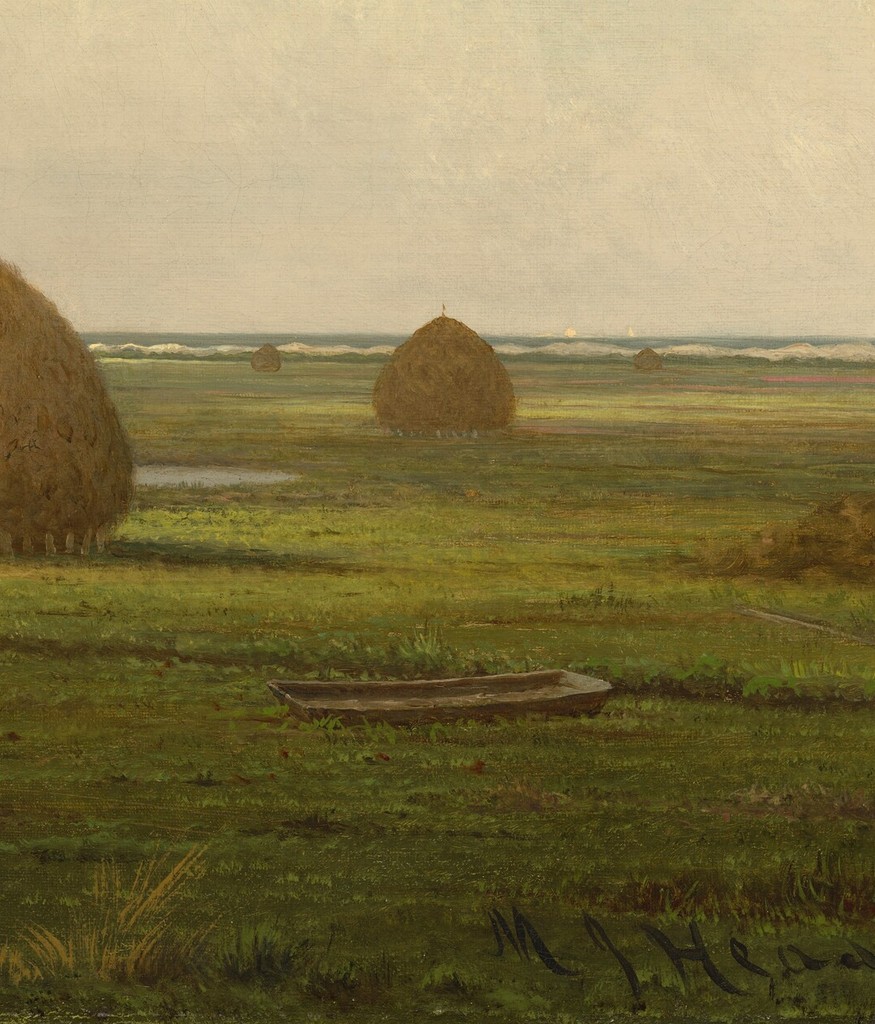
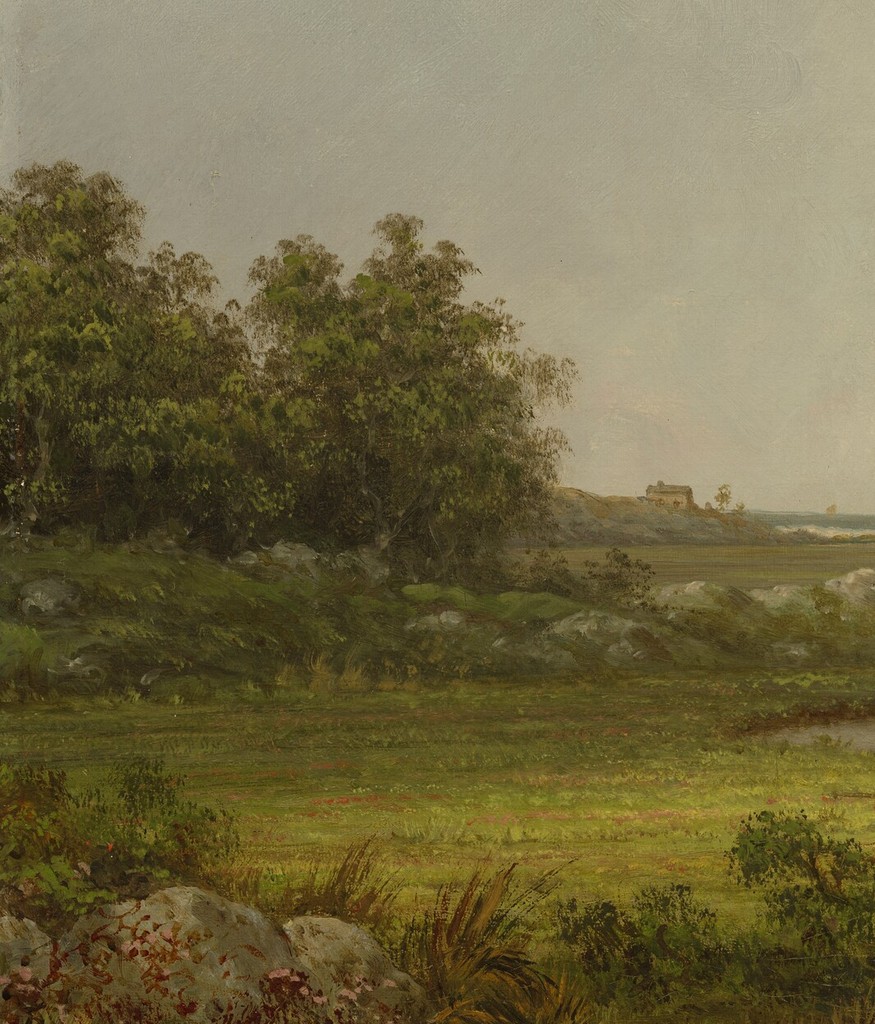
View of Marshfield
Large near haystack
The large stack rises above the level marsh, with smaller stacks extending behind it. Their different sizes help establish distance.
Low marsh boat
A low open boat rests near the narrow foreground channel. Its long horizontal shape differs from the rounded haystacks.
Wooded left margin
Trees and low rocky ground enclose the left side. Their irregular silhouettes contrast with the flatter cultivated marsh.
Sudden Shower, Newbury Marshes
Waterfowl in the near channel
Small dark waterfowl occupy the nearer channel. Their silhouettes become easier to recognise in the cropped view than in the broad landscape.
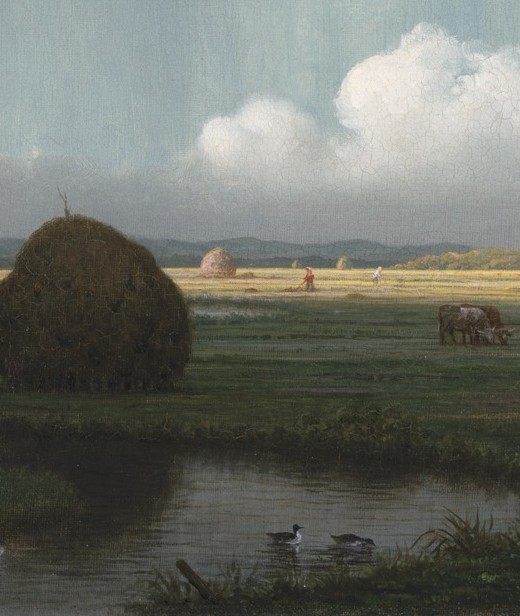
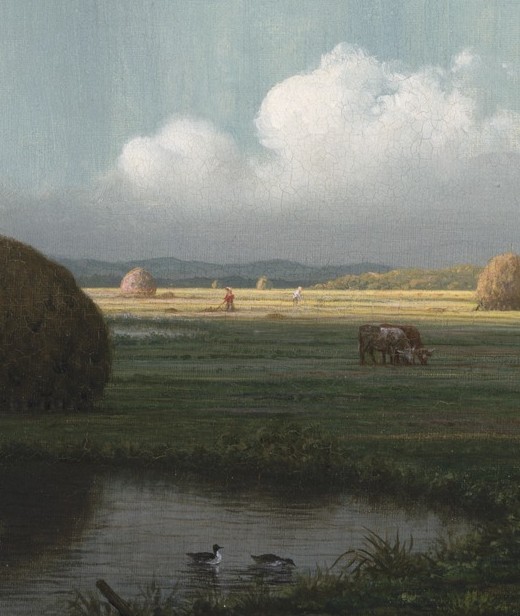
Distant harvest workers
Two small figures stand in the lighter field beyond the near haystack. The surrounding stacks and level ground establish their distance.
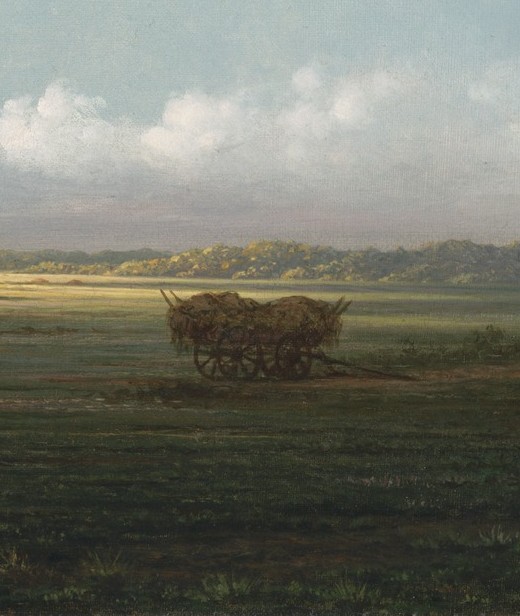
Loaded cart
A cart laden with hay crosses the right-hand field. Its wheel forms distinguish it from the stationary stacks nearby.
Haystacks, staddles and seasonal labour
Haystacks are among the most recognisable features of these paintings. Their rounded forms stand above flatter vegetation, giving the land a sequence of substantial objects. As the stacks diminish towards the horizon, they can help establish depth.
Sarah Cash’s View of Marshfield entry explains the raised platforms known as staddles. Stakes supported cut salt hay above damp ground while it dried and remained stored. What might initially appear to be an unusual pedestal is consequently part of a practical response to wet terrain.[1]
Cash places stack-building and maintenance within the late-summer cycle, especially August and September. The stored material could later be carried away by boat or across ice in winter. A painted stack can therefore suggest work already done and transport still to come.[1]
The same canvas includes a low boat near a small pile of hay. Cash identifies the craft as a flat-bottomed gundalow and links it with reaching the marsh at high tide. Water is both a visual element and a possible route for farm work.[1]
Some small objects remain less securely identified. Three diagonal poles in View of Marshfield may be haypoles or boundary markers, according to the catalogue note. Retaining both possibilities is more useful than giving every mark a definite agricultural function.[1]
Figures vary across the pictures. Two harvesters occupy the brighter distance in Sudden Shower, while workers and a loaded wagon appear in the Met’s Newburyport Meadows. These visible people prevent a blanket description of the later marshes as entirely empty landscapes.[3][7]
Human use can also remain evident where figures are absent or inconspicuous. Cut hay, grazing animals, vessels and managed channels provide other signs of activity. Quiet composition and working land are compatible aspects of Heade’s subject.
Water, pools and movement
Water interrupts the marsh in several forms. Narrow channels bend across the foreground; broader pools reflect portions of the sky; distant sea may form a continuous strip beyond the grass. These shapes create different relationships between near and far space.
A winding channel can lead the viewer through several changes of direction. Its edges divide the immediate land into irregular areas, supplying movement within a field whose horizon remains almost straight. Reflections also connect sky and ground without requiring a large lake.
Barringer describes a double-oxbow arrangement in Sudden Shower. His reading considers how water and stacks invite imaginative entry into a broad plain. It is an interpretation of painted space, rather than a topographic survey of the actual marsh.[3]
The water can simultaneously suggest difficult ground and practical access. A boat suited to shallow channels makes one kind of movement possible where walking or transporting a load across the field would be harder. Cash’s regional account gives that relationship historical substance.[1]
Matt Poole’s 2011 USFWS photograph at Parker River supplies a modern habitat comparison. Its pool, surrounding marsh grass and low horizon help readers consider how water occupies relatively flat coastal ground. It is a photograph of a different date and view, rather than a verified reconstruction of one of Heade’s compositions.[6]
The comparison does not require the photograph to contain painted haystacks or match every bend. Its value lies in the visible relationship between shallow water, vegetation and open horizon. The historical farming practices belong to the scholarly accounts of the paintings.
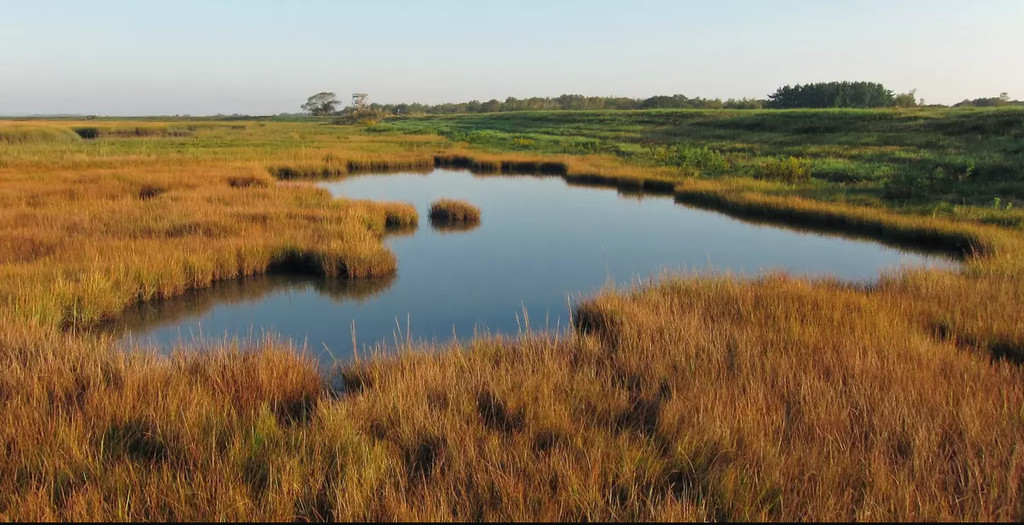
Matt Poole/USFWS, salt panne at Parker River National Wildlife Refuge, 26 September 2011. Modern habitat comparison; a different date and view from Heade’s paintings. Matt Poole/USFWS, via Wikimedia Commons. Image source. Public domain / US federal government. Resized only; no alteration of native appearance.
Newbury, Marshfield and other coastal places
Place names require care because several pictures share similar titles. The Met’s Newburyport Meadows is accession 1985.117, currently dated c.1876–81. The NGA’s Sunlight and Shadow is 2010.74.1, dated c.1871–75. They are separate canvases connected with the Newbury area.[7][8]
The NGA’s View of Marshfield is another object, accession 2015.19.173. Cash proposes Green Harbor in eastern Marshfield and a house near Blue Fish Rock, crediting local expertise for the location. The proposal remains probable rather than an exact modern viewing coordinate.[1][9]
Heade also painted marshes beyond these Massachusetts subjects. Katherine E. Manthorne’s Thyssen entry for Jersey Marshes, dated 1874, discusses the recurring horizontal view, water and receding hay. It places the work within a wider coastal practice rather than treating all such landscapes as Newburyport.[5]
Similar terrain can make exact sites difficult to identify. A low horizon and haystacks do not alone prove a town, while a title does not map every feature. Individual object records and qualified local studies provide firmer connections than an assumed resemblance between scenes.
Watch: Martin Johnson Heade
Choose a film to explore the artist’s work, its interpretation and its wider setting.
Museum Minute: Heade Hummingbirds
A brief Shelburne Museum introduction to Heade’s hummingbird paintings.
Watch on YouTubeMarsh painting after the move to Florida
Heade settled in St. Augustine in 1883, but the move did not end his landscape practice. Kelly’s NGA biography places Florida marsh and swamp scenes alongside continued flower, orchid and hummingbird painting. These subjects overlapped during the artist’s later career.[10]
The Florida context expands the geography of the marsh article without turning every late canvas into a view of the same wetland. A repeated horizontal format can connect pictures made in different regions, while their exact titles and histories continue to matter.
It also changes the idea of marsh painting as a brief phase replaced completely by magnolias. The artist could pursue different kinds of natural subject in parallel. His flowers and tropical birds are better understood beside continued landscape work than as its automatic successors.[10]
The separate Florida article follows his settlement, patronage and hotel-studio setting more closely. Here the later period establishes the persistence of a landscape interest whose earlier examples already combined weather, water and human use.
Cloud, rain and changing visibility
Weather varies markedly within the marsh group. Warm light and pink cloud help organise Sunlight and Shadow. Grey illumination spreads more evenly across Newburyport Meadows. In Sudden Shower, Newbury Marshes, rain crosses part of the distance beneath a large cloud while a brighter strip of grass remains visible.[2][3][4]
The differences change how stacks and people are encountered. A brightly lit mound separates from its surroundings; one in shadow can join the darker foreground. Rain can obscure the distance while leaving the nearer field comparatively distinct.
This variability also makes flat ground a productive subject. A dramatic mountain supplies a relatively fixed large form, whereas coastal grass and shallow water can change substantially in appearance under different cloud. Heade’s chosen terrain offered repeated opportunities to reconsider atmosphere.
The pictures should nevertheless remain paintings rather than weather records. Their visible light can be described, but it does not establish a precise tide, rainfall measurement or time of day. The compositions organise those appearances for a viewer.
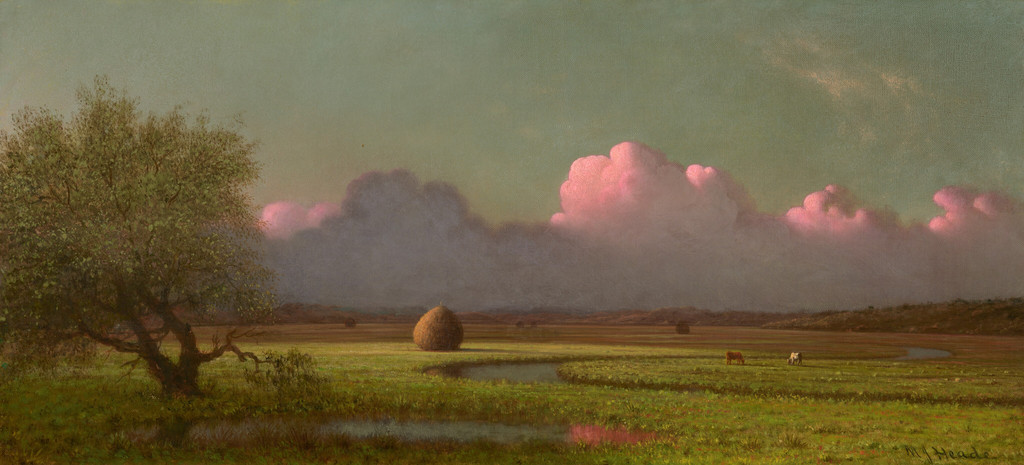
Martin Johnson Heade, Sunlight and Shadow: The Newbury Marshes, c.1871–75. National Gallery of Art, 2010.74.1. John Wilmerding Collection; National Gallery of Art. Image source. CC0 / Public domain. Resized only; native appearance preserved.
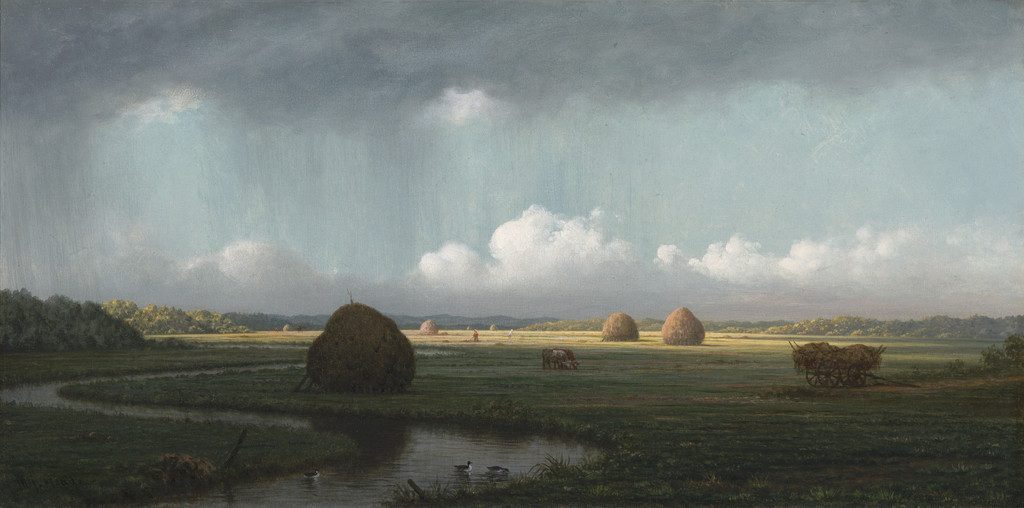
Martin Johnson Heade, Sudden Shower, Newbury Marshes, c.1865–75. Yale University Art Gallery, 1989.51.1. Image source. Public domain / PD-Art. Resized only; native appearance preserved.
Pictures built and revised in the studio
The surviving evidence demonstrates specific forms of construction. Cash connects View of Marshfield with a two-sheet graphite drawing at the MFA Boston, 60.1015. The finished canvas adds haystacks and removes a right-hand tree found in the drawing.[1]
Brock reports a different revision in Sunlight and Shadow. Infrared reflectography identified a painted-out stack near the middle, moved forward and left into sunlight. The finding changes how the final balance of tree, mound and open field can be understood.[2]
Neither finding establishes a universal method. The drawing concerns one Marshfield canvas; the hidden stack concerns one Newbury painting. Together they demonstrate that apparently settled scenes could develop through observation, selection and adjustment.
The ordinary colour reproductions show the finished compositions. They do not independently reveal every underlying change described by a catalogue. Published examinations and visible forms make different contributions to the account.
Later interpretations of the cultivated marsh
Brock considers nostalgia and the changing economics of salt hay, including the effects of rail transport on local demand. His interpretation places later marsh pictures within the history of a working landscape whose customary uses were changing.[2]
Barringer reads Sudden Shower through religion, industrial modernity and possible Civil War associations. He also compares it with Yale’s railway-bearing Lynn Meadows. These are critical arguments about particular paintings, rather than confirmed explanations supplied by Heade.[3]
Cash discusses possible debates over reclamation but notes the lack of evidence for a political motive in View of Marshfield. Its marsh therefore should not be labelled an established protest manifesto. Farming, fishing, weather and artistic composition already provide a substantial basis for understanding the image.[1]
The strongest comparisons begin with exact objects. Raised hay, a working boat, a shifted stack or a small wagon can then connect visible form with historical practice and interpretation. Heade’s marshes become richer when their quiet surfaces are examined alongside those distinctions.
Artworks directory
A collected selection of 26 individually identified museum paintings, including thirteen extended artwork studies. This is a bounded directory, rather than a complete catalogue raisonné. Two Boston entries retain dates from the 2002 conservation study. Links open a companion article where available, otherwise the cited institutional record or publication; unillustrated objects remain included.
Frequently Asked Questions
No. It is Matt Poole’s 2011 habitat photograph, used to compare water, vegetation and a low horizon. No exact match with a Heade painting is claimed.[6]
Discussion
Look again at the images and ideas explored in Martin Johnson Heade’s Marsh Paintings. These editorial prompts invite your observations.
Reader Insights
How do the stacks and channels guide attention across the ground?
What changes between rain, shadow and brighter open marsh?
How do cattle, harvesters and boats change your understanding of the place?
Join the Conversation
Share a detail, comparison or question about Martin Johnson Heade’s Marsh Paintings below.
References
- Sarah Cash, Corcoran Collection: American Paintings to 1945, printed pp.130–131 and notes p.266. Work-specific Marshfield study, regional practice, drawing and qualified site. View source
- Charles M. Brock, American Masters from Bingham to Eakins: The John Wilmerding Collection (NGA, 2004), printed pp.72–74. Sunlight and Shadow, infrared revision and historical marsh economy. View source
- Tim Barringer, Object Lessons: American Painting at Yale, printed pp.1–17. Sudden Shower, composition, labour and attributed interpretations. View source
- Diana J. Strazdes, Heade entries in American Paradise (Met, 1987), printed pp.177–178. Newburyport Meadows and changing atmosphere; older dating distinguished from current record. View source
- Katherine E. Manthorne, Thyssen, Jersey Marshes. Exact 1874 comparison, CTB.1979.34, and wider coastal subject. View source
- Wikimedia Commons / USFWS, Matt Poole, Parker River salt panne, 26 September 2011. Modern habitat photograph and federal public-domain evidence. View source
- Metropolitan Museum of Art, Newburyport Meadows, 1985.117. Current exact object and c.1876–81 dating. View source
- National Gallery of Art, Sunlight and Shadow: The Newbury Marshes, 2010.74.1. Current exact object and c.1871–75 dating. View source
- National Gallery of Art, View of Marshfield, 2015.19.173. Current exact object. View source
- Franklin Kelly, American Paintings of the Nineteenth Century, Part I (NGA, 1996), printed pp.287–288. St. Augustine settlement and overlapping later subjects. View source
- Splash image source.
Martin Johnson Heade, View of Marshfield, c.1866–76. National Gallery of Art, Corcoran Collection, 2015.19.173. Corcoran Collection (Museum Purchase, 1981); National Gallery of Art. CC0 / Public domain. Resized only; native appearance preserved.
View source