 by Tom Gurney
Tom Gurney BSc (Hons) is an art history expert with over 20 years experience
Email: tomgurney1@gmail.com / Phone: +44 7429 011000
Approaching Thunder Storm by Martin Johnson Heade: Introduction
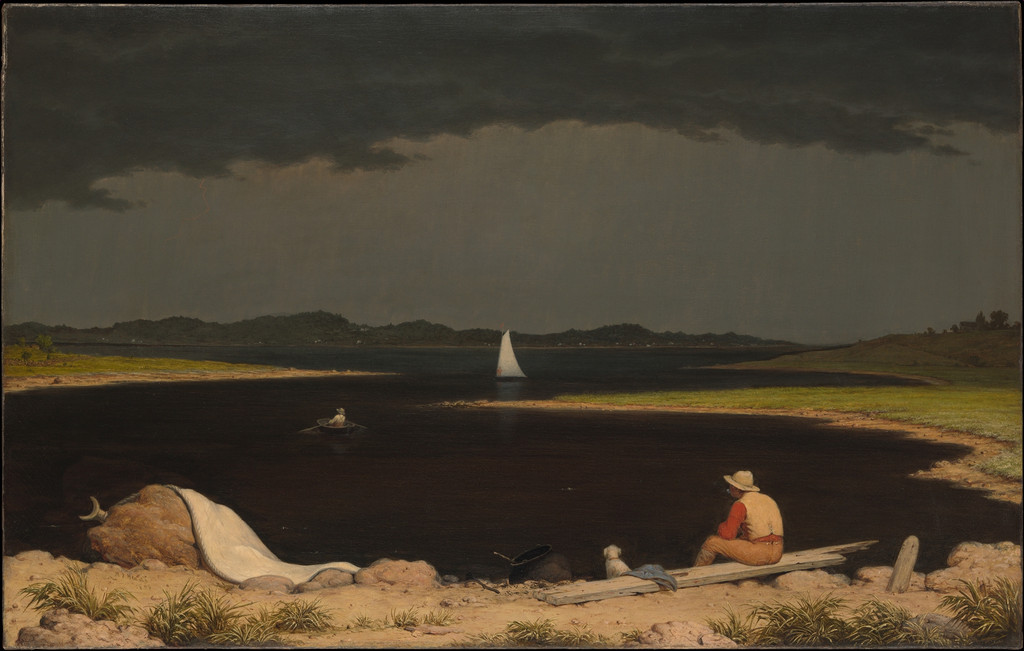
Martin Johnson Heade’s Approaching Thunder Storm places a seated fisherman and a few boats beneath an immense dark sky. The water is relatively still, so the approaching weather is felt through the weight of cloud and a pale flash of lightning rather than through a crashing sea. Painted in 1859, this oil on canvas belongs to the Metropolitan Museum of Art. A detailed catalogue account identifies changes to its composition and a disputed early exhibition history, making it possible to look beyond its striking first impression.[1][2]
At a Glance
- ArtistMartin Johnson Heade (1819–1904)
- TitleApproaching Thunder Storm
- Date1859
- MediumOil on canvas
- Dimensions71.1 × 111.8 cm
- CollectionMetropolitan Museum of Art, New York
- Accession1975.160
- Historical titleThe Coming Storm in the 1987 Met catalogue
This work across Martin Johnson Heade’s career
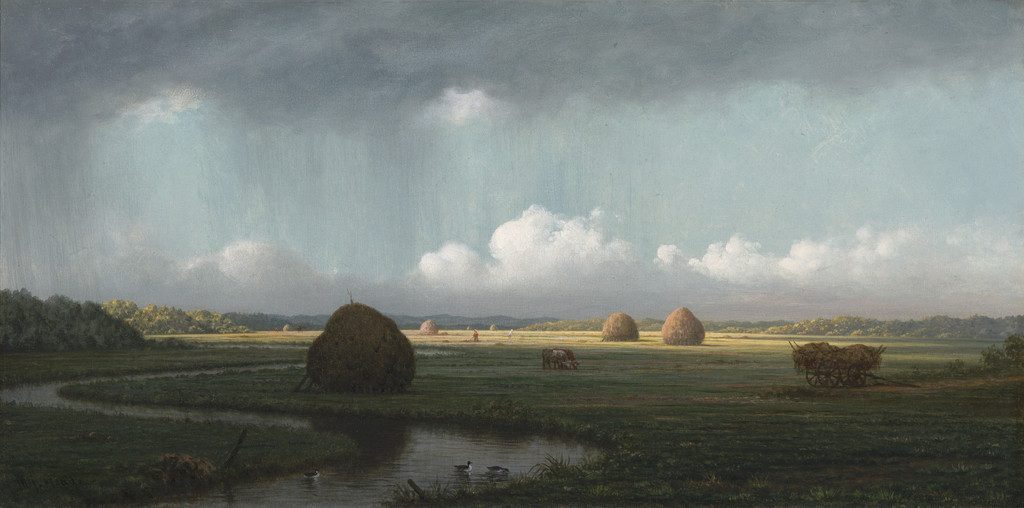
Sudden Shower, Newbury Marshes
c.1865–75View of Marshfield
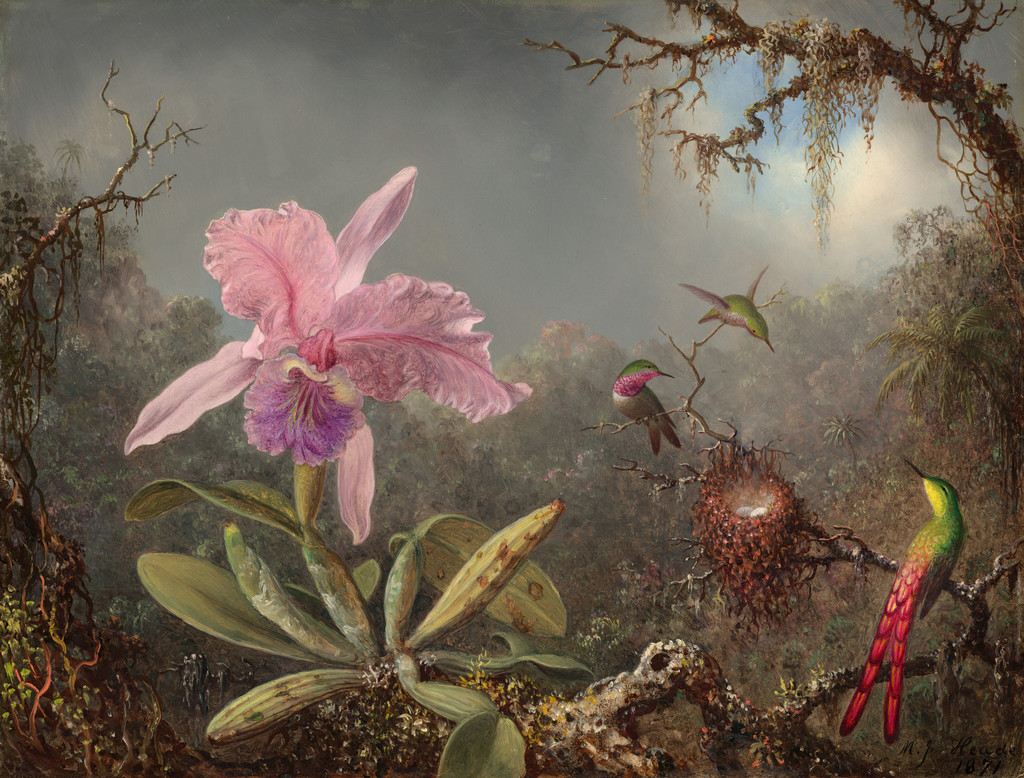
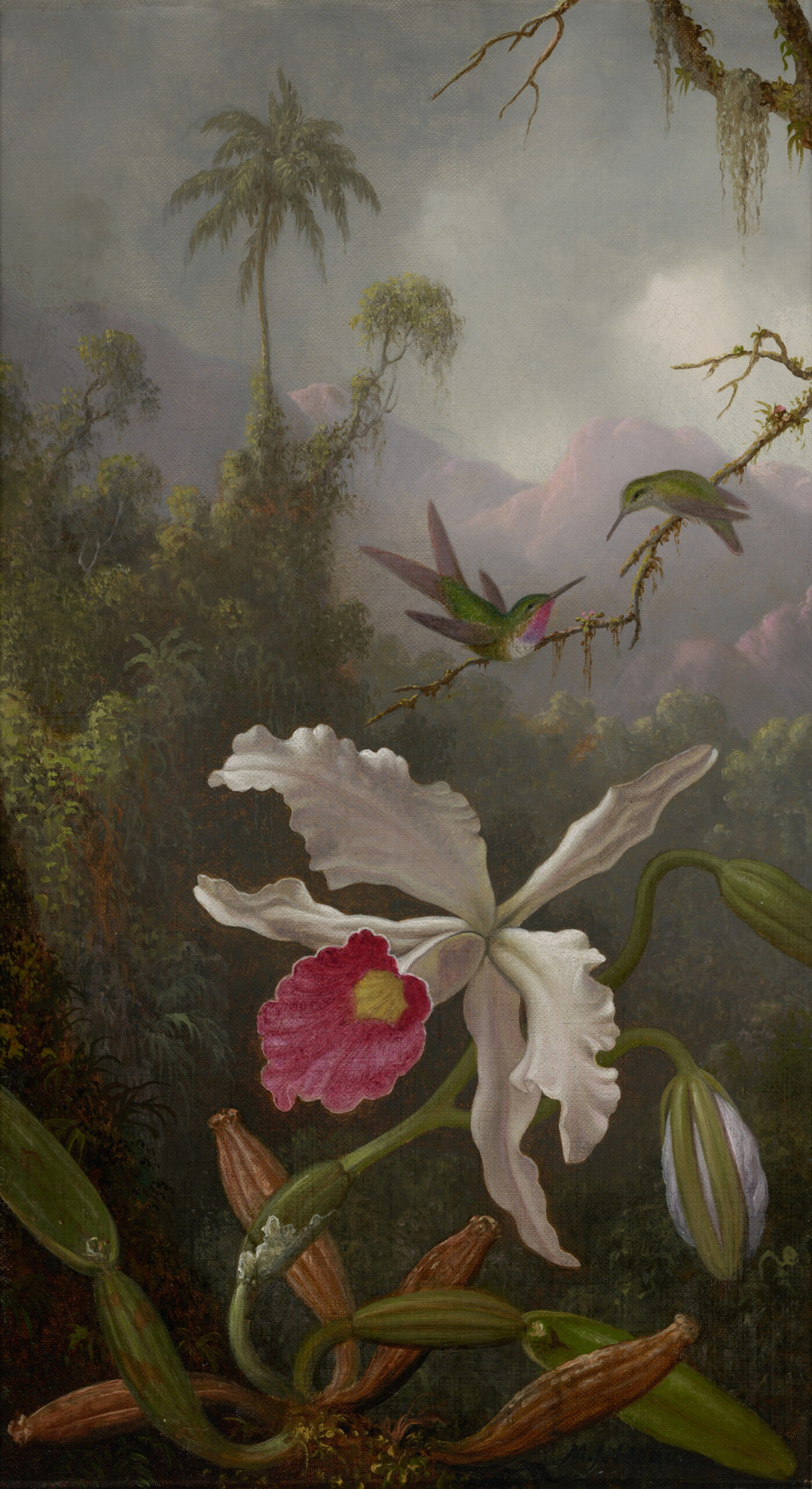
c.1866–76Hummingbird and Passionflowers
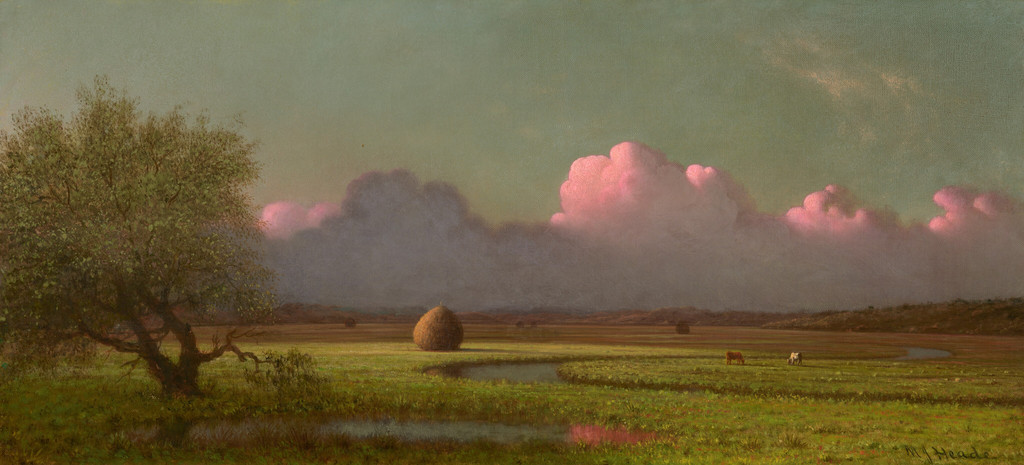
c.1875–85Newburyport Meadows
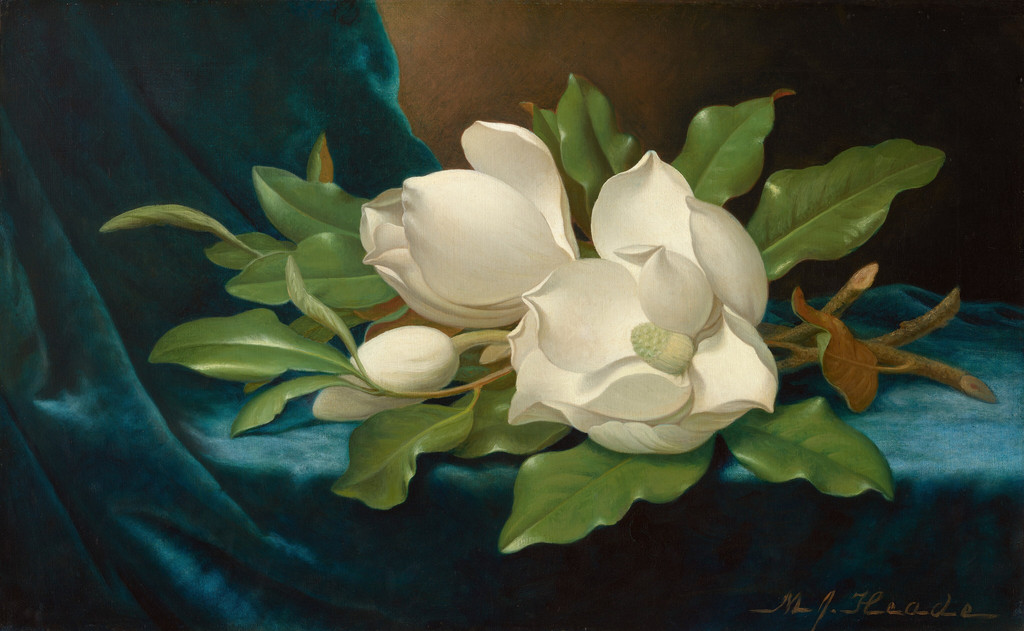
c.1876–81Magnolias on Light Blue Velvet Cloth
c.1885–95Contents
- The coast beneath the cloud
- Boats, a fisherman and ordinary work
- A lowered horizon and a revised foreground
- The Coming Storm and an uncertain exhibition history
- Storm paintings across three collections
- Weather and later historical readings
- Annotated details
The coast beneath the cloud
The cloud occupies a disproportionate amount of the picture. Land and water remain close to the lower edge, while a broad darkness spreads overhead. The darkest passages are not confined to one dramatic object: they connect the sky with the nearer bay, allowing the weather to affect the whole scene.
There is nevertheless a carefully graded distance. Near water appears almost black beside the buff and green shore. Farther away it lightens towards grey, meeting low hills whose silhouettes grow less emphatic as they approach the cloud. These changes allow the eye to travel out across the bay without finding a sharply separate bright background.
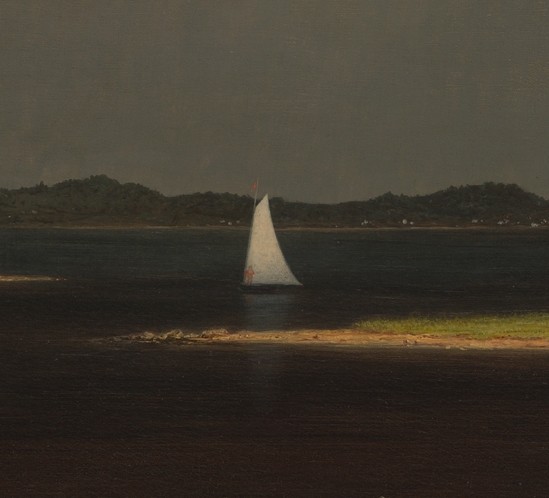
The lightning near the left horizon is small. Its importance comes from the limited pale accents surrounding it. A white sail nearer the centre offers another interruption, so a natural flash and a man-made object can be compared across the same dark field. Neither needs to dominate the canvas to register.
The Met identifies the coast as Narragansett Bay, Rhode Island, and connects the painting with a sketch of an approaching storm Heade witnessed from Prudence Island around 1858. Its current commentary also identifies the pale animal beside the seated man as his dog. This museum account gives the finished canvas a regional starting point without making every rock or distant hill a separately verified landmark.[1]
This balance matters to the sense of an approaching storm. The image does not present the full violence of breaking weather. Water remains broad and comparatively smooth, and the small vessels continue to occupy it. The dark sky changes how those ordinary elements feel before it visibly overturns their situation.
Annotated Details from Approaching Thunder Storm
The numbered points identify visible features discussed in this article. Return from each detail to the whole composition. Martin Johnson Heade, Approaching Thunder Storm, 1859. Metropolitan Museum of Art, 1975.160. Image source. CC0 / Public domain. Resized only; native appearance preserved.
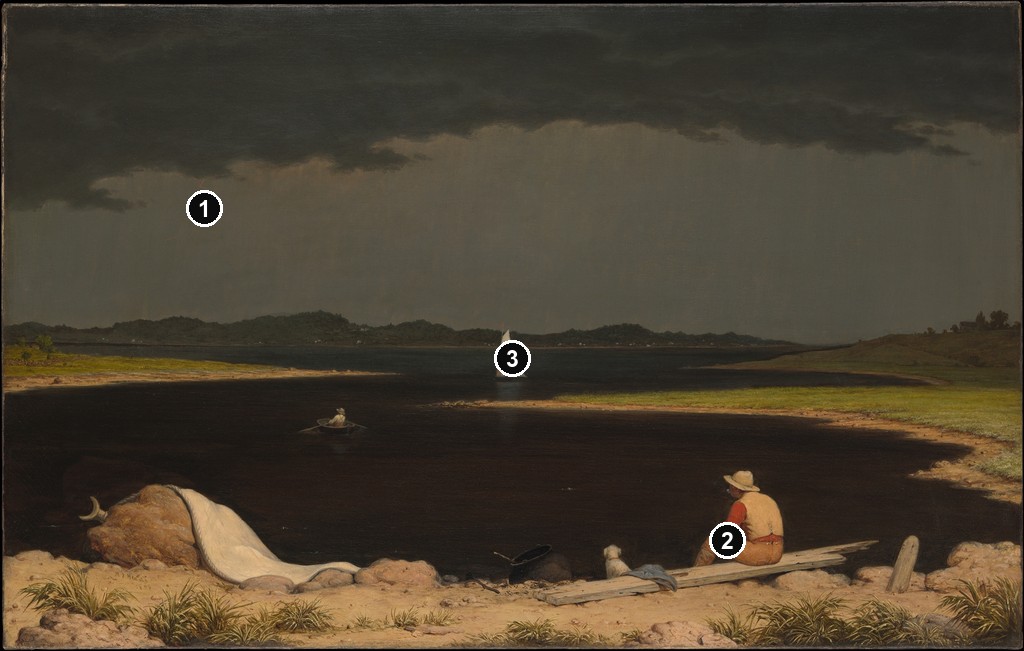
Details from APPROACHING THUNDER STORM
Compare the cropped details with the complete images above. Notice how their colours, shapes and positions contribute to the larger compositions.
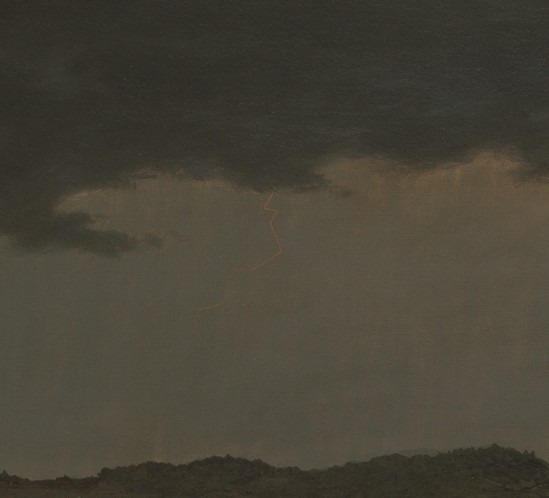
Lightning under the cloud
A narrow reddish zigzag descends beneath the dark cloud. Its slight scale contrasts with the much larger storm canopy.
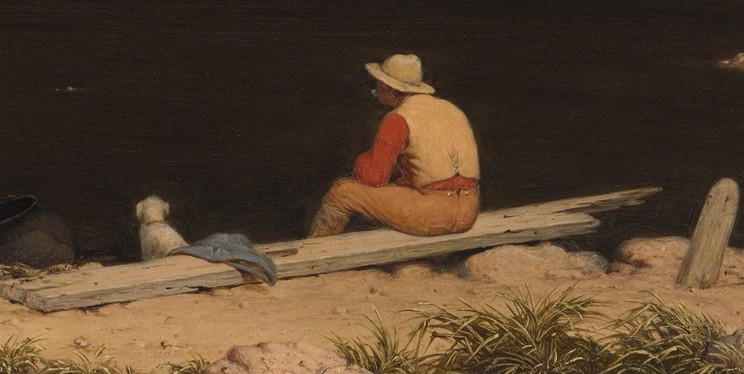
Seated shore figure
A red-sleeved figure sits on timber beside a dog and fishing equipment. These near forms establish a human scale for the broad water.
Pale central sail
A pale sail rises from the dark water beneath the distant shore. Its small light shape draws attention into the middle distance.
Boats, a fisherman and ordinary work
The seated figure on the right is turned towards the bay, giving the viewer a human counterpart within the picture. His position connects the foreground shore with the expanse beyond. He is close enough to be recognisable as a person, but too small to challenge the scale of the cloud.
Diana J. Strazdes’s entry in American Paradise identifies him as a fisherman and discusses the commonplace objects associated with this shoreline. The scene includes working boats and fishing equipment rather than a grand architectural landmark. Her account treats this relatively unadorned coast as a substantial choice within Heade’s landscape painting.[2]
The foreground is not uniformly bare. A pale cloth lies across rocks at the left, while timber and the seated figure occupy the right. These scattered objects help establish the shore as a place that people use. The cloth is especially noticeable because its lightness catches the eye before the viewer begins to follow the darker water.
The boats carry attention away from that near strip. A small rowboat lies offshore, and the brighter sail further out gives depth to the bay. Their scale changes with distance, allowing a broad space to remain legible with relatively few objects. Much of the centre is left open between them.
The fisherman’s stillness does not tell us exactly what he thinks. It offers a position from which to experience the weather. We can notice how his body faces the approaching darkness without assigning him a documented emotion, biography or symbolic role. The distinction preserves the figure’s usefulness to the composition while leaving his individual identity open.
A lowered horizon and a revised foreground
The painting’s simplicity was worked towards. Strazdes reports evidence of earlier forms beneath the visible composition: the hills were originally higher and more jagged, and the rock now on the shore had previously occupied the water. She explains the eventual result through the lowering of the hills and the movement of the rock towards the side.[2]
Those changes affect more than individual details. Higher hills would have created a stronger barrier along the horizon. A rock further into the water would have interrupted the open bay. Reducing those obstacles gives the sky and the water greater continuity, so the storm can be felt across a wider field.
The catalogue also draws attention to the bay’s nearly figure-eight shape, organised around the sailboat at anchor. This is a useful way to follow the alternating projections of land and open water. It does not require us to see a mathematically exact diagram; it describes how the shoreline directs attention through the middle of the painting.[2]
The reported earlier forms are historical examination evidence. A normal colour reproduction shows the final coastline and horizon clearly, but it does not independently demonstrate every underlying change. Looking at the image and reading the catalogue perform different tasks: one reveals the finished arrangement, while the other supplies evidence of how that arrangement developed.
This makes the painting valuable for understanding Heade’s method without inventing a universal recipe. Here, a composition was simplified through revision. That does not establish that all his coasts were painted in the same sequence, or that every apparently quiet surface conceals the same kind of change.
Watch: Martin Johnson Heade
Choose a film to explore the artist’s work, its interpretation and its wider setting.
Museum Minute: Heade Hummingbirds
A brief Shelburne Museum introduction to Heade’s hummingbird paintings.
Watch on YouTubeThe Coming Storm and an uncertain exhibition history
The Met now calls the painting Approaching Thunder Storm. Its 1987 catalogue entry calls the same accessioned canvas The Coming Storm. These titles should be treated as names attached to one object, not as evidence for two different pictures. The exact accession, 1975.160, anchors the identification.[1][2]
A further question concerns an exhibition entry titled Approaching Thunderstorm at the National Academy of Design in spring 1860. Strazdes considers the Met canvas a possible match, given its 1859 date and substantial size. She also records an earlier rejection of that identification, associated with Natalie Spassky’s catalogue work.[2]
The disagreement concerns whether the exhibited title refers to this particular surviving canvas. A matching subject and a plausible year do not settle that question. The 1860 exhibition can therefore be discussed as a possibility, while the current object’s date, medium and museum identity remain firmly stated.
This distinction also changes how early reception is handled. Comments about an exhibition entry should not automatically become comments about the Met picture if the identification is unresolved. Silence from critics is equally difficult to interpret: it could reflect the circumstances of an exhibition or the uncertainty of the surviving record.
The documented modern collection history is clearer. The Met received the painting in 1975 as a gift from the Erving Wolf Foundation and Mr. and Mrs. Erving Wolf, in memory of Diane R. Wolf. That credit establishes its entry into the present collection without filling gaps in earlier ownership with assumptions.[1]
Storm paintings across three collections
Heade returned to stormy coastal subjects, but similar titles need careful handling. The Amon Carter Museum’s Thunder Storm on Narragansett Bay is a separate painting dated 1868, accession 1977.17. Its broader shoreline, figures, boats and dramatic sky provide a later comparison rather than an alternative name for the Met canvas.[4]
The Museum of Fine Arts, Boston, has another large coastal storm, accession 45.889, discussed in the 1987 catalogue as Approaching Storm: Beach near Newport. That catalogue dates it around 1866–67; the later conservation study dates it around 1861–62. The date difference belongs to the Boston work and should not be transferred to the Met’s securely recorded 1859 canvas.[2][5]
Seeing these works together makes a recurring problem apparent: how much of a threatened coast should remain open, and how strongly should people and shore objects interrupt it? In the Met picture, relatively few objects occupy the central water. The scene’s breadth comes partly from what the final composition leaves unobstructed.
Heade’s York Harbor, Coast of Maine offers a quieter comparison. Its boats and reflections inhabit a similarly low coastal field, but the pale sky does not create the same looming ceiling. The comparison helps separate the use of a horizontal inlet from the particular meteorological pressure created here.
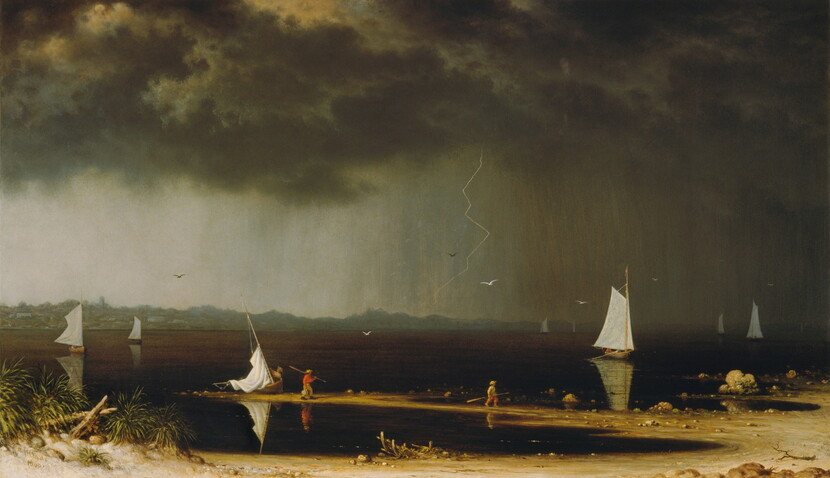
Martin Johnson Heade, Thunder Storm on Narragansett Bay, 1868. Oil on canvas. Amon Carter Museum of American Art, 1977.17. Image source. Public domain. Resized only; native appearance preserved.
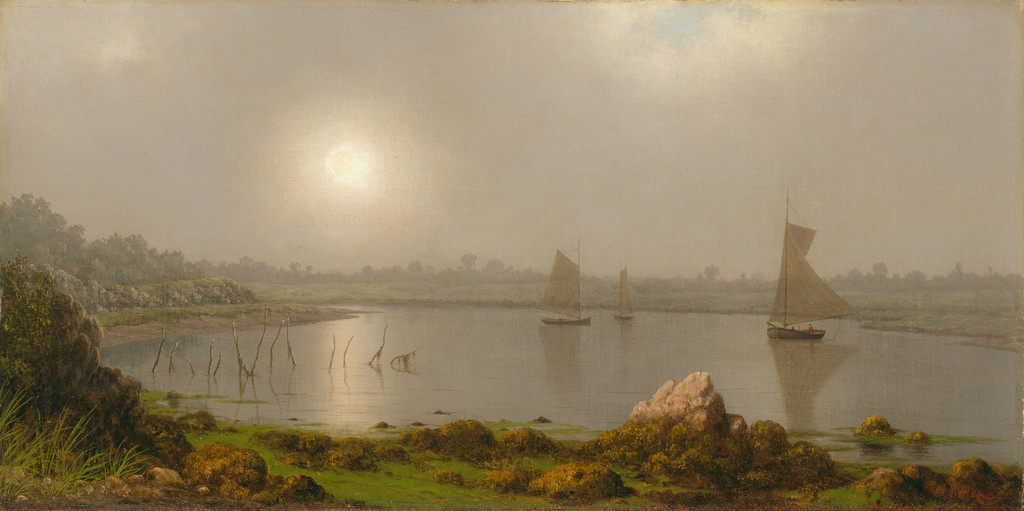
Martin Johnson Heade, York Harbor, Coast of Maine, 1877. Oil on canvas. Art Institute of Chicago, 1999.291. Image source. CC0 / Public domain. Resized only; native appearance preserved.
Weather and later historical readings
The date places Approaching Thunder Storm near Heade’s settlement in New York and his growing concentration on landscape. Franklin Kelly’s NGA biography identifies Frederic Edwin Church as a close friend and describes Heade’s interest in coastal light and atmospheric changes. This context connects the painting with an established direction in his career.[3]
Strazdes compares its expansive horizon with Church’s landscapes. That comparison is a scholarly explanation of a visual relationship, rather than documentary proof that Heade copied a particular Church canvas. The relatively plain shore and large open centre also give this painting a character of its own.[2]
Later storm pictures have invited readings connected with the Civil War and Reconstruction. The Carter’s current interpretation presents such associations as possibilities for its 1868 work. They should not be turned into a definite political programme for the Met painting, completed before the war, without separate evidence.[4]
The most immediate relationship remains between ordinary coastal life and extraordinary weather. Small boats, a seated fisherman and a spare shore are exposed to a cloud whose scale exceeds them. The revised horizon keeps that relationship open across the width of the canvas, allowing a few carefully placed forms to make the approaching change tangible.
Artworks directory
A collected selection of 26 individually identified museum paintings, including thirteen extended artwork studies. This is a bounded directory, rather than a complete catalogue raisonné. Two Boston entries retain dates from the 2002 conservation study. Links open a companion article where available, otherwise the cited institutional record or publication; unillustrated objects remain included.
Frequently Asked Questions
That identification is disputed. The catalogue considers it possible but records an earlier objection. It should not be presented as a certain event in this canvas’s exhibition history.[2]
Discussion
Look again at the images and ideas explored in Approaching Thunder Storm by Martin Johnson Heade. These editorial prompts invite your observations.
Reader Insights
How do the pale sail and dark cloud organise the coast?
What changes in the Carter1868storm or quiet York harbour?
What does the published X-ray account add to the final foreground?
Join the Conversation
Share a detail, comparison or question about Approaching Thunder Storm by Martin Johnson Heade below.
References
- Metropolitan Museum of Art, Approaching Thunder Storm, 1975.160. Current title, date, medium, dimensions and gift checked against the museum’s public collection API. View source
- Diana J. Strazdes, Heade entry in American Paradise: The World of the Hudson River School (Met, 1987), printed pp.164–165; related Boston storm entry pp.171–173. Original scans actually read; contributor initials verified at printed p.101. View source
- Franklin Kelly, Heade biography, American Paintings of the Nineteenth Century, Part I (NGA, 1996), printed pp.287–288. New York, Church and coastal painting context. View source
- Amon Carter Museum of American Art, Thunder Storm on Narragansett Bay, 1977.17. Distinct 1868 painting and qualified historical interpretation. View source
- Elizabeth Leto Fulton, Richard Newman, Jean Woodward and Jim Wright, “Methods and Materials of Martin Johnson Heade,” JAIC 41(2), 2002. Boston storm dating; this study is not an object-specific analysis of the Met canvas. View source
- Splash image source.
Martin Johnson Heade, Approaching Thunder Storm, 1859. Oil on canvas, 71.1 × 111.8 cm. Metropolitan Museum of Art, 1975.160. The Metropolitan Museum of Art. CC0 / Public domain. Resized only; native appearance preserved.
View source