by Tom Gurney
Tom Gurney BSc (Hons) is an art history expert with over 20 years experience
Email: tomgurney1@gmail.com / Phone: +44 7429 011000
Martin Johnson Heade Biography: Introduction
Martin Johnson Heade (1819–1904) built a long career across portraits, coastal landscapes, tropical birds and floral still lifes. He travelled repeatedly, maintained friendships with artists and natural-history enthusiasts, and eventually settled in St. Augustine. His later writing as Didymus adds another dimension: a painter supported by Florida’s resort economy could also criticise sporting excess and commercial destruction of wildlife. The paintings and the writing together reveal interests that overlapped throughout a changing life.[1][3][6]
At a Glance
- BornLumberville, Pennsylvania, 1819
- Original surnameHeed
- Early workPortraits; exhibited at PAFA in 1841 and the National Academy of Design in 1843
- New YorkEstablished in the late 1850s; friendship with Frederic Edwin Church
- Brazil1863–64, followed by other Central American and Caribbean journeys
- Marriage and settlementElizabeth Smith; St. Augustine, 1883
- Florida patronHenry Morrison Flagler
- Writing nameDidymus
- DiedSt. Augustine, 4 September 1904
Martin Johnson Heade in context
Bars show approximate historical periods. c. means circa (about).
Notes and sources
Hudson River School. Cole’s New York arrival and the Centennial frame this broad comparison. Kevin J. Avery, Metropolitan Museum of Art.
Luminism. c.1850–1875; later critical term. A later category for selected light and surface effects, rather than an organisation Heade joined. The period follows the American Light study cited by Porter. Charlotte M. Porter, Florida Museum.
Each bar runs from the artist’s birth to their death.
Asher Brown Durand
1796–1886 · Birth–death [22]Thomas Cole
1801–1848 · Birth–death [23]Martin Johnson Heade
1819–1904 · Birth–death [24]Frederic Edwin Church
1826–1900 · Birth–death [25]Notes and sources
Asher Brown Durand. Calendar comparison; separate documented relationships are described in the connections cards. Metropolitan Museum of Art.
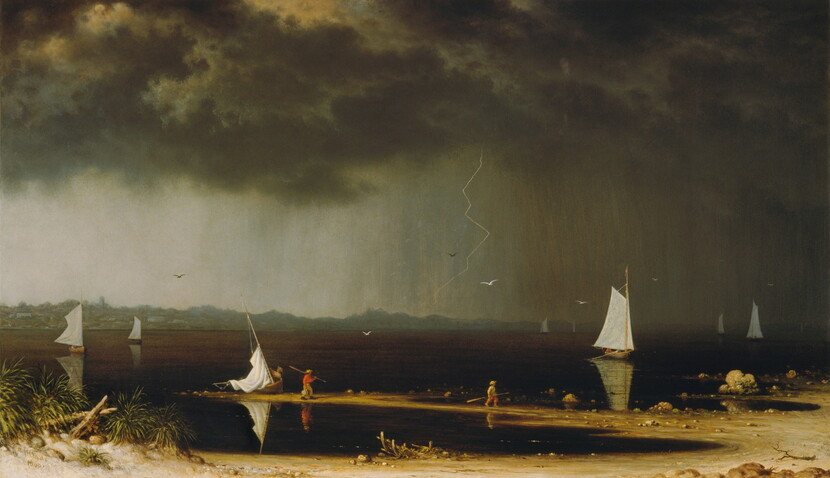
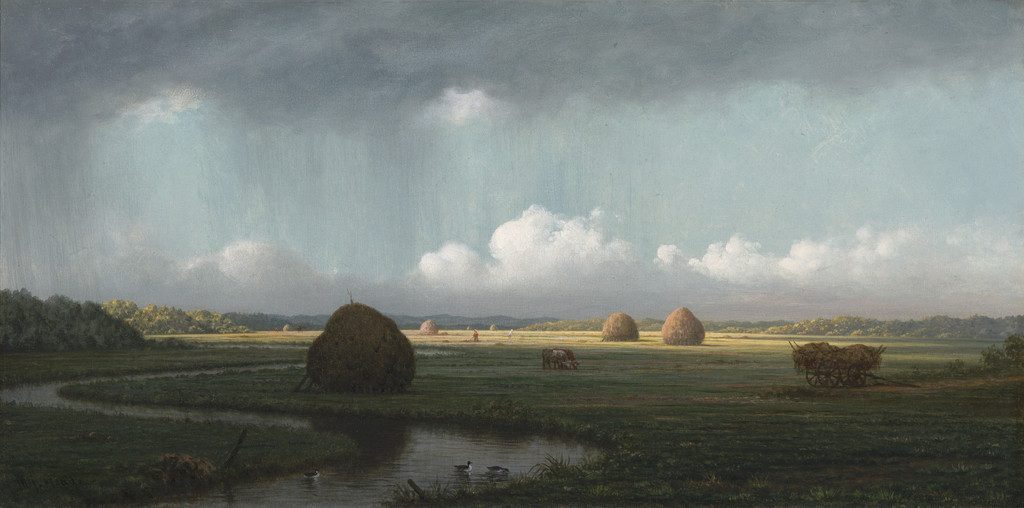
Sudden Shower, Newbury Marshes
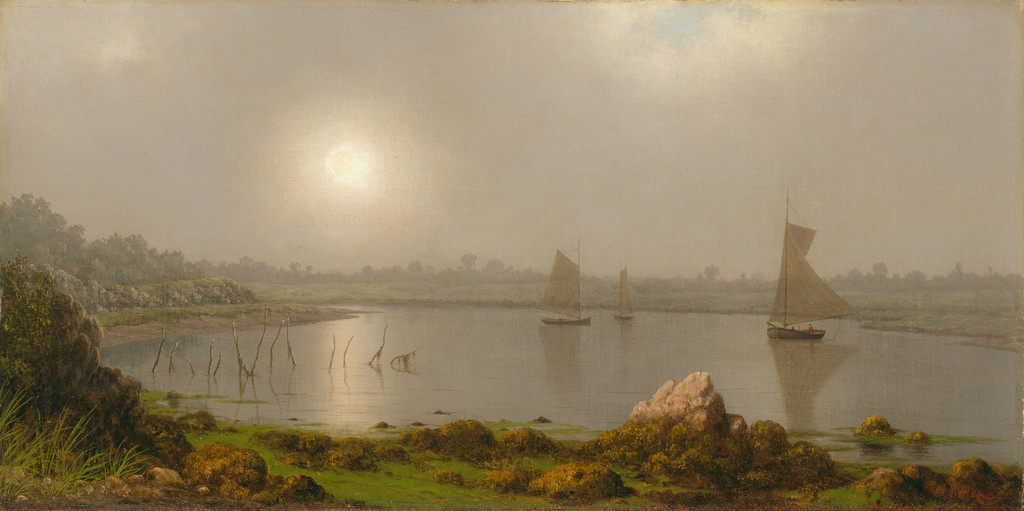
c.1865–75View of Marshfield
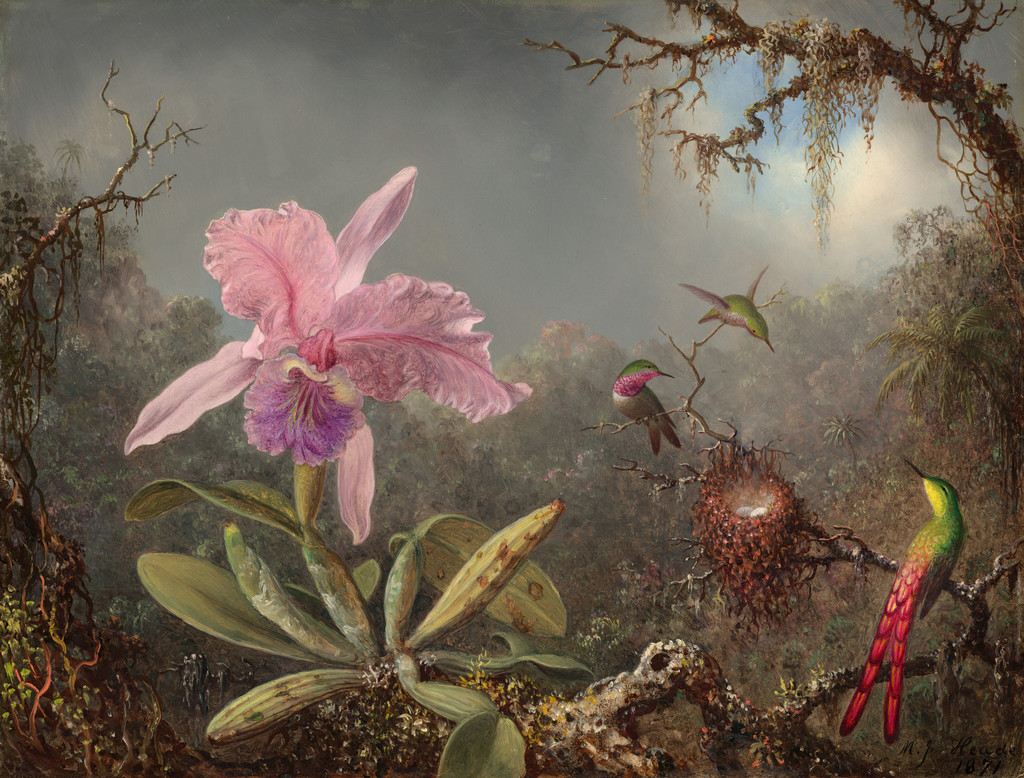
c.1866–76Hummingbird and Passionflowers
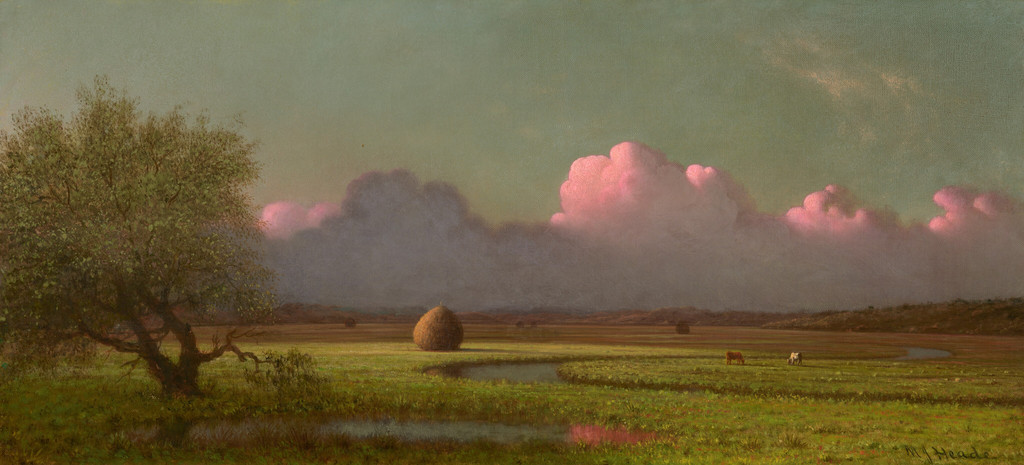
c.1875–85Newburyport Meadows
c.1876–81Magnolias on Light Blue Velvet Cloth
c.1885–95Contents
- Lumberville and the early training record
- Portrait exhibitions and an itinerant profession
- New York, Church and a wider artistic circle
- Coasts, marshes and the late 1850s landscape turn
- Flower painting before permanent Florida residence
- Brazil and the intended hummingbird book
- Further journeys and later studio compositions
- St. Augustine, Elizabeth Smith and Flagler
- Didymus and arguments about nature
- Annotated details
Lumberville and the early training record
Heade was born in Lumberville, Bucks County, Pennsylvania, in 1819, with the family surname originally spelled Heed. The rural setting belongs to the beginning of his life, although it should not be treated as a sufficient explanation for every landscape or natural-history interest that followed. Much of his professional development took place through later travel and changing artistic contacts.[1]
Edward Hicks, the Pennsylvania painter associated with Peaceable Kingdom subjects, is generally identified as an early teacher. Kelly’s NGA biography also raises possible instruction from Hicks’s younger cousin Thomas, a portrait painter. The conservation study describes the apprenticeship cautiously and finds no evidence of formal academic training. The relationship is useful context, with the precise extent of instruction left qualified.[1][10]
Early portraits supplied the first visible part of Heade’s professional activity. Their comparatively stiff handling differs from the complex paint effects developed later, but the difference records a changing practice rather than two unrelated careers. Painting faces, fabrics and interiors also placed him within a market for recognisable individual subjects.
The date of his first European journey remains uncertain. Kelly’s main account places it around 1838, while a note acknowledges an earlier scholarly dating to the early 1840s. A period in Rome is described in that account. The conflicting chronology should remain visible instead of being converted into an exact uninterrupted itinerary.[1]
Four stages of Martin Johnson Heade’s career
These periods group related developments; painting, travel and local work overlap across their boundaries.
Early training, exhibitions and travel
Qualified instruction in Pennsylvania, portrait exhibitions in 1841 and 1843, European travel and changing residence preceded the expanded landscape practice. [1]
Coastal weather and an intended bird book
New York friendships, coastal painting and the 1863–64 Brazilian journey brought broad marine views beside the small pictures intended for The Gems of Brazil. [1]
Marshes, birds and flowers together
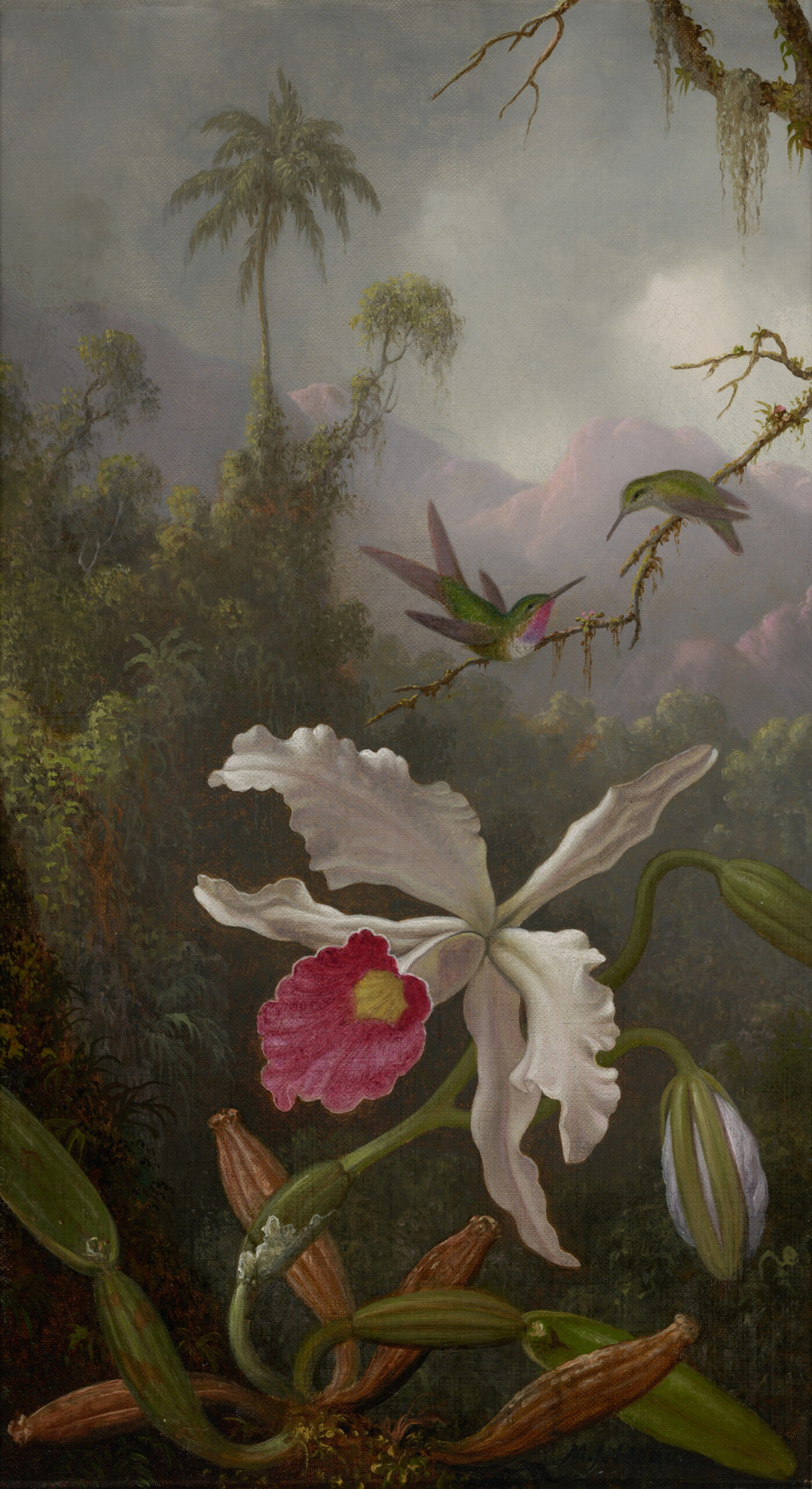
Journeys through Central America and the Caribbean continued alongside marshes, early floral arrangements and later bird-and-orchid compositions. [4]
Residence, patronage and later writing
Marriage to Elizabeth Smith and permanent Florida residence in 1883 introduced greater stability, Flagler’s support, cut magnolias and continuing landscape and tropical subjects. [1]
Annotated Details from Martin Johnson Heade Biography
The numbered points identify visible features discussed in this article. Return from each detail to the whole composition. The captions keep each work’s identity, date and medium separate.
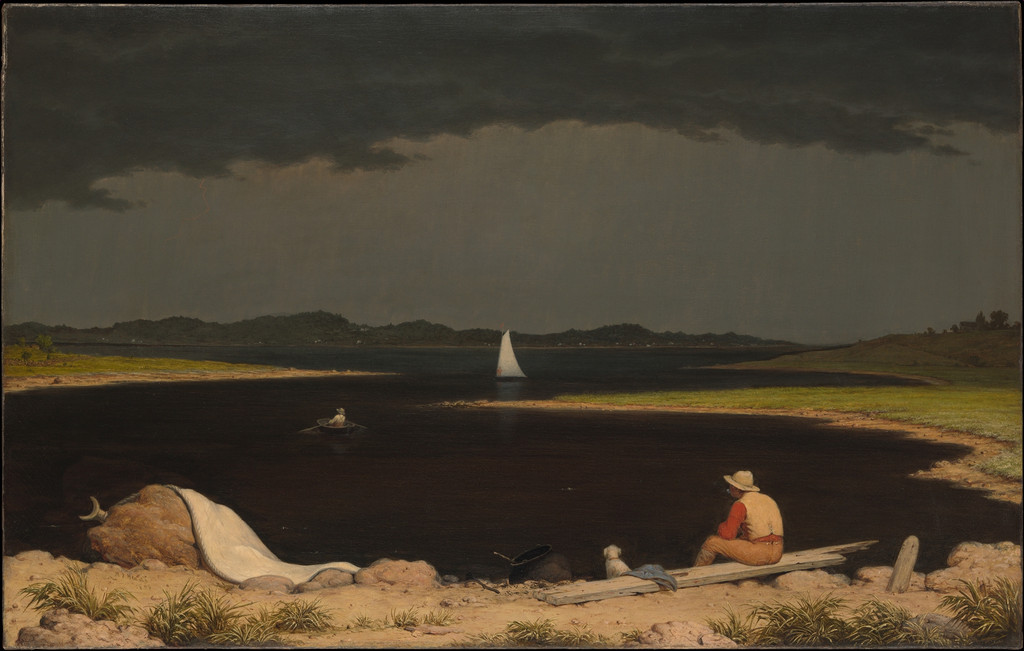
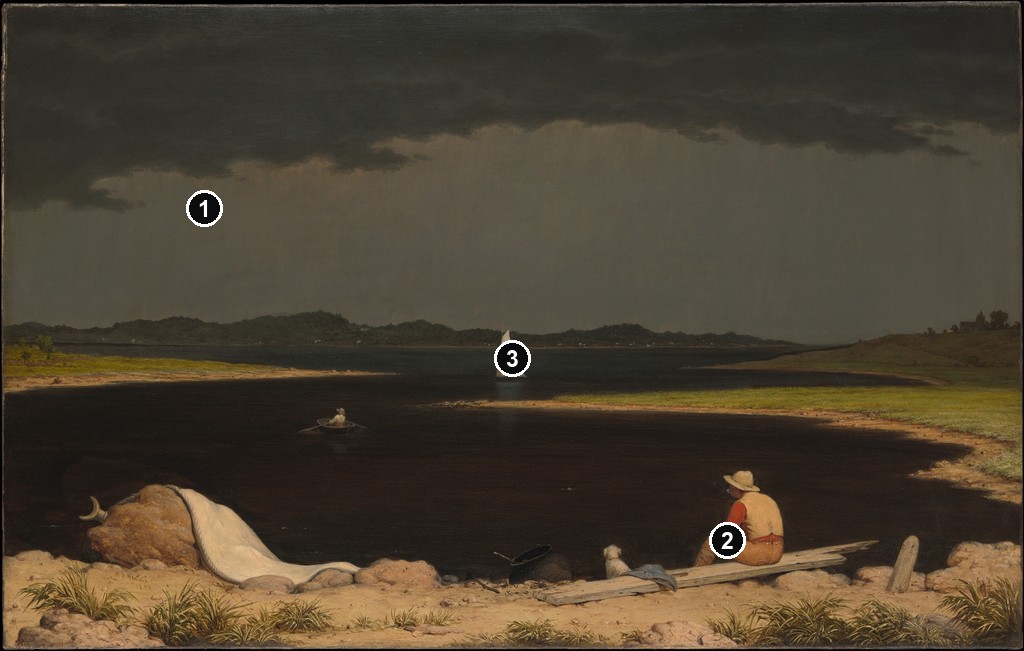
Approaching Thunder Storm
Martin Johnson Heade, Approaching Thunder Storm, 1859. Metropolitan Museum of Art, 1975.160. Image source. CC0 / Public domain. Resized only; native appearance preserved.
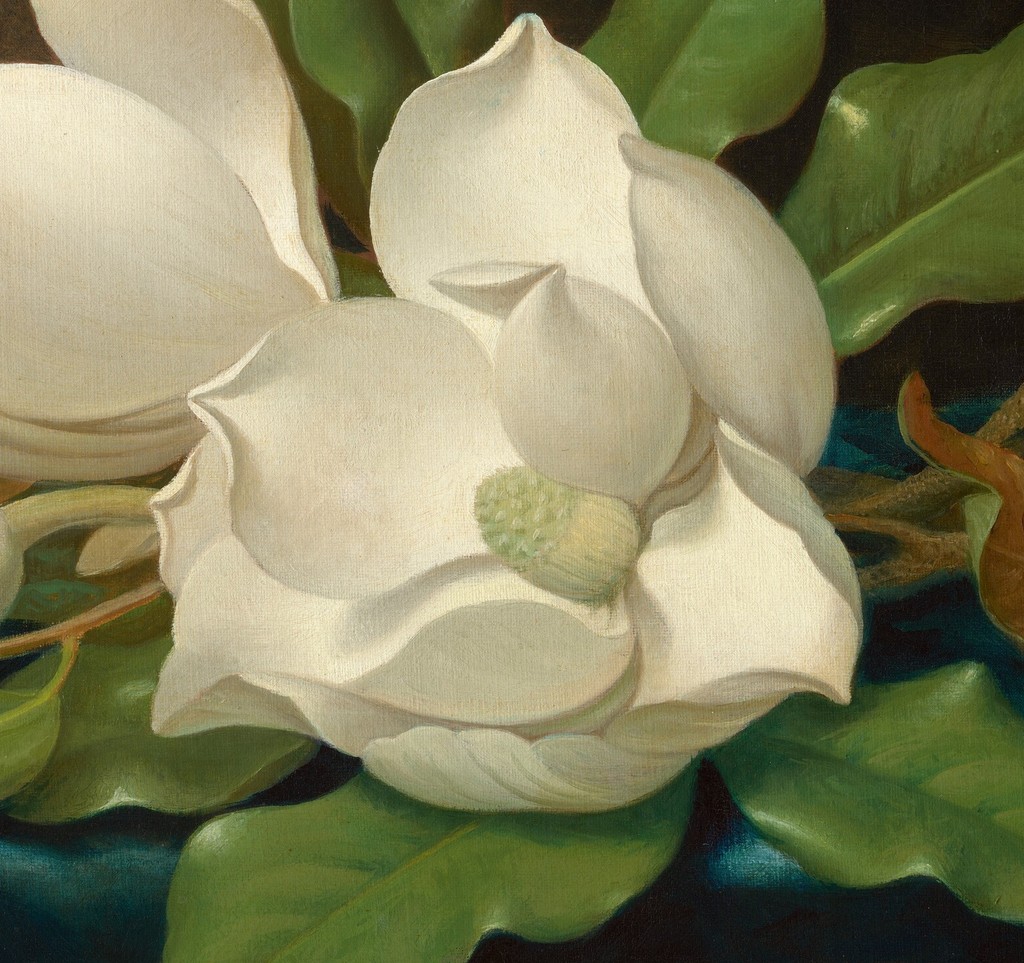
Giant Magnolias on a Blue Velvet Cloth
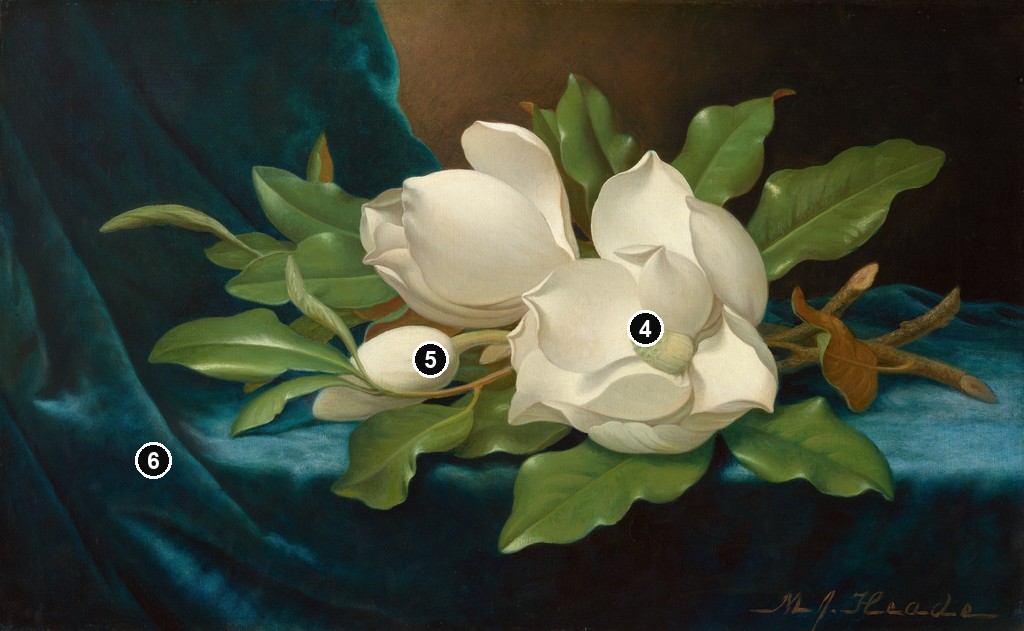
Martin Johnson Heade, Giant Magnolias on a Blue Velvet Cloth, c.1890. Oil on canvas, 38.4 × 61.5 cm. National Gallery of Art, 1996.14.1. Gift of The Circle of the National Gallery of Art in Commemoration of its 10th Anniversary; National Gallery of Art. Image source. CC0 / Public domain. Resized only; native appearance preserved.
Details from MARTIN JOHNSON HEADE BIOGRAPHY
Compare the cropped details with the complete images above. Notice how their colours, shapes and positions contribute to the larger compositions.
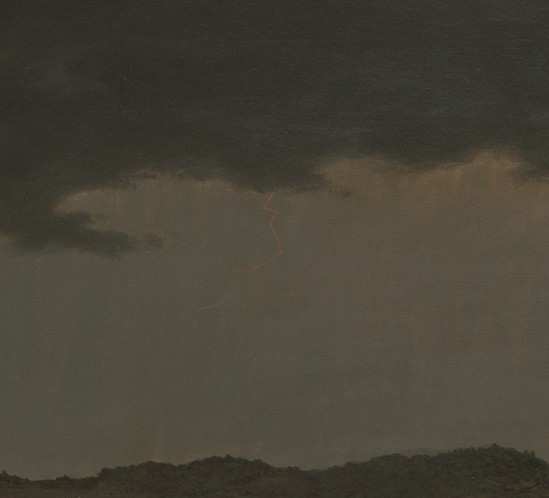
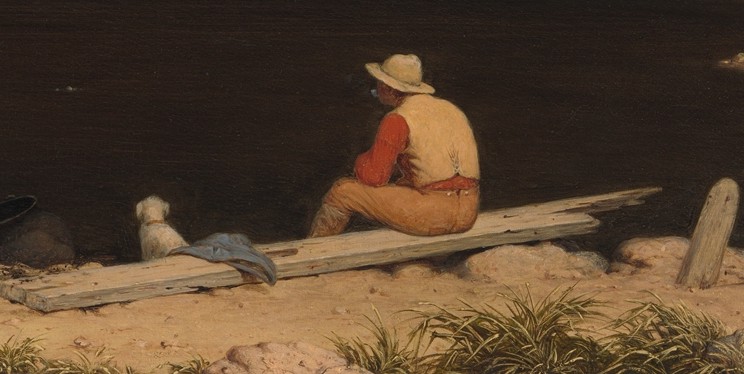
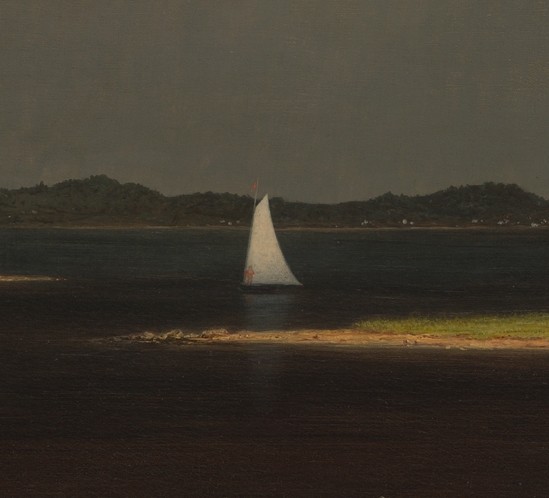
Approaching Thunder Storm
Lightning under the cloud
A narrow reddish zigzag descends beneath the dark cloud. Its slight scale contrasts with the much larger storm canopy.
Seated shore figure
A red-sleeved figure sits on timber beside a dog and fishing equipment. These near forms establish a human scale for the broad water.
Pale central sail
A pale sail rises from the dark water beneath the distant shore. Its small light shape draws attention into the middle distance.
Giant Magnolias on a Blue Velvet Cloth
Open magnolia centre
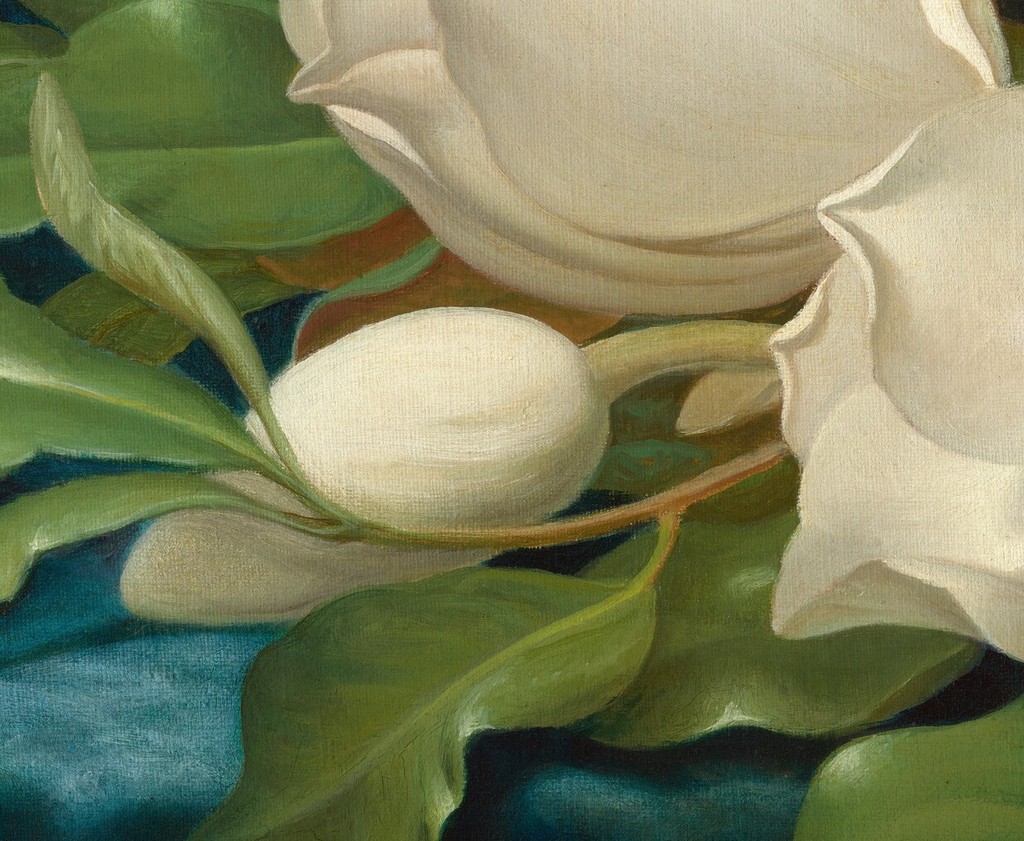
Pale petals surround the greenish centre of the open foreground magnolia. Their overlapping curves create depth within the bright flower.
Closed bud and leaves
A closed pale bud lies beside broader green leaves. Its rounded surface contrasts with the more open petals above.
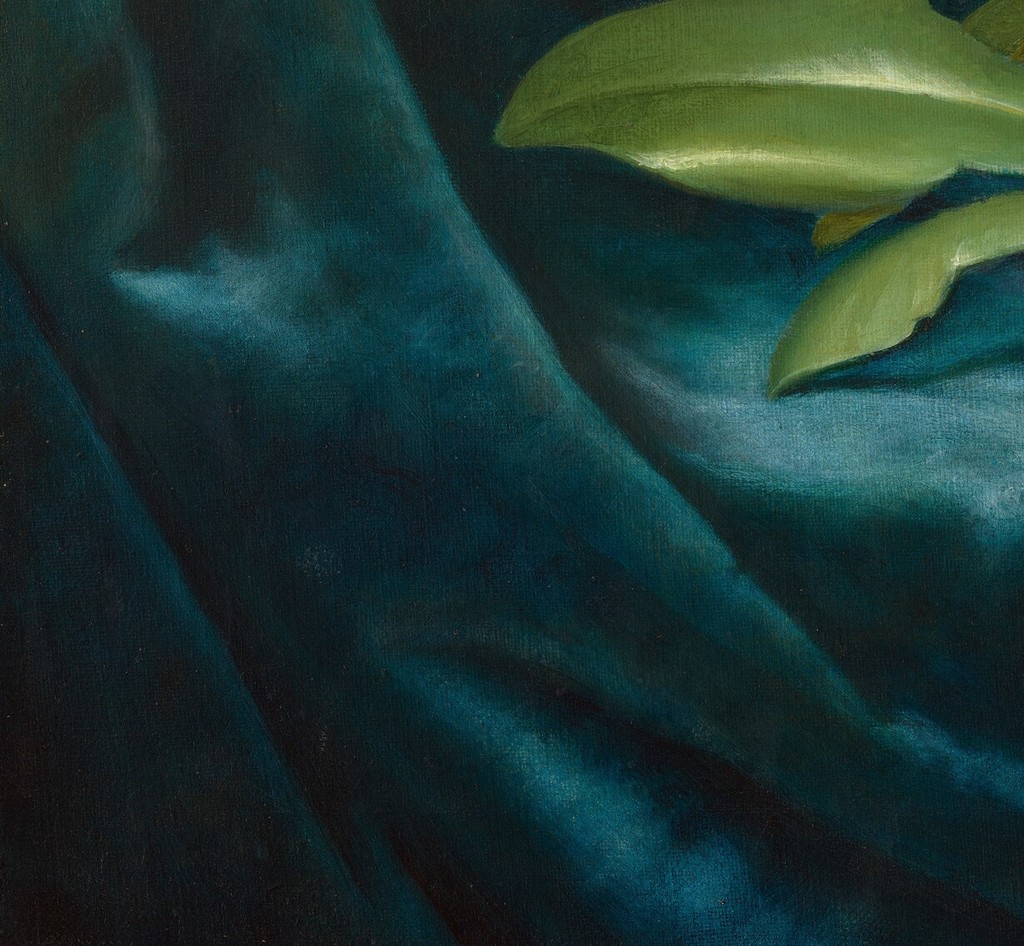
Blue cloth folds
Blue-green folds alternate between shadow and broad light. Their changes in tone support the flowers without becoming a flat background.
Portrait exhibitions and an itinerant profession
His professional debut is more firmly documented through exhibitions. Portrait of a Little Girl was accepted by the Pennsylvania Academy of the Fine Arts in 1841. A Portrait of a Young Lady appeared at New York’s National Academy of Design in 1843. Kelly records both, while identifying their locations as unknown.[1]
These exhibitions establish public activity without supplying surviving illustrated examples for every stage. A named picture in an old exhibition history may be important even when it cannot now be examined or matched securely to another work. The biography therefore relies on the documented events rather than substituting an unrelated portrait.
Porter dates the spelling change from Heed to Heade to 1846. The altered surname became the one familiar from the later paintings. It is a biographical change; the presence of either spelling alone does not establish the authenticity of an object.[3]
A further European visit in 1848 preceded more regular exhibiting, according to Kelly. Heade changed residence frequently during the late 1840s and early 1850s. Travel, commissions and professional opportunity formed a pattern that continued well beyond the early portrait years.[1]
By the mid-1850s he was experimenting with landscape. The move towards coast, weather and open space was gradual, and occasional portraits did not disappear immediately. The breadth of subjects later associated with him grew through additions to his practice rather than a single decisive conversion.
New York, Church and a wider artistic circle
Heade established himself in New York in the late 1850s. Accounts differ between 1858 and 1859, so the broader dating is appropriate. The Tenth Street Studio Building brought him into contact with artists whose interests included landscape, close observation and the changing effects of light.[1][2][10]
Frederic Edwin Church became a close friend. Church’s celebrated tropical panoramas offered a prominent example of painting connected with distant travel and natural-history interests. He encouraged Heade towards South American scenery, but their friendship did not make their approaches identical. Heade frequently concentrated on smaller subjects and more intimate spaces.[1]
Porter also identifies a friendship with F. O. C. Darley, the illustrator. Such connections broaden the picture of a working artist whose relationships extended beyond one famous landscapist. They help explain access to conversation and shared interests without requiring a documented collaboration on every canvas.[4]
Institutional acceptance was less secure. Kelly notes denial of membership in the Century Association and that Heade was never elected an associate of the National Academy. This is distinct from exhibiting at the Academy, which he had already done. Public participation and formal membership followed different paths.[1]
The resulting position was uneven: Heade could know influential artists and show accomplished pictures while remaining outside some institutions. It would be misleading to turn that unevenness into proof that he worked without an audience or professional contacts.
Coasts, marshes and the late 1850s landscape turn
The Met’s Approaching Thunder Storm, dated 1859, makes the landscape turn concrete. A broad cloud ceiling presses above comparatively still water, a pale sail and a seated shore figure with a dog. Weather becomes a major presence without requiring a dramatic mountain panorama.[11]
Salt marshes provided another sustained field of attention. Haystacks, winding channels, cattle and harvesting activity occur within wide views of changing light. The subjects are working coastal landscapes, and their carefully balanced appearances need not imply untouched wilderness.[2][9]
Heade returned to these motifs while varying the weather, arrangement and scale. View of Marshfield is dated 1866–76 in the NGA record; the Yale shower picture is dated c.1865–75. Their approximate ranges make them useful for understanding continuing practice rather than assigning every change to an exact year.[9][12]
People remained part of some later landscapes. The Met’s Newburyport Meadows, currently dated c.1876–81, includes harvesting figures and a loaded wagon. That visible example qualifies an older regional claim that human figures disappeared during the 1870s. Particular paintings are stronger evidence than a categorical account of the entire decade.[13]
Flower painting before permanent Florida residence
Floral still life was already developing beside landscape in the early 1860s. Brock’s NGA study examines Still Life with a Wine Glass, dated 1860, Roses and Heliotrope in a Vase on a Marble Tabletop, 1862, Apple Blossoms, 1867, and the mixed bouquet dated 1869. Their spread across the decade demonstrates an interest established well before settlement in St. Augustine.[16]
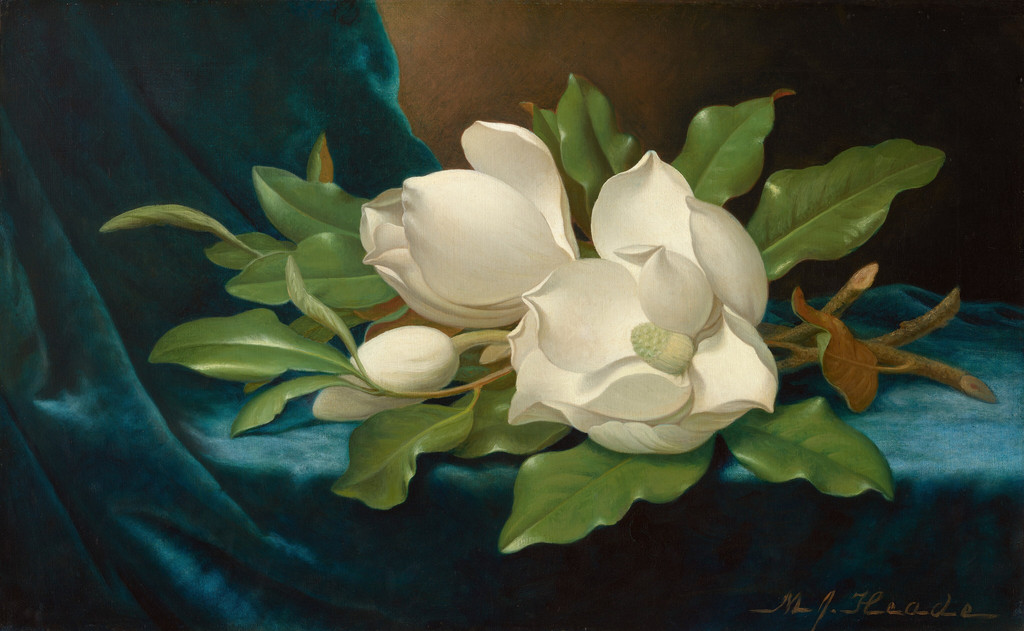
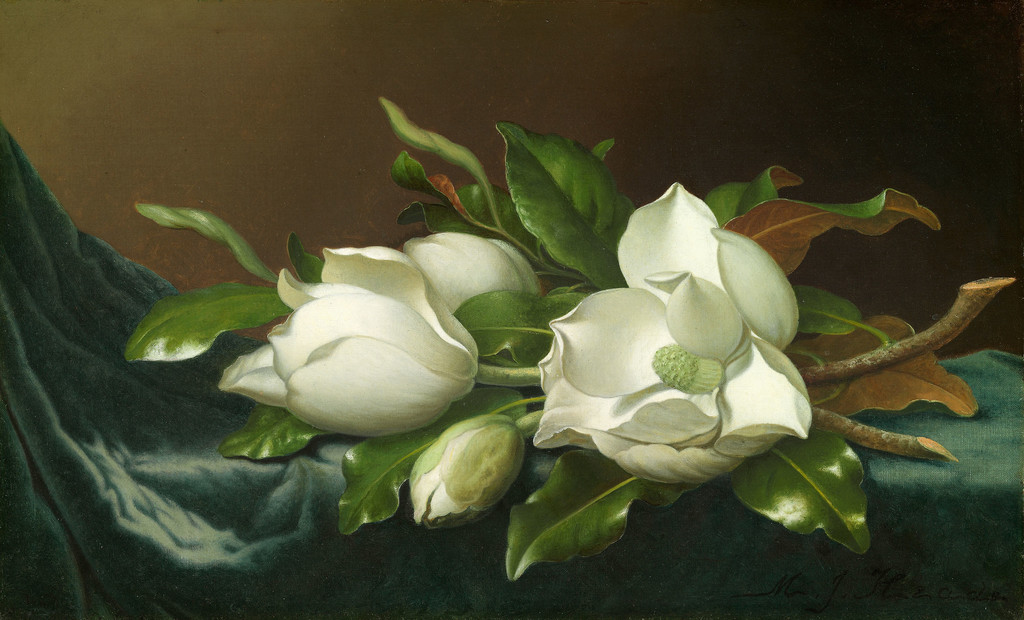
The settings also changed. A vessel, tabletop or dark backdrop gave the blossoms relationships different from those of a living orchid in a tropical foreground. Pale petals could be prominent against deep colour, while stems, leaves and containers organised the compact space. Later cut magnolias on velvet developed another form within this continuing floral practice.
The four early works appeared in the older study in the context of private collecting. The NGA’s current listing now gives them individual 2025 accession numbers. Their institutional history has therefore continued to change after the publications used to describe them.[17]
Brock also considers connections between still life and coastal painting, including white flowers against dark settings and white sails against weather. That comparison helps explain how Heade could work across subjects without abandoning an interest in bright forms, carefully chosen backgrounds and balanced surfaces. It is a scholarly account of pictorial relationships, rather than evidence that every flower arrangement carried an identical meaning.[16]
Brazil and the intended hummingbird book
Heade travelled to Brazil in 1863–64. Hummingbirds were central to an ambitious publication he planned as The Gems of Brazil: small paintings were to become colour illustrations accompanied by his own text. The project connected painting, observation and the market for lavish natural-history books.[1][8]
Imperial support mattered. The Carter Museum’s account describes twelve paintings displayed under the patronage of Pedro II. Heade’s relationship with this audience belongs to the Brazilian episode, rather than proving that all his later bird-and-orchid pictures were imperial commissions.[14]
The intended book was not completed. That outcome should be distinguished from an absence of printed experiments: trial chromolithographs survive. The later study by Cynthia Haveson Veloric examines four trial compositions and the unresolved printer attribution.[8]
Painting and reproduction presented different problems. A small oil picture could build colour through its own layers, while a printed illustration required another means of rendering fine distinctions. Kelly discusses difficulties achieving the desired colour effects. The incomplete publication was one episode within an artistic interest that continued for decades.[1]
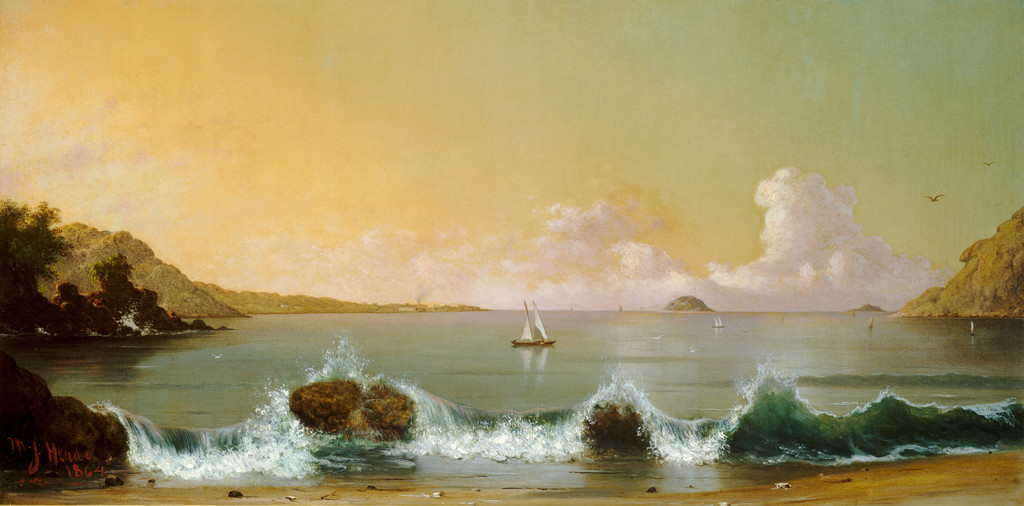
Brazil also produced coastal landscapes. The NGA’s Rio de Janeiro Bay, signed and dated 1864, contrasts near surf with quieter water and mountainous distance. It demonstrates that the journey’s pictorial results extended beyond the intended bird series.[1]
Martin Johnson Heade, Rio de Janeiro Bay, 1864. Oil on canvas, 45.5 × 91.1 cm. National Gallery of Art, 1965.2.1. Gift of the Avalon Foundation; National Gallery of Art. Image source. CC0 / Public domain. Resized only; native appearance preserved.
Watch: Martin Johnson Heade
Choose a film to explore the artist’s work, its interpretation and its wider setting.
Museum Minute: Heade Hummingbirds
A brief Shelburne Museum introduction to Heade’s hummingbird paintings.
Watch on YouTubeFurther journeys and later studio compositions
Porter distinguishes three tropical routes: Brazil in 1863–64, Nicaragua and Colombia in 1866, and Colombia, Panama and Jamaica in 1870. These were three Latin American and Caribbean journeys, rather than three visits to Brazil. Their separation helps explain the range of locations represented in later pictures.[4]
The date of a journey need not be the date of a finished painting. Strazdes describes Brazilian Forest, dated 1864, as completed in London after the Brazilian visit. Studies and remembered vegetation could contribute to pictures developed elsewhere. Travel, observation and execution are related stages, with their own evidence.[2]
The Fern-Tree Walk offers another chronological distinction. Its usual c.1870 dating relates it to Jamaican material, while a signature dated 1887 is associated in the catalogue with Flagler’s later purchase. That signature should not become evidence of a new 1887 Jamaican journey.[2]
Bird-and-orchid compositions became especially important in the 1870s. The NGA’s 1871 Cattleya panel combines one large flower, three birds, a nest and two eggs with a receding landscape. Its compact format makes a different encounter with tropical nature from the wide harbour canvas.[1]
Porter discusses botanical and ornithological observation alongside specimens, writing and composed settings. This combination explains why a detailed image need not record one exact outdoor encounter. Nor does proximity between a hummingbird and a particular orchid establish that the bird pollinates that species.[4]
St. Augustine, Elizabeth Smith and Flagler
In 1883 Heade married Elizabeth Smith and settled permanently in St. Augustine, following earlier Florida visits. Kelly interprets the move as the beginning of greater domestic and professional stability. Porter adds details of the household and local property interests.[1][5]
Henry Morrison Flagler became an important patron, buying and commissioning paintings. His hotel developments also provided a setting in which artists could meet visitors, display work and teach. This relationship linked Heade’s later production to the growth of Florida tourism.[1][5]
The Ponce de Leon Hotel opened in 1888, as Flagler College’s institutional history records. The historical parlour card used here shows that hotel in 1895. Its furnishings and paired stereoscopic views establish a period interior, without identifying the image as Heade’s studio.[7][15]
The Florida years included marsh and swamp scenes, magnolias and continuing tropical pictures. Cut flowers on velvet became a major later interest, but they did not replace all other subjects. Giant Magnolias on a Blue Velvet Cloth, c.1890, belongs to this overlapping late practice.[1]
The Thyssen’s Orchid and Hummingbird near a Mountain Waterfall, dated 1902, supplies a firmly dated example of the continued tropical interest close to the end of his life. Katherine E. Manthorne’s entry considers its botanical foreground and distant setting. The interval since Brazil is substantial, yet the bird-and-flower combination remained productive within a settled later career.[18]
Flagler’s support supplied a sustained professional connection, while individual pictures followed differing collecting histories. Patronage helps explain the period without making every later canvas a commission for the same buyer.
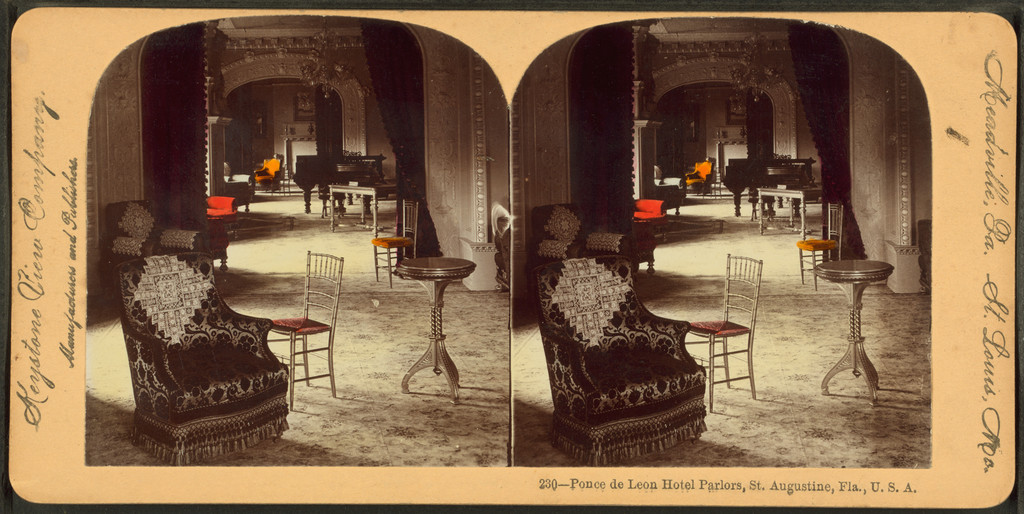
Ponce de Leon Hotel parlours, St. Augustine, 1895. Historical stereoscopic card, New York Public Library, Robert N. Dennis collection. Hotel context; no Heade studio or installation is identified. Image source. Public domain / PD-US-expired; PD-scan. Resized only; complete stereoscopic card retained.
Martin Johnson Heade, Giant Magnolias on a Blue Velvet Cloth, c.1890. Oil on canvas, 38.4 × 61.5 cm. National Gallery of Art, 1996.14.1. Gift of The Circle of the National Gallery of Art in Commemoration of its 10th Anniversary; National Gallery of Art. Image source. CC0 / Public domain. Resized only; native appearance preserved.
Didymus and arguments about nature
Heade’s letters and articles in Forest and Stream appeared under the name Didymus. Porter’s study describes interests in game management, outdoor observation and the consequences of commercial killing. This writing gives the later biography a voice beyond the images.[3][6]
His position was not opposition to all hunting. He remained involved in sporting life while criticising excessive catches, private monopolies and destructive trade. The distinction matters because it places the arguments within the practices and conflicts of his own audience.[5][6]
Porter discusses concern about the plume trade and market shooting, along with support for management and enforcement. The environmental consequences of luxury and commercial demand were therefore part of his later concerns, even as wealthy visitors and patrons sustained his art.[6]
Those tensions do not make every flower picture a coded policy statement. Paintings, natural-history interests and sporting arguments shared a life, but an individual canvas still needs its own evidence before a particular political meaning is assigned to it.
The magazine writings are known here through the museum’s later transcription and bibliography. They extend the available biographical material beyond an older suggestion that little written evidence survived. Their historical arguments can be paraphrased without pretending that every original magazine page has been independently consulted.[2][6]
Death and the recovery of the career
Heade died in St. Augustine on 4 September 1904. Kelly describes diminished wider attention by the end of his life, followed by renewed interest during the revival of American painting from the 1940s. His reputation was therefore shaped by later collecting and scholarship as well as by contemporary response.[1]
Another recovery came in 1981, when sixteen small hummingbird paintings were rediscovered in England. Their relationship with the larger intended Gems publication has to be studied carefully: the rediscovered group, the original project and proposed ownership associations are not interchangeable categories.[8]
Technical research added a further perspective. The MFA project that began in 1996 examined materials, drawing and revision across fifty paintings. It showed varied paint handling and posed new questions about repeated motifs. Study of the physical objects extended the biography beyond a sequence of exhibitions and journeys.[10]
The resulting career is best understood through continuing interests. Marshes persisted beside tropical subjects; floral paintings developed before permanent Florida residence; sporting writing coexisted with patronage. Following those overlaps gives Heade’s long life a more convincing shape than dividing it into completely separate artistic identities.
Artworks directory
A collected selection of 26 individually identified museum paintings, including thirteen extended artwork studies. This is a bounded directory, rather than a complete catalogue raisonné. Two Boston entries retain dates from the 2002 conservation study. Links open a companion article where available, otherwise the cited institutional record or publication; unillustrated objects remain included.
Frequently Asked Questions
It was originally Heed. Porter dates the spelling change to 1846.[3]
The reviewed regional account distinguishes Brazil in 1863–64 from later journeys through Nicaragua, Colombia, Panama and Jamaica.[4]
Didymus was Heade’s writing name in Forest and Stream, where he discussed wildlife and sporting practices.[6]
Discussion
Look again at the images and ideas explored in Martin Johnson Heade Biography. These editorial prompts invite your observations.
Reader Insights
Which dated painting makes a change in the career clearest?
How do early bouquets compare with late magnolias?
What does separating travel, signature and completion dates add to the life story?
Join the Conversation
Share a detail, comparison or question about Martin Johnson Heade Biography below.
References
- Franklin Kelly, American Paintings of the Nineteenth Century, Part I, NGA, 1996, printed pp.287–298. Biography, uncertain first European dating and exact Rio, Cattleya and magnolia entries. View source
- Diana J. Strazdes, Heade entries, American Paradise, Met, 1987, printed pp.163–178. Landscape development, Forest and Fern-Tree Walk; historical dates and evidence limitations retained. View source
- Charlotte M. Porter, Florida Museum, Martin Johnson Heade. Biographical introduction, spelling change and literary identity. View source
- Porter, “Visual Interests”. Distinct tropical routes, Darley friendship and botanical observation; categorical disappearance of figures qualified through the Met picture. View source
- Porter, “Florida Interests”. Elizabeth Smith, residence, local interests and studio audiences; hotel opening corrected through institutional history. View source
- Porter, Didymus / Forest and Stream essay. Sporting, trade and conservation arguments, paraphrased through later museum transcription. View source
- Flagler College, Hotel Ponce de Leon becomes Flagler College. Institutional 1888 opening chronology. View source
- Cynthia Haveson Veloric, “Hummingbirds, Emperors, and Railway Barons: Heade’s Gems and their Journeys,” Nineteenth Century 36(2), Fall 2016, printed pp.17–23. Intended publication, rediscovered paintings and trial chromolithographs; printer and ownership uncertainty. View source
- Sarah Cash, Corcoran Collection: American Paintings to 1945, printed pp.130–131 and notes p.266. Marshfield and the working landscape. View source
- Elizabeth Leto Fulton, Richard Newman, Jean Woodward and Jim Wright, “The Methods and Materials of Martin Johnson Heade,” JAIC, 2002. Training qualification, study sample and technical development. View source
- Met, Approaching Thunder Storm, 1975.160. Current 1859 identity and object record. View source
- Tim Barringer, Object Lessons: American Painting at Yale, printed pp.1–17. Shower picture, c.1865–75 dating and collection identity. View source
- Met, Newburyport Meadows, 1985.117. Current c.1876–81 dating; complete picture retains harvesting figures. View source
- Elizabeth Neely, Amon Carter Museum, An Orchid, an Emperor and Hummingbirds. Imperial support and twelve-picture display. View source
- Wikimedia Commons / NYPL, Ponce de Leon Hotel Parlors, 1895. Exact stereoscopic card and source record. View source
- Charles M. Brock, American Masters from Bingham to Eakins: The John Wilmerding Collection, NGA, 2004, printed pp.67–74. Early still lifes and relationships between floral and coastal pictures. View source
- NGA, current Martin Johnson Heade collection listing. Four early still-life records with 2025 accession numbers; current identities distinguished from older ownership. View source
- Katherine E. Manthorne, Thyssen, Orchid and Hummingbird near a Mountain Waterfall, CTB.1979.44. Exact 1902 work and continuing tropical practice. View source
- Splash image source.
Martin Johnson Heade, Approaching Thunder Storm, 1859. Oil on canvas, 71.1 × 111.8 cm. Metropolitan Museum of Art, 1975.160. The Metropolitan Museum of Art. CC0 / Public domain. Resized only; native appearance preserved.
View source - Kevin J. Avery, “The Hudson River School”, Metropolitan Museum of Art (2004). Origins in 1825 and decline in the 1870s–1880s; c. 1825–1880 is an approximate comparative range. View source
- John Wilmerding et al., American Light: The Luminist Movement, 1850–1875 (National Gallery of Art, 1980). A retrospective historical category. View source
- Smithsonian American Art Museum, Asher Brown Durand: 1796–1886. Artist life dates. View source
- Smithsonian American Art Museum, Thomas Cole: 1801–1848. Artist life dates. View source
- National Gallery of Art, Martin Johnson Heade: 1819–1904. Artist life dates. View source
- Amon Carter Museum of American Art, Frederic Edwin Church: 1826–1900. Artist life dates. View source