 by Tom Gurney
Tom Gurney BSc (Hons) is an art history expert with over 20 years experience
Email: tomgurney1@gmail.com / Phone: +44 7429 011000
Sunlight and Shadow: The Newbury Marshes by Martin Johnson Heade: Introduction
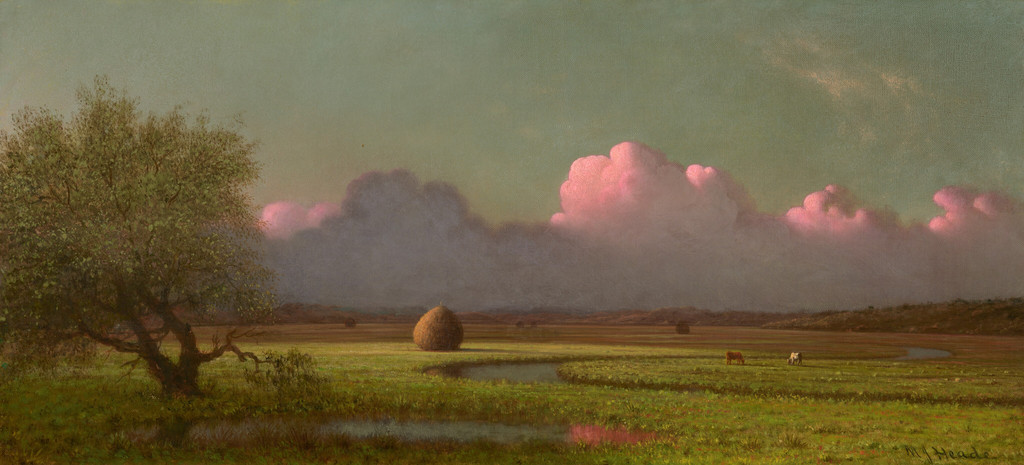
Martin Johnson Heade’s Sunlight and Shadow: The Newbury Marshes balances a leaning apple tree and a sunlit haystack against open wetland, cattle and pink clouds. The effect looks carefully settled, but a published infrared examination shows that Heade changed the stack’s position while painting. Dated approximately 1871–75, this small, wide canvas belongs to the National Gallery of Art. Its composition and documented revision make it a particularly useful example of the relationship between observed marshland and studio construction.[1][2]
At a Glance
- ArtistMartin Johnson Heade (1819–1904)
- TitleSunlight and Shadow: The Newbury Marshes
- Datec.1871–75
- MediumOil on canvas
- Dimensions30.5 × 67.3 cm
- CollectionNational Gallery of Art
- Accession2010.74.1
- Documented revisionA haystack moved forward and left, identified through infrared reflectography
This work across Martin Johnson Heade’s career
Sudden Shower, Newbury Marshes
c.1865–75View of Marshfield
c.1866–76Hummingbird and Passionflowers
c.1875–85Newburyport Meadows
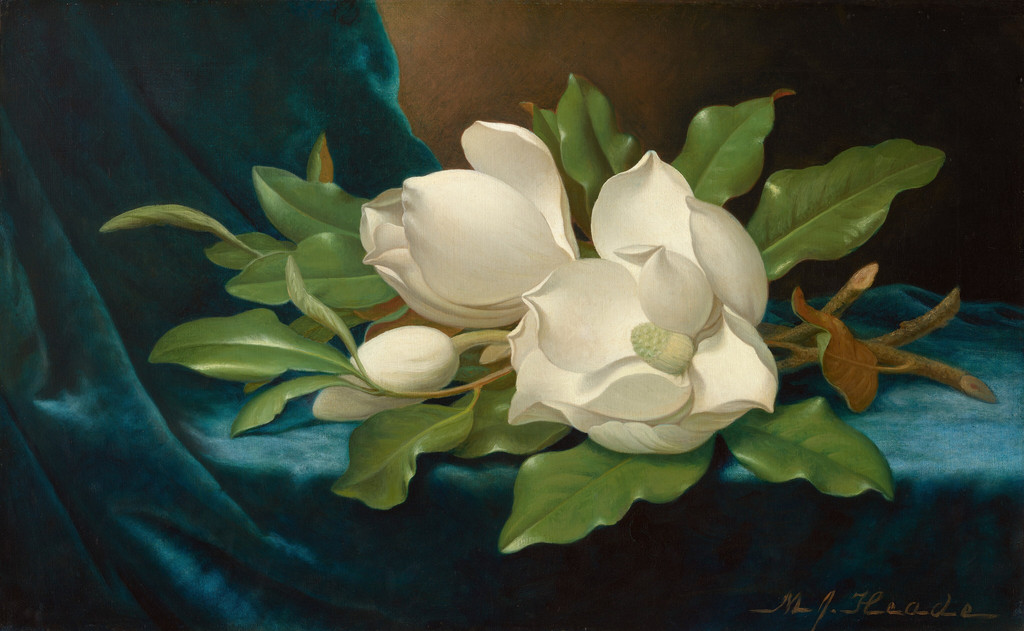
c.1876–81Magnolias on Light Blue Velvet Cloth
c.1885–95Contents
- The apple tree and the lit stack
- Water, cattle and reflected cloud
- Infrared evidence of a moved haystack
- A working marsh and an increasingly nostalgic subject
- Thoreau, Olmsted and the construction of apparent nature
- The Wilmerding collection and later NGA ownership
- Annotated details
The apple tree and the lit stack
The tree occupies the left foreground, where its irregular branches and leaning trunk introduce a substantial dark form. It does not enclose the whole landscape. The view opens beyond it towards the haystack and the extensive plain on the right.
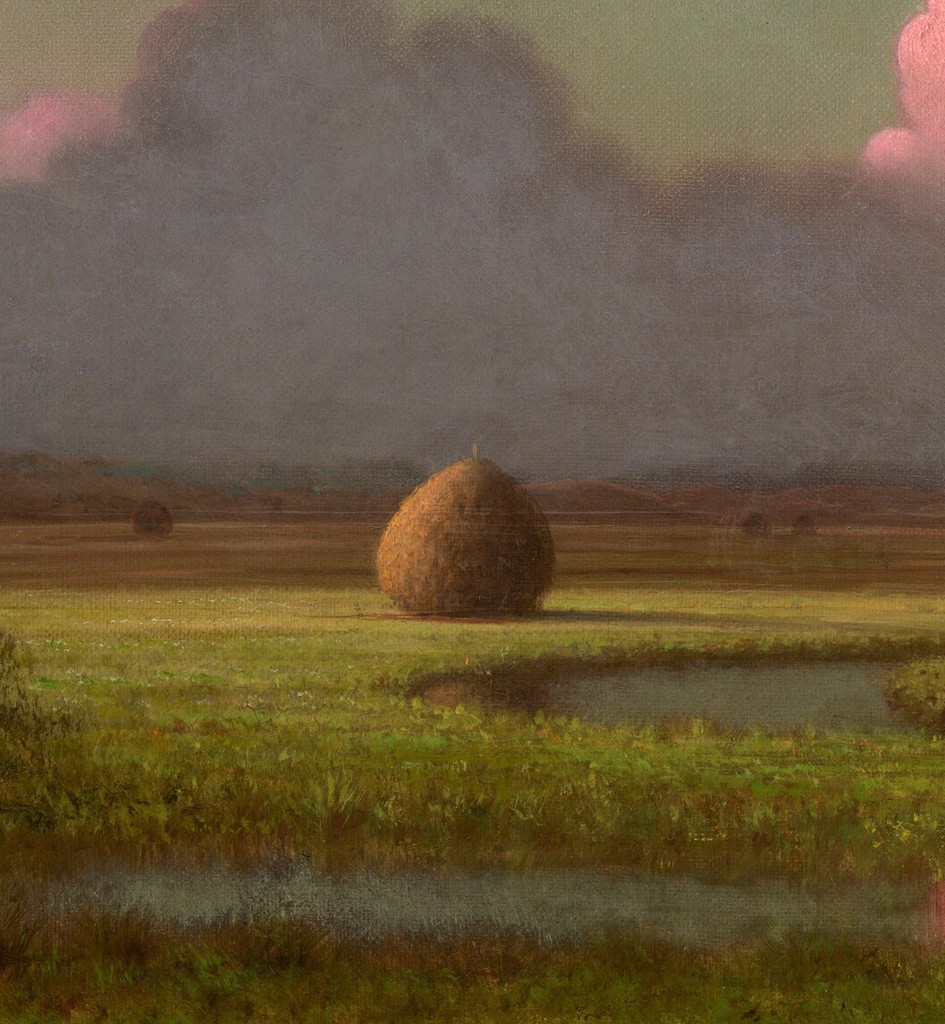
The nearer stack is smaller than the tree but more clearly isolated. A lighter side catches the eye against the green ground, while the darker side gives the mound volume. Its rounded contour repeats, on a reduced scale, some of the swelling shapes in the cloud above.
Charles M. Brock’s NGA catalogue entry explains the balance between the visual weight of tree and stack on the left and the receding creek on the right. The painting does not need equal masses on both sides. A more substantial foreground group can be balanced by a longer, more open route through the landscape.[2]
There are smaller stacks farther away. They remain part of the working marsh but lack the near stack’s strong separation into light and shade. Their reduced emphasis allows the foreground tree and mound to carry the composition while still suggesting that the field continues beyond them.
The tree is also different in texture from the stack. Thin branches and clusters of leaves create small interruptions around its edge, while the mound has a more continuous outline. These different kinds of description make the left-hand grouping more varied than a single dark barrier would have been.
Annotated Details from Sunlight and Shadow: The Newbury Marshes
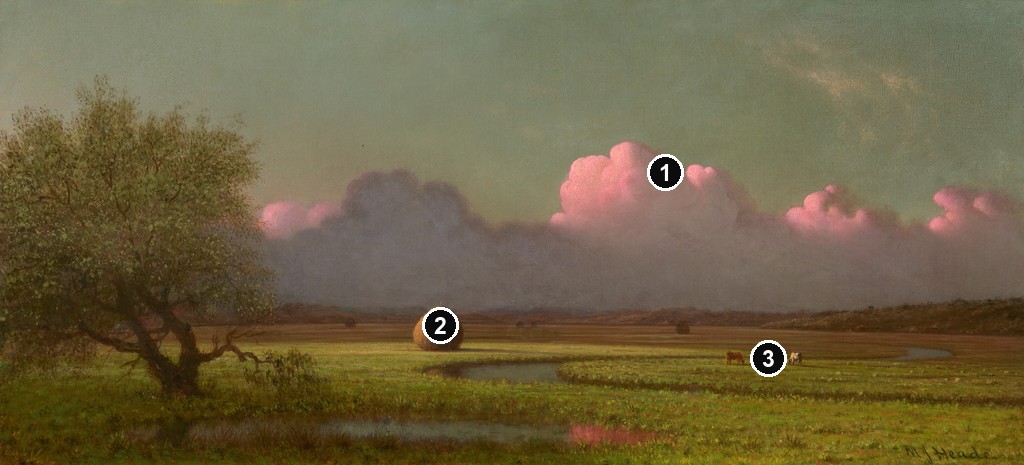
The numbered points identify visible features discussed in this article. Return from each detail to the whole composition. Martin Johnson Heade, Sunlight and Shadow: The Newbury Marshes, c.1871–75. National Gallery of Art, 2010.74.1. John Wilmerding Collection; National Gallery of Art. Image source. CC0 / Public domain. Resized only; native appearance preserved.
Details from SUNLIGHT AND SHADOW: THE NEWBURY MARSHES
Compare the cropped details with the complete images above. Notice how their colours, shapes and positions contribute to the larger compositions.
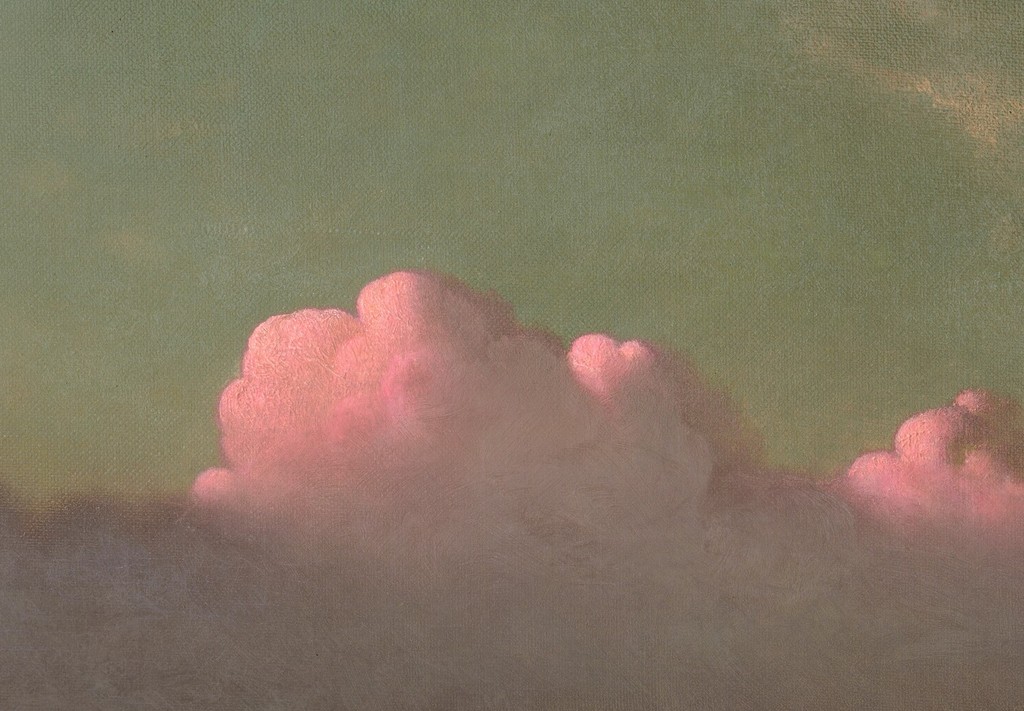
Pink-lit clouds
Pink highlights distinguish the upper cloud edges from the grey masses beneath. Compare their light with the quieter sky above.
Haystack beside the water
A rounded haystack stands beside a winding water channel. The warm stack and cooler water interrupt the level green marsh.
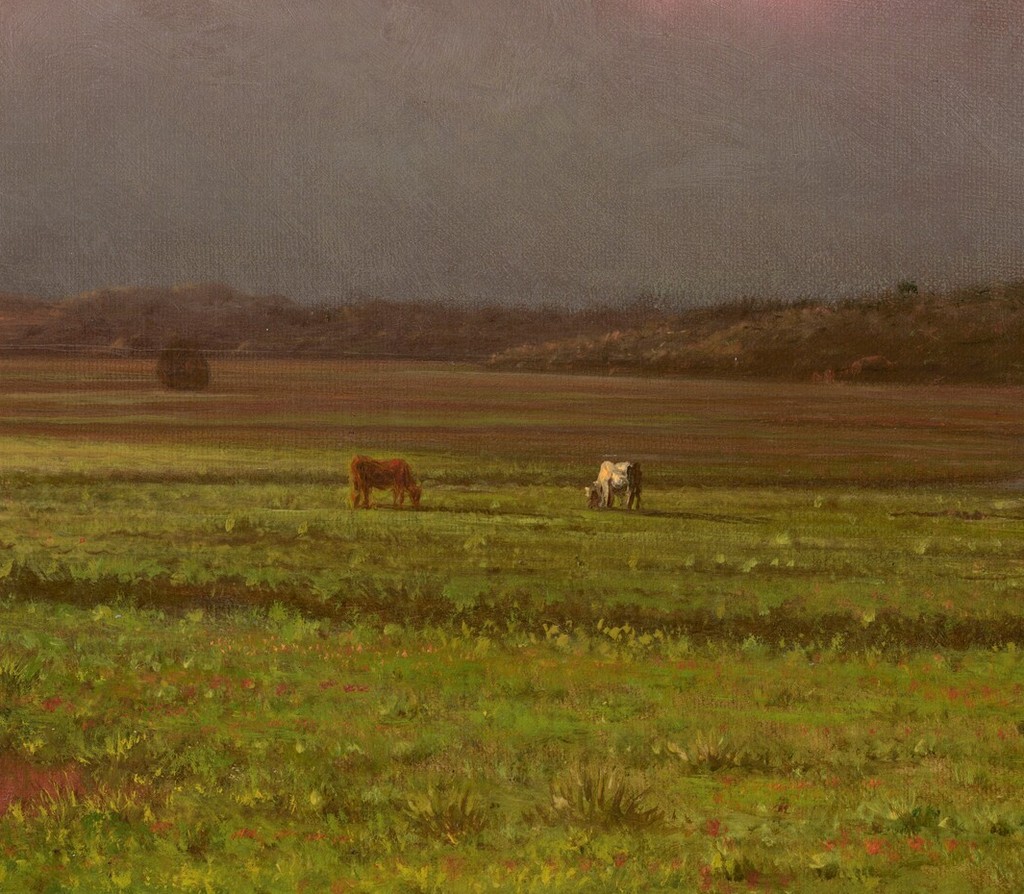
Grazing cattle
Two small cattle occupy the right-hand marsh. Their dark and pale bodies supply points of recognition within the extensive field.
Water, cattle and reflected cloud
The creek moves through the foreground in a succession of bends. It is not simply a straight line pointing towards the horizon. Its changing course gives the eye several movements through the lower part of the canvas before the marsh opens into the distance.
A shallow pool near the lower centre reflects the cloud’s pink. This small warm passage connects sky and ground across the painting’s height. The reflection remains broken by the water’s boundaries and surrounding grass, so it becomes another part of the marsh rather than a separate bright object.
Two cattle stand towards the right. Their different lightness creates a small counterpoint within the larger alternation of illuminated and shaded ground. Brock specifically connects this pair with the picture’s repeated play of light and dark, alongside the clouds and the stack.[2]
The sky is not uniformly calm or pale. Pink-lit cloud rises above a darker bank, while thin streaks occupy a quieter area towards the upper right. The near tree, curving water and differently shaped clouds make the composition active even though no large human action dominates it.
This explains why the title describes a relationship rather than a single time of day. The useful question is how sunlight and shadow are distributed across different forms. Tree, hay, cattle, cloud and water each participate, but they do so through different colours, shapes and degrees of emphasis.
Infrared evidence of a moved haystack
Brock reports that infrared reflectography revealed a haystack painted out near the middle of the canvas. Heade moved this prominent element slightly forward and to the left, bringing it out of shadow and into sunlight. The final placement helped rebalance the composition and intensify its light-dark relationships.[2]
The finding makes the near stack more than an attractive object in a field. Its position was a decision reconsidered during the work. Moving it affected both depth and lateral balance: it became more immediate to the viewer and more closely associated with the left-hand tree.
Changing its relationship to light also altered its importance. A stack in shade could have joined the darker ground near the middle. In the finished arrangement, the illuminated side becomes a more distinct point of attention, helping the eye travel from the tree into the open marsh.
The earlier position is not clearly demonstrated by the normal colour illustration supplied here. The image shows the finished mound, tree and creek; the underlying change comes from the published examination. Keeping those sources separate prevents a visible dark patch from being labelled an abandoned stack without evidence.
The examination supports a specific revision in this painting. It does not establish a rule that Heade moved every haystack or began every canvas with the same arrangement. Its value lies in showing a particular example of the thought and adjustment behind an apparently settled landscape.
A working marsh and an increasingly nostalgic subject
The subject belongs to coastal Massachusetts. Brock places Heade’s early marsh painting around Newbury and Newburyport, near the mouth of the Merrimack River, beginning around 1859. He suggests an acquaintance with Bishop Thomas March Clark as a possible reason for the artist’s interest, alongside the less certain attraction of Whittier’s local poetry. The later canvas belongs to an extended engagement with that region.[2]
The stacks and cattle belong to a landscape used by people. Salt marsh could supply hay and pasture as well as support hunting and fishing. Brock treats this combination of natural processes and human use as an essential part of Heade’s subject.[2]
Sarah Cash’s catalogue discussion of Heade’s separate View of Marshfield supplies more detailed harvesting context. Cut salt hay was placed on raised supports to keep it above wet ground, and seasonal transport could involve boats or winter conditions. Those practices help explain the working structures that recur across his marsh pictures.[3]
That regional history should not be converted into an exact account of the day depicted here. The cattle and stacks establish use, but the painting does not provide a dated harvest diary. Nor does the normal reproduction identify every plant or describe the precise state of the tide.
Brock also discusses the declining economic importance of local marsh hay as rail transport brought other hay into the region. Drawing on Theodore Stebbins’s research, he interprets the later marsh pictures as increasingly nostalgic evocations of a customary way of life. That interpretation belongs to the wider history of the subject, rather than a verified intention recorded by Heade for this canvas.[2]
The working character of the scene consequently matters even where figures are not prominent. The land is shaped partly by natural water and weather, partly by the uses represented by hay and cattle. Its serenity can coexist with those activities instead of requiring an untouched wilderness.
Watch: Martin Johnson Heade
Choose a film to explore the artist’s work, its interpretation and its wider setting.
Museum Minute: Heade Hummingbirds
A brief Shelburne Museum introduction to Heade’s hummingbird paintings.
Watch on YouTubeThoreau, Olmsted and the construction of apparent nature
Brock places Heade beside Thoreau’s marsh writing and Frederick Law Olmsted’s landscape design. The comparison concerns different ways of presenting marshland to an audience: painted arrangements, persuasive prose and engineered park scenery. It does not establish that the three men worked together.[2]
His discussion of Olmsted’s Boston Fens is especially useful to the question of apparent naturalness. A designed marsh could look like a preserved coastal landscape while requiring considerable planning. Similarly, the revised stack in Heade’s painting reveals adjustment behind a scene that might initially seem simply found.
Brock extends the point through Gremlin in the Studio, a separate Heade picture in which the mechanics of landscape painting become a humorous subject. That comparison belongs to his argument about artistic construction. It should not be turned into a claim that Sunlight and Shadow depicts the contents of an actual studio.[2]
These analogies make the marsh picture richer without replacing its visible subjects. Tree, water, hay and cattle remain the forms through which the painting works. The interpretation asks how their selection and arrangement produce a persuasive experience of a place.
The Wilmerding collection and later NGA ownership
The 2004 catalogue discusses the painting within John Wilmerding’s collection. The current NGA accession is 2010.74.1. The earlier private-collection setting and the present museum identity belong to different stages of the work’s collecting history, so the older publication should not be used as evidence that it is still privately owned.[1][2]
Its small height and extended width are also important to its physical character. At 30.5 by 67.3 centimetres, the canvas provides a compact panoramic field in which several kinds of detail can remain subordinate to the larger distribution of light. The scale encourages a closer encounter than a monumental landscape would demand.[1]
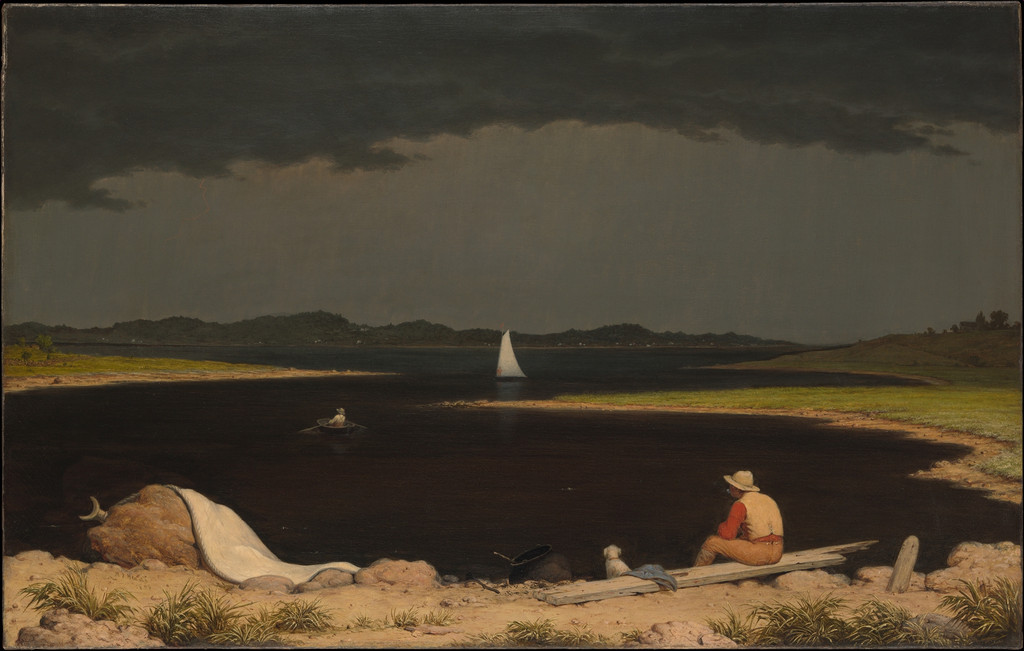
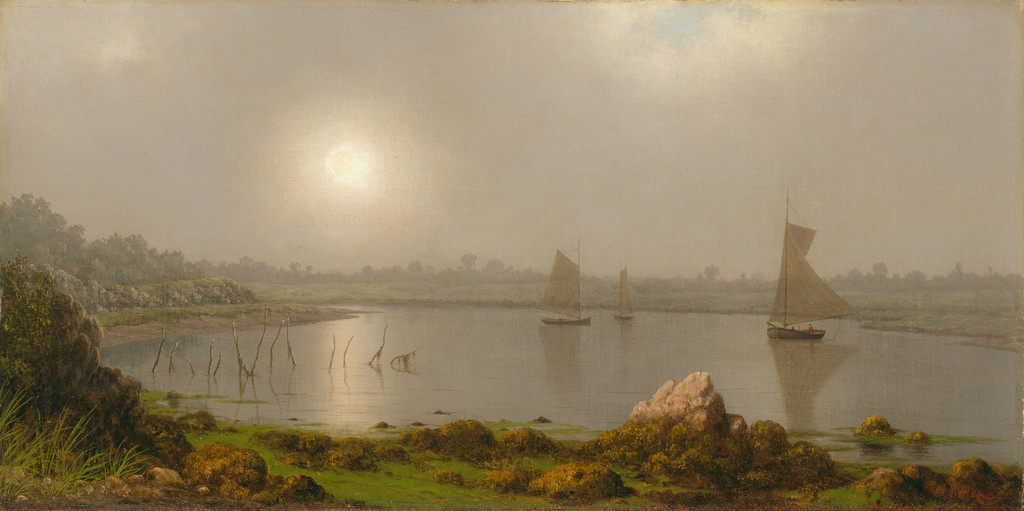
The Met’s Newburyport Meadows offers a distinct comparison, with more diffuse grey illumination and no large foreground tree. Its current c.1876–81 date and accession 1985.117 belong to a different object. The shared region and haystacks do not make the two pictures interchangeable.[4]
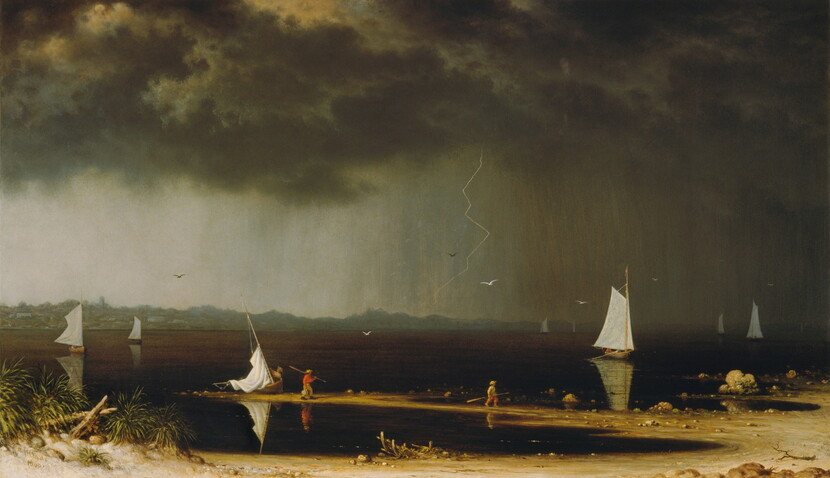
Yale’s Sudden Shower, Newbury Marshes develops another balance between cloud and working land. Its enormous dark weather field and larger foreground stack differ from the warmly accented tree-and-creek arrangement here. Tim Barringer’s extended reading of that picture provides a separate interpretive account of the cultivated marsh.[5]
Together the comparisons show that Heade’s repeated subject gave him different compositional problems. Sunlight and Shadow is distinctive because the tree, lit stack, paired cattle and pink reflection are connected through carefully distributed contrasts. The documented move of the stack gives material support to the sense that this balance was actively made.
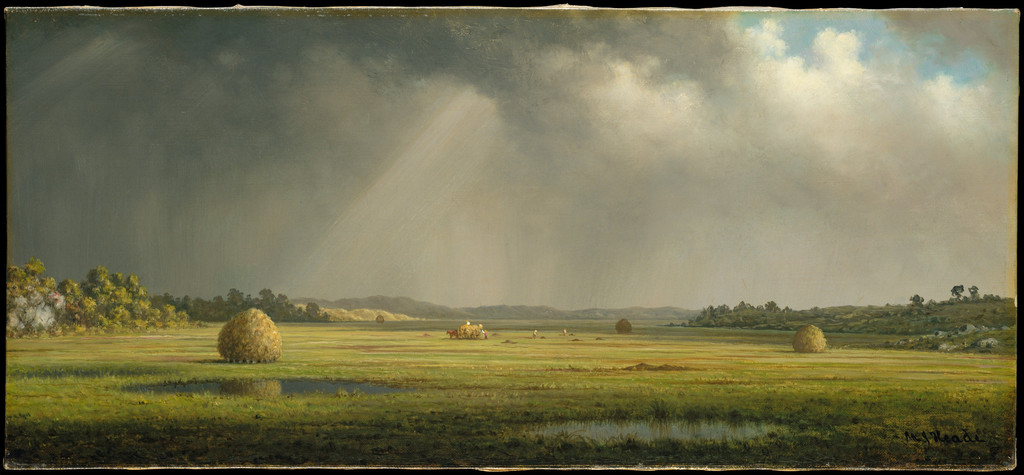
Martin Johnson Heade, Newburyport Meadows, c.1876–81. Oil on canvas. Metropolitan Museum of Art, 1985.117. Image source. CC0 / Public domain. Resized only; native appearance preserved.
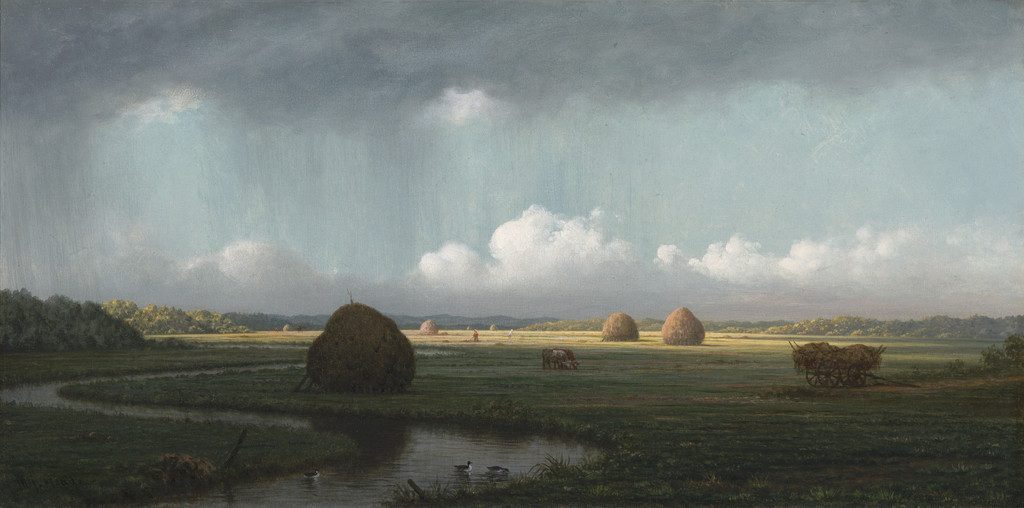
Martin Johnson Heade, Sudden Shower, Newbury Marshes, c.1865–75. Oil on canvas. Yale University Art Gallery, 1989.51.1. Image source. Public domain / PD-Art. Resized only; native appearance preserved.
Artworks directory
A collected selection of 26 individually identified museum paintings, including thirteen extended artwork studies. This is a bounded directory, rather than a complete catalogue raisonné. Two Boston entries retain dates from the 2002 conservation study. Links open a companion article where available, otherwise the cited institutional record or publication; unillustrated objects remain included.
Frequently Asked Questions
No. Brock’s catalogue reports an earlier central stack discovered by infrared reflectography. Heade moved the element forward and left into sunlight.[2]
The published finding comes from infrared examination. The normal colour image illustrates the final arrangement and should not be treated as independent proof of the hidden earlier form.[2]
Discussion
Look again at the images and ideas explored in Sunlight and Shadow: The Newbury Marshes by Martin Johnson Heade. These editorial prompts invite your observations.
Reader Insights
How do the lit stack and shaded tree balance the picture?
What changes in the Met meadows or Yale shower?
What does the infrared finding add without being visible in the colour reproduction?
Join the Conversation
Share a detail, comparison or question about Sunlight and Shadow: The Newbury Marshes by Martin Johnson Heade below.
References
- National Gallery of Art, Sunlight and Shadow: The Newbury Marshes, 2010.74.1. Current title, date, dimensions and collection identity. View source
- Charles M. Brock, American Masters from Bingham to Eakins: The John Wilmerding Collection (NGA, 2004), printed pp.72–74. Composition, moved haystack, historical marsh economy and attributed Thoreau/Olmsted comparisons. View source
- Sarah Cash, Corcoran Collection: American Paintings to 1945, View of Marshfield entry, printed pp.130–131 and associated notes. Regional harvesting practices; evidence concerns the separate Marshfield work. View source
- Metropolitan Museum of Art, Newburyport Meadows, 1985.117. Exact comparison and current c.1876–81 dating checked against the museum’s API. View source
- Tim Barringer, Object Lessons: American Painting at Yale, printed pp.1–17. Separate Sudden Shower composition and cultivated-marsh interpretation. View source
- Splash image source.
Martin Johnson Heade, Sunlight and Shadow: The Newbury Marshes, c.1871–75. Oil on canvas, 30.5 × 67.3 cm. National Gallery of Art, 2010.74.1. John Wilmerding Collection; National Gallery of Art. CC0 / Public domain. Resized only; native appearance preserved.
View source