 by Tom Gurney
Tom Gurney BSc (Hons) is an art history expert with over 20 years experience
Email: tomgurney1@gmail.com / Phone: +44 7429 011000
Martin Johnson Heade in Brazil and the Caribbean: Introduction
Martin Johnson Heade’s tropical pictures grew from distinct journeys and continued through work in studios after his return. Brazil in 1863–64 supplied harbour views and hummingbird studies; later travel included Nicaragua, Colombia, Panama and Jamaica. A canvas dated during a visit, a forest picture completed in London and a Jamaican landscape signed years later provide different relationships between place and picture. Following those differences gives a clearer account than treating every tropical image as a scene painted immediately outdoors.[1][2][3]
At a Glance
- 1863–64Brazil, including Rio harbour and hummingbird subjects
- 1866Nicaragua and Colombia
- 1870Colombia, Panama and Jamaica
- Dated harbour canvasNGA Rio de Janeiro Bay, 1864
- London completionRISD Brazilian Forest, 1864
- Later signatureView from Fern-Tree Walk, Jamaica, associated with c.1870 work but signed 1887
- Important distinctionJourney, study, painting, signature and purchase dates can differ
Contents
- Church and tropical travel
- Brazil in 1863–64
- Rio harbour and a period map
- Nicaragua and Colombia in 1866
- Colombia, Panama and Jamaica in 1870
- Brazilian Forest completed in London
- Journey dates and later signatures
- Annotated details
Church and tropical travel
Heade’s friendship with Frederic Edwin Church forms part of the context for his interest in tropical subjects. Kelly places the artists’ connection within Heade’s New York years and the development of his landscape practice. The relationship supplies a documented artistic connection rather than an explanation for every later decision.[1]
Strazdes considers Church’s encouragement when discussing the Jamaican journey. Church had visited the island in 1865, and the catalogue proposes that his suggestion may have helped prompt Heade’s detour in 1870. The distinction between encouragement and a certain travel itinerary planned by another artist should remain intact.[3]
The two painters also approached tropical landscapes differently. The catalogue’s Jamaican comparison considers Heade’s ordering of abundant vegetation beside Church’s more overt dramatic possibilities. Shared interests and friendship did not require identical compositions.[3]
Annotated Details from Martin Johnson Heade in Brazil and the Caribbean
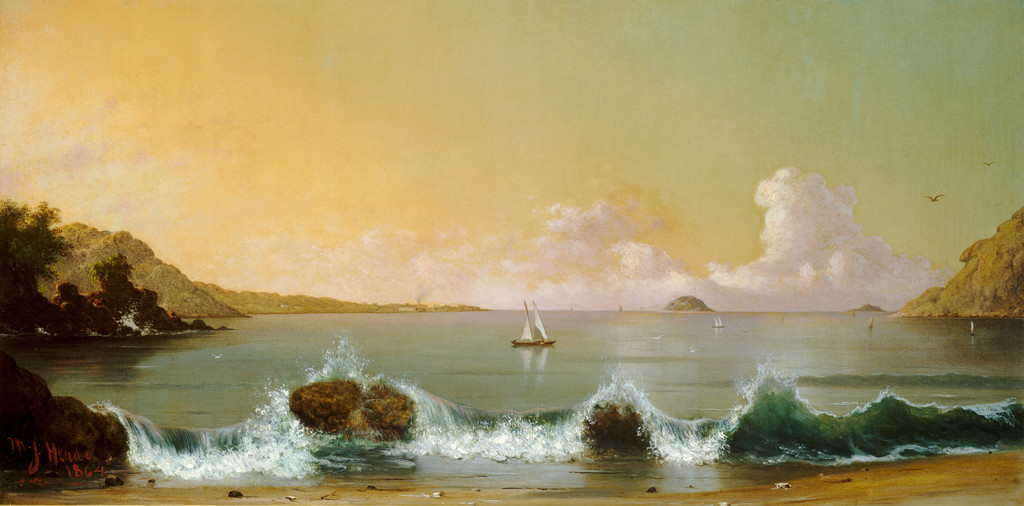
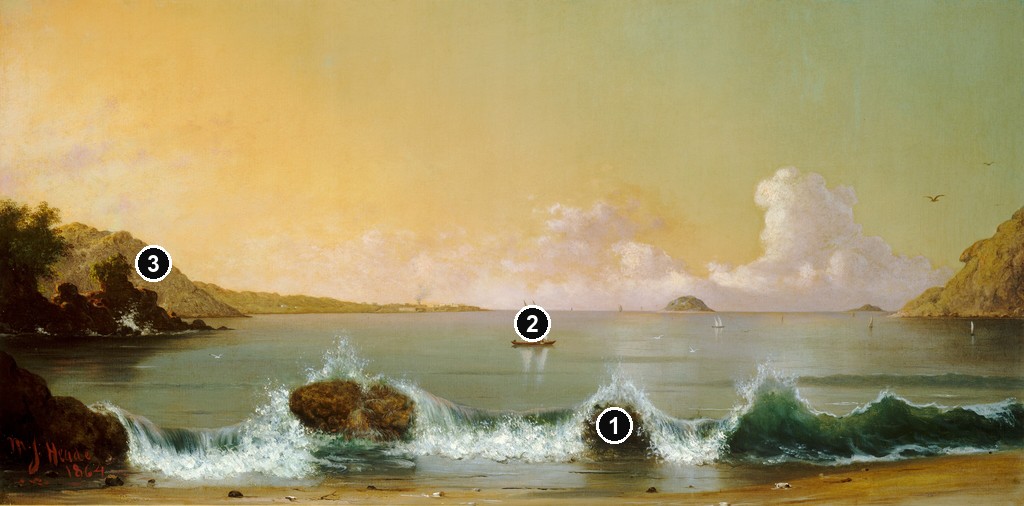
The numbered points identify visible features discussed in this article. Return from each detail to the whole composition. Martin Johnson Heade, Rio de Janeiro Bay, 1864. Oil on canvas. National Gallery of Art, 1965.2.1. Image source. CC0 / Public domain. Resized only; native appearance preserved.
Details from MARTIN JOHNSON HEADE IN BRAZIL AND THE CARIBBEAN
Compare the cropped details with the complete images above. Notice how their colours, shapes and positions contribute to the larger compositions.
Breaking foreground water
Pale foam rises around dark foreground rocks. Its lively contours differ from the calm horizontal water beyond.
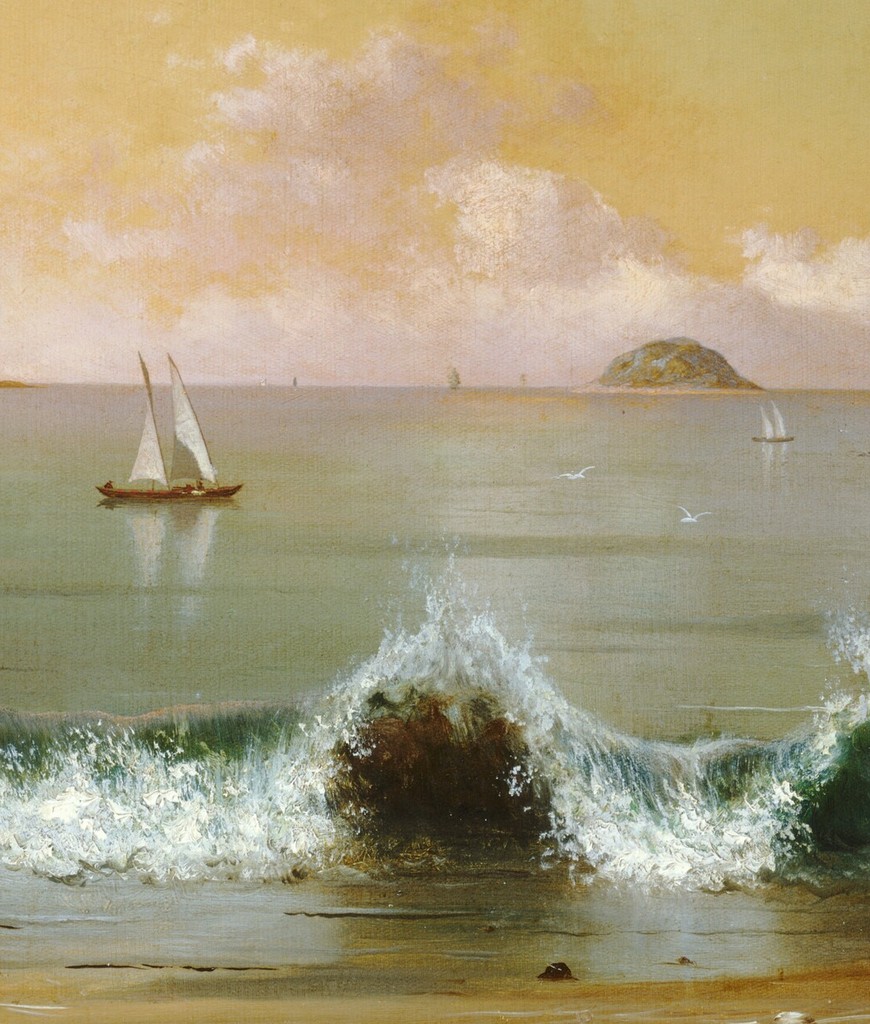
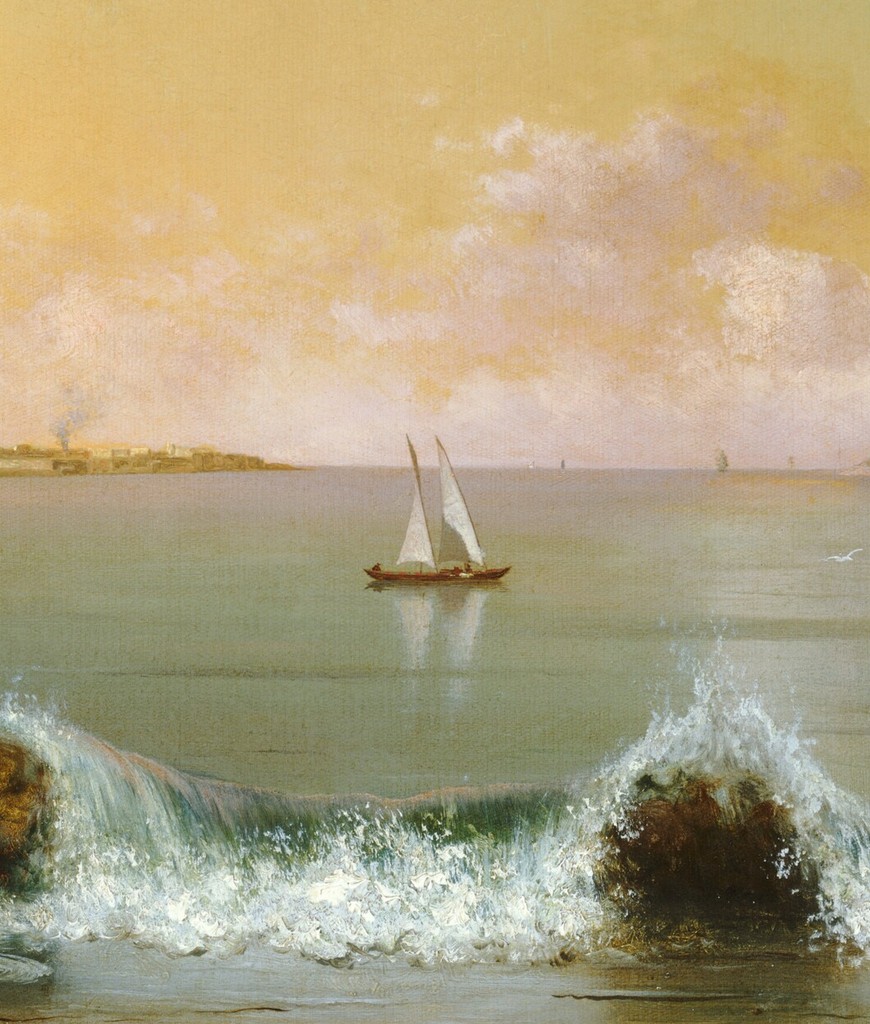
Sailing vessel
A small vessel carries pale sails across the bay. Its reflection links the upright sails to the quieter water.
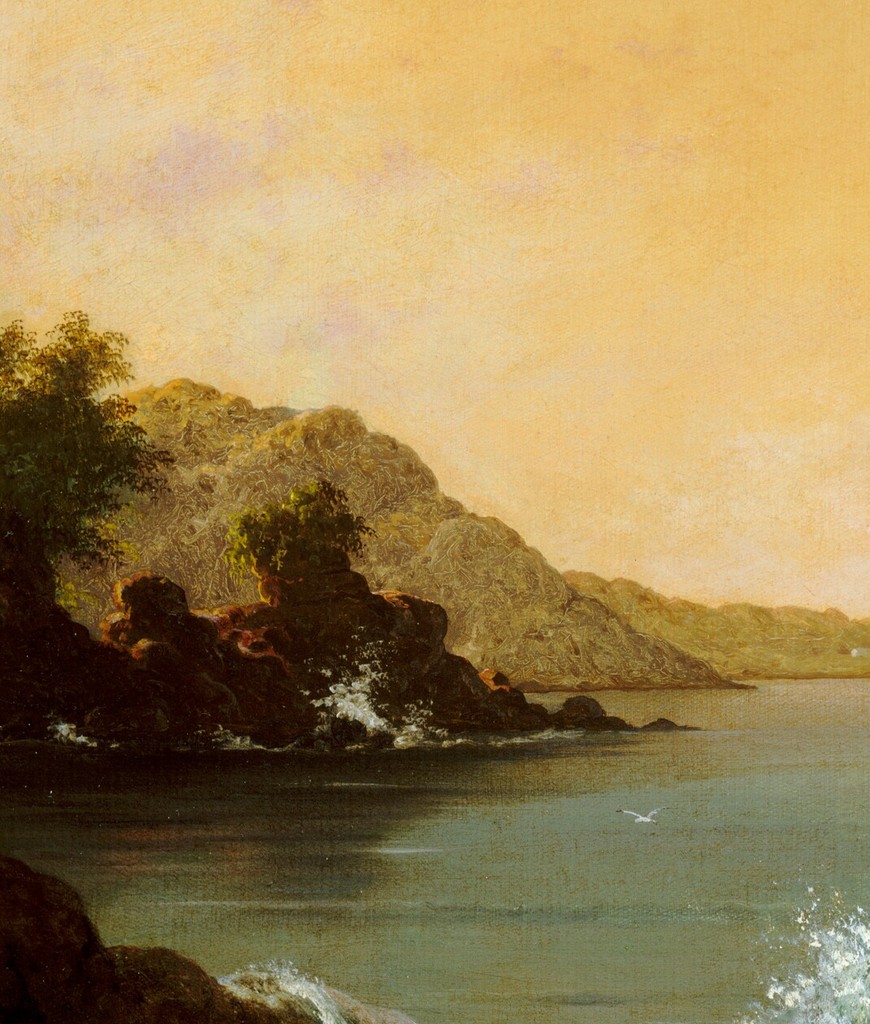
Left-hand rocky shore
Dark near rocks and vegetation overlap paler distant slopes. Changes of tone separate the different distances.
Brazil in 1863–64
The first journey to Brazil connected several activities. Heade studied hummingbirds, made landscape material and developed harbour pictures. His planned Gems of Brazil book belonged to this period, but was not the only purpose reflected in the resulting art.[1]
Elizabeth Neely’s Carter essay describes imperial encouragement and a display of twelve hummingbird pictures. The account places the project within Brazilian patronage. That support does not establish a commission for every tropical canvas Heade painted in later decades.[7]
The book itself remained unfinished. Veloric’s study nevertheless documents executed trial chromolithographs and working proofs. The publishing history should therefore distinguish an abandoned complete publication from a total absence of prints.[8]
The separate Gems of Brazil article follows the project and collecting questions in detail. For the travel story, its importance is the movement from Brazilian observation to further artistic and publishing work abroad.
Rio harbour and a period map
Rio de Janeiro Bay carries the date 1864. The NGA canvas combines breaking foreground surf with calmer water, sailing boats and a warm sky. Its museum identity is accession 1965.2.1, distinct from smaller related harbour pictures.[5]
Kelly proposes a view near Botafogo looking northeast across Guanabara Bay, with the base of Sugar Loaf at the right. The location remains probable. The arrangement does not provide a precise modern coordinate or establish where every study was made.[1]
The 1858 Planta da cidade do Rio de Janeiro provides geographic context from shortly before Heade’s visit. Its city plan, coastal outlines, labels and subsidiary material organise the setting in a different way from the painting’s surf, sails and light.[6]
No verified artist viewpoint is marked on this map. Its role is to help readers consider the contemporary city and harbour area. The original source permits closer reading of the fine labels than a small page illustration can provide.
The painting and map should consequently be compared as different representations of place. One organises geographic information; the other selects forms and atmosphere for a pictorial encounter. Their historical connection does not make either a complete record of the artist’s movements.
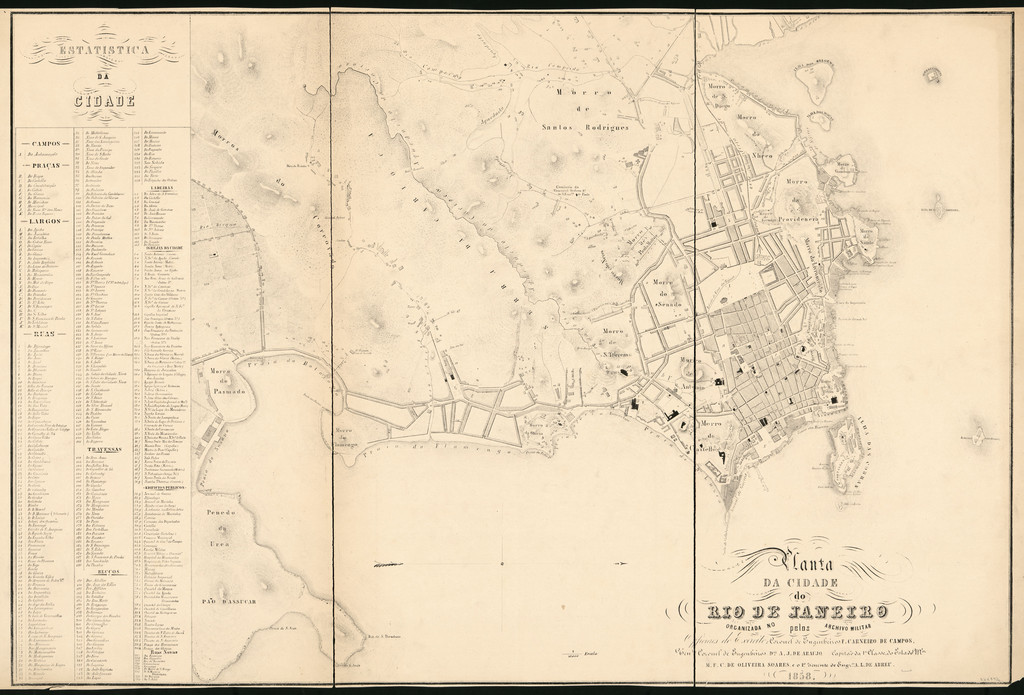
Brazil, Archivo Militar, Planta da cidade do Rio de Janeiro, 1858. Library of Congress, Geography and Map Division. Period geography; no verified Heade viewpoint is marked. Brazil. Archivo Militar; Library of Congress, Geography and Map Division. Image source. Public domain / PD-Art. Resized only; no alteration of native appearance.
Nicaragua and Colombia in 1866
Porter’s Florida Museum essay identifies a further journey to Nicaragua and Colombia in 1866. Kelly likewise places subsequent tropical travel within Heade’s continuing career. This visit is separate from the earlier Brazilian stay.[1][2]
Keeping the destinations distinct prevents a recurring biographical error: three Latin American journeys do not amount to three visits to Brazil. The geographical range matters to an artist who continued to work with different coastlines, vegetation and tropical subjects.
A journey can expand the material available for later pictures without dating every subsequent canvas to the year of travel. Studies, memories and repeated motifs may remain useful after the artist returns. Exact objects and inscriptions provide stronger chronological evidence than an assumed resemblance to a tropical region.
The Thyssen’s Sunrise in Nicaragua supplies a concrete example. Dated 1869, the oil canvas measures 38.7 by 73 centimetres and has accession CTB.1997.6. Its later date separates the finished object from the 1866 journey.[9]
Kenneth W. Maddox’s museum entry describes haze, light struggling through the atmosphere and a solitary sailing vessel. He also reports Heade’s disappointment with Nicaragua through a letter to John Russell Bartlett. That account is paraphrased through the museum, rather than quoted as an independently consulted original.[9]
Maddox discusses Mark Twain’s response to an earlier, separately titled Nicaraguan painting. Twain’s description should not be reassigned to the 1869 canvas as its direct exhibition review. The related subjects remain distinct objects.[9]
The example adds atmosphere and later execution to the route itself. Nicaragua entered Heade’s art through both a journey and subsequent paintings, whose exact chronology requires more than the travel year.[9]
Watch: Martin Johnson Heade
Choose a film to explore the artist’s work, its interpretation and its wider setting.
Museum Minute: Heade Hummingbirds
A brief Shelburne Museum introduction to Heade’s hummingbird paintings.
Watch on YouTubeColombia, Panama and Jamaica in 1870
Porter identifies Colombia, Panama and Jamaica within the 1870 journey. Strazdes’s account describes Heade’s Jamaican stay around Kingston and drawings of individual plants, flowers and trees. The studies provided specific botanical material for later work.[2][3]
The catalogue associates View from Fern-Tree Walk, Jamaica with this period. It discusses dense vegetation, a route towards the sea and small figures contributing to the represented scale. Its analysis also distinguishes individual plant studies from the wider composition that brings them together.[3]
In that reading, detailed plants do not guarantee that the entire panoramic arrangement was copied from one outdoor position. Botanical records and invented relationships can coexist within a landscape. The picture’s larger space is an artistic construction using, but extending beyond, the available studies.[3]
The same principle makes the travel dates useful without turning them into universal picture dates. An artist can return to a subject later, change its arrangement or complete a larger work from smaller records made abroad.
Brazilian Forest completed in London
RISD’s Brazilian Forest, accession 68.052, supplies a specific example of work completed elsewhere. The 1864 canvas has a recorded reverse inscription naming London. The museum’s label explains that Heade finished it in a London studio and sold it to Henry Lippitt after returning.[3][4]
The label also connects the picture with annotated Brazilian studies and an inscription referring to a tree fern. Its tropical subject and British completion are compatible parts of the same history. A scene’s represented country need not be its place of final execution.[4]
London also belonged to the attempted publishing process for Gems. Veloric considers the trial printing and difficulties surrounding the project. The move from field material to a studio or printer shows that travel could be followed by several stages of transformation.[8]
The comparison is particularly helpful beside the NGA harbour painting. Rio’s inscription fixes a date; the Forest’s recorded reverse wording supplies a place of completion. Different evidence answers different questions about each object.
Journey dates and later signatures
Strazdes dates View from Fern-Tree Walk, Jamaica approximately 1870 while recording a lower-left signature dated 1887. Her entry associates the later signing with Henry Flagler’s purchase. The account distinguishes the original work from its later collecting stage.[3]
The 1887 inscription therefore should not automatically be used as proof of a new Jamaican expedition that year. Journey, initial execution and signing may belong to different moments. The catalogue’s proposed early chronology remains qualified where its identification is not certain.
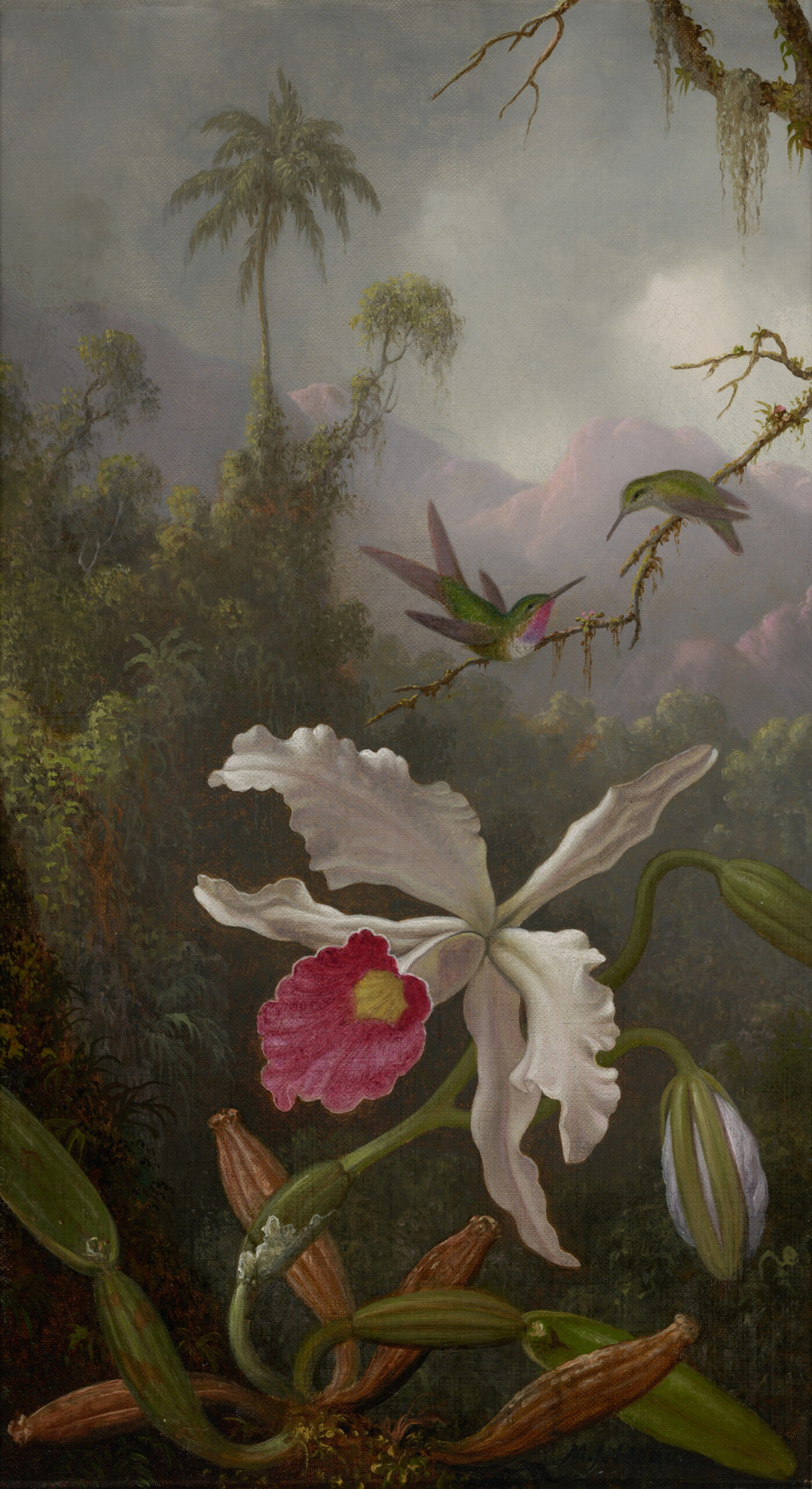
Later bird-and-flower paintings provide another continuation of tropical interests. The NGA’s Cattleya Orchid and Three Hummingbirds dates to 1871 and gathers a flower, birds, nest and distant vegetation into a composed setting. Kelly places it within a later practice following the earlier Brazilian project.[1]
The travel story consequently extends beyond a list of destinations. It includes observation abroad, studies carried away, paintings developed in different studios, attempted reproduction and later collecting. Exact dates and qualified interpretations keep those stages connected without collapsing them into one event.
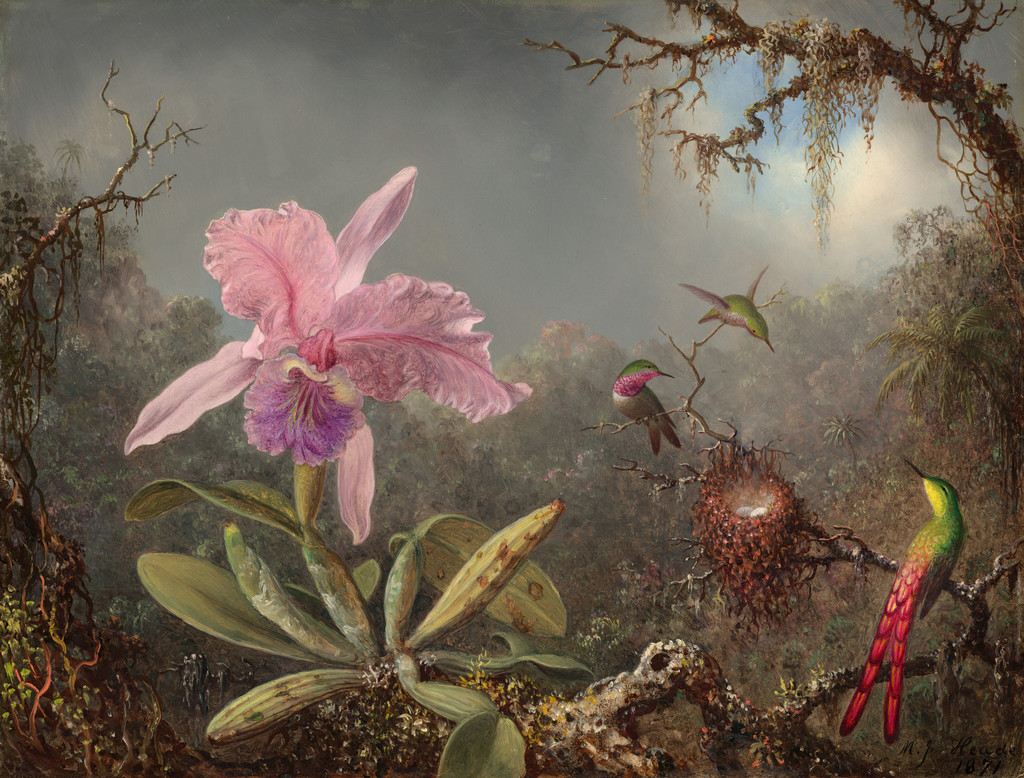
Martin Johnson Heade, Cattleya Orchid and Three Hummingbirds, 1871. National Gallery of Art, 1982.73.1. Image source. CC0 / Public domain. Resized only; native appearance preserved.
Artworks directory
A collected selection of 26 individually identified museum paintings, including thirteen extended artwork studies. This is a bounded directory, rather than a complete catalogue raisonné. Two Boston entries retain dates from the 2002 conservation study. Links open a companion article where available, otherwise the cited institutional record or publication; unillustrated objects remain included.
Frequently Asked Questions
The reviewed regional account distinguishes Brazil in 1863–64, Nicaragua and Colombia in 1866, and Colombia, Panama and Jamaica in 1870.[2]
The consulted catalogue connects the 1887 signing with a later purchase and associates the work with approximately 1870. It does not establish a new journey from the signature alone.[3]
Discussion
Look again at the images and ideas explored in Martin Johnson Heade in Brazil and the Caribbean. These editorial prompts invite your observations.
Reader Insights
How do surf and distant stillness work together in the Rio view?
What changes when a dated painting is compared with the date of a journey?
What can the1858map add while leaving the exact viewpoint unmarked?
Join the Conversation
Share a detail, comparison or question about Martin Johnson Heade in Brazil and the Caribbean below.
References
- Franklin Kelly, American Paintings of the Nineteenth Century, Part I (NGA, 1996), printed pp.287–294. Career, Rio location proposal and later Cattleya practice. View source
- Charlotte M. Porter, Florida Museum, “Visual Interests”. Distinct 1863–64, 1866 and 1870 routes. View source
- Diana J. Strazdes, Heade entries in American Paradise (Met, 1987), printed pp.170 and 174–176. Brazilian Forest, Jamaican studies, Church comparison and later signing. View source
- RISD Museum, collected exhibition labels, PDF pp.100–101. Brazilian Forest, 68.052, London completion and Lippitt purchase account. View source
- National Gallery of Art, Rio de Janeiro Bay, 1965.2.1. Exact dated harbour canvas. View source
- Wikimedia Commons / Library of Congress, Planta da cidade do Rio de Janeiro, 1858. Period geography and original map source. View source
- Elizabeth Neely, Carter Museum, “An Orchid, an Emperor, and Hummingbirds” (2023). Brazilian visit and imperial patronage context. View source
- Cynthia Haveson Veloric, “Hummingbirds, Emperors, and Railway Barons: Heade’s Gems and their Journeys,” Nineteenth Century 36(2), Fall 2016, printed pp.17–23. Trial chromolithographs and publishing history. View source
- Kenneth W. Maddox, Thyssen, Sunrise in Nicaragua, CTB.1997.6. Exact 1869 canvas and attributed travel/critical context; original letters and reviews not independently consulted. View source
- Splash image source.
Martin Johnson Heade, Rio de Janeiro Bay, 1864. National Gallery of Art, 1965.2.1. Gift of the Avalon Foundation; National Gallery of Art. CC0 / Public domain. Resized only; native appearance preserved.
View source