 by Tom Gurney
Tom Gurney BSc (Hons) is an art history expert with over 20 years experience
Email: tomgurney1@gmail.com / Phone: +44 7429 011000
Martin Johnson Heade’s Hummingbirds and Orchids: Introduction
Martin Johnson Heade’s hummingbird-and-flower paintings bring small birds close to large blossoms while opening views into hazy tropical landscapes. Some include nests and eggs; others isolate a perched bird among red flowers or place two birds above a white orchid. These pictures combine natural-history interests with decisions about scale, colour and space. They are best understood through exact objects and carefully qualified research, rather than treated automatically as literal field records of species interacting.[1][2]
At a Glance
- Earlier projectGems of Brazil, planned during the 1863–64 Brazilian visit; book unfinished
- Later practiceBirds, flowers and constructed tropical settings
- NGA exampleCattleya Orchid and Three Hummingbirds, 1871, oil on wood
- Carter exampleTwo Hummingbirds above a White Orchid, c.1875–90
- Met exampleHummingbird and Passionflowers, c.1875–85
- Modern comparisonDario Sanches’s male amethyst woodstar photograph, 2008
- Late exampleThyssen Orchid and Hummingbird near a Mountain Waterfall, 1902
Contents
- An interest extending beyond decoration
- From Gems to bird-and-flower pictures
- A large flower within a small landscape
- Different birds, nests and material supports
- A modern living-bird comparison
- Orchids and ecological relationships
- Darwin and inferred intention
- Imperial patronage and later tropical pictures
- Comparing observation and construction
- Annotated details
An interest extending beyond decoration
Charlotte M. Porter’s Florida Museum essays connect Heade’s pictures with his interest in observing hummingbirds, feeding them and maintaining study skins. They also discuss his later natural-history writing under the name Didymus. This background places the painted birds within a broader engagement with living subjects and their study.[2][3]
The activities are related but distinct. Watching a live bird, examining a skin, writing about behaviour and constructing a painting each supply different kinds of information. A finished canvas may draw on several without recording a single witnessed instant.
Heade’s tropical journeys are another part of that background. Porter distinguishes Brazil in 1863–64 from Nicaragua and Colombia in 1866, and Colombia, Panama and Jamaica in 1870. These routes should not be compressed into three visits to Brazil.[2]
The experience of travel helps explain the artist’s continuing attention to unfamiliar vegetation and birds, but it does not establish the precise place represented in every later picture. A tropical setting can be composed years after travel from studies, remembered forms and the artist’s accumulated practice.
Annotated Details from Martin Johnson Heade’s Hummingbirds and Orchids
The numbered points identify visible features discussed in this article. Return from each detail to the whole composition. The captions keep each work’s identity, date and medium separate.
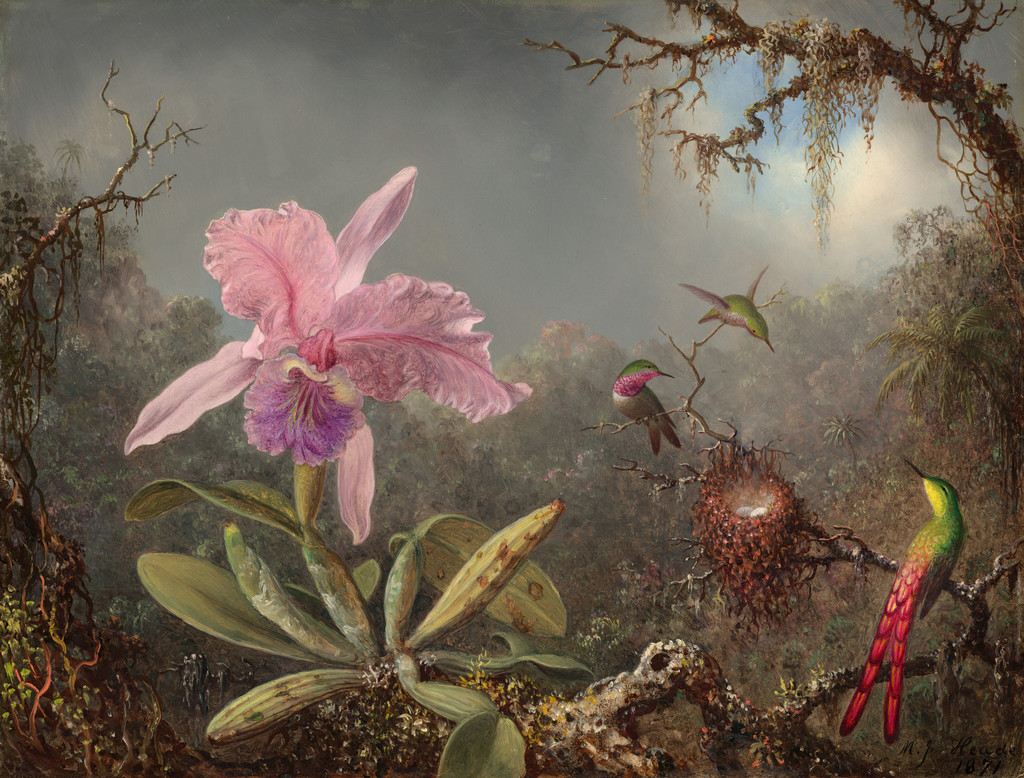
Cattleya Orchid and Three Hummingbirds
Martin Johnson Heade, Cattleya Orchid and Three Hummingbirds, 1871. Oil on wood. National Gallery of Art, 1982.73.1. Image source. CC0 / Public domain. Resized only; native appearance preserved.
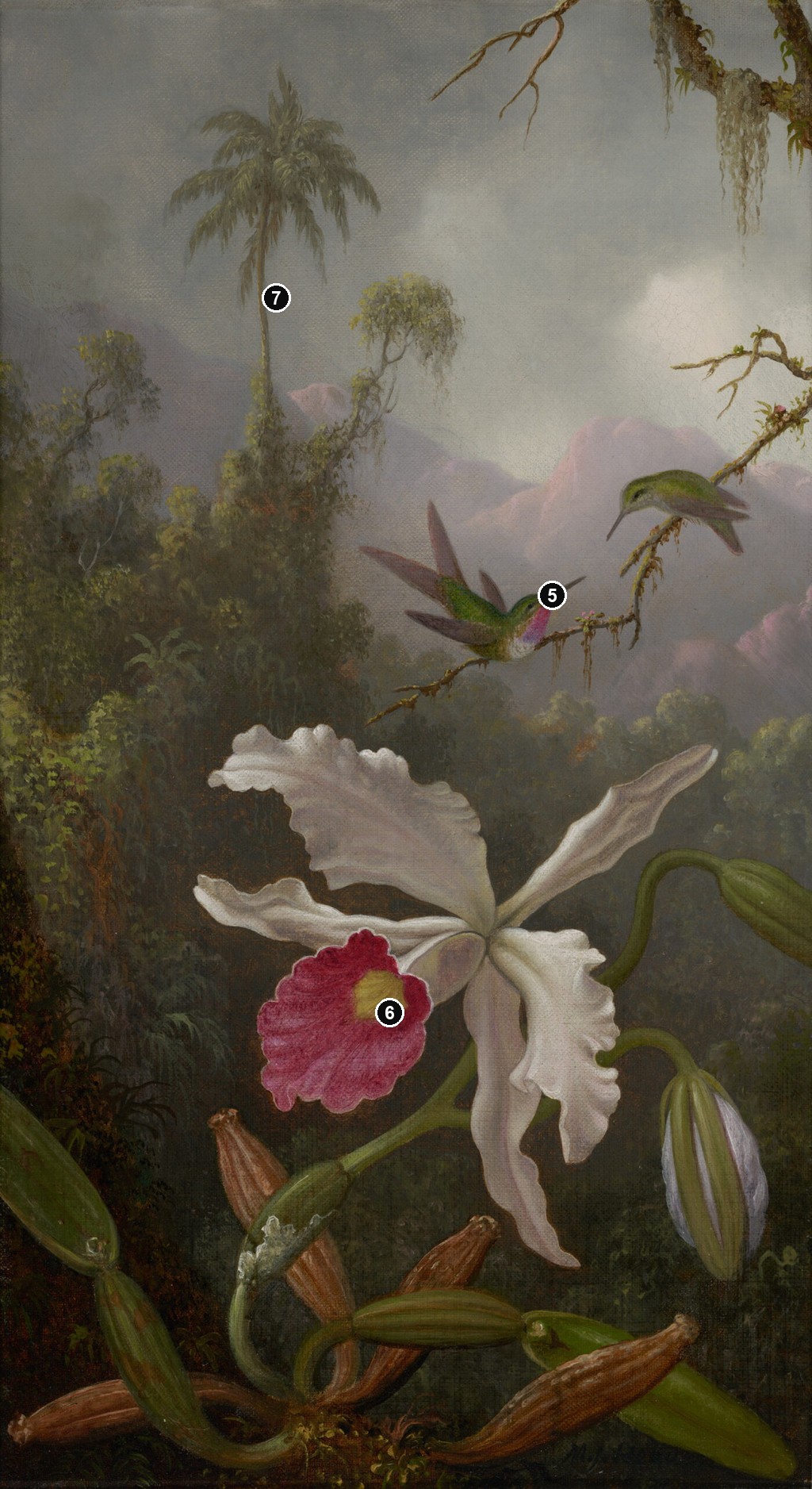
Two Hummingbirds above a White Orchid
Martin Johnson Heade, Two Hummingbirds Above a White Orchid, c.1875–90. Oil on canvas, 18 1/8 × 10 1/8 inches. Amon Carter Museum of American Art, Fort Worth, 1981.33. Image source. Public domain. Resized only; native appearance preserved.
Details from MARTIN JOHNSON HEADE’S HUMMINGBIRDS AND ORCHIDS
Compare the cropped details with the complete images above. Notice how their colours, shapes and positions contribute to the larger compositions.
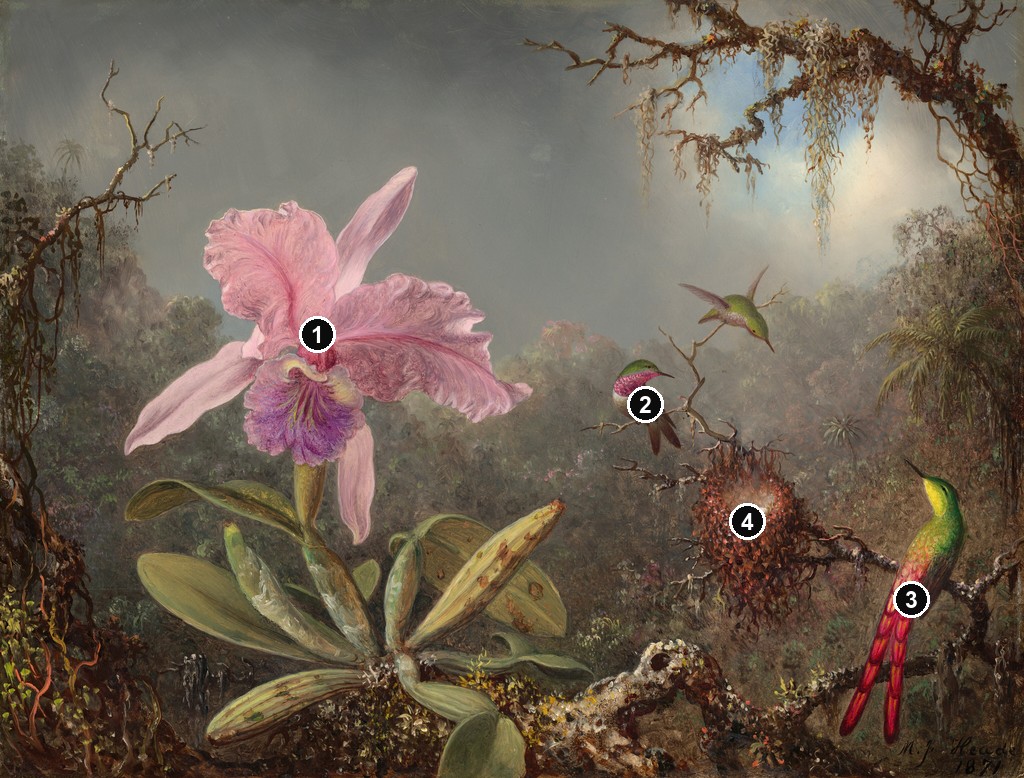
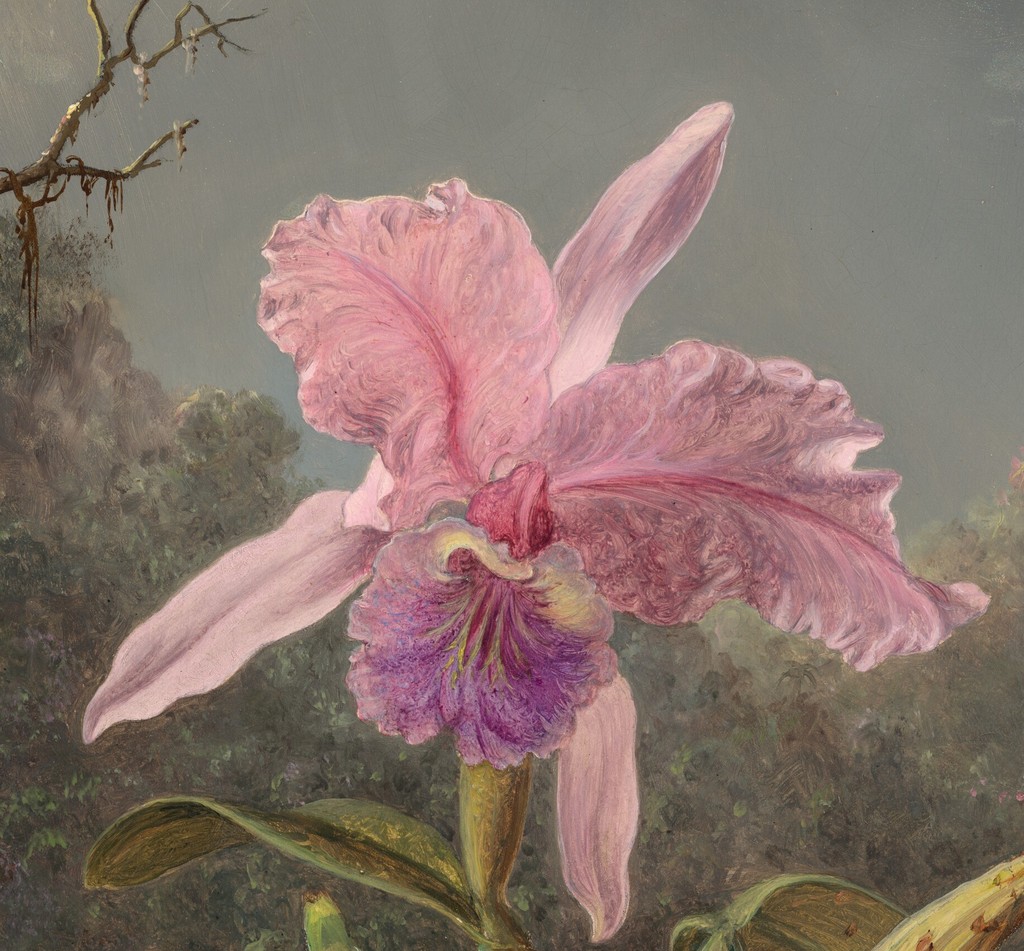
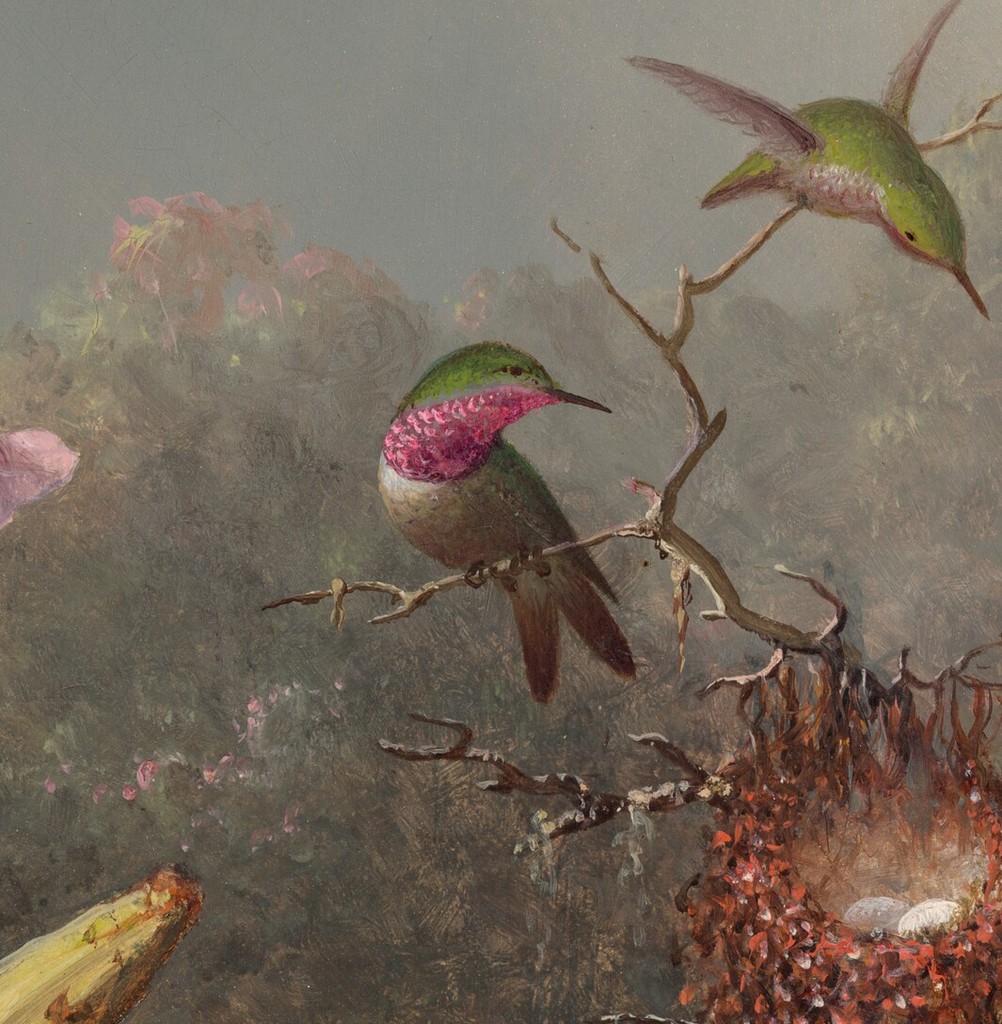
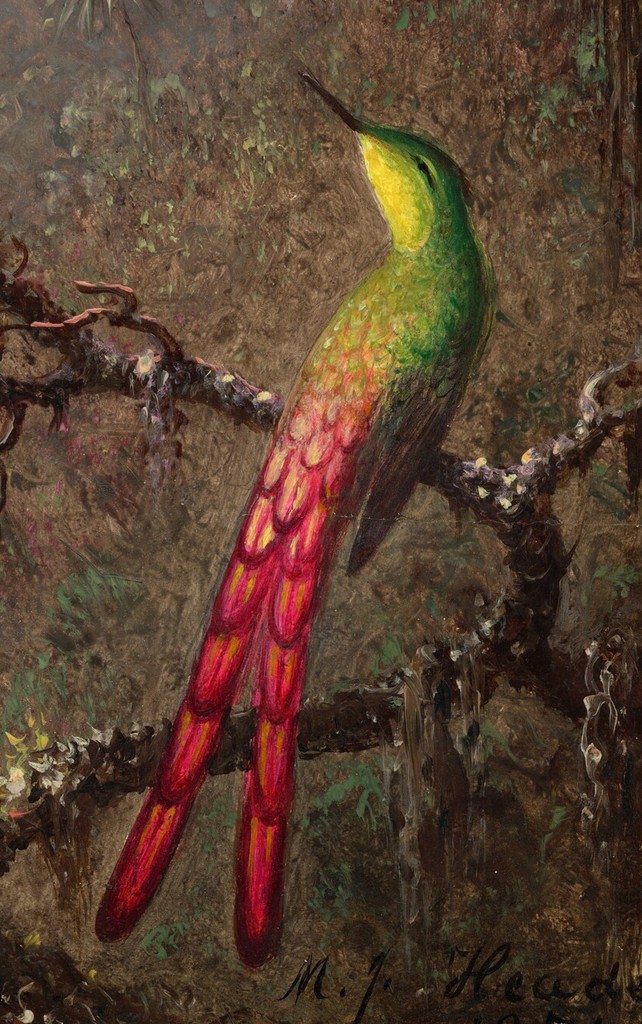
Cattleya Orchid and Three Hummingbirds
Large orchid bloom
Pink and purple folds spread around the orchid’s darker centre. Its large scale establishes a foreground distinct from the hazier woodland.
Perched bird
A green bird with a bright throat sits on a slender branch. Its stationary posture differs from the bird in flight above.
Long-tailed lower bird
The lower bird has a bright green neck and long red tail feathers. Its upright form balances the large orchid at the left.
Nest among the branches
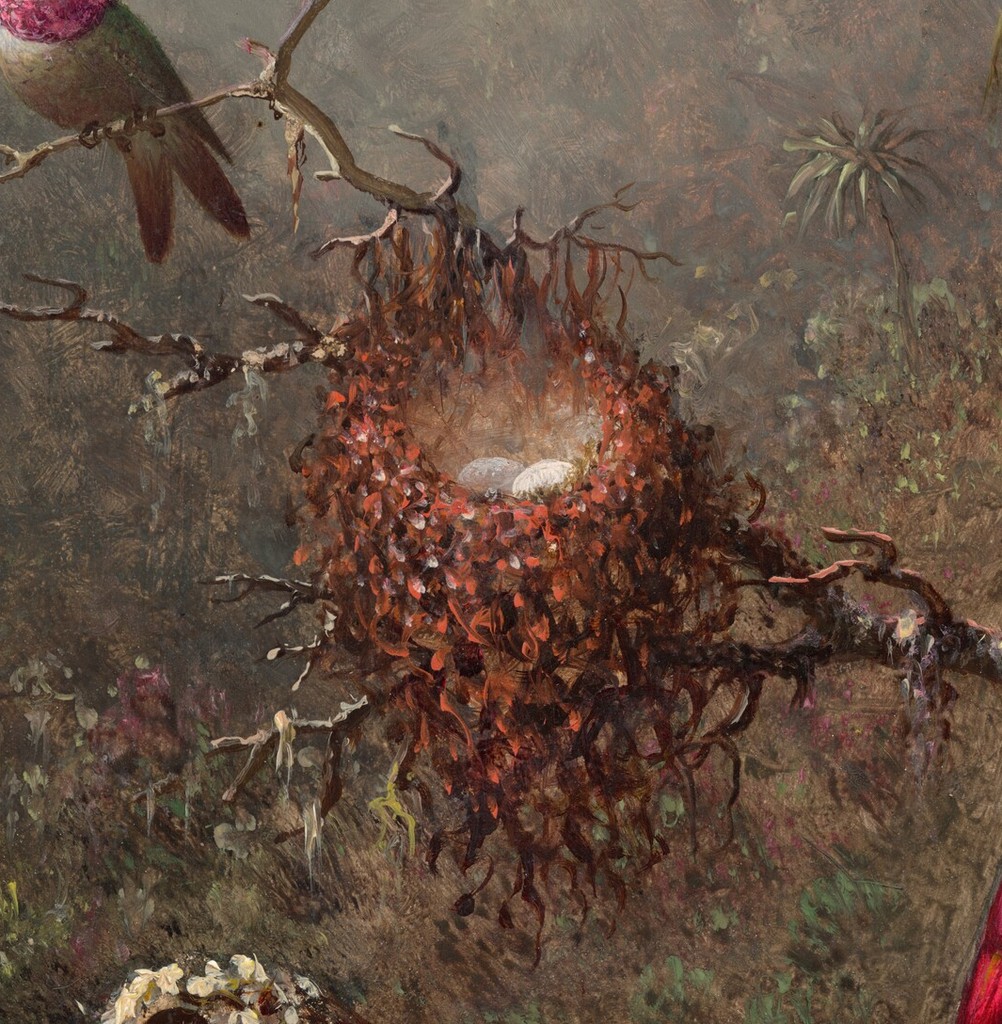
A small nest rests amid tangled branching below the perched bird. The pale forms inside remain distinct from the surrounding darker material.
Two Hummingbirds above a White Orchid
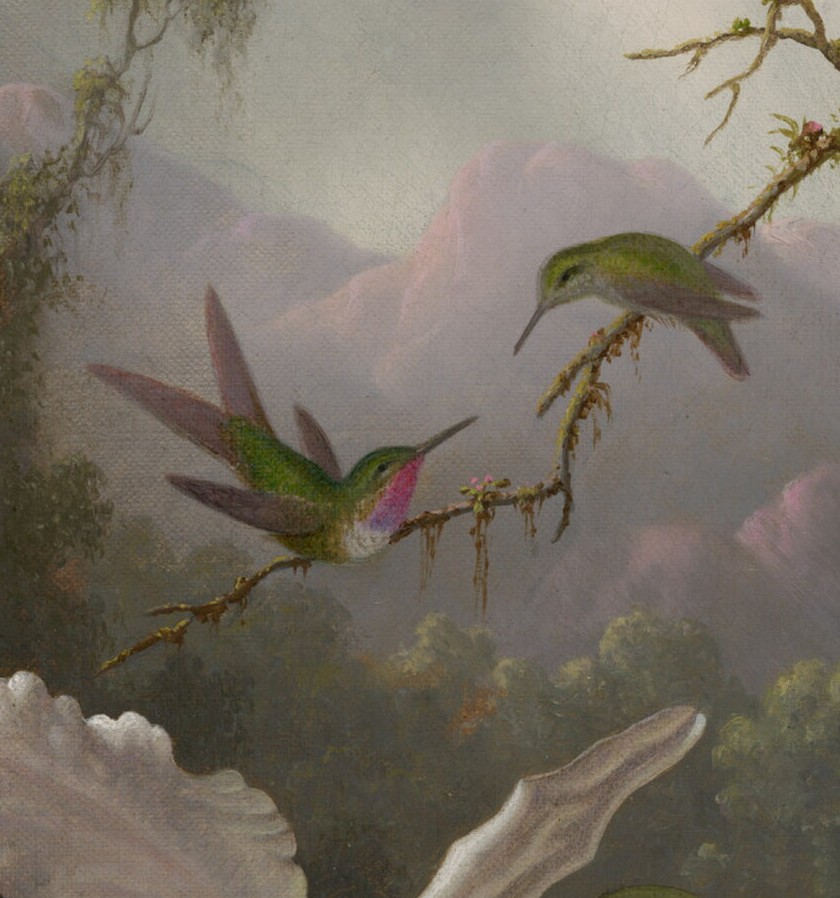
Two birds above the orchid
One bird hovers below another perched on a branch. Their different poses occupy the open air above the flower.
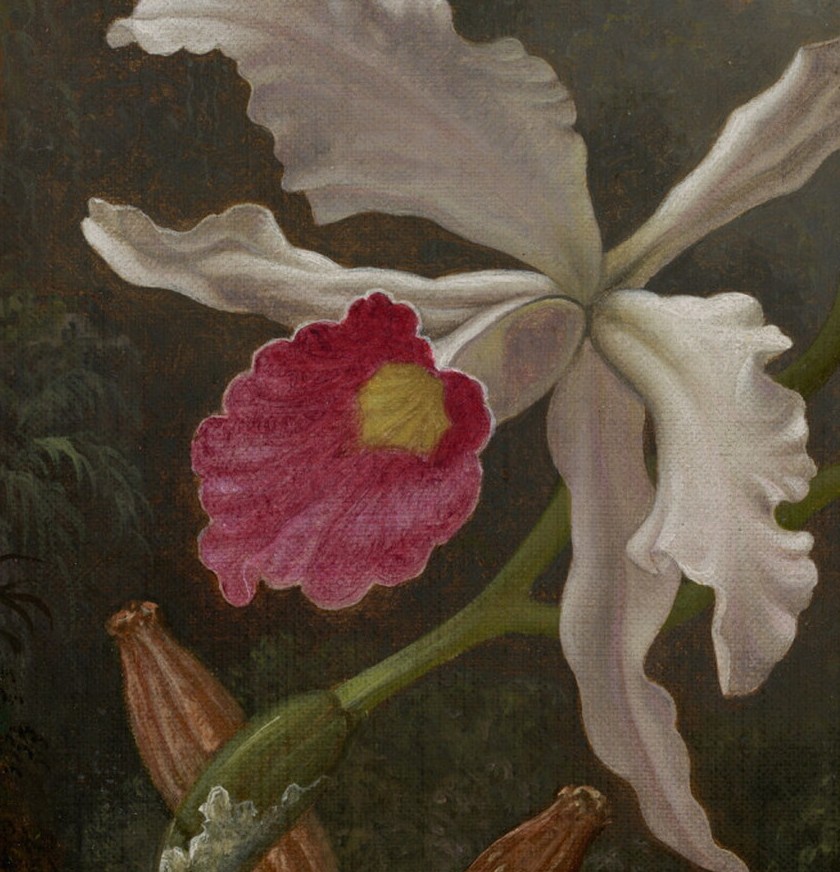
White orchid and coloured lip
Large pale petals surround a crimson lip with a yellow centre. The contrast makes the flower conspicuous against the darker woodland.
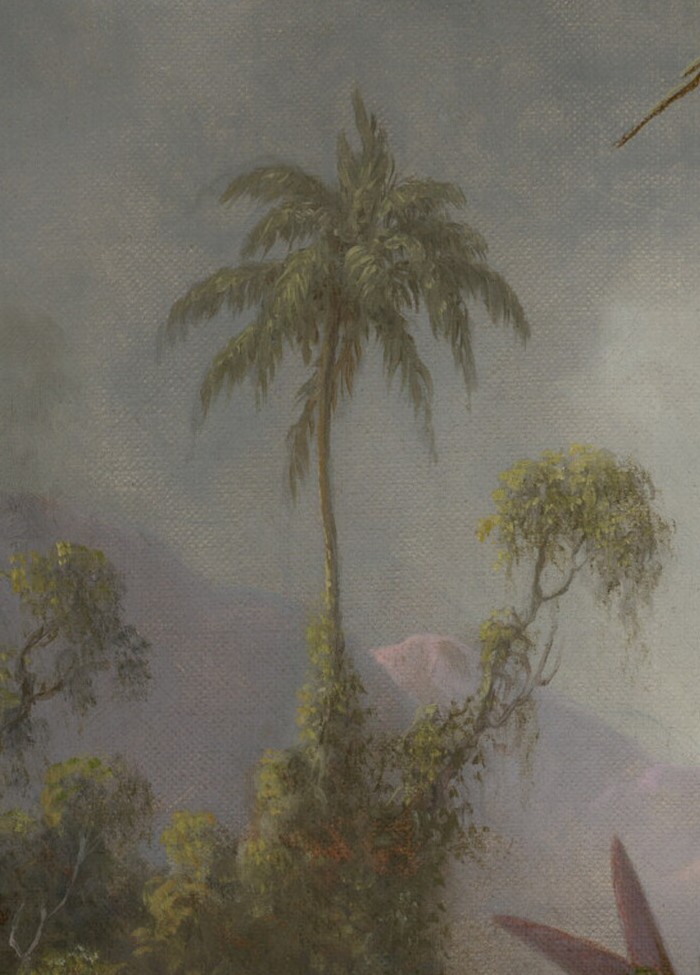
Tall background palm
A slender palm rises behind the foreground subjects. Its height contributes to the deep, upright forest setting.
From Gems to bird-and-flower pictures
Kelly’s NGA account places the unfinished Gems of Brazil project before Heade’s later combinations of hummingbirds with orchids and other flowers. The proposed book provided an early focus on Brazilian birds, while the later works developed a wider set of pictorial relationships.[1]
The publishing history requires a distinction between an unfinished book and executed prints. Cynthia Haveson Veloric’s scholarly article discusses trial chromolithographs and working proofs. Their existence does not mean that the complete planned book appeared.[10]
Nor should different historical groups of paintings be combined into one certain list. Veloric distinguishes the account of an original project from a group rediscovered in London and cautions against assuming all the collecting histories are identical. The separate Gems of Brazil article follows those questions more closely.[10]
For the later bird-and-flower paintings, the main change is compositional. A large orchid, winding branch, nest and background landscape can share the canvas with birds. The image becomes an arrangement of several subjects rather than only an individual bird presented for identification.
Porter compares Heade’s project with John Gould’s hummingbird illustrations, including their more isolated presentation against largely pale pages. The comparison concerns different ways of making birds available to viewers. It helps explain how Heade’s darker vegetation and atmospheric distance could give a natural-history subject a distinctive pictorial setting.[3]
A large flower within a small landscape
The NGA’s Cattleya Orchid and Three Hummingbirds places a pink orchid on the left and birds around a nest on the right. Mossy branches cross the foreground, while trees and atmospheric distance recede behind the group. The flower remains prominent without occupying the entire picture.[1]
The relationship between foreground and distance is fundamental. Closely described flower parts and bird plumage appear against less distinct vegetation. The viewer can examine a small subject while also experiencing a landscape beyond it.
In the Carter’s Two Hummingbirds above a White Orchid, the tall format produces another arrangement. The large pale orchid occupies much of the lower field, while the two birds sit above it among branches. The flower’s light surface and coloured lip differ from the greener surrounding vegetation.[9]
The orchid’s prominence can make the birds seem especially small. That is a relationship within the composition, rather than proof that the plant has been enlarged beyond its natural scale. The Carter’s account considers the subjects in connection with their observed sizes.[9]
The smaller distant vegetation provides another scale. Heade can combine a near flower, a tiny bird and a broad background within one compact image. Their relative emphasis gives the viewer both intimacy and a suggestion of extensive space.
Different birds, nests and material supports
The NGA picture contains three birds and a nest with two eggs. Kelly’s historical entry identifies two Brazilian amethysts and a Sappho comet. Those identifications belong to the catalogue’s account; they are not a new taxonomic determination made solely from the reproduction.[1]
The nest adds a distinct form and context. Its woven structure occupies the same foreground branch system as the flower and birds. The eggs are visible within it, while different bird poses create several directions of attention nearby.
These relationships do not supply a complete behavioural sequence. A painting gathers gestures into one fixed image, and the presence of a nest does not establish every interaction implied by the birds’ positions. Description can remain precise without identifying an observed territorial encounter.
The Carter’s current object commentary identifies its pair as amethyst woodstars and the orchid as Cattleya purpurata. The terms are attributed to the museum. The separate botanical history of names should not be silently resolved through a casual visual resemblance.[9]
Support also differs between works. The 1871 NGA Cattleya is painted on wood, whereas the Carter White Orchid and Met Passionflowers are canvases. The shared subject does not establish one physical format or an identical painting process for the group.[1][6][9]
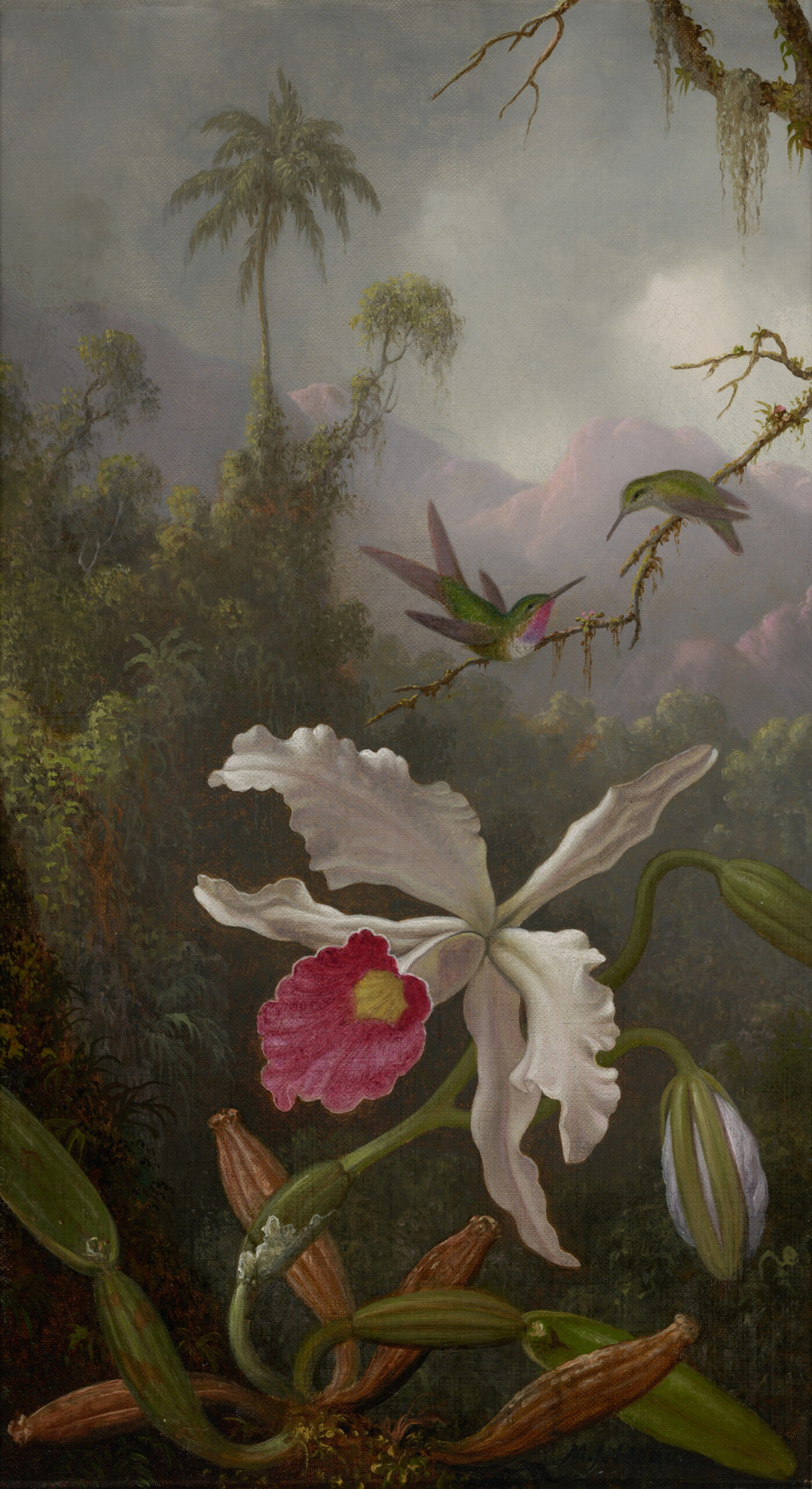
Martin Johnson Heade, Two Hummingbirds above a White Orchid, c.1875–90. Amon Carter Museum of American Art, 1981.33. Image source. Public domain. Resized only; native appearance preserved.
A modern living-bird comparison
Dario Sanches’s photograph shows a male amethyst woodstar perched on a twig. The file record dates it to 26 April 2008 at Chácara Antonio Wuo in Mogi das Cruzes, São Paulo. It supplies a modern comparison with the bird named in the Carter commentary.[8]
Its purple throat, pale chest and green head can be examined within a photographic setting. The photograph also makes the difference between a crisp near bird and a softly blurred background particularly clear. These are observable features of this image, rather than a reconstruction of Heade’s working conditions.
The bird was photographed more than a century after the painter’s death. It is not his specimen, an illustration he consulted or evidence of his exact viewpoint. Its value is as a living-bird comparison linked explicitly to a museum identification.
Painting and photograph organise the background differently. Sanches’s image separates the bird through focus, while Heade’s tropical compositions give flowers, branches and distant vegetation their own roles. The comparison helps readers examine the bird without reducing the painted setting to a photographic snapshot.
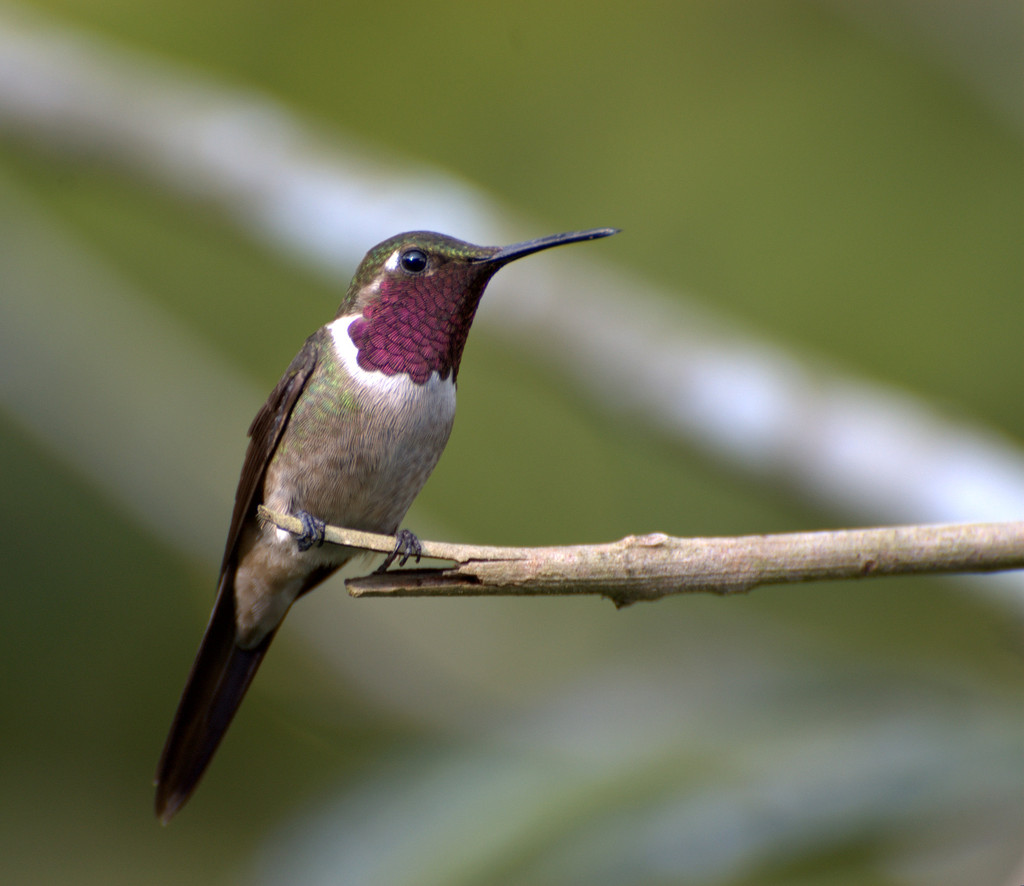
Male amethyst woodstar photographed by Dario Sanches at Chácara Antonio Wuo, Mogi das Cruzes, São Paulo, Brazil, 26 April 2008. Modern living-bird comparison, not a specimen used by Heade. Resized only; this photograph remains CC BY-SA 2.0. Dario Sanches, via Wikimedia Commons. Image source. CC BY-SA 2.0. Resized only; photograph remains CC BY-SA 2.0.
Watch: Martin Johnson Heade
Choose a film to explore the artist’s work, its interpretation and its wider setting.
Museum Minute: Heade Hummingbirds
A brief Shelburne Museum introduction to Heade’s hummingbird paintings.
Watch on YouTubeOrchids and ecological relationships
Porter discusses the realism and intimacy of Heade’s orchid pictures alongside the question of pollination. Drawing on botanical expertise, she explains that birds placed beside particular orchids do not necessarily depict their actual pollinators. Visual association and ecological interaction are different claims.[2]
This distinction makes the compositions more interesting as arrangements. Flower and bird can be connected through colour, line, scale and the viewer’s attention without recording a scientifically established feeding event. A detailed image can still be selectively constructed.
The Met’s Hummingbird and Passionflowers offers another subject. One bird perches among four open red flowers, with curling tendrils and hazy distance. Its c.1875–85 date and accession 46.17 identify a separate canvas.[6]
The bird is visibly perched rather than shown entering a flower. The image alone does not establish nectar feeding. Porter’s orchid discussion also cannot be transferred automatically to this different flowering vine as a specific pollination claim.
Exact ecological statements require exact subjects and supporting research. The paintings can nevertheless be studied through their visible arrangements, leaving species and behaviour qualified where the consulted evidence does not settle them.
Darwin and inferred intention
Porter’s Darwin essay considers relationships between male combat, female choice and spectatorship. She asks whether the viewer’s judgement of paintings might be compared with selection among birds. Her proposal is an interpretation of Heade’s art and writing.[4]
The broader nineteenth-century context of natural history makes such questions possible. Kelly also discusses potential intellectual associations in the bird-and-flower paintings. Neither account establishes a personal friendship between Heade and Darwin or a fixed evolutionary programme for every tropical canvas.[1]
The distinction between context and intention is useful. A reader can consider natural-history debates while still asking what the particular image actually shows. Nest, eggs, bird poses and flower placement provide the visible starting points; interpretation develops from them with its sources identified.
It also prevents uncertainty from becoming a dramatic biography. A possible interest in orchid research does not prove a visit to Kew Gardens, and a depiction of flight does not prove that the finished bird was painted directly on the wing. Those assertions require different evidence.
Imperial patronage and later tropical pictures
Elizabeth Neely’s Carter essay discusses Heade’s 1863–64 Brazilian visit, a display of twelve hummingbird pictures and the emperor’s encouragement. It provides a useful patronage context for the earlier project. The account does not establish an imperial commission of the much later White Orchid canvas.[5]
The distinction keeps the biography connected with exact works. A patron’s support during travel can affect an artist’s opportunities without explaining every later subject or determining who first owned each canvas.
Tropical subjects persisted well into Heade’s Florida years. Manthorne’s Thyssen entry identifies Orchid and Hummingbird near a Mountain Waterfall as a 1902 painting, accession CTB.1979.44. Its close foreground subject and distant waterfall belong to a late continuation of the practice.[7]
The date is important because the picture follows the earlier Latin American journeys by decades. It should not be treated as proof of a new 1902 expedition. The continuing subject could develop through accumulated studies and artistic invention.
Manthorne considers the relationship between intimate detail and tropical distance, including interpretive associations with nature and evolution. Her argument supplies a comparison with the NGA, Carter and Met examples while remaining attached to its own object.[7]
Comparing observation and construction
The most productive reading holds several kinds of evidence together. Current museum records establish the objects; scholarly catalogues explain history and, in specific cases, materials; the complete images show how birds, flowers and space are arranged. A modern photograph can supply a clearly dated comparison.
No single category replaces the others. A museum species identification should be credited, an interpretive argument should remain attributed, and a visible pose should not become a behavioural experiment. These distinctions preserve the paintings’ richness rather than diminishing their natural-history interest.
Across the group, Heade repeatedly makes small living forms substantial to the viewer. Colourful flowers and birds become close subjects within larger imagined or observed environments. The differences between the wood-panel Cattleya, tall White Orchid, red Passionflowers and later waterfall picture demonstrate how flexible that approach remained.
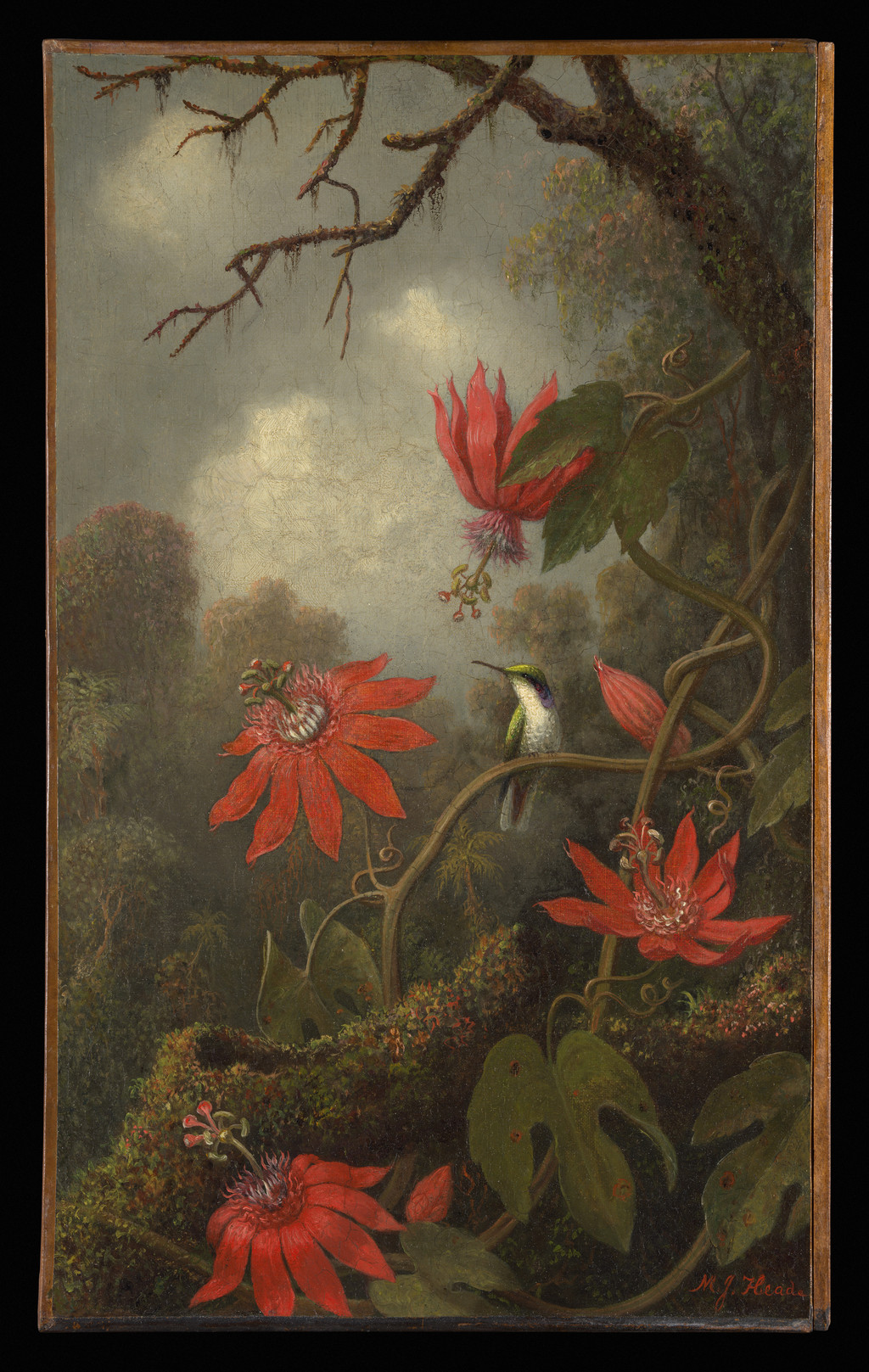
Martin Johnson Heade, Hummingbird and Passionflowers, c.1875–85. Metropolitan Museum of Art, 46.17. Purchase, Gift of Albert Weatherby, 1946; Metropolitan Museum of Art. Image source. CC0 / Public domain. Resized only; native appearance preserved.
Artworks directory
A collected selection of 26 individually identified museum paintings, including thirteen extended artwork studies. This is a bounded directory, rather than a complete catalogue raisonné. Two Boston entries retain dates from the 2002 conservation study. Links open a companion article where available, otherwise the cited institutional record or publication; unillustrated objects remain included.
Frequently Asked Questions
They should not be assumed to be. Porter distinguishes visual groupings of orchids and birds from ecological relationships, and individual pictures require their own evidence.[2]
No. Sanches took it in Brazil in 2008. It is a modern living-bird comparison with the museum-identified subjects.[8]
No. The Thyssen’s 1902 Orchid and Hummingbird near a Mountain Waterfall provides a late example, long after the earlier Latin American journeys.[7]
Discussion
Look again at the images and ideas explored in Martin Johnson Heade’s Hummingbirds and Orchids. These editorial prompts invite your observations.
Reader Insights
How does a bird’s pose change its relationship with a large flower?
What does the modern woodstar photograph add to your looking at the painted birds?
Where do observation and composed space each become important?
Join the Conversation
Share a detail, comparison or question about Martin Johnson Heade’s Hummingbirds and Orchids below.
References
- Franklin Kelly, American Paintings of the Nineteenth Century, Part I (NGA, 1996), printed pp.287–294. Career, earlier project and exact Cattleya painting. View source
- Charlotte M. Porter, Florida Museum, “Visual Interests”. Travel routes, studies, birds and attributed orchid-pollination discussion. View source
- Charlotte M. Porter, Florida Museum, “Natural History”. Broader natural-history and writing context; unconsulted primary excerpts paraphrased through the museum. View source
- Charlotte M. Porter, Florida Museum, “Darwin and Heade”. Attributed interpretation of combat, choice and spectatorship. View source
- Elizabeth Neely, Carter Museum, “An Orchid, an Emperor, and Hummingbirds” (2023). Brazilian journey and imperial patronage context. View source
- Metropolitan Museum of Art, Hummingbird and Passionflowers, 46.17. Exact separate canvas, current dating and dimensions. View source
- Katherine E. Manthorne, Thyssen, Orchid and Hummingbird near a Mountain Waterfall, CTB.1979.44. Exact 1902 work and attributed spatial interpretation. View source
- Wikimedia Commons, Dario Sanches, male amethyst woodstar photograph. Exact 2008 image, location and CC BY-SA 2.0 record. View source
- Amon Carter Museum of American Art, Two Hummingbirds above a White Orchid, 1981.33. Exact canvas and current museum species identifications. View source
- Cynthia Haveson Veloric, “Hummingbirds, Emperors, and Railway Barons: Heade’s Gems and their Journeys,” Nineteenth Century 36(2), Fall 2016, printed pp.17–23. Trial chromolithographs, project and qualified collecting-group history. View source
- Splash image source.
Martin Johnson Heade, Cattleya Orchid and Three Hummingbirds, 1871. Oil on wood. National Gallery of Art, 1982.73.1. Gift of The Morris and Gwendolyn Cafritz Foundation; National Gallery of Art. CC0 / Public domain. Resized only; native appearance preserved.
View source