 by Tom Gurney
Tom Gurney BSc (Hons) is an art history expert with over 20 years experience
Email: tomgurney1@gmail.com / Phone: +44 7429 011000
Thunder Storm on Narragansett Bay by Martin Johnson Heade: Introduction
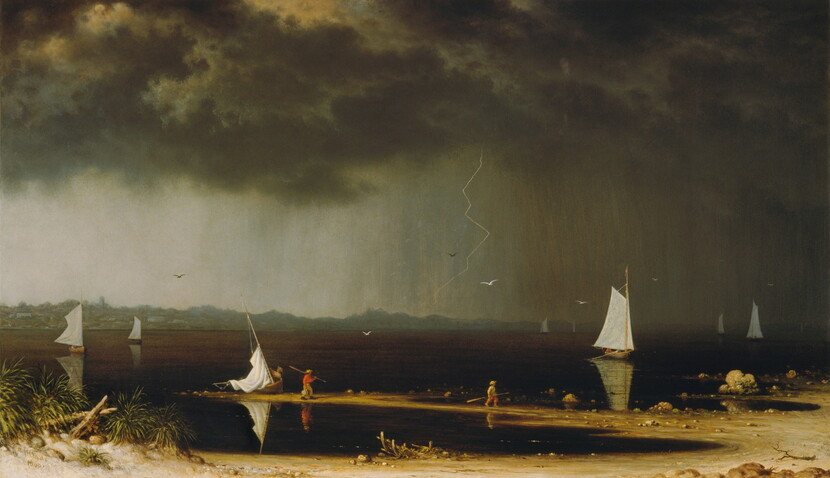
Martin Johnson Heade’s Thunder Storm on Narragansett Bay spreads dark cloud and rain above remarkably still water. White sails and a thin lightning bolt interrupt the darkness, while figures return along the sandy shore beside a boat. Painted in 1868, the canvas belongs to the Amon Carter Museum of American Art. The museum’s account emphasises the contrast between unsettled weather and calm sailors, and considers possible meanings associated with the Civil War and Reconstruction.[1]
At a Glance
- ArtistMartin Johnson Heade (1819–1904)
- TitleThunder Storm on Narragansett Bay
- Date1868
- MediumOil on canvas
- Dimensions32⅛ × 54¾ inches
- CollectionAmon Carter Museum of American Art, Fort Worth
- Accession1977.17
- Visible contrastsDark cloud, still bay, pale sails, lightning and shore activity
This work across Martin Johnson Heade’s career
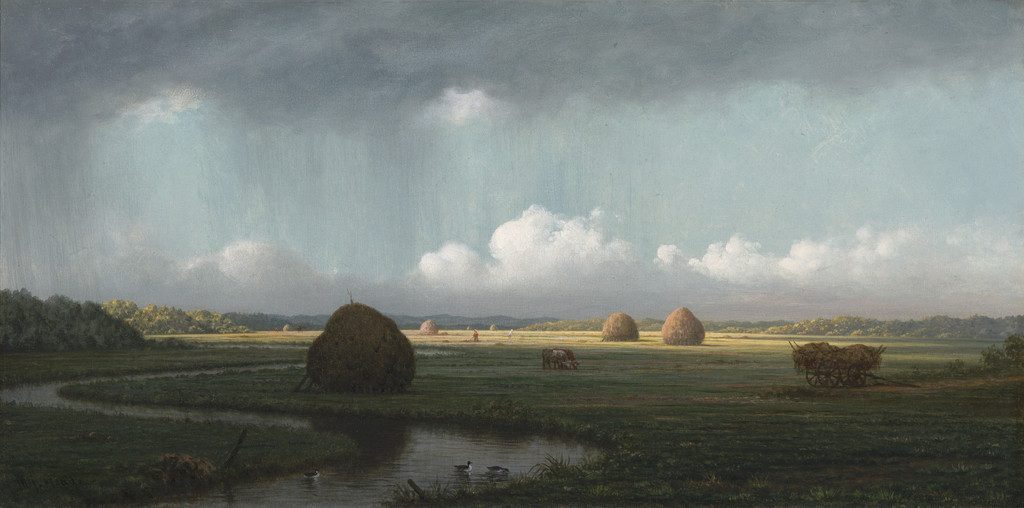
Sudden Shower, Newbury Marshes
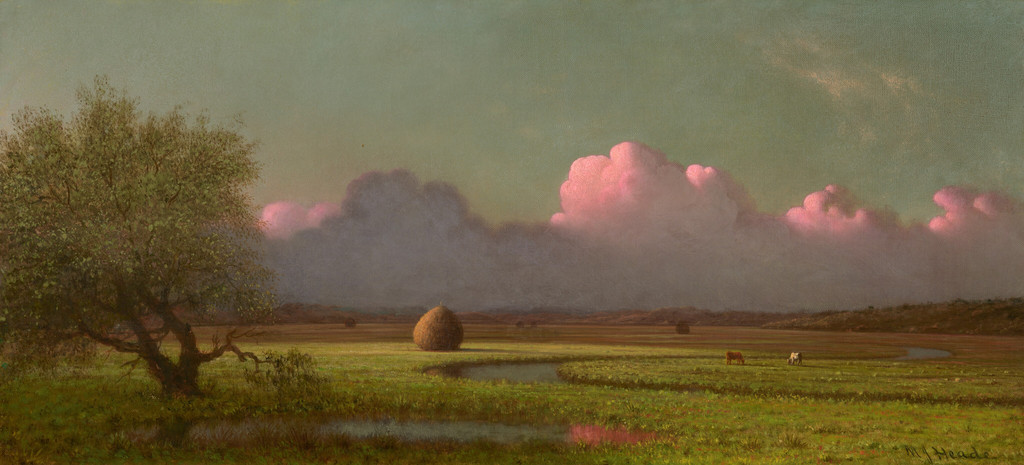
c.1865–75View of Marshfield
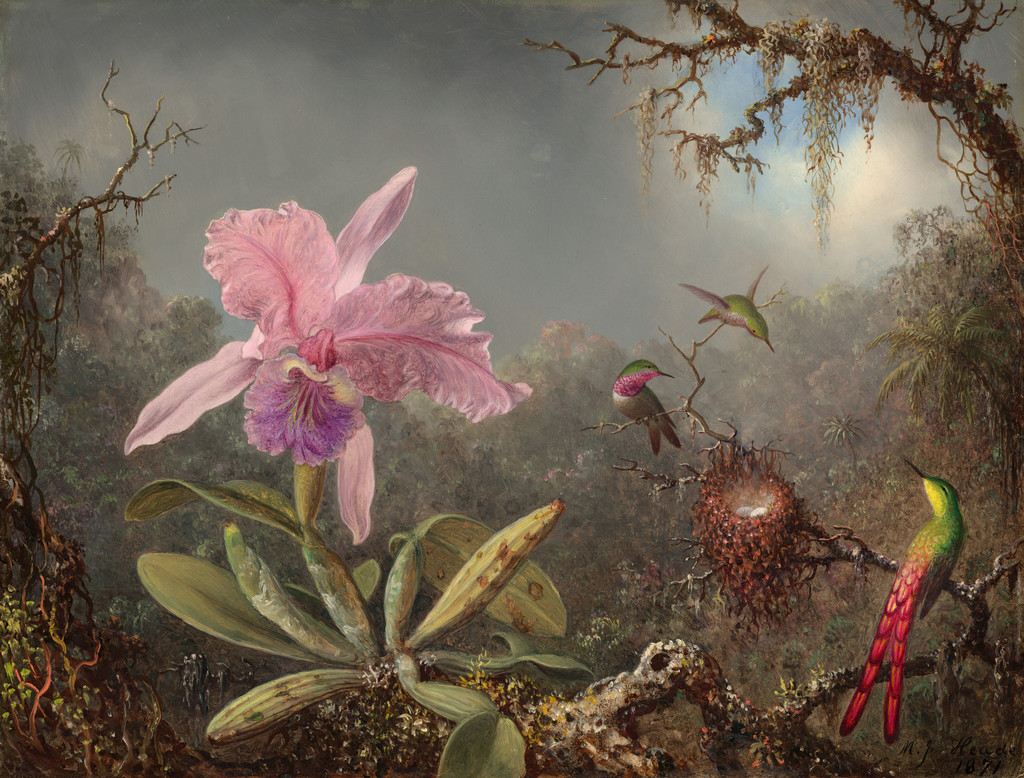
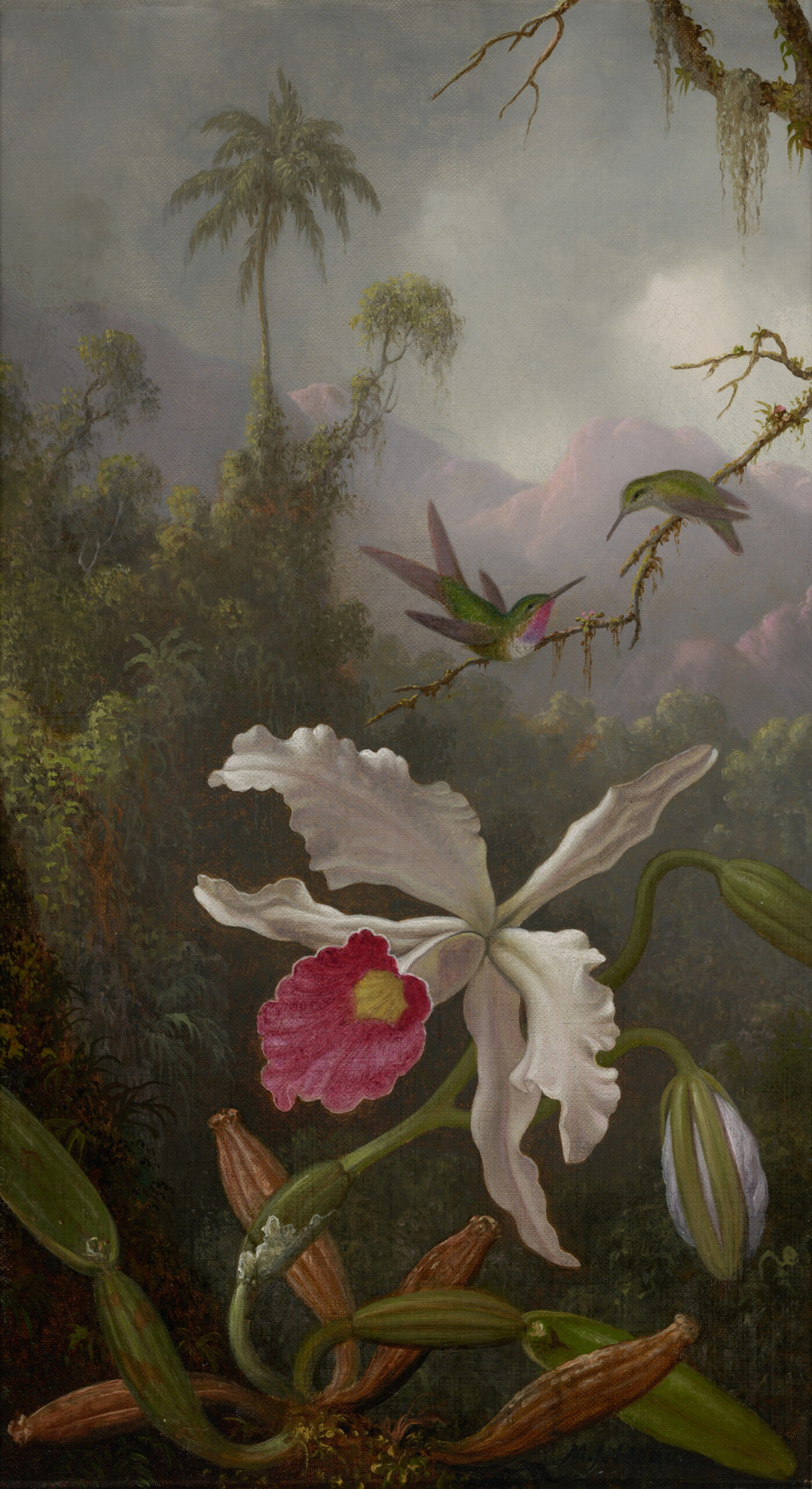
c.1866–76Hummingbird and Passionflowers
c.1875–85Newburyport Meadows
c.1876–81Magnolias on Light Blue Velvet Cloth
c.1885–95Contents
- The storm’s horizontal reach
- Lightning and white sails
- People at the water’s edge
- Narragansett, date and object history
- Comparison with earlier storms and a quieter harbour
- Civil War and Reconstruction as possible readings
- Annotated details
The storm’s horizontal reach
The cloud stretches across almost the entire upper part of the painting. Its lower edge is uneven, with darker forms gathering above the bay and lighter areas appearing nearer the left. This broad mass gives the weather a reach much greater than any individual boat below it.
Rain descends into the distance, particularly on the right. The far shore becomes less distinct through that darker air, while buildings and vegetation remain more legible towards the left. Visibility changes across the picture along with the weather.
The bay is comparatively calm. Its smooth surface reflects nearby sails, and long darker bands run across it. The contrast with the churned cloud makes the scene tense without requiring a violently broken foreground wave.
The pale shore occupies a smaller portion of the canvas than the sky, but it gives the viewer a place close to the water. Grass, scattered wood and stones interrupt the sand. These low forms help establish the immediate position from which the weather is encountered.
The Carter’s visual description estimates that the sky occupies about two thirds of the canvas. That distribution helps explain the weather’s dominance: the sailors and their equipment occupy a much smaller field below a broad atmosphere extending across the whole bay.[1]
The composition holds together through broad horizontal relationships: beach, water, distant land and sky. Their boundaries are not equally distinct everywhere. Rain obscures part of the far shore while clearer areas allow the eye to follow it towards the left.
Annotated Details from Thunder Storm on Narragansett Bay
The numbered points identify visible features discussed in this article. Return from each detail to the whole composition. Martin Johnson Heade, Thunder Storm on Narragansett Bay, 1868. Oil on canvas. Amon Carter Museum of American Art, 1977.17. Native 830-pixel-wide museum image; no enlargement. Image source. Public domain. Resized only; native appearance preserved.
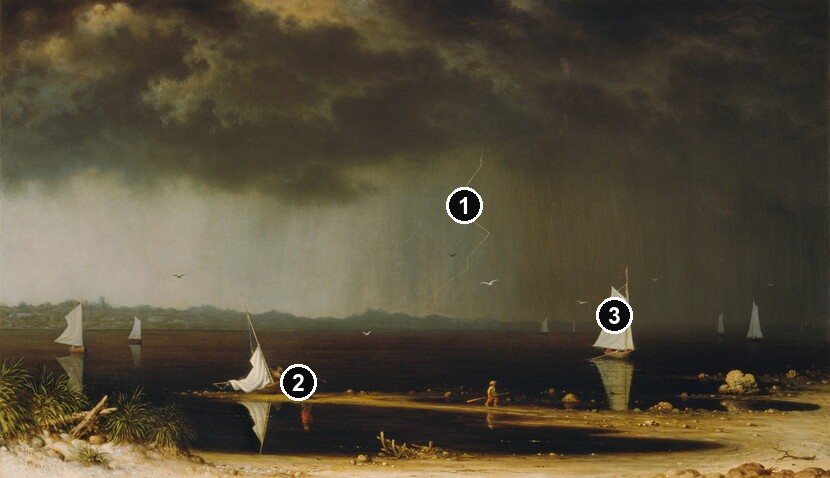
Details from THUNDER STORM ON NARRAGANSETT BAY
Compare the cropped details with the complete images above. Notice how their colours, shapes and positions contribute to the larger compositions.
Lightning and changing sky
A pale zigzag descends beneath the storm cloud. This broad view retains the relationship between lightning, cloud and distant water.
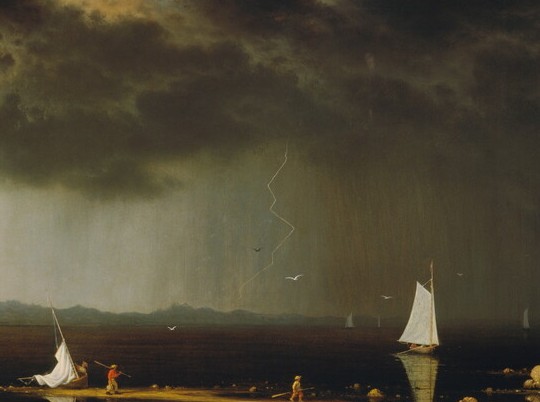
Near boat and shore figures
A boat and small figures occupy the illuminated foreground shore. Their broad setting is retained here; this source does not support minute facial detail.
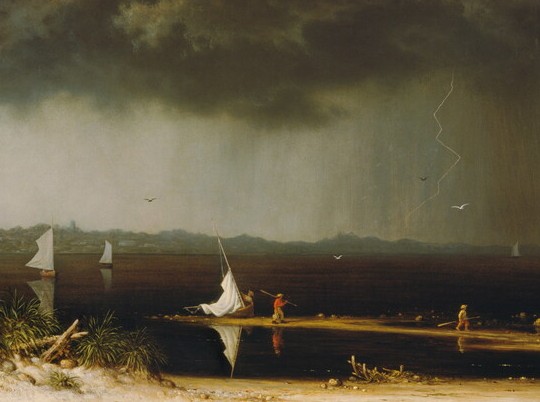
Light sail against dark water
A pale sail stands against the dark water and rain. The broad crop connects it with the nearby shore and storm.
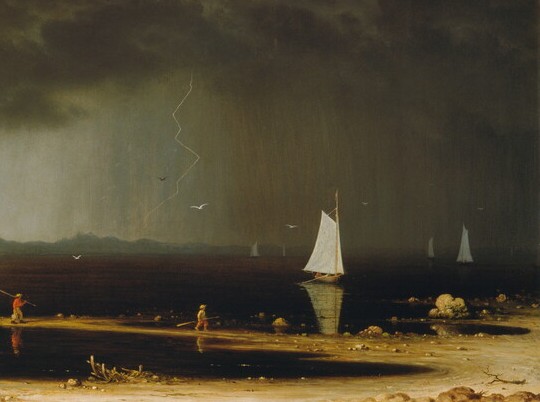
Lightning and white sails
The lightning bolt is narrow and angular. It occupies little of the canvas, yet its pale line is conspicuous against the dark cloud and rain. Its zigzag shape differs from the straighter masts and smoother outlines of the sails.
Several vessels occupy the water. The larger pale sail on the right is particularly clear, and its reflection extends down through the still bay. Smaller sails farther away become thin light accents within the darker distance.
The boats establish scale beneath the enormous sky. Their reduced size makes the weather seem extensive, while their differences in distance give the water depth. The bay remains an inhabited space rather than an abstract dark strip.
The boat near the shore has a less fully extended sail. Its pale fabric and reflection form a paired shape close to the figures. That relationship connects the distant sailing activity with the immediate shore.
Birds provide additional small interruptions above the water. Their slight marks add movement without competing with the larger sails or lightning. They also help link the air above the bay with the forms below it.
Together these pale details prevent the dark atmosphere from becoming visually empty. Lightning, sailcloth, birds and reflection perform different jobs, even where each depends on a relatively small area of light paint.
People at the water’s edge
Two figures walk along the sandbar, separate from the boat but close enough to remain connected with it. Their red and pale clothing is more colourful than much of the surrounding scene. The figures remain small, yet they give the foreground a human scale.
The Carter’s visual description identifies an oar and bucket carried by one walker and another oar held by the second. It also describes a shadowed third figure working with the boat’s sail. The museum’s object commentary interprets the group as sailors arriving safely on shore.[1]
Their pace appears unhurried in that curatorial account. The weather is threatening, but the people do not perform a dramatic rescue or visible panic. This difference between atmosphere and action is one of the painting’s most distinctive relationships.[1]
The shore offers stability within the composition. Its sand and scattered objects contrast with the larger unsettled cloud, while the nearby boat links land and water. The viewer can follow the figures’ movement without assuming that every vessel farther out is already safe.
The painting does not identify the individuals by name. Their value within the scene lies in their actions, equipment and relationship to the boat and beach. The small scale allows human activity to remain part of a much larger weather event.
Watch: Martin Johnson Heade
Choose a film to explore the artist’s work, its interpretation and its wider setting.
Museum Minute: Heade Hummingbirds
A brief Shelburne Museum introduction to Heade’s hummingbird paintings.
Watch on YouTubeNarragansett, date and object history
The title places the subject at Narragansett Bay in Rhode Island. The Carter records a lower-left signature and date, 1868, together with the accession 1977.17. The museum’s current dimensions are used here rather than the slightly different width printed in the older Met catalogue.[1][2]
The approximate geographic subject should not be confused with a verified map position for every boat or shoreline feature. The painting provides an arrangement of bay, beach and storm; it is not a navigational chart recording an exact instant.
The museum lists historical appearances in Wild Spaces, Open Seasons: Hunting and Fishing in American Art in 2017–18 and From Remington to O’Keeffe: The Carter’s Greatest Hits in 2018–19. These different exhibition settings show how a storm seascape can be considered alongside outdoor activity and within a broader collection selection.[1]
Comparison with earlier storms and a quieter harbour
The Met’s Approaching Thunder Storm dates to 1859 and has accession 1975.160. Its foreground man, dog and shore differ from the boat-handling group here. The shared dark weather connects the pictures without making them interchangeable.[3]
Strazdes’s American Paradise entry compares the Carter picture with the separate Approaching Storm: Beach Near Newport at the Museum of Fine Arts, Boston. She sees less abrupt separation between sky and sea in the later Narragansett canvas. Her argument concerns differences between particular storm compositions.[2]
The Boston work is accession 45.889, with differing date ranges in historical publications. Its title should not be used as an alternative name for either the Met’s 1859 picture or the Carter’s 1868 canvas. Exact object identities matter when interpreting Heade’s recurring weather subjects.[2]
York Harbor, Coast of Maine offers a later and quieter comparison. The Art Institute’s 1877 painting uses boats and reflected light within a more open, illuminated harbour. It shows that Heade’s coastal practice extended beyond threatening skies.[4]
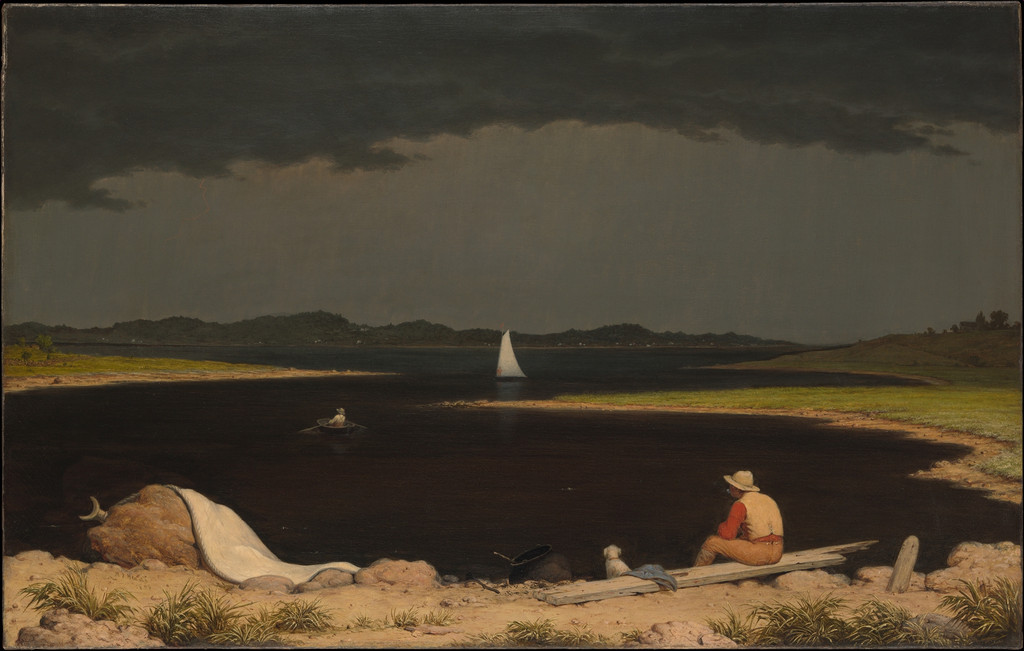
Martin Johnson Heade, Approaching Thunder Storm, 1859. Metropolitan Museum of Art, 1975.160. Image source. CC0 / Public domain. Resized only; native appearance preserved.
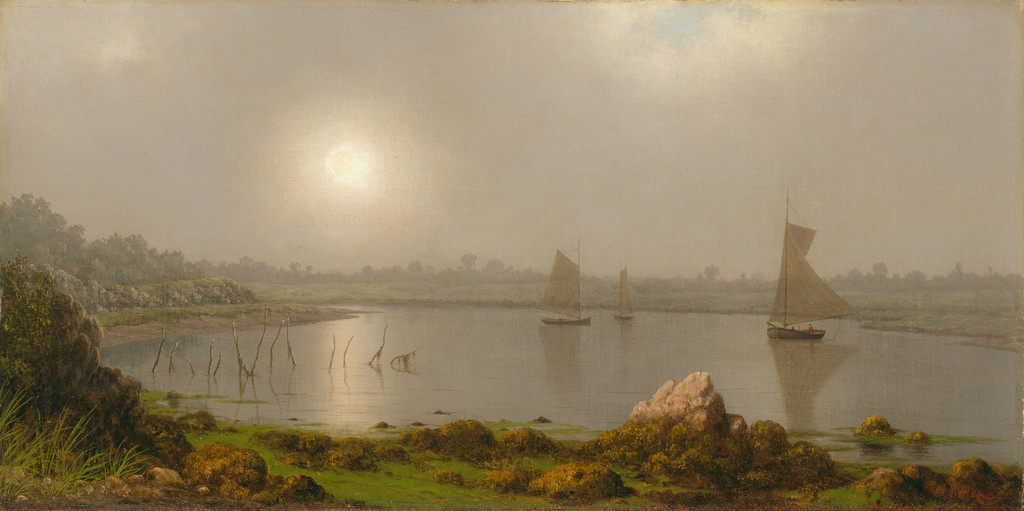
Martin Johnson Heade, York Harbor, Coast of Maine, 1877. Art Institute of Chicago, 1999.291. Image source. CC0 / Public domain. Resized only; native appearance preserved.
Civil War and Reconstruction as possible readings
The Carter’s 2023 handbook commentary describes at least eight storm canvases made between 1859 and 1868. That is a stated historical grouping, rather than a complete count of every painting involving unusual weather across Heade’s career.[1]
The museum proposes that storms, lightning and returning ships could carry metaphorical significance during the Civil War and early Reconstruction. In this account, the contrast between turbulent weather and arrival on shore can be considered alongside national disruption and hopes of stability.[1]
The proposal remains interpretive. The consulted sources do not supply an explanation by Heade declaring that each sailor represents a political figure or that a particular boat stands for the United States. Such details would go beyond the evidence.
The visible scene also works as an observation of changing weather and coastal activity. Its calm figures, lowered sail, reflected boats and distant rain establish relationships that remain available whether a reader adopts the historical metaphor or concentrates on the storm itself.
Artworks directory
A collected selection of 26 individually identified museum paintings, including thirteen extended artwork studies. This is a bounded directory, rather than a complete catalogue raisonné. Two Boston entries retain dates from the 2002 conservation study. Links open a companion article where available, otherwise the cited institutional record or publication; unillustrated objects remain included.
Frequently Asked Questions
The Carter describes three sailors: one working with the sail and two walking along the shore with equipment. Their individual names are not established in the consulted account.[1]
The museum proposes Civil War and Reconstruction associations, but treats the metaphor as a possibility. No fixed explanatory statement by Heade was established in the consulted evidence.[1]
Discussion
Look again at the images and ideas explored in Thunder Storm on Narragansett Bay by Martin Johnson Heade. These editorial prompts invite your observations.
Reader Insights
How do lightning, sails and dark cloud divide the scene?
What changes beside the Met1859storm and quiet York inlet?
How does the museum’s third sailor change your attention near the boat?
Join the Conversation
Share a detail, comparison or question about Thunder Storm on Narragansett Bay by Martin Johnson Heade below.
References
- Amon Carter Museum of American Art, Thunder Storm on Narragansett Bay, 1977.17. Current object data, visual description, 2023 handbook commentary and historical exhibitions. View source
- Diana J. Strazdes, Heade entries in American Paradise: The World of the Hudson River School (Met, 1987), printed pp.171–173. Separate Boston storm and Carter comparison; historical dimensions and chronology. View source
- Metropolitan Museum of Art, Approaching Thunder Storm, 1975.160. Exact separate 1859 object. View source
- Art Institute of Chicago, York Harbor, Coast of Maine, 1999.291. Exact separate 1877 harbour painting. View source
- Splash image source.
Martin Johnson Heade, Thunder Storm on Narragansett Bay, 1868. Oil on canvas, 32⅛ × 54¾ inches. Amon Carter Museum of American Art, 1977.17. Amon Carter Museum of American Art, Fort Worth, Texas. Public domain. Resized only; native appearance preserved.
View source