 by Tom Gurney
Tom Gurney BSc (Hons) is an art history expert with over 20 years experience
Email: tomgurney1@gmail.com / Phone: +44 7429 011000
Two Hummingbirds Above a White Orchid by Martin Johnson Heade: Introduction
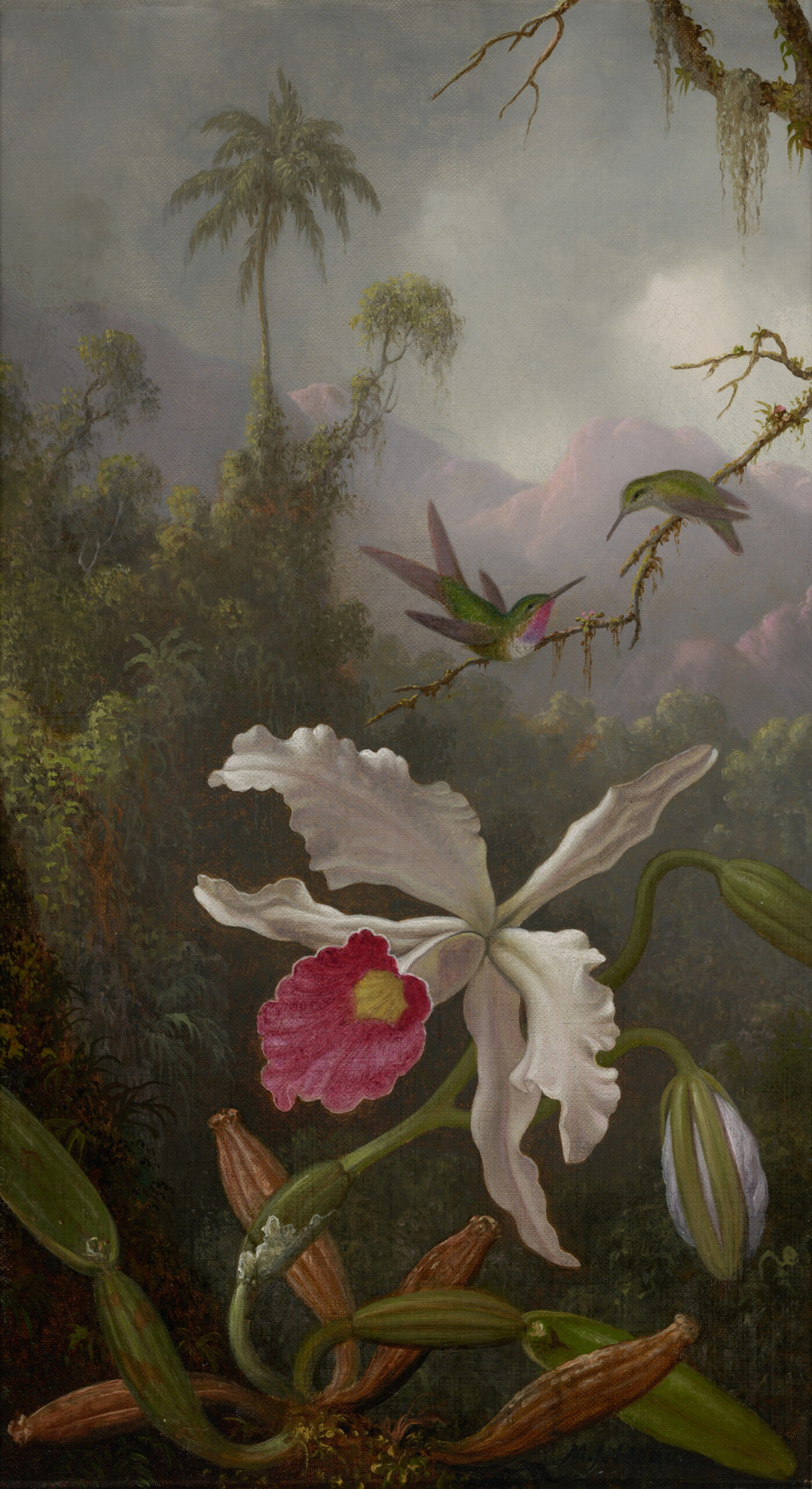
In Martin Johnson Heade’s Two Hummingbirds Above a White Orchid, a brilliantly pale flower occupies the near foreground while two much smaller birds perch above it. A dense forest, distant mountains and a heavy sky extend behind these closely observed subjects. The Amon Carter Museum of American Art dates the canvas to approximately 1875–90. Its account connects the birds and orchid with natural-history illustration, while the complete image reveals a landscape carefully built around their different shapes and colours.[1]
At a Glance
- ArtistMartin Johnson Heade (1819–1904)
- TitleTwo Hummingbirds Above a White Orchid
- Datec.1875–90
- MediumOil on canvas
- Dimensions18 1/8 × 10 1/8 inches
- CollectionAmon Carter Museum of American Art, Fort Worth
- Accession1981.33
- Museum identificationsAmethyst Woodstar hummingbirds and Cattleya purpurata orchid
This work across Martin Johnson Heade’s career
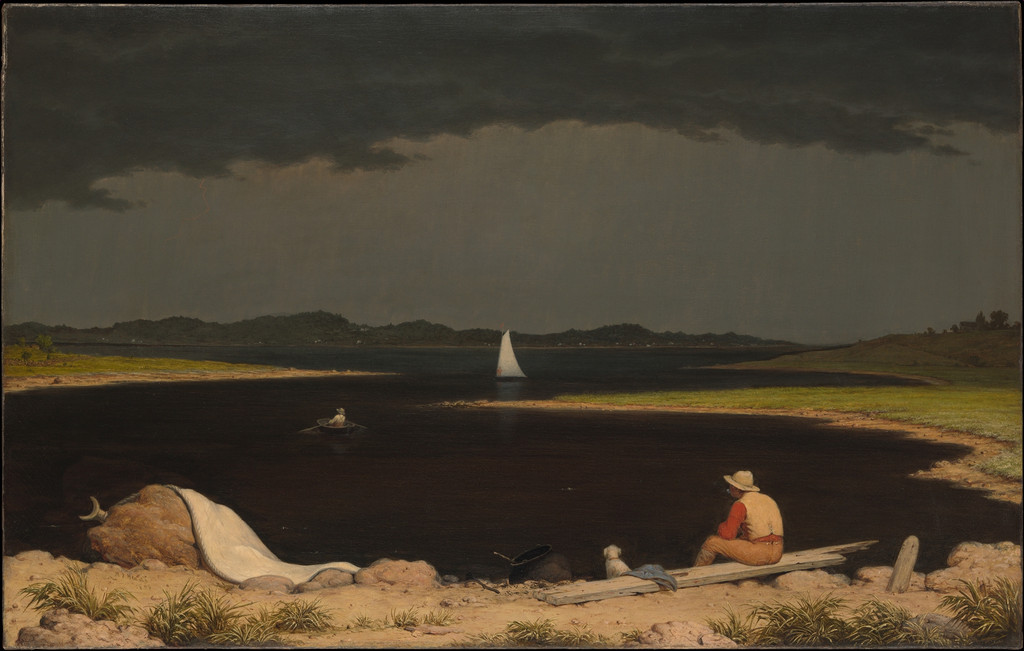
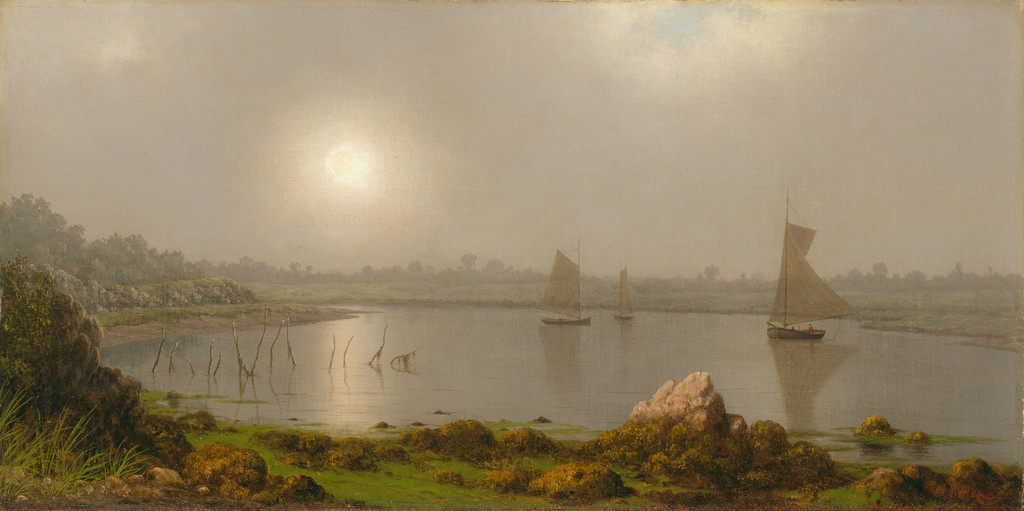
Sudden Shower, Newbury Marshes
c.1865–75View of Marshfield
c.1866–76Hummingbird and Passionflowers
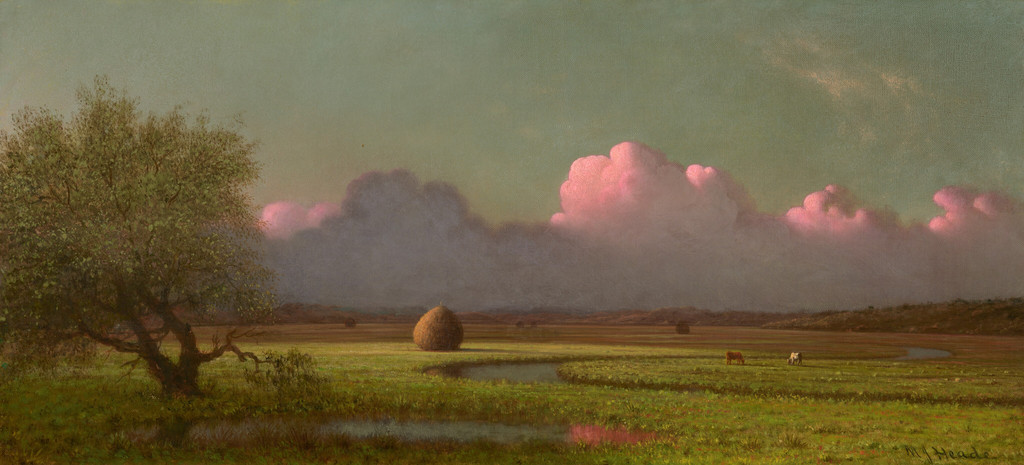
c.1875–85Newburyport Meadows
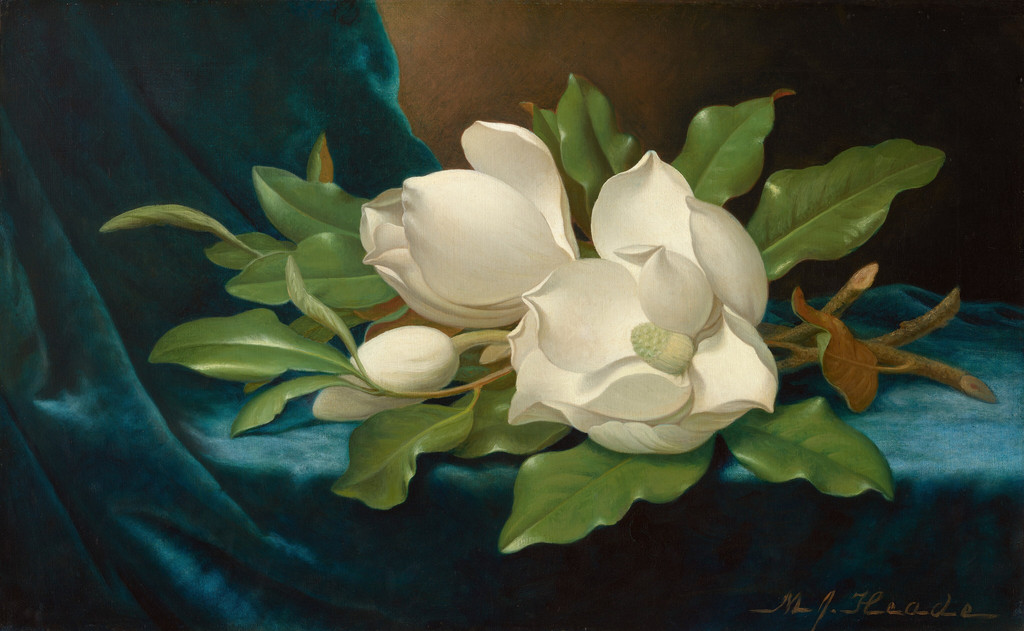
c.1876–81Magnolias on Light Blue Velvet Cloth
c.1885–95Contents
- An unusually tall tropical space
- Two birds above the flower
- White petals and a coloured lip
- Museum identifications and a constructed habitat
- Brazil and the later studio picture
- A complete image and related paintings
- Annotated details
An unusually tall tropical space
The picture is much taller than it is wide. Rather than spreading a tropical panorama across a horizontal canvas, Heade places the flower, birds and distant scenery along its height. The result invites the eye to move between nearby forms and a landscape that recedes behind them.
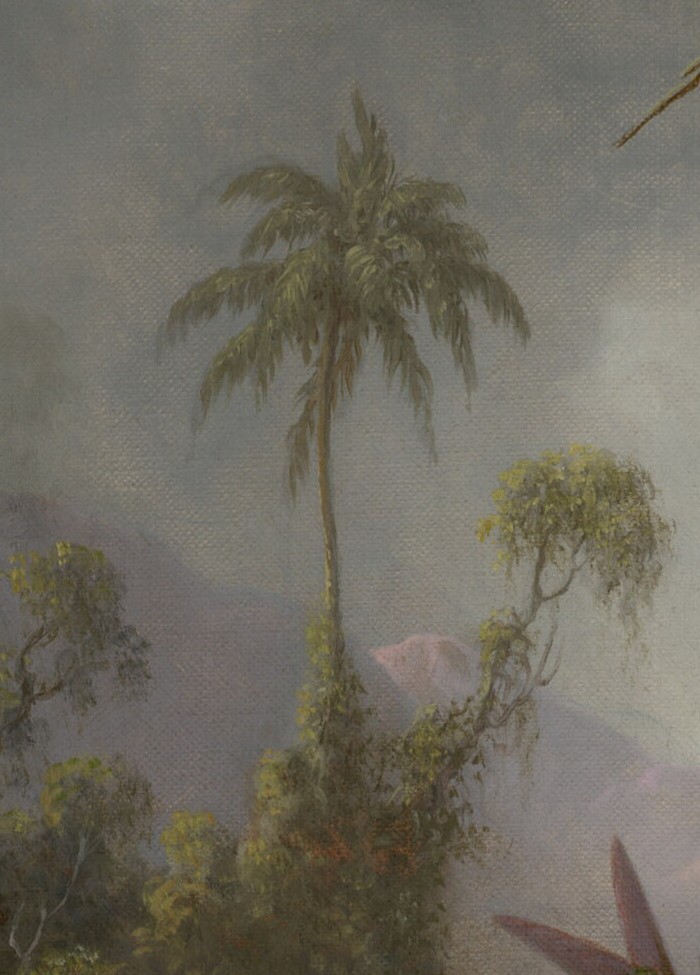
The orchid occupies much of the lower half. Above it, the branch carrying the birds rises diagonally towards the right edge. Hanging branches enter from the top, while a slender palm rises on the left. These different vertical and diagonal forms connect the close subjects with the taller picture field.
The distant mountains have a pink-grey tone, softened beneath the cloud. They are recognisable enough to establish another layer of space without competing with the flower. Small pale openings between the nearer vegetation give glimpses into that distance rather than a single unobstructed view.
Elizabeth Neely’s museum essay approaches the painting through foreground, middle ground and background. That division is useful, but the zones also overlap: the birds are displayed against the distant mountains, and the orchid’s long petals reach across darker greenery. The picture holds its different distances together through these shared boundaries.[2]
Annotated Details from Two Hummingbirds Above a White Orchid
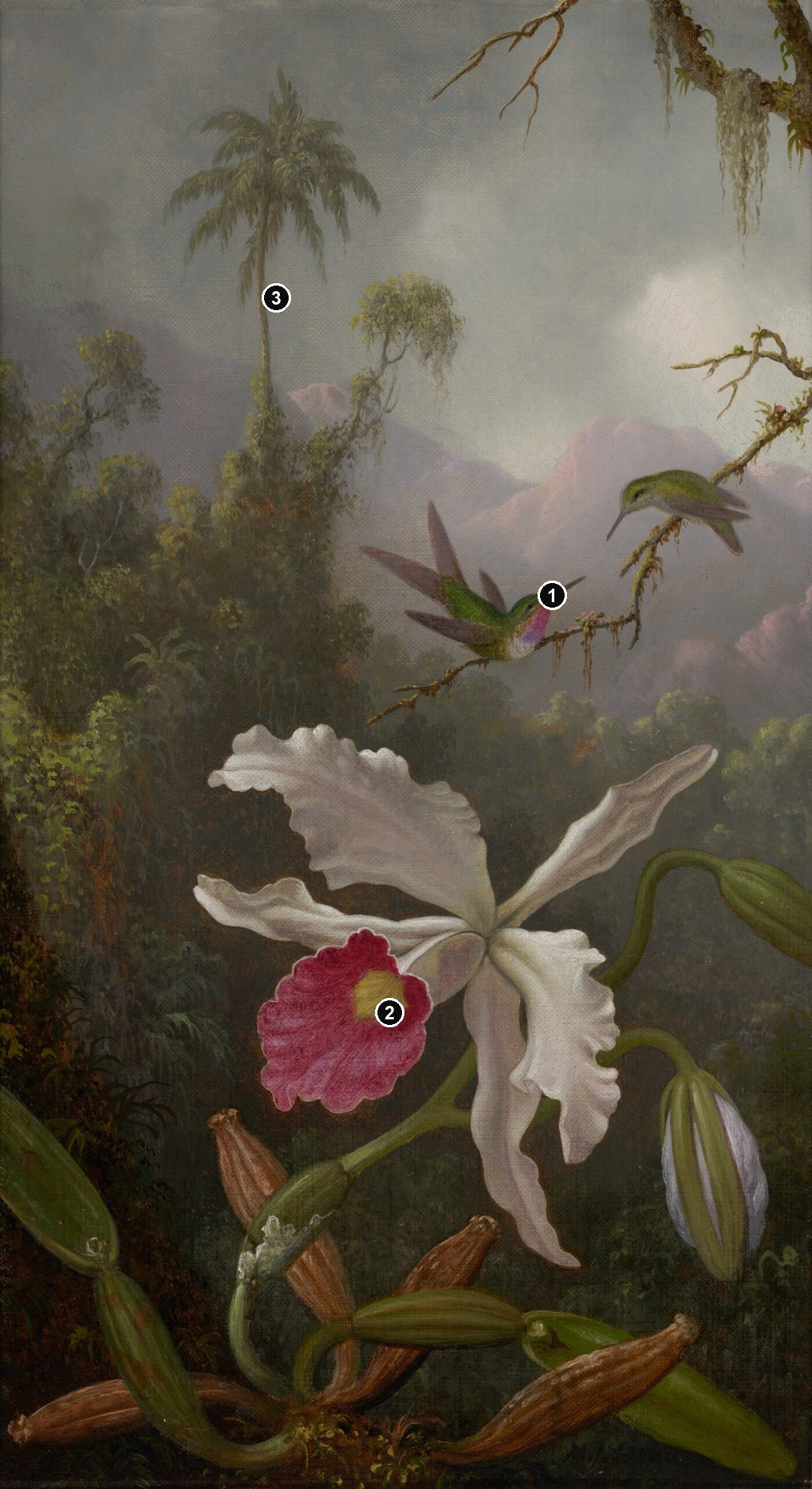
The numbered points identify visible features discussed in this article. Return from each detail to the whole composition. Martin Johnson Heade, Two Hummingbirds Above a White Orchid, c.1875–90. Oil on canvas, 18 1/8 × 10 1/8 inches. Amon Carter Museum of American Art, Fort Worth, 1981.33. Image source. Public domain. Resized only; native appearance preserved.
Details from TWO HUMMINGBIRDS ABOVE A WHITE ORCHID
Compare the cropped details with the complete images above. Notice how their colours, shapes and positions contribute to the larger compositions.
Two birds above the orchid
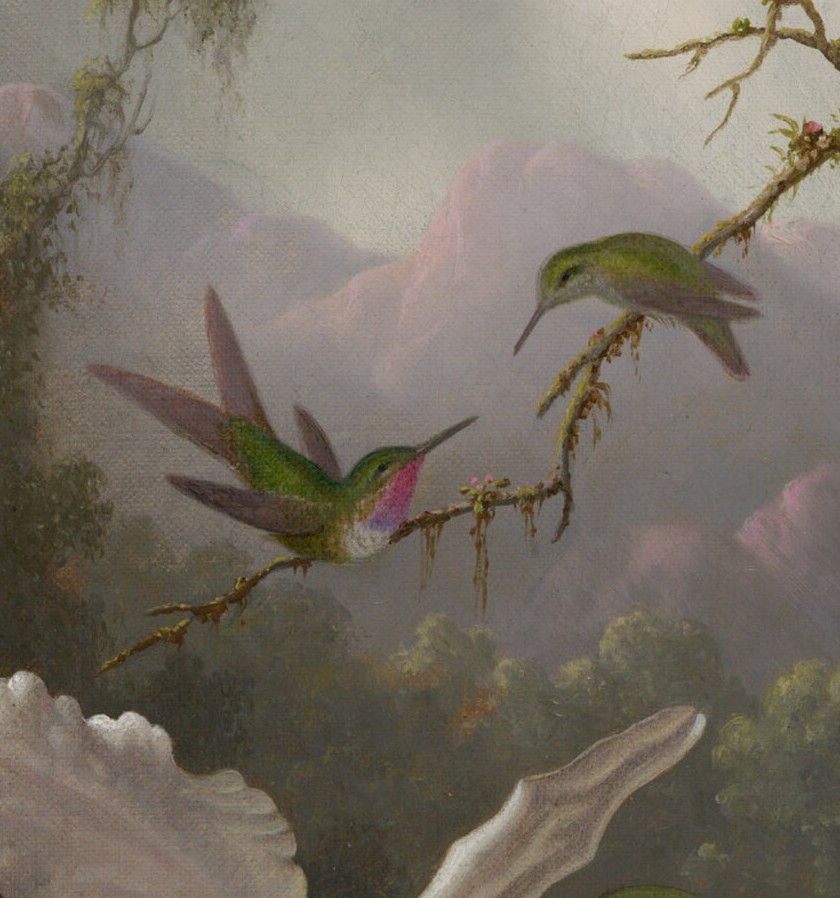
One bird hovers below another perched on a branch. Their different poses occupy the open air above the flower.
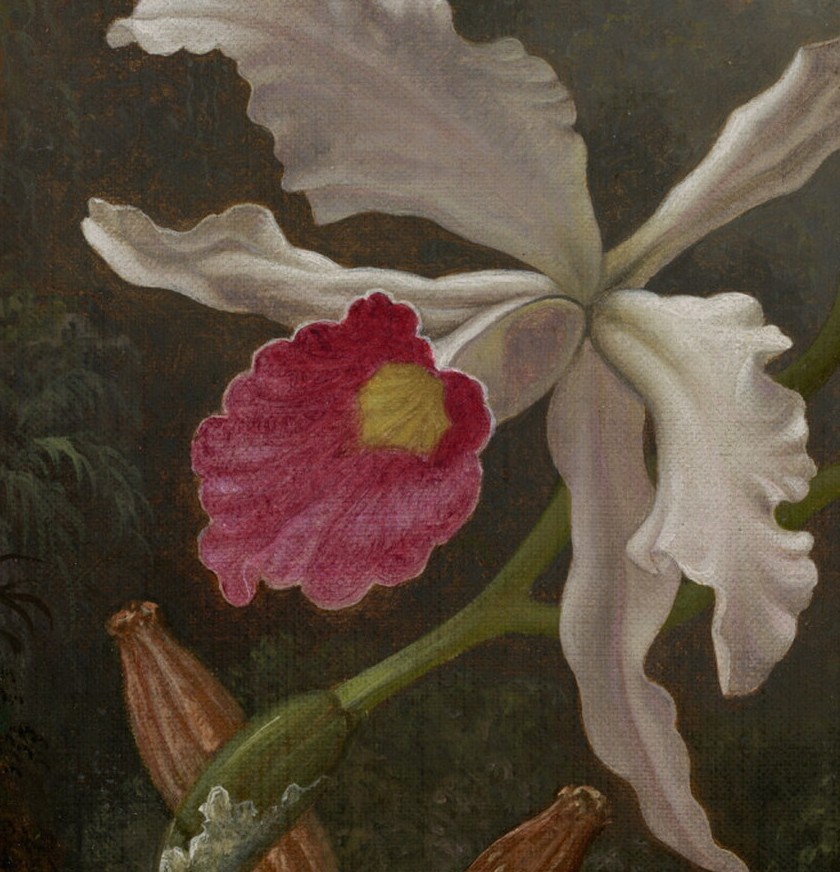
White orchid and coloured lip
Large pale petals surround a crimson lip with a yellow centre. The contrast makes the flower conspicuous against the darker woodland.
Tall background palm
A slender palm rises behind the foreground subjects. Its height contributes to the deep, upright forest setting.
Two birds above the flower
The lower bird has raised wings and a brightly coloured throat. Its green back, pale lower body and pink accent remain distinct even against the varied vegetation. The upper bird bends forward from a higher section of the branch, bringing the two small forms into a visible relationship.
Their positions establish a sequence along the diagonal perch. The viewer can follow the twig from the lower bird towards the higher one and then towards the right edge. The branch is thin, but its direction provides an organising line within a picture otherwise filled with irregular plant shapes.
The Carter identifies the birds as Amethyst Woodstars and describes both birds and orchid as life-scale subjects brought close to the picture plane. This explains why the small birds remain convincing beside a much larger flower: the difference in their apparent size is integral to the natural-history presentation, rather than a reason to treat the orchid as fantastically enlarged.[1]
A modern photograph of a male Amethyst Woodstar offers a useful separate comparison. Its purple throat, light chest and green plumage help make the museum’s identification easier to follow. The photograph records a living bird in Brazil in 2008; it is not a specimen used by Heade or evidence that he worked at the photographer’s location.[5]
The painting itself does not establish a precise moment of courtship, aggression or feeding. Raised wings and a downward gaze create an expressive arrangement, but the behavioural explanation remains open. Close observation can describe the birds’ positions without turning those positions into a documented scientific event.
White petals and a coloured lip
The orchid supplies the largest light area. Its petals do not form a flat white shape: they twist, fold and curl, creating shaded undersides and bright outer edges. Their irregular outlines give the flower a sense of volume against the darker forest.
The coloured central lip intensifies that effect. Crimson-pink surrounds a yellow area, producing a concentrated accent within the broad pale blossom. The lower bird’s bright throat offers a smaller echo above. Those two accents draw attention between flower and bird without making their shapes alike.
The plant extends beyond its open flower. Green buds and long fleshy growths appear to the right and below, while brown cut or dried-looking ends interrupt the base. The full arrangement gives the blossom a botanical setting rather than isolating it as a decorative emblem.
The Carter’s object text identifies the orchid as Cattleya purpurata. Its separate visual description uses an older genus name with inconsistent spelling. Keeping the identification explicitly attached to the museum avoids presenting the page as an independent revision of botanical taxonomy.[1]
The reproductive mechanism is not demonstrated by the painting. Neither bird is visibly inserting its bill into the flower, and proximity alone does not prove pollination. Charlotte M. Porter’s Florida Museum essay discusses the limits of ecological realism in Heade’s orchid pictures; that discussion is best kept separate from what the canvas directly shows.[4]
Watch: Martin Johnson Heade
Choose a film to explore the artist’s work, its interpretation and its wider setting.
Museum Minute: Heade Hummingbirds
A brief Shelburne Museum introduction to Heade’s hummingbird paintings.
Watch on YouTubeMuseum identifications and a constructed habitat
The Carter contrasts Heade’s tropical setting with natural-history illustrations that placed bird specimens against relatively empty backgrounds. Here the birds are integrated into dense vegetation, a distant mountain range and a threatening-looking sky. Botanical and ornithological detail become part of a landscape experience.[1]
Neely nevertheless stresses that the exact setting is unspecified. Her essay associates the identified birds and orchid with Brazil, while acknowledging that the background could be generic. These are compatible observations: the subjects can carry Brazilian associations without proving a particular forest location.[2]
The distinction is useful for looking at the distant mountains. Their role in the painting is to deepen the space and provide a muted setting for the birds. No checked source identifies them as a particular range, and their colour cannot supply that missing geographic evidence.
Nor should the image be described as a single outdoor encounter simply because its subjects appear naturalistic. The Carter’s account describes knowledge gathered through travel, specimens and scientific texts. Such sources could be brought together within a finished painting, allowing close detail and a composed landscape to coexist.[1]
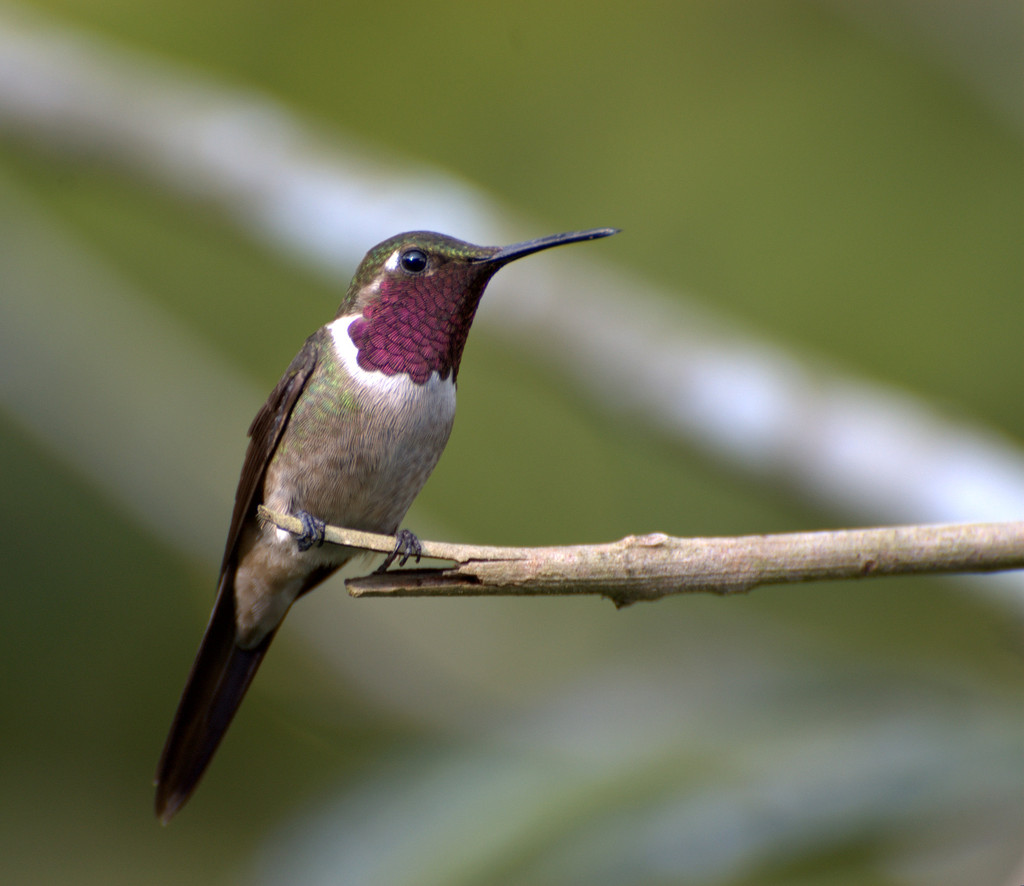
Male Amethyst Woodstar photographed at Chácara Antonio Wuo, Mogi das Cruzes, Brazil, 26 April 2008. A modern living-bird comparison; not a specimen used by Heade. Resized only; this photograph remains CC BY-SA 2.0. Dario Sanches, via Wikimedia Commons. Image source. CC BY-SA 2.0. Resized only; photograph remains CC BY-SA 2.0.
Brazil and the later studio picture
Heade’s Brazilian visit took place in 1863–64, substantially earlier than the date range assigned to this canvas. During that journey he pursued a proposed illustrated publication, The Gems of Brazil, which remained unfinished. The white-orchid painting belongs to the later development of his bird-and-flower subjects, rather than automatically to that earlier series.[2][3]
The interval matters. Tropical interests persisted after the first journey and through later travel, giving Heade a subject he could continue to develop. The approximate 1875–90 dating does not establish the exact year or studio in which this particular canvas was completed.
Neely also discusses the Brazilian emperor Dom Pedro II’s support for the earlier bird project and his award following the display of twelve pictures. That history explains part of the larger natural-history context. It does not make the emperor a documented commissioner of this later White Orchid canvas.[2]
A complete image and related paintings
The upper branches and lower plant growth are important to the vertical arrangement. The complete museum reproduction preserves them, allowing the birds, flower and surrounding habitat to be considered together. A tight crop centred on the flower would give a misleading account of the space above it and the supporting forms below.
Heade’s Cattleya Orchid and Three Hummingbirds offers a different construction. That 1871 painting is horizontal, painted on wood, and includes three birds and a nest with two eggs. Its orchid occupies the left while the birds extend the composition towards the right.[3]
The Met’s Hummingbird and Passionflowers returns to a vertical format but uses red flowers and a single perched bird. It dates to approximately 1875–85, overlapping the Carter’s broad date range. Similar subject matter and approximate dates therefore need exact titles and collection identities to keep the works distinct.[6]
In the Carter painting, the particularly tall field and the great white blossom give the paired birds a distinctive setting. Their small bright bodies remain noticeable because the surrounding mountain tones are subdued, while the flower becomes substantial through folds and shade. The natural-history subjects carry the picture, and the landscape gives them room to belong to a larger world.
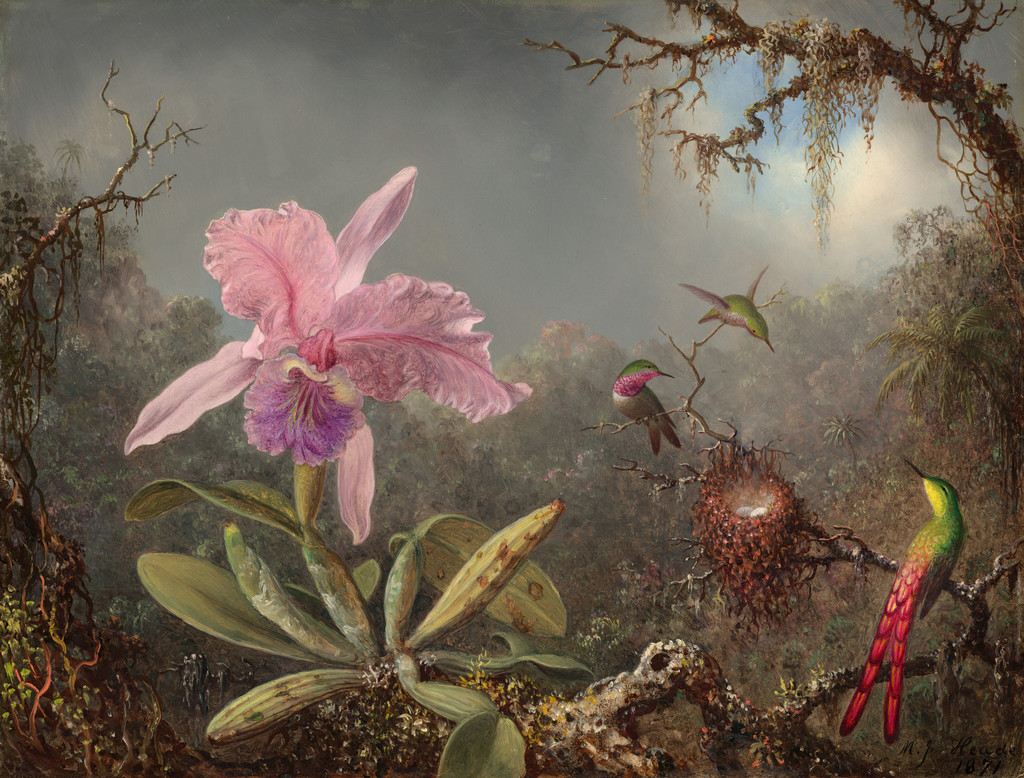
Martin Johnson Heade, Cattleya Orchid and Three Hummingbirds, 1871. Oil on wood. National Gallery of Art, 1982.73.1. Image source. CC0 / Public domain. Resized only; native appearance preserved.
Artworks directory
A collected selection of 26 individually identified museum paintings, including thirteen extended artwork studies. This is a bounded directory, rather than a complete catalogue raisonné. Two Boston entries retain dates from the 2002 conservation study. Links open a companion article where available, otherwise the cited institutional record or publication; unillustrated objects remain included.
Frequently Asked Questions
The Carter identifies them as Amethyst Woodstars. The identification belongs to the museum’s object commentary, rather than an independent taxonomic assessment of the painted birds.[1]
No exact location is established. Neely links the birds and flower with Brazil while describing the rainforest setting as potentially generic.[2]
Discussion
Look again at the images and ideas explored in Two Hummingbirds Above a White Orchid by Martin Johnson Heade. These editorial prompts invite your observations.
Reader Insights
How do the upper birds lead your eye towards the orchid?
What changes in the wood Cattleya panel’s wider arrangement?
What does the modern bird photograph clarify while remaining a different individual?
Join the Conversation
Share a detail, comparison or question about Two Hummingbirds Above a White Orchid by Martin Johnson Heade below.
References
- Amon Carter Museum of American Art, Two Hummingbirds Above a White Orchid, 1981.33. Exact metadata, visual description and object text from the 2023 Carter Handbook. View source
- Elizabeth Neely, “An orchid, an emperor, and hummingbirds: Martin Johnson Heade in Brazil” (Carter, 22 November 2023). Foreground/background account, later date, unspecified setting and earlier patronage. View source
- Franklin Kelly, American Paintings of the Nineteenth Century, Part I (NGA, 1996), printed pp.287–288 and 291–293. Biographical project history and the distinct three-bird Cattleya painting. View source
- Charlotte M. Porter, Florida Museum, “Visual Interests”. Museum discussion of natural history, composed tropical subjects and ecological limits; hypothetical activities are not treated as established facts. View source
- Dario Sanches, male Amethyst Woodstar photograph, 26 April 2008, Wikimedia Commons. Modern specimen comparison; CC BY-SA 2.0, original licence review recorded on the file page. View source
- Metropolitan Museum of Art, Hummingbird and Passionflowers, 46.17. Exact identity and current c.1875–85 date checked against the museum’s API. View source
- Splash image source.
Martin Johnson Heade, Two Hummingbirds Above a White Orchid, c.1875–90. Oil on canvas, 18 1/8 × 10 1/8 inches. Amon Carter Museum of American Art, Fort Worth, 1981.33. Public domain. Resized only; native appearance preserved.
View source