 by Tom Gurney
Tom Gurney BSc (Hons) is an art history expert with over 20 years experience
Email: tomgurney1@gmail.com / Phone: +44 7429 011000
Magnolias on Light Blue Velvet Cloth by Martin Johnson Heade: Introduction
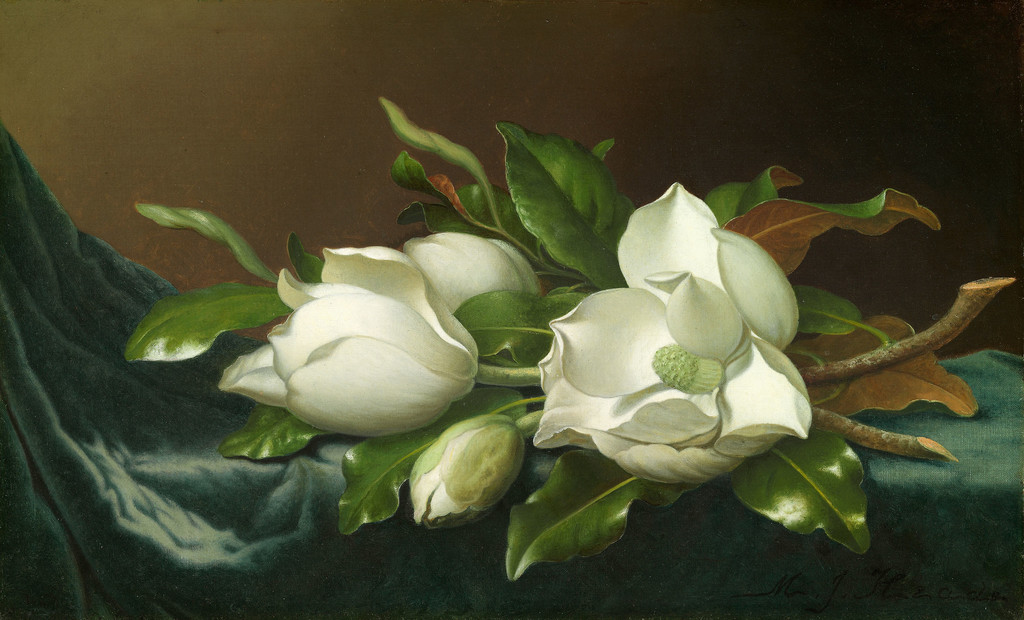
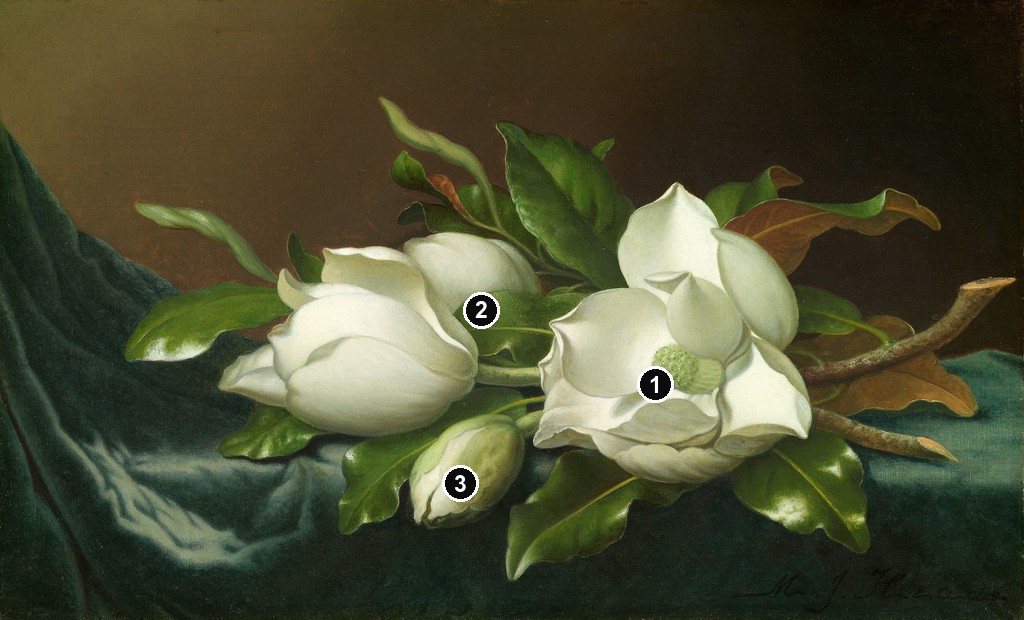
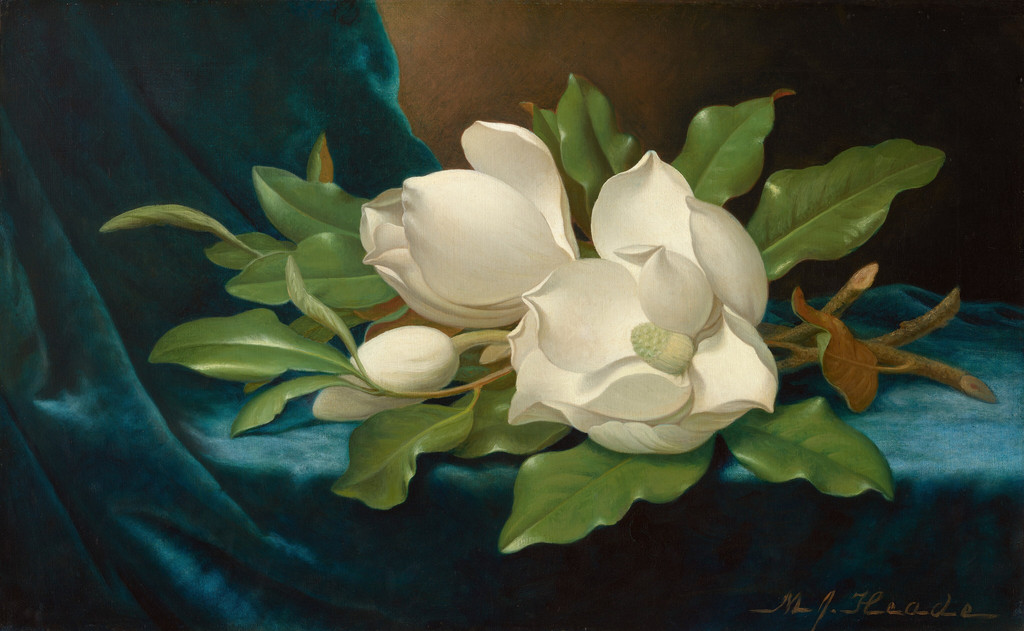
Martin Johnson Heade’s Magnolias on Light Blue Velvet Cloth arranges pale flowers, a foreground bud, glossy leaves and cut stems across folded fabric. Two large blossoms dominate the view, while another rounded flower is partly concealed behind the left one. Dated approximately 1885–95, the Art Institute of Chicago painting is a distinct four-form arrangement within Heade’s late magnolia still lifes. Its accession, 1983.791, separates it from the similarly titled blue-cloth canvas at the National Gallery of Art.[1][2]
At a Glance
- ArtistMartin Johnson Heade (1819–1904)
- TitleMagnolias on Light Blue Velvet Cloth
- Datec.1885–95
- MediumOil on canvas
- Dimensions38.6 × 61.8 cm
- CollectionArt Institute of Chicago
- Accession1983.791
- Floral arrangementTwo prominent open flowers, a partly concealed rounded blossom and a foreground bud
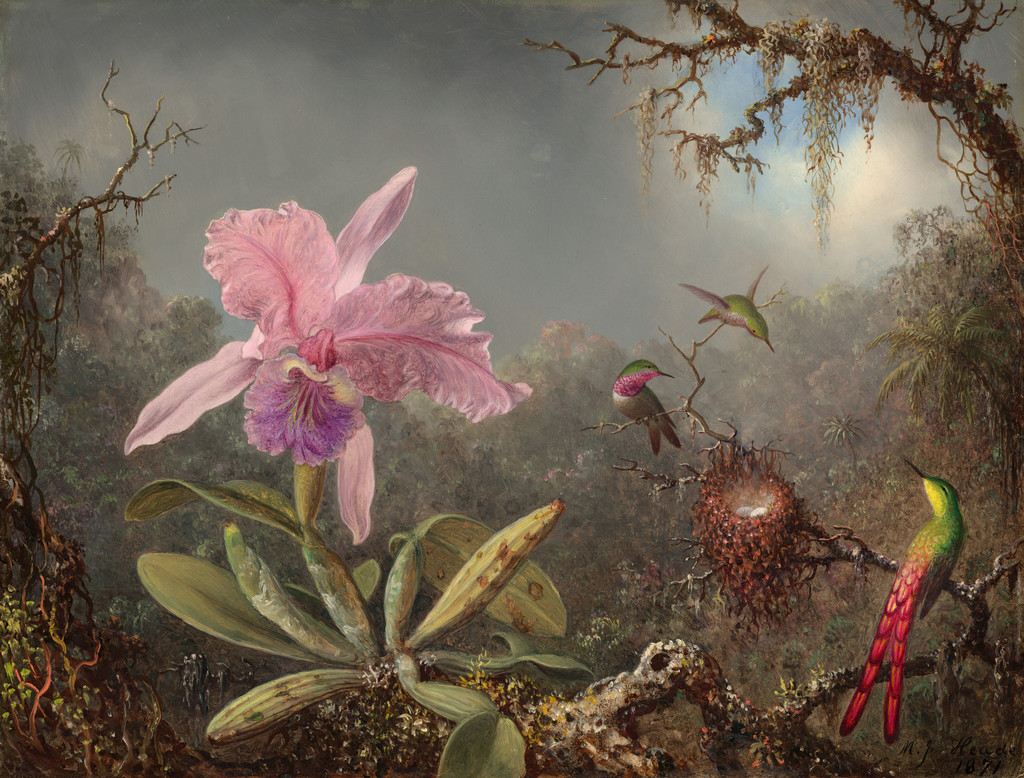
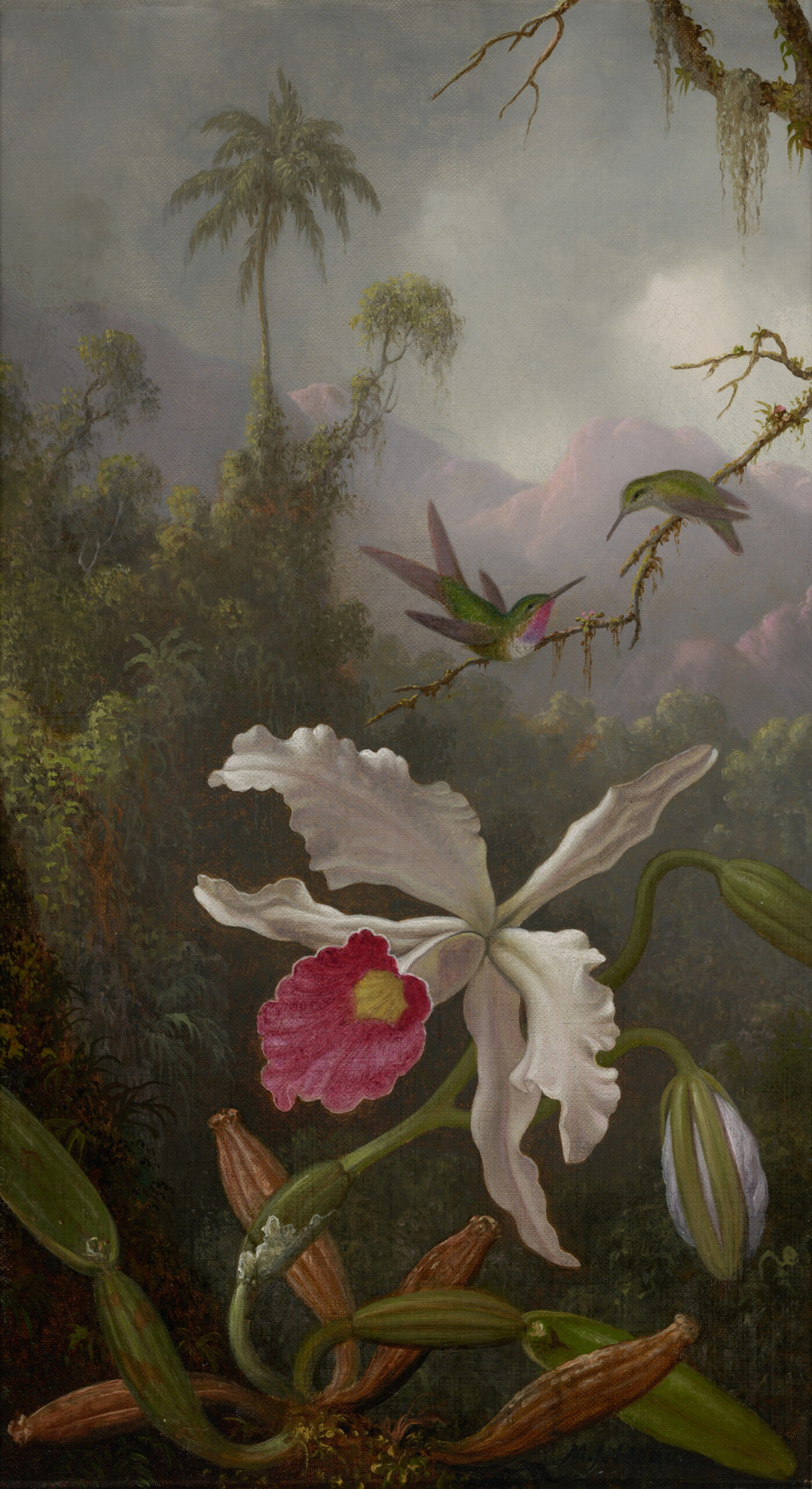
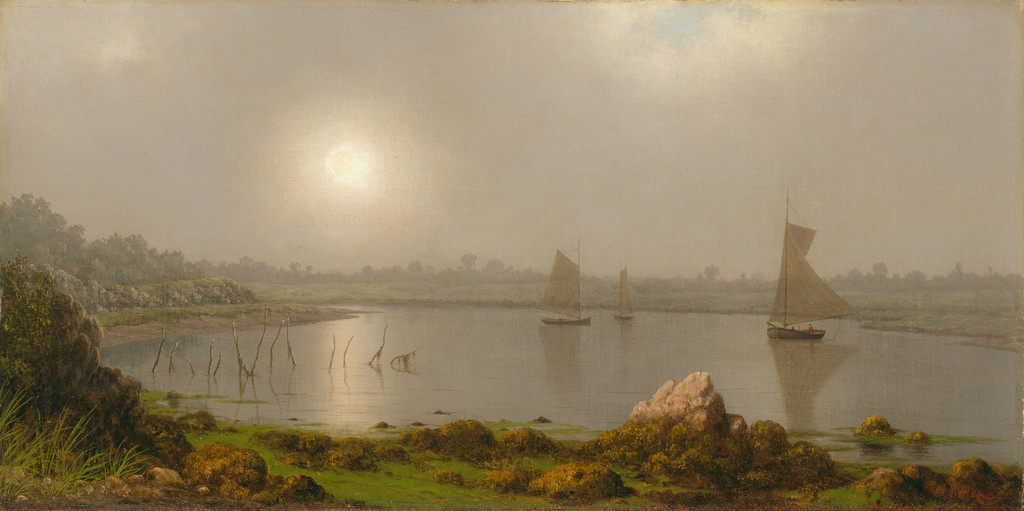
This work across Martin Johnson Heade’s career
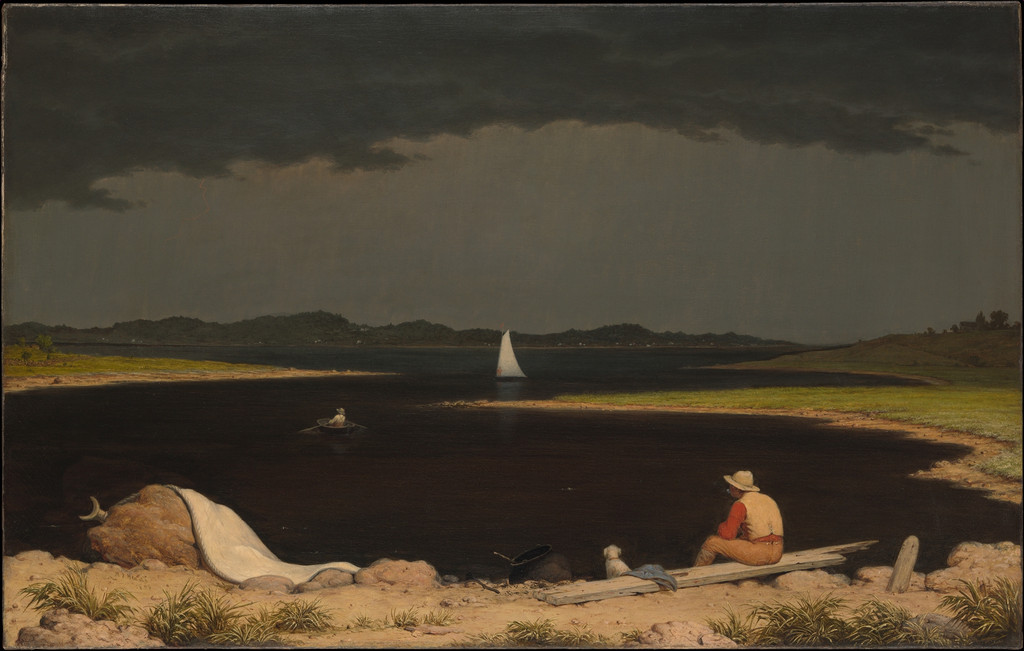
Sudden Shower, Newbury Marshes
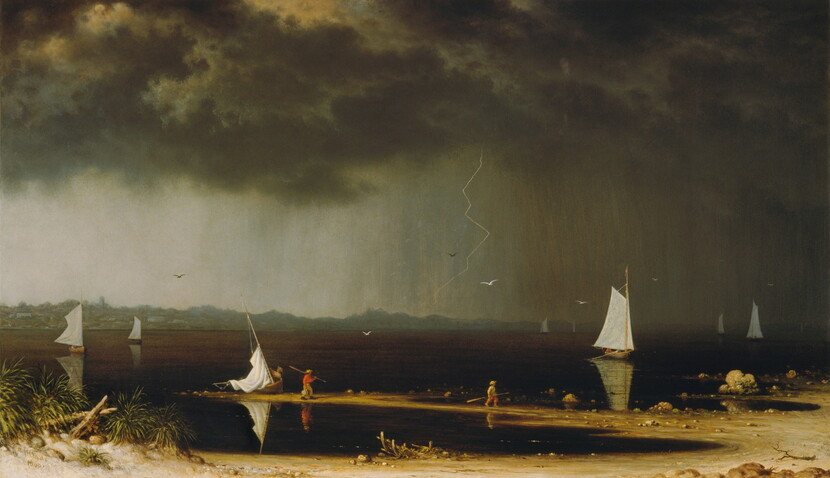
c.1865–75View of Marshfield
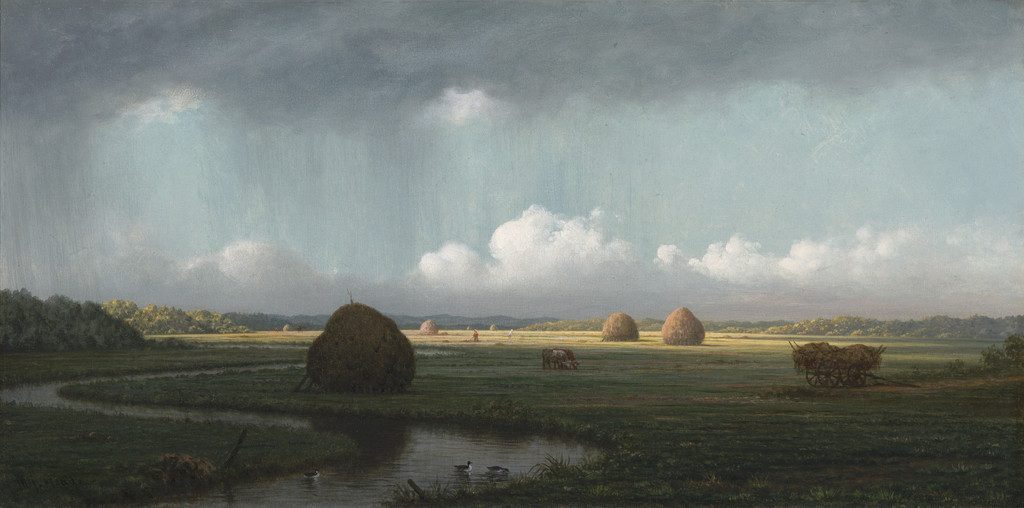
c.1866–76Hummingbird and Passionflowers
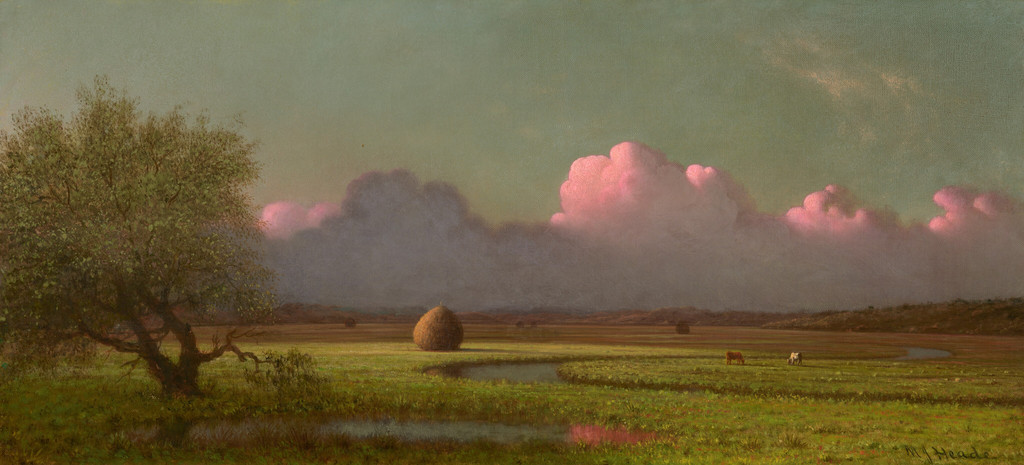
c.1875–85Newburyport Meadows
c.1876–81Contents
- Four floral forms and their overlap
- Leaves, stems and the indoor arrangement
- Blue cloth and changing shadows
- Exact identity and approximate date
- Comparison with Giant Magnolias
- What technical comparisons can establish
- Annotated details
Four floral forms and their overlap
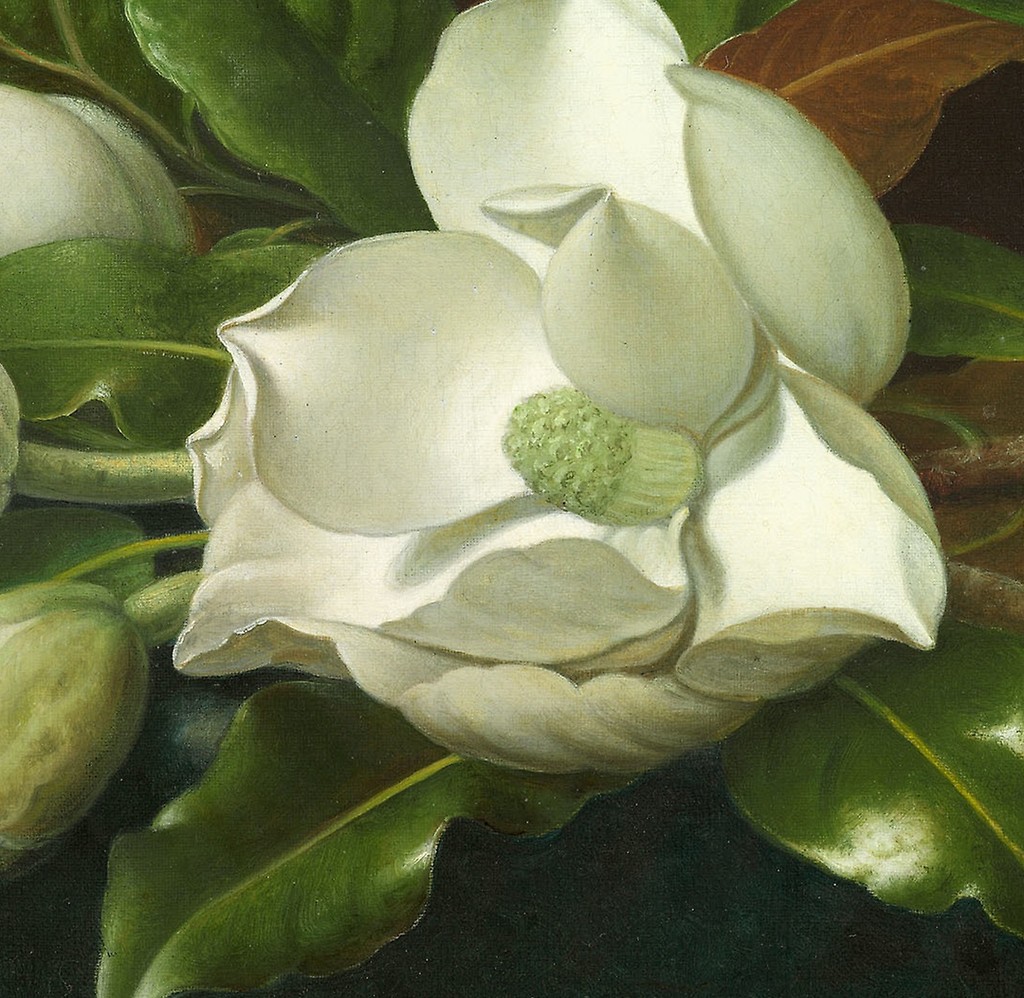
The flower on the right faces the viewer more openly. Its broad pale petals surround a small green centre, with darker recesses between overlapping edges. Its lower petals extend towards the cloth and leaves beneath it.
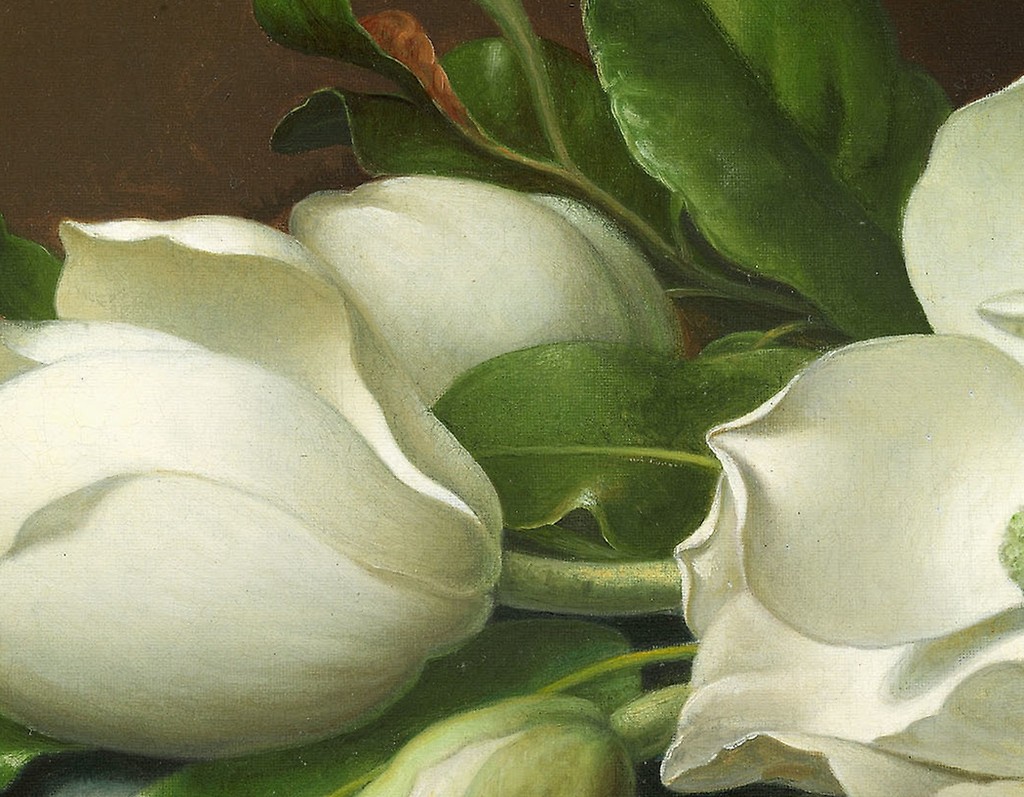
The large flower on the left presents a more enclosed profile. A broad petal curves across its lower part, while other edges rise and turn above it. Behind this blossom, another rounded pale form emerges between the petals and the upper leaves.
The partly concealed flower deserves attention because it changes the group’s structure. The left side contains an overlap of floral forms rather than a single isolated bloom. Its exact degree of opening is difficult to determine from the visible portion, but its separate presence is clear.
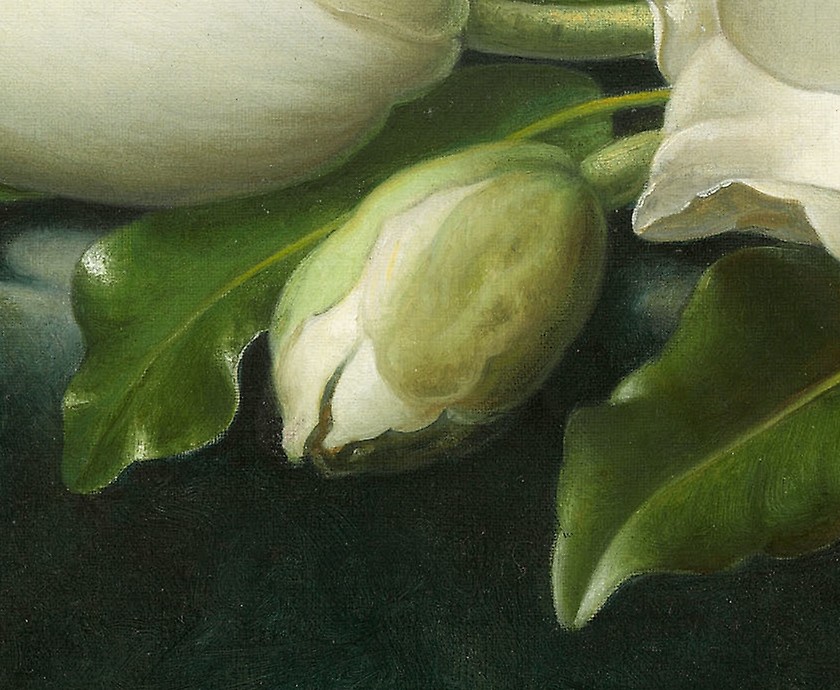
The foreground bud lies lower, between the two main flowers. Its pointed, folded shape differs from their broader petals. Greenish and cream passages describe a compact form whose outer surfaces remain close together.
These differences allow the arrangement to move between spreading, enclosed and partly hidden forms. The painting is not simply a line of identical white flowers. It uses overlap and changing orientation to give the botanical group a sense of depth.
Pale colour also varies within each blossom. The petals carry warmer and cooler passages, with some edges bright against dark leaves and others softened where light surfaces meet. Their volume depends on those shifts as much as on an external outline.
Annotated Details from Magnolias on Light Blue Velvet Cloth
The numbered points identify visible features discussed in this article. Return from each detail to the whole composition. Martin Johnson Heade, Magnolias on Light Blue Velvet Cloth, c.1885–95. Oil on canvas, 38.6 × 61.8 cm. Art Institute of Chicago, 1983.791. Purchased with funds provided by Gloria and Richard Manney; Harold L. Stuart Endowment Fund; Art Institute of Chicago. Image source. CC0 / Public domain. Resized only; native appearance preserved.
Details from MAGNOLIAS ON LIGHT BLUE VELVET CLOTH
Compare the cropped details with the complete images above. Notice how their colours, shapes and positions contribute to the larger compositions.
Open right-hand flower
The open right-hand magnolia exposes its greenish centre amid curved pale petals. The flower projects over the darker foliage.
Partly concealed blossom
A rounded pale blossom appears behind the prominent left-hand flower and foliage. Its partly concealed form contributes to the layered arrangement.
Closed lower bud
A closed bud lies low in the arrangement beside the cloth. Its compact form differs from the open flowers.
Leaves, stems and the indoor arrangement
Large leaves surround and separate the flowers. A particularly substantial green leaf rises near the upper centre, giving the group an upright form behind the lower horizontal spread. Other leaves lie beneath the flowers or extend towards the sides.
Their surfaces have an apparent gloss, described through sharp highlights and darker neighbouring areas. Some leaves turn to expose brown undersides. That difference gives the foliage more variety than a continuous green surround would provide.
Cut stems extend towards the right edge. Their visible ends and branching forms help identify the subjects as detached flowers arranged indoors. They also create lateral lines that connect the group with the edge of the canvas.
The stems are less bright than the petals, but they contribute to the picture’s structure. They establish how the flowers might lie together and provide a contrast between woody, angular forms and soft curves. The arrangement gains coherence through those physical connections.
The lower bud sits close to the fabric, while leaves overlap both cloth and flowers. These layered relationships give the still life several depths within a small interior space. They reward attention to what lies in front of, behind or beneath another form.
Blue cloth and changing shadows
The cloth rises at the left into a fold before spreading beneath the flowers. Its upper edge creates a diagonal movement, while lower folds introduce curved highlights and dark recesses. The fabric becomes an active part of the composition.
Although the title identifies light blue velvet, much of its painted surface is darker or shaded towards green-grey. A title naming a material’s colour does not require every passage to appear equally light. The shadowed folds give the fabric weight and distinguish it from the pale flowers.
At the lower left, a broad reflected highlight bends with the cloth. Farther right, the fabric becomes quieter beneath the stems. Its changing emphasis helps move attention back towards the blossoms rather than keeping the entire lower canvas equally bright.
The brown background provides another kind of surrounding surface. It remains comparatively open above the flowers, where its subdued colour makes the foliage and petals more distinct. The brightest forms are concentrated in the botanical group.
The Art Institute interprets the arrangement as both sensuous and decorative, discussing sharply illuminated petals and an almost dreamlike intensity. Its comparison with a reclining figure is a curatorial response to the flowers and velvet, rather than a documented declaration of intention by Heade.[1]
Watch: Martin Johnson Heade
Choose a film to explore the artist’s work, its interpretation and its wider setting.
Museum Minute: Heade Hummingbirds
A brief Shelburne Museum introduction to Heade’s hummingbird paintings.
Watch on YouTubeExact identity and approximate date
The museum gives the canvas’s dimensions as 38.6 by 61.8 centimetres and its medium as oil on canvas. It records a signature at the lower right. These details identify a compact horizontal still life, rather than a large decorative mural.[1]
Its c.1885–95 date is approximate. The range places the painting within Heade’s later career, after his move to St. Augustine in 1883. Kelly’s NGA account connects that period with magnolia painting and greater stability under the patronage of Henry Morrison Flagler.[1][3]
That general context does not establish an exact completion year or a Flagler commission for the Chicago canvas. The museum’s object history instead records a private collection in Chestnut Hill, Pennsylvania, by 1975, followed by Spanierman Gallery and sale to the Art Institute in 1983.[1]
The purchase was supported by funds from Gloria and Richard Manney and the Harold L. Stuart Endowment Fund. The accession year belongs to that collecting history, many decades after the painting’s approximate period of execution.[1]
Comparison with Giant Magnolias
The NGA’s Giant Magnolias on a Blue Velvet Cloth contains two open flowers and a closed bud. Its arrangement differs from Chicago’s additional partly concealed blossom and more centrally placed foreground bud. The cloth folds, stem distribution and flower contours also change.[3]
The titles are close, but the pictures remain distinct museum objects. The NGA canvas has accession 1996.14.1 and dates c.1890; Chicago’s is 1983.791 and dates c.1885–95. Similar subjects and overlapping date ranges do not make one a second photograph of the other.[1][3]
Kelly’s broader discussion shows that Heade varied blossom numbers, cloth colours and arrangements across the late floral group. The repeated subject supplied different opportunities for light, contour and texture. Each canvas can consequently be read as a particular arrangement within an extended practice.[3]
The Timken Museum’s The Magnolia Blossom, dated 1888, develops another relationship between a pale flower and coloured fabric. Its museum essay discusses a red edge around the flower as part of the spatial effect. That observation belongs to a separate painting.[5]
Martin Johnson Heade, Giant Magnolias on a Blue Velvet Cloth, c.1890. National Gallery of Art, 1996.14.1. Image source. CC0 / Public domain. Resized only; native appearance preserved.
What technical comparisons can establish
Kelly’s NGA entry describes a sequence involving flowers, leaves, deeper shadows, background and velvet highlights in Giant Magnolias. It is valuable evidence for that canvas. The visible similarities between the two blue-cloth works do not establish an identical layer order in Chicago’s painting.[3]
The 2002 conservation study by Elizabeth Leto Fulton, Richard Newman, Jean Woodward and Jim Wright examined fifty Heade paintings and reports pigment analysis of twenty-one. Its sampled group is a defined historical study, and the Chicago canvas is not listed among those twenty-one analysed works.[4]
The article therefore supplies comparative knowledge about Heade’s materials without identifying a complete pigment recipe for this particular still life. The colours visible here can be described directly, while their chemical composition requires object-specific evidence.
This distinction leaves plenty to examine. The pale petals, glossy leaves, exposed stems, overlapping blossom and shaded velvet already demonstrate a carefully constructed image. Their exact arrangement makes Chicago’s painting individual even within a familiar and repeatedly explored subject.
Artworks directory
A collected selection of 26 individually identified museum paintings, including thirteen extended artwork studies. This is a bounded directory, rather than a complete catalogue raisonné. Two Boston entries retain dates from the 2002 conservation study. Links open a companion article where available, otherwise the cited institutional record or publication; unillustrated objects remain included.
Frequently Asked Questions
Two prominent open flowers, a rounded blossom partly concealed behind the left flower, and a closed foreground bud form a group of four.
Discussion
Look again at the images and ideas explored in Magnolias on Light Blue Velvet Cloth by Martin Johnson Heade. These editorial prompts invite your observations.
Reader Insights
How does the partly concealed pale blossom change the overlap?
What changes beside the two open flowers and bud in the NGA canvas?
Why does object identity matter when comparing technical findings?
Join the Conversation
Share a detail, comparison or question about Magnolias on Light Blue Velvet Cloth by Martin Johnson Heade below.
References
- Art Institute of Chicago, Magnolias on Light Blue Velvet Cloth, 1983.791. Current object data, description, dimensions, credit and collecting history. View source
- Wikimedia Commons, Art Institute museum-origin reproduction of 1983.791. Exact accession and CC0 image record, independently visually checked against the museum identity. View source
- Franklin Kelly, American Paintings of the Nineteenth Century, Part I (NGA, 1996), printed pp.287–288 and 295–298. Florida context and separate NGA magnolia entry. View source
- Elizabeth Leto Fulton, Richard Newman, Jean Woodward and Jim Wright, “The Methods and Materials of Martin Johnson Heade,” JAIC 41(2), 2002, including appendices. Defined study and sampled objects; comparative technical evidence. View source
- Timken Museum, “Martin Johnson Heade, The Magnolia Blossom, 1888”. Separate magnolia painting and work-specific edge discussion. View source
- Splash image source.
Martin Johnson Heade, Magnolias on Light Blue Velvet Cloth, c.1885–95. Oil on canvas, 38.6 × 61.8 cm. Art Institute of Chicago, 1983.791. Purchased with funds provided by Gloria and Richard Manney; Harold L. Stuart Endowment Fund; Art Institute of Chicago. CC0 / Public domain. Resized only; native appearance preserved.
View source