 by Tom Gurney
Tom Gurney BSc (Hons) is an art history expert with over 20 years experience
Email: tomgurney1@gmail.com / Phone: +44 7429 011000
Giant Magnolias on a Blue Velvet Cloth by Martin Johnson Heade: Introduction
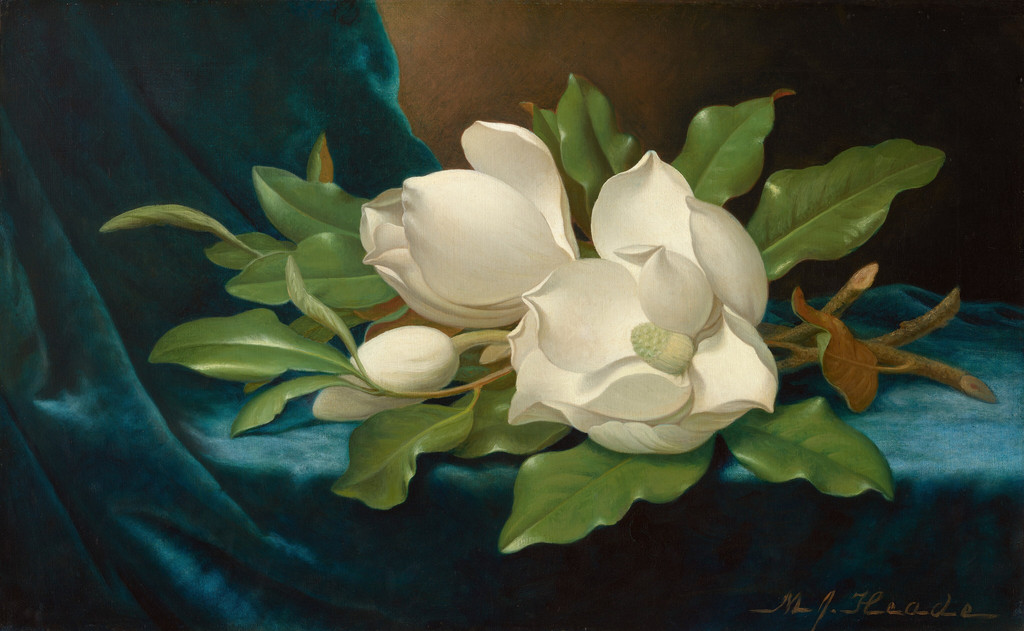
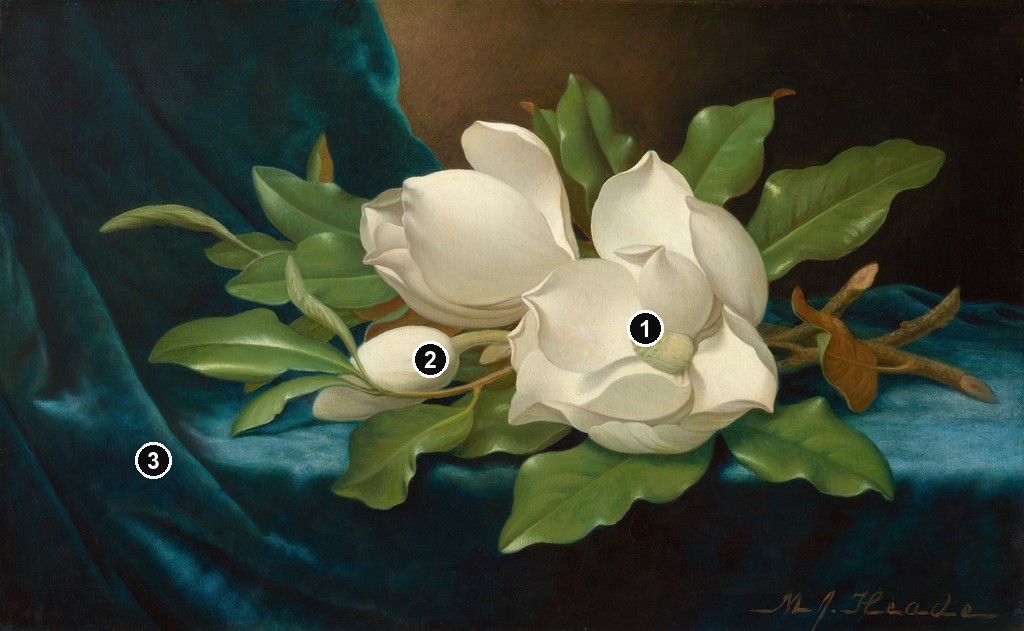
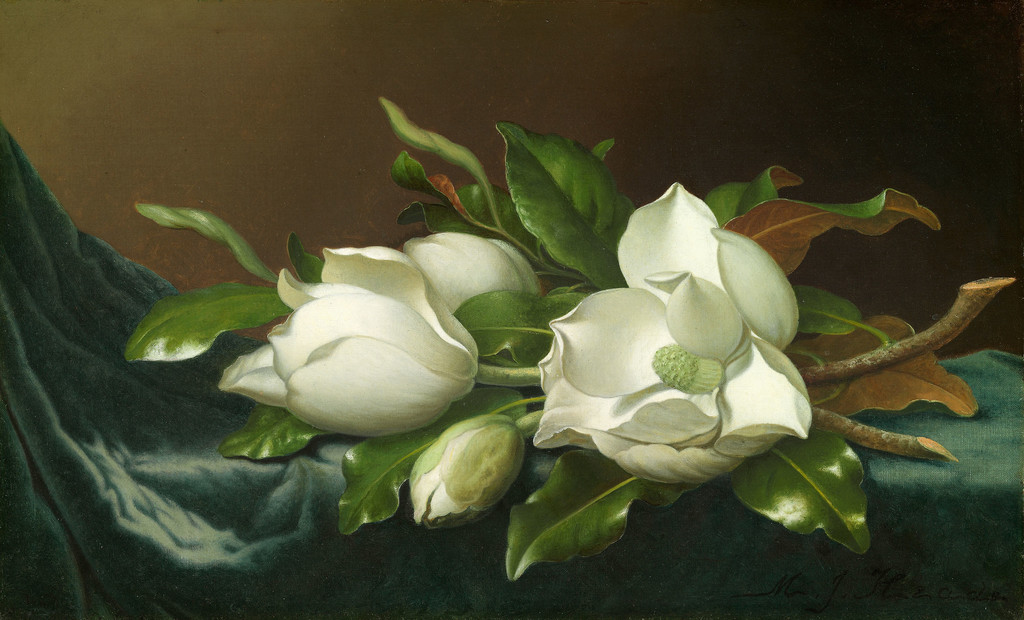
Martin Johnson Heade’s Giant Magnolias on a Blue Velvet Cloth places two open creamy flowers and a closed bud among green leaves, cut stems and deeply folded fabric. The pale blossoms occupy a dark interior setting, where different textures become as important as the flowers themselves. Dated approximately 1890, the canvas belongs to the National Gallery of Art. Franklin Kelly’s catalogue entry provides unusually specific evidence about its painting process and explains its place among Heade’s late magnolia still lifes.[1][2]
At a Glance
- ArtistMartin Johnson Heade (1819–1904)
- TitleGiant Magnolias on a Blue Velvet Cloth
- Datec.1890
- MediumOil on canvas
- Dimensions38.4 × 61.5 cm
- CollectionNational Gallery of Art
- Accession1996.14.1
- ArrangementTwo open flowers and one closed bud
This work across Martin Johnson Heade’s career
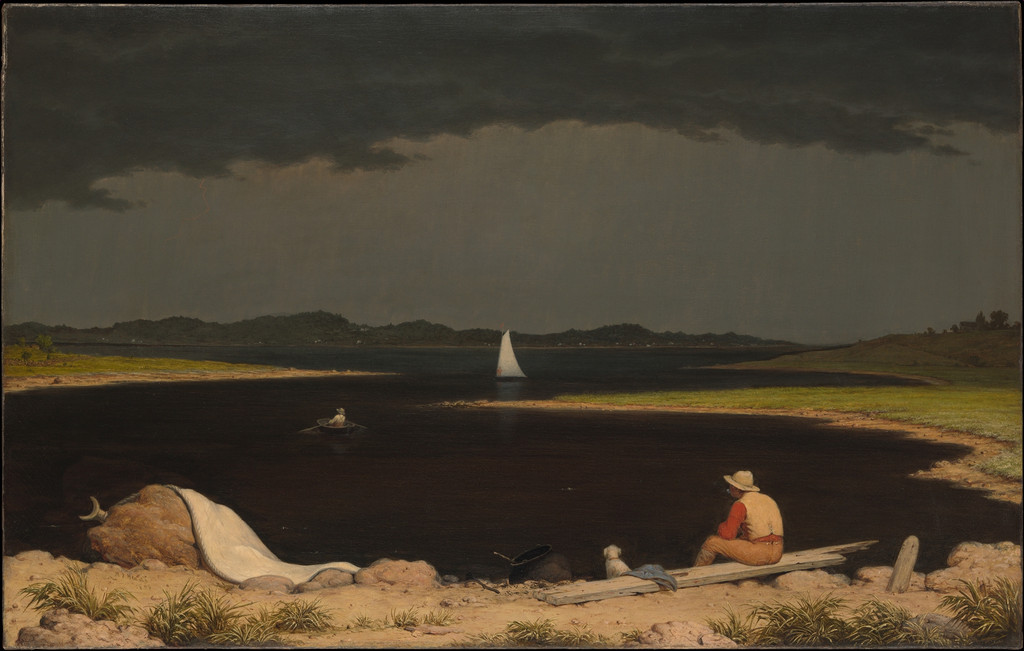
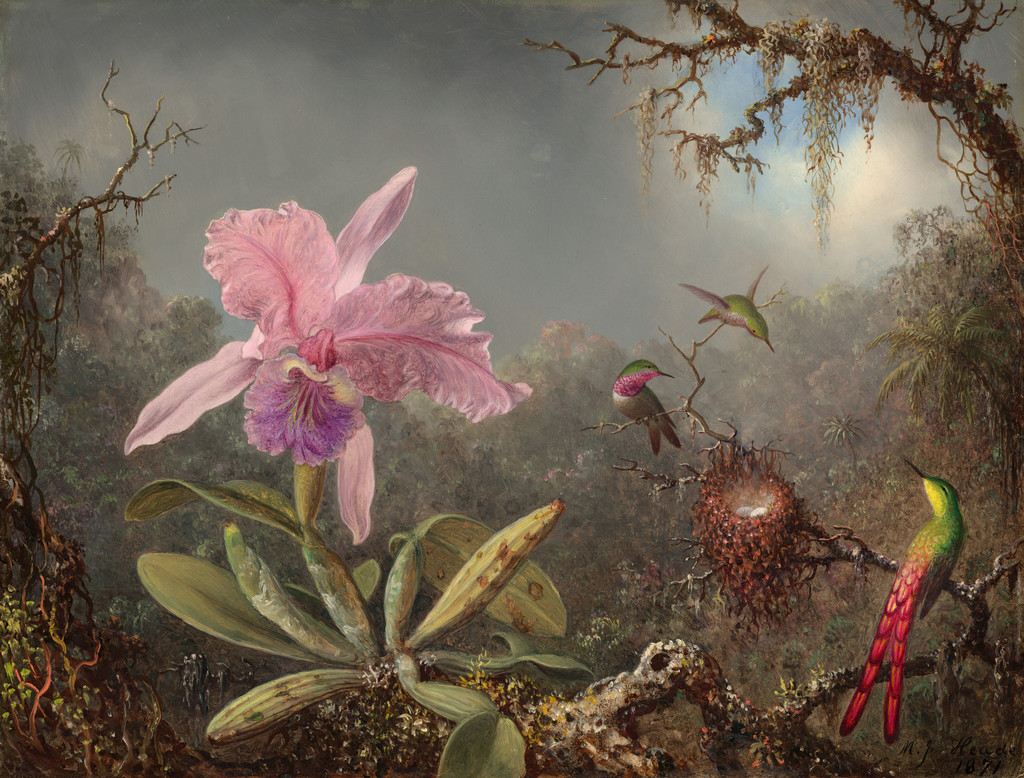
Sudden Shower, Newbury Marshes
c.1865–75View of Marshfield
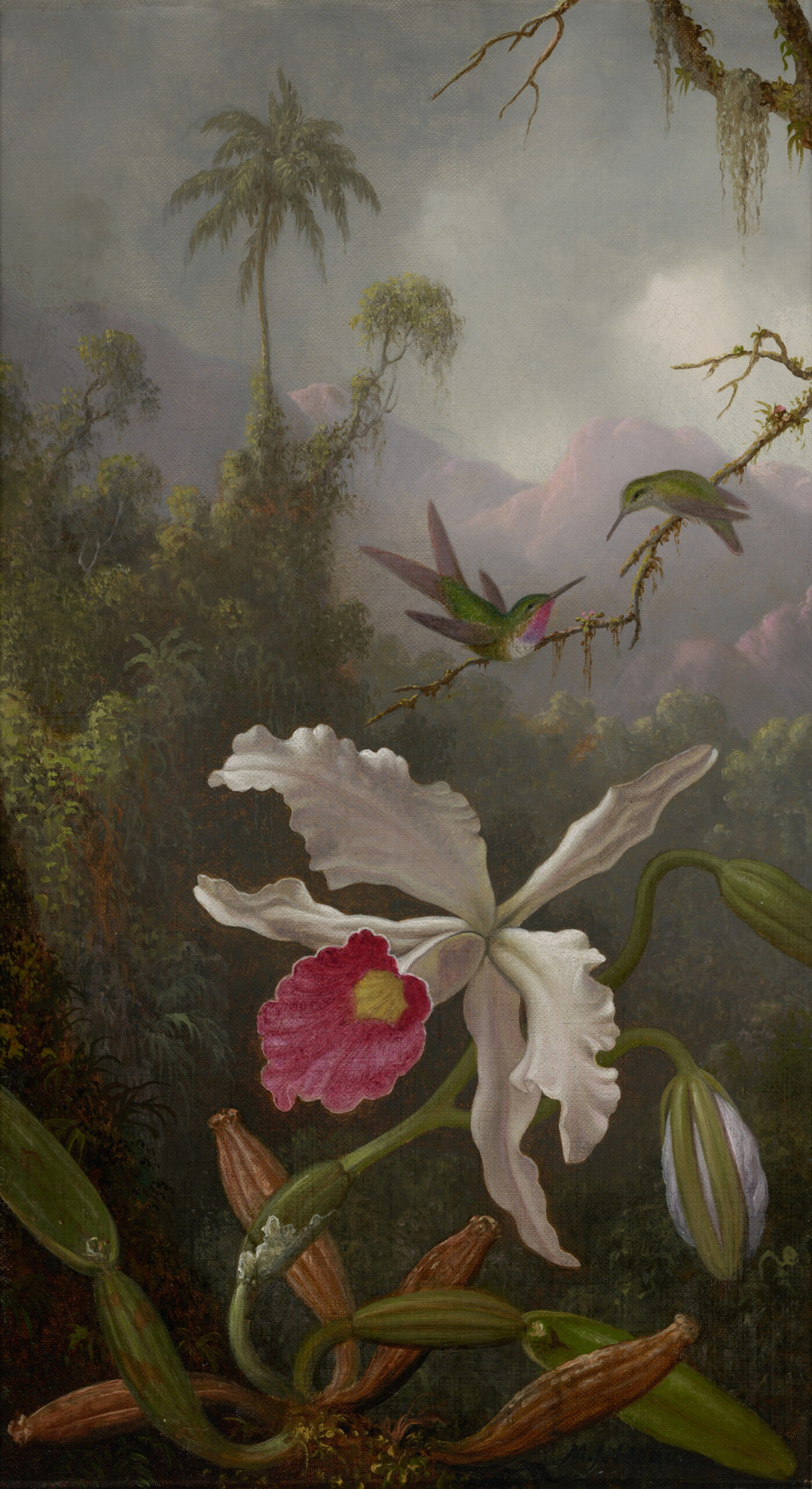
c.1866–76Hummingbird and Passionflowers
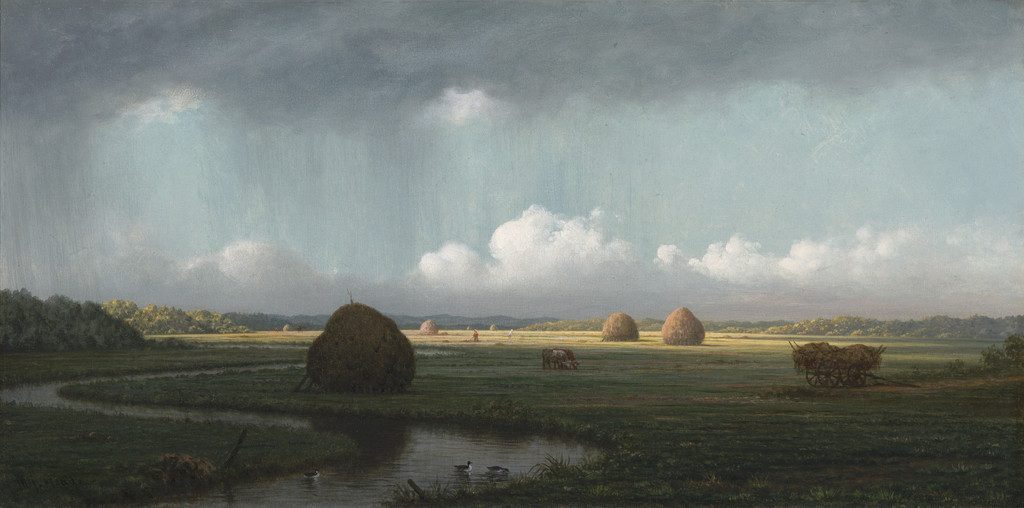
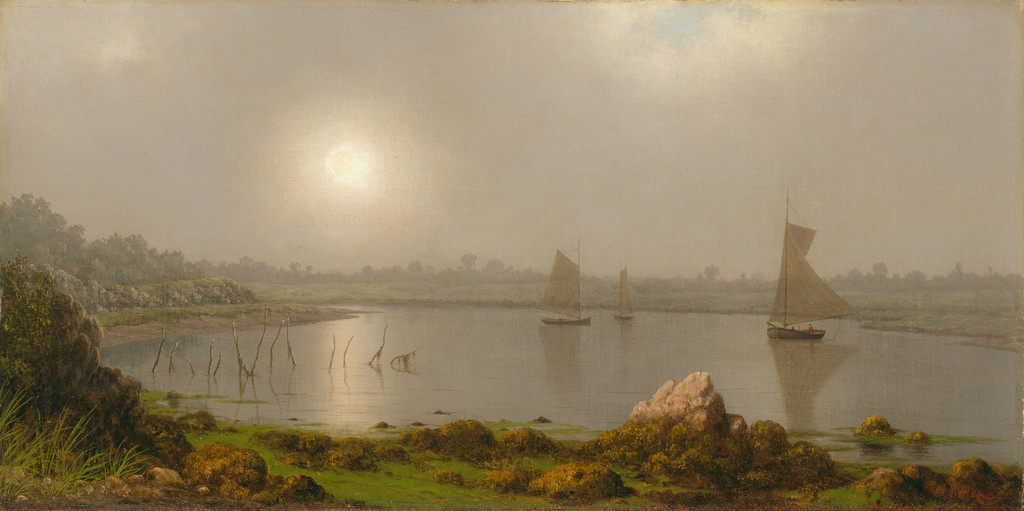
c.1875–85Newburyport Meadows
c.1876–81Magnolias on Light Blue Velvet Cloth
c.1885–95Contents
- Two open flowers and a closed bud
- Leaves, cut stems and folded velvet
- A surface made in stages
- Bright petals and deeper surrounding paint
- Different magnolia pictures
- Florida and interior display
- The 1996 acquisition
- Annotated details
Two open flowers and a closed bud
The open flower on the right turns more directly towards the viewer. Its broad petals surround a pale green centre, with shadows describing their overlapping edges. The flower farther left presents a more enclosed form, its petals rising and folding around a centre that is less exposed.
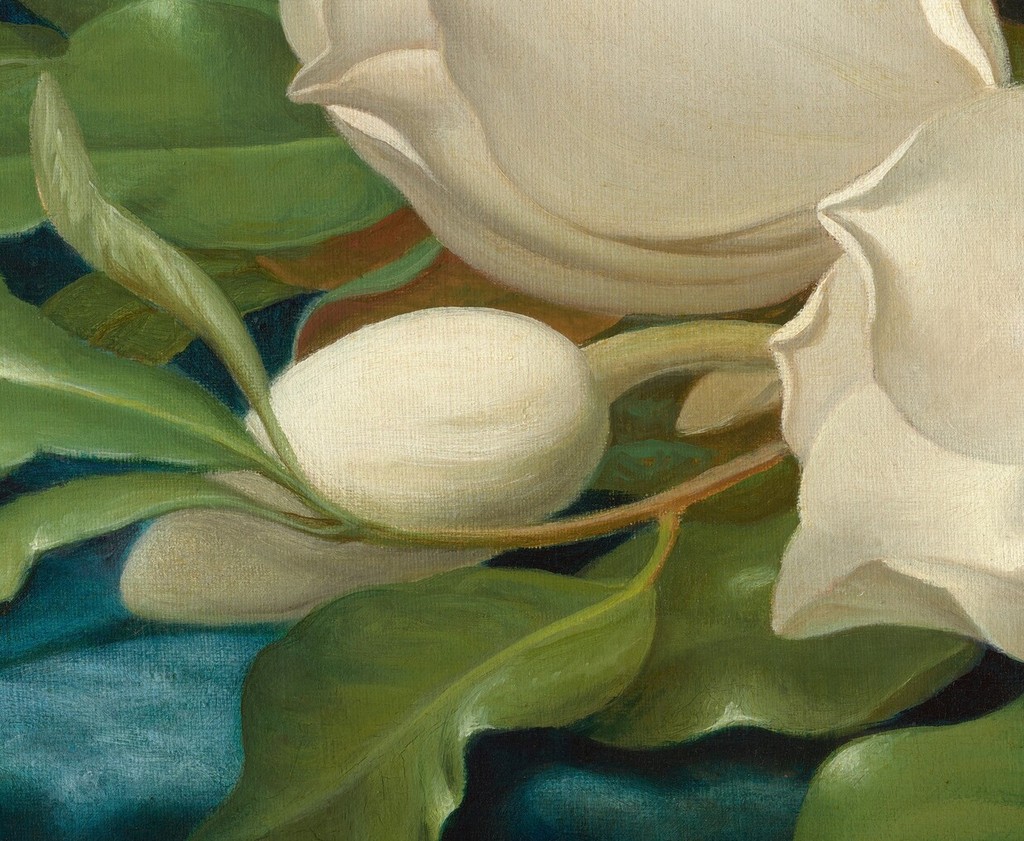
The closed bud lies below and between these larger blossoms, closer to the left. Its compact oval shape differs from their spreading contours. This distinction creates a sequence of forms without requiring the viewer to imagine three fully open flowers.
Kelly connects the varying stages with an impression of unfolding and the passage of time. That is a reading of the arranged flowers within a single image. The picture does not document a timed botanical experiment or prove that the three forms belong to one physical blossom observed successively.[2]
The petals are creamy rather than uniformly pure white. Warm areas coexist with cooler shadows, so each curved surface appears to turn within the light. Their brightness is strongest where it meets darker leaves or cloth, and quieter where one pale petal overlaps another.
The open forms also differ in scale and direction. Their relationship gives the group an asymmetry that keeps it from becoming a row of repeated circles. The closed bud, leaves and stems fill the intervals without concealing those differences.
The flowers occupy much of the composition, but they retain space around their edges. Darker passages between petals and leaves allow separate forms to emerge. The arrangement can feel abundant while remaining legible as a collection of distinct parts.
Annotated Details from Giant Magnolias on a Blue Velvet Cloth
The numbered points identify visible features discussed in this article. Return from each detail to the whole composition. Martin Johnson Heade, Giant Magnolias on a Blue Velvet Cloth, c.1890. Oil on canvas, 38.4 × 61.5 cm. National Gallery of Art, 1996.14.1. Gift of The Circle of the National Gallery of Art in Commemoration of its 10th Anniversary; National Gallery of Art. Image source. CC0 / Public domain. Resized only; native appearance preserved.
Details from GIANT MAGNOLIAS ON A BLUE VELVET CLOTH
Compare the cropped details with the complete images above. Notice how their colours, shapes and positions contribute to the larger compositions.
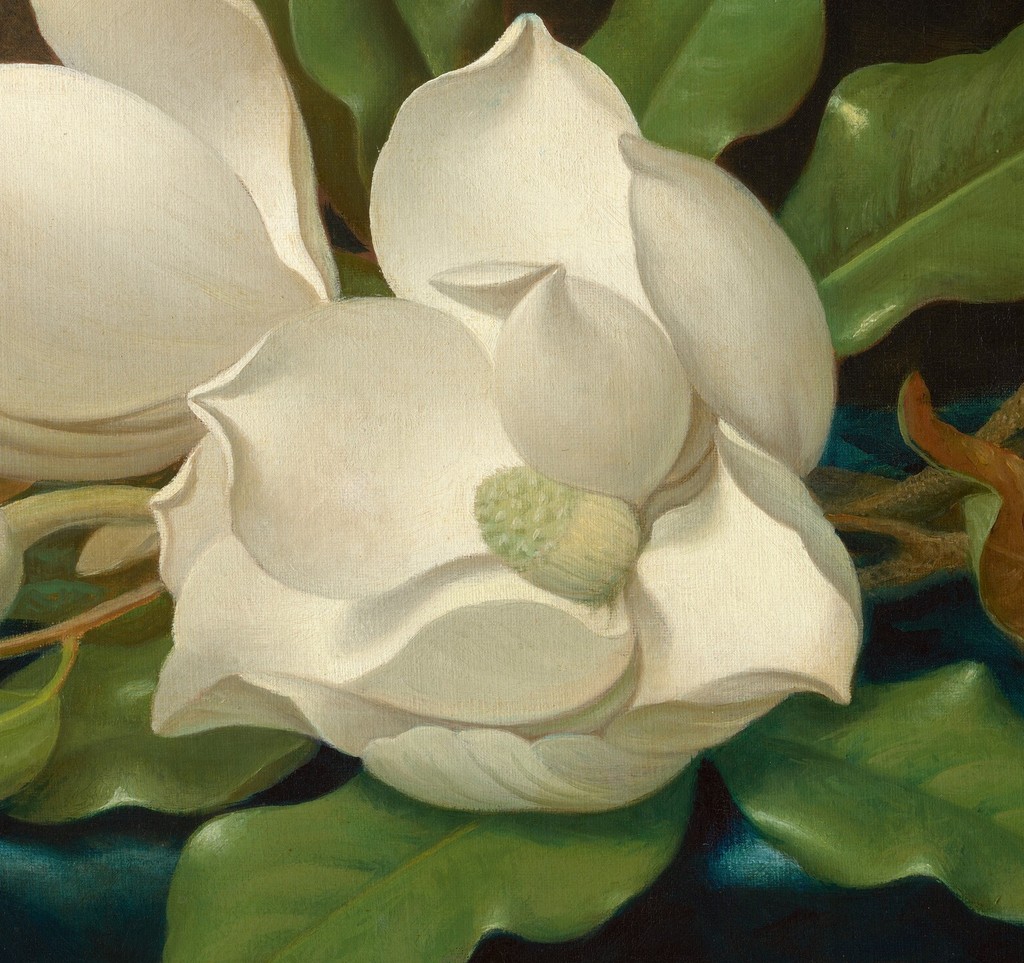
Open magnolia centre
Pale petals surround the greenish centre of the open foreground magnolia. Their overlapping curves create depth within the bright flower.
Closed bud and leaves
A closed pale bud lies beside broader green leaves. Its rounded surface contrasts with the more open petals above.
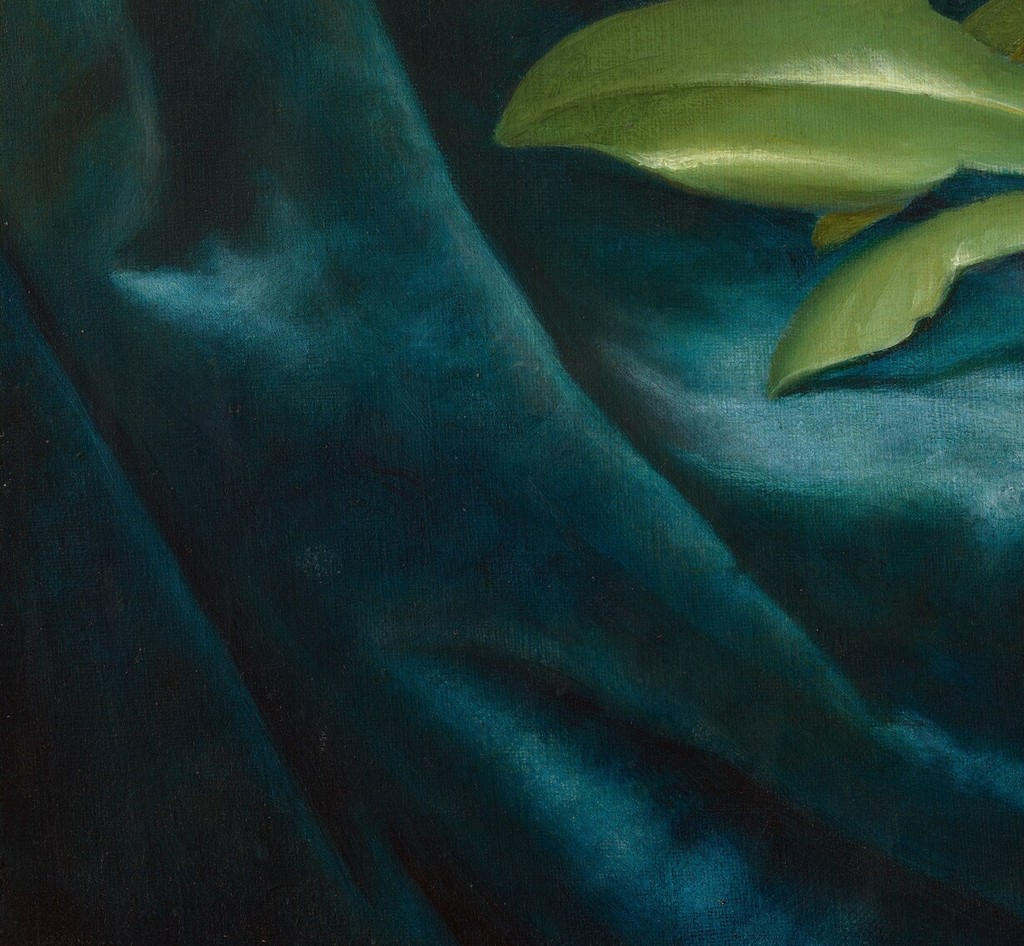
Blue cloth folds
Blue-green folds alternate between shadow and broad light. Their changes in tone support the flowers without becoming a flat background.
Leaves, cut stems and folded velvet
Large green leaves extend above, beside and beneath the flowers. Their surfaces carry stronger changes between bright and dark than a flat outline would suggest. Some curl or turn, while others spread more broadly across the fabric.
The brown underside of a leaf and the cut stems on the right interrupt the dominant green. They also reveal that these are detached botanical forms placed indoors. The painting does not show a flowering tree in its natural habitat.
The stems lead laterally towards the edge, while the leaf shapes return attention to the main blossoms. Their lines provide routes through the group rather than simply acting as filler around the flowers. The arrangement depends on the relationship between cut material and its support.
The blue cloth rises into a substantial fold at the left and continues beneath the flowers. Its changing light creates a different texture from the leaves. Broad highlights describe soft fabric, while the darkest folds make deep recesses around the group.
Blue also changes in character across the picture. Some parts move towards turquoise, while others remain very dark. Those shifts allow the cloth to hold the flowers within an interior space without becoming a flat coloured backdrop.
The upper background is quieter and browner. It gives the leaves room to stand out while preserving the picture’s enclosed atmosphere. There is no broad landscape beyond the flowers competing for attention with the tabletop arrangement.
Kelly emphasises the interplay of petal, leaf and cloth contours, together with differences of colour and texture. His discussion helps explain why the work’s effect depends on the entire arrangement rather than on a single isolated blossom.[2]
A surface made in stages
The NGA’s 1996 technical notes describe a fine, lightweight plain-weave canvas and an overall off-white ground. They state that the major flower outlines were probably drawn in graphite. The qualification matters: probable drawing material should not be presented as a completely settled identification.[2]
The same notes record a sequence of painting. The white blossoms were laid in first, mainly wet into wet and with little glazing. Leaves and stems followed, with their initial modelling also blended while wet and built from darker towards lighter paint.[2]
Deeper shadows were developed with transparent glazes. The background was painted over the ground in further glazed passages. Highlights on the velvet were added over middle tones and then reduced as the work progressed.[2]
This sequence makes the picture’s different materials more intelligible. The flowers’ pale modelling, the leaves’ stronger tonal contrasts and the cloth’s subdued highlights were not necessarily achieved through the same method. Their final unity could involve different handling in different parts of the canvas.
The normal colour illustration shows the resulting appearance, not a direct view through all the layers. The evidence for order and materials comes from the published examination. A bright patch in the reproduction should not be labelled a glaze or an underdrawing solely because of how it looks on screen.
The catalogue also records that the original tacking margins had been removed and the stretcher was not original. Those observations belong to the historical examination. They are relevant to the object’s physical history, but do not establish a current conservation diagnosis.[2]
Bright petals and deeper surrounding paint
The most immediate effect is the separation of pale petals from darker surroundings. Some petal edges appear clearly defined, while others are softened by adjacent light forms. The modelling gives the blossoms volume without making every boundary equally sharp.
The darker paint performs several jobs. It describes leaves and cloth, opens spaces behind the stems, and gives the flower group a setting. These passages allow the light forms to remain luminous without filling the whole canvas with bright paint.
The historical examination suggests why the shadows should be considered as actively made passages. Transparent glazes could deepen them while preserving relationships to underlying modelling. Their visual richness is not simply the absence of detail.[2]
The flowers likewise avoid a single flat white. Overlapping petals, shaded undersides and the centre of the nearer blossom create a small internal landscape of light and colour. The arrangement rewards attention both to the broad group and to these local differences.
The foreground cloth returns that attention to the whole picture. Its folds cross beneath the leaves and around the flowers, linking separate botanical forms through a shared surface. The still life therefore depends on an interior arrangement as much as on botanical description.
Watch: Martin Johnson Heade
Choose a film to explore the artist’s work, its interpretation and its wider setting.
Museum Minute: Heade Hummingbirds
A brief Shelburne Museum introduction to Heade’s hummingbird paintings.
Watch on YouTubeDifferent magnolia pictures
Kelly places this canvas among Heade’s late pictures of flowers on velvet. The group varies in size, number of blossoms, arrangement and cloth colour. Repetition of the subject gave the artist several ways to test relationships between pale petals and richer surrounding materials.[2]
A closely related Giant Magnolias at the R. W. Norton Art Gallery in Shreveport shows three open flowers. Kelly discusses both works in relation to a painted study in St. Augustine, but explains that their order of execution cannot be established. The different flower states do not prove that they were conceived as a pair.[2]
The Art Institute of Chicago’s Magnolias on Light Blue Velvet Cloth is another distinct object, accession 1983.791, dated c.1885–95. Its title and blue fabric may invite confusion, but its flower placement and surrounding cloth differ from the NGA arrangement.[3]
The Timken Museum’s The Magnolia Blossom, dated 1888, provides a further comparison. The museum discusses a red edge around the pale flower and its contribution to the image’s spatial effect. That work-specific account should not be transferred automatically to either blue-cloth canvas.[4]
These distinctions matter for both interpretation and technical evidence. A finding about one painting does not become a recipe for the whole magnolia group. Exact titles, collections and arrangements allow the pictures to be compared while preserving their individual identities.
Martin Johnson Heade, Magnolias on Light Blue Velvet Cloth, c.1885–95. Art Institute of Chicago, 1983.791. Image source. CC0 / Public domain. Resized only; native appearance preserved.
Florida and interior display
Heade settled in St. Augustine in 1883, the year he married Elizabeth Smith. Kelly places the late magnolias within the greater personal and professional stability associated with that move and with Henry Morrison Flagler’s patronage. The context is important, although it does not establish Flagler as the commissioner of this particular canvas.[2]
Charlotte M. Porter’s Florida Museum essay describes the hotel studios as places where artists exhibited, taught and met visitors. That regional account provides a useful setting for considering pictures intended for close viewing in interiors, rather than vast public landscape displays.[5]
Kelly also discusses the flowers’ sensuous effect and earlier comparisons with reclining figures. He explicitly leaves uncertainty about a specifically sexual intention. Such analogies can illuminate the curve, light and luxurious material of the arrangement while remaining critical responses to the work.[2]
The picture’s material qualities can also be examined without adopting that interpretation. Cut stems, curled leaves, broad petals and folded velvet already provide a substantial set of relationships. Their differences make the still life more complex than a neutral display of plant specimens.
The 1996 acquisition
The National Gallery acquired the painting in February 1996. It was given by The Circle of the National Gallery of Art in commemoration of the group’s tenth anniversary. The accession 1996.14.1 identifies this two-open-flower-and-bud composition within the larger magnolia family.[1][2]
Kelly’s catalogue traces earlier ownership through dealer Victor Spark, Dr. and Mrs. Samuel Finkelstein, descent and a later gallery consignment. That recorded path differs from a claim that the picture remained in Florida or passed directly from Flagler to the NGA.[2]
The same entry records inclusion in the 1969 Heade exhibition and the Museum of Modern Art’s The Natural Paradise in 1976. These historical appearances place the still life within the later reconsideration of American painting.[2]
At 38.4 by 61.5 centimetres, the canvas is compact enough for its leaves, petals and fabric to invite close attention. Its significance lies in that concentrated arrangement and in the documented care with which its different surfaces were made.[1]
Artworks directory
A collected selection of 26 individually identified museum paintings, including thirteen extended artwork studies. This is a bounded directory, rather than a complete catalogue raisonné. Two Boston entries retain dates from the 2002 conservation study. Links open a companion article where available, otherwise the cited institutional record or publication; unillustrated objects remain included.
Frequently Asked Questions
No. The NGA painting contains two open flowers and a closed bud. The related Norton picture has three open blossoms.[2]
The historical NGA examination describes different stages and handling for blossoms, leaves, shadows, background and velvet. The findings apply to this canvas.[2]
Discussion
Look again at the images and ideas explored in Giant Magnolias on a Blue Velvet Cloth by Martin Johnson Heade. These editorial prompts invite your observations.
Reader Insights
Where do the petals separate most clearly from the folded cloth?
What changes in the Chicago four-form arrangement?
How does the staged painting account affect your looking at shadows and highlights?
Join the Conversation
Share a detail, comparison or question about Giant Magnolias on a Blue Velvet Cloth by Martin Johnson Heade below.
References
- National Gallery of Art, Giant Magnolias on a Blue Velvet Cloth, 1996.14.1. Current title, dimensions, date and credit. View source
- Franklin Kelly, American Paintings of the Nineteenth Century, Part I (NGA, 1996), printed pp.295–298. Work-specific technical examination, comparative magnolias, Florida context and collecting history. View source
- Art Institute of Chicago, Magnolias on Light Blue Velvet Cloth, 1983.791. Exact separate object, date range, dimensions and collection. View source
- Timken Museum, “Martin Johnson Heade, The Magnolia Blossom, 1888”. Separate painting, acquisition history and work-specific edge discussion. View source
- Charlotte M. Porter, Florida Museum, “Florida Interests”. Regional account of Heade’s St. Augustine life and hotel studios; hotel opening dates corroborated separately in the Florida article. View source
- Splash image source.
Martin Johnson Heade, Giant Magnolias on a Blue Velvet Cloth, c.1890. Oil on canvas, 38.4 × 61.5 cm. National Gallery of Art, 1996.14.1. Gift of The Circle of the National Gallery of Art in Commemoration of its 10th Anniversary; National Gallery of Art. CC0 / Public domain. Resized only; native appearance preserved.
View source