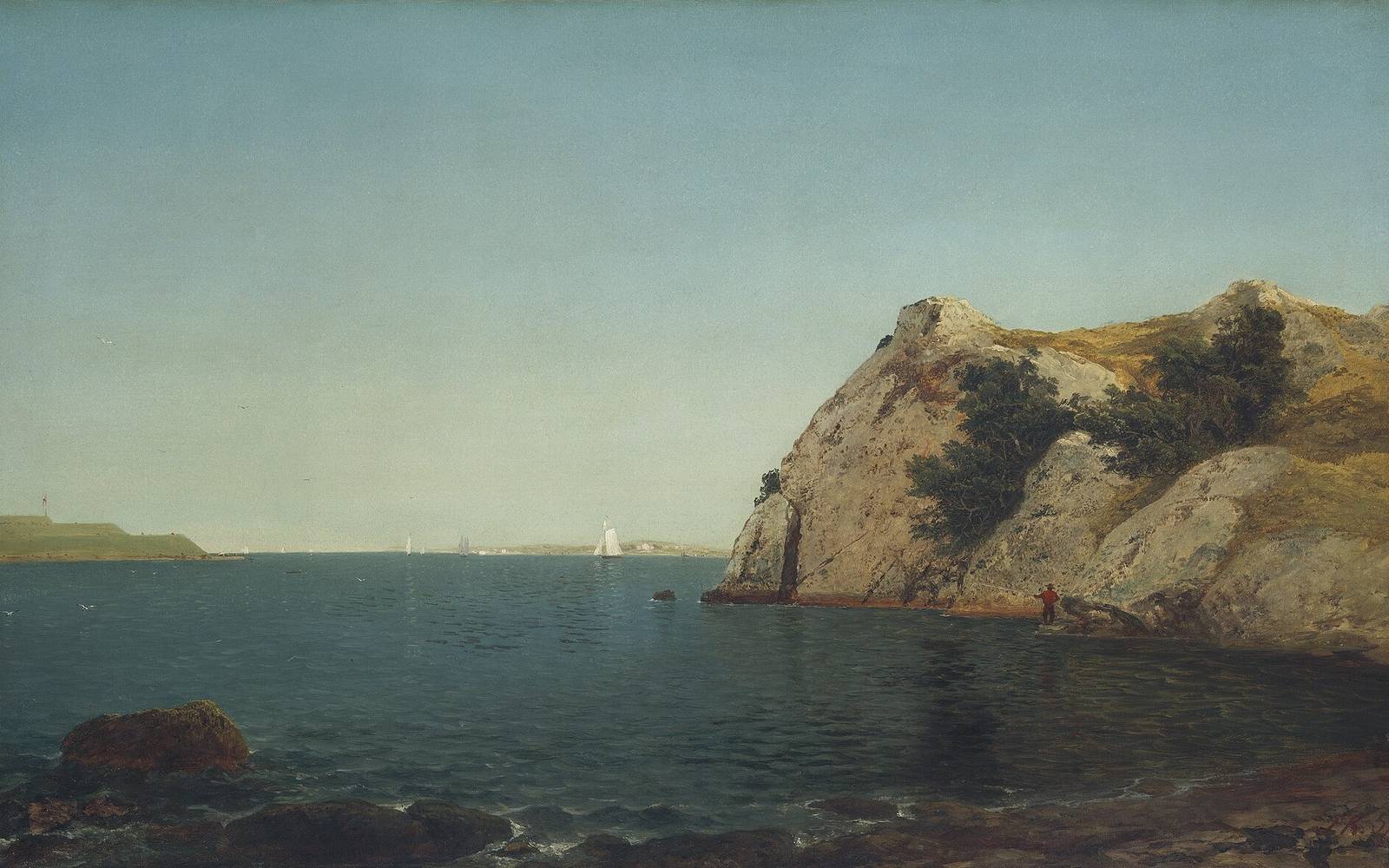
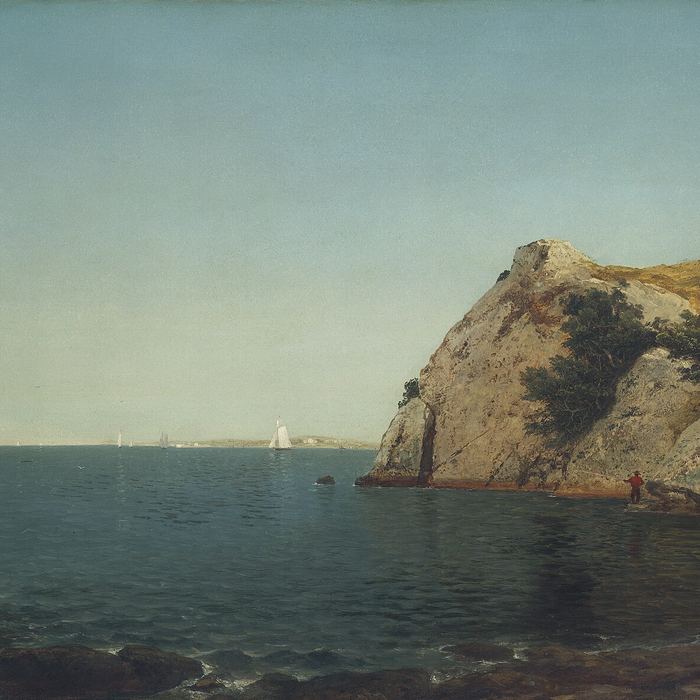
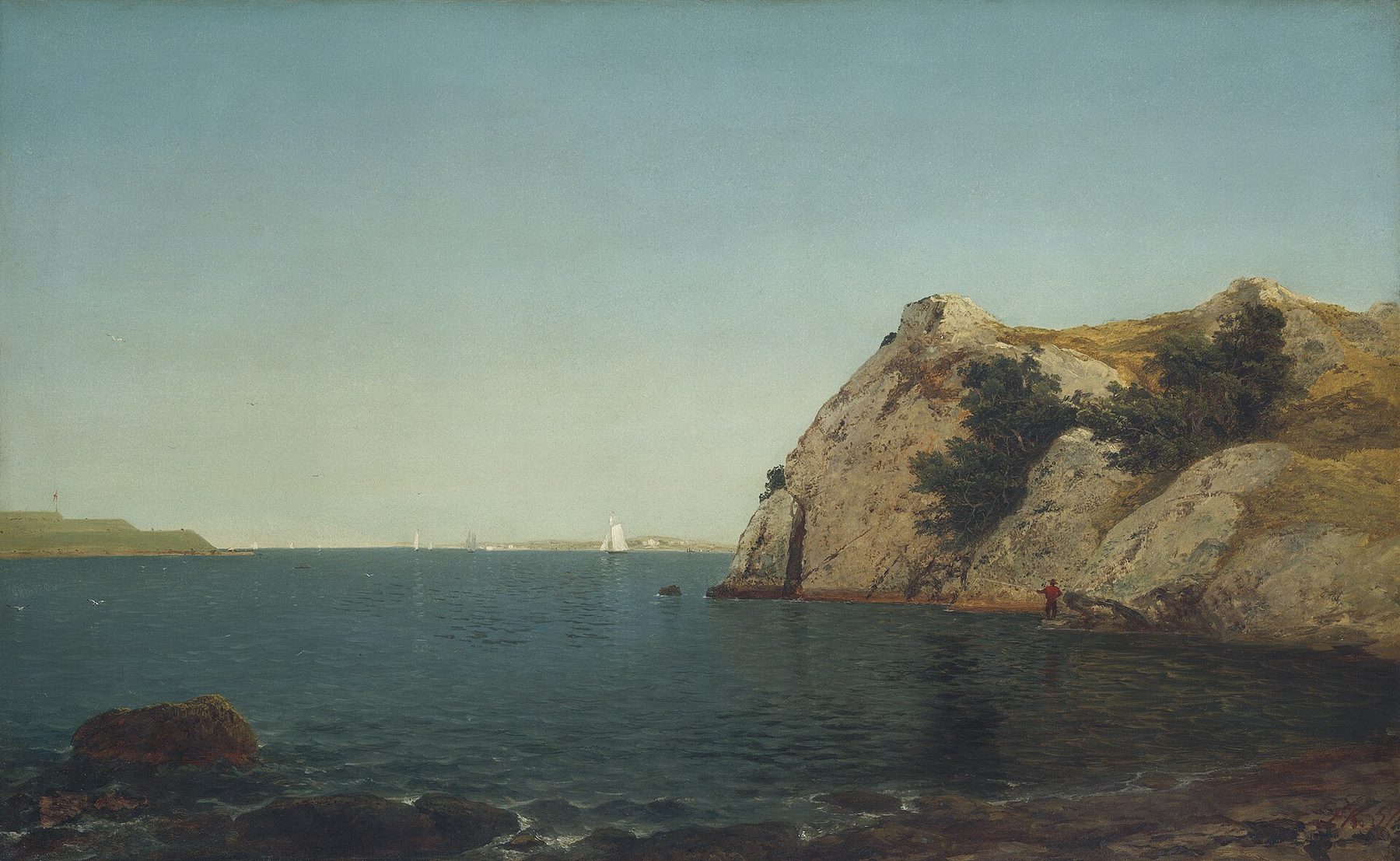
Image reference: John Frederick Kensett's Beacon Rock, Newport Harbor, 1857.
At a Glance
- Core periodc. 1850–1875, with earlier foundations and later marine afterlives
- Principal settingThe United States, especially New England and New York coasts, harbors, lakes and marshes
- Known forpervasive light, horizontal order, still water, tonal calibration and restrained final facture
- Key figuresFitz Henry Lane, John Frederick Kensett, Martin Johnson Heade, Sanford Robinson Gifford and Frederic Edwin Church
- Broader contextHudson River School, Romanticism, Realism, photography and early conservation
- Historical statusa retrospective and debated category rather than a group named by its painters
Contents
- Where it fits
- Was it a movement?
- Hudson River foundations
- How light was made
- Four stages
- Artists to know
- Essential works
- Where to see
- Suggested books
- Artist directory
Where Luminism fits
Fitz Henry Lane
Principal activityJohn Frederick Kensett
Principal activityMartin Johnson Heade
Principal activityWorthington Whittredge
Principal activitySanford Robinson Gifford
Principal activityFrederic Edwin Church
Principal activityFrancis Augustus Silva
Principal activityAlfred Thompson Bricher
Principal activityLuminist paintings can make a few seconds feel immeasurably long. A harbor lies under air so still that sails hang slack. A low strip of land divides reflective water from a pale sky. One boat, fisherman or haystack gives scale without disturbing the larger order. The light does not merely illuminate objects; it appears to occupy every interval between them. Brushstrokes withdraw, distances remain lucid, and ordinary weather takes on the concentration of an event.
Yet no nineteenth-century painter stood before such a canvas and called it Luminist. Luminism is a retrospective name, created by historians to describe a current within United States landscape painting around 1850–75. John I. H. Baur established the term in the mid-twentieth century, and the National Gallery of Art’s 1980 exhibition American Light made a canon around Fitz Henry Lane, John Frederick Kensett, Martin Johnson Heade, Sanford Robinson Gifford and Frederic Edwin Church. The exhibition also included drawings and photographs, treating the phenomenon as a broad period of attention to light rather than a painters’ club.[1] [2] [3]
That later origin is not a reason to discard the word. It is a reason to use it carefully. Luminism identifies a persuasive family of visual decisions: horizontal design, still water, broad sky, fine tonal change, suppressed brushwork and a mood of temporal suspension. It does not prove that the artists shared a programme, and it cannot turn every bright Hudson River School picture into the same style. Several core painters used the mode only intermittently. Church’s immense spectacles and Bierstadt’s western panoramas can overlap with it without matching the quiet concentration of Lane’s Gloucester or Kensett’s late coasts.
Luminism is most illuminating when it names a way of organising attention rather than a brotherhood. Its calm must also be placed back into history. These paintings were made amid expanding maritime commerce, railway tourism, Indigenous dispossession, slavery, Civil War and accelerating environmental change. Boats, steamships, fort ruins, hay harvests and tiny figures prevent their spaces from being truly timeless. The challenge is to preserve their remarkable stillness without mistaking stillness for innocence.
Was Luminism really a movement?
No manifesto, exhibition society or contemporary critic gathered the painters under this name. Baur looked backward from the twentieth century and found a shared sensibility in works that their makers had classified as landscape, marine painting or views of particular places. The National Gallery later called Luminism the culminating phase of Hudson River painting and set its strongest period between 1850 and 1875.[2] [3]
Even the name can mislead. It seems to say that unusual brightness is the defining test. But many Romantic, academic and naturalist landscapes are luminous. A Luminist work generally coordinates light with a distinctive structure: a long horizontal format, low or stable horizon, broad lateral zones, finely calibrated reflections, reduced incident and a surface whose handling does not demand attention. The entire field seems illuminated under one atmospheric law.
Nor does the category have fixed membership. Lane and Kensett occupy its centre because their mature marine and coastal paintings repeatedly sustain these relations. Heade’s marshes and storms complicate calm with meteorological tension. Gifford often uses warmer veils and more evident emotion. Church alternates between small studies, ordered atmospheric landscapes and panoramic showpieces. Bricher, Silva, Whittredge, Cropsey, Casilear, William Trost Richards and photographers enter at different points.
The retrospective term shaped collecting as well as interpretation. Lane had fallen from broad public memory before scholars reconstructed his career and oeuvre. American Light brought more than 160 paintings together with 49 drawings and watercolours and 47 photographs, teaching viewers to recognise a period through comparison.[1] In other words, museums did not simply find a fully formed movement waiting in storage; exhibitions, catalogues and acquisitions helped produce the category through which the pictures are now seen.
This history should remain visible in the article. Calling a painting Luminist is an argument about relations among objects, not a recovered nineteenth-century membership card. The term succeeds when it prompts exact looking and fails when it becomes a poetic synonym for “beautiful light.”
From the Hudson River School to a quieter mode
The foundation lies in the Hudson River School, itself a later name for the first major tradition of landscape painting in the United States. Thomas Cole used the Catskills, Italian scenery and allegorical cycles to give landscape narrative and moral ambition. His compositions often lead viewers through time: civilisation rises and falls, a traveller ages, or ruins announce the fate of power. Luminist painters inherited landscape’s elevated status but frequently reduced explicit story.[31] [32]
Asher B. Durand moved toward close natural observation. Originally an engraver, he became a landscape painter, president of the National Academy of Design and a guide to the generation after Cole. In his 1855 “Letters on Landscape Painting,” Durand urged artists to learn from modest natural forms outdoors rather than repeat inherited formulas. His woodland interiors fill the eye with trees, rocks and foliage; the later Luminist coast often opens a larger interval around fewer things.[30]
Durand’s European journey with Kensett and John W. Casilear supplied a crucial encounter with John Constable. They saw paintings and outdoor studies through the American expatriate Charles Robert Leslie, and Durand praised their simple truth and naturalness. Constable’s weather and direct study did not dictate Luminism, but they strengthened a culture of exact attention. John Ruskin’s demand for truth to nature provided another influential language.[30]
Older European art mattered too. Seventeenth-century Dutch river and marine painting offered low horizons, sailing vessels, reflective surfaces and daily commerce ordered under extensive skies. Claude Lorrain provided measured recession and radiant atmosphere. Gifford admired Turner’s colour and light, while painters travelling in Italy confronted lakes and haze quite unlike New England weather. Technical research into Lane’s series traces plausible links to Dutch, British and Scottish-English sources rather than treating the mode as born untouched from American soil.[12]
Print culture was equally important. Lane, Kensett and Durand trained as engravers or lithographers. That work encouraged clear silhouettes, controlled gradation and topographic legibility. Prints circulated scenes beyond original exhibition rooms, creating audiences for harbors, towns and landscape. Precision was therefore both aesthetic discipline and professional skill.
Photography entered this field during the same decades. Early eastern landscape photographers worked at sites also painted by Kensett and others, and shared interests in clouds, reflective water, geology and exact topography. Some photographers knew painters or drew on Cole, Ruskin and Transcendental writing. Civil War photography then made altered and devastated land newly unavoidable.[33]
The resemblance should not become a simple cause. A long photographic exposure could intensify stillness, while a glass plate registered information painters might select away. Luminist compositions often assemble studies or viewpoints that no single lens would produce. Painting and photography developed beside one another, making the era’s desire to hold transient light in a durable image visible through different material systems.
How Luminist light was made
The apparent effortlessness of a Luminist surface is a technical achievement. Painters prepared pale grounds, built thin layers, adjusted tonal steps and sometimes used glazes or varnish to deepen atmosphere. Gifford was known for warm colour and multiple varnish layers. Lane calibrated penumbral colour against stronger new pigments. The final surface may suppress individual strokes, but it contains many decisions about absorption, reflection and edge.[4] [27]
Horizontal construction is the first visible tool. Land, water and sky form stacked bands; capes, clouds or vessels establish intervals across them. A vertical mast or rock then becomes more emphatic because it interrupts a predominantly lateral world. Low horizons expand sky, while high viewpoints can increase the sweep of water. Repetition—sail after sail, ripple after ripple—measures distance without theatrical perspective.
Still water performs two roles. It opens space and repeats light. Reflection can join upper and lower halves without making them symmetrical. In Heade’s marshes, tidal creeks bend through flat land and carry the sky inward. Along Kensett’s coast, a narrow change of hue can separate shallow water, open sea and haze. Lane’s harbors use anchorage and slack sail to make calm physically credible.
Edges are carefully varied. A nearby rock may be sharply described, while a distant shore nearly dissolves. The contrast allows air to become perceptible. Minute foreground detail does not necessarily fight spaciousness; it can make the interval beyond feel larger. Suppressed brushwork means that touch serves the depicted surface rather than announcing the painter’s speed.
Preparatory work tells another story. Gifford’s tiny oil sketches use rapid, visible marks to catch sunset, rock and sky. Durand sketched directly from nature. Church gathered many studies before constructing a composite exhibition canvas. The smooth finished painting was not simply copied from a tranquil view; it translated mobile study into controlled duration.[28] [35]
Light also depends on exclusion. Luminist painters reduce weather to a few legible transitions and hold anecdote to the edge. That economy can feel spiritual because it slows attention, but formal restraint is not proof that every artist intended a Transcendental meditation. Emersonian and Thoreauvian thought belong to the cultural field, as do Protestant ideas of nature and a national “New Eden.” Individual pictures still need evidence rather than automatic theology.[3] [4] [44]
Luminist artists to know
Fitz Henry Lane
Lane transformed lithographic precision and practical harbor knowledge into measured fields of sail, rock, water and light.
John Frederick Kensett
Kensett progressively reduced incident while remaining deeply involved in New York institutions, wartime relief and museum formation.
Martin Johnson Heade
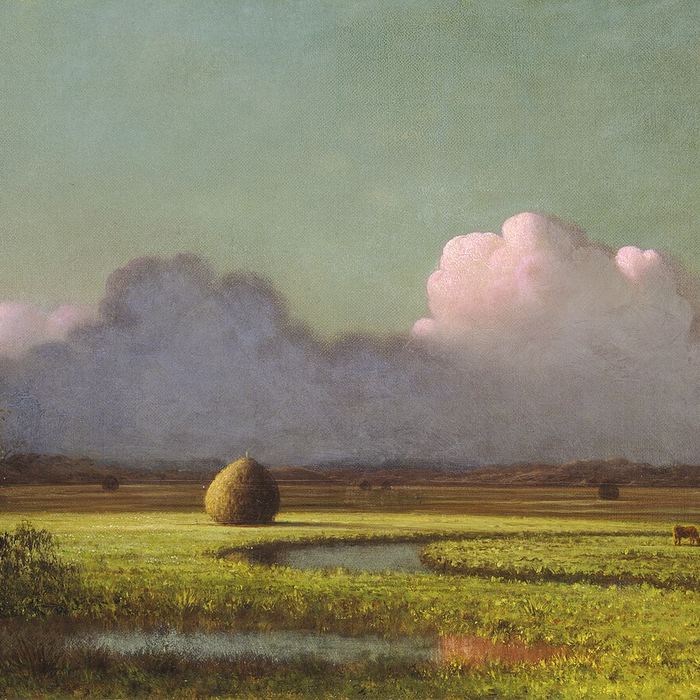
Heade used weather to organise worked wetlands and carried atmospheric inquiry far beyond the standard New England coast.
Sanford Robinson Gifford
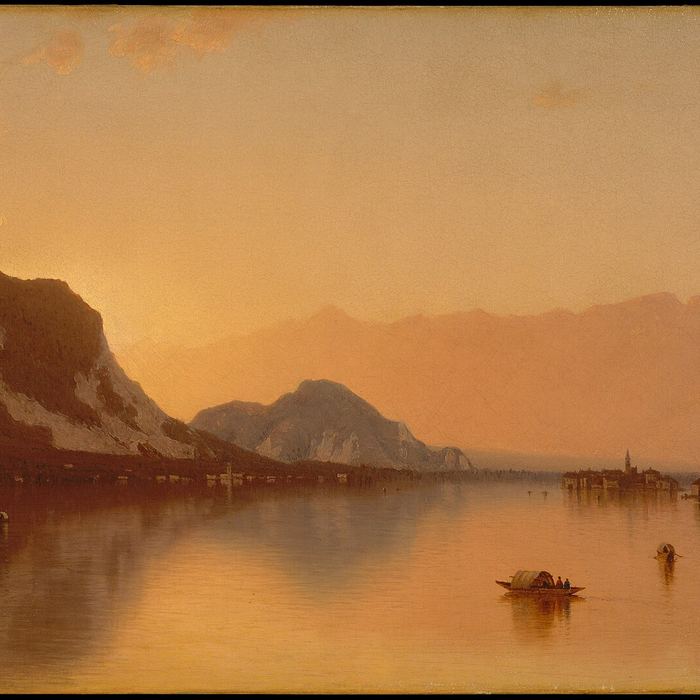
Gifford developed luminous exhibition surfaces from rapid studies, travel and carefully layered tonal transitions.
Frederic Edwin Church
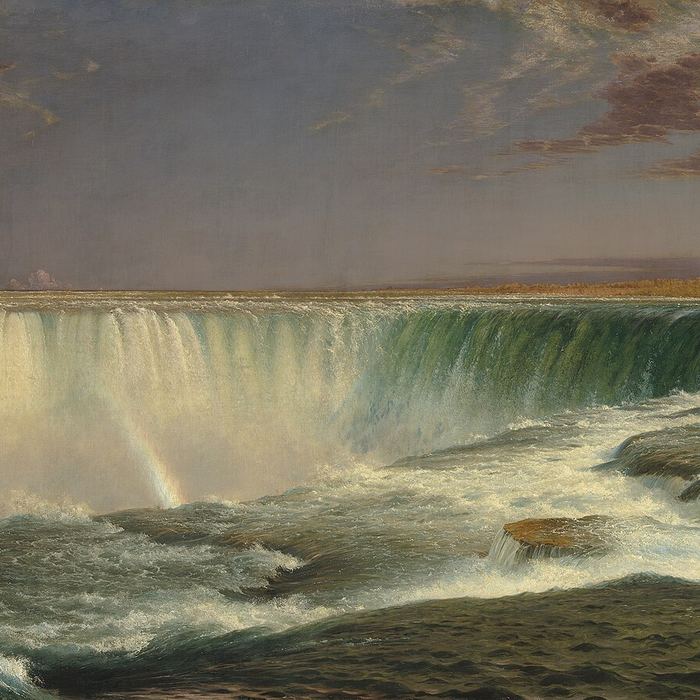
Church belongs at Luminism's expansive border, where exact light and composite study become large-scale public spectacle.
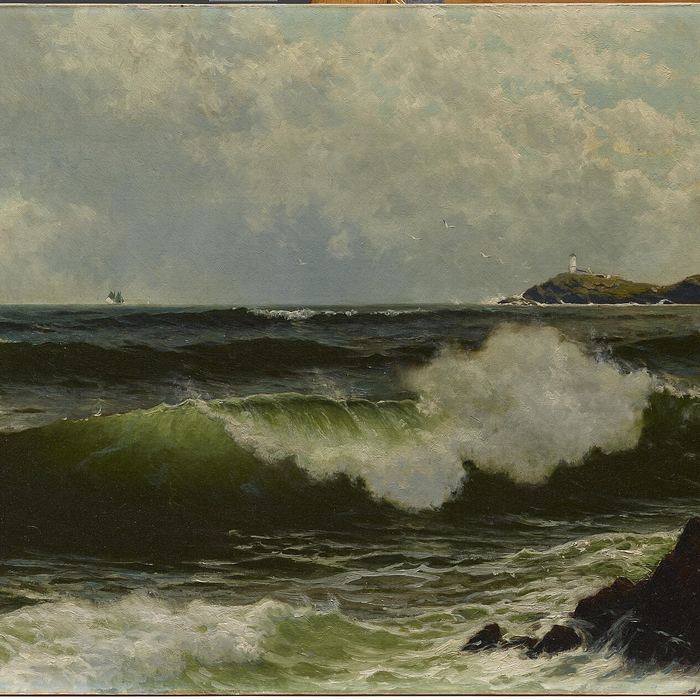
Alfred Thompson Bricher
Bricher extended the marine mode through later coastal views, active surf and images circulated to a broad market.
Follow Luminism through four stages
–early 1850s
Hudson River foundations and new visual tools
Cole and Durand elevate United States landscape while European art, engraving, lithography, outdoor study and early photography prepare a quieter language of precision and atmosphere.
–1850s
Harbor, coast and panoramic light emerge
Lane's harbors, Kensett's returned European practice and Church's composite spectacle establish several distinct ways to make light organise modern American space.
–1860s
Stillness deepens during national crisis
Lane, Kensett, Heade and Gifford refine controlled surfaces, open water and limited incident while commerce, Civil War and changing land remain inside the calm.
–1890s
Refinement, diffusion and changing styles of light
Late Kensett, Heade's long marsh practice and Bricher's marine afterlife extend the mode as Tonalism and American Impressionism reorganise atmosphere, colour and visible touch.
Fitz Henry Lane: the harbor held still
Fitz Henry Lane was born in Gloucester, Massachusetts, a port shaped by fishing, shipbuilding and Atlantic trade. He trained in Boston lithography and became highly skilled at topographic town views and ship portraits before concentrating on painting. His knowledge of vessels was not decorative. Hull, rigging, sail and anchorage carried the authority of a person who understood how a harbor worked.[3] [4]
That origin changes the meaning of his precision. A ship portrait identifies a valuable object and its owner; a town view records businesses, streets and shore. Lane’s mature art did not leave this descriptive world behind. It reordered it until commerce and atmosphere seem to share one measure. A mast is both nautical equipment and a vertical accent; a steamship is modern transport and a dark mass crossing illuminated water.
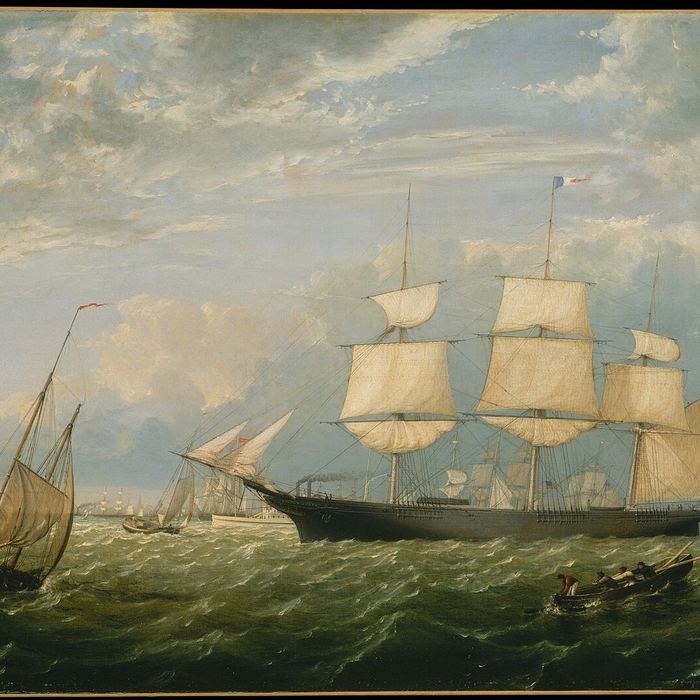
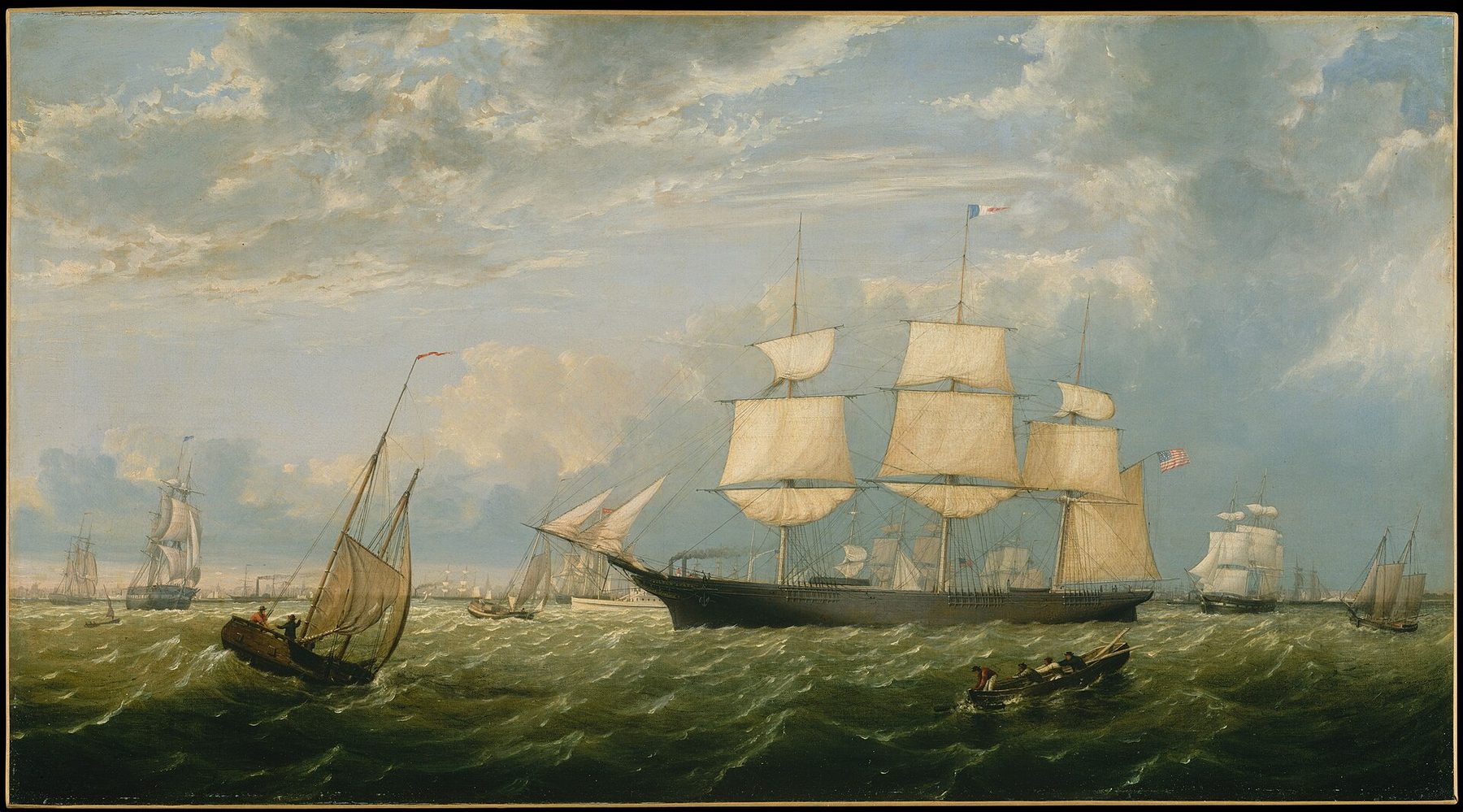
The Golden State Entering New York Harbor of 1854 presents such modernity directly. A large steam vessel belongs to expanding coastal movement and trade. The painting’s polished distance does not cancel noise, fuel or business; it contains them within a pictorial atmosphere. Luminism was capable of absorbing industrial technology without making industry the dominant drama.[11]
Gloucester supplied Lane with subjects he could revisit. Repetition allowed him to alter light, tide, vessels and viewpoint while preserving recognisable landmarks. Technical study of related paintings indicates that series were also economic: patrons wanted versions of meaningful sites, and the painter adjusted compositions for ownership and occasion. The ideal of a solitary revelation therefore sits beside a professional practice responsive to local clients.[12]
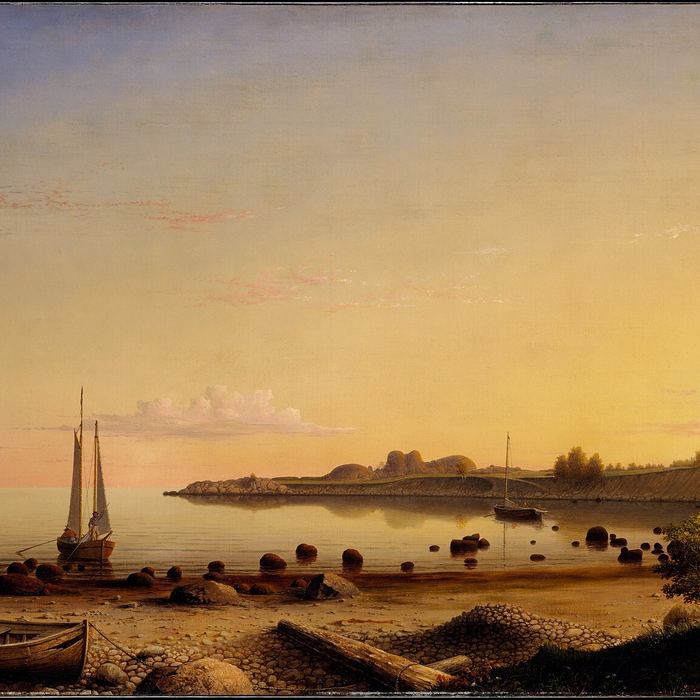
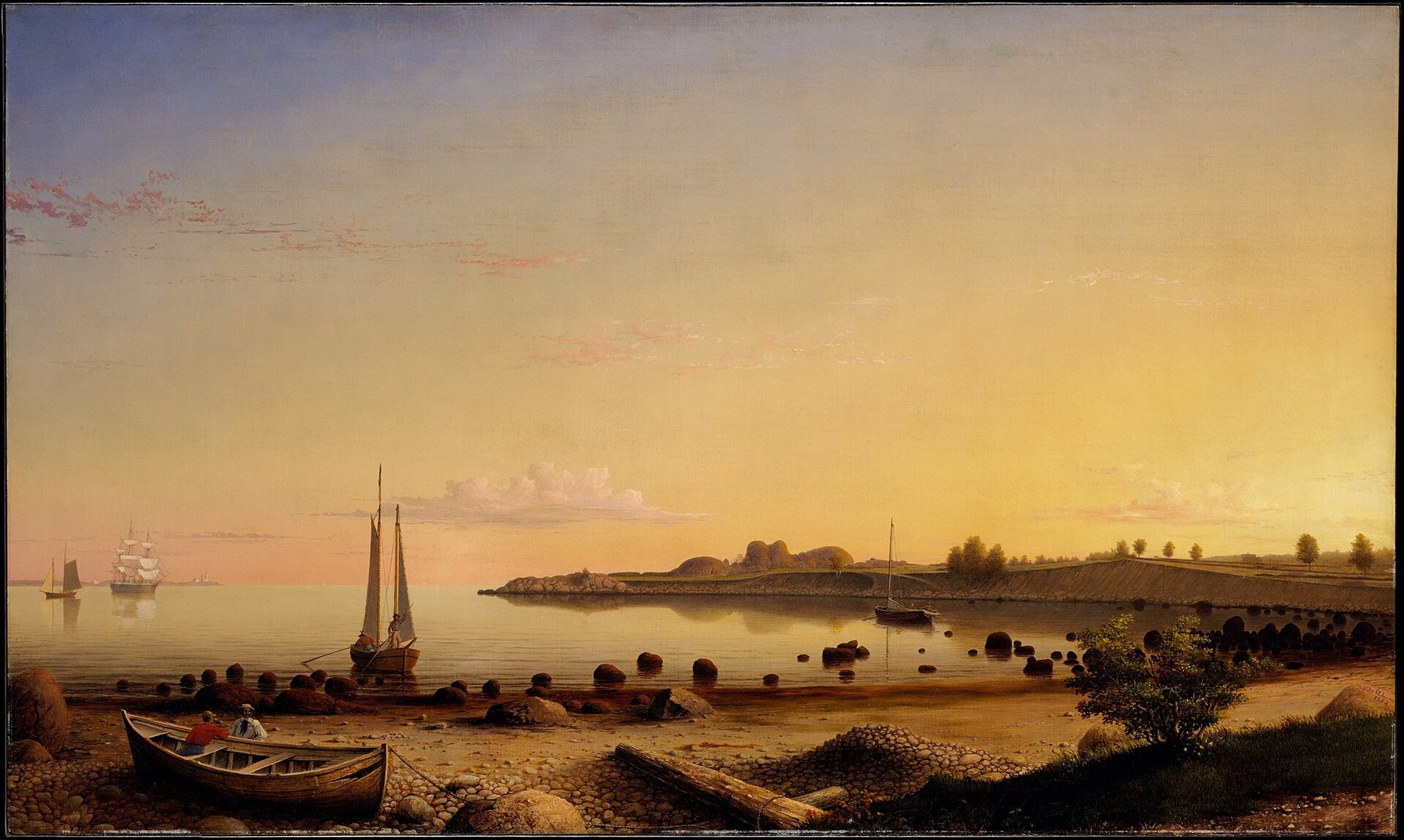
Stage Fort across Gloucester Harbor of 1862 is one of Lane’s most concentrated works. The overgrown fort, associated with early English settlement, occupies an arching landform that leads toward a pale glowing distance. Boats remain almost motionless; slack sails show that air and water are still. The absence of visible work creates an uncanny pause rather than simple contentment. The Metropolitan Museum describes the light as unearthly and the mood as hermetic and elegiac.[10]
History is quiet but not absent. Stage Fort is a ruin, and the port around it was changing. The picture sets colonial memory against a light that seems to exceed human duration. Lane’s late paintings often use wrecks, beached hulls or obstructing rocks to introduce mortality. In versions of Brace’s Rock, the decaying skeleton of a boat makes purified space harder to read as untouched paradise.[13]
Lane’s disability has sometimes been turned into a biographical key for stillness, as though limited mobility produced an inward art. Such explanation is too easy. He travelled along the New England coast, maintained professional networks and knew active harbors. His paintings’ silence came from composition, colour, observation and revision. It should not be treated as the symptom of a body.
The artist’s reputation also demonstrates how art history changes. Nineteenth-century viewers knew Lane as a marine and local painter. Twentieth-century scholars recovered works, refined his biography and placed him at the centre of Luminism. That recovery allowed extraordinary paintings to be seen, but it also encouraged them to illustrate a category invented long after his death. The best reading moves in both directions: Lane clarifies Luminism, and his specific Gloucester world prevents Luminism from becoming an abstraction.
John Frederick Kensett: clarity and public culture
John Frederick Kensett began in his father’s engraving business and worked for engravers in New Haven, New York and Albany. In 1840 he travelled to Europe with Casilear and Durand, studying old masters, drawing outdoors and developing the ambition to become a landscape painter. Back in the United States, he established a successful career through New York’s academies, associations, patrons and clubs.[5]
His public activity complicates the idea that Luminist calm was withdrawn from society. Kensett helped lead the Artists’ Fund Society, served on a committee concerned with the United States Capitol, participated in the Union League Club and the great Sanitary Fair of 1864, and became a founding trustee of the Metropolitan Museum of Art. The maker of seemingly private silences was deeply involved in constructing national cultural institutions.[5] [9]
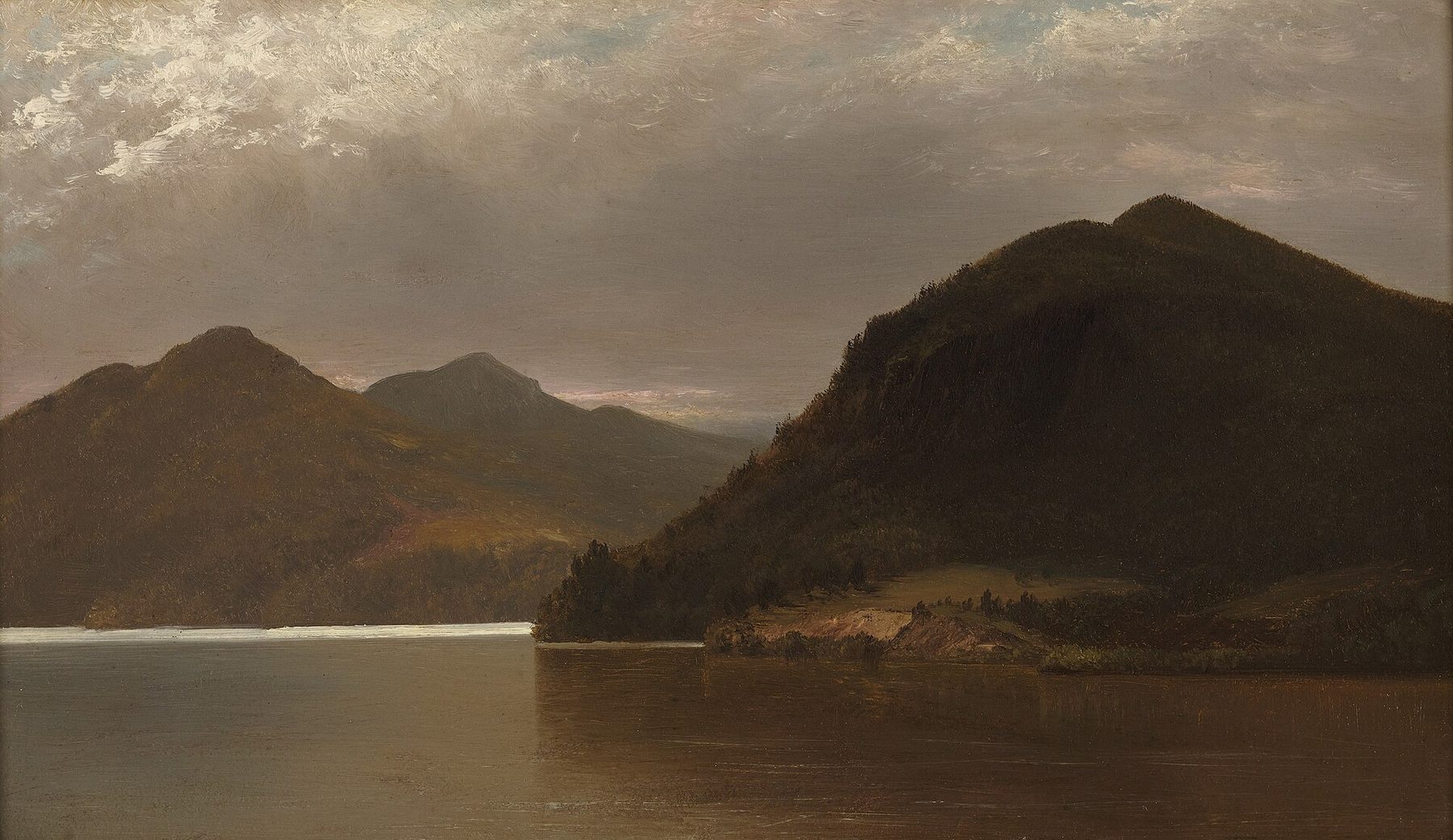
Kensett’s early landscapes could be more conventionally picturesque, with mountain, woodland and detailed recession. From the mid-1850s, coastal sites encouraged a quieter organisation. Beacon Rock, Newport Harbor of 1857 places a great rock mass at the right and opens water toward a low distant shore. A fisherman in red stands at the edge, minute beside geology; sailing boats register ordinary movement without breaking calm.[7]
The precision is active rather than static. Small waves meet foreground stones, sails answer one another across the water, and the rock’s weight balances the luminous opening. Kensett did not remove humanity; he changed its scale. The fisherman remains sufficient to connect contemplation with use.
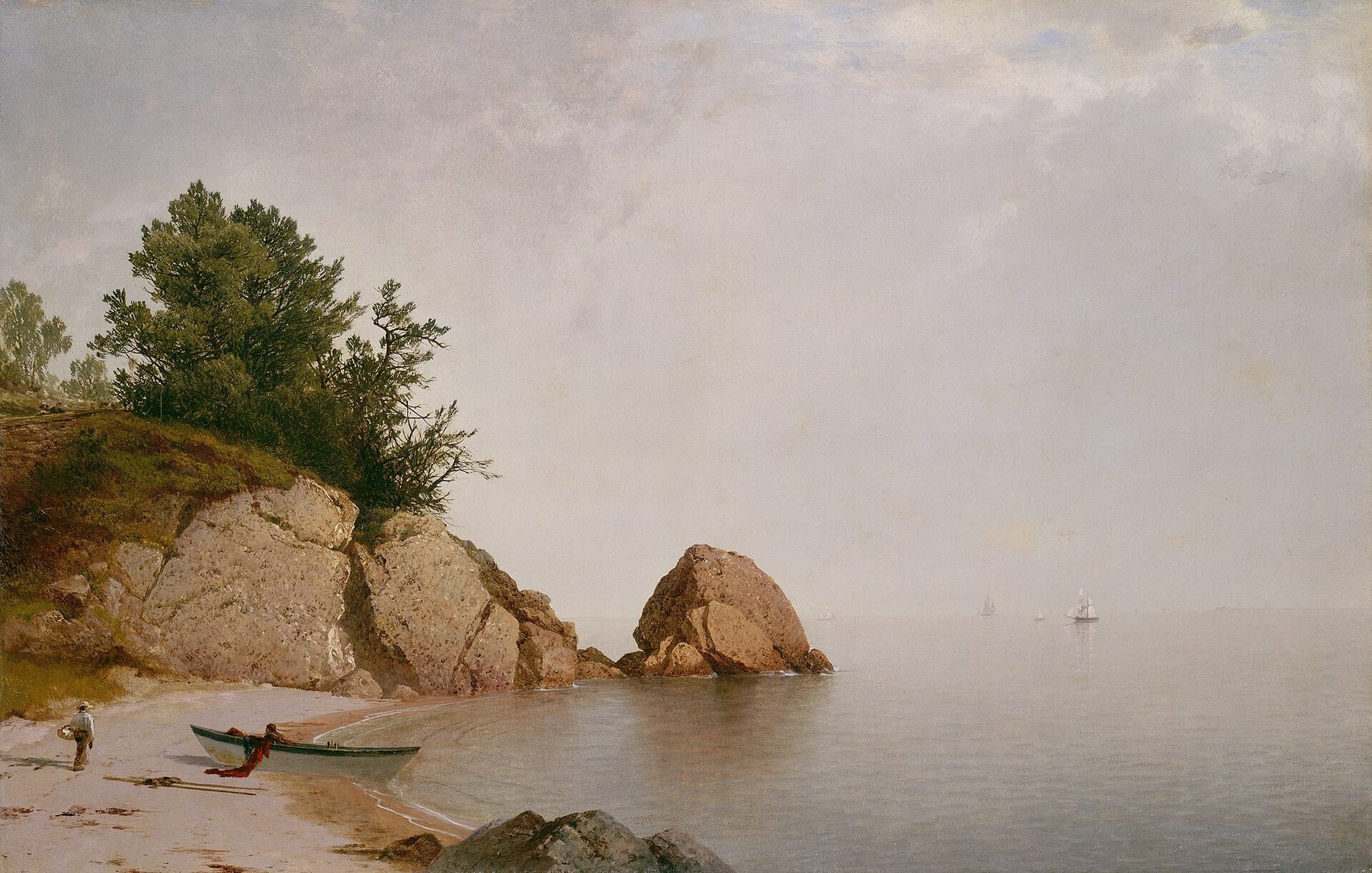
Beach at Beverly, painted around 1869–72, is more radically spare. A low cliff and bushes close the left, while beach, water and sky open rightward. A boat has been drawn onto the sand; one figure works near it and another walks away with a basket. Cloud gathers and sailboats sit near the horizon. The scene contains weather and labour, but every incident is calibrated against rock, water and sky.[6]
The elevated viewpoint lowers the horizon and increases the sense of breadth. Darker cloud and cliff anchor the left while light dissolves distance at the right. The National Gallery reads this as a balance between the immediate and imminent—people, boats and changing weather—and the apparently timeless materials of coast. Calm is therefore not frozen time. It is a structure in which different durations become simultaneously visible.[6]
Kensett returned repeatedly to Beverly, Newport and Lake George. Repetition let tiny changes of haze and water become the subject. At Lake George, a boat or bird may be the only break in an extensive clarity. Contemporary criticism compared his minute execution with old Flemish painting, while modern accounts identify the warm tranquillity and reduced form as exemplary Luminism.[8]
Lake George was not historically empty. It had been a theatre of French and Indian War and Revolutionary conflict, entered national literature through James Fenimore Cooper, and became accessible to tourists through railway development. The “unspoiled” lake was already a remembered, travelled and marketed place. Its serenity could support national pride precisely because culture had assigned meanings to it.[45]
The systematic study of Kensett’s paintings also shows how titles and dates can shift. Beach at Beverly was once exhibited as Beach at Newport, while patron records do not always confirm family tradition. Luminist timelessness depends on objects with changing names, owners and catalogues—a reminder that museum knowledge is made through evidence rather than inherited certainty.[49]
Martin Johnson Heade: weather over worked ground
Martin Johnson Heade followed the least orderly route through the supposed movement. He began as a portrait painter, lived in several American cities, travelled in Europe and only made landscape central around 1859. Although he exhibited at the National Academy of Design, he never became a member and remained somewhat apart from New York’s institutional centre. Later life in Florida and work on flowers and hummingbirds further exceed the standard Luminist story.[15] [18]
The salt marshes of Newbury, Newburyport, Rhode Island and New Jersey became his most sustained landscape subject. Heade painted more than one hundred marsh scenes, close to a fifth of his known work. No contemporary investigated the environment with comparable persistence. The New Jersey paintings confirm a regional investigation rather than attachment to one celebrated Massachusetts viewpoint.[16] [19]
These wetlands were open but not empty. Tides flooded and drained them. Local people cut naturally growing salt hay, hunted and fished. Creeks served as channels, boundaries and reflective surfaces. Modern ecology recognises salt marshes as habitats, pollution filters and buffers against erosion. Heade’s haystacks, cattle and small figures preserve evidence of a worked ecosystem whose instability is atmospheric and material.[17]
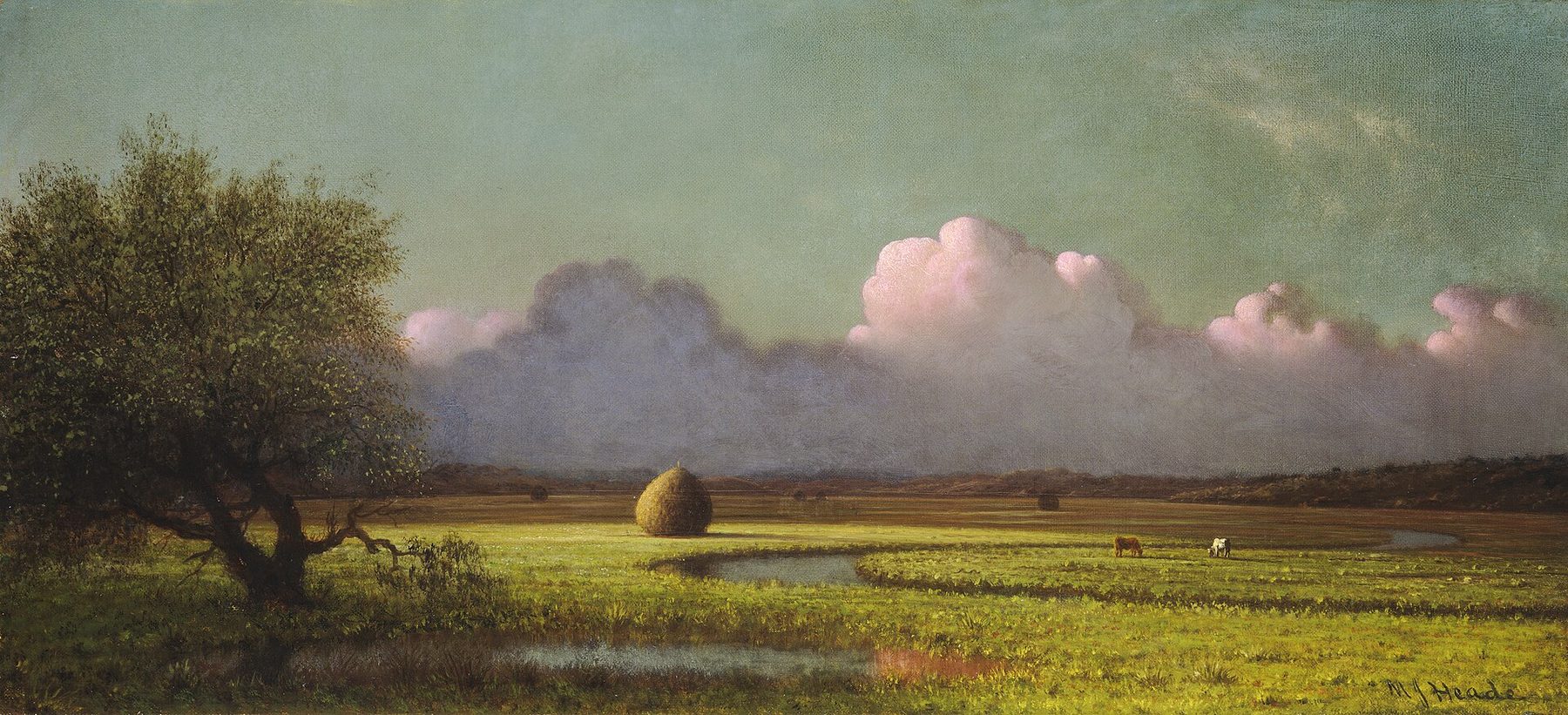
Sunlight and Shadow: The Newbury Marshes builds unity from counterforces. A tree and haystack weight the left; a tidal creek bends into the plain; cattle punctuate the right. Pink and purple clouds run across the horizon, reflect in shallow water and cast changing bands over grass. The leaning tree answers a sweep of cloud. Light and shadow move across the haystack as if it were a weather instrument.[16] [48]
The picture does not eliminate work, but harvesting has paused. Human intervention survives in the carefully formed haystack, the grazed land and perhaps the creek’s use. Luminist stillness becomes a temporary phase within tidal and economic cycles. The longer Heade painted marshes, the more variations of storm, sunset, harvest and season he could extract from the apparently limited terrain.
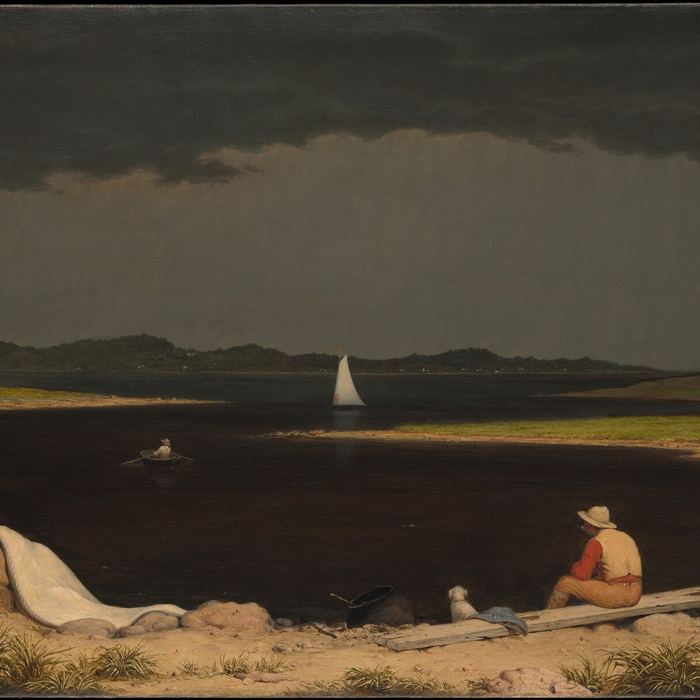
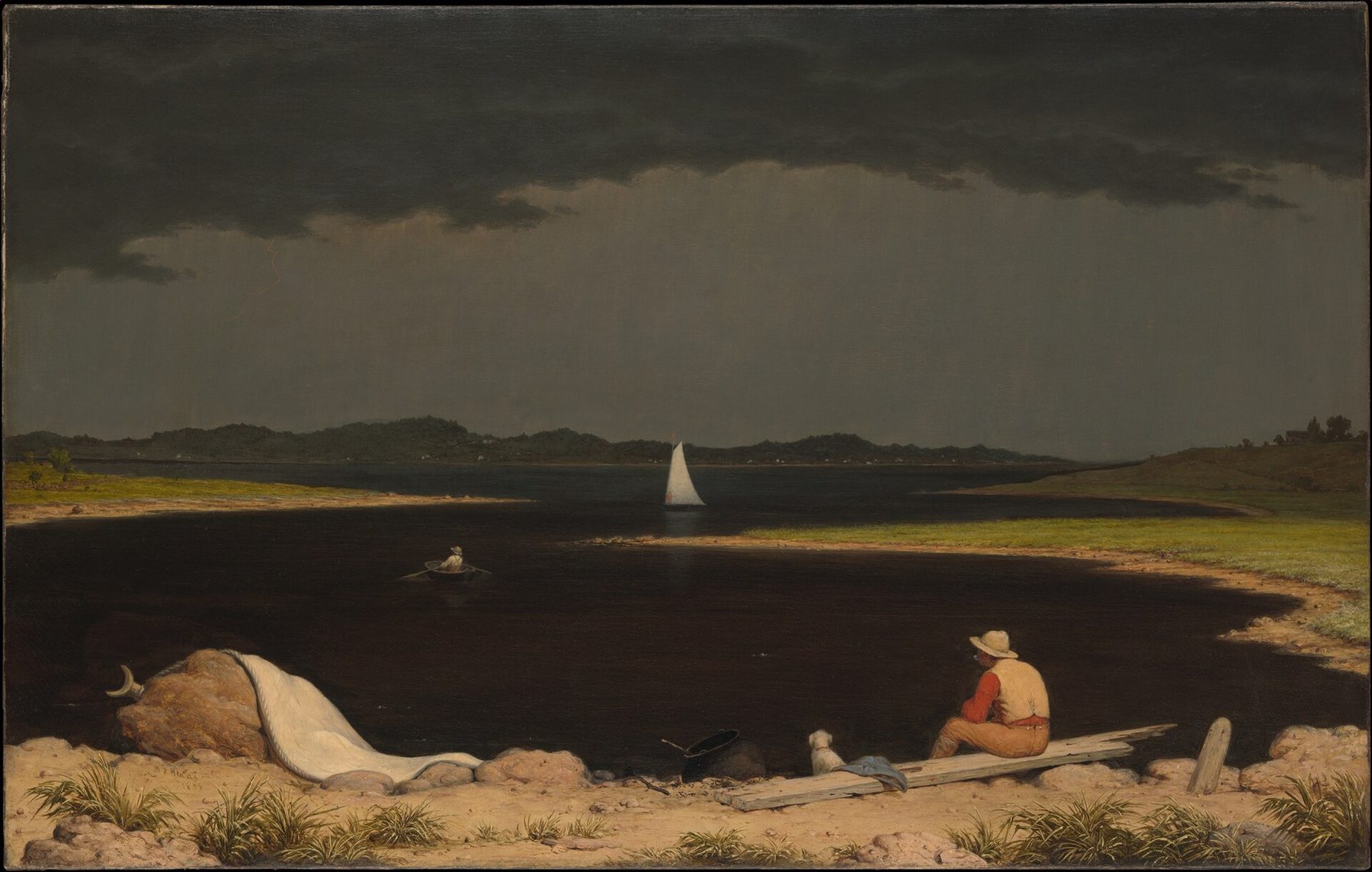
Approaching Thunder Storm of 1859 places a darkening sky above water that reflects the last harsh light. A seated figure and dog wait near shore while a boat moves under a white sail. Because the painting preceded the Civil War and was displayed during its aftermath, scholars have connected its tension with national crisis. The relationship is plausible as atmosphere, not as a deciphered code. A curator cautions that Heade did not simply enter his studio intending to illustrate “the war” through one thunderstorm.[21] [22]
Civil War history nevertheless changes the horizon of interpretation. The conflict destroyed confidence in the United States as a harmonious New Eden. Landscape and genre painters addressed the war’s unease, emancipation and aftermath indirectly as well as explicitly, while photography made battlefield consequences newly visible. Heade’s suspended weather belongs to that culture even when no cloud equals a named battle.[23]
Heade also carried atmospheric inquiry into the tropics. He travelled to Central and South America, painting Nicaragua, Brazil and Jamaica as well as exotic birds and flowers. Sunrise in Nicaragua replaces New England openness with dense vegetation, fog and oblique light over water. A solitary boat barely establishes human scale. The humid enclosure shows that Luminist attention did not require a cold northern coast.[20]
His friendship with Frederic Edwin Church supported exchanges in both directions. Church’s scientific travel and panoramic ambition may have encouraged Heade, while Heade’s darker, more generalised tropical atmosphere may later have affected Church. The idea of one master influencing one follower gives way to a conversation between unlike careers.[15] [20]
Sanford Robinson Gifford: atmosphere in layers
Sanford Robinson Gifford turned from portrait training to landscape after seeing Cole’s work. He sketched in the Catskills and Berkshires, exhibited at the American Art-Union and National Academy, and travelled repeatedly through Europe and the United States. Turner’s colour and light impressed him in Britain; Barbizon painting and Ruskin entered his thinking. Yet Gifford warned in his journal against surrendering to any method or school until it usurped nature.[24] [25]
That warning could stand as a nineteenth-century answer to the later Luminist label. Gifford did not seek to exemplify a movement. He studied particular conditions and developed a recognisable way of filtering them through warm atmosphere. Thin tonal veils and glazes allow light to seem suspended between eye and terrain. Contemporary viewers sometimes complained that he could paint nothing but warmth, evidence that the effect was as distinctive in his own time as it appears now.[27]
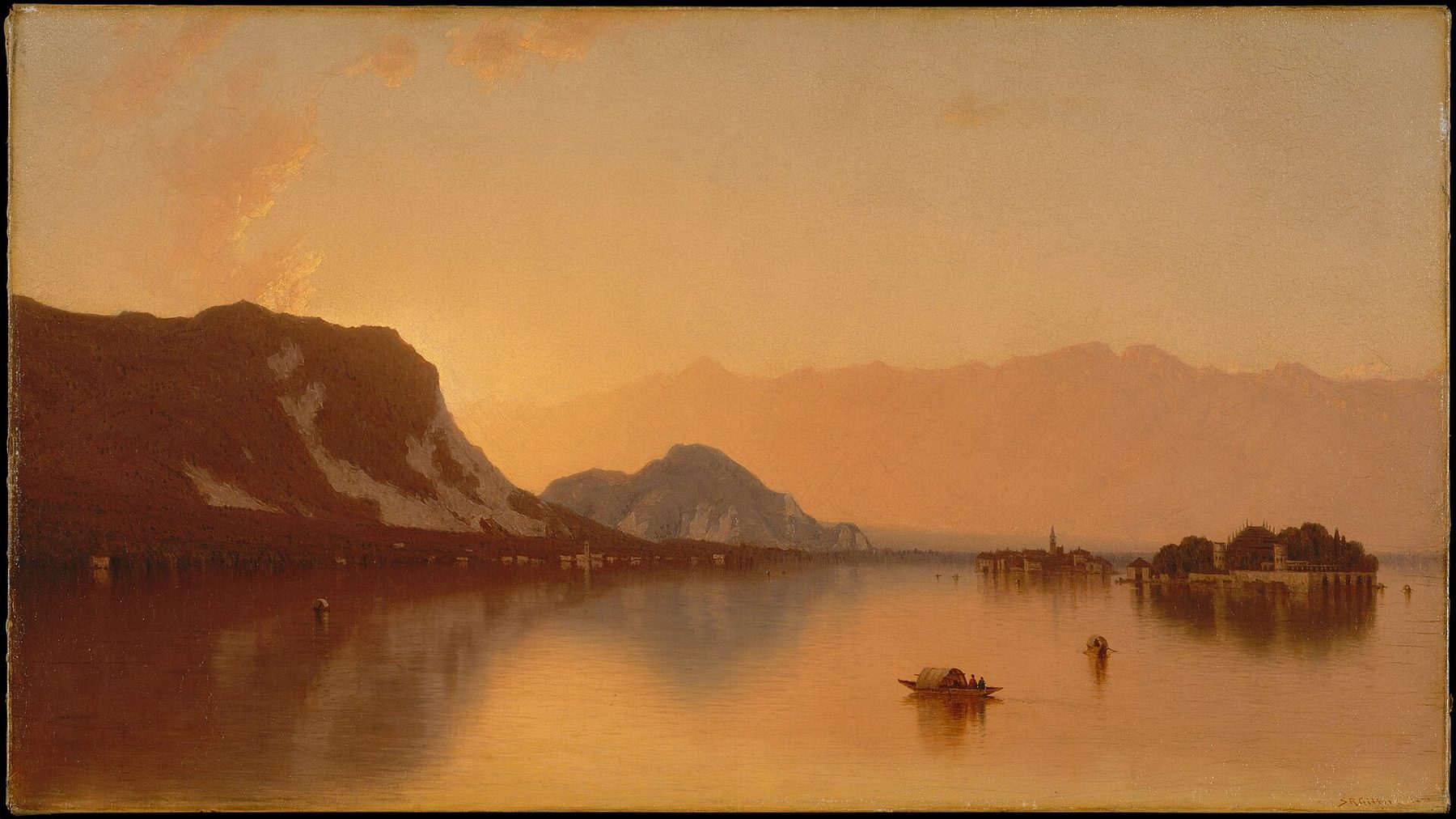
Isola Bella in Lago Maggiore of 1871 came from studies made during Italian travel. The island and mountains are present, but exact topographic inventory is secondary to gradations across water and sunset air. A horizontal format makes the lake a field through which brightness travels. Gifford’s subject is not a monument isolated in space; it is the changing optical relation among island, distance, sky and reflective surface.[26]
Small sketches reveal the speed behind such finish. From the Shawangunk Mountains is only a few inches wide and uses quick, expressive marks to register rock, trees and summer sunset. The sketch does not possess the smooth, recessed facture commonly called Luminist. It supplied immediate notation that could be reorganised in the studio.[28]
Surface history matters especially for Gifford. Layers of varnish age, darken and can compress subtle transitions into a general brown glow. Conservation of A Gorge in the Mountains combined material evidence with period accounts to recover contrasts in which one beam of light transformed shadowed trees. What viewers call atmosphere is partly the artist’s making and partly an object’s later physical life.[29]
Gifford also served in the Civil War and travelled with a western geological survey. His luminous mode was not confined to sheltered eastern leisure. Italian lake, mountain gorge, military experience and expedition geography entered one career without settling into a single national formula.
Church and Bierstadt: luminous spectacle at the borders
Church appears in nearly every historical Luminist survey because he could make light organise vast spaces with extraordinary precision. Yet the scale and theatrical publicity of his major canvases differ from the intimate arrest of Lane or Kensett. He expands the viewer’s field until light becomes national and planetary spectacle.[2] [36]
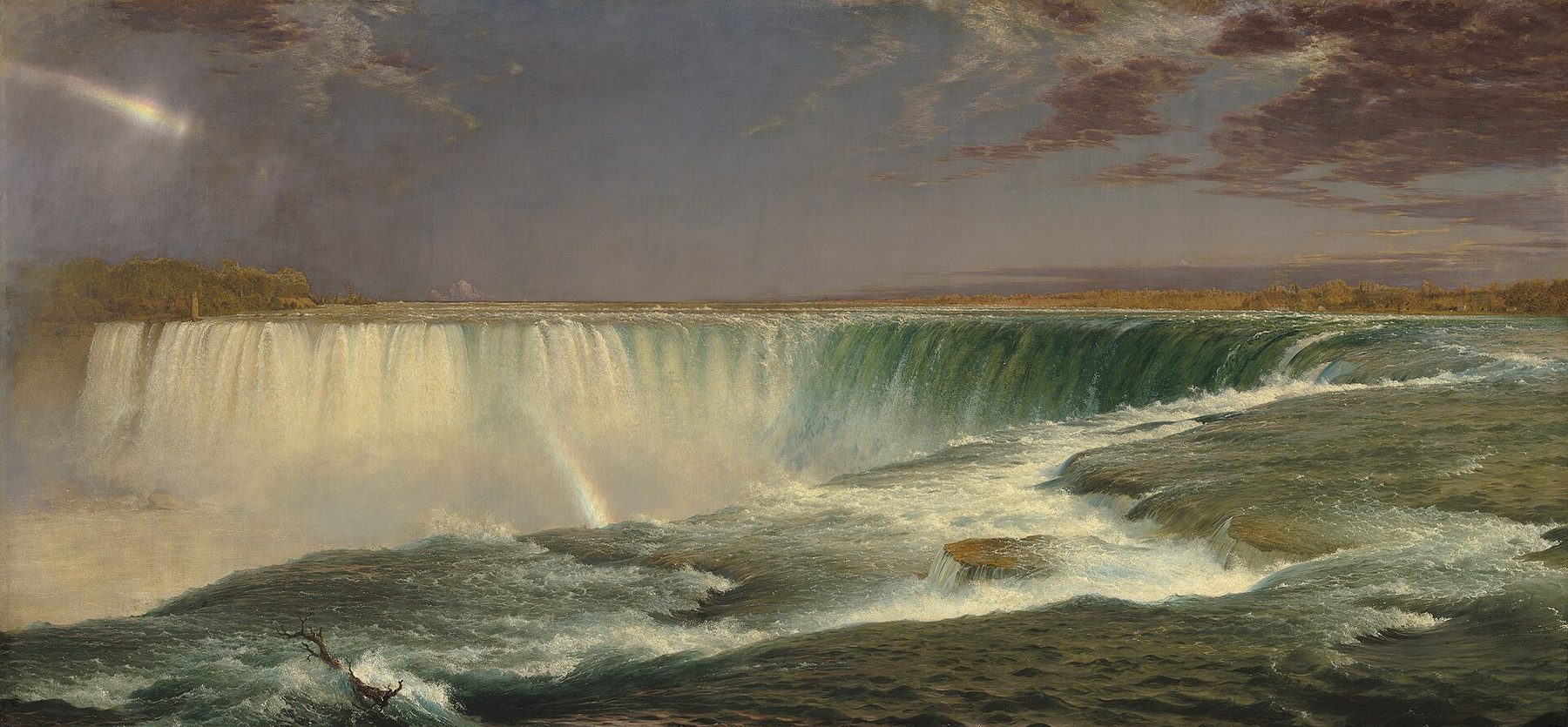
Niagara of 1857 is a decisive example. Church studied the falls on several visits, moving between the United States and Canadian sides. Back in the studio he combined viewpoints into a position no eye could occupy continuously, suspending the viewer over the green water just before it drops. Horizon, mist, rainbow and cloud create atmosphere, but rushing force replaces Luminist stasis.[34] [35]
The painting was also a nineteenth-century blockbuster. Exhibited alone, publicised, reproduced and toured, it turned landscape into an event for paying viewers. Niagara had already become a tourist destination and national image; Church renewed a familiar subject through immersive construction. The commercial display is not external to the art. It helps explain its size, immediacy and controlled revelation.[35]
The site carried histories beyond national wonder. Niagara marked a border with Canada. Enslaved people brought north by travelling owners were sometimes aided by free Black workers at the Cataract House and crossed near the falls toward freedom. Looking at Church’s symbol of national vitality alongside this route does not insert a hidden figure into the painting. It restores political geography to the place represented.[34]
Church’s South American landscapes similarly join luminous atmosphere to travel, science and empire. Inspired by Alexander von Humboldt’s vision of connected natural systems, he gathered botanical, geological and meteorological detail. El Rio de Luz opens a river beneath dense tropical vegetation and distant settlement, using light to unify a world of particulars.[37] Scientific curiosity coexisted with commercial travel, North American collecting and the desire to possess distant nature pictorially.
Albert Bierstadt brought related precision and radiant weather to the American West. His immense mountains, valleys and lakes usually intensify scale, drama and theatrical depth rather than reduce incident. Government surveys, railways and expanding markets made western travel possible. Bierstadt turned studies into studio spectacles and displayed paintings amid Native objects and animal skins, making the artist’s room another theatre of possession.[38]
Western imagery cannot be separated from expansion. Artists and audiences often treated land as sublime, open and available while Native nations were being displaced. Bierstadt stated that Indigenous life was rapidly passing and that he should record it. Such “vanishing” language made colonial destruction appear inevitable. A work such as Indians in Council, California can preserve observations and still participate in a story that places Native people outside modern futurity.[40]
Thomas Moran used western spectacle and chromatic light within later survey, tourism and conservation history. He is a related successor, not a core Luminist. The distinction helps prevent radiant atmosphere from swallowing every nineteenth-century American landscape category.[39]
Quiet pictures in a nation at war
The high Luminist decades and the Civil War overlap almost exactly. This fact unsettles any belief that calm coast and lake paintings floated outside politics. Church, Gifford, Heade, Kensett and their patrons lived through secession, mass death, emancipation and contested reconstruction. Kensett organised within the Union League and Sanitary Fair; Gifford served in the New York Seventh Regiment; Francis Silva’s art career followed military service.[5] [22] [43]
Landscape rarely offered literal reportage. Artists used broken weather, burning skies, divided terrain and restored light to articulate unease or hope. The Smithsonian’s Civil War project argues that landscape and genre, rather than traditional history painting alone, registered the conflict’s transformation of national experience.[22] [23]
Interpretive caution remains necessary. A sunset made in 1863 is not automatically an emancipation allegory, and each dark cloud cannot be assigned to a battle. Titles, letters, exhibition timing and reception determine whether a specific political reading is supported. History should widen the field around formal analysis, not replace it with a codebook.
The war also changed how land could be seen. Photographs of dead soldiers, trenches, ruined cities and cut forests opposed the fantasy of an untouched continent. Luminist stillness may consequently read as consolation, denial, mourning or renewed order depending on the work and viewer. Its strongest paintings often retain enough ambiguity to sustain these conflicting desires.
Nature, nation and the fiction of emptiness
Nineteenth-century writers and artists repeatedly imagined the United States as a new Eden. Landscape supplied a cultural ancestry to a nation that claimed political newness. Mountains, rivers and forests could function as monuments more ancient and authoritative than European architecture. Luminist clarity intensified this idea by presenting land and water as coherent, lucid and apparently available.[44]
But apparently empty land was never historically empty. Indigenous nations inhabited and governed the sites represented. Settlement, warfare, property law and tourism changed them. Lake George’s military and literary associations, Niagara’s border and freedom routes, and western survey landscapes make the national image inseparable from conflict.[34] [45]
Even the core eastern subjects contain economies. Gloucester was a fishing and shipbuilding port. New York Harbor carried steam traffic. Salt marshes produced hay and food. Resorts brought visitors to Newport and Beverly. Tiny figures and vessels may be formally subordinate, but they locate nature within labour and movement.
That scale can naturalise human activity. A distant steamship becomes one dark accent in a harmonious world; a haystack seems to grow as organically as a cloud. Viewers should recognise the elegance without assuming that pictorial balance proves social or ecological balance. Art makes relations appear coherent that history may leave contested.
Luminist landscapes nevertheless contributed to an emerging public valuation of scenery. Tourism, painting, photography and conservation could reinforce one another. Kensett’s Lake George images and cultural work helped nature become collective heritage; survey pictures shaped support for preserved sites. Yet tourism required transport and construction, and conservation could remove Indigenous people from lands declared wilderness. A “pre-ecological” sensitivity is valuable only if these contradictions remain visible.[33] [45]
The Terra Foundation therefore cautions against treating the Hudson River tradition as benign reverence for untouched nature. Land remains a site of business, identity, activism and contested meaning. Lane’s wrecks, Heade’s worked marshes and Church’s border allow Luminism itself to support that more critical view.[13]
Later Luminists and changing styles of light
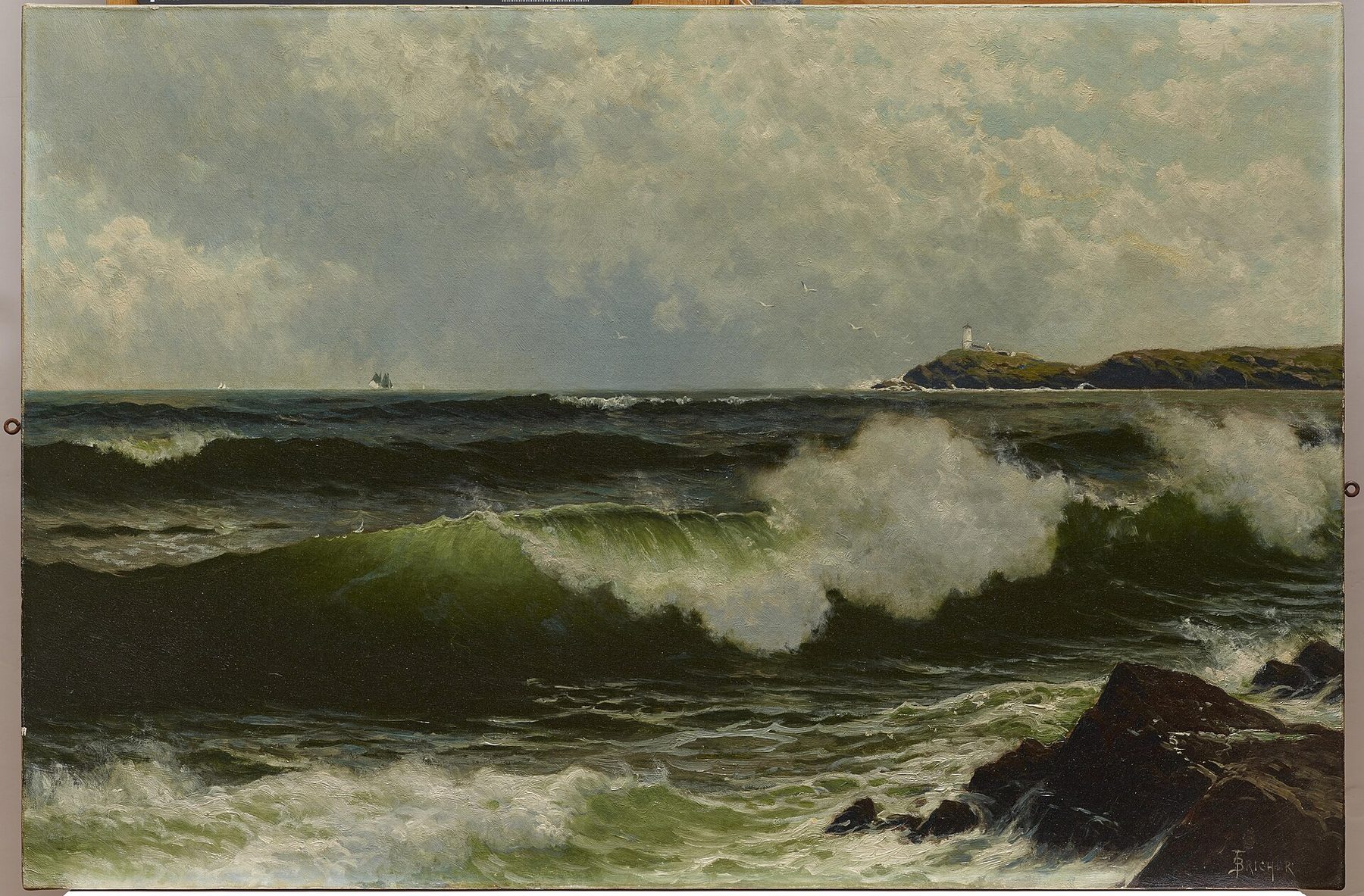
Alfred Thompson Bricher extended the marine mode after the classic period. His low horizons, long formats, glowing water and restrained brushwork connect him directly to Luminist conventions. Popular chromolithographs spread his images widely, and commercial success funded homes near coastal subjects. Later works introduce more active surf, figures and visible handling.[41]
His Sidewheeler “The City of St. Paul” on the Mississippi River brings the aesthetic far from the usual northeastern sites. Still water and open sky surround a specific freight vessel whose ownership and route anchor the picture in regional commerce. The painting proves that Luminist order can organise technological modernity rather than merely exclude it.[14]
Francis Augustus Silva began exhibiting professionally after Civil War service. Largely self-trained, he painted New York, New Jersey and New England coasts and joined the American Water-Color Society. His subtle marine atmospheres show the mode’s persistence beyond a handful of famous names.[43]
Worthington Whittredge, Jasper Cropsey, Casilear, Richards and others made pictures that enter Luminist exhibitions through particular compositions. Whittredge’s Hunter Mountain, Twilight belongs to the history through its light, spacing and reception, not through lifetime membership in a group.[42]
By the 1880s American Impressionism changed the relation between light and surface. Artists studying in France adopted broken brushwork, brighter divided colour and direct outdoor methods, then reshaped those practices for American audiences. The shift was not an instant replacement: smooth atmospheric painting, Tonalism, marine realism and Impressionism overlapped.[50]
Winslow Homer offers a useful comparison. His sea pictures can be brilliantly luminous, but waves, weather, figures and visible paint often produce bodily danger and immediate action rather than Luminist suspension. The difference confirms that subject and brightness alone do not define the mode.
The word also travelled. Historians have described Russian artists such as Arkhip Kuindzhi as Luminist because of brilliant light, horizontal structure and panoramic space. The comparison can be revealing, but the Metropolitan Museum’s study warns against projecting an American school backward onto artists formed by different institutions and ideas.[46] Belgian and Canadian “Luminism” likewise name other histories. This page retains the specific United States context while acknowledging that light cannot belong to one nation.
How to recognise a Luminist painting
Begin with the whole surface, not the sun. Does light bind the scene together, or does it spotlight one dramatic object? Luminist illumination usually feels pervasive, passing through water, sky and distance as a continuous atmosphere.
Follow the horizon. A stable low division often allows large zones of sky and water to develop. Long capes, cloud banks and shorelines create lateral rhythm. One mast, rock or tree may provide the vertical counterweight.
Look at water as structure. It can repeat the sky, open distance and slow time. Reflections are rarely exact duplicates; small tonal differences preserve depth and current.
Inspect the surface. Finished brushwork is controlled and often difficult to isolate. Nearby rocks, vessels or grasses can be minute, while distant edges dissolve. A rapid sketch by the same artist may look entirely different.
Count incidents. Figures, cattle, haystacks, forts and boats are often few and carefully placed. Their small size does not make them meaningless. Ask what work, transport or history they introduce.
Test the mood against the facts. Still air, evening light and empty foreground can generate contemplation, but title, site and date may reveal commerce, war, tourism or settlement. Calm is a formal effect before it is a moral quality.
Compare scale and spectacle. Lane’s intimate harbor and Church’s Niagara both organise light, yet one withholds event while the other immerses viewers in it. Luminism has a porous boundary, not an unlimited one.
Finally, remember the term’s later birth. A strong attribution explains which traits and historical relations justify it. Simply calling any radiant landscape Luminist avoids the very close looking the category was created to encourage.[2] [9]
Essential Luminist works
Stage Fort across Gloucester Harbor
Fitz Henry Lane · 1862 · Slack sails, motionless water and a colonial remnant turn Gloucester Harbor into an image of composed, elegiac stasis.
The Golden State Entering New York Harbor
Fitz Henry Lane · 1854 · Lane places a modern steamship inside crystalline atmosphere, showing that Luminist order could include commerce and technology.
Beacon Rock, Newport Harbor
John Frederick Kensett · 1857 · A massive rock, open water, distant sails and one tiny fisherman balance geological duration against human use.
Beach at Beverly
John Frederick Kensett · c. 1869–1872 · Temporary figures, boats and approaching weather are precisely calibrated against the longer durations of rock, sea and sky.
Lake George
John Frederick Kensett · c. 1870 · Reduced incident and finely measured atmosphere make a historically travelled and contested lake appear almost timeless.
Sunlight and Shadow: The Newbury Marshes
Martin Johnson Heade · c. 1871–1875 · Creek, haystack, cattle, reflected cloud and moving shade reveal the marsh as a worked tidal environment rather than empty wilderness.
Approaching Thunder Storm
Martin Johnson Heade · 1859 · Suspended weather and waiting figures can register Civil War-era unease without becoming a one-to-one political code.
Isola Bella in Lago Maggiore
Sanford Robinson Gifford · 1871 · Warm gradations across lake and sky make changing sunlight more important than complete topographic description.
Niagara
Frederic Edwin Church · 1857 · Church combines viewpoints and immense scale so that luminous atmosphere becomes theatrical force rather than quiet suspension.
Seascape
Alfred Thompson Bricher · c. 1885–1890 · Bricher carries low horizons, radiant water and controlled detail into a later, more active marine afterlife.
Where to see Luminist art
National Gallery of Art, Washington
Kensett’s Beach at Beverly and Beacon Rock, Heade’s Sunlight and Shadow, Church’s Niagara and the Wilmerding collection make this the best single destination. The wider landscape displays allow the proposed Luminist family to be tested against markedly different kinds of American scenery. The freely available American Light catalogue also preserves the exhibition that established the modern canon.[1] [2] [6] [16] [47]
Metropolitan Museum of Art, New York
Lane’s Stage Fort, Gifford’s Isola Bella, Heade’s Newburyport Meadows and extensive Hudson River galleries enable direct comparison. The museum’s technical publications are especially useful for separating original atmosphere from aged surfaces.[10] [17] [26] [29]
Smithsonian American Art Museum, Washington
The collection places Gifford, Heade, Bierstadt and Civil War material within a broader national history. Its exhibition research shows how landscape registered conflict without depending on conventional battle painting.[22] [27]
Cape Ann Museum, Gloucester
Gloucester is indispensable for Fitz Henry Lane. A concentrated holding of paintings, drawings and lithographs connects his luminous compositions to actual harbor geography, ships, patrons and the city in which he lived.
Museum of Fine Arts, Boston
New England landscape and marine holdings place Lane, Heade and related painters beside the regional artistic and commercial cultures from which Luminism emerged.
Wadsworth Atheneum, Hartford
The museum’s Hudson River School collection supplies a long view from Cole and Durand through Church and later landscape. It is ideal for testing where narrative Romanticism ends and Luminist restraint begins.
Museo Nacional Thyssen-Bornemisza, Madrid
Kensett’s Lake George, Heade’s marshes and tropical work, Silva and broader United States landscape make Madrid the strongest European destination in this survey. Spanish collection texts also offer a useful international account of national nature and environmental consciousness.[8] [15] [43] [45]
Olana State Historic Site, Hudson, New York
Church’s designed home, studio, views and collections reveal how landscape painting, travel, architecture and self-presentation formed a total environment. Olana also clarifies why Church belongs at Luminism’s expansive edge rather than inside only its quietest definition.
Where to see Luminism
Displays rotate and some works travel or remain in storage. Check the current collection display before travelling.
- 01
National Gallery of Art
Washington, DC, USA
Kensett, Heade and Church, together with the Wilmerding collection and the freely available American Light catalogue, make this the strongest single destination.
Core canon and exhibition historyVisit collection website - 02
The Metropolitan Museum of Art
New York, USA
Lane, Gifford and Heade can be tested against extensive Hudson River holdings and unusually strong technical publications.
Lane, Gifford and technical studyVisit collection website - 03
Smithsonian American Art Museum
Washington, DC, USA
Gifford, Heade, Bierstadt and Civil War material place luminous landscape within a broader and more critical national history.
Landscape, nation and Civil WarVisit collection website - 04
Cape Ann Museum
Gloucester, Massachusetts, USA
Paintings, drawings and lithographs reconnect Lane's visual order with Gloucester's harbor geography, ships, patrons and working culture.
Fitz Henry Lane in GloucesterVisit collection website - 05
Museum of Fine Arts, Boston
Boston, Massachusetts, USA
New England landscape and marine holdings place Lane, Heade and related painters within the artistic and commercial cultures from which the mode emerged.
New England landscape and marine artVisit collection website - 06
Wadsworth Atheneum
Hartford, Connecticut, USA
Its Hudson River School collection provides the long view from Cole and Durand through Church and later landscape.
Hudson River foundations and afterlivesVisit collection website - 07
Museo Nacional Thyssen-Bornemisza
Madrid, Spain
Kensett, Heade and Silva make this the strongest European destination in the survey, supported by valuable Spanish-language collection research.
American landscape in EuropeVisit collection website - 08
Olana State Historic Site
Hudson, New York, USA
Church's home, studio, views and collections reveal how travel, architecture, landscape painting and self-presentation formed a total environment.
Frederic Edwin Church's worldVisit collection website
Suggested books
American Light: The Luminist Movement, 1850–1875, by John Wilmerding and contributors
The foundational modern catalogue remains the essential starting point. Its paintings, drawings and photographs established the period’s principal artists and visual vocabulary. Read it both as rich scholarship and as the historical act that consolidated Luminism into a canon.[2]
Nature and Culture: American Landscape and Painting, 1825–1875, by Barbara Novak
Novak situates luminous landscape within philosophy, science, national identity and visual tradition. The book is particularly helpful for readers interested in Transcendentalism and the relation between precise natural fact and symbolic meaning.
Fitz Henry Lane, by John Wilmerding
This monographic study reconstructs Lane’s development from lithography and ship portraiture to the late Gloucester and Maine paintings. It provides the depth needed to see why one artist exceeds the movement he helped define.[4]
John Frederick Kensett: An American Master, by John Paul Driscoll and John K. Howat
The major Kensett study follows engraving, European travel, New York institutional life and the increasingly reduced coastal paintings. It corrects any assumption that quiet pictures came from social withdrawal.
The Life and Work of Martin Johnson Heade, by Theodore E. Stebbins Jr.
Heade’s long, mobile career requires a catalogue that can connect portraiture, marshes, tropical travel, hummingbirds and flowers. The book demonstrates both his relevance to Luminism and his resistance to its boundaries.
Major artists associated with Luminism
| Name | Nationality | Key Works |
|---|---|---|
| Albert Bierstadt | American | Among the Sierra Nevada · Indians in Council, California |
| Alfred Thompson Bricher | American | Time and Tide · Seascape |
| Asher B. Durand | American | Kindred Spirits · Study from Nature, Stratton Notch |
| David Johnson | American | View from Garrison, West Point · Natural Bridge, Virginia |
| Fitz Henry Lane | American | Stage Fort across Gloucester Harbor · The Golden State Entering New York Harbor |
| Francis Augustus Silva | American | Sunrise at Tappan Zee · Evening at Newburyport |
| Frederic Edwin Church | American | Niagara · El Rio de Luz |
| George Inness | American | The Lackawanna Valley · Peace and Plenty |
| Jasper Francis Cropsey | American | Autumn on the Hudson River · Starrucca Viaduct |
| John Frederick Kensett | American | Beacon Rock, Newport Harbor · Beach at Beverly |
| John William Casilear | American | Lake George · Genesee Meadows |
| Martin Johnson Heade | American | Sunlight and Shadow · Approaching Thunder Storm |
| Samuel Colman | American | Storm King on the Hudson · Ships Unloading |
| Sanford Robinson Gifford | American | Isola Bella in Lago Maggiore · A Gorge in the Mountains |
| Thomas Cole | American | The Oxbow · The Course of Empire |
| Thomas Moran | American | The Grand Canyon of the Yellowstone · Childe Roland to the Dark Tower Came |
| William Hart | American | Peace and Plenty · Autumn in the Catskills |
| William Stanley Haseltine | American | The Natural Arch at Capri · Narragansett Bay |
| William Trost Richards | American | The League Long Breakers Thunder on the Reef · Woodland Landscape |
| Worthington Whittredge | American | Hunter Mountain, Twilight · The Old Hunting Grounds |
Frequently Asked Questions
About 1850–75 is the standard core range. Important foundations precede 1850, Heade and others continued related work later, and the name itself was created many decades afterward.[2]
Painting and early landscape photography shared sites, framing, detailed description and studies of light. Photographers sometimes knew painters. The relationship was reciprocal and contextual; photography did not simply invent the painted style.[33]
Discussion
Which Luminist painting most convincingly slows your sense of time? Look again for the boat, worker, fort, railway-era destination or weather change held inside its calm. Does that historical detail disrupt the stillness, or make the artist’s achievement more complex?
Reader Insights
Notice how a low division and long lateral intervals allow water and sky to slow the scene before any subject is identified.
Boats, workers, haystacks, ruins and tourists may be tiny, but they return commerce, labour and history to apparently timeless nature.
Ask which conjunction of light, surface, scale and historical context justifies the Luminist label instead of using it as a synonym for brightness.
Join the Conversation
Which Luminist painting most convincingly slows your sense of time—and what historical detail complicates its calm?
References
- American Light. National Gallery of Art. View Source
- American Light: The Luminist Movement, 1850–1875. National Gallery of Art / John Wilmerding. View Source
- Paintings by Fitz Hugh Lane at the National Gallery. National Gallery of Art. View Source
- Paintings by Fitz Hugh Lane. National Gallery of Art / John Wilmerding. View Source
- John Frederick Kensett 1816–1872. Metropolitan Museum of Art (Portuguese and English; consulted in Portuguese and English). View Source
- Beach at Beverly. National Gallery of Art. View Source
- Beacon Rock Newport Harbor. National Gallery of Art. View Source
- Lake George. Museo Nacional Thyssen-Bornemisza. View Source
- The Inquiring Eye: American Painting. National Gallery of Art. View Source
- Stage Fort across Gloucester Harbor. Metropolitan Museum of Art. View Source
- The Golden State Entering New York Harbor. Metropolitan Museum of Art. View Source
- Fitz Henry Lane’s Series Paintings. Terra Foundation for American Art. View Source
- Landscape Painting: Conversations with the Collection. Terra Foundation for American Art. View Source
- The Sidewheeler The City of St. Paul on the Mississippi River. Terra Foundation for American Art. View Source
- Martin Johnson Heade. Museo Nacional Thyssen-Bornemisza (Spanish; consulted in Spanish). View Source
- Sunlight and Shadow: The Newbury Marshes. National Gallery of Art. View Source
- Newburyport Meadows. Metropolitan Museum of Art. View Source
- Martin Johnson Heade. Smithsonian American Art Museum. View Source
- Jersey Meadows at Sunset. Smithsonian American Art Museum. View Source
- Amanecer en Nicaragua. Museo Nacional Thyssen-Bornemisza (Spanish; consulted in Spanish). View Source
- War and Paint: Art of the Civil War. Smithsonian American Art Museum. View Source
- The Civil War and American Art. Smithsonian American Art Museum. View Source
- The Civil War and American Art. Smithsonian American Art Museum / Eleanor Jones Harvey. View Source
- Hudson River School Visions: Sanford R. Gifford. Metropolitan Museum of Art. View Source
- Sanford Robinson Gifford 1823–1880. Metropolitan Museum of Art (German; consulted in German). View Source
- Isola Bella in Lago Maggiore. Metropolitan Museum of Art. View Source
- Sanford Robinson Gifford. Smithsonian American Art Museum. View Source
- From the Shawangunk Mountains. Smithsonian American Art Museum. View Source
- Sanford Robinson Gifford’s Gorge in the Mountains Revived. Metropolitan Museum of Art. View Source
- Asher Brown Durand 1796–1886. Metropolitan Museum of Art. View Source
- Landscape—Scene from Thanatopsis. Metropolitan Museum of Art. View Source
- Hudson River School. National Gallery of Art. View Source
- Earliest Photographs of Eastern American Landscapes. National Gallery of Art. View Source
- Niagara. National Gallery of Art. View Source
- The Nineteenth-Century Blockbuster: Church’s Niagara. National Gallery of Art. View Source
- Frederic Edwin Church. National Gallery of Art. View Source
- El Rio de Luz. National Gallery of Art. View Source
- Albert Bierstadt. Smithsonian American Art Museum. View Source
- Nineteenth Century Highlights. Smithsonian American Art Museum. View Source
- Indians in Council California. Smithsonian American Art Museum. View Source
- Alfred Thompson Bricher. Terra Foundation for American Art. View Source
- Hunter Mountain Twilight. Terra Foundation for American Art. View Source
- Francis A. Silva. Museo Nacional Thyssen-Bornemisza (Spanish; consulted in Spanish). View Source
- Exploring Eden: American Landscape of the Nineteenth Century. Museo Nacional Thyssen-Bornemisza (Spanish; consulted in Spanish). View Source
- Camino del Agua. Museo Nacional Thyssen-Bornemisza (Spanish; consulted in Spanish). View Source
- A Russian Luminist School. Metropolitan Museum of Art. View Source
- Landscapes. National Gallery of Art. View Source
- American Masters: The John Wilmerding Collection. National Gallery of Art. View Source
- American Paintings of the Nineteenth Century Part I. National Gallery of Art. View Source
- American Impressionism: A New Vision 1880–1900. Terra Foundation for American Art. View Source
- Luminism image records. Wikimedia Commons: Stage Fort across Gloucester Harbor (CC0; The Metropolitan Museum of Art Open Access), The Golden State Entering New York Harbor (CC0; The Metropolitan Museum of Art Open Access), Beacon Rock, Newport Harbor (CC0; National Gallery of Art Open Access), Beach at Beverly (CC0; National Gallery of Art Open Access), Lake George (Public domain; Princeton University Art Museum), Sunlight and Shadow: The Newbury Marshes (CC0; National Gallery of Art Open Access), Approaching Thunder Storm (CC0; The Metropolitan Museum of Art Open Access), Isola Bella in Lago Maggiore (CC0; The Metropolitan Museum of Art Open Access), Niagara (CC0; National Gallery of Art Open Access), Seascape (Public domain; Dallas Museum of Art).