


 by Tom Gurney
Tom Gurney BSc (Hons) is an art history expert with over 20 years experience
Published on June 19, 2020 / Updated on October 14, 2023
Email: tomgurney1@gmail.com / Phone: +44 7429 011000
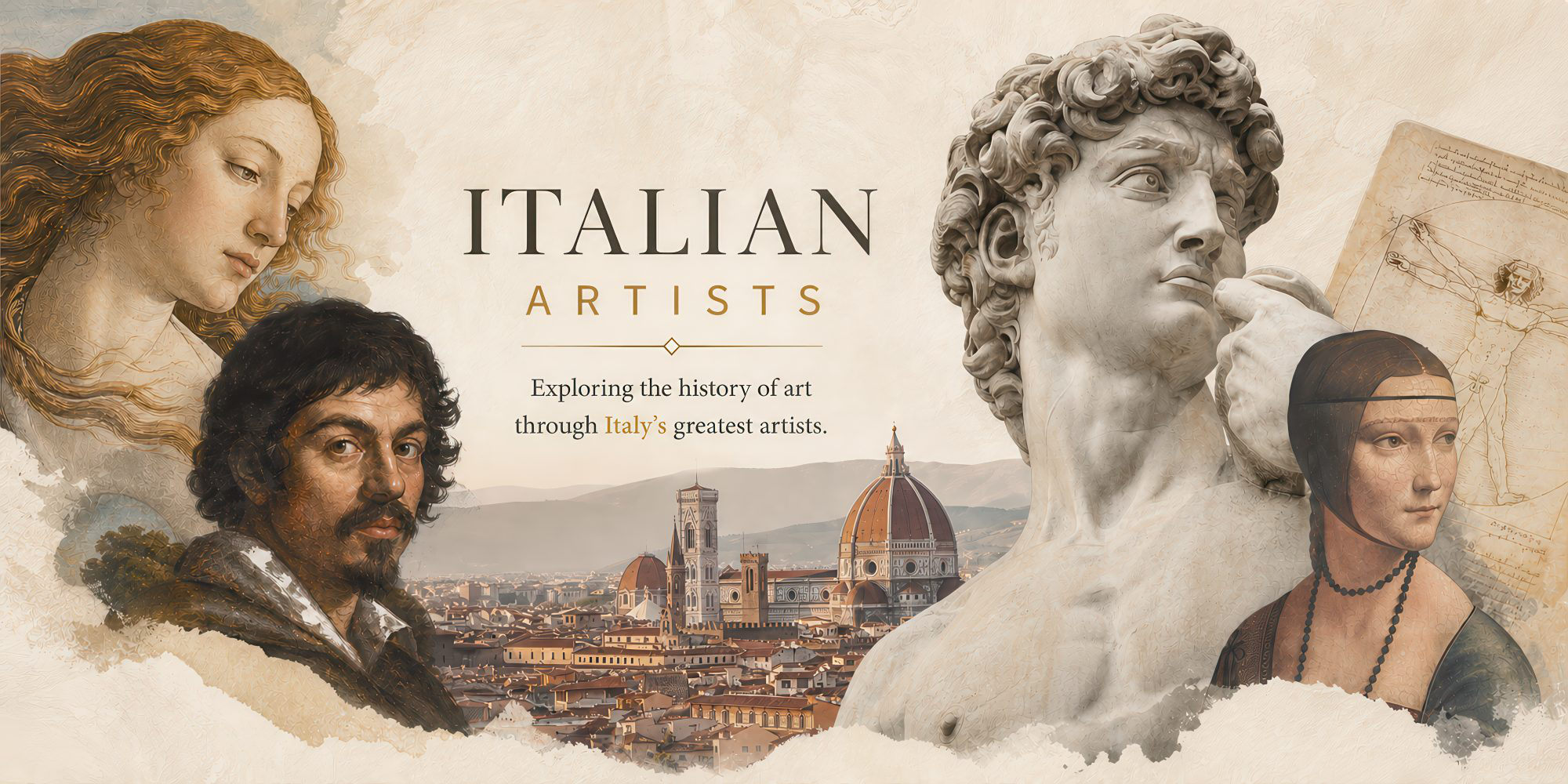
Italian Artists: Renaissance Masters, Baroque Painters and Modern Italian Art
Italian artists have shaped the history of Western art more than almost any other national tradition. From the early breakthroughs of Giotto and Cimabue, to the High Renaissance achievements of Leonardo da Vinci, Michelangelo and Raphael, Italy produced many of the most influential painters, sculptors and architects in art history.
This page brings together the most important Italian artists on TheHistoryOfArt.org, organised by period and movement. It is designed as a national hub for visitors who want to explore Italian Renaissance art, Venetian painting, Baroque drama, Mannerism, sculpture, architecture and modern Italian art.
For wider browsing, you can also explore artists by nationality, century or movement.
- Nationality: Italian
- Major Periods: Medieval, Renaissance, Mannerism, Baroque, Modern
- Key Centres: Florence, Rome, Venice, Milan, Siena
- Famous Artists: Leonardo, Michelangelo, Raphael, Botticelli, Caravaggio
- Best Known For: Renaissance painting, sculpture, architecture and religious art
Why Italian Artists Matter
Italian art is central to the story of European art because it transformed how artists understood the human body, space, light, perspective and classical antiquity. The Italian Renaissance in particular created a new model of artistic ambition, where painters, sculptors and architects were no longer viewed simply as craftsmen, but as intellectual figures capable of reshaping culture.
The development was not limited to Florence. Venice produced colourists such as Titian, Giorgione and Paolo Veronese; Rome became the centre of papal commissions and monumental art; Siena had its own Gothic and devotional traditions through artists such as Duccio di Buoninsegna, Simone Martini and Ambrogio Lorenzetti.
Italian artists also played a major role beyond painting. Donatello, Lorenzo Ghiberti, Filippo Brunelleschi, Gian Lorenzo Bernini and Antonio Canova helped shape sculpture and architecture across several centuries.
Early Italian Artists
The early development of Italian art can be seen in the transition from Byzantine-influenced religious imagery to a more human, spatial and emotionally direct form of painting. Cimabue and Giotto are especially important in this story.
Giotto's work introduced greater solidity, drama and human feeling into religious scenes. His influence helped prepare the ground for later Renaissance artists, who would push perspective, anatomy and naturalism much further.
Italian Renaissance Artists
The Italian Renaissance remains one of the greatest periods in art history. Artists studied classical sculpture, anatomy, mathematics, architecture and perspective, creating works that combined technical mastery with intellectual ambition.
Leonardo da Vinci brought together art, science and observation. Michelangelo transformed sculpture, painting and architecture through heroic human form. Raphael created images of grace, clarity and compositional harmony. Together, they define the High Renaissance.
Earlier and contemporary Renaissance masters such as Sandro Botticelli, Fra Angelico, Andrea Mantegna, Piero della Francesca and Pietro Perugino each contributed to this extraordinary period.
- Leonardo da Vinci
- Michelangelo
- Raphael
- Sandro Botticelli
- Fra Angelico
- Piero della Francesca
- Andrea Mantegna
- Pietro Perugino
- Filippo Lippi
- Filippino Lippi
- Domenico Ghirlandaio
- Luca Signorelli
- Andrea del Verrocchio
- Lorenzo di Credi
- Masaccio
- Masolino
- Paolo Uccello
- Antonello da Messina
- Pisanello
Venetian Artists
Venice developed a distinctive artistic identity based on colour, atmosphere, surface and richness of light. While Florentine artists often emphasised drawing and structure, Venetian painters became famous for glowing colour and painterly effects.
Titian was the central figure of Venetian painting, producing religious works, mythologies and portraits of enormous influence. Giorgione brought poetic mystery to the Venetian tradition, while Tintoretto and Paolo Veronese created dramatic, large-scale works filled with movement and theatricality.
- Giovanni Bellini
- Gentile Bellini
- Giorgione
- Titian
- Tintoretto
- Paolo Veronese
- Vittore Carpaccio
- Canaletto
Italian Mannerist Artists
After the High Renaissance, some Italian artists moved toward more artificial, elegant and expressive forms. This style, often known as Mannerism, can be seen in elongated bodies, unusual colours, complex poses and sophisticated compositions.
Artists such as Pontormo, Parmigianino, Bronzino and Giorgio Vasari helped define this period, which deliberately moved beyond the balance and calm of Raphael and Leonardo.
Italian Baroque Artists
Italian Baroque art brought drama, movement, theatrical lighting and emotional intensity to religious and secular subjects. Caravaggio was one of the most revolutionary painters of the period, using dramatic contrasts of light and dark to give biblical scenes startling immediacy.
In sculpture and architecture, Gian Lorenzo Bernini became the dominant figure of the Roman Baroque. His work gave marble the illusion of movement, flesh, fabric and spiritual ecstasy.
- Caravaggio
- Gian Lorenzo Bernini
- Annibale Carracci
- Artemisia Gentileschi
- Guido Reni
- Francesco Borromini
Italian Sculptors and Architects
Italian art history cannot be separated from sculpture and architecture. Donatello helped transform Renaissance sculpture through realism and psychological presence. Lorenzo Ghiberti became famous for the bronze doors of the Florence Baptistery. Filippo Brunelleschi revolutionised architecture with his dome for Florence Cathedral.
Later, Antonio Canova became one of the greatest sculptors of Neoclassicism, while Bernini dominated Baroque sculpture and architecture in Rome.
- Donatello
- Lorenzo Ghiberti
- Filippo Brunelleschi
- Leon Battista Alberti
- Donato Bramante
- Michelozzo
- Luca della Robbia
- Andrea Pisano
- Benvenuto Cellini
- Bartolommeo Bandinelli
- Antonio Canova
Modern Italian Artists
Italian art continued to develop beyond the Renaissance and Baroque periods. In the modern era, Amedeo Modigliani became one of the most recognisable Italian artists of the 20th century, known for elongated portraits and nudes that combine modernist form with a deep sense of melancholy.
Modern Italian art also includes Futurism, metaphysical painting and later avant-garde movements, though this page currently focuses mainly on artists already covered in depth on TheHistoryOfArt.org.
All Italian Artists on TheHistoryOfArt.org
The links below provide a crawlable index of Italian artists currently covered on the site. As the Italian cluster grows, this section can be expanded with more artists, movements and regional groupings.
- Amedeo Modigliani
- Ambrogio Lorenzetti
- Andrea del Sarto
- Andrea del Verrocchio
- Andrea Mantegna
- Andrea Pisano
- Andrea Solari
- Annibale Carracci
- Antonello da Messina
- Antonio Canova
- Artemisia Gentileschi
- Bartolommeo Bandinelli
- Benvenuto Cellini
- Bronzino
- Canaletto
- Caravaggio
- Cimabue
- Correggio
- Cosimo Tura
- Domenico Ghirlandaio
- Donatello
- Donato Bramante
- Duccio di Buoninsegna
- Federico Barocci
- Filippo Brunelleschi
- Filippo Lippi
- Filippino Lippi
- Fra Angelico
- Gentile Bellini
- Gian Lorenzo Bernini
- Giotto
- Giorgione
- Giorgio Vasari
- Giovanni Bellini
- Giuseppe Arcimboldo
- Lavinia Fontana
- Leon Battista Alberti
- Leonardo da Vinci
- Lorenzo di Credi
- Lorenzo Ghiberti
- Lorenzo Lotto
- Luca della Robbia
- Luca Signorelli
- Masaccio
- Masolino
- Michelozzo
- Michelangelo
- Paolo Uccello
- Paolo Veronese
- Parmigianino
- Piero della Francesca
- Pietro Perugino
- Pisanello
- Pontormo
- Raphael
- Sandro Botticelli
- Sebastiano del Piombo
- Simone Martini
- Sofonisba Anguissola
- Tintoretto
- Titian
- Vittore Carpaccio
FAQs
The most famous Italian artists include Leonardo da Vinci, Michelangelo, Raphael, Sandro Botticelli, Titian, Caravaggio, Donatello, Bernini and Amedeo Modigliani.
Italian artists are important because they transformed painting, sculpture and architecture during the Renaissance and later shaped Baroque, Neoclassical and modern art through major innovations in perspective, anatomy, composition and emotional expression.
Florence is often seen as the most important centre for Renaissance art, producing or attracting artists such as Leonardo da Vinci, Michelangelo, Botticelli, Donatello, Brunelleschi and many others. Venice, Rome, Milan and Siena were also major artistic centres.
Many of the most famous Italian artists belong to the Renaissance, but Italian art also includes major Medieval, Mannerist, Baroque, Neoclassical and modern artists, including Caravaggio, Bernini, Canova and Modigliani.