by Tom Gurney
Tom Gurney BSc (Hons) is an art history expert with over 20 years experience
Published on June 19, 2020 / Updated on November 1, 2026
Email: tomgurney1@gmail.com / Phone: +44 7429 011000
Giotto: Introduction
A woman bends over the body of her son. One hand supports his head; her face moves close to his. Around them, other mourners kneel, reach, stand motionless or throw their arms backwards. Above, angels turn through the blue air with open mouths and hands pressed to their faces. In Giotto’s Lamentation, painted in the Scrovegni Chapel in Padua, sorrow has weight, direction and room to move. Even the pale ridge of rock seems to guide us towards the encounter between the two faces.
This is one of the best places to begin with Giotto di Bondone, the Florentine painter who lived from about 1265 or 1267 to 1337. His pictures give sacred history a compelling bodily presence. A figure occupies space through the breadth of a shoulder, the bend of a knee or the way a garment settles over a seated body. People respond to one another through glances and movements that can be read across a chapel. Architecture draws them together, separates them or makes their actions public. These effects remain powerful even when the painted surface is damaged and the original setting has changed.
Giotto worked in an Italy of religious orders, competing cities, wealthy family chapels and princely courts. His surviving art includes fresco cycles, painted wooden crosses, monumental Madonnas and smaller narrative panels. Important commissions have disappeared, and several major attributions remain disputed. His achievement becomes clearer when these different kinds of evidence are allowed to retain their individual character. The intimate movement of a hand in a panel, the vast organisation of the Scrovegni walls and the practical demands of a royal painting workshop all belong to the same remarkable career.
The following introduction follows those connections through representative works. The biography develops the life story, the paintings guide explores the works more fully, and the timeline sets out the principal dates.
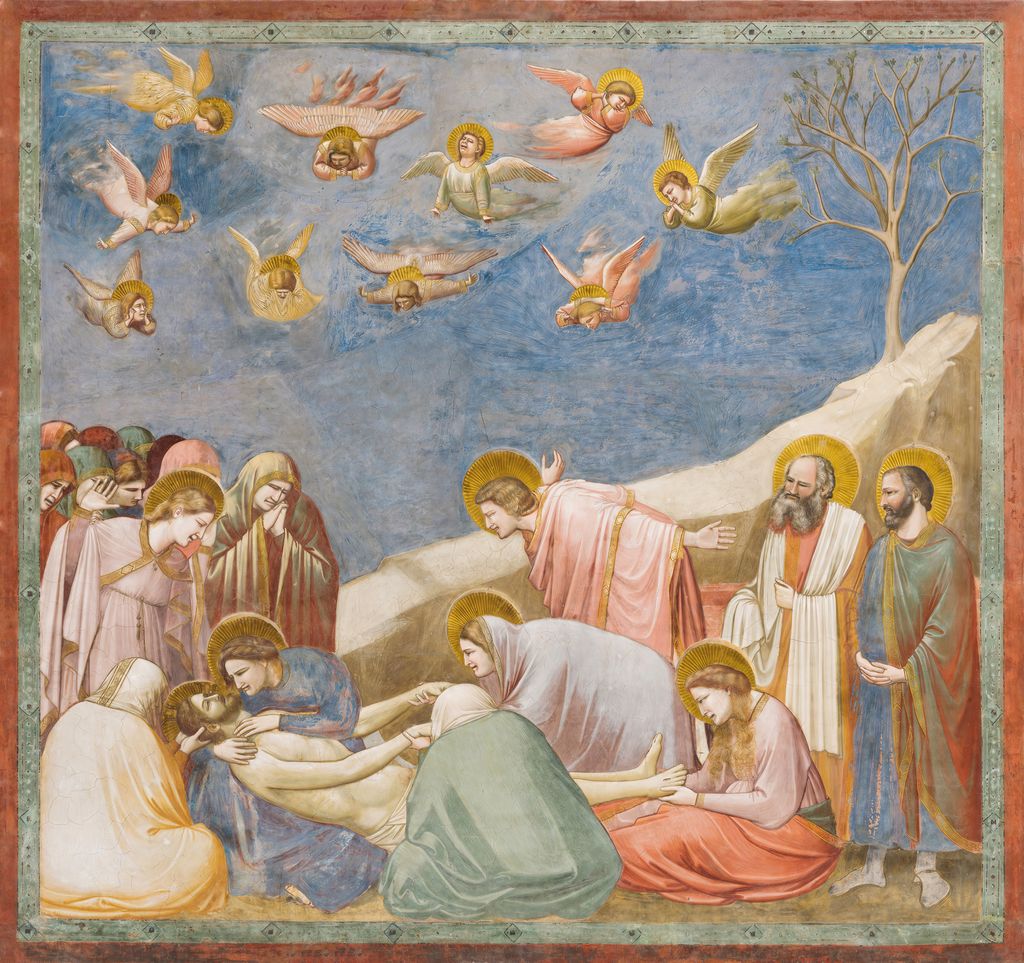
Lamentation, Scrovegni Chapel, Padua: the complete composition and painted border.
At a Glance
- Scrovegni ChapelCommissioned by Enrico Scrovegni in Padua; painted about 1303–05. [1]
- Civic roleFlorence appointed Giotto to cathedral and communal building responsibilities on 12 April 1334. [2]
- OriginsGiotto’s birth year is approximate; the birthplace association rests on later tradition. [3]
Giotto in context
Byzantine traditions
Historical frame c.330–1453; artistic traditions continue beyond political boundaries [4] [5]International Gothic
Late 14th–mid 15th centuries; later artistic context [12]Simone Martini
c.1284–1344 (approximate lifespan) [16]Santa Maria Novella Crucifix
Late 13th century; c.1288–89 or 1298–1301; disputed; track: c.1288–89 [19]Life of Saint Francis — Upper Church cycle, Assisi
Traditionally Giotto; late 13th–early 14th century; authorship and date disputed; track: c.1290–95 convention [20] [21] [22] [23] [24]Scrovegni Chapel — painted decoration
c.1303–05 (chapel campaign); Giotto and workshop (painted decoration) [25] [26] [27]Ognissanti Madonna
c.1300–05 (Uffizi); c.1310 also proposed; track: c.1300–05 [28]Madonna and Child — Washington / Goldman Madonna
c.1310–1315 (National Gallery of Art) [29]Stefaneschi Triptych
c.1320; 1315–20 (Vatican Museums); Giotto and workshop [30]Bardi Chapel — painted decoration
After 1317, usually the 1320s; disputed; Giotto and workshop / Giottesque painters; individual hands disputed [31] [32]Baroncelli Polyptych
After 1328; completion uncertain; band continues to axis edge; Giotto and workshop [33]Giotto’s Campanile — Florence Cathedral bell tower
Giotto’s phase 1334–37; completed 1359 by successors [34] [35] [36]Giotto’s artistic connections
Comparisons, commissions, collaboration, literary testimony and later studies connect these names with Giotto. Each card labels its relationship; the groups describe context and reception, with personal contacts qualified where uncertain.
- Cimabue: Predecessor and comparison; later teacher tradition. Painted crosses and Maestà panels make Cimabue a central comparison. Ghiberti and Vasari supplied the training story much later; no surviving apprenticeship contract documents Giotto’s training with him. [14] [37] [38]
- Arnolfo di Cambio: Sculptural and architectural comparison. The Archdiocese relates the San Giorgio Madonna’s throne to Arnolfo’s architectural language. Florence Cathedral provides a further building context; personal instruction remains unestablished. [39]
- Enrico Scrovegni and Padua: Documented commission and painted setting. Enrico commissioned the Padua chapel, where narratives, moral images and judgement form a connected interior. Its family and devotional functions leave his complete private motives open. [40] [41]
- Franciscan Assisi: Institutional setting; disputed assignments. The Upper and Lower Churches contain distinct programmes and collaborators. The traditional association with Giotto coexists with competing attributions and disputed dates. [20] [42] [21] [23] [43]
- Giotto’s collaborators: Collaborative painting under a named master. The Naples account names Giotto as leading master while paying painters and manual workers. Signatures can associate a project with him while leaving individual hands uncertain. [44] [45]
- Cennino Cennini: Later professional lineage testimony. Cennini traced his training through Agnolo Gaddi and Taddeo Gaddi to Giotto. His later account describes a professional lineage across generations. [46]
- Dante: Contemporary literary reputation. Oderisi’s speech in Purgatorio XI compares Cimabue’s and Giotto’s fame within a meditation on pride. The passage establishes contemporary reputation; it leaves a personal meeting or advice on the chapel programme unproved. [47]
- Michelangelo: A surviving study after a Peruzzi painting. The Louvre’s study, dated 1490–92, extracts two figures from the Ascension of John in the Peruzzi Chapel. The sheet records a later artist’s specific act of study and adaptation. [48]
- Cardinal Jacopo Stefaneschi: Patron of Roman works. The cardinal commissioned the double-sided triptych for Old Saint Peter’s and is associated with the lost Navicella. The two works have different histories of survival. [45] [49]
- Robert of Anjou and Naples: Documented royal service. The salary order of December 1328, familiar status of January 1330 and chapel account of May 1331 establish royal employment and an organised workshop. The familiar designation concerns court status; it does not establish a knighthood. [44]
Contents
- A famous painter with an incomplete life story
- Bodies that make a picture convincing
- The Scrovegni Chapel: an entire interior made meaningful
- Before Christ’s birth: exclusion, waiting and reunion
- The Arrest of Christ: a crowd gathered around a still centre
- The Lamentation: how a group becomes a shared act of mourning
- Judgement, virtues and the viewer’s own choices
- Rooms, thresholds and painted depth
- Fresco, tempera and the presence of gold
- The painted cross: a body within the church
A famous painter with an incomplete life story
Giotto was celebrated during his lifetime, yet the beginning of his life remains uncertain. The traditional birthplace is Vespignano in the Mugello, north of Florence. The association rests on later biographical tradition and on his family’s property history. Even the familiar birth year, 1267, is calculated from later testimony about his age at death. An approximate date is more faithful to the evidence than a confidently stated birthday. [3]
The surviving records place his family firmly within Florentine urban society. Archival identifications connect his father, Bondone, with the blacksmith’s trade. This gives us a rather different setting from the famous story of a shepherd boy drawing sheep and being discovered by Cimabue. The story expresses a persuasive idea about talent recognising nature before formal instruction; it does not provide a documented account of Giotto’s training. His relationship with Cimabue remains an important artistic question, best explored through the works and the histories written about them. [3]
By 1301 Giotto owned a house in Florence. Later documents concern property, debts, family arrangements and business transactions, as well as painting. His wife, Ciuta, and seven documented children emerge from this material. These records make him recognisable as the head of a substantial household, with interests extending beyond the scaffolding and the painter’s bench. [3]
The geographical reach of his fame is unusually clear. The early fourteenth-century chronicler Riccobaldo names works at Assisi, Rimini and Padua, including the Arena Chapel and Padua’s communal palace. This is valuable testimony to an artist whose reputation travelled between cities. It does not identify the painter of every passage that survives in those places. The distinction matters especially at Assisi, where the connection between Giotto’s name, the design of the programmes and the hands that executed them remains debated. [50]
Later stages of the career have firmer documentary anchors. A royal order of 8 December 1328 assigned Giotto a salary in Naples, effective from the beginning of that month. On 20 January 1330 he was received among King Robert of Anjou’s royal familiars. A treasury account of 20 May 1331 records work and materials for the chapels of Castel Nuovo. Florence appointed him to major cathedral and civic building responsibilities on 12 April 1334. He died on 8 January 1337 in modern dating. [2]
These facts establish a painter working at a high professional and social level. His surviving pictures came out of demanding commissions, religious institutions, family ambitions and organised labour. Those circumstances help us understand both their magnificence and their variety.
Four stages of Giotto’s career
These overlapping phases group related works and documentary anchors. Several major campaigns retain disputed dates and attributions.
Building weight and presence
San Giorgio alla Costa, the Santa Maria Novella cross and the Badia altarpiece explore bodily weight, sacred presence and the framed panel. Their approximate dates overlap and remain debated. The later childhood-discovery story offers a different kind of testimony. [9] [51] [52] [14]


Painting for connected spaces
Padua’s c.1303–05 painting campaign anchors the development of an integrated narrative environment. The Upper Church cycle at Assisi has disputed authorship and chronology; the Magdalene Chapel belongs to a distinct campaign. [53] [54] [55] [56]

 Giotto.jpg)

Different formats, shared resources
The dispersed Christ panels, Washington Madonna and Stefaneschi altarpiece show related designs across portable objects and collaborative production. Bardi brings Franciscan narratives into a Florentine chapel. Peruzzi has competing early and late datings. [57] [58] [59] [60] [61]
.jpg)
A master across institutions
Naples records salaried royal service from December 1328 and a large painting enterprise in 1331. Florence’s 1334 appointment belongs alongside overlapping late painting activity. Giotto died in 1337; his successors completed the Campanile in 1359. [62] [63] [64] [10] [11] [65]

Bodies that make a picture convincing
Giotto’s figures often become persuasive before we have identified the subject. A broad back blocks our view. A seated body presses into the space around it. A face turns within a halo, and the direction of that turn changes the relationship between two people. His art rewards attention to these ordinary physical facts.
In the Lamentation, the two crouching figures nearest us show their backs. Their garments swell into large, simplified masses. We cannot inspect their expressions, but their positions tell us that they belong to the ring of people tending Christ’s body. The concealment has a practical effect: it makes the space continue behind them. We see only part of what is happening, as we might when approaching an actual group gathered around someone on the ground.
A similar sense of volume can operate in a ceremonial image. In the Ognissanti Madonna, the Virgin’s knees establish the breadth of her seated body beneath the dark mantle. The Child’s weight belongs to her lap. The throne’s projecting steps, narrow openings and coloured architectural members give their bodies a structured setting. The figures remain hieratic and carefully ranked, while the throne makes that hierarchy seem physically inhabited. [66]
“Naturalism” describes a world that feels physically convincing while remaining carefully composed. Giotto adjusts scale and spacing to preserve an action’s importance. Buildings can be compressed, crowds selectively arranged and faces turned so that an encounter remains legible. His world is composed for attention. It allows a viewer to recognise how an action feels in the body without requiring every part of the picture to obey one uniform optical system.
Gesture works in the same way. A hand can touch, bless, accuse, defend, receive or refuse. Its meaning depends on the body attached to it and the person towards whom it moves. In the Arrest of Christ, hands and weapons generate pressure around the central meeting. In the Lamentation, supporting hands and open palms create a network of care. The repeated human instrument acquires a different force in each situation.
Clothing contributes more than colour. Folds describe weight and movement, but they also organise the image at a distance. A large unbroken mantle can hold the centre of a crowded scene. A sharp change in the direction of a fold can reinforce a bent elbow. A pale garment can bring a figure forward against a darker cluster. The clarity that visitors recognise across a chapel has been built from such decisions.
These qualities did not arise in an empty artistic world. Earlier Byzantine and Italian painters, monumental mosaics and medieval sculpture had already developed expressive bodies, solemn faces and complex gestures. Giotto’s importance lies in the strength and consistency with which he brought such resources together for particular pictorial tasks. His pictures give us abundant reasons to look closely without requiring us to call him the inventor of every effect we admire.
The Scrovegni Chapel: an entire interior made meaningful
The Scrovegni Chapel, also called the Arena Chapel, is the most complete surviving introduction to Giotto’s narrative art. Enrico Scrovegni commissioned it in Padua, where it was dedicated to Santa Maria della Carità. Its principal painting campaign belongs to about 1303–05. The interior makes clear how much can be lost when individual scenes are reproduced without their neighbours. [1]
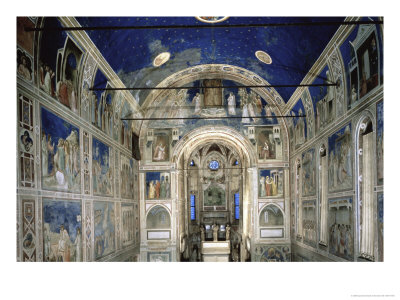
Looking towards the sanctuary of the Scrovegni Chapel; the vault and narrative tiers belong to one interior.
The stories unfold in registers along the walls. The lives of Mary and Christ occupy the principal narrative fields; the sequence begins with Mary’s parents, Joachim and Anna, before moving towards the birth and public life of Christ, the Passion and its aftermath. Lower down, fourteen figures of Vices and Virtues establish a different kind of sequence. The enormous Last Judgement occupies the entrance wall, while the vaulted ceiling extends overhead as a blue field of stars and sacred medallions. [1]
These parts encourage several kinds of looking. A visitor can follow events horizontally, moving from one episode to another. The walls also invite comparison between subjects placed above, below or opposite one another. Finally, the room itself gives the stories a destination: the history of salvation is encountered within an interior where judgement, moral choice and worship remain continually present.
The distinction between narrative time and a worshipper’s time is especially fruitful. The stories happen in succession, but everyone entering the chapel occupies the same room as their complete painted arrangement. A beginning, an act of betrayal and an image of resurrection can all remain available to memory. Giotto’s individual compositions are economical enough to be remembered, allowing one scene to change the experience of another.
The altar end offers a particularly rich meeting of image and building. The Annunciation belongs to a larger ensemble across the triumphal arch, with the heavenly dispatch of Gabriel above. The central figure of God the Father is painted on a wooden panel, set among wall paintings. Even this celebrated fresco interior therefore includes a significant difference of support. The different media work together within one architectural and religious setting. [67]
Recent scholars have explored the programme through scriptural interpretation and the chapel’s liturgical use. Nadia Munari considers how literal stories, moral instruction, correspondences between biblical events and the promise of final salvation can operate together. Francesca Leto emphasises the participation of worshippers in the religious rites associated with the scenes. These approaches are useful because a chapel was a place of action as well as looking. They offer ways of understanding the ensemble, while the precise instructions agreed between painter and patron remain unknown. [68]
The commission also requires care in the treatment of Enrico himself. His family’s association with moneylending has encouraged interpretations of the chapel as a single act of penitence for usury. Such interpretations can illuminate particular images, but the building also served devotion, family commemoration and public standing. Laura Jacobus’s critique of an exclusively penitential explanation shows how much depends on assumptions about the patron’s intentions. The painted ensemble is richer than a simple transaction between a frightened banker and salvation. [69]
Before Christ’s birth: exclusion, waiting and reunion
One of the chapel’s most affecting decisions is to begin with Joachim and Anna. Their story belongs to the apocryphal traditions surrounding Mary’s birth, rather than to the four canonical Gospels. Giotto gives this preliminary history substantial visual space. The family into which Mary will be born is introduced through rejection, separation, divine promise and reunion. [70]
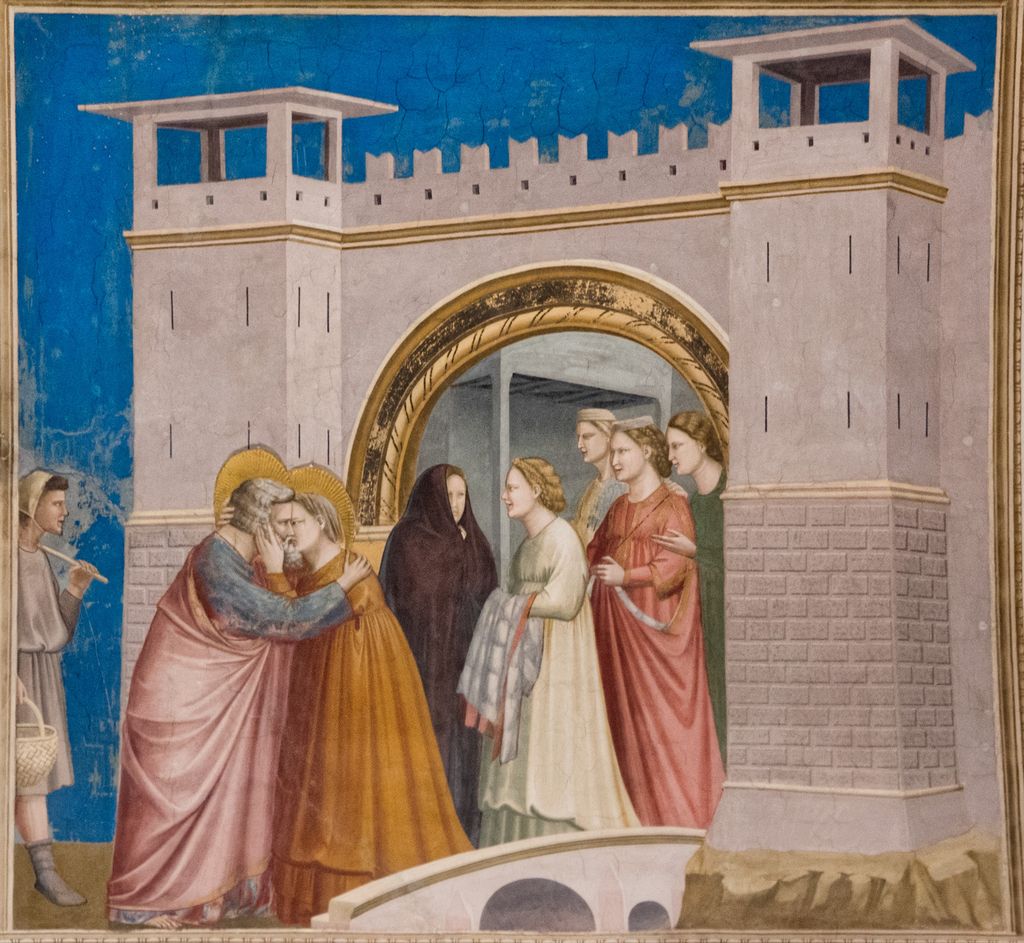
Joachim and Anne meet outside the Golden Gate in the Scrovegni Chapel. Photo: © Jörgens.Mi/Wikipedia, CC BY-SA3.0, Wikimedia Commons. Image source. CC BY-SA 3.0. Proportionally reduced reproduction; no colour or content enhancement.
In the Expulsion of Joachim, the action is public. An offering at the Temple becomes an occasion of exclusion because Joachim has no child. The institution’s catalogue connects the scene to the Gospel of Pseudo-Matthew. This narrative background matters: without it, the painting could look like an unexplained confrontation at a sacred building. With it, the movement of a body away from a place of worship becomes a sharp expression of social and religious humiliation. [70]
The narrative then allows time for withdrawal and waiting. These episodes give the eventual Meeting at the Golden Gate its force. The embrace of Joachim and Anna belongs to a sequence in which the couple have been separated and received assurances about the future. Its tenderness has a narrative history. A modern reproduction of the embrace can convey affection immediately; the chapel supplies the distance travelled to reach it.
The Golden Gate also gives intimacy a public setting. The catalogue describes the women accompanying Anna in contemporary-looking dress and hairstyles. Sacred history appears in a world that could offer recognisable clothing and social groupings to fourteenth-century viewers. The architecture and costumes make an inherited story visible through a world familiar to the people for whom the paintings were made. [70]
Some details have invited much more speculative readings. The veiled woman near the meeting has been understood in different ways; the gateway has been compared with the Roman arch at Rimini. These are possibilities to examine, rather than secure evidence of a complete symbolic code or a precisely dated itinerary. The larger narrative remains clear without requiring every secondary figure to receive a settled name.
The sequence also prepares the chapel’s later stories through repeated human situations. A message arrives; someone listens. A family gathers; a body is welcomed or rejected. A sacred event takes place at the edge of a house or institution. Such repetitions help viewers relate episodes separated by time and theological significance. Giotto makes them work through the organisation of bodies and places, allowing connections to be felt before they are explained.
The Arrest of Christ: a crowd gathered around a still centre
The Arrest of Christ, often called the Kiss of Judas, shows how decisively Giotto can organise a crowded event. Judas’s yellow mantle forms a large central shape. His arms reach around Christ, bringing the two faces into close contact. Their encounter is almost enclosed by cloth, while the crowd presses in on either side.
Above the heads, staffs, spears and torches cut through the blue background at competing angles. Below, the bodies form a more solid barrier. The contrast creates a particular kind of tension: the upper part is restless and jagged, while the central group seems locked together. The most important exchange happens through the direction of the faces, held within this surrounding agitation.
The Gospel narratives describe several actions connected with the arrest. The kiss identifies Jesus to the approaching group, while John names Peter as the disciple who strikes the high priest’s servant, Malchus. Giotto brings the violence at the side into the same field as the central betrayal. The episode contains both the apparent closeness of an embrace and the physical rupture of an attack. [71]
 Giotto.jpg)
The Arrest of Christ in Padua, with Judas’s cloak at the centre of the crowd.
Our eyes do not have to process every figure equally. A pointing arm on the right directs attention inward; the cluster on the left introduces another burst of action. The heads behind Christ and Judas establish the density of the group without all becoming separate portraits to study. Giotto gives the scene enough individual variation to feel populated, while preserving the dominance of the encounter that gives it meaning.
This is also a useful place to resist turning appearance into a universal moral judgement. Medieval Christian images frequently used visual difference to mark opponents of Christ, and the interpretation of such imagery requires awareness of its historical religious polemics. The painting’s force can be analysed through gesture, colour and crowd organisation without accepting physiognomy as evidence of anyone’s actual character.
The scene becomes still more revealing beside the Meeting at the Golden Gate. Both involve faces brought close and bodies joined in an embrace. Their narrative meanings differ radically. An action associated with recognition and welcome can become the instrument of betrayal. The comparison grows from looking at how closely related human movements have been placed at the service of different stories.
The Lamentation: how a group becomes a shared act of mourning
In the Lamentation, Giotto distributes grief across almost the whole image. Mary supports Christ’s upper body and bends towards his face. Mary Magdalene sits at his feet. Other women kneel close, touching and supporting him. John leans forwards with his arms thrown behind him. The two standing men at the right provide a quieter upright presence, while the mourners at the left press into a compact group.
The diagonal rock face is essential. It rises towards the sparsely leafed tree at the upper right and falls towards the meeting of Mary and Christ at the lower left. Small green leaves and shoots appear along the exposed branches. The line gives the setting a strong direction without filling it with incident. The sky above remains spacious enough for the angels’ movements to register separately. Earth and air become two distinct regions of response.
The angels plunge, twist and turn. Some stretch their arms; others press their hands against their faces. The variety corresponds to the different bodily expressions below, yet the small airborne figures possess their own agitation. Their bodies seem to arrive out of the sky, abbreviated by the way they emerge into the picture.
On the ground, the scale of movement changes. The woman supporting Christ’s head in the foreground is largely concealed by her mantle. Beside the extended body, another broad back creates a substantial green mass. These figures make the lower edge of the image feel occupied. They also prevent grief from becoming an exhibition of facial expressions alone. A turned back can belong as fully to the event as an exposed face.
Touch provides a second structure. Hands support Christ, meet his hand, attend to his feet and draw his body towards the living. The dead body joins these acts without responding. Mary’s nearness is especially painful because the two faces are brought into a relationship whose reciprocity has ended. The painting allows that physical fact to carry much of its emotional meaning.
John’s gesture enlarges the group in another way. His body projects forwards, but his arms move backwards and outwards. The pose converts a small area of ground into a wide field of movement. It also gives the surrounding mourners room to differ: some fold themselves towards Christ, some stand, some reach, while John seems unable to contain the scale of his response.
The subject gathers traditions of mourning around Christ’s death. It should not be mistaken for a literal transcription of one Gospel paragraph listing every mourner in precisely this arrangement. Giotto’s composition makes a devotional image out of the Passion narrative and its later visual and religious traditions. The distinction leaves the picture’s immediacy intact while explaining why the group is so carefully shaped. [72]
The image is often praised for its universality, and its physical language certainly travels beyond the original audience. Yet its details remain specifically Christian: Christ’s wounds, the halos, the mourners known through the Passion traditions and the grief of angels belong to a sacred history. Its human accessibility grows within that history. The more closely we look, the more the picture offers both a recognisable encounter with death and a highly organised image of the death of Christ.
Judgement, virtues and the viewer’s own choices
The Last Judgement changes the scale of the chapel’s address. Individual stories have shown people acting within particular circumstances; the entrance wall places human action within a final separation of salvation and damnation. Christ appears at the centre of a great ordered company, while the lower regions set the blessed against the terror and disorder of Hell. [73]
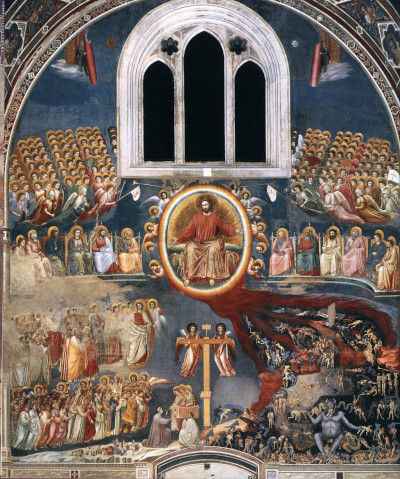
The Last Judgement on the Scrovegni Chapel’s entrance wall.
The fourteen Vices and Virtues bring the question closer to the level of the viewer. Painted below the narrative scenes, they resemble sculptural figures set within an architectural system. Their restricted colouring distinguishes them from the stories above. A person walking through the chapel encounters a succession of moral dispositions given bodily form.
Envy is a particularly memorable example. The institutional catalogue describes a blinded figure, a serpent in place of the tongue and flames that burn her. These details turn a destructive inward state into an image that can be read through the body. The figure’s physical impossibility is part of its effectiveness: allegory makes visible something that ordinary appearance cannot show. [74]
The arrangement contains seven opposing pairs. It is not simply an illustration of the familiar canonical list of the Seven Deadly Sins. The selected virtues and vices establish a particular moral path within this chapel. Their relationship to the Last Judgement helps the room bring together narrated history and the visitor’s present conduct. [1]
The Judgement also includes the patron. Enrico kneels with a model of the chapel, presenting the building within the painted sacred order. It is an extraordinary image of a real commission translated into a religious offering. The model joins architecture, patronage and salvation in one gesture. The identity of the cleric who helps support it has been debated, so the familiar identification with Altegrado de’ Cattanei should be treated as a proposal rather than a signed portrait. [69]
Interpretation becomes less secure when it tries to name every small figure or decode every punishment. Scholars have offered competing identities for the small nude figure near the cross, including Adam and the Wandering Jew. Giovanna Valenzano’s recent discussion presents an Adam interpretation while acknowledging difficulties and objections. A responsible account can describe that debate without pretending that a difficult image has been finally solved. [75]
The room’s religious appeal includes hope, warning, prayer and the promise of renewal. Different viewers will have attended to these elements differently. Its carefully ordered sacred company and its frightening Hell can coexist within one programme. Giotto’s achievement includes the capacity to organise both, allowing the entrance wall to be an ending to the stories and a continuing presence in the worshipper’s experience.
Rooms, thresholds and painted depth
Giotto’s spaces are most interesting when we ask what they enable people to do. A room can hold a meal, a gate can frame a reunion and a doorway can mark the boundary between an interior and the people waiting outside. Buildings give narratives a physical grammar. They establish who is admitted, who remains apart and where a decisive action takes place.
The Scrovegni Chapel’s two painted recesses, or coretti, provide an especially concentrated example. The institutional records describe Gothic arches in the foreground, windows at the rear, sharply foreshortened rib vaults and hanging metal lamps. No crowd or miracle occupies them. The persuasive depth of an apparently empty space becomes the subject of the painting. [76]
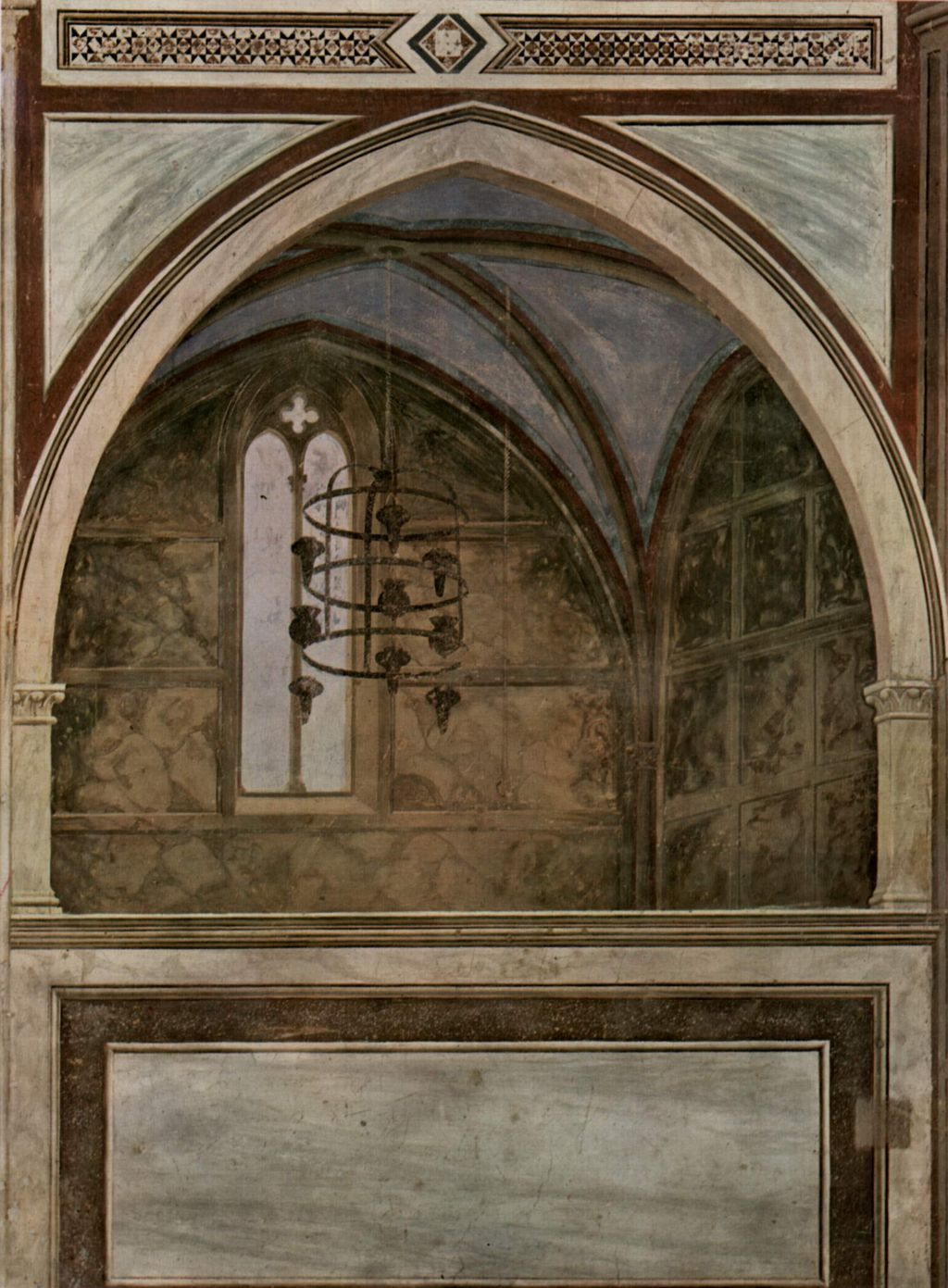
The right, south coretto: a painted recess in the Scrovegni Chapel. Image source. Public domain. Proportionally reduced reproduction; no colour or content enhancement.
The suspended lamps are important because they imply a distance between ceiling and floor. Their vertical descent gives the eye a measure within the fictive chamber. The rear windows suggest a boundary beyond the immediate arch. Together these details encourage the viewer to read the wall as an opening into a place that could be entered, even though the surface remains solid.
This experiment belongs to a broader range of spatial devices. In narrative scenes, overlaps make a crowd dense; angled furniture gives a room breadth; buildings establish separate zones within one composition. Such arrangements can be convincing locally without being governed by the single mathematically coordinated system associated with later Renaissance perspective. Giotto’s solutions are closely tied to what each image needs to communicate.
The difference can help us enjoy the paintings more fully. A building whose sides do not converge as a modern viewer expects may still make an action exceptionally clear. The question becomes how successfully a painted structure contains the figures and guides attention. A small change in the angle of a wall can open a scene towards the visitor; a frontal barrier can make an event seem remote or difficult to enter.
Giotto also works with the actual architecture around the image. At Scrovegni, the arch and the narrative registers belong to an interior that viewers experience by moving and turning. In the Peruzzi Chapel at Santa Croce, Michael Viktor Schwarz has considered how oblique viewing positions can alter the apparent relationship between painted and real space. This is a useful reminder that a flattened photograph offers only one experience of pictures designed for a particular room. [77]
Fresco, tempera and the presence of gold
Calling a work “a Giotto” can conceal major differences in how it was made. A fresco belongs to a plastered wall. A tempera panel is a constructed wooden object with prepared layers, gilding, paint and often an elaborate frame. A monumental cross occupies a church as a shaped object, visible against the architecture around it. The medium changes the picture’s scale, surface and relationship to a viewer.
In true fresco, colour is applied to fresh lime plaster and becomes bound into the setting surface. Work on dry plaster requires a different means of adhesion. Medieval wall paintings can contain both kinds of work, and Giotto’s surviving art offers clear evidence of variation. The Scrovegni catalogue, for example, identifies both fresco and dry-painted passages in the overturned table of the Expulsion of the Money Changers. Its record of the Adoration of the Magi describes lost dry-applied colour and areas where the preparatory drawing has become visible. [78]
Such details change the way we interpret damaged pictures. An exposed line may belong to an earlier stage of making. A face now visible through an architectural element may have been more fully covered when the painting was new. The apparent simplicity of a worn surface can result partly from the loss of finishing layers. Close looking therefore needs to hold together what survives and what technical examination tells us about its history.
Panel painting offers another set of possibilities. The Washington Madonna and Child was painted on poplar over a white gesso ground, with fabric between the wood and the preparation. The gold was laid over green earth and red bole. Incised outlines and decoration helped organise the surface; thin layers built the flesh over green and verdaccio preparation. Infrared examination also revealed an adjustment to the Child’s face. The image’s apparent assurance was compatible with revision during its making. [79]
There was no single unchanging recipe across the workshop’s production. Dillian Gordon’s technical account of the London Pentecost records thin flesh painting without a green underpaint. Its gilding and lost metal rays present another material history. Comparing these objects is more instructive than giving Giotto one technique and applying it to every surviving picture. [80]
Gold itself deserves attention as a visible material. It reflects light differently from painted flesh and cloth. An incised halo can catch light as the viewer moves; a gilded ground can give a small panel a presence beyond its dimensions. Giotto’s substantial bodies exist within this luminous world. Their physical conviction and the precious surface work together, allowing human encounters to occupy a space set apart for sacred attention.
The painted cross: a body within the church
The Crucifix in Santa Maria Novella makes the relation between body and object unusually direct. Its outline follows the cross, while the small mourners at the ends of the horizontal arm face towards Christ. His head falls forward, his torso hangs and the knees and feet draw the lower body into a heavy downward movement. The surrounding gold and ornament give this body a solemn, highly finished setting.
The painted figure remains continuous across a large wooden construction. For a viewer in the church, the image can first register as a great cross suspended within real architectural space, then as a body whose weight is made visible within that cross. Its scale and placement affect how it is encountered. It could be seen across a distance by people moving, praying or listening, rather than only examined at the comfortable height of a museum painting.
The work was already associated with Giotto in early fourteenth-century records. A 1312 testament provides a secure early anchor, although proposed dates within his earlier career vary. The cross’s relationship to the former screen dividing the lay nave from the friars’ choir has also been reconstructed from architectural and liturgical evidence. Its present location should be understood in relation to that history, rather than as an untouched medieval arrangement. [81]
The shaped painted Crucifix in Santa Maria Novella, Florence.
Giotto did not introduce the suffering Christ into Italian painting. The Christus patiens, with the dead or suffering body, had a substantial earlier history. Comparison with Cimabue and other predecessors instead shows different ways of giving that body weight, arranging the mourners and directing devotional attention. The achievement is specific enough to survive the removal of an extravagant invention claim.
Other crosses extend the comparison. The Rimini Crucifix belongs to another city and religious setting; the Padua Crucifix relates to the Scrovegni ensemble; the Ognissanti Crucifix raises its own questions about date, workshop contribution and conservation. Each deserves to be treated as a physical work with a separate history.
At Ognissanti, examination has made that physical complexity particularly clear. The huge cross contains a carefully assembled wooden support and a richly worked surface. The Opificio delle Pietre Dure’s conservation account records painted and gilded glass and artificial gems in Christ’s halo, alongside the painted modelling of the body. These findings expand our sense of what a Giotto image could contain: precious reflected light and constructed surface effects belonged beside the representation of flesh. [82]
Madonnas: authority, intimacy and three different objects
Giotto’s Madonnas offer a useful way to see how closely related subjects can answer different pictorial needs. The great Ognissanti Madonna, the Washington rose-bearing Madonna and Child and the Madonna of San Giorgio alla Costa are separate works. Their titles and histories should remain distinct even when their compositions are compared.
 in Detail Giotto.jpg)
Whole surviving San Giorgio panel despite filename in Detail
The Ognissanti Madonna in the Uffizi is monumental: 325 by 204 centimetres, painted in tempera on wood with a gold ground. The museum currently dates it to about 1300–05, although about 1310 is also frequently encountered in the literature. Its original position in the Florentine church of Ognissanti is uncertain; a side altar or the church screen has been proposed. [66]
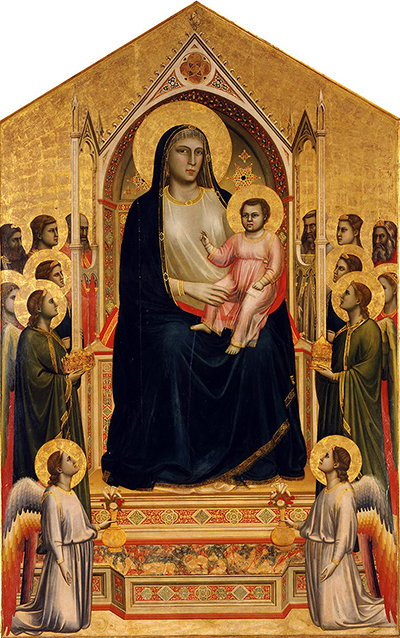
The Ognissanti Madonna, a monumental gold-ground panel now in the Uffizi.
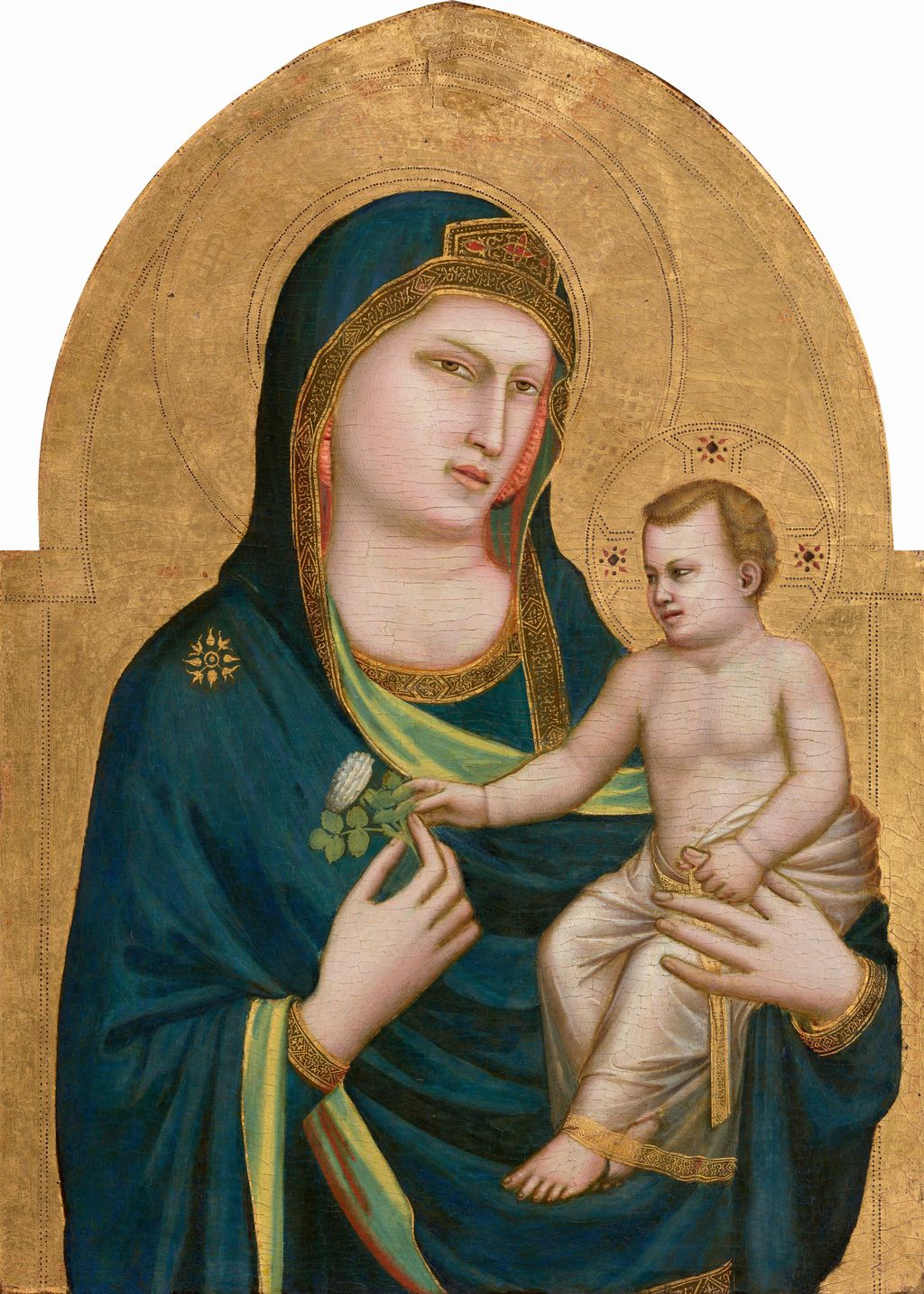
The Washington Madonna and Child, NGA 1939.1.256, with the rose and the Child’s reaching hands. National Gallery of Art, Washington, Samuel H. Kress Collection,1939.1.256. Image source. Public domain. Proportionally reduced reproduction; no colour or content enhancement.
Mary sits within a throne that resembles a Gothic architectural canopy. Angels and saints gather around it, some partly hidden by its members and by one another’s halos. These overlaps help establish a populated space. The large dark mantle gives the Virgin an impressive bodily breadth, while her right hand rests across the Child’s legs. His small bare feet, pink garment and blessing hand register clearly against her blue.
The offerings extend the image beyond a simple mother-and-child encounter. The kneeling angels hold vases of roses and lilies; the nearer standing angels present a crown and a pyx, a vessel associated with the Eucharist. Daniela Parenti’s Uffizi account connects the flowers with purity and charity and cautiously relates the pyx to the Passion. The throne and offerings make the image an assembly of devotion, with the central figures receiving sustained attention from the surrounding company. [66]
The Washington panel concentrates the relationship into a smaller field. Mary holds a rose, and the Child reaches towards the finger that supports it. Her other hand steadies him. The flower and the exchange between the hands are both delicate and conspicuous, positioned where the viewer can follow the movement from one body to the other. The gold remains richly worked, but the action is intimate. [79]
Miklós Boskovits’s catalogue essay considers the rose’s Marian and ecclesial meanings and the Child’s gesture as potentially symbolic as well as affectionate. These readings can coexist with the immediately visible action. A rose can be an object held between two people and a bearer of religious association. Giotto’s painting lets the small physical exchange sustain more than one level of attention. [79]
The Washington panel’s original altarpiece is disputed. Scholars have associated it with saints now in other collections, including the Horne Museum’s Saint Stephen. An especially useful warning comes from the National Gallery of Art’s editorial notes: later technical findings changed one of the material arguments that had been used against this association. The reconstruction remains a question to investigate, rather than an arrangement that can be accepted or rejected from one outdated detail. [79]
The separate Madonna of San Giorgio alla Costa belongs to the discussion of Giotto’s earlier painting. Keeping its identity separate allows the differences of scale, framing, gesture and condition among these Madonnas to become informative. The subject is repeated; the viewing experience is renewed.
Small narratives with a larger lost arrangement
The Metropolitan Museum’s Adoration of the Magi compresses several actions into a panel only about forty-five centimetres high. Mary reclines beneath a roof while the kneeling king lifts the Child from the manger, and shepherds receive the angelic announcement above. The painting draws the Nativity and the Magi’s homage together within one continuous setting. [83]
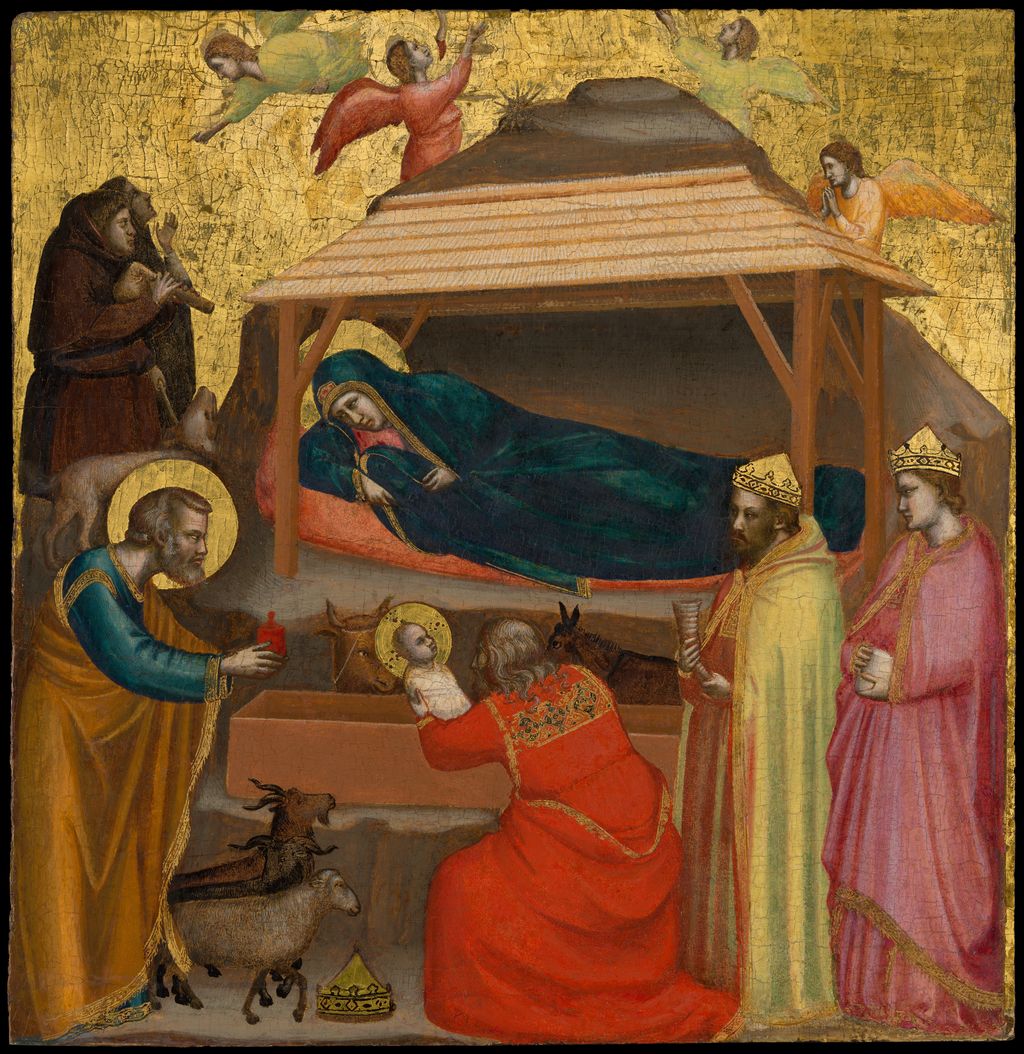
The Met’s Nativity and Adoration panel, accession 11.126.1; the present star includes later alteration. Image source. Public domain. Proportionally reduced reproduction; no colour or content enhancement.

Pentecost, National Gallery, London, NG5360: a wooden panel by Giotto and Workshop.
The shelter is essential to this organisation. Its long roof establishes a strong diagonal plane and a broad area of shadow beneath. Mary’s reclining form lies across the middle. Joseph stands at the left with a small red vessel, while the kings occupy the foreground and right. The kneeling king has removed his crown, which rests near the lower edge. The scale remains small, but the principal shapes are as deliberate as those of a chapel scene.
Here gold fills the space around the structure and the figures. The roof projects, the bodies possess volume and the animals gather behind the Child. Constructed depth and the brilliance of a gold ground work together within one small panel.
The star above the roof is a caution against reading every striking detail as untouched medieval evidence. Keith Christiansen noted the conspicuous tailed star as a later addition. Gordon’s subsequent technical discussion relates the original star to surviving traces of gilded tin and considers the history of later alterations. The present star therefore cannot serve as straightforward proof of Giotto’s observation of Halley’s comet. That question must also be kept separate from the different Adoration painted at Padua. [84]
The panel belongs to a group of seven scenes from Christ’s life, now divided between collections. Gordon’s catalogue gives a particularly strong reason for connecting them: X-radiographic comparison of the wood grain shows that they came from one long board, approximately 308 centimetres in length. The New York panel and London Pentecost occupied opposite ends. [80]
What the whole object was remains less certain. The group has been reconstructed as a predella, the low narrative strip beneath a larger altarpiece. Gordon argues instead for an autonomous dossal, a low horizontal altarpiece. The distinction changes how we imagine its original viewing height and relationship to other images. The shared wood is physical evidence; the full original function is a scholarly reconstruction.
The London Pentecost must also remain distinct from the Scrovegni fresco of the same subject. The panel presents apostles within a detailed loggia, with listeners outside. Its lost raised metal rays would once have added another kind of brilliance to the descent of the Spirit. This portable narrative world combines bodies, architecture and precious materials on a scale very different from the chapel walls. [80]
A funeral image and the life around an altar
The Berlin Death of the Virgin, also called the Dormition, spreads its figures across a long, low panel. Mary lies upon an ornate bier or sarcophagus. Christ stands at the centre holding a small figure representing her soul. Apostles and angels gather around her, their heads and halos overlapping against gold. The shallow gable above brings the assembly towards its central axis. [85]
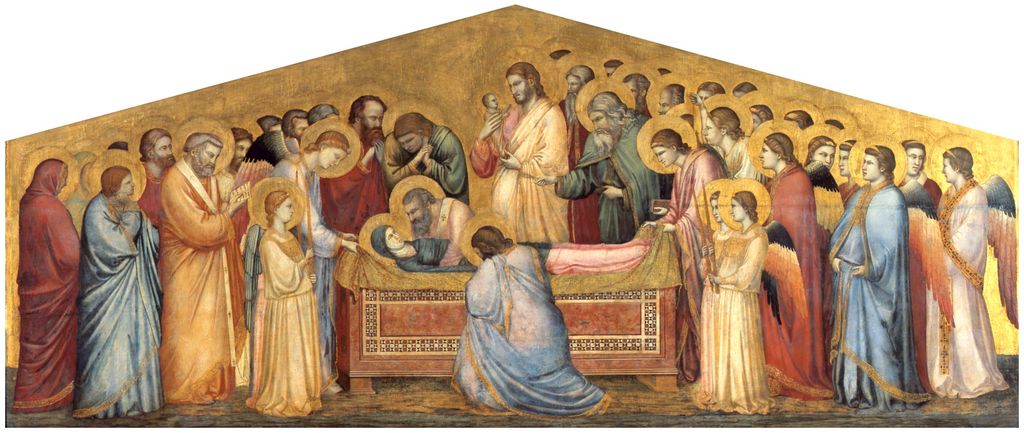
The Death of the Virgin in Berlin, with its broad gabled outline. Image source. Public domain. Proportionally reduced reproduction; no colour or content enhancement.
At the front, a kneeling figure presents a broad back to the viewer. The pale blue garment curves around the body, drawing attention towards the dead Virgin while partially interrupting our view. Once again, Giotto makes a person’s position within an event available through the weight and orientation of a body. The picture becomes a gathering that extends away from us, with some participants seen clearly and others only in part.
The angels at the sides introduce different scales of response. Some stand quietly with hands held before them; another presses a hand to the face. The long horizontal body of Mary stabilises the middle while the surrounding heads rise, turn and incline. Colour links figures across the composition, preventing the group from breaking into isolated pairs.
The subject comes from traditions outside the canonical Gospels. As Stephan Weppelmann explains in the Berlin catalogue, accounts of Mary’s death, funeral, burial and reception in heaven developed through several textual stages. The picture brings together elements that the narratives distinguish in time. Its composition is a devotional synthesis rather than a literal snapshot of a single moment. [85]
Weppelmann relates the panel’s Ognissanti setting to the Humiliati community’s burial and memorial services. This interpretation gives the work a meaningful relationship to the actions that could take place in front of an altar: the depicted sacred funeral could accompany prayer for an actual dead person. The proposal is valuable because it places the picture within lived ritual, while its precise original arrangement remains part of the reconstruction. [85]
Seen beside the Padua Lamentation, the panel shows how Giotto could vary a shared subject of death and gathering. The fresco concentrates attention along a diagonal descent towards two faces. The Berlin panel builds a long ceremonial assembly around a stable horizontal body. Their emotional registers emerge from the way bodies are organised, even before the differences between the two sacred narratives are fully explained.
Assisi: Franciscan stories and the problem of authorship
The paintings at Assisi are indispensable to Giotto’s history, and their attribution must be approached with care. The Upper and Lower Churches contain different programmes, painted in different circumstances by several important artists. “The Assisi frescoes” is too broad a label to identify one cycle, date or painter.
In the Upper Church, the twenty-eight episodes of the life and miracles of Saint Francis occupy the lower narrative register of the nave. The basilica’s own account recognises the central disagreement: some scholars attribute the cycle to Giotto, while others connect it with a Roman school. There are further questions about the division of labour, separate campaigns and the relationship between design and execution. [86]
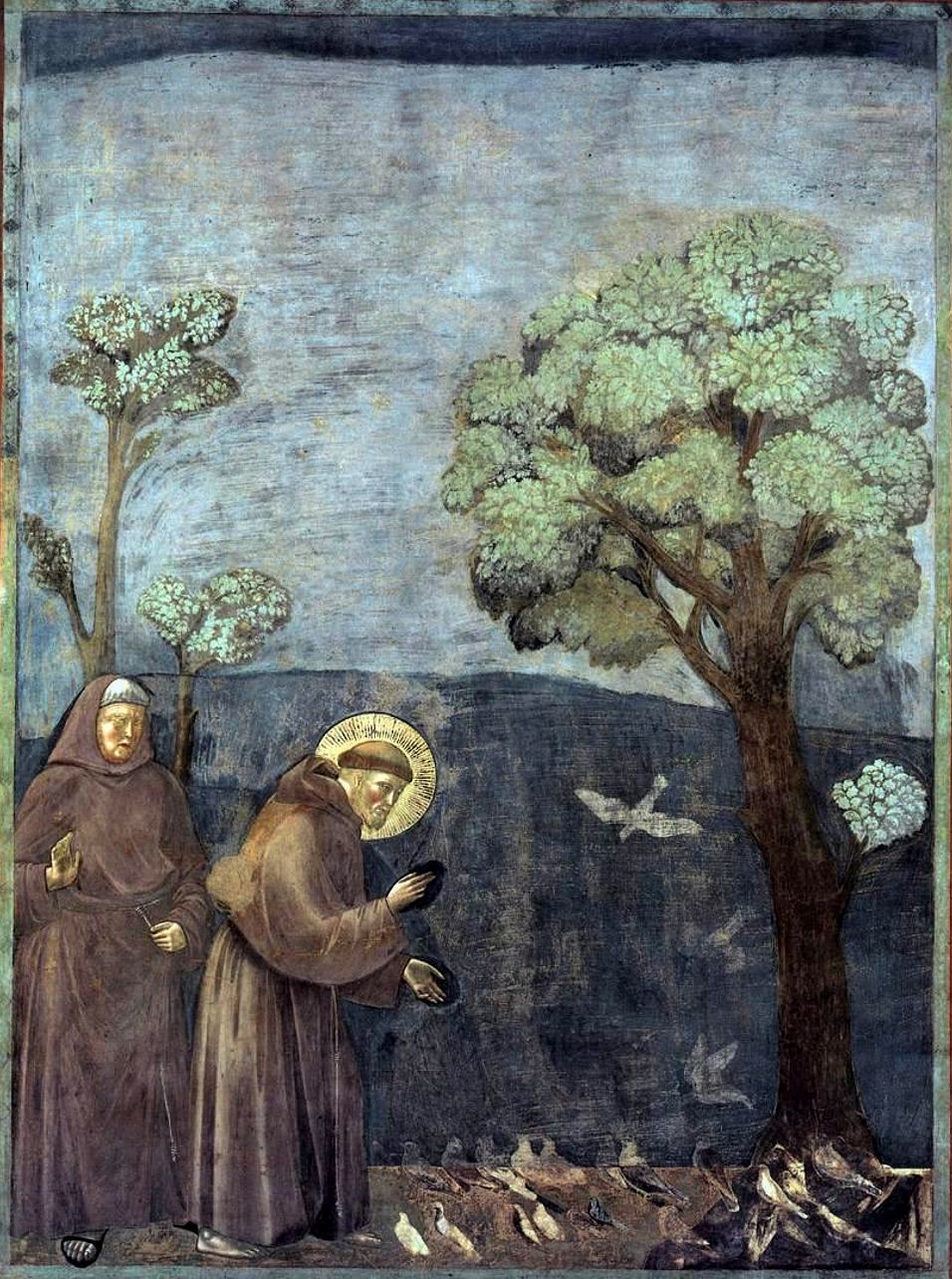
The bird sermon in Assisi’s Upper Church, from a cycle whose authorship remains disputed. Image source. Public domain. Proportionally reduced reproduction; no colour or content enhancement.
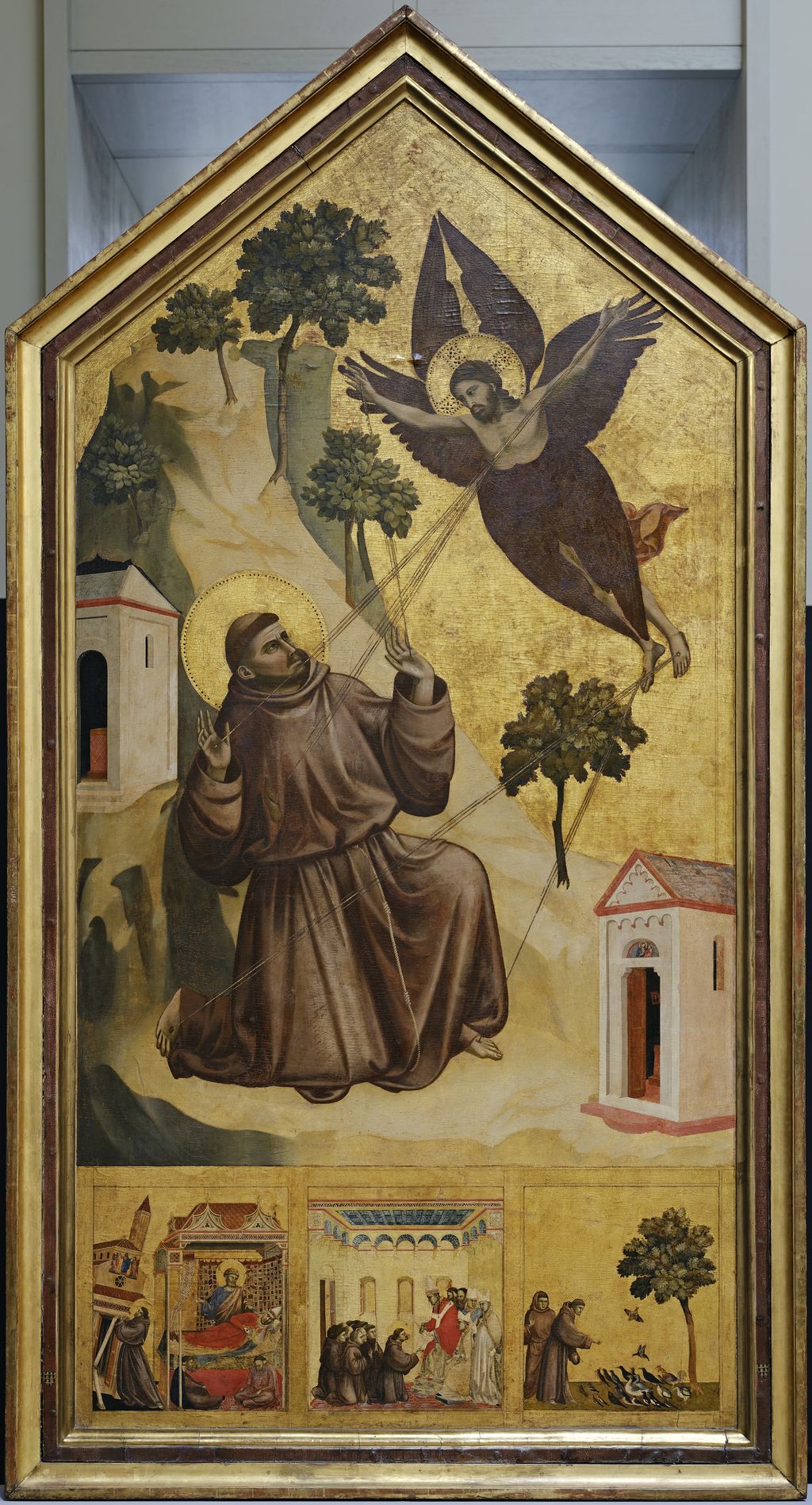
The signed Louvre Saint Francis altarpiece, with all three predella scenes. Shonagon / Wikimedia Commons / Public Domain Mark1.0. Image source. Public domain. Proportionally reduced reproduction; no colour or content enhancement.
Bonaventure’s Major Legend supplies the principal narrative framework. It is a Franciscan account of the founder’s holiness, written to present a life with spiritual authority. Its stories explain what the pictures narrate; they do not independently certify miraculous events or identify the painter who made each scene. [87]
This distinction can sharpen even familiar subjects. The man who receives Francis’s mantle is described by Bonaventure as an impoverished soldier of noble birth. The building in Innocent III’s dream is the Lateran basilica. In the trial before the sultan, the narrative describes a proposed ordeal and the sultan’s refusal to carry it out; it does not say that Francis walked through the flames unharmed. Precise reading restores the particular meaning of stories that can otherwise dissolve into generic scenes of charity, prophecy and miracle. [87]
The cycle gives those subjects public settings. Francis’s renunciation is a rupture involving family, property and episcopal protection. The approval of his way of life places a new religious community before papal authority. The Greccio episode concerns a liturgical commemoration of the Nativity, with Mass and Gospel chanting at its centre. The spiritual life becomes visible through institutions, objects, witnesses and assembled bodies. [87]
Schwarz has challenged the assumption that the Upper Church cycle must be a completely unified, early work executed throughout by Giotto. His discussion of different groups and campaigns remains one position within a larger scholarly debate. For the reader, the useful consequence is to keep several questions separate: who conceived the scenes, who supervised their execution, which hands painted particular passages and when the work took place. [88]
The Lower Church introduces a different set of monuments. Its vault allegories of Poverty, Chastity and Obedience, together with Francis in glory, are associated by the basilica with Giotto and his workshop around 1315. The Magdalene Chapel belongs to a further commission with its own patronal and narrative context. These works should not be absorbed into the Upper Church attribution as though one label settled them all. [89]
The signed Louvre Saint Francis Receiving the Stigmata adds an important comparison across media. It is a large gold-ground wooden panel from San Francesco in Pisa, with three narrative scenes below, and bears the inscription identifying it as the work of Giotto of Florence. The Louvre currently dates it broadly to 1300–25. It is neither a detached Assisi fresco nor the nineteenth episode of the Upper Church cycle. [90]
In the panel, Francis kneels beneath the crucified seraphic figure, and fine lines connect the apparition with his body. The rocky setting and small buildings create a place for the encounter, while the gold intensifies its supernatural character. Below, the dream of Innocent, the approval of the Rule and the preaching to the birds set the extraordinary bodily event within the story of the order. Its signature supplies an important anchor for comparison with other Franciscan images.
Patrons, orders and cities
Giotto’s career connects several kinds of patronage. The Franciscans provided major settings at Assisi and Santa Croce. The Dominicans of Santa Maria Novella possessed a monumental painted cross. The Humiliati at Ognissanti commissioned works for their own church. Enrico Scrovegni’s chapel brought the painter into the ambitions and religious life of a wealthy Paduan household. Each setting supplied different expectations, spaces and audiences.
The distinctions are visible in the objects. A large cross offers a commanding focus within a church. A family chapel creates a more concentrated environment where narrative, burial and commemoration can work together. An altarpiece may address viewers on more than one side. To imagine all these works as pictures originally displayed on neutral walls is to lose much of their purpose.
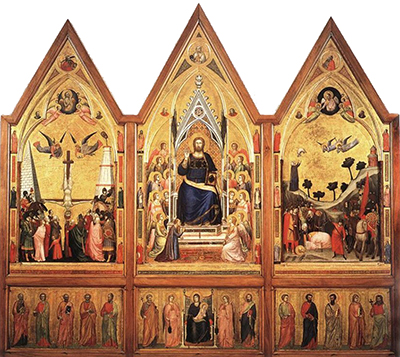
The Stefaneschi Triptych demonstrates this especially well. Cardinal Jacopo Stefaneschi commissioned it for Old Saint Peter’s in Rome. The Vatican Museums describe a double-sided painting intended to be seen by clergy and faithful. One face centres upon Christ, the other upon Saint Peter; martyrdoms, apostles, saints and the kneeling patron extend the programme. The cardinal’s presentation of a model of the triptych makes the commission itself part of the sacred image. [91]
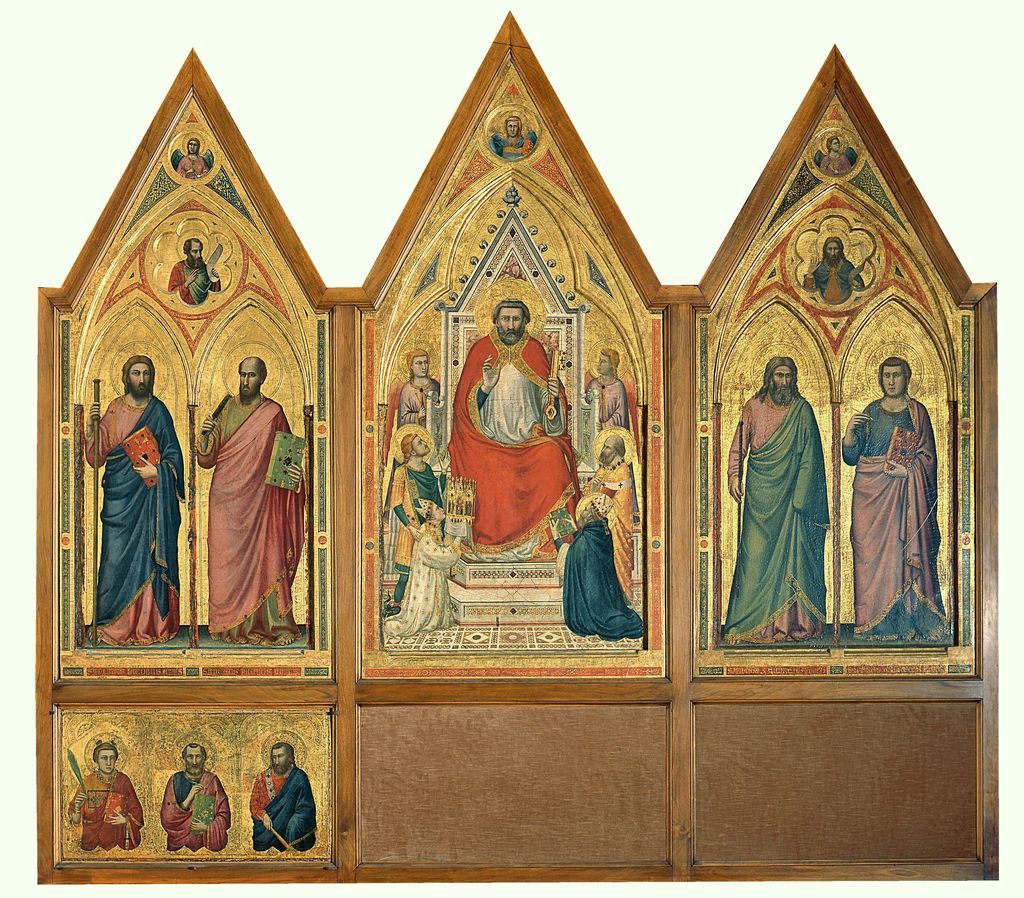
The Peter and donor face of the Stefaneschi Triptych, by Giotto and assistants. Self-scanned reproduction, Commons uploader Eugene a. Image source. Public domain. Proportionally reduced reproduction; no colour or content enhancement.
This is patronage made visible without displacing the religious subject. The donor appears within an order larger than himself. His gift, status and devotion are connected through the painted object. The Vatican’s attribution to Giotto and assistants also reminds us that the magnificence of such a commission depended on a working group.
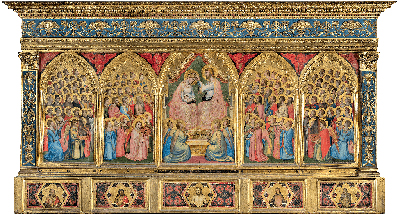
In Florence, the Bardi and Peruzzi chapels at Santa Croce placed important family commissions within a Franciscan church. Their subjects differ: Francis’s life in the Bardi Chapel, the two Saints John in the Peruzzi. Their dating also requires care. The current Bardi historical dossier establishes that its programme follows the canonisation of Saint Louis of Toulouse in 1317, while leaving the precise date debated. The institution dates the Peruzzi paintings approximately to 1310–11; Schwarz has argued for a much later position in Giotto’s career. The disagreement should remain visible whenever the two cycles are used to build a chronological development. [92]
The names of places provide another route through the career. Florence supplies the household, major surviving panels, crosses and late civic appointment. Padua preserves the most complete narrative ensemble. Assisi raises important questions about Franciscan imagery and authorship. Rimini has its own cross and local reception. Rome connects Giotto with cardinal and papal institutions, while Naples documents his place at a royal court. The map has strong anchors, but it also contains lost works and uncertain intervals. No documented journey to France or Ephesus is needed to explain the presence of far-reaching artistic and commercial connections.
A workshop capable of large ambitions
The scale of Giotto’s commissions makes workshop practice essential to understanding his achievement. Someone had to prepare walls, organise plaster, grind and apply colours, assemble wooden supports, gild surfaces and coordinate work across a substantial programme. These activities could involve different skills and changing groups. A coherent visual result does not imply that one person physically executed every part.
The Neapolitan treasury account of 20 May 1331 offers an unusually concrete glimpse. It names Giotto as the leading master of the painting work and records materials including fine gold, gilded tin, pigments, cloth and glue. It also accounts for the labour of different painters and manual workers. A panel had been painted at Giotto’s lodging by royal order, alongside work associated with the great and private chapels of Castel Nuovo. [2]
This record helps bridge the gap between impressive artistic results and the practical circumstances that produced them. The royal works required a supply system, payments and coordination with the building. The account even discusses changes associated with windows and drainage. Painting was part of a larger physical project, exposed to the same questions of access, water, construction and maintenance as the architecture around it. [2]
Elsewhere, the evidence is less explicit. It is unsafe to give Giotto an exact number of assistants at Padua simply because a large team seems plausible. Nor can every variation of quality or style be converted into a named pupil. A quieter passage might reflect a collaborator, a different stage of execution, a different demand from the patron or a change in condition. Attribution requires comparison among several kinds of evidence.
Technical study can make those comparisons more precise. Shared wood grain can connect separated panels. Incisions, drawing methods and preparation layers can reveal working choices. Signatures and early records establish another kind of relationship. None of these automatically answers every question about the division of labour, but together they provide a firmer basis than an impression of “Giotto-like” figures alone.
The National Gallery of Art’s Washington catalogue supplies a telling example. An older argument treated a supposed difference in the gilding preparation of the Madonna and the Horne Saint Stephen as evidence against their common origin. Subsequent examination found the relevant layering in the latter too, and the editors explicitly explained why Boskovits’s submitted essay could not incorporate that result. Scholarship can preserve an important interpretation while also recording the evidence that changes it. [79]
Workshop history is therefore part of the art’s interest. It allows us to ask how a compelling conception travelled through a group, how painters adapted it to different objects and how an artist’s name could stand for work produced through collaboration. The workshop and attribution guide follows these questions in greater detail.
The Navicella and the scale of what has been lost
Some of Giotto’s most celebrated work survives only indirectly. The Navicella mosaic, commissioned by Cardinal Stefaneschi for Old Saint Peter’s, was an enormous image associated with Christ’s rescue of Peter on the water. Its destruction, displacement and reworking during the rebuilding of the basilica have made it one of the clearest examples of the difference between a famous work and a securely recoverable appearance. [93]
The early commission testimony connects the mosaic with Giotto and the cardinal. Its exact dating is less secure. The frequently discussed year 1298 comes through an indirect transmission, and competing interpretations of the programme have been used to support different chronologies. A broad account of the work can acknowledge its importance without pretending that one exact year has been conclusively documented. [93]
The original setting mattered. The mosaic occupied the entrance structure associated with the atrium of Old Saint Peter’s. Visitors could pass beneath it and then turn back towards it. The image therefore belonged to arrival, movement and prayer in one of Christianity’s most important pilgrimage destinations. Its audience and architectural scale were very different from those of a small panel or a family chapel.
Copies and prints preserve information, but they do not all preserve the same information. Schwarz compares sixteenth-century engravings that differ in proportion, detail and orientation. The seventeenth-century version in the portico of the present basilica is a remake, rather than Giotto’s original surface preserved intact. A reproduction of it needs to be understood through that history. [93]
The loss changes our picture of the artist. If we knew Giotto only through surviving frescoes and panels, mosaic would occupy a much smaller place in our account than it did in his historical reputation. The same problem affects Naples and other lost decorations. Survival has selected the works through which modern viewers know him. The surviving achievement is immense, but it is also incomplete.
Conservation changes the Giotto we see
Giotto’s art has lived through alterations in worship, architecture and taste. Panels have been cut and separated; chapels have been whitewashed and rediscovered; original colour has flaked; restorers have added and removed paint. The surface visible today is the result of both medieval making and later history.
The Bardi Chapel provides a particularly clear case. Its paintings were covered with limewash before 1730. Nineteenth-century cenotaphs damaged parts of the lower walls, and the uncovering of the cycle in 1851 caused further abrasion and losses. Gaetano Bianchi supplied extensive reconstruction and a unifying tempera coating. For about a century, viewers encountered a Giotto partly shaped by nineteenth-century restoration. [92]
Between 1957 and 1959, Ugo Procacci and Leonetto Tintori oversaw a very different intervention. Bianchi’s additions were removed to recover the surviving original work, with the older additions preserved separately as evidence. The resulting paintings were more fragmentary, and the balance between legibility, surviving paint and visible loss had changed profoundly. [92]
The restoration begun in 2022 and completed in 2026 again addressed preservation and the ability to read the cycle. Its historical dossier is explicit about retaining the traces of the paintings’ history. A newly clarified figure or colour relationship can change our experience, while the losses remain part of what must be understood. [92]
The Peruzzi Chapel has a related but separate history. Santa Croce identifies the paintings as executed almost entirely on a dry ground and describes damage from whitewashing, nineteenth-century cleaning and later treatment. Their fragility helps explain why a comparison of photographs can appear to offer several different works. The faintness of a passage is evidence about its present condition, not a reliable measure of the original ambition of the painting. [77]
At Scrovegni, the major campaign of 2001–02 was followed by continuing monitoring and planned maintenance. Conservation here includes the building and its environment as well as the painted surface. The continuing attention reminds us that an apparently stable chapel interior is actively cared for. [94]
Carlo Naya’s photographs of the Scrovegni paintings, made in 1863–66, preserve an especially valuable record. Elena Racheeva’s study of the Pushkin Museum’s holdings distinguishes photographs taken before and after restoration, including an 1863 view of the Wedding Procession and Joachim’s Dream after restoration in 1865. They allow changes in appearance to be studied, while their monochrome tones require care when discussing original colour. [95]
These histories also affect digital images. Older photographs may show overpainting that has since been removed. A monochrome reproduction can preserve valuable evidence of an earlier condition while transforming colour relationships. A clear contemporary image reveals another state, under particular lighting. When two reproductions seem inconsistent, the difference can belong to the work’s treatment or the photograph rather than to a mistake in our looking.
The practical reward is greater patience. Instead of dismissing a damaged picture because it lacks the immediate brilliance of Padua, we can ask what survives, what has been restored and which relationships remain readable. Conservation is one of the ways Giotto’s art continues to become newly visible.
Giotto’s tower and the people who continued it
The bell tower beside Florence Cathedral carries Giotto’s name, but the present building records a succession of designers and builders. His appointment on 12 April 1334 covered cathedral and civic responsibilities, including city walls, fortifications and communal works. The appointment’s date does not itself prove that he was physically in Florence that day. It records a formal commitment to bring his authority and reputation into the city’s service. [96]
Florence’s cathedral bell tower, begun by Giotto and continued by Andrea Pisano and Francesco Talenti.
Giovanni Villani gives 18 July 1334 as the date of the tower’s foundation. A cathedral workshop document names Giotto as a witness on 12 December 1335. These anchors establish an active late connection with the enterprise, even though the precise division between his design, work completed during his lifetime and later alterations remains a subject of reconstruction. [96]
Andrea Pisano and Francesco Talenti continued the building after his death. The sculptural programme likewise belongs to several makers and periods. The Opera del Duomo’s museum account identifies Andrea Pisano and assistants, including his son Nino, in the important early phase. The original sculptures are displayed in the museum; the exterior programme is represented by copies. Giovanni Pisano, whose sculpture belongs to the Scrovegni Chapel, should not be confused with these Campanile makers. [97]
For Giotto’s career, the tower matters as more than an additional item in a list of occupations. It shows the public status of an artist whose reputation could become a civic asset. His experience of painted architecture and complex altarpiece structures offers suggestive connections with design, but it does not by itself establish him as the author of every architectural project associated with his name. The cathedral existed as an enterprise before him and continued long after him.
The Campanile guide separates the successive phases more closely. Looking at the tower through that history preserves the significance of Giotto’s role while allowing its later makers their own place in the monument.
Fame, transmission and the stories told about a beginning
Giotto’s influence includes the works that painters studied, the practices transmitted through workshops and the stories writers used to explain artistic change. These forms of inheritance overlap, but they are not interchangeable.
Dante’s famous reference in Purgatorio XI places Giotto beside Cimabue in a discussion of changing fame. The words belong to the character Oderisi, who reflects on pride and the instability of worldly reputation. They show that Giotto’s name could serve as an immediately meaningful example for readers; they do not document an apprenticeship or a meeting between painter and poet. [98]
Cennino Cennini offers a different kind of witness. In the opening of the Book of Art, he traces his own training through Agnolo Gaddi and Taddeo Gaddi to Giotto. His account of painting flesh also invokes the authority of a practice inherited through that chain. Here Giotto belongs to the memory of working painters, with technique and professional identity transmitted from teacher to pupil. [99]
Cennini’s formulation of a change from Greek to Latin painting has often helped later writers describe Giotto as the beginning of something new. It is a forceful historical judgement, shaped by the author’s own artistic allegiance. Looking at actual works reveals continuities alongside innovation: gold grounds, sacred hierarchies, established subjects and inherited forms remain active within Giotto’s convincing bodies and spaces.
The later legends continue the same work of explanation. The gifted boy drawing animals, the perfect circle and the witty painter give artistic intelligence a memorable human form. Their value lies partly in what later generations wanted an artist’s life to mean. The documents offer a different, equally absorbing figure: an urban professional with a household, property, collaborators, influential patrons and a reputation that crossed political boundaries.
The pictures remain the strongest invitation to understand why that reputation endured. In the Ognissanti Madonna, a ceremonial assembly acquires bodily breadth. In the Met panel, a small painted structure accommodates several actions from sacred history. In the Berlin Dormition, a long gathering takes shape around a dead woman and the promise represented by Christ. At Padua, the same capacity for arranging bodies and attention expands across an entire room.
Begin with one of those works and follow the movement of a hand, a shoulder or a glance. Then look at what surrounds it: the supporting body, the architecture, the precious surface, the neighbouring scene. Giotto’s art becomes richer through those relationships. Its extraordinary clarity is an invitation to keep looking.
Essential Giotto works
Lamentation — Scrovegni Chapel, Padua
c.1303–05 (chapel campaign); Giotto and workshop · Bodies and gestures gather grief around Christ. [100] [25]
Arrest of Christ — Scrovegni Chapel, Padua
c.1303–05 (chapel campaign); Giotto and workshop · The encounter between Judas and Christ concentrates a crowded arrest. [101] [25]
Scrovegni Chapel — painted decoration
c.1303–05 (chapel campaign); Giotto and workshop (painted decoration) · An interconnected painted interior joins narrative, moral figures and judgement. [25] [26] [27]
Ognissanti Madonna
c.1300–05 (Uffizi); c.1310 also proposed · A monumental Virgin occupies a Gothic throne among angels and saints. [28]
Santa Maria Novella Crucifix
Late 13th century; c.1288–89 or 1298–1301; disputed · A shaped wooden cross makes bodily weight central to devotion. [19]
Stefaneschi Triptych
c.1320; 1315–20 (Vatican Museums); Giotto and workshop · A double-sided altarpiece makes patronage and liturgical viewing visible. [30]
Bardi Chapel — painted decoration
After 1317, usually the 1320s; disputed; Giotto and workshop / Giottesque painters; individual hands disputed · Francis’s life unfolds within a Florentine family chapel and a collaborative painted structure. [31] [32]
Baroncelli Polyptych
After 1328; detached pinnacle c.1328–35; Giotto and workshop · Coronation, saints and music fill an altered altarpiece attributed to Giotto and his workshop. [33]
Giotto’s Campanile — Florence Cathedral bell tower
Giotto’s phase 1334–37; tower completed 1359 by successors · Giotto’s late building office begins a tower completed by successors. [34] [35] [36]
Artworks directory
This directory brings together 209 records for paintings, ensembles, individual scenes and components, architectural work, an associated disputed design, and reported or lost projects connected with Giotto. Ensembles and their parts appear separately, so 209 is a count of records rather than independent paintings or commissions. Attributions and dates remain qualified where disputed; inclusion does not establish Giotto’s own hand throughout.
| Name | Date | Medium, attribution and status |
|---|---|---|
| Expulsion of Joachim from the Temple — Scrovegni Chapel, Padua | c.1303–05 (chapel campaign) | Fresco / wall painting. Giotto and workshop. Scene within a cycle. Padova Musei. Chapel overview. |
| Joachim among the Shepherds — Scrovegni Chapel, Padua | c.1303–05 (chapel campaign) | Fresco / wall painting. Giotto and workshop. Scene within a cycle. Padova Musei. Chapel overview. |
| Annunciation to Saint Anne — Scrovegni Chapel, Padua | c.1303–05 (chapel campaign) | Fresco / wall painting. Giotto and workshop. Scene within a cycle. Padova Musei. Chapel overview. |
| Sacrifice of Joachim — Scrovegni Chapel, Padua | c.1303–05 (chapel campaign) | Fresco / wall painting. Giotto and workshop. Scene within a cycle. Padova Musei. Chapel overview. |
| Joachim’s Dream — Scrovegni Chapel, Padua | c.1303–05 (chapel campaign) | Fresco / wall painting. Giotto and workshop. Scene within a cycle. Padova Musei. Padova Musei. Chapel overview. |
| Meeting at the Golden Gate — Scrovegni Chapel, Padua | c.1303–05 (chapel campaign) | Fresco / wall painting. Giotto and workshop. Scene within a cycle. Padova Musei. Chapel overview. |
| Birth of the Virgin — Scrovegni Chapel, Padua | c.1303–05 (chapel campaign) | Fresco / wall painting. Giotto and workshop. Scene within a cycle. Padova Musei. Padova Musei. Chapel overview. |
| Presentation of the Virgin in the Temple — Scrovegni Chapel, Padua | c.1303–05 (chapel campaign) | Fresco / wall painting. Giotto and workshop. Scene within a cycle. Padova Musei. Chapel overview. |
| Delivery of the Rods — Scrovegni Chapel, Padua | c.1303–05 (chapel campaign) | Fresco / wall painting. Giotto and workshop. Scene within a cycle. Padova Musei. Chapel overview. |
| Prayer of Joseph and the Suitors — Scrovegni Chapel, Padua | c.1303–05 (chapel campaign) | Fresco / wall painting. Giotto and workshop. Scene within a cycle. Padova Musei. Chapel overview. |
| Marriage of the Virgin — Scrovegni Chapel, Padua | c.1303–05 (chapel campaign) | Fresco / wall painting. Giotto and workshop. Scene within a cycle. Padova Musei. Chapel overview. |
| Wedding Procession of Mary — Scrovegni Chapel, Padua | c.1303–05 (chapel campaign) | Fresco / wall painting. Giotto and workshop. Scene within a cycle. Padova Musei. Chapel overview. |
| Annunciation on the triumphal arch — complete ensemble (Scrovegni Chapel, Padua) | c.1303–05 (chapel campaign) | Wall painting with a central painted wooden panel. Giotto and workshop. Ensemble. Includes the Mission of Gabriel and the lower Annunciation pair; the original central wooden panel is in the Musei Civici agli Eremitani, with a conservation copy in the chapel. Padova Musei. Padova Musei. Scholarly study. Chapel overview. |
| Visitation — Scrovegni Chapel, Padua | c.1303–05 (chapel campaign) | Fresco / wall painting. Giotto and workshop. Scene within a cycle. Padova Musei. Chapel overview. |
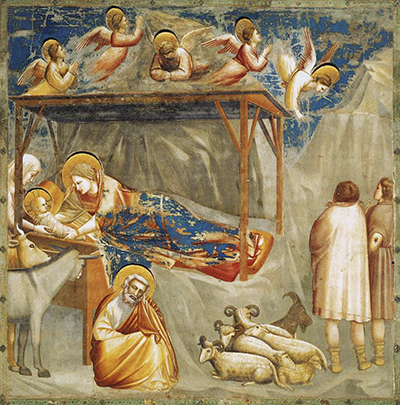
| Nativity — Scrovegni Chapel, Padua | c.1303–05 (chapel campaign) | Fresco / wall painting. Giotto and workshop. Scene within a cycle. Padova Musei. Chapel overview. |
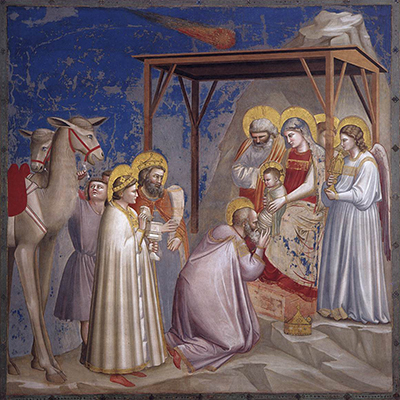
| Adoration of the Magi — Scrovegni Chapel, Padua | c.1303–05 (chapel campaign) | Fresco / wall painting. Giotto and workshop. Scene within a cycle. Padova Musei. Chapel overview. |
| Presentation of Christ at the Temple — Scrovegni Chapel, Padua | c.1303–05 (chapel campaign) | Fresco / wall painting. Giotto and workshop. Scene within a cycle. Padova Musei. Chapel overview. |
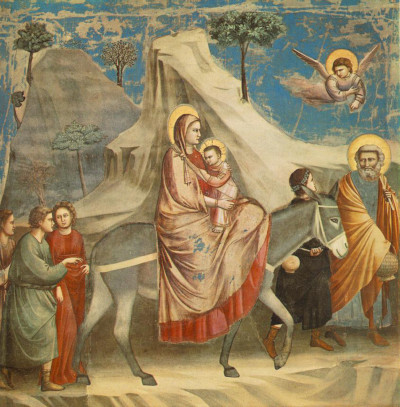
| Flight into Egypt — Scrovegni Chapel, Padua | c.1303–05 (chapel campaign) | Fresco / wall painting. Giotto and workshop. Scene within a cycle. Padova Musei. Chapel overview. |
| Massacre of the Innocents — Scrovegni Chapel, Padua | c.1303–05 (chapel campaign) | Fresco / wall painting. Giotto and workshop. Scene within a cycle. Padova Musei. Chapel overview. |
| Christ among the Doctors — Scrovegni Chapel, Padua | c.1303–05 (chapel campaign) | Fresco / wall painting. Giotto and workshop. Scene within a cycle. Padova Musei. Chapel overview. |
| Baptism of Christ — Scrovegni Chapel, Padua | c.1303–05 (chapel campaign) | Fresco / wall painting. Giotto and workshop. Scene within a cycle. Padova Musei. Chapel overview. |
| Marriage at Cana — Scrovegni Chapel, Padua | c.1303–05 (chapel campaign) | Fresco / wall painting. Giotto and workshop. Scene within a cycle. Padova Musei. Padova Musei. Chapel overview. |
| Raising of Lazarus — Scrovegni Chapel, Padua | c.1303–05 (chapel campaign) | Fresco / wall painting. Giotto and workshop. Scene within a cycle. Padova Musei. Chapel overview. |
| Entry into Jerusalem — Scrovegni Chapel, Padua | c.1303–05 (chapel campaign) | Fresco / wall painting. Giotto and workshop. Scene within a cycle. Padova Musei. Chapel overview. |
| Expulsion of the Money Changers — Scrovegni Chapel, Padua | c.1303–05 (chapel campaign) | Fresco / wall painting. Giotto and workshop. Scene within a cycle. Padova Musei. Padova Musei. Chapel overview. |
| Judas Receiving the Payment — Scrovegni Chapel, Padua | c.1303–05 (chapel campaign) | Fresco / wall painting. Giotto and workshop. Scene within a cycle. Padova Musei. Chapel overview. |
| Last Supper — Scrovegni Chapel, Padua | c.1303–05 (chapel campaign) | Fresco / wall painting. Giotto and workshop. Scene within a cycle. Padova Musei. Chapel overview. |
| Washing of the Feet — Scrovegni Chapel, Padua | c.1303–05 (chapel campaign) | Fresco / wall painting. Giotto and workshop. Scene within a cycle. Padova Musei. Chapel overview. |
| Arrest of Christ — Scrovegni Chapel, Padua | c.1303–05 (chapel campaign) | Fresco / wall painting. Giotto and workshop. Scene within a cycle. Padova Musei. Chapel overview. |
| Christ before Annas and Caiaphas — Scrovegni Chapel, Padua | c.1303–05 (chapel campaign) | Fresco / wall painting. Giotto and workshop. Scene within a cycle. Padova Musei. Chapel overview. |
| Mocking of Christ and Flagellation — Scrovegni Chapel, Padua | c.1303–05 (chapel campaign) | Fresco / wall painting. Giotto and workshop. Scene within a cycle. Padova Musei. Chapel overview. |
| Road to Calvary — Scrovegni Chapel, Padua | c.1303–05 (chapel campaign) | Fresco / wall painting. Giotto and workshop. Scene within a cycle. Padova Musei. Chapel overview. |
| Crucifixion — Scrovegni Chapel, Padua | c.1303–05 (chapel campaign) | Fresco / wall painting. Giotto and workshop. Scene within a cycle. Padova Musei. Chapel overview. |
| Lamentation — Scrovegni Chapel, Padua | c.1303–05 (chapel campaign) | Fresco / wall painting. Giotto and workshop. Scene within a cycle. Padova Musei. Chapel overview. |
| Resurrection / Noli me tangere — Scrovegni Chapel, Padua | c.1303–05 (chapel campaign) | Fresco / wall painting. Giotto and workshop. Scene within a cycle. Padova Musei. Chapel overview. |
| Ascension — Scrovegni Chapel, Padua | c.1303–05 (chapel campaign) | Fresco / wall painting. Giotto and workshop. Scene within a cycle. Padova Musei. Chapel overview. |
| Pentecost — Scrovegni Chapel, Padua | c.1303–05 (chapel campaign) | Fresco / wall painting. Giotto and workshop. Scene within a cycle. Padova Musei. Padova Musei. Chapel overview. |
| Coretto — right painted recess (Scrovegni Chapel, Padua) | c.1303–05 (chapel campaign) | Fresco / painted fictive architecture. Giotto and workshop. Ensemble component. Padova Musei. Padova Musei. Scholarly study. Chapel overview. |
| Coretto — left painted recess (Scrovegni Chapel, Padua) | c.1303–05 (chapel campaign) | Fresco / painted fictive architecture. Giotto and workshop. Ensemble component. Padova Musei. Padova Musei. Scholarly study. Chapel overview. |
| Envy — Scrovegni Chapel, Padua | c.1303–05 (chapel campaign) | Grisaille fresco / wall painting. Giotto and workshop. Ensemble component. Padova Musei. Chapel overview. Scholarly study. Padova Musei. |
| Despair — Scrovegni Chapel, Padua | c.1303–05 (chapel campaign) | Grisaille fresco / wall painting. Giotto and workshop. Ensemble component. Padova Musei. Chapel overview. Scholarly study. Padova Musei. |
| Prudence — Scrovegni Chapel, Padua | c.1303–05 (chapel campaign) | Grisaille fresco / wall painting. Giotto and workshop. Ensemble component. Padova Musei. Chapel overview. Scholarly study. Padova Musei. |
| Fortitude — Scrovegni Chapel, Padua | c.1303–05 (chapel campaign) | Grisaille fresco / wall painting. Giotto and workshop. Ensemble component. Padova Musei. Chapel overview. Scholarly study. Padova Musei. |
| Temperance — Scrovegni Chapel, Padua | c.1303–05 (chapel campaign) | Grisaille fresco / wall painting. Giotto and workshop. Ensemble component. Padova Musei. Chapel overview. Scholarly study. Padova Musei. |
| Justice — Scrovegni Chapel, Padua | c.1303–05 (chapel campaign) | Grisaille fresco / wall painting. Giotto and workshop. Ensemble component. Padova Musei. Chapel overview. Scholarly study. Padova Musei. |
| Faith — Scrovegni Chapel, Padua | c.1303–05 (chapel campaign) | Grisaille fresco / wall painting. Giotto and workshop. Ensemble component. Padova Musei. Chapel overview. Scholarly study. Padova Musei. |
| Charity — Scrovegni Chapel, Padua | c.1303–05 (chapel campaign) | Grisaille fresco / wall painting. Giotto and workshop. Ensemble component. Padova Musei. Chapel overview. Scholarly study. Padova Musei. |
| Hope — Scrovegni Chapel, Padua | c.1303–05 (chapel campaign) | Grisaille fresco / wall painting. Giotto and workshop. Ensemble component. Padova Musei. Chapel overview. Scholarly study. Padova Musei. |
| Folly — Scrovegni Chapel, Padua | c.1303–05 (chapel campaign) | Grisaille fresco / wall painting. Giotto and workshop. Ensemble component. Padova Musei. Chapel overview. Scholarly study. Padova Musei. |
| Inconstancy — Scrovegni Chapel, Padua | c.1303–05 (chapel campaign) | Grisaille fresco / wall painting. Giotto and workshop. Ensemble component. Padova Musei. Chapel overview. Scholarly study. Padova Musei. |
| Wrath — Scrovegni Chapel, Padua | c.1303–05 (chapel campaign) | Grisaille fresco / wall painting. Giotto and workshop. Ensemble component. Padova Musei. Chapel overview. Scholarly study. Padova Musei. |
| Injustice — Scrovegni Chapel, Padua | c.1303–05 (chapel campaign) | Grisaille fresco / wall painting. Giotto and workshop. Ensemble component. Padova Musei. Chapel overview. Scholarly study. Padova Musei. |
| Infidelity / Idolatry — Scrovegni Chapel, Padua | c.1303–05 (chapel campaign) | Grisaille fresco / wall painting. Giotto and workshop. Ensemble component. Padova Musei. Chapel overview. Scholarly study. Padova Musei. |
| Starry vault — complete ensemble (Scrovegni Chapel, Padua) | c.1303–05 (chapel campaign) | Vault painting. Giotto and workshop. Ensemble. Padova Musei. Padova Musei. Chapel overview. |
| Last Judgement — Scrovegni Chapel, Padua | c.1303–05 (chapel campaign) | Fresco / wall painting. Giotto and workshop. Scene within a cycle. Padova Musei. Padova Musei. Chapel overview. Padova Musei. |
| Prophet Malachi — vault medallion — Scrovegni Chapel, Padua | c.1303–05 (chapel campaign) | Fresco / wall painting. Giotto and workshop. Ensemble component. Padova Musei. Padova Musei. Chapel overview. Padova Musei. |
| Prophet Baruch — vault medallion — Scrovegni Chapel, Padua | c.1303–05 (chapel campaign) | Fresco / wall painting. Giotto and workshop. Ensemble component. Padova Musei. Padova Musei. Chapel overview. Padova Musei. |
| Prophet Isaiah — vault medallion — Scrovegni Chapel, Padua | c.1303–05 (chapel campaign) | Fresco / wall painting. Giotto and workshop. Ensemble component. Padova Musei. Padova Musei. Chapel overview. Padova Musei. |
| Prophet Daniel — vault medallion — Scrovegni Chapel, Padua | c.1303–05 (chapel campaign) | Fresco / wall painting. Giotto and workshop. Ensemble component. Padova Musei. Padova Musei. Chapel overview. Padova Musei. |
| Christ Pantocrator — vault medallion — Scrovegni Chapel, Padua | c.1303–05 (chapel campaign) | Fresco / wall painting. Giotto and workshop. Ensemble component. Padova Musei. Padova Musei. Chapel overview. Padova Musei. |
| Virgin and Child — vault medallion — Scrovegni Chapel, Padua | c.1303–05 (chapel campaign) | Fresco / wall painting. Giotto and workshop. Ensemble component. Padova Musei. Padova Musei. Chapel overview. Padova Musei. |
| Prophet Ezekiel — vault medallion — Scrovegni Chapel, Padua | c.1303–05 (chapel campaign) | Fresco / wall painting. Giotto and workshop. Ensemble component. Padova Musei. Padova Musei. Chapel overview. Padova Musei. |
| Prophet Micah — vault medallion — Scrovegni Chapel, Padua | c.1303–05 (chapel campaign) | Fresco / wall painting. Giotto and workshop. Ensemble component. Padova Musei. Padova Musei. Chapel overview. Padova Musei. |
| Saint John the Baptist — vault medallion — Scrovegni Chapel, Padua | c.1303–05 (chapel campaign) | Fresco / wall painting. Giotto and workshop. Ensemble component. Padova Musei. Padova Musei. Chapel overview. Padova Musei. |
| Scrovegni Chapel — painted decoration | c.1303–05 (chapel campaign) | Fresco / wall painting, with a painted wooden panel. Giotto and workshop (painted decoration). Ensemble. Includes separately listed scenes and components. The original central God the Father panel is in the Musei Civici agli Eremitani; a conservation copy is in the chapel. Chapel overview. Padova Musei. Padova Musei. Source. Source. Source. Padova Musei. Scholarly study. |
| Vices and Virtues — complete fourteen-figure programme | c.1303–05 (chapel campaign) | Grisaille fresco / wall painting. Giotto and workshop. Ensemble. Fourteen figures: seven virtues and seven opposed vices. Padova Musei. Chapel overview. Scholarly study. |
| Coretti — paired fictive chapels | c.1303–05 (chapel campaign) | Fresco / painted fictive architecture. Giotto and workshop. Ensemble. Two separate painted recesses, also listed individually. Padova Musei. Padova Musei. Scholarly study. |
| Mission of Gabriel — heavenly assembly | c.1303–05 (chapel campaign) | Wall painting with central painted wooden image. Giotto and workshop. Ensemble component. Central wooden God the Father panel preserved at the Musei Civici agli Eremitani; conservation copy in the chapel. Chapel overview. Padova Musei. Scholarly study. Padova Musei. |
| Annunciation — Gabriel and Mary in facing chambers | c.1303–05 (chapel campaign) | Fresco / wall painting. Giotto and workshop. Ensemble component. Chapel overview. Scholarly study. Padova Musei. |
| God the Father — central wooden panel of the Mission of Gabriel | c.1303–05 (chapel campaign) | Painting on wood. Associated with Giotto. Ensemble component. Original at the Musei Civici agli Eremitani, Padua; conservation copy in the Scrovegni Chapel. Padova Musei. Padova Musei. Scholarly study. Source. |
| Life of Saint Francis — Upper Church cycle, Assisi | Late 13th–early 14th century; dating disputed | Fresco / wall-painting cycle. Traditionally associated with Giotto; Giotto, Roman-school and other attributions disputed. Ensemble. Twenty-eight-scene nave cycle; scenes also listed individually. Basilica catalogue. Scholarly study. Basilica catalogue. Source. Source. |
| Homage of a Simple Man — Upper Church, Assisi | Late 13th–early 14th century; dating disputed | Wall painting. Traditionally associated with Giotto; authorship and dating disputed. Scene within a cycle. Source. Scholarly study. Source. Source. Source. |
| Gift of the Mantle — Upper Church, Assisi | Late 13th–early 14th century; dating disputed | Wall painting. Traditionally associated with Giotto; authorship and dating disputed. Scene within a cycle. Basilica catalogue. Scholarly study. Source. Source. Source. |
| Dream of the Palace Full of Arms — Upper Church, Assisi | Late 13th–early 14th century; dating disputed | Wall painting. Traditionally associated with Giotto; authorship and dating disputed. Scene within a cycle. Basilica catalogue. Source. Scholarly study. Source. Source. Source. |
| Prayer before the Crucifix at San Damiano — Upper Church, Assisi | Late 13th–early 14th century; dating disputed | Wall painting. Traditionally associated with Giotto; authorship and dating disputed. Scene within a cycle. Source. Source. Source. Scholarly study. Source. Source. |
| Renunciation of Worldly Goods — Upper Church, Assisi | Late 13th–early 14th century; dating disputed | Wall painting. Traditionally associated with Giotto; authorship and dating disputed. Scene within a cycle. Source. Scholarly study. Source. Source. |
| Dream of Innocent III — Upper Church, Assisi | Late 13th–early 14th century; dating disputed | Wall painting. Traditionally associated with Giotto; authorship and dating disputed. Scene within a cycle. Source. Source. Scholarly study. Source. Source. |
| Confirmation of the Rule — Upper Church, Assisi | Late 13th–early 14th century; dating disputed | Wall painting. Traditionally associated with Giotto; authorship and dating disputed. Scene within a cycle. Source. Scholarly study. Source. Source. |
| Vision of the Flaming Chariot — Upper Church, Assisi | Late 13th–early 14th century; dating disputed | Wall painting. Traditionally associated with Giotto; authorship and dating disputed. Scene within a cycle. Source. Source. Scholarly study. Source. Source. |
| Vision of the Thrones — Upper Church, Assisi | Late 13th–early 14th century; dating disputed | Wall painting. Traditionally associated with Giotto; authorship and dating disputed. Scene within a cycle. Basilica catalogue. Scholarly study. Source. Source. Source. |
| Expulsion of Devils from Arezzo — Upper Church, Assisi | Late 13th–early 14th century; dating disputed | Wall painting. Traditionally associated with Giotto; authorship and dating disputed. Scene within a cycle. Source. Source. Scholarly study. Source. Source. Source. |
| Trial by Fire before the Sultan — Upper Church, Assisi | Late 13th–early 14th century; dating disputed | Wall painting. Traditionally associated with Giotto; authorship and dating disputed. Scene within a cycle. Source. Source. Scholarly study. Source. Source. |
| Ecstasy of Saint Francis — Upper Church, Assisi | Late 13th–early 14th century; dating disputed | Wall painting. Traditionally associated with Giotto; authorship and dating disputed. Scene within a cycle. Source. Source. Source. Scholarly study. Source. Source. |
| Nativity at Greccio — Upper Church, Assisi | Late 13th–early 14th century; dating disputed | Wall painting. Traditionally associated with Giotto; authorship and dating disputed. Scene within a cycle. Basilica catalogue. Scholarly study. Source. Source. Source. |
| Miracle of the Spring — Upper Church, Assisi | Late 13th–early 14th century; dating disputed | Wall painting. Traditionally associated with Giotto; authorship and dating disputed. Scene within a cycle. Source. Scholarly study. Source. Source. Source. |
| Sermon to the Birds — Upper Church, Assisi | Late 13th–early 14th century; dating disputed | Wall painting. Traditionally associated with Giotto; authorship and dating disputed. Scene within a cycle. Basilica catalogue. Scholarly study. Source. Source. Source. |
| Death of the Knight of Celano — Upper Church, Assisi | Late 13th–early 14th century; dating disputed | Wall painting. Traditionally associated with Giotto; authorship and dating disputed. Scene within a cycle. Source. Source. Scholarly study. Source. Source. |
| Sermon before Pope Honorius III — Upper Church, Assisi | Late 13th–early 14th century; dating disputed | Wall painting. Traditionally associated with Giotto; authorship and dating disputed. Scene within a cycle. Source. Source. Scholarly study. Source. |
| Apparition at the Chapter of Arles — Upper Church, Assisi | Late 13th–early 14th century; dating disputed | Wall painting. Traditionally associated with Giotto; authorship and dating disputed. Scene within a cycle. Basilica catalogue. Scholarly study. Source. Source. Source. |
| Stigmatisation — Upper Church, Assisi | Late 13th–early 14th century; dating disputed | Wall painting. Traditionally associated with Giotto; authorship and dating disputed. Scene within a cycle. Source. Scholarly study. Source. Source. |
| Death and Ascension of Saint Francis — Upper Church, Assisi | Late 13th–early 14th century; dating disputed | Wall painting. Traditionally associated with Giotto; authorship and dating disputed. Scene within a cycle. Basilica catalogue. Scholarly study. Source. Source. Source. |
| Apparition to Brother Augustine and Bishop Guido — Upper Church, Assisi | Late 13th–early 14th century; dating disputed | Wall painting. Traditionally associated with Giotto; authorship and dating disputed. Scene within a cycle. Zeri catalogue. Scholarly study. Source. Source. Source. |
| Verification of the Stigmata — Upper Church, Assisi | Late 13th–early 14th century; dating disputed | Wall painting. Traditionally associated with Giotto; authorship and dating disputed. Scene within a cycle. Source. Source. Scholarly study. Source. Source. |
| Mourning of the Poor Clares — Upper Church, Assisi | Late 13th–early 14th century; dating disputed | Wall painting. Traditionally associated with Giotto; authorship and dating disputed. Scene within a cycle. Basilica catalogue. Source. Scholarly study. Source. Source. |
| Canonisation of Saint Francis — Upper Church, Assisi | Late 13th–early 14th century; dating disputed | Wall painting. Traditionally associated with Giotto; authorship and dating disputed. Scene within a cycle. Source. Source. Scholarly study. Source. Source. Source. |
| Apparition to Pope Gregory IX — Upper Church, Assisi | Late 13th–early 14th century; dating disputed | Wall painting. Traditionally associated with Giotto; authorship and dating disputed. Scene within a cycle. Zeri catalogue. Scholarly study. Source. Source. Source. |
| Healing of John of Lerida — Upper Church, Assisi | Late 13th–early 14th century; dating disputed | Wall painting. Traditionally associated with Giotto; authorship and dating disputed. Scene within a cycle. Source. Source. Scholarly study. Source. Source. |
| Resurrection of a Woman — Upper Church, Assisi | Late 13th–early 14th century; dating disputed | Wall painting. Traditionally associated with Giotto; authorship and dating disputed. Scene within a cycle. Source. Scholarly study. Source. Source. Source. |
| Liberation of the Prisoner Peter — Upper Church, Assisi | Late 13th–early 14th century; dating disputed | Wall painting. Traditionally associated with Giotto; authorship and dating disputed. Scene within a cycle. Source. Source. Scholarly study. Source. Source. Source. |
| Santa Maria Novella Crucifix | Late 13th century; c.1288–89 or 1298–1301; disputed | Tempera and gold on a shaped wooden cross. Giotto. Source. |
| Death of the Virgin / Dormition — Berlin | c.1310 | Tempera and gold on poplar; gabled dossal. Giotto. Source. Source. |
| Peruzzi Altarpiece | c.1311–1315 (North Carolina Museum of Art) | Tempera and gold on panel. Giotto and workshop. Ensemble. Source. |
| Bologna Polyptych | c.1330 | Tempera and gold on panel. Giotto and workshop. Ensemble. Source. |
| Death of Saint Francis, Bardi Chapel | After 1317, usually the 1320s; disputed | Wall painting with wet-plaster and dry-applied passages. Giotto. Scene within a cycle. Source. |
| Bardi Chapel — painted decoration | After 1317, usually the 1320s; disputed | Wall painting with wet-plaster and dry-applied passages. Giotto and workshop / Giottesque painters; individual hands disputed. Ensemble. Scholarly study. Source. |
| Badia Polyptych | c.1300; proposed dates include 1295–1300 and 1301–02 | Tempera and gold on panel; five cusped compartments. Giotto. Ensemble. Scholarly study. Source. Source. |
| Baroncelli Polyptych | After 1328; detached pinnacle c.1328–35 | Tempera and gold on panel; later altered framing. Giotto and workshop. Ensemble. Detached central pinnacle in San Diego. Santa Croce. |
| Adoration of the Magi / Epiphany — Metropolitan Museum panel | Possibly c.1320; c.1310–18 also proposed for the group | Tempera and gold on wood. Giotto. Part of the dispersed seven-scene board; original function disputed. Met catalogue. Source. |
| Franciscan Allegories | Early 14th century, often c.1315; disputed | Vault wall painting. Giotto and workshop / Giottesque painters; individual hands disputed. Ensemble. Basilica catalogue. |
| Navicella — lost / reworked original mosaic | Late 13th–early 14th century; date disputed | Mosaic. Original attributed to Giotto. Original lost / reworked; fragments and later remakes survive. Scholarly study. |
| Pentecost — London panel | Possibly c.1310–18 (Gordon) | Egg tempera on poplar. Giotto and workshop. Part of the dispersed seven-scene board; original function disputed. National Gallery. Source. |
| Saint Stephen — Horne panel | c.1330–1335 (Museo Horne) | Tempera and gold on panel. Giotto. Proposed association with the Washington and Chaalis panels remains hypothetical. Source. |
| Saint Francis Receiving the Stigmata — Louvre altarpiece | 1300–25 (Louvre) | Tempera and gold on poplar. Giotto. Louvre catalogue. |
| Stefaneschi Triptych | c.1320; 1315–20 (Vatican Museums) | Tempera and gold on panel; painted on both sides. Giotto and workshop. Ensemble. Vatican Museums. |
| Crucifixion, Berlin | c.1315–1320 | Tempera and gold on poplar. Giotto. Source. |
| Madonna and Child — Washington / Goldman Madonna | c.1310–1315 (National Gallery of Art) | Tempera and gold on poplar. Giotto. Washington panel, distinct from San Giorgio alla Costa; proposed Horne/Chaalis companions remain hypothetical. NGA catalogue. |
| Ognissanti Madonna | c.1300–05 (Uffizi); c.1310 also proposed | Tempera and gold on panel. Giotto. Uffizi. |
| Madonna of Borgo San Lorenzo | c.1290–95; dating and attribution debated | Tempera and gold on a fragment of a wooden panel. Giotto. Fragmentary. Source. |
| Madonna of San Giorgio alla Costa | c.1288–95 (Opera del Duomo); later dates also proposed | Tempera and gold on panel; cut edges. Giotto. Damaged in 1993 and treated in 1995. Source. |
| Magdalene Chapel — painted decoration | c.1307–08 (basilica); disputed | Wall painting with wet-plaster and dry-applied passages. Giotto and workshop / Giottesque painters; individual hands disputed. Ensemble. Basilica catalogue. |
| Ognissanti Crucifix | c.1315–1320 (Opificio) | Painting on a shaped wooden cross. Giotto and workshop. Workshop participation and alternative attributions debated. Source. |
| Padua Crucifix | c.1303–05 (Zeri catalogue) | Tempera and gold on a shaped wooden cross. Giotto. Zeri catalogue. |
| Peruzzi Chapel — painted decoration | c.1310–11 (Santa Croce); 1334–36 proposed by Schwarz | Wall painting with substantial dry-applied work and loss. Giotto and workshop / Giottesque painters; individual hands disputed. Ensemble. Santa Croce. |
| Rimini Crucifix | c.1300; late 13th century also proposed | Tempera and gold on a shaped wooden cross. Giotto. Source. |
| Giotto’s Campanile — Florence Cathedral bell tower | Begun 1334; completed 1359 under successors | Marble-clad masonry bell tower. Begun under Giotto; continued by Andrea Pisano and Francesco Talenti. Successive building and sculptural campaigns. Source. Scholarly study. Scholarly study. |
| Tower elevation on parchment, Siena — disputed relation to Giotto | 14th century; date and design context disputed | Brown ink and coloured washes over incised construction on three parchment skins. Attribution disputed; possibly a Giotto design transmitted through another hand. Associated design; autograph attribution unestablished. Alternative attributions include Lando di Pietro. Scholarly study. Source. Source. |
| Seven scenes of Christ — dispersed painted board | Possibly c.1310–18 (Gordon); component dates vary | Tempera and gold on a single wooden board, subsequently divided. Giotto and workshop; individual attributions vary. Reconstructed dispersed ensemble. Common board supported by matching wood grain; predella or dossal function disputed. Source. Source. |
| Presentation of Christ at the Temple — Boston panel | Possibly c.1310–18 (Gordon’s group dating) | Tempera and gold on wood. Giotto and workshop; individual attribution varies within the group. Ensemble component. Source. Source. |
| Last Supper — Munich panel | Possibly c.1310–18 (Gordon’s group dating) | Tempera and gold on wood. Giotto and workshop; individual attribution varies within the group. Ensemble component. Source. Source. Source. |
| Crucifixion — Munich panel | Possibly c.1310–18 (Gordon’s group dating) | Tempera and gold on wood. Giotto and workshop; individual attribution varies within the group. Ensemble component. Source. Source. Source. |
| Descent into Limbo — Munich panel | Possibly c.1310–18 (Gordon’s group dating) | Tempera and gold on wood. Giotto and workshop; individual attribution varies within the group. Ensemble component. Source. Source. Source. |
| Entombment — Villa I Tatti panel | Possibly c.1310–18 (Gordon’s group dating) | Tempera and gold on wood. Giotto and workshop; individual attribution varies within the group. Ensemble component. Source. Source. |
| God the Father with Angels — detached Baroncelli pinnacle | c.1328–1335 (San Diego Museum of Art) | Tempera and gold on wood. Giotto and workshop. Ensemble component. Detached in later remodelling; collection home in San Diego. Source. Source. |
| Saint John the Evangelist — Chaalis panel | c.1320 (INHA/RETIF) | Painting on wood. Giotto (INHA/RETIF attribution). Collection: Musée Jacquemart-André, Fontaine-Chaalis. Chantilly’s exhibition announcement, as of 1 November 2026, gives temporary display from 24 January 2026 with no end date. Association with the Washington/Horne altarpiece remains hypothetical. NGA catalogue. Source. Source. Source. Source. |
| Saint Lawrence — Chaalis panel | c.1320 (INHA/RETIF) | Painting on poplar. Giotto; possible execution by a collaborator (INHA/RETIF). Collection: Musée Jacquemart-André, Fontaine-Chaalis. Chantilly’s exhibition announcement, as of 1 November 2026, gives temporary display from 24 January 2026 with no end date. Association with the Washington/Horne altarpiece remains hypothetical. NGA catalogue. Source. Source. Source. Source. |
| Allegory of Poverty — Lower Church crossing vault, Assisi | Early 14th century, often c.1315; disputed | Vault wall painting. Giotto’s workshop / Giottesque painters; alternatives include Stefano. Ensemble component. Basilica catalogue. Source. Scholarly study. |
| Allegory of Chastity — Lower Church crossing vault, Assisi | Early 14th century, often c.1315; disputed | Vault wall painting. Giotto’s workshop / Giottesque painters; alternatives include Stefano. Ensemble component. Basilica catalogue. Source. Scholarly study. |
| Allegory of Obedience — Lower Church crossing vault, Assisi | Early 14th century, often c.1315; disputed | Vault wall painting. Giotto’s workshop / Giottesque painters; alternatives include Stefano. Ensemble component. Basilica catalogue. Source. Scholarly study. |
| Saint Francis in Glory — Lower Church crossing vault, Assisi | Early 14th century, often c.1315; disputed | Vault wall painting. Giotto’s workshop / Giottesque painters; alternatives include Stefano. Ensemble component. Basilica catalogue. Source. Scholarly study. |
| Renunciation of Worldly Goods — Bardi Chapel, Florence | After 1317, usually the 1320s; disputed | Wall painting: fresco with extensive dry-applied passages. Giotto and workshop; individual hands uncertain. Scene within a cycle. Source. Santa Croce. Scholarly study. Source. |
| Confirmation of the Rule — Bardi Chapel, Florence | After 1317, usually the 1320s; disputed | Wall painting: fresco with extensive dry-applied passages. Giotto and workshop; individual hands uncertain. Scene within a cycle. Source. Santa Croce. Scholarly study. Source. |
| Apparition at the Chapter of Arles — Bardi Chapel, Florence | After 1317, usually the 1320s; disputed | Wall painting: fresco with extensive dry-applied passages. Giotto and workshop; individual hands uncertain. Scene within a cycle. Source. Santa Croce. Scholarly study. Source. |
| Trial by Fire before the Sultan — Bardi Chapel, Florence | After 1317, usually the 1320s; disputed | Wall painting: fresco with extensive dry-applied passages. Giotto and workshop; individual hands uncertain. Scene within a cycle. Source. Santa Croce. Scholarly study. Source. |
| Apparitions to Brother Augustine and Bishop Guido — Bardi Chapel, Florence | After 1317, usually the 1320s; disputed | Wall painting: fresco with extensive dry-applied passages. Giotto and workshop; individual hands uncertain. Scene within a cycle. Source. Santa Croce. Scholarly study. Source. |
| Saint Francis Receiving the Stigmata — Bardi Chapel, Florence | After 1317, usually the 1320s; disputed | Wall painting: fresco with extensive dry-applied passages. Giotto and workshop; individual hands uncertain. Scene within a cycle. Source. Santa Croce. Scholarly study. Source. |
| Saint Louis of Toulouse — Bardi Chapel niche | After 1317; campaign date disputed | Wall painting. Giotto and workshop. Ensemble component. Source. Scholarly study. |
| Saint Clare — Bardi Chapel niche | After 1317; campaign date disputed | Wall painting. Giotto and workshop. Ensemble component. Source. Scholarly study. |
| Saint Elizabeth of Hungary — Bardi Chapel niche | After 1317; campaign date disputed | Wall painting. Giotto and workshop. Ensemble component. Source. Scholarly study. |
| Franciscan virtues — Bardi Chapel vault programme | After 1317; campaign date disputed | Vault wall painting. Giotto and workshop. Group of ensemble components. Santa Croce. Source. |
| Annunciation to Zacharias — Peruzzi Chapel, Florence | c.1310–11 (Santa Croce); 1334–36 proposed by Schwarz | Wall painting with substantial dry-applied work. Giotto and workshop. Scene within a cycle. Santa Croce. Scholarly study. Santa Croce. |
| Birth and Naming of John the Baptist — Peruzzi Chapel, Florence | c.1310–11 (Santa Croce); 1334–36 proposed by Schwarz | Wall painting with substantial dry-applied work. Giotto and workshop. Scene within a cycle. Santa Croce. Scholarly study. Santa Croce. |
| Feast of Herod — Peruzzi Chapel, Florence | c.1310–11 (Santa Croce); 1334–36 proposed by Schwarz | Wall painting with substantial dry-applied work. Giotto and workshop. Scene within a cycle. Santa Croce. Scholarly study. Santa Croce. |
| Vision of John on Patmos — Peruzzi Chapel, Florence | c.1310–11 (Santa Croce); 1334–36 proposed by Schwarz | Wall painting with substantial dry-applied work. Giotto and workshop. Scene within a cycle. Santa Croce. Scholarly study. Santa Croce. |
| Raising of Drusiana — Peruzzi Chapel, Florence | c.1310–11 (Santa Croce); 1334–36 proposed by Schwarz | Wall painting with substantial dry-applied work. Giotto and workshop. Scene within a cycle. Santa Croce. Scholarly study. Santa Croce. |
| Death and Ascension of John the Evangelist — Peruzzi Chapel, Florence | c.1310–11 (Santa Croce); 1334–36 proposed by Schwarz | Wall painting with substantial dry-applied work. Giotto and workshop. Scene within a cycle. Santa Croce. Scholarly study. Santa Croce. |
| Evangelist symbols — Peruzzi Chapel vault | c.1310–11 (Santa Croce); 1334–36 proposed by Schwarz | Wall painting. Giotto and workshop. Group of ensemble components. Santa Croce. |
| Eight prophets — Peruzzi Chapel entrance arch | c.1310–11 (Santa Croce); 1334–36 proposed by Schwarz | Wall painting. Giotto and workshop. Group of ensemble components. Santa Croce. |
| Mystic Lamb — Peruzzi Chapel fragment | c.1310–11 (Santa Croce); 1334–36 proposed by Schwarz | Wall painting. Giotto and workshop. Ensemble component; fragmentary. Santa Croce. |
| Meal in the Pharisee’s House — Magdalene Chapel, Assisi | c.1307–08 (basilica); disputed | Fresco / wall painting. Giotto and workshop; individual hands debated. Scene within a cycle. Basilica catalogue. Scholarly study. |
| Raising of Lazarus — Magdalene Chapel, Assisi | c.1307–08 (basilica); disputed | Fresco / wall painting. Giotto and workshop; individual hands debated. Scene within a cycle. Basilica catalogue. Scholarly study. |
| Noli me tangere — Magdalene Chapel, Assisi | c.1307–08 (basilica); disputed | Fresco / wall painting. Giotto and workshop; individual hands debated. Scene within a cycle. Basilica catalogue. Scholarly study. |
| Miracle of the Ruler of Marseille — Magdalene Chapel, Assisi | c.1307–08 (basilica); disputed | Fresco / wall painting. Giotto and workshop; individual hands debated. Scene within a cycle. Basilica catalogue. Scholarly study. |
| Angelic Elevation of Mary Magdalene — Magdalene Chapel, Assisi | c.1307–08 (basilica); disputed | Fresco / wall painting. Giotto and workshop; individual hands debated. Scene within a cycle. Basilica catalogue. Scholarly study. |
| Mary Magdalene Clothed by a Hermit — Magdalene Chapel, Assisi | c.1307–08 (basilica); disputed | Fresco / wall painting. Giotto and workshop; individual hands debated. Scene within a cycle. Basilica catalogue. Scholarly study. |
| Last Communion and Ascent of the Magdalene’s Soul — Magdalene Chapel, Assisi | c.1307–08 (basilica); disputed | Fresco / wall painting. Giotto and workshop; individual hands debated. Scene within a cycle. Basilica catalogue. Scholarly study. |
| Christ — Magdalene Chapel vault medallion | c.1307–08 (basilica); disputed | Vault wall painting. Giotto and workshop. Ensemble component. Basilica catalogue. Scholarly study. |
| Mary Magdalene — Magdalene Chapel vault medallion | c.1307–08 (basilica); disputed | Vault wall painting. Giotto and workshop. Ensemble component. Basilica catalogue. Scholarly study. |
| Martha — Magdalene Chapel vault medallion | c.1307–08 (basilica); disputed | Vault wall painting. Giotto and workshop. Ensemble component. Basilica catalogue. Scholarly study. |
| Lazarus — Magdalene Chapel vault medallion | c.1307–08 (basilica); disputed | Vault wall painting. Giotto and workshop. Ensemble component. Basilica catalogue. Scholarly study. |
| Teobaldo Pontano before Saint Rufinus — Magdalene Chapel donor image | c.1307–08 (chapel campaign) | Wall painting. Giotto and workshop; donor identified by Schwarz. Ensemble component. Scholarly study. |
| Teobaldo Pontano before Mary Magdalene — Magdalene Chapel donor image | c.1307–08 (chapel campaign) | Wall painting. Giotto and workshop; donor identified by Schwarz. Ensemble component. Scholarly study. |
| Penitential saints — Magdalene Chapel entrance programme | Early 14th century; associated with the c.1307–08 campaign | Wall painting. Giotto and workshop / associated chapel programme. Group of ensemble components. Scholarly study. |
| Life of Mary Magdalene — stained-glass window | Early 14th century; exact date uncertain | Stained glass. Associated chapel programme; designer and maker uncertain. Associated programme. Eleven-episode stained-glass window, distinct from the wall paintings. Basilica catalogue. Scholarly study. |
| Childhood of Christ and Franciscan miracles — Lower Church north transept | Early 14th century, often c.1315; disputed | Fresco / wall painting. Giotto and workshop; Stefano proposed by Schwarz; individual hands disputed. Ensemble. Basilica catalogue. Scholarly study. Source. |
| Flight into Egypt — Lower Church north transept, Assisi | Early 14th century; c.1308–11 (Zeri); disputed | Fresco / wall painting. Giotto’s workshop / Giottesque painters; Stefano proposed by Schwarz. Scene within a cycle. Basilica catalogue. Scholarly study. Source. Zeri catalogue. |
| Adoration of the Magi — Lower Church north transept, Assisi | Early 14th century; c.1308–11 (Zeri); disputed | Fresco / wall painting. Giotto’s workshop / Giottesque painters; Stefano proposed by Schwarz. Scene within a cycle. Basilica catalogue. Scholarly study. Source. Zeri catalogue. |
| Angel medallion from the Navicella — Vatican | Late 13th–early 14th-century original; later restoration | Mosaic. Associated with Giotto’s Navicella; medieval material and later restoration. Fragmentary and restored. Scholarly study. |
| Angel medallion from the Navicella — Boville Ernica | Late 13th–early 14th-century original; later restoration | Mosaic. Associated with Giotto’s Navicella; medieval material and later restoration. Fragmentary and restored. Scholarly study. |
| Dream of Innocent III — Louvre Stigmatisation predella | 1300–25 (Louvre’s dating of the altarpiece) | Tempera and gold on wood. Part of the signed Giotto altarpiece; individual hand uncertain. Ensemble component. Louvre catalogue. Louvre catalogue. |
| Approval of the Rule — Louvre Stigmatisation predella | 1300–25 (Louvre’s dating of the altarpiece) | Tempera and gold on wood. Part of the signed Giotto altarpiece; individual hand uncertain. Ensemble component. Louvre catalogue. Louvre catalogue. |
| Saint Francis Preaching to the Birds — Louvre Stigmatisation predella | 1300–25 (Louvre’s dating of the altarpiece) | Tempera and gold on wood. Part of the signed Giotto altarpiece; individual hand uncertain. Ensemble component. Louvre catalogue. Louvre catalogue. |
| Possible wall decoration at San Francesco, Rimini — lost | c.1300; exact date uncertain | Possibly fresco / wall painting. Possible association with Giotto. Possible lost commission. Programme and extent unknown. Source. Scholarly study. |
| Works at the Basilica of Saint Anthony, Padua — reported, lost | By c.1313 (reported activity); exact date unknown | Painting; wall or panel support uncertain. Giotto’s activity reported by Riccobaldo. Lost works reported in historical accounts. Scholarly study. Scholarly study. |
| Painted heaven / celestial decoration, Palazzo della Ragione — lost | Early 14th century (Giovanni da Nono’s account) | Painting; wooden-vault tempera or wall fresco disputed. Associated with Giotto in historical accounts. Lost. Wooden-vault interpretation proposed by Schwarz; present astrological murals follow the 1420 fire. Scholarly study. |
| Great chapel decoration, Castel Nuovo — disputed / largely lost | Documented 20 May 1331; Neapolitan service 1328–33 | Wall painting with metal decoration and mixed materials. Giotto-led documented commission. Largely lost; attribution of fragments disputed. Other masters participated; surviving window fragments leave the programme uncertain. Scholarly study. Source. |
| Private chapel decoration, Castel Nuovo — documented, lost | Documented 20 May 1331; execution dates unknown | Wall painting / chapel decoration; technique uncertain. Giotto. Documented commission; lost. Separate from the great chapel; programme unknown. Scholarly study. |
| Royal cona made in Giotto’s house, Naples — documented, lost | Recorded 20 May 1331 | Panel painting (cona); exact technique uncertain. Documented in Giotto’s house. Documented object; lost. Movable panel; subject, dimensions and composition unknown. Scholarly study. |
| Calvary and Lamentation / decoration — Santa Chiara, disputed fragments | Late 1320s–early 1330s; exact date uncertain | Wall painting and painted architectural furnishings. Associated with Giotto and collaborators; individual attributions disputed. Fragmentary programme. Extent of surviving decoration disputed. Source. Scholarly study. |
| Apocalypse paintings, Naples — reported, lost | Undated; associated in later accounts with Naples | Painting; support unknown. Attributed to Giotto in later accounts. Lost works reported in historical accounts. Programme uncertain. Source. Scholarly study. |
| Gloria mondana / Worldly Glory — disputed identification | Undated; proposed Milanese context disputed | Painting; support and format unknown. Association with Giotto and identity disputed. Lost; identity and location disputed. Scholarly study. Source. Scholarly study. |
| Marian cycle, Tosinghi-Spinelli Chapel — lost interior | Undated; reported by Ghiberti and Vasari | Wall painting. Attributed to Giotto by Ghiberti and Vasari. Lost cycle reported in historical accounts. Interior cycle distinct from the damaged entrance Assumption. Scholarly study. Scholarly study. |
| Assumption of the Virgin — Tosinghi-Spinelli entrance, badly preserved | Undated; associated with the Santa Croce decoration | Wall painting. Associated with Giotto in scholarship; attribution uncertain. Badly preserved trace reported in scholarship. Trace distinguished from the lost interior cycle by Schwarz and Theis. Scholarly study. Scholarly study. |
| Apostolic histories, Giugni Chapel — reported, lost | Undated; described by Vasari | Wall painting. Attributed to Giotto by Vasari. Lost cycle reported in historical accounts. Scholarly study. |
| Life of John the Baptist, Santa Maria del Carmine — reported, lost | Undated; attributed by Vasari | Wall painting. Attributed to Giotto by Vasari. Lost cycle reported in historical accounts. Scholarly study. |
| Marian wall decoration — Badia Fiorentina, disputed fragments | Undated; attribution disputed | Wall painting. Association with Giotto disputed. Fragmentary programme. Separate from the Badia Polyptych. Source. Scholarly study. |
| Allegory of the Commune Being Robbed — reported, lost | Undated; reported by Ghiberti | Wall painting / civic allegory. Attributed to Giotto by Ghiberti. Lost work reported in historical accounts. Composition uncertain. Scholarly study. Source. |
| Chapel decoration, Castello di Galliera, Bologna — reported, lost | Before 1334; chapel traces reported in 1560 | Wall painting. Associated with Giotto in historical accounts. Lost cycle reported in historical accounts. The chapel survived the fortress’s 1334 demolition; traces reported in 1560; date of final loss unknown. Scholarly study. Source. |
| Crucifixion — Lower Church north transept, Assisi | Early 14th century; c.1308–11 (Zeri); disputed | Fresco / wall painting. Giotto’s workshop (Zeri); alternative attributions disputed. Scene within a cycle. Zeri catalogue. |
| Young Man of Sessa Recovered from the Ruins — Lower Church north transept, Assisi | Early 14th century; c.1308–11 (Zeri); disputed | Fresco / wall painting. Giotto’s workshop (Zeri); alternative attributions disputed. Scene within a cycle. Separate scene from the Resurrection of the Young Man of Sessa. Zeri catalogue. Source. |
| Saint Francis Revives a Child Fallen from a Palace Window — Lower Church north transept, Assisi | Early 14th century; c.1308–11 (Zeri); disputed | Fresco / wall painting. Giotto’s workshop (Zeri); alternative attributions disputed. Scene within a cycle. Revival in Zeri’s title; the child’s identity and alternative harmless-fall interpretation remain disputed. Zeri catalogue. |
| Resurrection of the Young Man of Sessa — Lower Church north transept, Assisi | Early 14th century; c.1308–11 (Zeri); disputed | Fresco / wall painting. Giotto’s workshop (Zeri); alternative attributions disputed. Scene within a cycle. Separate scene from the Recovery of the Young Man of Sessa from the Ruins. Zeri catalogue. Source. |
| Saint Francis with Death — Lower Church north transept, Assisi | Early 14th century; c.1308–11 (Zeri); disputed | Fresco / wall painting. Giotto’s workshop (Zeri); alternative attributions disputed. Ensemble component. Zeri catalogue. |
| Visitation — Lower Church north transept, Assisi | Early 14th century; c.1308–11 (Zeri); disputed | Fresco / wall painting. Giotto’s workshop (Zeri); alternative attributions disputed. Scene within a cycle. Zeri catalogue. |
| Nativity — Lower Church north transept, Assisi | Early 14th century; c.1308–11 (Zeri); disputed | Fresco / wall painting. Giotto’s workshop (Zeri); alternative attributions disputed. Scene within a cycle. Zeri catalogue. |
| Presentation of Christ at the Temple — Lower Church north transept, Assisi | Early 14th century; c.1308–11 (Zeri); disputed | Fresco / wall painting. Giotto’s workshop (Zeri); alternative attributions disputed. Scene within a cycle. Zeri catalogue. |
| Massacre of the Innocents — Lower Church north transept, Assisi | Early 14th century; c.1308–11 (Zeri); disputed | Fresco / wall painting. Giotto’s workshop (Zeri); alternative attributions disputed. Scene within a cycle. Zeri catalogue. |
| Return of the Holy Family after the Temple Episode — Lower Church north transept, Assisi | Early 14th century; c.1308–11 (Zeri); disputed | Fresco / wall painting. Giotto’s workshop (Zeri); alternative attributions disputed. Scene within a cycle. Also titled Return to Bethlehem or Return to Nazareth; one physical painting. Zeri catalogue. |
| Annunciation — Lower Church north transept, Assisi | c.1310 (basilica); disputed | Fresco / wall painting. Collaborator of Giotto (basilica attribution). Scene within a cycle. Basilica catalogue. Scholarly study. |
| Christ among the Doctors — Lower Church north transept, Assisi | Early 14th century; disputed | Fresco / wall painting. Giottesque workshop; Stefano proposed by Schwarz. Scene within a cycle. Scholarly study. |
Discussion
Look again at the images and ideas explored in Giotto. These editorial prompts invite your observations.
Reader Insights
How does the Lamentation make grief visible through the placement of bodies?
What changes when you compare a Giotto panel with a painting made for an entire chapel?
Join the Conversation
Share a detail, comparison or question about Giotto below.
References
- Comune di Padova, “La Cappella di Giotto,” Scrovegni Chapel institutional overview, on the c. 1303–05 campaign and the narrative and moral paths through the interior. Official chapel overview. View source. (in Italian).
- Schwarz and Theis, Giottos Leben (2004), pp. 55–61 and documents I b1–3, pp. 222–225. The documentary edition gives 8 December 1328, 20 January 1330 and 20 May 1331; the last date corrects the year given in one passage of the book’s running discussion. The Neapolitan texts survive through later transmission, not the original documents. Open-access volume. View source. (in German).
- Michael Viktor Schwarz and Pia Theis, Giottus Pictor, vol. I, Giottos Leben (Vienna: Böhlau, 2004), pp. 35–43, 49–54, on origins, property and the seven documented children. Open-access volume. View source. (in German).
- Metropolitan Museum of Art, Byzantium (ca. 330–1453), collection essay. View source.
- Metropolitan Museum of Art, Italian Painting of the Later Middle Ages, collection essay. View source.
- National Gallery, Gothic, glossary. View source.
- Padova Musei Civici, Vano prospettico, right coretto collection record. View source.
- National Gallery, Cimabue, artist biography. View source.
- Opera di Santa Maria del Fiore, “Giotto, Madonna of San Giorgio alla Costa, ” object record, sections “Information” and description; c.1288–1295 and c.1295. View source.
- Schwarz and Theis, Giottus Pictor I (2004), document I e 2, pp. 267–269, Florentine decision of 12 April 1334, transcribing ASF, Provvisioni Registri26, 100 v–101 r; editorial commentary on the invitation and scope of the office. View source. (in German).
- Giovanni Villani, Nuova Cronica, XI.12, written before 1348, reproduced in Schwarz and Theis, Giottus Pictor I (2004), testimony II a 1, p. 285; see also pp. 60–62 for discussion. View source. (in German).
- National Gallery, International Gothic, glossary. View source.
- Michael Viktor Schwarz and Pia Theis, Giottus Pictor I, Giottos Leben (2004), pp.35–39, especially37–38. View source. (in German).
- Michael Viktor Schwarz and Pia Theis, Giottus Pictor I: Giottos Leben (Vienna: Böhlau, 2004), pp. 14–15, 31, 35–38, 45–47, 54; Lorenzo Ghiberti, Commentarii, book II, critical text and commentary reproduced as II a 4, pp. 291–294; Giorgio Vasari, Lives, 1550 and 1568 selections, pp. 305, 310, 314; late Dante commentaries II e 5–6, pp. 364–366. . These selected witnesses distinguish the later training stories from surviving documentary evidence. View source. (in German).
- National Gallery, Duccio, artist biography. View source.
- National Gallery, Simone Martini, artist biography. View source.
- National Gallery, Pietro Lorenzetti, artist biography. View source.
- Schwarz, Giottus Pictor II (2008), pp. 355–359, 363–366 and 383–389, on the Lower Church transept and vault programmes, compositional comparisons, attribution to Stefano and the proposed sequence; . See also the institutional account cited in note 2 for the different Giotto/workshop attribution and c. 1315 label. View source. (in German).
- Opera per Santa Maria Novella, “The Crucifix by Giotto,” current church account, undated, accessed 31 October 2026, . Its early dating, colour symbolism and theological interpretation are identified here as the institution's account. View source.
- Basilica Papale di San Francesco in Assisi, “Chiesa Superiore,” institutional description, accessed 1 November 2026, . Building, decorative registers and explicitly competing Giotto/Roman-school attributions. View source. (in Italian).
- Michael Viktor Schwarz, with Michaela Zöschg, Giottus Pictor, vol. II, Giottos Werke (Vienna, Cologne and Weimar: Böhlau, 2008), pp. 331–344, especially pp. 333–334 on programme relationships, 335–337 on campaigns, 338–342 on comparisons and proposed borrowing, and 343–344 on work sequence and the proposed chronology; . Schwarz's reconstruction is presented as his argument. View source. (in German).
- Felice Autieri, OFMConv, “Il Presepe di Greccio nella Basilica superiore,” Basilica Papale di San Francesco in Assisi, accessed 1 November 2026, . Episode identity, institutional dating and discussion of represented liturgical furniture. View source. (in Italian).
- Miklós Boskovits, “Giotto di Bondone,” Dizionario Biografico degli Italiani, vol. 55 (2001), sections on the Upper Church biblical paintings, the twenty-eight Storie della leggenda di s. Francesco and the 1307–09 Assisi connection; . The account's attribution and chronology are distinguished from later alternatives. View source.
- Directorio Franciscano, “Vida de San Francisco de Asís: Textos de San Buenaventura e ilustraciones de Giotto,” complete twenty-eight-episode index with paired Legenda maior references, , accessed 1 November 2026; narrative details checked against the Salter edition cited in note 3. View source. (in Spanish).
- Comune di Padova, Cappella degli Scrovegni, “La Cappella di Giotto,” official overview, programme, dedication, vault and Giovanni Pisano sculpture. View source. (in Italian).
- Padova Musei Civici, Vita di Maria, collection inventory. View source. (in Italian).
- Padova Musei Civici, Dio Padre incarica l’arcangelo Gabriele di dare l’annuncio a Maria, collection record. View source. (in Italian).
- Daniela Parenti, “Virgin and Child enthroned, surrounded by angels and saints (Ognissanti Maestà),” Uffizi Galleries, current collection record, accessed 1 November 2026. View source.
- National Gallery of Art, Washington, “Madonna and Child,” Giotto, c. 1310/1315, accession 1939.1.256, current artwork overview and object details, accessed 1 November 2026. View source.
- Vatican Museums, “Giotto di Bondone and assistants, Stefaneschi triptych,” Pinacoteca, Room II, current object description, consulted 1 November 2026; date 1315–1320, commission, two-sided arrangement and principal figures. View source.
- Michael Viktor Schwarz, with Michaela Zöschg, Giottus Pictor, vol. 2, Giottos Werke, Vienna, Cologne and Weimar: Böhlau, 2008, pp. 412–14, on the proposed chronology, and pp. 418–26: chapel status and liturgical memoria, pp. 418–19; Ridolfo, burial evidence and patronage, pp. 419–20; programme and memorial interpretation, pp. 420–26. View source. (in German).
- Opera di Santa Croce, , historical dossier, 11 September 2026, on programme, probable patron, post-1317 dating and the conservation history. View source.
- Opera di Santa Croce, “Incoronazione della Vergine tra angeli e santi (Polittico Baroncelli), Giotto,” current institutional catalogue, object information and introductory account, accessed 1 November 2026. View source. (in Italian).
- Opera di Santa Maria del Fiore, “Giotto's Bell Tower,” current institutional monument record, sections on structure, building chronology, sculpture and bells, consulted 1 November 2026. . The specialist museum records cited below control the early sculptors' names. View source.
- Michael Viktor Schwarz, with Michaela Zöschg, Giottus Pictor II: Giottos Werke (Vienna, Cologne and Weimar: Böhlau, 2008), “Der Campanile: Nachleben im Bau,” pp. 599–603 and 613–614: site sequence, design experience, structural breaks and sculptural attribution. View source. (in German).
- Michael Viktor Schwarz and Pia Theis, Giottus Pictor I: Giottos Leben (Vienna: Böhlau, 2004), pp. 58–62; appointment of 12 April 1334, pp. 267–269, transcribing Florence, Archivio di Stato, Provvisioni Registri 26, fols. 100v–101r. Foundation, 1335 witness and modern conversion of the death year: pp. 60–61. View source. (in German).
- Daniela Parenti, “Virgin and Child Enthroned, and Prophets (Santa Trinita Maestà),” Gallerie degli Uffizi, current object record, inventory 1890 no. 8343, accessed 1 November 2026. View source.
- Opera di Santa Croce, “Crucifix: Cimabue, Before 1288,” current collection record, accessed 1 November 2026; object data, flood and conservation history, former setting and images of the surviving cross. View source.
- Arcidiocesi di Firenze, “Al Museo dell’Opera del Duomo la Madonna di San Giorgio alla Costa di Giotto,” announcement of the deposit, 2018, including Timothy Verdon’s discussion of the throne and Arnolfo di Cambio. View source. (in Italian).
- Comune di Padova, “La Cappella di Giotto,” Scrovegni Chapel institutional overview, on the c. 1303–05 campaign and the narrative and moral paths through the interior. View source. (in Italian).
- Laura Jacobus, review of Anne Derbes and Mark Sandona, The Usurer’s Heart: Giotto, Enrico Scrovegni, and the Arena Chapel in Padua, The Medieval Review 09.07.18 (2009), discussing the proposed conversion narrative, donor portrait, Altegrado identification and interpretive method. View source.
- Basilica Papale di San Francesco in Assisi, “Chiesa Inferiore,” institutional description, accessed 1 November 2026, . Construction and translation chronology; high-altar vault programme and institutional attribution/date. View source. (in Italian).
- Basilica Papale di San Francesco in Assisi, “La Cappella della Maddalena nella Chiesa Inferiore,” accessed 1 November 2026, . Dedication, donor, institutional 1307–08 date and principal subjects. View source. (in Italian).
- Schwarz and Theis, Giottos Leben (2004), pp. 55–61 and documents I b1–3, pp. 222–225. The documentary edition gives 8 December 1328, 20 January 1330 and 20 May 1331; the last date corrects the year given in one passage of the book’s running discussion. The Neapolitan texts survive through later transmission, not the original documents. View source. (in German).
- Vatican Museums, “Giotto di Bondone and assistants, Stefaneschi triptych,” inventory 40120, collection record, on its two painted faces, patron, subjects and c. 1320 dating. View source.
- Cennino Cennini, Il libro dell’arte, chapters 1 and 67, reproduced and discussed in Schwarz and Theis, Giottos Leben (2004), pp. 336–337, source II c5. View source. (in German).
- Dante Alighieri, Purgatorio XI, especially lines 91–96, in the speech of Oderisi; discussed by Schwarz and Theis, Giottos Leben (2004), pp. 45–46. View source. (in German).
- Musée du Louvre, “Étude de deux figures d’après Giotto,” Michelangelo, INV 706 recto, 1490–92, description and materials; commentary referring to Achim Gnann, 2011. View source.
- Schwarz, Giottos Werke (2008), pp. 255–258, “Die Navicella: Überlieferung,” on commission testimony, indirect dating, original location and the differing evidential status of copies and the later remake. View source. (in German).
- Schwarz and Theis, Giottos Leben (2004), pp. 40–41, discussing Riccobaldo’s testimony and its evidential limits. Open-access volume. View source. (in German).
- Santa Maria Novella, The Crucifix by Giotto, church account. View source.
- Gallerie degli Uffizi, Badia Polyptych, collection presentation on Google Arts and Culture. View source. (in English/Italian).
- Basilica Papale di San Francesco in Assisi, Chiesa superiore, institutional account. View source. (in Italian).
- Cappella degli Scrovegni, La Cappella di Giotto, official overview. View source. (in Italian).
- Basilica Papale di San Francesco in Assisi, , institutional chapel account, sections “Il ciclo pittorico,” “Arte e luce” and “L'ultimo restauro”; location, patron's episcopate, proposed 1307–08 dating and 2020 restoration. View source. (in Italian).
- Schwarz, Giottus Pictor II (2008), pp. 384–386, ; proposed 1308 attribution, relation to Padua and a team drawn partly from the Assisi working environment. View source. (in German).
- National Gallery of Art, Washington, Madonna and Child, 1939.1.256, c.1310/1315, current object metadata and description. View source.
- National Gallery, London, Giotto and Workshop, Pentecost, NG5360, collection record. View source.
- Opera di Santa Croce, Peruzzi Chapel, institutional account. View source.
- Opera di Santa Croce, The painted cycle: from concealment to restoration, historical dossier,11September2026. View source.
- Vatican Museums, “Giotto di Bondone and assistants, Stefaneschi triptych, ” inventory 40120, label and description. View source.
- Opera di Santa Croce, “Incoronazione della Vergine tra angeli e santi (Polittico Baroncelli), ” metadata, signature and remodelling sections. View source. (in Italian).
- Schwarz and Theis, Giottus Pictor I (2004), Neapolitan documents I b 1–3, pp. 222–225: salary order 8 December 1328, familiar 20 January 1330, account 20 May 1331; the reproduced Latin dating clauses govern the dates. View source. (in German).
- Schwarz and Theis, Giottus Pictor I (2004), pp. 55–57, account of Neapolitan service and later payments. View source. (in German).
- Opera di Santa Maria del Fiore, “Giotto's Bell Tower, ” construction history, 1334–1359. View source.
- Daniela Parenti, “Madonna col Bambino in trono, angeli e santi (Maestà di Ognissanti),” Gallerie degli Uffizi, inventory 1890 no. 8344, object description and metadata: tempera on panel, 325 × 204 cm, c. 1300–05. Uffizi collection record. View source. (in Italian).
- Padova Musei Civici, “Dio Padre incarica l’arcangelo Gabriele di dare l’annuncio a Maria,” Scrovegni Chapel collection record, especially the distinction between the wooden central panel and the surrounding wall paintings. Collection record. View source. (in Italian).
- Nadia Munari, “Storia della Salvezza e visioni dell’Aldilà nella Cappella degli Scrovegni e nel Battistero di Padova,” pp. 71–78, especially pp. 73–75; and Francesca Leto, “La liturgia iconica degli spazi della Cappella degli Scrovegni e del Battistero di Padova,” pp. 79–88, especially pp. 79–81, in Federica Millozzi and Giovanna Valenzano, eds., Inferno e Paradiso. La storia biblica della Salvezza nella Cappella degli Scrovegni e nel Battistero di Padova (Padua: Padova University Press, 2025). Open-access volume. View source. (in Italian).
- Laura Jacobus, review of Anne Derbes and Mark Sandona, The Usurer’s Heart: Giotto, Enrico Scrovegni, and the Arena Chapel in Padua, The Medieval Review 09.07.18 (2009), discussing the proposed conversion narrative, donor portrait, Altegrado identification and interpretive method. Scholarly review. View source.
- Padova Musei Civici, “Gioacchino cacciato dal tempio,” and “Incontro di Gioacchino e Anna alla Porta Aurea,” Scrovegni Chapel collection records. The former cites Pseudo-Matthew 2.1; the latter distinguishes visible participants from proposed interpretations. Joachim’s expulsion; Golden Gate. View source 1. View source 2.
- Padova Musei Civici, “La cattura di Cristo,” Scrovegni Chapel collection record, citing John 18:1–10 for Peter and Malchus; compare Matthew 26:47–56 and Luke 22:47–53 for the arrest and kiss. Collection record. View source.
- Padova Musei Civici, “Il compianto sul Cristo morto,” Scrovegni Chapel collection record, on the medieval devotional subject and composition. Collection record. View source.
- Padova Musei Civici, “Il Giudizio Universale,” Scrovegni Chapel collection record; Munari, “Storia della Salvezza,” in Inferno e Paradiso (2025), pp. 74–75. The latter identifies scriptural references including Matthew 19:28, 24:29–31 and 25:31–46, John 5:29 and Daniel 7:10. Collection record; scholarly volume. View source 1. View source 2. (in Italian).
- Padova Musei Civici, “Invidia,” Scrovegni Chapel collection record. Collection record. View source.
- Giovanna Valenzano, “I circoncisi e l’immagine di Adamo nell’Inferno di Giotto,” in Inferno e Paradiso (2025), pp. 29–37, especially pp. 36–37 for the acknowledged limits of the proposed Adam identification. Open-access volume. View source. (in Italian).
- Padova Musei Civici, “Vano prospettico,” records for the right and left recesses on the triumphal arch of the Scrovegni Chapel. Right recess; left recess. View source 1. View source 2.
- Opera di Santa Croce, “Peruzzi Chapel,” on subject, approximate dating, dry-ground technique and conservation history; Michael Viktor Schwarz, with Michaela Zöschg, Giottus Pictor, vol. II, Giottos Werke (Vienna, Cologne and Weimar: Böhlau, 2008), pp. 555–557, on viewing positions and the relationship between painted and actual space. Santa Croce account; open-access scholarly volume. View source 1. View source 2. (in German).
- Padova Musei Civici, “La cacciata dei mercanti dal tempio,” and “Adorazione dei Magi,” Scrovegni Chapel collection records, on mixed wet/dry execution and losses of dry-applied colour. Money changers; Adoration. View source 1. View source 2.
- Miklós Boskovits, “Madonna and Child,” accession 1939.1.256, in Italian Paintings of the Thirteenth and Fourteenth Centuries (Washington: National Gallery of Art, 2016), pp. 462–467; editorial notes 6 and 8, pp. 473–474; “Technical Summary,” pp. 486–487. The editorial notes explicitly update the discussion of the Horne Saint Stephen and the preparation beneath its gilding. National Gallery of Art systematic catalogue. View source.
- Dillian Gordon, “Giotto di Bondone and Workshop, NG 5360, Pentecost,” in The Italian Paintings Before 1400 (London: National Gallery Company and Yale University Press, 2011), official online version 4, 29 October 2026, sections “Technical Notes,” “Companion Panels,” “Function” and “Attribution and Date.” National Gallery catalogue entry. View source.
- Santa Maria Novella Dominican historical account, “Croce corale di Giotto,” on the former ponte, the pre-15 June 1312 documentary anchor and the return after restoration in March 2001. Historical account. View source. (in Italian).
- Opificio delle Pietre Dure, “Giotto, Croce, 1315–1320 ca., Chiesa di San Salvatore a Ognissanti, Firenze,” sections “Informazioni storico-descrittive” and “Tecnica esecutiva,” on the support, workshop attribution and glass and artificial gems in the halo; conservation 2002–10. Conservation account. View source. (in Italian).
- Metropolitan Museum of Art, “The Adoration of the Magi,” accession 11.126.1, possibly c. 1320, tempera on wood with gold ground, 45.1 × 43.8 cm. Keith Christiansen, “Fourteenth-Century Italian Altarpieces,” The Metropolitan Museum of Art Bulletin 40, no. 1 (1982), p. 52, describes the king lifting the Child from the manger. Collection record; Christiansen’s study. View source 1. View source 2.
- Keith Christiansen, “Fourteenth-Century Italian Altarpieces,” The Metropolitan Museum of Art Bulletin 40, no. 1 (1982), p. 50; Dillian Gordon, “Giotto di Bondone and Workshop, NG 5360, Pentecost” (2011), official online version 4, 29 October 2026, sections “Technical Notes” and “Companion Panels,” notes 7 and 11, on the later star and gilded-tin evidence. Christiansen’s study; Gordon’s catalogue entry. View source 1. View source 2.
- Stephan Weppelmann, “Mariä Entschlafung,” in 200 Masterpieces of European Painting: Gemäldegalerie Berlin (2019), reproduced in the Staatliche Museen zu Berlin online collection record, accession 1884, object 865492: c. 1310, poplar, 75.8 × 179.7 cm. Berlin collection record and curatorial essay. View source.
- Basilica Papale di San Francesco in Assisi, “Chiesa Superiore,” institutional description explicitly acknowledging competing Giotto and Roman-school attributions for the Franciscan cycle. Upper Church account. View source. (in Italian).
- Bonaventure, The Life of Saint Francis, translated by E. Gurney Salter (London: J. M. Dent, 1904), Major Legend I.2, II.4, III.10, IX.8 and X.7, for the mantle, renunciation, Lateran dream and approval, proposed trial by fire, and Greccio. This is a hagiographical narrative source. Digitised text. View source.
- Schwarz, Giottos Werke (2008), pp. 331–344, “Giotteskes in Assisi: Die Franzlegende,” for his critical reconstruction of the Upper Church cycle and its historiography. Open-access volume. View source. (in German).
- Basilica Papale di San Francesco in Assisi, “Chiesa Inferiore,” and “La Cappella della Maddalena nella Chiesa Inferiore,” on the distinct Lower Church programmes and Giotto/workshop attributions. Lower Church account; Magdalene Chapel account. View source 1. View source 2. (in Italian).
- Musée du Louvre, “Saint François d’Assise recevant les stigmates,” INV 309 / MR 253, collection record, including inscription, material, predella subjects and provenance; current broad dating 1300–25. Louvre collection record. View source.
- Vatican Museums, “Giotto di Bondone and assistants, Stefaneschi triptych,” inventory 40120, collection record, on its two painted faces, patron, subjects and c. 1320 dating. Vatican collection record. View source.
- Opera di Santa Croce, “The Painted Cycle: From Concealment to Restoration,” historical press dossier, 11 September 2026, on the Bardi programme, post-1317 dating, probable patron, limewash, rediscovery and successive restorations; “Restoration of Giotto’s Frescoes Completed,” 11 September 2026. For the differing Peruzzi chronology, see Santa Croce’s “Peruzzi Chapel” and Schwarz, Giottos Werke (2008), pp. 538–540 and 567. Historical dossier; completion announcement; Peruzzi Chapel; Schwarz’s volume. View source 1. View source 2. View source 3. View source 4. (in German).
- Schwarz, Giottos Werke (2008), pp. 255–258, “Die Navicella: Überlieferung,” on commission testimony, indirect dating, original location and the differing evidential status of copies and the later remake. Open-access volume. View source. (in German).
- Padova Musei Civici, “Il restauro dal 2000 ad oggi,” on the July 2001–March 2002 campaign and subsequent maintenance and monitoring. Chapel conservation account. View source. (in Italian).
- Elena Racheeva, “Master of ‘Moonlight’, Photographer and Entrepreneur Carlo Naya” [“Мастер «лунного света», фотограф и предприниматель Карло Найя”], Pushkin State Museum of Fine Arts, electronic publication, pp. 7–10, especially the Scrovegni discussion and dated captions on pp. 8–9. Museum study. View source. (in Russian).
- Schwarz and Theis, Giottos Leben (2004), pp. 58–61 and document I e2, pp. 267–269, for the Florentine appointment, tower foundation, workshop witness and death; Schwarz, Giottos Werke (2008), pp. 599–603, for the building’s successive phases. Documentary volume; works volume. View source 1. View source 2. (in German).
- Opera di Santa Maria del Fiore, “Galleria del Campanile,” on Andrea Pisano, Nino Pisano and assistants, and the original sculptural programme; “Giotto’s Bell Tower,” for the continuation under Andrea Pisano and Francesco Talenti and the substitution of external copies. Museum gallery account; tower account. View source 1. View source 2. (in Italian/English).
- Dante Alighieri, Purgatorio XI, especially lines 91–96, in the speech of Oderisi; discussed by Schwarz and Theis, Giottos Leben (2004), pp. 45–46. Critical discussion. View source. (in German).
- Cennino Cennini, Il libro dell’arte, chapters 1 and 67, reproduced and discussed in Schwarz and Theis, Giottos Leben (2004), pp. 336–337, source II c5. Text and critical discussion. View source. (in German).
- Padova Musei Civici, “Il compianto sul Cristo morto,” full object record, fields “Cronologia,” “Materiale e Tecnica,” “Dimensioni” and “Collocazione,” The record's description of Magdalene's support differs from the visible painting; the figure shown at the right holds Christ's feet. View source.
- Padova Musei Civici, “La cattura di Cristo,” Scrovegni Chapel collection record, fields “Dimensioni” and “Collocazione,” with institutional reproduction, (accessed 1 November 2026). View source.
- Splash image, Saint Francis Receiving the Stigmata, the signed Louvre altarpiece with its three-scene predella.