by Tom Gurney
Tom Gurney BSc (Hons) is an art history expert with over 20 years experience
Published on June 19, 2020 / Updated on October 21, 2026
Email: tomgurney1@gmail.com / Phone: +44 7429 011000
Botticelli paintings: what, where and by whom
The most familiar Botticelli paintings answer very different requests. Fortitude was made for a Florentine tribunal, the Del Lama Adoration for a chapel, Primavera for a wealthy household, and the Sistine Chapel frescoes for a coordinated programme in Rome. A catalogue that places them side by side is useful only if it keeps those purposes visible. Scale, support, audience and the hands involved can change what a picture means as much as its title.[1][2][3][4][5]
This page is a guide to painted works and painted designs associated with Botticelli. It includes secure works by him, works attributed to him, collaborations, and objects now assigned to his workshop or followers when their history helps explain his art. The catalogue below counts entries, not surviving autograph paintings. Each object page gives its current collection identity and the confidence of its attribution. Drawings, including the Dante illustrations, have their own drawings hub.[1][10][11][12]
Watch: Botticelli - Beauty, Myth and Mystery - From Birth of Venus to Dante - Renaissance Art Documentary
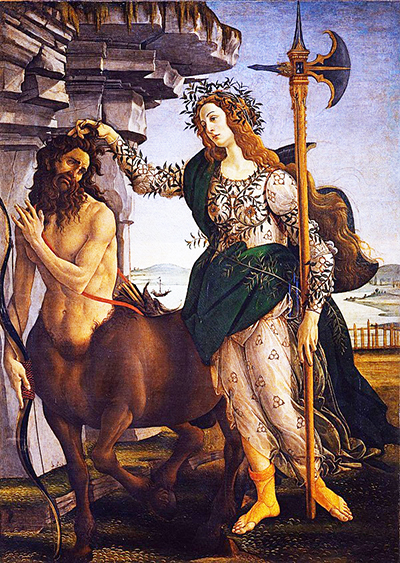
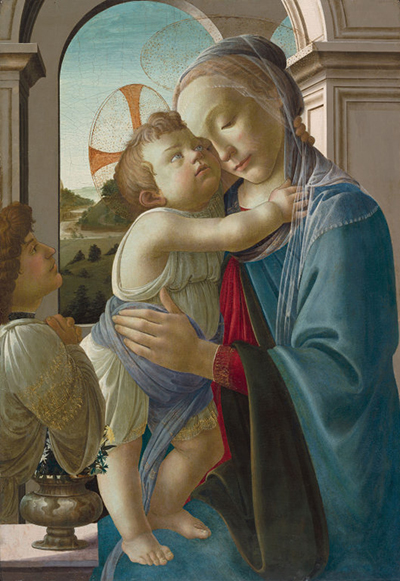
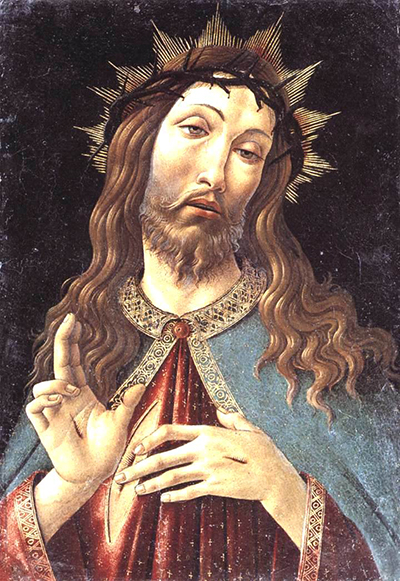
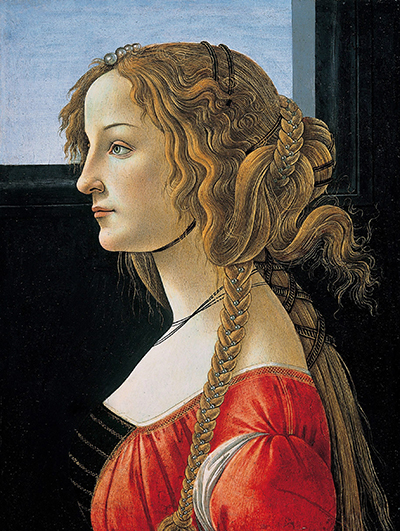
Browse all 80 Botticelli paintings
Choose an artwork below, or use the searchable catalogue further down the page.


















Contents
- How to use the paintings catalogue
- Public images in Florence
- Painting as part of a room
- Sacred pictures for different viewers
- Mythologies and household painting
- A story told around a marriage room
- Frescoes made for a household room
- An ancient painting recreated from words
- Portraits and names
- Later stories and workshop questions
- What technical study can settle
- Browse by the question you bring
How to use the paintings catalogue
Start with a subject or work you recognise, then check the object page's collection, inventory number, material and attribution. Those facts protect against several common mix-ups. Botticelli painted more than one Adoration of the Magi and more than one Madonna; two images with similar subjects may be separate objects, while two old web pages may use the same photograph. A historic title can also survive after a museum revises the artist or sitter identification. The owner record, not a familiar short label, controls which painting the page discusses.[1][3][10][11]
The following terms have distinct meanings in this catalogue. By Botticelli follows an owning collection's current direct attribution. Attributed to Botticelli signals a plausible but less secure assignment, as in the Metropolitan Museum's Madonna and Child with Two Angels. Botticelli and another artist reports a shared or sequential contribution supported by the object record or conservation. Workshop of describes work produced within his studio or under its practice without promising that he painted every passage. Follower of usually describes an artist working in relation to his designs or style rather than a documented workshop member. The National Gallery uses these different labels in its own collection.[1][10][11][12]
The labels may change when a panel is examined or a related drawing is found. That is a reason to show the evidence, not a reason to hide the painting. The National Gallery's investigation of an Adoration of the Kings uses surface study, infrared and material mapping to ask how Botticelli and Filippino Lippi worked on the same object. A red-cap youth long given to Botticelli is currently catalogued by the National Gallery of Art as Filippino Lippi. These cases show why a visual resemblance cannot settle every authorship question.[11][12]
Six painted formats to explore

Saint Sebastian
1474 · Public devotional image. Berlin Gemäldegalerie 1128; museum image marked Public Domain.
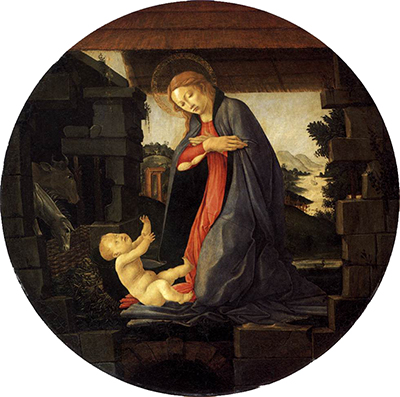
The Virgin Adoring the Child
1480/1490 · Devotional tondo. National Gallery of Art, Washington, 1952.2.4; Public Domain.

Bardi Altarpiece
1484–85 · Large church painting. Berlin Gemäldegalerie 106; museum image marked Public Domain.

Portrait of a Youth
c. 1482–85 · Unidentified sitter. National Gallery of Art, Washington, 1937.1.19; Public Domain.
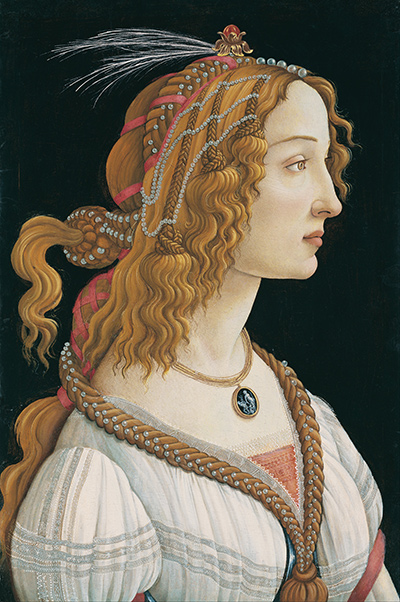
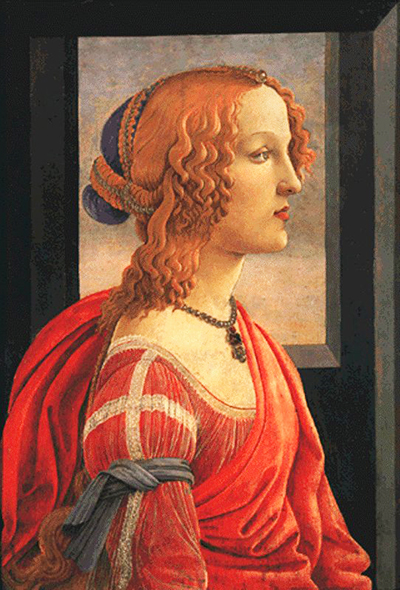
Idealised Portrait of a Lady
c. 1480–85 · Ideal portrait, not a strict Simonetta likeness. Städel Museum 936; Public Domain.

Last Communion of Saint Jerome
early 1490s · Later devotional panel. Metropolitan Museum of Art 14.40.642; Public Domain.
Public images in Florence
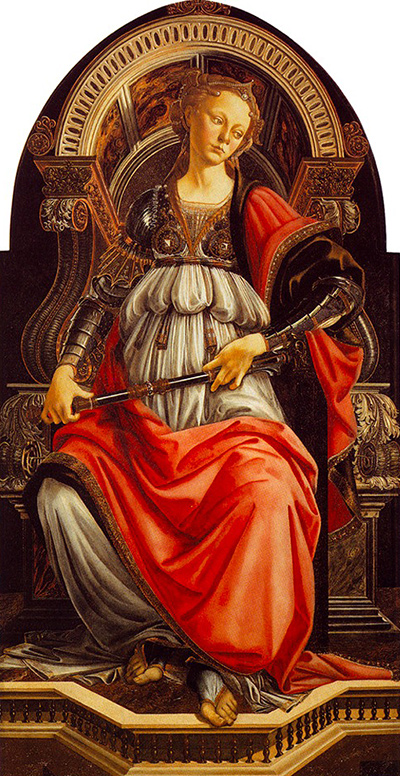
The Fortitude of 1470 was one of seven Virtues for the Tribunal of Mercantile Affairs, which dealt with commercial disputes and the city's guilds. Most of the commission went to Piero del Pollaiolo; Botticelli received one panel through the intervention of Tommaso Soderini. Its armoured woman sits on a carved throne, holding a sceptre. In the tribunal, that image of moral strength had a civic address. It was not simply a graceful figure painted for private enjoyment.[2]
The panel's material gives another clue to the conditions of its making. The Uffizi says Botticelli used poplar, while the other Virtues were on cypress. The difference does not by itself prove independence or rivalry; the museum's commission account supplies that context. Looking at the panel beside its partners reveals a young painter solving the same brief in a different way. This is why the catalogue links related works without flattening their production histories into a single artist's series.[2]
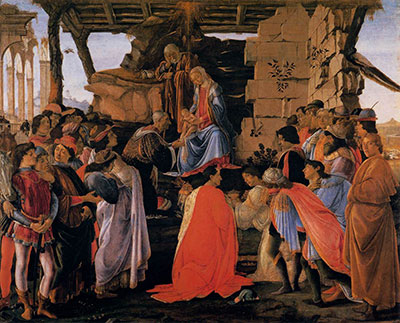
Church commissions could also bring a contemporary Florentine audience into a sacred image. The Del Lama Adoration of the Magi was made for a chapel in Santa Maria Novella. The Uffizi identifies its patron, Gaspare del Lama, and discusses proposed portraits of Medici figures in the gathering. Such likenesses link biblical time with the city's social world, but their certainty differs from the named chapel commission. The figure sometimes called Botticelli's own portrait remains only a possibility in the museum's account.[3]
An altarpiece, a fresco and a small devotional panel give a painter different physical problems. A church painting may be seen from below, across a nave, under changing light or as part of an altar's architecture. A small Madonna can support close attention to a touch, a fruit or a book. The Uffizi's early Sant'Ambrogio altarpiece, made around 1470, was revised during execution according to its conservation record. That material evidence describes a maker adjusting a substantial commission, not an endlessly repeatable formula appearing fully formed.[13]
The repeated Adoration of the Kings shows how much format can alter a familiar subject. The National Gallery's research on its large round Adoration, NG1033, compares it with an earlier rectangular picture made by Botticelli and Filippino. In the rectangular work, the Magi and their company approach Mary and the Child across the panel; in the round one, Mary stands at the centre of a semicircle of visitors. These are different solutions to organising a procession, not simply two sizes of the same design. The Gallery records many incised planning lines beneath the round picture and changes to its architecture during painting.[23]
That architecture carries meaning as well as perspective. A ruined, basilica-like building fills much of the round panel. The research essay notes drawn arches beneath the paint on the right that would once have balanced those on the left; the revised design leaves a view of Jerusalem in the distance. Mary occupies the middle of the old church's nave, a placement the author compares with an altar. The visible painting and its buried plan let us see decisions being made on a particular support. They also caution against treating every Botticelli Adoration as one interchangeable icon with a single patron or first setting.[23]
Painting as part of a room
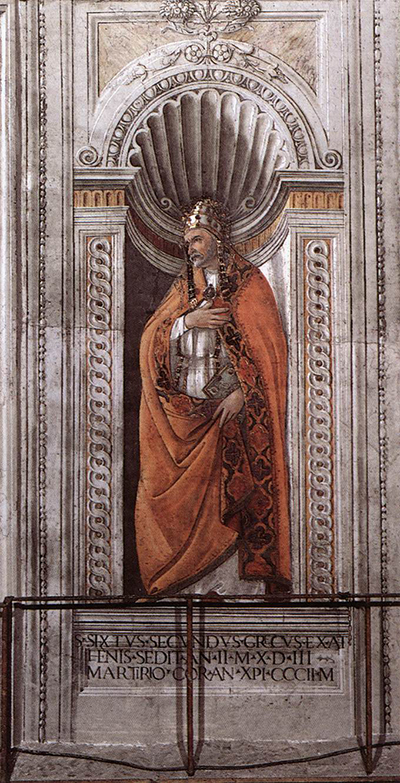
Botticelli's most extensive public painting work outside Florence was the Sistine Chapel campaign of 1481–82. The Vatican describes facing cycles from the lives of Moses and Christ, papal figures above and contributions by several painters. The Punishment of the Rebels belongs to the Moses sequence; the Temptations of Christ belongs to the Christ sequence. Their figures and episodes should be read across the room, not as two isolated pictures lifted out of their wall settings.[4]
Fresco also differs materially from Botticelli's movable panels and canvas. A wall programme is divided among scenes and artists, with architectural boundaries and an institutional purpose already present. In the Punishment, separate moments of one story appear within a shared landscape. A viewer follows Moses and the rebels through space while holding the opposite Christ cycle in mind. The room's logic matters: the fresco is one component of a larger argument about authority and succession, a context the cropped web image cannot display on its own.[4]
Separate entries for the frescoes let readers find a subject or detail and then return to the Vatican sequence. A page for a papal figure does not mean Botticelli painted the chapel by himself. Nor does one image labelled “Moses” make every Moses scene the same object. The distinct Trials of Moses and Punishment of the Rebels are separate episodes on the wall.[4]
Sacred pictures for different viewers
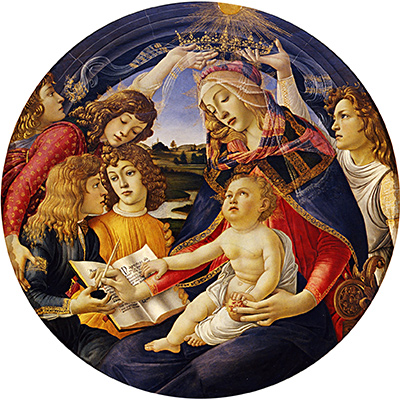
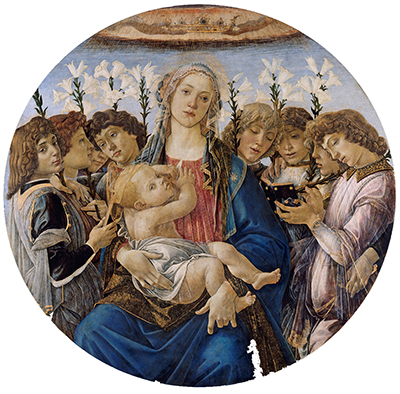
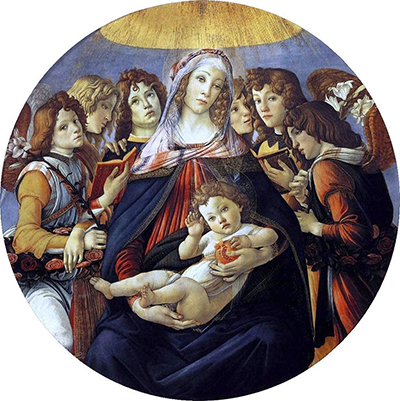
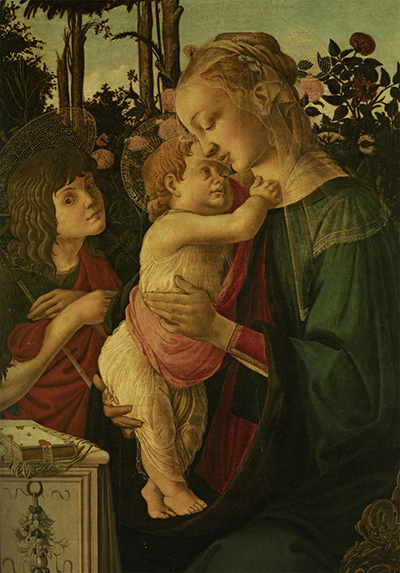
The Virgin and Child appears across Botticelli's career in paintings of varied size, shape, authorship and intended setting. A round panel, or tondo, asks figures to turn within its circular boundary. In the Uffizi Madonna of the Magnificat, Mary writes her canticle under the guidance of the Child while a pomegranate enters the group. Its 118 cm diameter is considerable. The museum says round pictures often belonged in elite homes, but it does not know this painting's original destination and even raises a possible public tribunal setting. The broad use of a format should not be reported as the provenance of this one object.[7]
The National Gallery of Art's Virgin Adoring the Child offers a different circular composition, dated 1480/1490 in the owner's record. Mary kneels before the infant beneath a shelter, with animals and landscape behind. Its subject, pose and collection number distinguish it from a similarly named Uffizi drawing and from other painted Adorations. The museum marks the object's media Public Domain; that rights status concerns its image, while its object record supplies the title and attribution.[8]
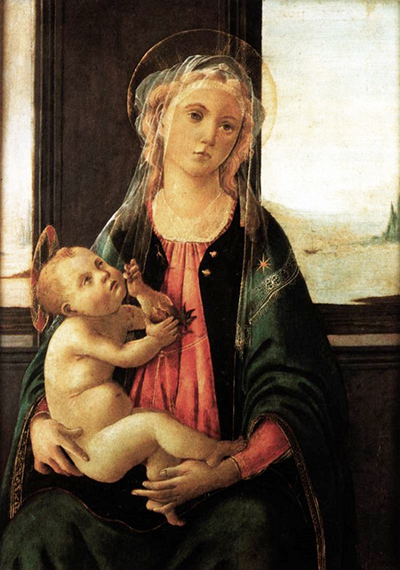
Some related compositions demand explicit attribution wording. The Metropolitan Museum calls its oval Madonna and Child with Two Angels attributed to Botticelli. A different Botticelli page with a similar title or a workshop copy should not silently inherit the Met's object number. Likewise, a museum's “workshop” label is a positive statement about the source of a design or production environment, but a narrower statement about Botticelli's personal painting hand. The reader should see both parts.[10][1]
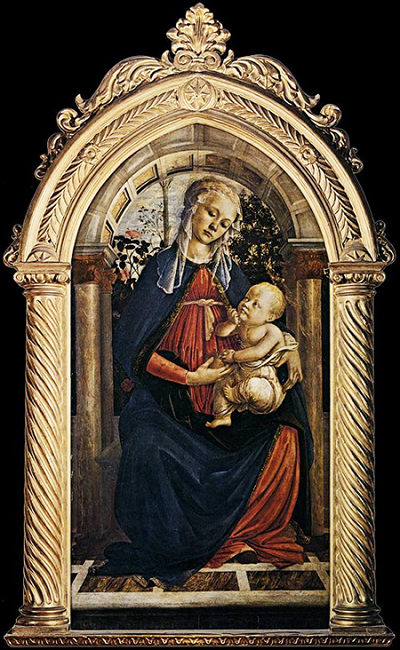
The catalogue therefore gives religious pictures their own entries even where repeated titles appear. It follows the exact owning collection's object and the current local image match. That is more useful than treating “Madonna and Child” as a single invention copied without variation: gesture, scale, support, accompanying saints and the relationship between Mary and the Child all differ. The object pages describe those differences at close range; this hub helps a reader choose which one to open.[7][8][10]
Mythologies and household painting
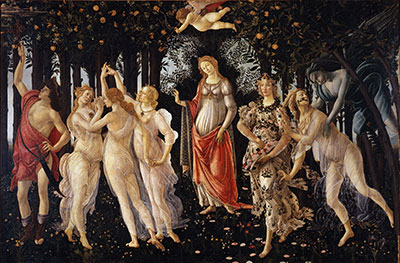
The Primavera and Birth of Venus are central to Botticelli's modern reputation, but their surviving histories begin at different points. The Uffizi dates Primavera to about 1480, records tempera grassa on wood, and says the painting was in a Via Larga house belonging to the heirs of Lorenzo di Pierfrancesco de' Medici toward the end of the fifteenth century. It later moved to the Villa di Castello. The setting supports a household reading without delivering a complete explanation of the garden's nine mythological figures.[5]
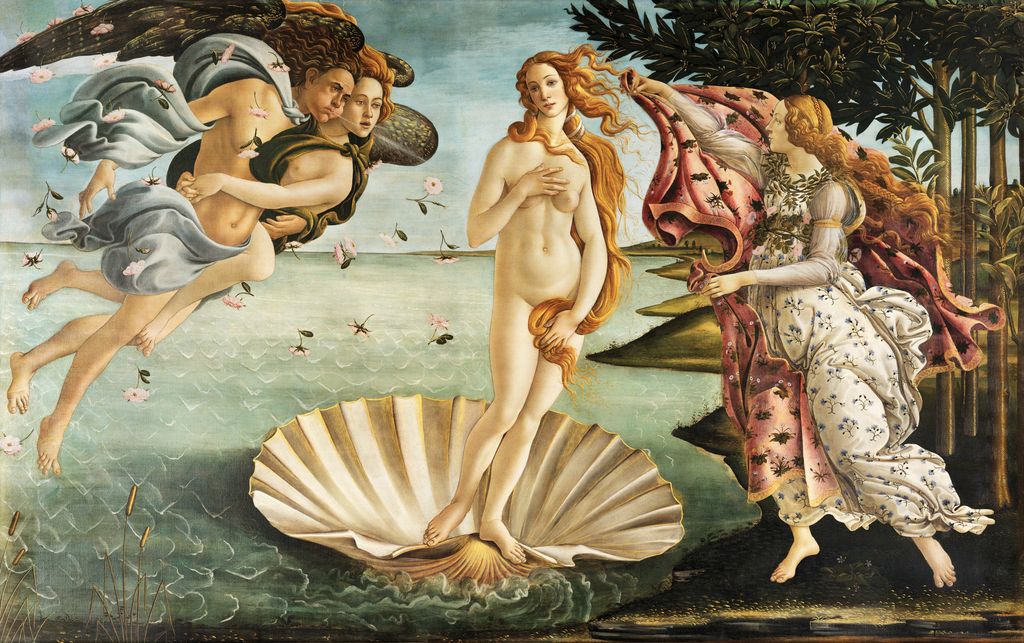
The Uffizi dates Birth of Venus to around 1485 and records tempera on canvas. Its first written notice is Vasari's 1550 account of the painting at Castello. A Medici family commission is considered highly probable, but the museum does not cite an original contract. The canvas support suited large decorative paintings intended for noble houses. The subject is Venus arriving on shore after birth from the sea, a useful reminder that even the settled popular title does not describe the exact instant shown.[6]
Their joint later display cannot prove that both were commissioned at once or for the same room. The support difference matters as a physical fact before any interpretation: wood and canvas impose different methods of preparation and movement, and the paintings occupy different scales and spaces. Their shared interest in classical gods, animated hair and drapery invites comparison; it does not close the historical gaps. Read the individual object pages for the classical sources, figure identifications and disputed interpretations rather than letting one symbolic key solve both works.[5][6]
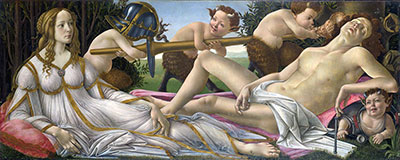
The National Gallery's Venus and Mars adds a third kind of mythological scene. Venus remains alert as Mars sleeps and satyrs play with his equipment. The museum considers a marriage context probable. That does not identify the couple for whom the picture may have been made. Its horizontal format and comic imbalance offer a domestic use of classical characters that differs from both the crowded Primavera garden and the broad shore of Birth of Venus.[9]
A story told around a marriage room
The Story of Nastagio degli Onesti offers a rare case in which a domestic narrative has a named commission. The Prado identifies Antonio Pucci as the commissioner of four panels made in 1483 for the marriage of his son Giannozzo to Lucrezia Bini. Three panels are now in the Prado and the fourth is privately held. They adapt a tale from Boccaccio's Decameron, following a young man rejected by a woman, a terrifying repeated hunt in a pine forest, and the banquet at which the story is turned towards marriage. The scenes were part of a room's furnishings, not a book illustration that happened to be enlarged.[19]
The third panel makes the marriage context visible through the Pucci, Bini and Medici coats of arms. It also shows Nastagio's guests responding to the hunt and his beloved sending a maid with her acceptance. The fourth panel presents a wedding banquet beyond Boccaccio's narrative ending. This should not be softened into a simple romance: the tale uses fear and punishment to press a woman towards consent. A reader of the painting should see both the sumptuous social occasion and the unsettling story selected for it.[19][20]
The production is equally revealing. The Prado credits Botticelli with the general design and some figures, while identifying participation by Bartolomeo di Giovanni and Jacopo del Sellaio. Its technical account says X-rays and infrared images show different ways of painting even the recurring trees and landscape across the three Prado panels. A coherent cycle could therefore be designed as an ensemble and carried out by several hands. The old shorthand “four Botticellis” obscures the very workshop process that let a large room scheme be finished for a family event.[19][20]
Andrea Bayer's Metropolitan Museum study places this kind of spalliera painting within the furnished Florentine camera. Panels could be integrated with chests, benches, backs and wall fittings rather than encountered as equal-sized pictures at modern eye level. This does not provide the precise original hanging of every surviving Botticelli panel, but it changes how to imagine their first viewing. A narrative moved around a room as well as across each painted board; its subjects, coats of arms and physical placement worked together.[21]
Frescoes made for a household room
The two Villa Lemmi frescoes now in the Louvre enlarge the idea of domestic painting beyond movable wood panels. The museum says that they once decorated the walls of a first-floor room in a villa near Florence owned by the Tornabuoni family. One shows Venus and the Three Graces offering gifts to a young woman; the other introduces a young man to the Liberal Arts. Their life-sized allegorical figures would have occupied the room itself, surrounding viewers rather than standing separately in modern frames. The Louvre records a third fresco on those walls, left in place in a very damaged state and later destroyed. The pair in Paris is therefore a survival from a larger decoration, not a complete room programme.[24]
The Louvre describes the identities of the young people as disputed. One proposal connects them to Lorenzo Tornabuoni and Giovanna degli Albizzi, married in 1486; others identify different Tornabuoni marriages or Lorenzo's later wife. The frescoes can still be read as images of education, gifts and social expectation, but a confident wedding date cannot be extracted from the figures alone. Their later history also changes how we see them: discovered under whitewash in 1873, they remained in the villa until 1881 and were acquired for the Louvre in 1882 through the dealer Stefano Bardini and Charles Ephrussi. The museum records their medium as true fresco on plaster. Detaching a painting from its wall made its preservation and museum display possible while removing the architectural setting that had given the paired scenes their first scale and sequence.[24]
An ancient painting recreated from words
The Calumny of Apelles broadens the catalogue beyond the familiar Venus pictures. The Uffizi dates the 62 × 91 cm tempera panel to about 1495. At one end, a ruler with donkey ears listens to Ignorance and Suspicion; Calumny pulls a nearly naked young man by his hair, while other figures groom and escort her. Penitence turns back towards Truth at the far side. The viewer can follow the accusation across the scene, but cannot simply call the event a portrait of a particular Florentine trial. The Uffizi says Botticelli drew on a description of a lost picture attributed to the ancient Greek painter Apelles. This is a new painting made from transmitted words, not a copy made in front of the ancient object.[27]
Those words circulated in more than one form. Lucian's ancient account reached fifteenth-century readers through Greek, Latin and Italian versions; Leon Battista Alberti also retold it in a treatise on painting. Art historian Angela Dressen compares their details with Botticelli's image and argues that Cristoforo Landino's 1481 commentary on Dante is a closer immediate source than Alberti. She points to Midas's ears, the accused man's appeal upwards and Penitence looking back towards Truth, details that Alberti's version does not describe in the same way. In Landino, the slander story illustrates a moral discussion about lies; Alberti uses it chiefly to demonstrate how a painter can make a compelling narrative. Dressen's comparison gives a reason to inspect the painting's individual gestures, though a close match cannot document the book Botticelli actually read or exclude several texts in a learned workshop.[28]
The panel also tests a simple division between Botticelli's “classical” and “religious” periods. Its principal story is ancient, while its moral urgency belongs to a Florence debating accusation, judgement and public life in the 1490s. The portico's tiny reliefs bring in classical, biblical and medieval subjects; their exact relation to the foreground is still debated. The Uffizi allows that Bartolomeo di Giovanni may have helped execute some of these details, a reminder that a painting credited to Botticelli may still have required another hand. Vasari later placed the panel with Fabio Segni, but the museum treats an original personal motive for Botticelli as possible rather than documented. The work is therefore a strong late-career case for reading subject, source, material and authorship together without making a lost commission appear certain.[27][28]
Portraits and names
Botticelli's portraits can appear more documentary than the mythologies, yet an exact sitter's name is often harder to establish than an artist or collection. The National Gallery's Portrait of a Young Man presents a red-capped youth nearly frontally; the museum does not name him. The National Gallery of Art's different Portrait of a Youth tilts his head and raises a hand to his chest. Their current owner records, poses and inventories distinguish two paintings that a generic “young man” label could easily collapse.[14][15]
At the Städel Museum, Idealised Portrait of a Lady includes the traditional subtitle “Portrait of Simonetta Vespucci as Nymph.” The museum's own explanation calls it an ideal portrait, not a strict record of Simonetta's appearance. Hair, costume and cameo belong to a constructed image. Treating every beautiful Botticelli woman as Simonetta would erase the difference between a proposed name, an ideal type and a demonstrable likeness.[16]
Attribution can change a portrait's place in the catalogue too. The National Gallery of Art now assigns a window-framed red-cap youth to Filippino Lippi after a long history of Botticelli attribution. The painting belongs in a catalogue of Filippino's work, while its older Botticelli attribution remains part of its history.[12]
Later stories and workshop questions
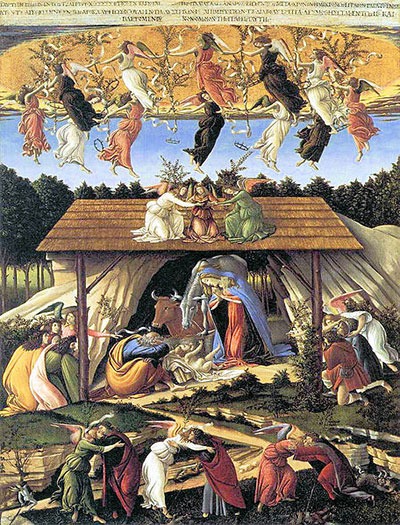
Botticelli's later paintings do not fit a single story of abrupt decline. The Mystic Nativity bears a date of 1500 and an inscription that the National Gallery relates to the turbulent religious life of Florence. Its hovering angels and crowded earthly action make the painting unlike a serene household Madonna. But its mood cannot be applied as a diagnosis to every work of the final decade, nor can it prove that the painter ceased making other kinds of pictures.[17]
The Saint Zenobius series offers a different later narrative problem. Four panels now spread across London, New York and Dresden show episodes from the Florentine saint's life. In the National Gallery's Three Miracles, several events occupy a long panel, and recognisable Florentine streets help orient the viewer. The Gallery connects the sequence to a written biography by Clemente Mazza. This is a painting project about moving through stories and local places, not simply an example of an artist turning inward after political upheaval.[18]
The paintings represented here were also made in an active workshop. The National Gallery lists works under Botticelli, “workshop of” and “follower of,” and conservation of the shared Adoration of the Kings makes the relationship with Filippino tangible. The catalogue preserves such distinctions even when a traditional title has long attached a work to Botticelli alone. Where institutions disagree or an older attribution remains in circulation, the object page explains the disagreement rather than changing an uncertain work into a certain masterpiece for the sake of a neat list.[1][11]
A documented 1505 commission makes the caution about late work concrete. Rachel McGarry's 2022 Minneapolis/Uffizi catalogue reports that the Confraternity of Santo Spirito in Montelupo ordered a Pentecost altarpiece from Botticelli for 70 gold florins, with a planned height exceeding 15 feet. The surviving painting in Birmingham is much smaller. In her direct treatment account, V&A conservator Catherine Nunn describes it as a reduced, heavily damaged Botticelli and workshop panel: five vertical boards, opened joins, lost paint and old retouching. The contract shows that an institution still sought an ambitious work from him; the surviving fragment does not expose the complete original design or identify every passage painted by his hand. A catalogue of “late Botticelli” needs both pieces of evidence before making stylistic claims from today's surface.[25][26]
What technical study can settle
A collection's short “tempera” or “oil” field is a starting point, not a universal formula for Botticelli. In a published study of paint media, National Gallery conservators Catherine Higgitt and Raymond White distinguish pictures painted mainly in egg tempera, works combining egg and oil in different colours or layers, and works painted in walnut oil. They report Birth of Venus as essentially egg tempera on a gesso-grounded canvas, while analyses of Primavera suggest egg with some oil, particularly in greens. The difference between support—canvas or panel—and binder—what holds the pigment—is important for a catalogue spanning many formats.[22]
The same study says the examined workshop and autograph pictures followed contemporary technical practice, but the materials alone did not reliably identify which hand painted them. That is a useful boundary for the attribution labels above. Infrared examination, changes beneath the paint, paint-layer structure and comparison with securely documented works can strengthen an argument; no one pigment makes a picture automatically “by Botticelli.” The Nastagio panels give a practical example, because the Prado reads several kinds of evidence together to describe a designed cycle with multiple makers.[19][22]
Browse by the question you bring
For a public commission, begin with Fortitude and its Pollaiolo context. For a named chapel patron, use the Del Lama Adoration. For a wall cycle, follow the Sistine Chapel scenes and their room setting. For an intimate religious subject, compare the Madonna of the Magnificat with the NGA tondo and the Met attributed panel.[2][3][4][7][8][10]
For domestic mythologies, read Primavera, Birth of Venus and Venus and Mars as separate objects before comparing them. For portraits, start with an owner-identified work whose sitter may remain unnamed. For later storytelling, use Mystic Nativity or the last Saint Zenobius panel. The searchable catalogue below lists paintings by title and date; each entry leads to details about the object and its attribution.[5][6][9][14][16][17][18]
The accompanying artist overview spans Botticelli's painting and drawing, while the biography follows people, places and commissions through time. The drawings hub keeps sheets distinct from painted works, and the Dante project addresses a dispersed illustrated corpus. Moving between these pages should make each picture's evidence clearer, without asking one famous Venus to stand for an entire career.[1][4][5][6]
Paintings and related catalogue entries
Discussion
Which painting changes when you learn where it was first seen or how it is attributed?
Reader Insights
How does a panel, canvas or fresco setting change the way you look at a subject?
Which workshop or shared-attribution label helped you understand a particular object?
What traditional title should be checked against an owner collection record?
Join the Conversation
Share a source-led observation or question below.
References
- National Gallery, London, Sandro Botticelli artist profile and collection, work types and artist/workshop/follower labels; accessed 1 October 2026 View source.
- Uffizi Galleries, Fortitude, 1470 Virtues commission, support and Tribunal setting; accessed 1 October 2026 View source.
- Uffizi Galleries, Del Lama Adoration of the Magi, patron, chapel and qualified portraits; accessed 1 October 2026 View source.
- Vatican Museums, Sistine Chapel south wall, shared programme and Moses stories; accessed 1 October 2026 View source.
- Uffizi Galleries, Primavera / Spring, c.1480, wood support and Via Larga setting; accessed 1 October 2026 View source.
- Uffizi Galleries, Birth of Venus, c.1485, canvas, subject and first written notice; accessed 1 October 2026 View source.
- Uffizi Galleries, Madonna of the Magnificat, 118 cm tondo and unknown original destination; accessed 1 October 2026 View source.
- National Gallery of Art, Washington, The Virgin Adoring the Child, 1952.2.4, tondo subject and Public Domain media; accessed 1 October 2026 View source.
- National Gallery, London, Venus and Mars, subject and probable marriage context; accessed 1 October 2026 View source.
- Metropolitan Museum of Art, Madonna and Child with Two Angels, 29.100.17, current “attributed to” label and support; accessed 1 October 2026 View source.
- National Gallery, London, conservation of the Adoration of the Kings, part three, examination of Botticelli and Filippino contributions; accessed 1 October 2026 View source.
- National Gallery of Art, Washington, Filippino Lippi, Portrait of a Youth, current Filippino attribution and older Botticelli history; accessed 1 October 2026 View source.
- Uffizi Galleries, Sant'Ambrogio altarpiece conservation, early reworking; accessed 1 October 2026 View source.
- National Gallery, London, Portrait of a Young Man, frontal pose and unidentified sitter; accessed 1 October 2026 View source.
- National Gallery of Art, Washington, Portrait of a Youth, 1937.1.19, distinct pose and collection identity; accessed 1 October 2026 View source.
- Städel Museum, Idealised Portrait of a Lady, inv. 936 and traditional Simonetta subtitle; accessed 1 October 2026 View source.
- National Gallery, London, Mystic Nativity, 1500 date and inscription; accessed 1 October 2026 View source.
- National Gallery, London, Three Miracles of Saint Zenobius, four-panel sequence and Clemente Mazza source; accessed 1 October 2026 View source.
- Museo Nacional del Prado, Scenes from the Story of Nastagio degli Onesti, commission, four-panel cycle, coats of arms and workshop roles; indexed museum record consulted 1 October 2026 View source.
- Museo Nacional del Prado, extended Nastagio technical catalogue, X-radiography and infrared comparison of the three Prado panels; indexed museum record consulted 1 October 2026. Direct Prado endpoints remained inaccessible View source.
- Andrea Bayer, “Paintings of Love and Marriage in the Italian Renaissance”, Metropolitan Museum of Art, domestic camera and spalliera context; consulted 1 October 2026 View source.
- Catherine Higgitt and Raymond White, “Analyses of Paint Media: New Studies of Italian Paintings of the Fifteenth and Sixteenth Centuries”, National Gallery Technical Bulletin 26 (2005), pp. 89–91 and note 5, Botticelli binder variation and limits of material analysis for hand attribution; consulted 1 October 2026 View source.
- Alasdair Flint, “Sandro Botticelli, The Adoration of the Kings”, National Gallery, London, Building the Picture (2014), on NG1033's circular composition, incised plan, architectural changes and comparison with the rectangular Botticelli–Filippino picture; consulted 1 October 2026 View source.
- Musée du Louvre, Venus and the Three Graces Presenting Gifts to a Young Woman, RF 321 and A Young Man Introduced to the Liberal Arts, RF 322, collection records for the Villa Lemmi frescoes, room setting, disputed identifications, lost third fresco, materials and 1873–82 transfer; consulted 1 October 2026 View source View source.
- Rachel McGarry, “Finding Sandro Botticelli” and chronology, in Botticelli and Renaissance Florence: Masterworks from the Uffizi (Minneapolis Institute of Art, 2022), pp. 22–23 and 14 May 1505 entry, reporting the Montelupo commission from published document research; consulted 1 October 2026. The original contract remains to be checked View source.
- Catherine Nunn, “Conservation of Pentecost by Sandro Botticelli”, Victoria and Albert Museum, conservator's account of the Birmingham fragment and its treatment, updated 17 April 2024; consulted 1 October 2026 View source.
- Uffizi Galleries, Daniela Parenti, Calumny of Apelles, inventory 1890 no. 1496, object data, figures, architectural details, qualified workshop attribution and Segni ownership account; consulted 1 October 2026 View source.
- Angela Dressen, “From Dante to Landino: Botticelli’s Calumny of Apelles and its Sources”, Mitteilungen des Kunsthistorischen Institutes in Florenz 59, no. 3 (2017), pp. 324–39, especially pp. 326–29 and 337–38; full article consulted 1 October 2026. Its preference for Landino over Alberti is an argued source attribution, not evidence of a surviving studio copy or reading note View source.
- Image credit. Sandro Botticelli, The Virgin Adoring the Child, 1480/1490. National Gallery of Art, Washington, Samuel H. Kress Collection, 1952.2.4. Public Domain (CC0) View source.