by Tom Gurney
Tom Gurney BSc (Hons) is an art history expert with over 20 years experience
Published on June 19, 2020 / Updated on October 2, 2026
Email: tomgurney1@gmail.com / Phone: +44 7429 011000
A closer look
A young man in a red cap looks straight towards us and holds a round gold likeness between both hands. The face on the roundel is not his. It is Cosimo the Elder de' Medici, remembered as “Father of the Fatherland.” Botticelli sets a living, unnamed sitter before a celebrated dead statesman. The portrait's question is therefore twofold: who is the man we see, and why does he choose to show us Cosimo?[1]
The Uffizi in Florence calls the painting Portrait of a Young Man with a Medal and dates it to about 1475. It is a tempera painting on wood, 57 × 44 cm, with a gilded stucco medal. The museum gives it inventory 1890 no. 1488 and states plainly that the sitter's identity is unknown. The medal is its defining feature and helps distinguish this portrait from other images of young men by Botticelli.[1]
At a glance
- ArtistSandro Botticelli
- TitlePortrait of a Young Man with a Medal
- Datec. 1475
- Mediumtempera on wood with gilded stucco medal
- Dimensions57 × 44 cm
- Current collectionUffizi Galleries, Florence
- Inventory1890 no. 1488
- Sitterunidentified
These facts follow the Uffizi's current object record. It names Cosimo only as the person represented on the medal, not the person posing for Botticelli. Cosimo died in 1464, before this portrait's approximate date. The distinction prevents the roundel's famous face from supplying an unsupported identity for the youth holding it.[1][3]
An older Italian national-catalogue record measures the panel at 57.5 × 44 cm rather than the Uffizi page's rounded 57 × 44 cm. Both identify the same work by inventory 1890 no. 1488, medium and medal. The half-centimetre difference does not indicate another portrait; the current Uffizi measurement is used in the fact box.[1][4]
This work in Botticelli’s career
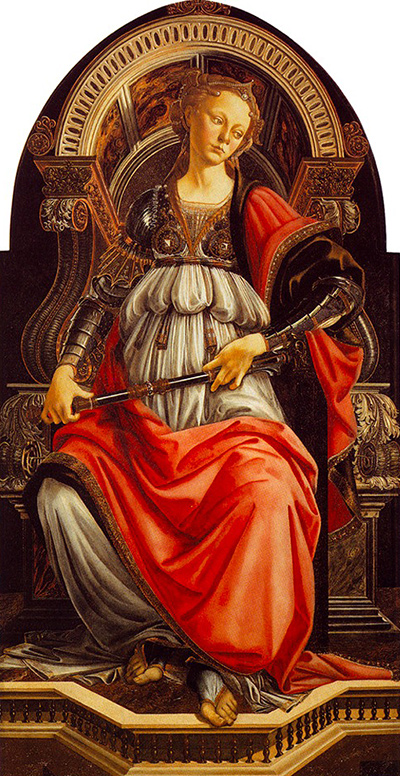
Fortitude
1470Young Man with a Medal
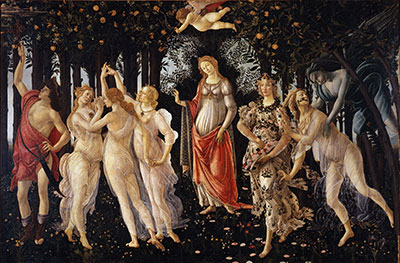
about 1475Primavera
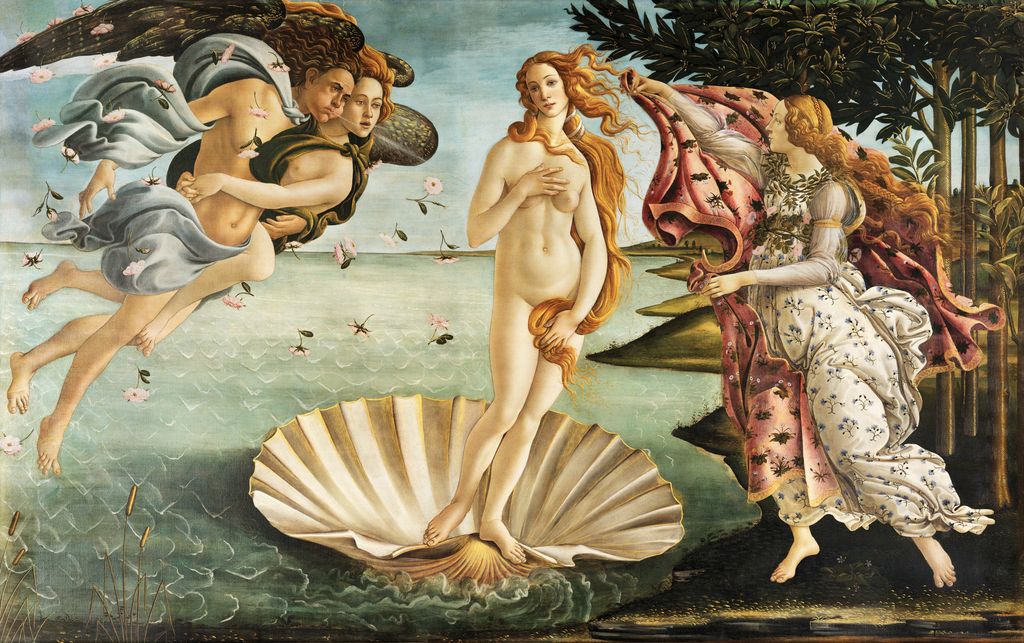
c. 1480Birth of Venus
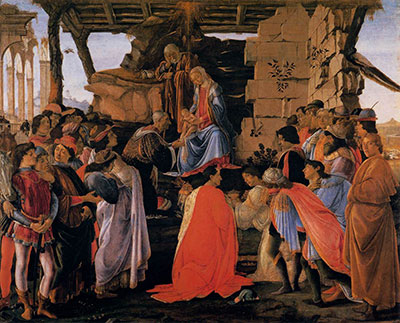
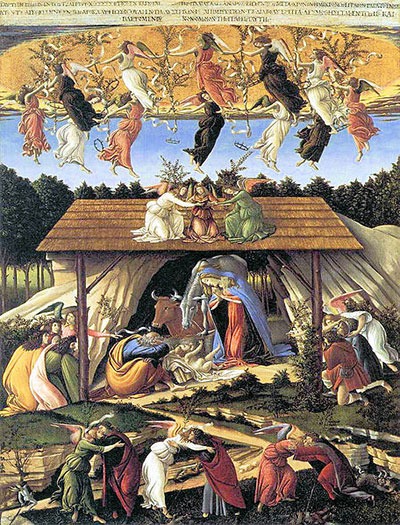
c. 1485Mystic Nativity
1500Contents
- At a Glance
- Two Faces, Two Kinds of Image
- Hands, Rings and Display
- Could He Be Botticelli's Brother?
- A Portrait Built Around a Claim
Two Faces, Two Kinds of Image
The young man is painted almost frontally, his dark hair spreading across his shoulders beneath the bright red cap. His eyes meet the viewer while his hands raise the circular object at the lower centre of the picture. The arrangement invites a quick comparison between his softly painted face and Cosimo's hard profile on the medal. One is represented as a person present before us; the other appears as a public commemorative image.[1]
The roundel is more than a painted circle that happens to contain a portrait. The Uffizi describes it as gilded stucco fixed within the tempera panel. Its relief catches light differently from the surrounding painted hands and garment. Botticelli makes the sitter physically present a sign of allegiance or remembrance, as though he has brought an object into the portrait for us to inspect. The material difference heightens the medal's importance without telling us exactly who ordered the painting.[1]
The medal's physical attachment has also shaped the panel's conservation. In a Getty Conservation Institute account of panel-support repairs, conservator George Bisacca describes a split rising from the bottom of this Uffizi portrait that threatened to fracture the pastiglia roundel. He reports that Ezio Buzzegoli and Marco Marchi lifted a continuous thin layer of wood around the split, inserted wedges to close and support it, then reattached that original layer. The aim was to stabilise the panel while leaving its painted appearance undisturbed. This is a published account of a specific structural intervention, not evidence that Botticelli applied the stucco in a particular sequence or that the sitter's identity has been found.[6]
Cosimo's profile faces sideways in the format of a medal or coin. The Uffizi relates its design to a model produced between 1465 and 1469, after Cosimo's death in 1464. An inscription praises him with the words “MAGNUS COSMUS / MEDICES PPP” and commemorates his title Pater Patriae. The exact expansion of the abbreviated letters matters less for a first viewing than the public role they signal: the likeness honours Cosimo as a founder and father figure for Florence. It is a deliberate political reference, not an incidental ornament.[1][3]
Yet the young man does not disappear behind the memorial. The red of his cap, deep green clothing and mass of dark curls occupy most of the panel. He stands before an open landscape rather than a bare neutral ground. The distant land creates a quiet setting for the direct gaze and prominent hands. Nothing in that scenery names him. Botticelli gives the viewer a vivid individual appearance and withholds the documentary identification that would turn it into a secure biography.[1]
Hands, Rings and Display
The sitter holds the medal firmly but does not cover its face. His fingers frame it so the raised image can be seen. The gesture turns a private portrait into an act of display. He is showing something he values to whoever looks at the panel. The Uffizi reads the portrait as exalting Cosimo, and the open presentation supports that interpretation. It does not prove whether the young man was a blood relative, a supporter or an artist associated with Medici patronage.[1]
The Uffizi's online exhibition Jewels in the Uffizi draws attention to two rings on his little finger: one set with a ruby, the other with an emerald. They are small beside the medal, but the museum reads them as part of the sitter's constructed identity. Their coloured stones show wealth and taste; the exhibition proposes symbolic meanings for the gems. Those readings are interpretive, while the rings' position and colours are visible details of the painting.[2]
The exhibition also explains that rings on a little finger need not be read as marriage signs. Their placement differs from a ring deliberately worn on the ring finger, and signet or gem rings could speak to status or self-presentation. In this portrait they sit close to the hands that exhibit Cosimo's likeness. Botticelli clusters the clues to identity at the front of the picture, even though none tells us the sitter's name beyond doubt.[2]
The gilded medal and two rings make the portrait unusually concerned with objects. The sitter's face gives us character and presence, while the things he holds or wears invite social interpretation. It is tempting to treat them as a code that must resolve into one proper name. The Uffizi does not do so. Its own title remains generic, and its text leaves the person unidentified. Looking closely can explain the political message without pretending to solve a question the evidence has not settled.[1][2]
Could He Be Botticelli's Brother?
One suggestion has linked the sitter to Antonio Filipepi, Botticelli's brother and a goldsmith. The Uffizi's jewellery exhibition reports the proposal because the young man's facial features have been compared with those of the painter, and Antonio's trade might suit the display of a medal. The same exhibition makes clear that the medal has not solved the portrait's mystery. Resemblance and professional plausibility are arguments, not an identified likeness with a name attached in a contemporary record.[2]
The question has a longer history than this one suggestion. The national catalogue notes that inventories and later scholars at various times proposed Pico della Mirandola, different members of the Medici family, or even a maker of the medal. None became a secure identification. It also records an attribution history for the painting itself: early inventories left the artist anonymous, an 1825 inventory named Filippino Lippi, and Giovanni Morelli later argued for Botticelli. The Uffizi's present attribution to Botticelli should therefore be distinguished from the unresolved name of the sitter; neither question is answered by reading Cosimo's inscription as a label for the young man's face.[1][4]
This uncertainty is useful when considering the work's purpose. A portrait can proclaim admiration for Cosimo without being made for a Medici family member. It can display goldwork without depicting the goldsmith who made it. The museum's political interpretation and the brother hypothesis answer different questions: one concerns the medal's public meaning, the other asks who holds it. The first has a visible object and inscription behind it; the second still lacks a decisive identification.[1][2]
The date likewise calls for measured language. “About 1475” is the Uffizi's date for the painting. The medal model predates it by several years. That order makes sense for a youth exhibiting a commemorative image after Cosimo's death, but it does not yield a precise commission date or occasion. Botticelli could draw on the established image of the elder Medici without painting at the moment the original model was made.[1]
A Portrait Built Around a Claim
Many portraits introduce a sitter through face, clothes and setting. Here Botticelli adds another person's face at the very centre of the sitter's hands. The two likenesses differ in scale, material and direction of gaze. Cosimo's profile belongs to public memory; the young man's frontal look asks for a present response. Their meeting makes the picture more than a record of appearance. It is an assertion that Cosimo matters to the person holding the medal.[1]
The Uffizi's object database still lists the work in museum storage, but its June 2026 announcement of the newly arranged Botticelli rooms says the medal portrait was placed in a new display case between the rooms for Primavera and The Birth of Venus. The dated announcement is the better guide to the recent display; the object record remains the source for its inventory and measurements. The older, broad title Portrait of a Man does little to distinguish it; Cosimo's roundel gives the work its unmistakable identity.[1][5]
We can say with confidence what the sitter asks us to see: a gilded image of Cosimo the Elder displayed in his hands, with rings, red cap and direct gaze reinforcing the act of presentation. We cannot say with the same confidence that he is Antonio Filipepi or any other named Florentine. Botticelli's portrait holds those two states of knowledge together. Its political message is legible, while the young man who delivers it remains unknown.[1][2]
Botticelli and related artworks
Discussion
Which detail changes how you read Young Man with a Medal?
Reader Insights
How do the sitter and the medal’s profile invite comparison?
What does the gilded stucco add to the painted portrait?
Why does Cosimo’s likeness not identify the sitter?
Join the Conversation
Share a source-led observation or question below.
References
- Uffizi Galleries, “Portrait of a Young Man with a Medal,” current object record, inventory 1890 no. 1488, accessed 29 September 2026 View source.
- Uffizi Galleries, “Jewels in the Uffizi,” online exhibition, entry “Portrait of a man with a medal,” accessed 29 September 2026 View source.
- Uffizi Galleries, “Adoration of the Magi,” collection record noting Cosimo's 1464 death, accessed 29 September 2026 View source.
- Italian Ministry of Culture, “Ritratto d'uomo con medaglia di Cosimo il Vecchio de' Medici,” national catalogue 0900188553, Uffizi inventory 1890 no. 1488, compiled 1985 and updated through 2006; accessed 29 September 2026 View source.
- Uffizi Galleries, “The new permanent installation of the Botticelli Rooms,” announcement, 16 June 2026, accessed 29 September 2026 View source.
- George Bisacca, “Structural Considerations in the Treatment of a Nativity by Francesco di Giorgio Martini,” in Kathleen Dardes and Andrea Rothe, eds., The Structural Conservation of Panel Paintings (Getty Conservation Institute, 1998), p. 354, describing Buzzegoli and Marchi's repair of the Uffizi portrait; original 1992–93 treatment papers cited there but not directly consulted View source.