 by Tom Gurney
Tom Gurney BSc (Hons) is an art history expert with over 20 years experience
Published on June 19, 2020 / Updated on October 2, 2026
Email: tomgurney1@gmail.com / Phone: +44 7429 011000
Strength in a civic setting
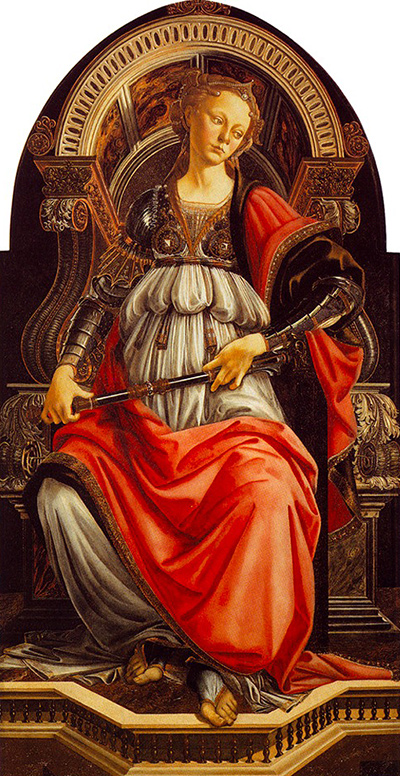
Sandro Botticelli’s Fortitude sits in a narrow marble throne, wearing armour over a pale dress. Her hands rest on a long staff across her lap. The metal breastplate and architectural setting suggest power, yet her lowered head and relaxed pose make that power look controlled rather than aggressive. Fortitude here means the strength to persist in doing good, not simply the ability to win a fight.[1]
Painted in 1470 for Florence’s Tribunale di Mercanzia, the panel was one of seven personifications of virtue intended for its audience hall. Piero del Pollaiolo had received the cycle, but Tommaso Soderini, one of its overseers, intervened to bring in Botticelli. The surviving accounts indicate that the younger painter was initially hired for two virtues; after Pollaiolo's protests, Fortitude was the only one he completed. The other six remained Pollaiolo's work.[1][5] The interruption made Fortitude an early public test of Botticelli’s independent skill.
At a glance
- ArtistSandro Botticelli
- TitleFortitude (Fortezza)
- Date1470
- Mediumtempera grassa on poplar panel
- Dimensions167 × 87 cm
- Original settingaudience hall of the Tribunale di Mercanzia, Florence
- Current locationUffizi Galleries, Florence, Room A10
- Inventory number1890 no. 1606
The Uffizi’s technical field says “tempera grassa on wood”; its accompanying description specifies poplar. That distinction matters because the six Pollaiolo panels are on cypress.[1] The medium label alone does not establish the precise recipe of the paint on Botticelli’s panel.
Fortitude in Botticelli’s career
Contents
- At a Glance
- A Virtue for Florence’s Commercial Court
- How Botticelli Makes Strength Visible
- The Diamonds and Pearls
- One Panel Among Pollaiolo’s Six
- From the Mercanzia to the Uffizi
A Virtue for Florence’s Commercial Court
The Tribunale di Mercanzia settled disputes among Florentine merchants and administered justice between the city’s guilds. Images of the virtues would have surrounded the officials and visitors who came to its audience hall. Fortitude therefore belonged to a public setting in which moral qualities were relevant to decisions and conduct. The seven figures formed a cycle: the cardinal virtues of Fortitude, Prudence, Justice and Temperance, together with the theological virtues of Faith, Hope and Charity.[1][3]
Pollaiolo received the commission in 1469 and completed Charity first. Botticelli’s opportunity came through Soderini, a member of the body supervising the work. The Uffizi connects both Soderini and the young painter to the Medici faction. Rachel McGarry’s account in the 2022 Uffizi–Minneapolis catalogue is more cautious about the precise route by which Botticelli reached Soderini: it is unknown whether he sought the work himself or was recommended by someone else.[1][4] A political connection helps explain the opportunity, but it does not document every step of the appointment.
Michelle O'Malley traces the sequence more closely through the Mercanzia's accounts. The officials first assessed Charity and other artists' designs, then recommissioned Pollaiolo for the remaining virtues late in 1469. When work had not appeared by June 1470, Soderini caused the court to hire Botticelli for two outstanding panels, bypassing that earlier process. A contemporary payment register records Botticelli's payment for Fortitude on 18 August 1470. That dated record makes this more than a general stylistic attribution to the early 1470s.[5][6]
O'Malley argues that Soderini's intervention may have served the politics of Lorenzo de' Medici's circle rather than a documented friendship with Botticelli. The often repeated anecdote about the two men was written down years later and cannot by itself establish their relationship in 1470. Nor is there evidence that the neighbouring Vespucci family recommended the painter, although their connections make the route plausible. The secure point is the intervention recorded in the Mercanzia accounts; the exact chain that put Botticelli's name before Soderini remains uncertain.[4][5]
The panel’s original setting also helps explain its restrained martial language. Fortitude is a personification, a human figure standing for a quality. Armour identifies her capacity to withstand danger; it does not turn the court into a battlefield. In a tribunal concerned with contested obligations, persistence, resolve and self-command were more pertinent than physical violence. That connection is an interpretation of the commission and image, rather than a surviving written instruction from its patrons.
How Botticelli Makes Strength Visible
The composition fits a tall, narrow panel. Botticelli places the woman inside a throne whose curved back rises around her head. Its uprights and carved capitals hold the figure in a firm architectural frame. Her body, by contrast, bends gently: the head inclines, the shoulders slope and the red mantle sweeps across her knees. The figure seems both enclosed by the seat and capable of moving within it.
Her clothing carries much of the painting’s tension. The polished armour sits over a finely pleated light dress. Dark metal frames the upper body and forearms, while a broad red mantle gathers over the lap and descends toward the floor. The staff across her hands gives the seated pose a horizontal counterweight to the panel’s height. The Uffizi calls it a ruler’s sceptre in its object description; its separate study of the painted jewels refers to Fortitude’s traditional iron mace.[1][2] Both descriptions point to an emblem of authority and force, but the sources should not be turned into a claim that she holds two separate weapons.
The throne is substantial, yet its decoration keeps the background active. Incised patterns, curling forms and the rounded arch give the marble a richness beyond a plain ceremonial seat. Her pointed feet and the hems of her clothing project over its lower edge. Botticelli makes the figure occupy the viewer’s space rather than simply fitting a flat emblem into a frame.
The face is neither triumphant nor frightened. Its downward turn and quiet expression temper the armour. Daniela Parenti, writing for the Uffizi, sees in it an early version of the languid, melancholy expression later associated with Botticelli’s female figures.[1] The observation is useful as a comparison within his work, though the panel does not require a biographical explanation for the sitter’s mood. Its effect is pictorial: strength appears as steadiness held in reserve.
The Diamonds and Pearls
Small ornaments sharpen this account of fortitude. An Uffizi exhibition on jewels identifies two pointed diamonds set into the breastplate and pearls in the woman’s hair and along her neckline. Its authors explain that the diamond’s hardness made it a fitting emblem of resistance, while the white pearls suggested purity.[2] These are the museum’s historically informed readings of the jewels, not a preserved list of meanings supplied by the Mercanzia.
The diamond detail is especially apt because it attaches the emblem of resistance to the armour itself. The breastplate already protects the body; its stones make the idea of hardness visible at a smaller scale. The pearls do something different. They soften the martial surface with ornaments associated with beauty and moral cleanliness. Seen together, the jewels keep the figure from becoming a simple image of armed aggression.
The Uffizi’s jewel study also draws a careful line around Botticelli’s training. It says that regular work in the Pollaiolo brothers’ workshop is unknown, even though goldsmith skills and knowledge of precious stones circulated among Florentine artists.[2] The diamonds cannot prove an apprenticeship with Pollaiolo. What they show within this painting is Botticelli’s attention to how a material detail could carry an ethical idea.
One Panel Among Pollaiolo’s Six
Charity, the first panel Pollaiolo made for the same cycle, offers a precise comparison. She nurses a child and holds a flame, signs of care and divine love. Both women sit in architectural seats, and both have richly described fabrics and surfaces. Yet their attributes lead the viewer toward different actions: Charity gives; Fortitude endures.[3]
There is a material difference beneath the painted surface as well. The Uffizi identifies Pollaiolo’s six panels as cypress and Botticelli’s Fortitude as poplar. It also singles out the more elaborate engraved decoration of Botticelli’s marble bench.[1][3] These differences make the one-panel intervention visible without requiring a claim that the two painters worked from a single identical design.
McGarry argues that Botticelli’s brighter colour, deeper space and sumptuous finish prompted changes in Pollaiolo’s later panels. She notes that Charity had been completed before Botticelli entered the project.[4] This is a comparative reading of the surviving works and their sequence, rather than a recorded instruction from one painter to the other. It gives the viewer a productive question: do the remaining virtues respond to the example set by Fortitude? The answer calls for looking across the full cycle, not assuming a one-way influence from this panel alone.
O'Malley makes the comparison more specific: Botticelli enlarged the figure's apparent monumentality and gave it a more classical architectural presence than the first Pollaiolo model; she sees those qualities echoed in Pollaiolo's final three virtues. This is an argument drawn from the panels' visible forms and order, not a claim that Pollaiolo acknowledged Botticelli's influence in writing. The woman's throne and sinuous figure can be examined both as a response to the set he joined and as an intervention that may have changed its later look.[5]
The comparison also clarifies Botticelli’s particular achievement. He accepted the cycle’s basic demand for a seated female virtue, then gave the figure a distinctive rhythm: a strong frame around a body whose line flows through armour, dress and mantle. Her polished surface is not mere display. It helps a public allegory attract and hold attention.
From the Mercanzia to the Uffizi
The seven panels remained associated with the Mercanzia long after their creation. In 1777 they were taken to the Uffizi as the tribunal’s property passed to Florence’s Chamber of Commerce.[1][3] Fortitude is now displayed with works by Pollaiolo and Botticelli in Room A10. The change of setting matters. In the tribunal, viewers encountered the image as part of the moral programme of a functioning court; in a gallery, they can examine it beside the other six and compare the painters’ choices.
The Uffizi's June 2026 reinstallation gave the virtues a newly arranged wall and returned the series to nineteenth-century gilded frames. It singled out Botticelli's panel as his first documented work. Those frames are part of the paintings' later museum history, not evidence for how the Mercanzia mounted the panels in 1470. The current display makes the full set easier to read as a sequence while preserving the distinction between the original civic setting and modern presentation.[7]
The paintings also reached that display through a long conservation campaign. In a 2012 account for the Friends of the Uffizi, Alessandro Cecchi says work on the seven virtues began with Botticelli's Fortitude in 1996 and continued across the cycle for roughly a decade. He explains why the treatment took time: the surviving painted surfaces had losses and the effects of older restorations. This does not mean every visible passage was repainted in the modern campaign. It means that the fresh comparison now possible in the gallery depends on careful work with damaged originals, as well as on the return of the later gilded frames.[6][7]
Its 1470 date places the painting near the start of Botticelli’s independent career. A documented workshop was his by that year, and the Mercanzia panel demonstrated his ability to handle a prominent civic commission.[4] Its success does not establish that every later patronage link came through Soderini, or that Botticelli had trained in Pollaiolo’s shop. It does show a young painter making an inherited allegorical format his own: the armour, jewels and staff convey the virtue’s conventional power, while the controlled pose and elaborate line give that power a recognisably individual form.
Botticelli and related artworks
Discussion
Where do you see strength held in reserve in Fortitude?
Reader Insights
How do armour, staff and lowered head work together?
What changes when you picture the panel in the Mercanzia audience hall?
Which comparison with Pollaiolo’s six virtues is strongest, and why?
Join the Conversation
Share a source-led observation or question below.
References
- Daniela Parenti, “Fortitude,” Uffizi Galleries, collection record, accessed 29 September 2026 View source.
- Uffizi Galleries, “Jewels in the Uffizi: The Secrets of Depicted Gems,” sections 19–20, accessed 29 September 2026 View source.
- Daniela Parenti, “Charity,” Uffizi Galleries, collection record, accessed 29 September 2026 View source.
- Rachel McGarry, “Finding Sandro Botticelli,” p. 8, and Annamaria Bernacchioni, “Chronology of Sandro Botticelli, 1445–1510,” p. 207, in Cecilia Frosinini and Rachel McGarry, eds., Botticelli and Renaissance Florence: Masterworks from the Uffizi (Minneapolis Institute of Art and Uffizi Galleries, 2022); catalogue PDF pp. 14–15 and 113, accessed 29 September 2026 View source.
- Michelle O'Malley, “Finding fame: painting and the making of careers in Renaissance Italy,” Renaissance Studies (2010), section on the Mercanzia, archival account, politics and comparison of the virtue panels, accessed 29 September 2026. A figure caption in this article calls Botticelli's support cypress; the owning Uffizi record identifies it as poplar, which this page follows View source.
- Alessandro Cecchi, “Risultati insperati,” Giornale degli Uffizi, no. 39 (2012), p. 2, report on the virtue-cycle restoration, beginning with Fortitude in 1996, and original Mercanzia registers, including payment dated 18 August 1470; scanned page consulted 1 October 2026 View source.
- Uffizi Galleries, “The new permanent installation of the Botticelli Rooms,” 16 June 2026, accessed 29 September 2026 View source.