by Tom Gurney
Tom Gurney BSc (Hons) is an art history expert with over 20 years experience
Published on June 19, 2020 / Updated on October 2, 2026
Email: tomgurney1@gmail.com / Phone: +44 7429 011000
Paradiso VI: Dante and Beatrice in Mercury
Two large figures float within a nearly empty circle. Dante turns toward Beatrice, who raises her hand, while many tiny flickering forms surround them. Botticelli's drawing for Paradiso VI makes the Heaven of Mercury look unlike an earthly place: there are no roads, buildings or clouds to follow. The pale parchment and small lights ask the viewer to imagine a realm defined by radiance. The work is in Berlin's Kupferstichkabinett, which catalogues it as Botticelli, Paradiso 6.[1][2]
The canto itself is full of words. The emperor Justinian tells Dante the history of Roman rule and explains the spirits who appear in Mercury. Botticelli does not try to turn that political account into a sequence of emperors and battles. Instead, he shows the travelers suspended among the blessed. The image captures the setting and the change in Dante's experience, while the poem supplies the long speech.[1][2][3]
At a glance
- Current titleLa Divina Commedia, Paradiso VI: Second Planetary Sphere (Heaven of Mercury)
- ArtistSandro Botticelli in the current Berlin record
- Dateabout 1492–95
- Mediummetalpoint and brown pen on parchment
- Dimensions32.0 × 47.0 cm, sheet size
- Current collectionKupferstichkabinett, Staatliche Museen zu Berlin
- Inventory numberBotticelli, Paradiso 6
- SubjectDante and Beatrice in the second planetary sphere, where Justinian addresses Dante
Where this work sits in Botticelli’s career
Fortitude
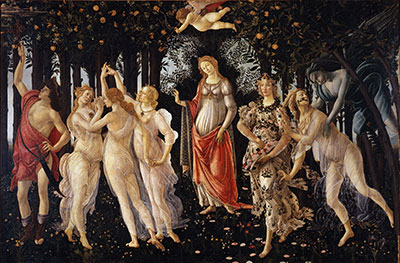
1470Primavera
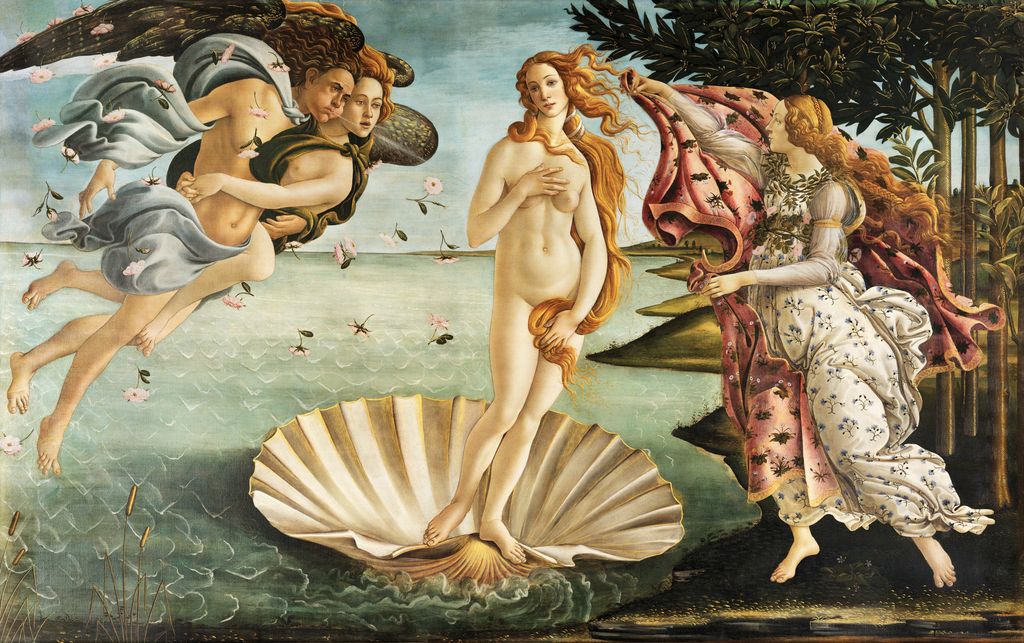
c. 1480The Birth of Venus
c. 1485Paradiso VI
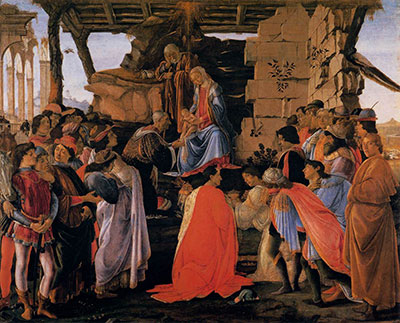
c. 1492–95The Mystical Nativity
c. 1500Contents
- A Circle for the Heaven of Mercury
- What Justinian Tells Dante
- Beatrice as Guide
- Reading Reproductions of the Sheet
These object facts come from Berlin's current record. Its official photograph is marked Public Domain Mark 1.0. The full frame preserves the wide margins and faint traces visible across the parchment; a tight crop of the two central figures would lose the measured circle and the scale of the many smaller lights.[1]
A Circle for the Heaven of Mercury
A fine outline forms a wide, almost complete circle across the page. Dante and Beatrice hover just below its centre. There is no painted sky beyond the border and no solid ground beneath their feet. Botticelli uses a simple geometric shape to make the second planetary heaven legible. Berlin's institutional account calls attention to this increasingly abstract way of illustrating Paradise.[1][2]
The pair are large in comparison with the small marks around them. Beatrice's raised hand leads the eye upward, while Dante faces her. Their bodies remain recognizably human, but their drapery and floating poses loosen the pull of ordinary gravity. The circle gives the figures a location without turning Heaven into a familiar room or landscape.[1][2]
Across the sphere are dozens of tiny curled forms. They resemble flickers or flamelets more than separate standing people. Berlin's presentation connects them with the souls of the blessed in Mercury. The repeated marks give the circle life: they are distributed rather than arranged into a crowd with a single front row. The viewer notices their lightness before trying to count or name them.[1][2]
It would be tempting to pick one spark and call it Justinian. The museum image does not label an individual mark, and the story's point is broader than a portrait identification. Botticelli shows the conditions of Dante's encounter with luminous souls. Justinian's distinctive identity and historical argument emerge in Dante's text, not in a tiny face we can confidently isolate on this sheet.[1][3]
What Justinian Tells Dante
Mercury is the second planetary sphere in Dante's Paradise. In this part of the poem, the spirits pursued worthy deeds on earth but were also drawn by the desire for honor and fame. The University of Texas Danteworlds commentary explains that this mixed motive shapes their place in the poem. Their appearance as bright souls is not a punishment scene; it is part of Dante's graduated vision of blessedness.[3][4]
Justinian is a sixth-century Roman emperor associated with a major compilation of law. His speech in Paradiso VI traces the imperial eagle through Roman history and turns toward the politics of Dante's own time. Princeton's canto summary and Texas commentary place this long account at the centre of the canto. Botticelli's drawing does not depict the historical episodes one by one. It lets the viewer see the environment in which Dante hears them.[3][4]
The contrast between verbal density and visual spareness is important. On other Dante sheets, Botticelli repeats the travelers as they move through a complicated terrain. Here the same two figures remain within a single sphere. The small lights recur, but there is no procession of Roman rulers to decode. The artist concentrates the picture on a condition of seeing: Dante has entered a realm where souls appear as light.[1][2][3]
The canto title also requires care. Herbert Horne's close description of the series observes that the drawing answers most directly to the end of Paradiso V, when Dante and Beatrice enter Mercury and a multitude of bright souls approaches them. Justinian's long reply occupies Paradiso VI, but Botticelli does not show a separate figure speaking or turn the imperial history into a procession. The Berlin inventory names the sheet for canto VI, the position it holds in the illustrated cycle; that label should not be taken to mean every visible feature comes from verses within VI alone. The image works at a narrative threshold: the arrival and expectation established at the end of V become the setting for the voice heard in VI. This helps explain why a reader can find Dante's scene here even though the most distinctive episode of the labelled canto is verbal rather than pictorial.[5][3]
Friedrich Lippmann's 1896 description of the drawings makes the crossing especially precise. For the sheet he numbers VI, he points to Paradiso V from line 91: Dante likens the speed of their passage into the second realm to an arrow reaching its mark, then sees Beatrice's joy brighten Mercury. The approaching spirits are compared with fish moving toward food in clear water. Lippmann treats the drawing as this arrival and gathering, while noting that Justinian's speech in VI offers little separate action to picture. His reading is an early published interpretation, not a title written by Botticelli on the drawing; it helps locate the scene in the poem without changing Berlin's present inventory.[6][1]
Justinian also speaks of Romeo of Villeneuve, a capable servant whose good work was met with suspicion and exile. This final example matters to Dante's account of fame, gratitude and injustice. It is part of the poem's argument, although the image does not supply a separately identifiable Romeo. The drawing's uniform little flames resist the idea that every figure needs a visible individual biography.[3][4]
Beatrice as Guide
Beatrice accompanies Dante through Paradise after Virgil's guidance ends. In the image she is the more active of the two large figures, reaching upward while Dante turns toward her. The gesture provides a line for the eye to follow into the upper part of the circle. It also makes their relationship clear without the architectural paths used in Botticelli's Inferno drawings.[1][2]
Berlin describes the couple as hovering in Mercury. Their placement is calm, but the surrounding flame-like marks create movement. Botticelli balances a central exchange between guide and pilgrim against many small signs of a heaven filled with souls. The circle holds both scales together.[1][2]
The artist's materials help create that effect. Metalpoint and brown pen make delicate lines on parchment rather than broad areas of paint. The circle is almost fragile; the spirits are brief strokes. In a small web image the drawing can look empty, but the full sheet reveals the pattern of lights and the figures' drapery. The large blank areas are part of the composition's sense of space.[1]
Some faint writing and marks can also be seen through or around the parchment in the museum photograph. An older black-and-white reproduction of this same composition makes writing especially prominent. That difference in reproduction should not be mistaken for a second painted scene. The figure pair and the ring of lights identify the same Berlin sheet.[1]
Reading Reproductions of the Sheet
Older reproductions of this image differ in contrast and cropping. One black-and-white view makes faint writing behind the figures much stronger; another concentrates on the pair and the surrounding lights. Berlin's full-frame photograph places both within the original sheet. Comparing those versions helps distinguish the drawn circle and spirits from writing visible through the parchment.[1]
The subject is also distinct from Botticelli's later Paradiso XXX drawing. There Dante and Beatrice encounter a river of light on their way toward the Empyrean. Here the circle marks Mercury and Justinian's canto. Both sheets simplify heavenly space, yet their forms and positions in the poem differ. Confusing them would blur Dante's progress through Paradise.[1][2]
Look again from Beatrice's hand to the tiny lights above it. The eye moves through a world that Botticelli defines with surprisingly few elements: two travelers, a boundary and a field of brightness. Justinian's many words have not disappeared; they are the unseen conversation taking place within this quiet, luminous sphere.[1][2][3]
Botticelli and related artworks
Discussion
Look again at the details and evidence discussed above. Which part of the drawing changes most when you know its history?
These prompts invite close looking and source-led questions rather than a single settled interpretation.
Reader Insights
How do you move between the central pair and the many small lights?
What does the circle tell you about the place they have entered?
Why might Botticelli leave Justinian’s Roman history outside the visible scene?
Join the Conversation
Share an observation or question about the drawing below.
References
- Staatliche Museen zu Berlin, Kupferstichkabinett, “La Divina Commedia, Paradiso VI,” inv. Botticelli, Paradiso 6, current collection record updated 12 August 2026, accessed 29 September 2026 View source.
- Kupferstichkabinett, Staatliche Museen zu Berlin, “Botticelli Featuring Dante,” institutional exhibition story, section on Paradiso VI, accessed 29 September 2026 View source.
- Princeton Dante Project, “Summary of Paradiso VI,” canto summary, accessed 29 September 2026 View source.
- University of Texas at Austin, Danteworlds, “Mercury,” commentary on Paradiso V–VII, accessed 29 September 2026 View source.
- Herbert P. Horne, Alessandro Filipepi, Commonly Called Sandro Botticelli (1908), p. 241 (PDF p. 391), distinguishing the scene of arrival and gathering lights at the end of Paradiso V from Justinian's speech in VI; consulted 1 October 2026 View source.
- Friedrich Lippmann, The Drawings by Sandro Botticelli for Dante's Divina Commedia (1896), pp. 72–73 (scan pp. 84–85), entry VI on Paradiso V.91 and the arriving souls; original facsimile commentary consulted 1 October 2026 View source.
- Image credit. Sandro Botticelli, Paradiso VI: Heaven of Mercury, about 1492–95, Staatliche Museen zu Berlin, Kupferstichkabinett, inv. Botticelli, Paradiso 6. Photo: Philipp Allard. Public Domain Mark 1.0. View the full-size museum image View source · View source · View source.