by Tom Gurney
Tom Gurney BSc (Hons) is an art history expert with over 20 years experience
Published on June 19, 2020 / Updated on October 2, 2026
Email: tomgurney1@gmail.com / Phone: +44 7429 011000
A closer look
Three small figures gather within the curved top of a sheet. Wings and cloth overlap, while a broad area beneath them remains open. The Fondazione Federico Zeri photo archive calls this drawing Angeli cantori, or singing angels, and identifies it as Uffizi prints and drawings inventory 187 E. The older English title Three Angels is a useful plain description, but the inventory number is what distinguishes this small work on paper from Botticelli's many painted angels.[1]
The unusual format drives the image. At 100 × 235 millimetres, the sheet is more than twice as wide as it is high. It has a shallow arch or lunette shape, and the three figures follow that rise rather than standing in a row. A nineteenth- or early twentieth-century reproduction could make them look like a detail cut from a finished painting. The surviving object is catalogued as a drawing in pen on paper, with a form whose original intended setting has not been securely identified.[1][2][3]
At a glance
- Catalogue titleAngeli cantori (singing angels); commonly Three Angels
- Artist headingSandro Botticelli in the Zeri bibliography-based record
- ObjectDrawing, Uffizi Gabinetto dei Disegni e delle Stampe, 187 E
- MediumPen on paper in Zeri; the Web Gallery of Art specifies brown shading on pink prepared paper
- Size100 × 235 mm, also 10 × 23.5 cm in an older catalogue
- DateDisputed at catalogue level: Zeri gives a broad c. 1490–1510, while the Web Gallery of Art proposes 1475–80
- Known related panelA Bartolomeo di Giovanni Three Angels fragment was reported by Nicoletta Pons as based on this Uffizi drawing; its original setting and any collaboration remain proposals[1][2][3][4]
This work in Botticelli’s career
Fortitude
1470Three Angels Drawing
late 15th centuryPrimavera
c. 1480Birth of Venus
c. 1485Mystic Nativity
1500Contents
- At a Glance
- How the Three Figures Fill the Curve
- A Small Study, Not a Coloured Painting
- Can It Be Connected to a Painting?
How the Three Figures Fill the Curve
The eye moves along the arched upper boundary and meets three bodies pressed into its shallow space. Their garments spread sideways in soft, broken folds. The wing forms help mark them as angels, but they do not wear the armour or carry the attributes of named archangels. The focus is on a collective movement rather than three separate portraits. Each figure contributes to the sweep of the group.[1][2]
There is an apparent tension between fullness and emptiness. Most of the visual activity happens near the top and ends; the lower middle of the sheet is comparatively unworked. This blank area is an active part of the design. It gives the clustered bodies a sense of suspension and leaves room for something below, although the sources do not identify what, if anything, once occupied a related painted setting. The drawing can therefore suggest a heavenly group without proving a lost altarpiece or fresco scheme.[1][2]
The shallow curve does not simply frame the figures. It sets their rhythm. One angel's drapery leads into the next, and the outer bodies bend back toward the centre. At this scale, their outlines and overlapping folds do much of the work that colour might perform in a painting. The figures have enough individuality to remain three, but their shared arc makes them one unit. That balance is a good reason to look at the sheet as a composition in its own right.[1][2]
The Zeri archive's Italian word cantori and an older Brogi photograph caption both describe the angels as singing. Bernard Berenson's historical catalogue similarly calls them floating and singing. The tiny legacy reproduction does not let a reader inspect each mouth with certainty; the song is an established subject label rather than a detail newly proved by a small online image. Their grouped, lifted bodies are consistent with a heavenly chorus, but the sources do not name a hymn or liturgical text.[1][3]
Herbert Horne's 1908 account makes the action slightly more specific: he described the three flying angels as singing from an open book. If that small shared object is followed through the overlapping bodies, the group looks less like three unrelated airborne figures and more like a coordinated choir. Horne's observation is useful for close looking, although it does not identify words, music or a liturgical occasion. It is his description of the sheet, not a newly recovered inscription.[5]
A Small Study, Not a Coloured Painting
Zeri gives the core medium as pen on paper. The Web Gallery of Art adds brown shading and a pink prepared ground. These are distinctions worth keeping. The warm tone beneath the pen marks is part of the sheet's visual effect. Darker shading makes the folds and wings separate, while areas of exposed paper keep the drawing light. This is different from a painted angel whose robes, flesh and feathers are built from opaque or translucent colour on wood or canvas.[1][2]
The small dimensions also change the meaning of detail. Ten centimetres of height leaves little room for individually finished hands, hair, feathers and cloth. The drawing gives just enough to make the angels' positions legible as a group. In the surviving reproduction, some lines are faint and some are emphatic. It would be unsound to call every faint area unfinished, since the drawing's age, medium and photographic reproduction all affect how much a viewer can discern. What can be said from the image is that line and shading concentrate around the clustered figures rather than covering the whole sheet.[1][2]
The object number 187 E prevents a common identity slip. Botticelli drew and painted many angels, sometimes in groups of three or more. An image search for “three angels” may also return painted details from Marian works or another artist's archangels. This particular composition is the shallow Uffizi paper study: no large background architecture, no enthroned Virgin and no Tobias walking with Raphael, Michael and Gabriel. Its subject is a close chorus held inside an arch.[1][2]
Can It Be Connected to a Painting?
The Web Gallery of Art says a direct link to one of Botticelli's paintings has not been established. That caution matters because the arched form could seem ready-made for a lunette or an upper band of an altarpiece. A plausible visual use is not the same as a documented surviving destination. No source cited here provides a contract or transfer record for the sheet.[2]
There is, however, a more specific reported relationship with a painting by Bartolomeo di Giovanni. A Christie's catalogue describes his small tempera panel Three Angels as a fragment from the top of an altarpiece. The lot essay says Nicoletta Pons recognised it as based on a Botticelli drawing in the Uffizi; it also raises possible collaboration between the two painters. That is a significant scholarly comparison, even though the sale text does not supply inventory 187 E or reconstruct the full altar. The panel is catalogued under Bartolomeo, not as a surviving Botticelli painting. The Web Gallery of Art's narrower statement about Botticelli's own paintings can stand alongside this reported link.[2][4]
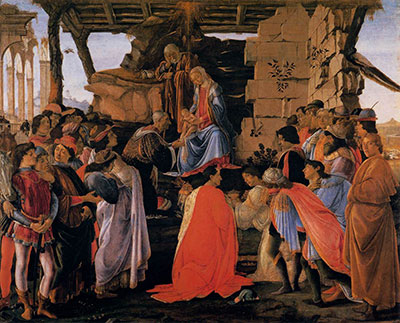
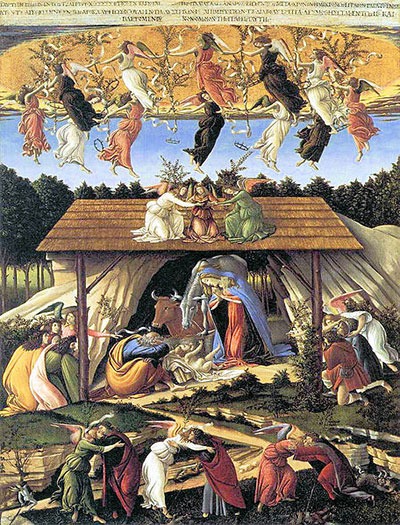
Horne compared the drawing's movement with two Botticelli painted groups: the angels in the San Marco Coronation of the Virgin and those above the shelter in the National Gallery's Mystic Nativity. He offered them as comparisons of line, grouping and feeling, not as panels for which 187 E was demonstrably the cartoon. The distinction helps sort three levels of evidence on this page: a visible book on the drawing, resemblances to Botticelli's own paintings, and the reported adaptation in Bartolomeo di Giovanni's separate panel. None supplies a surviving commission brief for the Uffizi sheet.[5][4]
One interpretation sees Botticelli's drawings as a store of motifs that his workshop could reuse. This is a reasonable description of Renaissance studio practice, but it does not tell us that inventory 187 E was physically traced onto a named panel. The sheet may have served as an experiment in arranging figures, a possible design for another medium or a resource kept for later reference. Those possibilities remain open. Treating the drawing as an autonomous surviving work avoids giving it a made-up first commission.[2]
Its date is unsettled in the accessible catalogues. The Web Gallery of Art proposes 1475–80, making the group relatively early in Botticelli's career. Zeri's photo archive gives the much broader, later c. 1490–1510 span. The difference is too large to hide behind a generic “late fifteenth century” without comment. Neither entry reports an inscribed year on the sheet. Their dates represent different scholarly or cataloguing assessments, and the present evidence does not resolve them.[1][2]
The Zeri record names Botticelli on the basis of bibliography, including Berenson's drawing catalogue. Berenson identified a Uffizi lunette numbered 187 and measuring 10 × 23.5 cm, which aligns closely with Zeri's 187 E and 100 × 235 mm. That continuity gives a useful historical check on object identity. It does not make every historical dating or attribution judgement current museum policy. A direct, recent Uffizi object page for the sheet was not available in this research pass, so the source of the Botticelli label should remain visible.[1][3]
Seen on its own terms, Three Angels holds together through proportion and restraint. The three figures fill the curve, overlapping without dissolving into one mass, and the open lower centre lets them appear suspended. The drawing's precise future use is unknown, and its date needs a qualified label. Neither uncertainty prevents us from recognising the achievement of a small, arched group made legible through pen marks on prepared paper.[1][2]
Botticelli and related artworks
Discussion
Which detail changes how you read Three Angels Drawing?
Reader Insights
How do the figures fill the arched space?
Which details reveal this as a drawing rather than a painting?
Can a specific finished painting be linked securely?
Join the Conversation
Share a source-led observation or question below.
References
- Fondazione Federico Zeri / Everett Fahy photo archive, “Angeli cantori,” entry 107960, Uffizi GDSU 187E; title, bibliography-based artist heading, dimensions, medium and broad date, accessed 1 October 2026 View source.
- Web Gallery of Art, “Three Angels,” exact-image comparison, pink prepared paper, 1475–80 proposal and caution about a direct painting link, accessed 1 October 2026 View source.
- Bernard Berenson, The Drawings of the Florentine Painters, historical catalogue entry for Uffizi no. 187, a lunette of three floating and singing angels, 10 × 23.5 cm; used as an identity cross-check, accessed 1 October 2026 View source.
- Christie's, “Bartolomeo di Giovanni, Three Angels,” lot essay reporting Nicoletta Pons's comparison of the Bartolomeo panel with a Botticelli Uffizi drawing and proposed collaboration, accessed 1 October 2026 View source.
- Herbert P. Horne, Alessandro Filipepi, commonly called Sandro Botticelli, painter of Florence (1908), printed p. 325 (PDF p. 523), Uffizi frame 55 no. 187, open book and attributed comparisons with the San Marco Coronation and National Gallery Mystic Nativity; consulted 1 October 2026. His comparisons do not document a direct design transfer View source.