by Tom Gurney
Tom Gurney BSc (Hons) is an art history expert with over 20 years experience
Published on June 19, 2020 / Updated on October 2, 2026
Email: tomgurney1@gmail.com / Phone: +44 7429 011000
The Flight into Egypt, Attributed to Sandro Botticelli
Mary is standing, not riding. She holds the infant Jesus close to her face while a small donkey lowers its head to browse at the edge of a path. Joseph steps out from behind them with a bundle on his shoulder. These figures make the Flight into Egypt at Paris's Musée Jacquemart-André feel less like a journey in progress than a pause within one. The Holy Family is still together, yet its route and destination remain outside the picture.[1]
The museum dates the tall painting to 1510, near the end of Botticelli's life, and attributes it to him with an assistant's work in Joseph. That is one current assessment, not a settled account of every painted hand. Fondazione Zeri and the French national art-history inventory catalogue the same object as workshop work. The national inventory also gives an earlier date and a different painting material. The painting rewards close looking even while those basic catalogue fields remain debated.[1][2][6]
At a glance
- Current museum titleThe Flight into Egypt (La Fuite en Égypte)
- ArtistAttributed to Sandro Botticelli, with assistant participation in Joseph, according to the Musée Jacquemart-André; Botticelli workshop in the Zeri and INHA records
- Date1510 in the museum's record; about 1495–1500 in the INHA record
- MediumOil on canvas according to the museum; tempera on wood according to INHA — unresolved published disagreement
- Size151 × 89 cm
- CollectionMusée Jacquemart-André, Paris
- Inventory numberMJAP-P 1838 in the Zeri and INHA catalogues
- SubjectMary, Jesus and Joseph fleeing Herod's threat, shown beside a grazing donkey
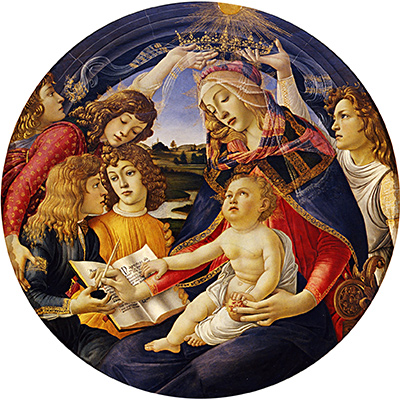
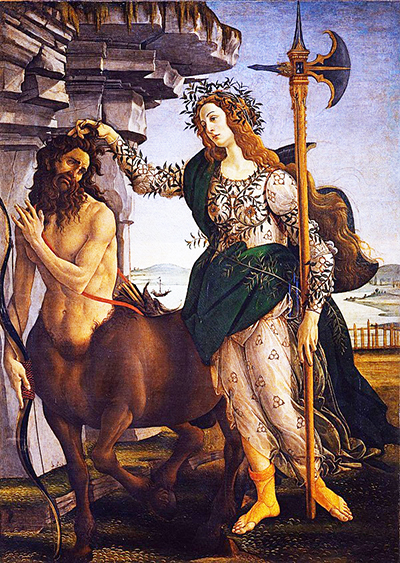
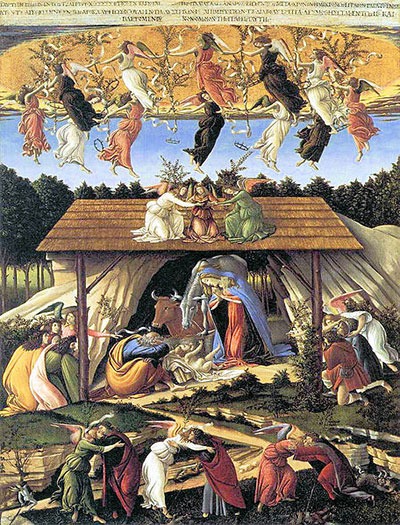
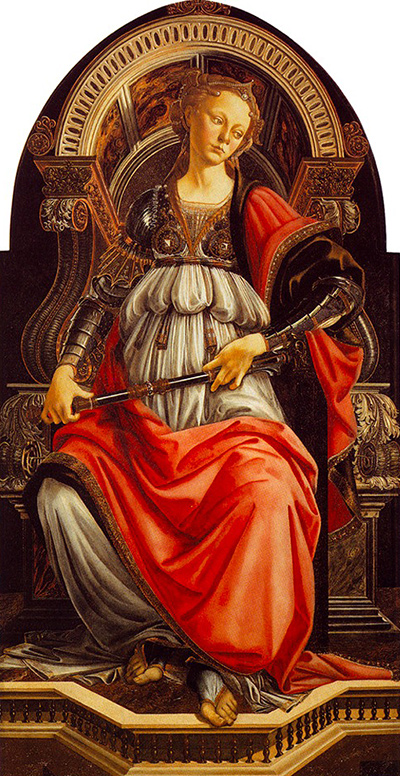
Published dates in Botticelli’s career
Fortitude
1470Primavera
c. 1480Mystic Nativity
1500The Flight into Egypt
c. 1495–1500 (INHA); 1510 (museum)Contents
- Annotated details
- A Journey Held Still
- What Matthew Says, and What the Painter Adds
- Botticelli, His Workshop and the Date
- From Florence to Paris
Annotated Details from The Flight into Egypt
Three details show how the painting holds a journey still. Select a numbered point, or read the close-up cards below.
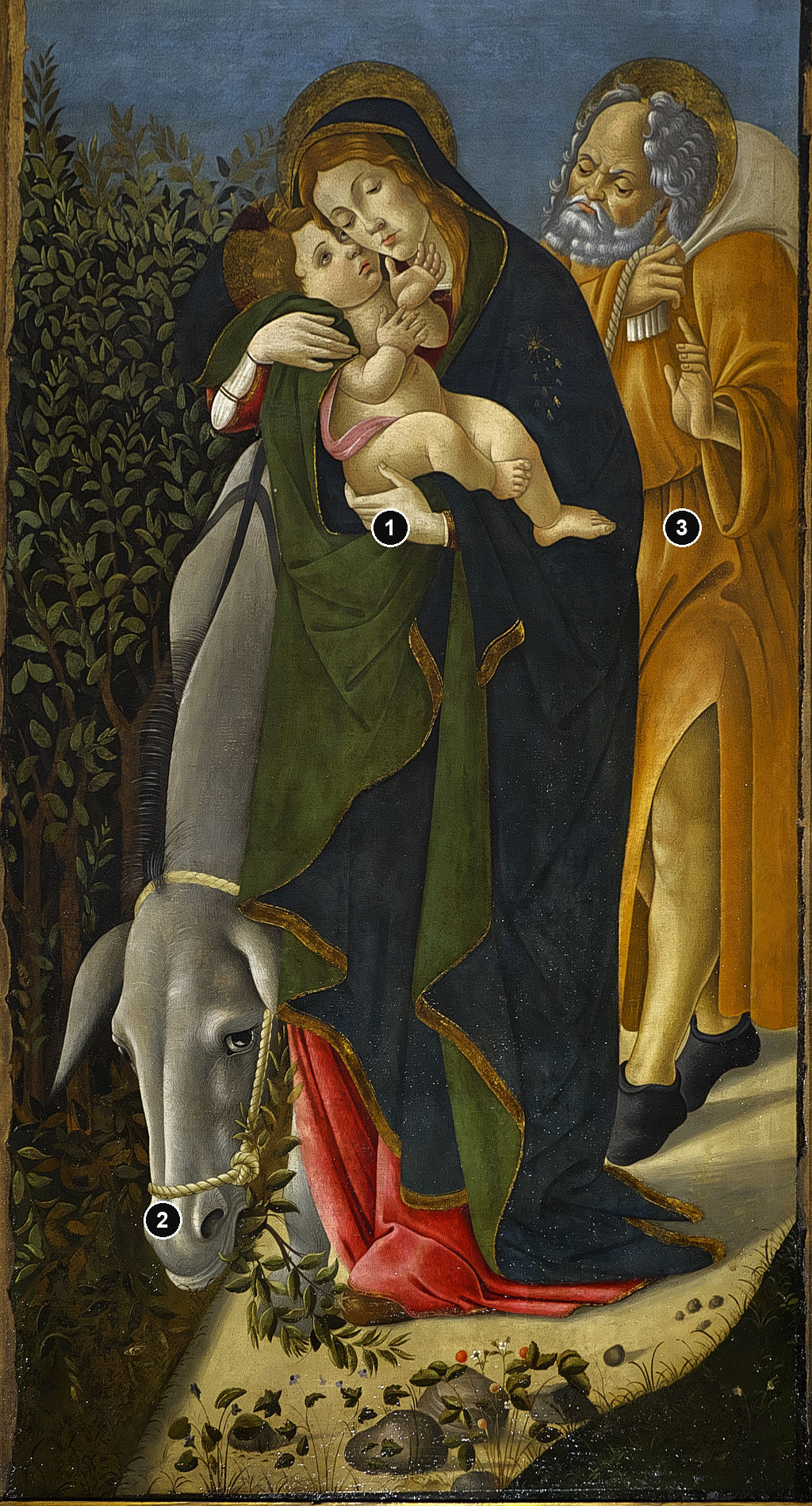
Details from THE FLIGHT INTO EGYPT
All three crops come from Jl FilpoC’s photograph of this same Jacquemart-André painting. They enlarge the relationships described in the article without proposing a new attribution for any painted passage.
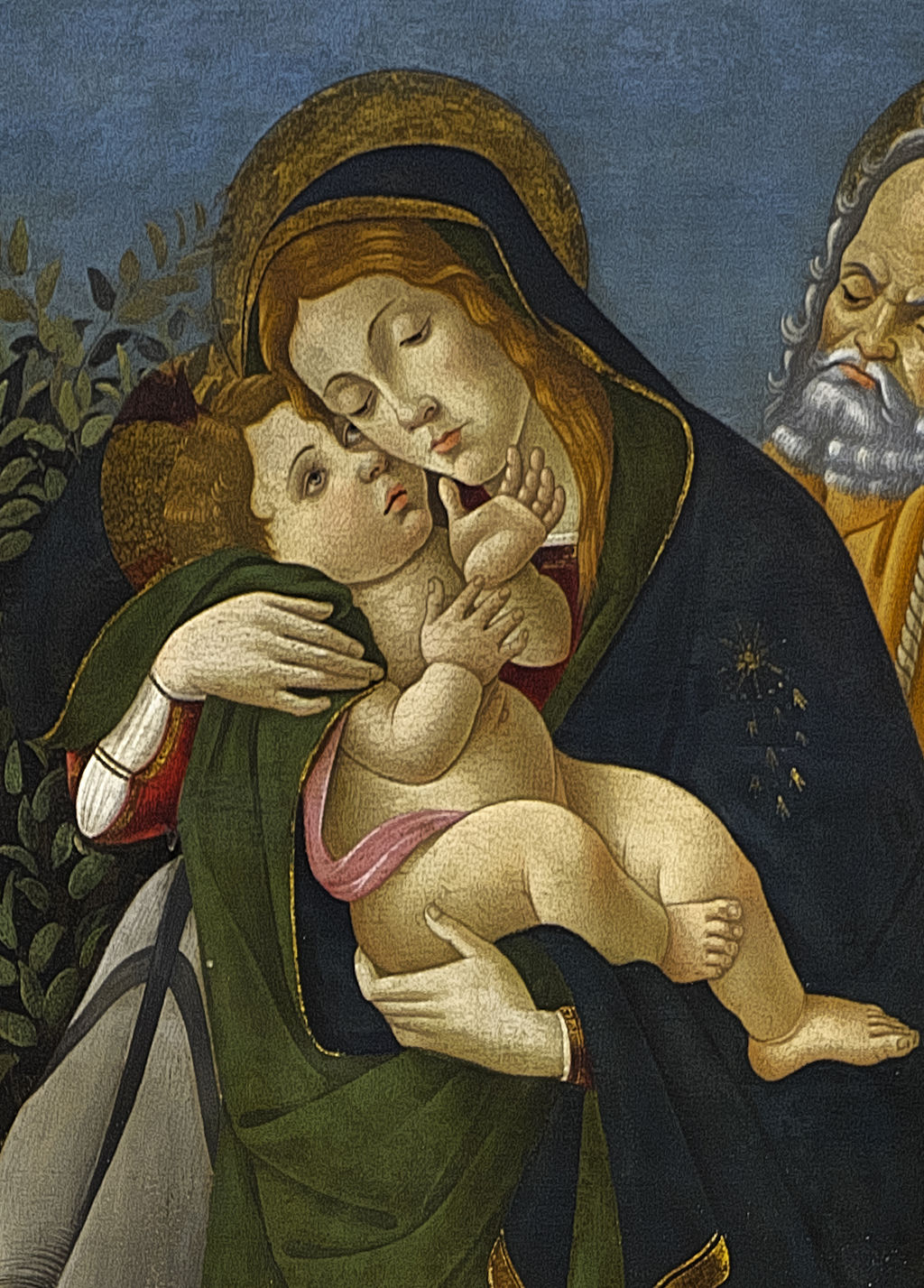
Mary and the Child
Mary bends toward Jesus as she carries him. His raised hand and her enclosing arms make protection visible while the journey remains outside the frame.
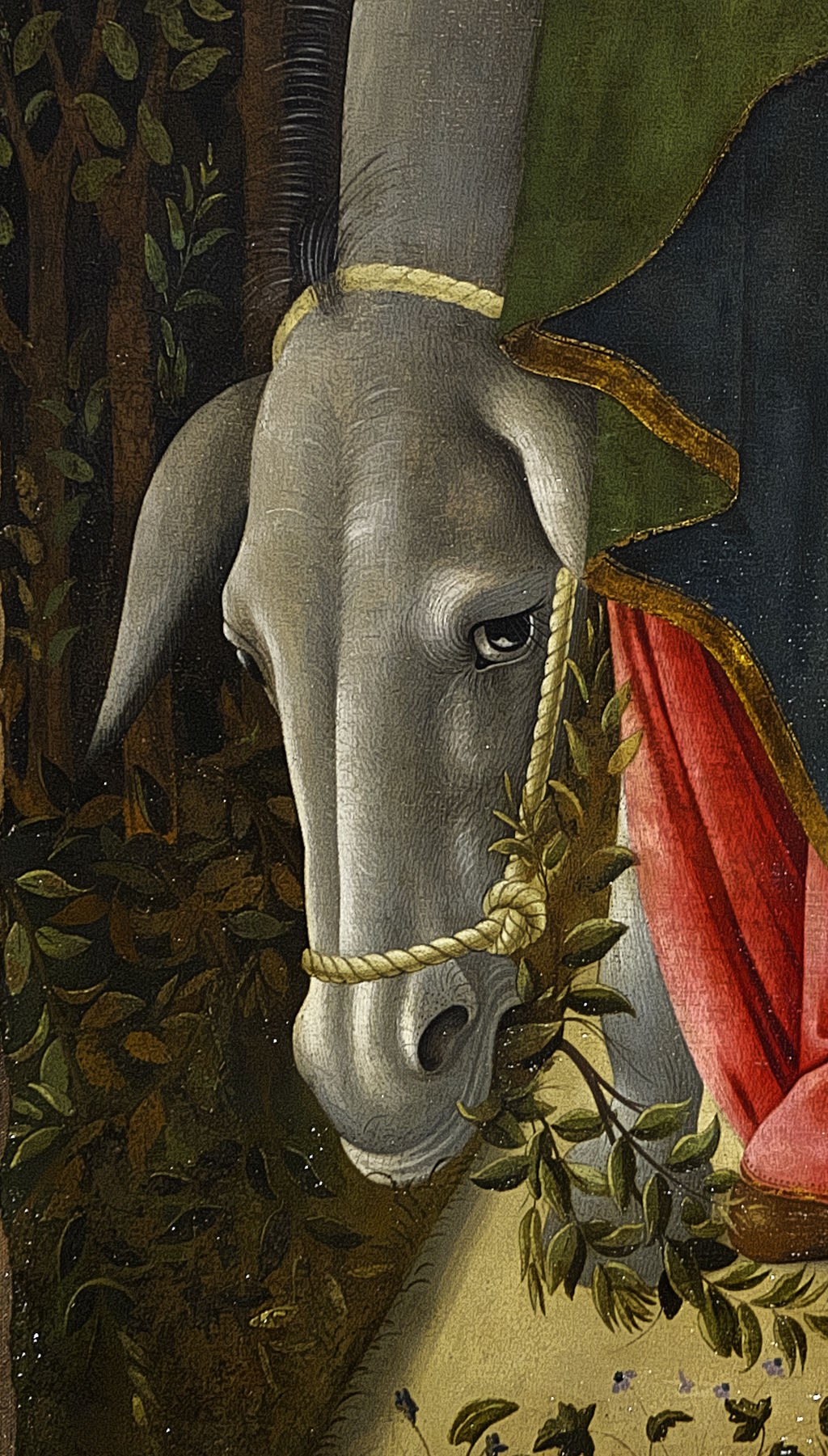
The grazing donkey
The animal lowers its head among leaves at the path edge. This ordinary pause is painted beside the biblical urgency of escape.
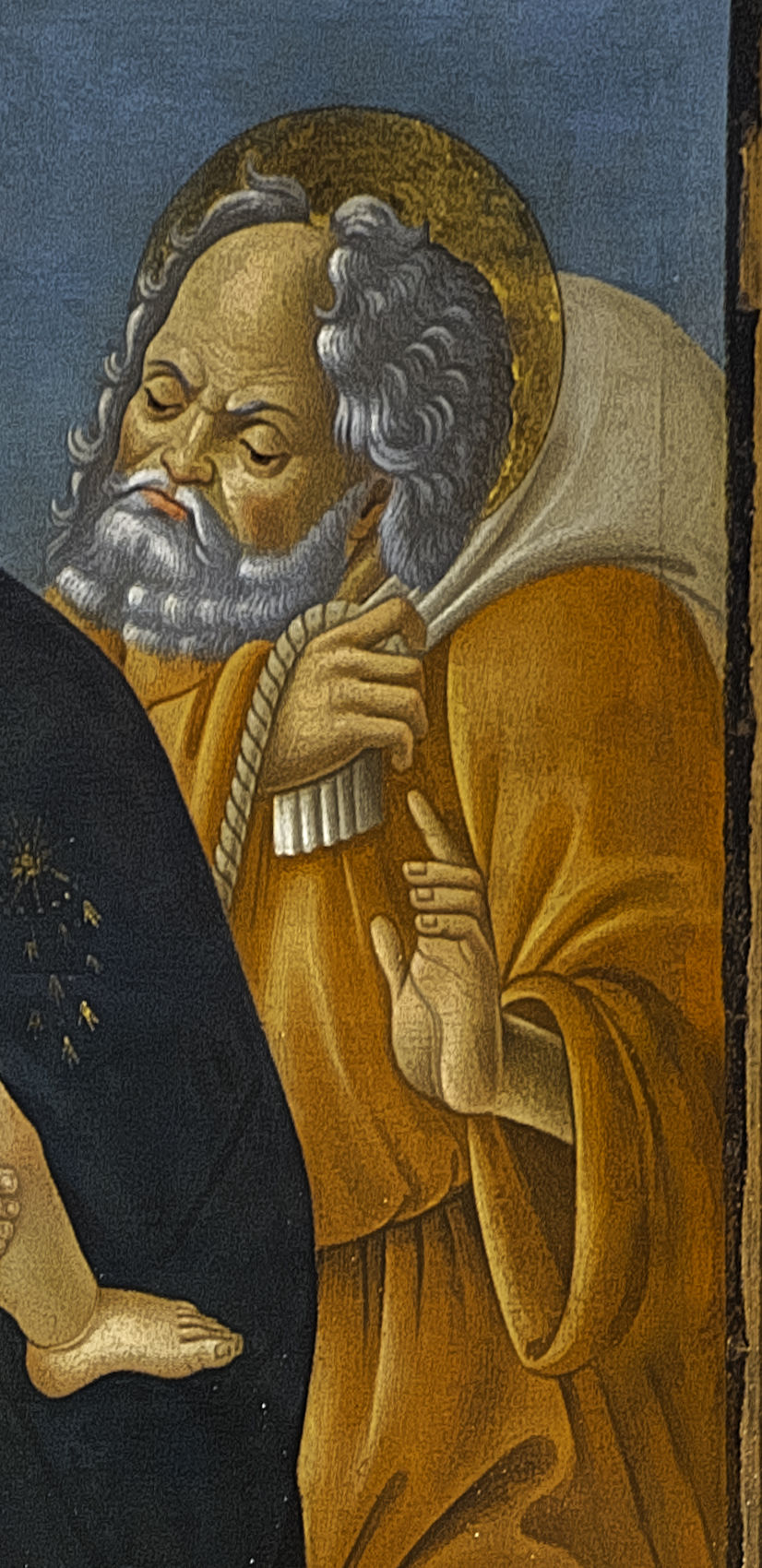
Joseph and the bundle
Joseph follows behind Mary with a bundle. The museum assigns his figure to an assistant, while other catalogues classify the whole painting more broadly as workshop work.
The museum and INHA agree on the dimensions and inventory identity but differ on date, support, binder and attribution. Their public records do not establish a named first patron or original room for the painting. A technical report on this canvas or panel would be needed to resolve the material conflict; it cannot be settled from photographs.[1][2][6]
A Journey Held Still
The painting is unusually narrow for a scene involving four bodies, including the donkey. Mary occupies the central foreground. Her blue outer garment descends almost to the bottom edge and makes a long, dark shape against the lighter path. The Child lies across her arms, turning toward her face. Their closeness holds the eye before the viewer notices where the journey might lead.[1]
The donkey is beside Mary rather than under her. Its grey head bends down at the lower left, with its muzzle among leafy stems. The museum draws attention to this departure from a common way of depicting the Flight: Mary is often shown seated on the animal with Jesus in her lap. Here she stands with him, while the donkey eats. That choice makes the journey feel temporarily suspended, though the picture does not identify a precise stopping place or hour.[1]
Joseph stands a little behind Mary on the right. His pale beard and ochre clothing separate him from her blue cloak, while his carrying bundle suggests the practical demands of travel. He is close enough to shelter the group but does not take the centre. The museum assigns the execution of his figure to an assistant. A viewer can describe his place in the composition without turning that museum assessment into a confident diagnosis of individual brushstrokes.[1]
The background gives little space for a distant itinerary. Dense foliage rises beside the donkey at left; a pale incline passes Joseph at right. A strip of blue sky opens above the figures. These elements tell us that the family is outdoors, but they do not map the road to Egypt. The tight frame keeps the threatened travelers near the viewer rather than setting them in a broad landscape to be surveyed.[1]
Small shifts in direction carry the scene. The donkey's head moves downward, Joseph's body faces forward, and Mary bends inward toward the Child. The infant's lifted hand touches the space between his face and hers. No one is pictured rushing. The contrast between the biblical urgency of escape and the image's quiet, protective contact gives the painting much of its emotional force.[1][5]
What Matthew Says, and What the Painter Adds
In Matthew's account, an angel appears to Joseph in a dream after the visit of the Magi and warns him that Herod intends to kill the child. Joseph takes Jesus and Mary to Egypt and remains there until Herod's death. The passage gives the danger and the destination. It does not describe a donkey, Mary's posture, the foliage, or a stop beside a path. Those are choices made within the visual tradition of the subject.[5]
The donkey makes the family recognizable as travelers, yet its grazing turns the scene toward ordinary bodily needs. Joseph's bundle does similar work: it suggests that people who flee must carry what they can. The Child is not isolated as a formal emblem; Mary has to hold him. These details make the story legible through care and movement without illustrating the threatening king or the angel's dream in the same image.[1][5]
The museum compares this unusual standing Mary with other Flight images in which she rides. That comparison is useful, but it does not prove Botticelli copied a particular earlier picture or that this work belonged to a known cycle. No surviving commission is cited by the museum. The painting can be read as one devotional image that concentrates on the family after Joseph's warning, while its exact original use remains unknown.[1][5]
Botticelli, His Workshop and the Date
The Musée Jacquemart-André places the work in 1510, the year Botticelli died. It states that older doubts about his authorship included an assumption that an awkward-looking passage betrayed another painter. Its present description attributes the painting to Botticelli and says an assistant helped with Joseph. It also rejects an older proposal that the work began on wood, was transferred to canvas and therefore must have been completed after Botticelli's death. The museum now catalogues it as oil on canvas.[1]
Other specialist records remain more cautious about authorship. Fondazione Zeri's record for inventory MJAP-P 1838 is headed as a work of Botticelli's workshop. The French national art-history inventory likewise calls it a late workshop copy, perhaps after a lost Botticelli prototype, while allowing that the master might have worked on parts of it. The French national conservation centre, discussing technical research on a different workshop Madonna, mentions the Jacquemart-André Flight as another probably workshop painting. That classification does not assign its figures to individual painters.[2][3][6]
The conservation centre's account contains a more specific finding than an attribution comparison. It says the Jacquemart-André Flight was analysed at the C2RMF and probably contains grains of soda glass in its paint. Its main study concerns the separate Champigny Madonna, where such particles were identified in sampled paint layers. For the Flight, the public article gives only the probable finding: it does not publish a sampling map, glass composition, binder results or a full treatment history. Tiny particles could help researchers compare workshop materials, but this brief reference cannot resolve the published canvas-versus-wood disagreement or identify the painter of Joseph. The underlying Flight analysis dossier remains the necessary next source.[3]
These descriptions are best kept side by side. The museum proposes Botticelli with help on Joseph; Zeri and INHA give the workshop the primary classification. None of these public sources supplies a complete map of hands or an original contract. Calling the picture simply “by Botticelli” would conceal a real question; dismissing the owner's present assessment would also flatten the evidence.[1][2][6]
The disagreement reaches beyond authorship. The museum prints 1510 and oil on canvas. INHA dates the work about 1495–1500 and records tempera on wood. The owner's rejection of an old wood-to-canvas transfer theory is not the same as an inspection of the physical object reported in the INHA entry; the two current material labels simply conflict. Neither published record cited here explains that discrepancy with a shared technical analysis. The facts panel therefore presents both rather than silently choosing one, while keeping the museum's precise 1510 label separate from INHA's earlier range.[1][6]
From Florence to Paris
The painting's first home is not known from these records. Its later collecting history is clearer. INHA records its purchase from the Florentine dealer Stefano Bardini on 20 October 1887, its place in the André collection in Paris and Nélie Jacquemart-André's 1912 bequest to the Institut de France. Palazzo Blu's account of a recent loan exhibition likewise places this work and another Jacquemart-André Botticelli-attributed Madonna in the late-nineteenth-century Florentine art market. The museum identifies Nélie as especially interested in Botticelli. Those facts give the painting a documented collecting history without supplying a Renaissance patron or devotional site.[1][4][6]
The painting remains in the Musée Jacquemart-André's collection, where the museum locates it in the Venetian Gallery. That room name describes its modern display, not its place of manufacture or first use. Its vertical shape, quiet concentration and open attribution all travel with it into the present: a familiar biblical journey becomes a close exchange between Mary and her child, supported by Joseph and paused beside a working animal.[1][6]
Look again at the donkey's lowered head and the Child's raised hand. One gesture points to the practical need to stop; the other draws attention back to the people at the centre of the story. Whether a viewer follows the museum's mixed Botticelli-and-assistant attribution or the workshop classification, those relationships are visible in the same image. The painting holds flight and shelter together in a single, still moment.[1][2][5][6]
Botticelli and related artworks
Discussion
Look again at the details and evidence discussed above. Which part of the painting changes most when you know its history?
These prompts invite close looking and source-led questions rather than a single settled interpretation.
Reader Insights
How does the grazing donkey change your sense of a journey called a flight?
Which figure appears most active, and which provides a pause?
How should the museum and workshop attributions shape a description of this image?
Join the Conversation
Share an observation or question about the painting below.
References
- Musée Jacquemart-André, “The Flight into Egypt,” current object page, accessed 29 September 2026 View source.
- Fondazione Federico Zeri, “Filipepi Alessandro (Sandro Botticelli), bottega, Fuga in Egitto,” work record 15522, inventory MJAP-P 1838, accessed via indexed catalogue text 29 September 2026 View source.
- Centre de recherche et de restauration des musées de France, “La Vierge à l’Enfant et le jeune Saint Jean-Baptiste: étude d'œuvre,” 25 October 2023, paint-material discussion stating that the Jacquemart-André Flight was analysed at C2RMF and probably contains soda-glass particles; its published investigation and images concern a different Champigny Madonna. Consulted 1 October 2026 View source.
- Palazzo Blu, “Botticelli à Pise: Deux œuvres du musée Jacquemart-André de Paris,” 2025–26 exhibition notice, accessed 29 September 2026 View source.
- United States Conference of Catholic Bishops, “Matthew 2,” verses 13–15 and surrounding narrative, accessed 29 September 2026 View source.
- Institut national d'histoire de l'art, RETIF, “La Fuite en Égypte,” object MJAP-P 1838, record updated 1 April 2025, accessed 29 September 2026 View source.
- Image credit. Musée Jacquemart-André, Paris, MJAP-P 1838. Photo: Jl FilpoC, CC BY-SA 4.0; resized from the original. This derivative is offered under CC BY-SA 4.0 View source · View source.
- Image credit. Photo: Jl FilpoC, CC BY-SA 4.0. The numbered image and three crops were resized or cropped from the photographer’s original and are offered under CC BY-SA 4.0 View source · View source.