by Tom Gurney
Tom Gurney BSc (Hons) is an art history expert with over 20 years experience
Published on June 19, 2020 / Updated on October 2, 2026
Email: tomgurney1@gmail.com / Phone: +44 7429 011000
Saint Sebastian
Saint Sebastian stands almost the full height of Botticelli’s narrow painting. His hands are bound behind a tree trunk, and arrows pierce his body. Yet the soldiers who shot them are tiny figures far below and behind him. They can be missed on a quick look. Botticelli makes the injured saint, rather than the violence of the archers, the scene’s main presence.[1]
The painting dates to 1474 and was made for the church of Santa Maria Maggiore in Florence. It is now in Berlin’s Gemäldegalerie (1128). The panel measures 195 × 75 centimetres, so the figure was close to life size for someone standing before it. Its arched top and unusual height make it visually distinct from a square or wide altarpiece. They also suit the vertical emphasis of Sebastian’s body and the tree to which he is tied.[1]
At a glance
- ArtistSandro Botticelli
- TitleSaint Sebastian (Der heilige Sebastian)
- Date1474
- Mediumtempera on poplar panel, according to the Zeri catalogue; the Berlin record specifies the poplar support
- Dimensions195 × 75 cm
- Original settingSanta Maria Maggiore, Florence
- Current collectionGemäldegalerie, Staatliche Museen zu Berlin
- Inventory number1128
Where this work sits in Botticelli’s career
Fortitude
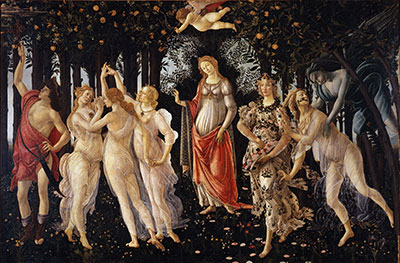
1470Primavera
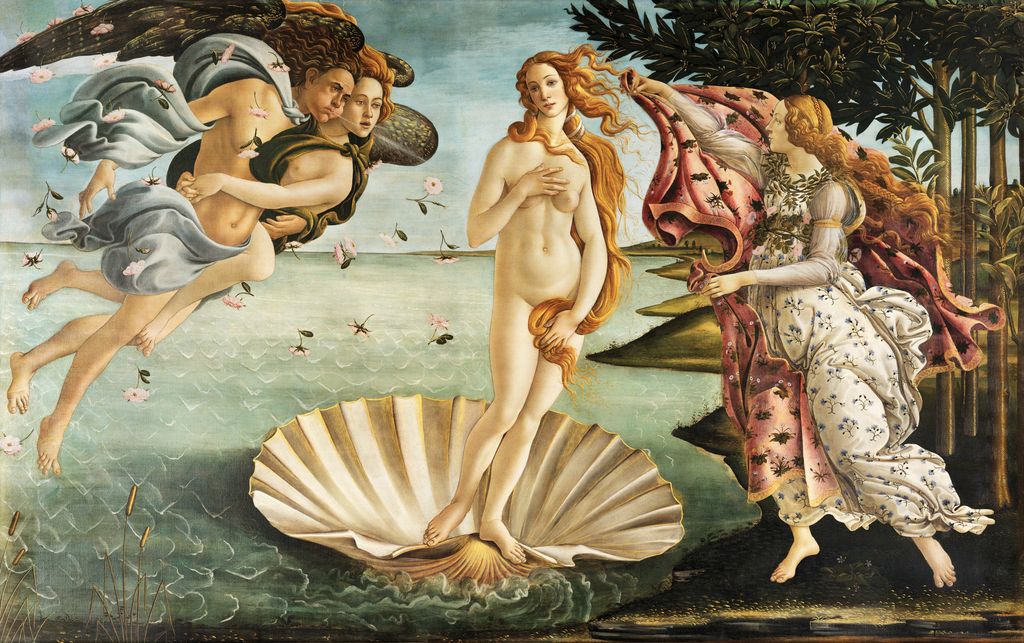
c. 1480The Birth of Venus
c. 1485Saint Sebastian
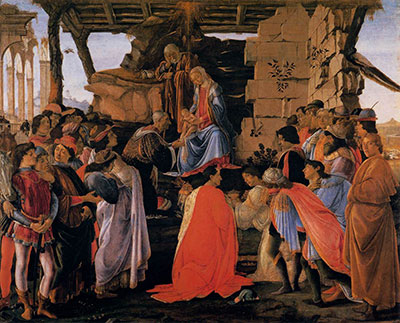
1474The Mystical Nativity
c. 1500Contents
- A Saint Who Survived the Arrows
- The Small Figures Beyond Him
- In Santa Maria Maggiore
- Another Florentine *Saint Sebastian*
- A Drawing and a Disputed Connection
- From Florence to Berlin
The Berlin museum identifies Botticelli as the painter and records 1474 as the date. Fondazione Federico Zeri gives a slightly broader 1473–74 range, but agrees on the object, dimensions and former church. The difference does not justify treating this picture as a separate work.[1][2]
A Saint Who Survived the Arrows
According to Sebastian’s legend, he served as a Roman officer during the rule of Diocletian. When his Christian allegiance became known, he was bound and shot by archers. The arrows did not kill him; after recovering, he confronted the emperor again and was killed by another means. Botticelli shows the first attack, not the saint’s final death. The arrows are real injuries within the story, but the viewer is looking at a man who will survive this ordeal.[1][3]
That knowledge changes the mood of the painting. Sebastian’s head tilts and his gaze drops, but his body remains upright. His arms curve back behind the trunk, leaving the chest and abdomen exposed. The white cloth around his hips catches light against the warmer tones of his skin. Several arrows enter from different directions; their dark shafts interrupt the smooth modelling of his torso and legs. Botticelli does not hide the assault, yet the saint’s stillness dominates it.[1]
The tree rises straight through the centre. Its top has been cut back to a rough stump above Sebastian’s head, and its lower cut forms a support beneath his feet. These two broken ends echo the wounds made by the arrows. The strong vertical line also keeps the figure in place: Sebastian is bound to the trunk, but the trunk holds the whole painted structure together.[1]
The saint’s feet make the scene feel close to the viewer. One rests on the dark cut surface of the tree; the other stretches towards a pale branch at the lower edge. The arches of his feet and the twist of his hips give movement to a pose that might otherwise seem rigid. His face is comparatively quiet. There is no cry, and his lowered gaze does not lead the eye towards the soldiers. Botticelli lets the viewer look back and forth between physical strain and composure.[1]
The Small Figures Beyond Him
Only after studying Sebastian’s body does the distant action become clear. At the lower left, groups of small armed figures occupy the landscape. The Berlin museum identifies the archers in the background. Botticelli places them far from the saint they have wounded, reducing the apparent power of the attackers in the picture. At the opposite side, a path winds past rocks and trees. Buildings and a pale horizon open across the distance.[1]
This arrangement gives two scales to one event. The soldiers belong to the story of an execution; Sebastian belongs to the immediate space of a devotional image. Their difference in size does not mean they were unimportant to the story. It directs attention to the saint’s endurance before asking how the attack took place. The distant city and low horizon make his body seem taller still.[1]
The arch at the top frames his head against a band of sky. In the museum’s full photograph, the painted edge is visible all around the curved upper field. The arch is part of the surviving panel’s shape, not a wide decorative surround. It concentrates the image above the saint’s shoulders and helps bring the viewer’s attention back from the busy landscape below to his face.[1]
In Santa Maria Maggiore
The Berlin record says the work was painted for Santa Maria Maggiore in Florence and hung on the first pier at the right. Its tall, narrow format makes sense in that architectural setting: it would present a standing saint within the church rather than a broad narrative scene above an altar. The recorded location is more precise than a general statement that Botticelli painted it “for a Florentine church,” but it does not tell us the exact height at which it was fixed or who ordered it.[1]
An early textual witness helps explain both the church location and the date. The writer known as the Anonimo Gaddiano recorded a Saint Sebastian by Botticelli on a panel at a column in Santa Maria Maggiore, made in January 1473. Herbert Horne printed the passage and pointed out that the Florentine calendar began its new year on 25 March: that January is January 1474 in modern dating. This brings the early account into line with Berlin's 1474 label. The witness describes the work and a month of making; it does not name a donor, give an exact installation day or establish that the surviving panel was commissioned by Lorenzo de' Medici.[6][1]
Sebastian had a wider role in late medieval and Renaissance devotion. People sought his protection against plague, connecting his survival of arrow wounds with hope of surviving disease. The National Gallery in London describes that association as part of the saint’s cult. It helps explain why images of Sebastian mattered to worshippers, but no surviving evidence cited by the Berlin museum identifies plague as the specific reason this panel was commissioned. The picture’s church setting and subject can be stated securely; a named patron or immediate crisis cannot.[1][3]
Its large figure would have been encountered differently there from in a modern gallery or a small screen image. A worshipper moving through Santa Maria Maggiore could see the saint from a distance and then approach the arrows, face and feet. The original route through the church is no longer available to us, but the scale and the recorded pier placement make that change in viewing distance a reasonable way to think about the work.[1]
Another Florentine Saint Sebastian
Antonio and Piero del Pollaiuolo completed a large Martyrdom of Saint Sebastian in 1475, now in the National Gallery, London. It is a separate painting, made for an oratory connected to Florence’s Santissima Annunziata, and much wider than Botticelli’s panel. The Pollaiuolo brothers spread their archers around the bound saint, giving the act of shooting a prominent place in the composition.[4]
The close dates and shared subject invite comparison. Botticelli puts the archers far away and reserves most of the painting’s height for a single body. The Pollaiuolo work gives more space to the attackers and the coordinated action of their bows. Neither contrast proves that one painting was a direct reply to the other. It shows how two Florentine workshops could turn the same episode into different viewing experiences.[1][4]
A Drawing and a Disputed Connection
A small figure study in the Louvre, INV 2693 recto, shows a standing nude with his hands joined behind his back. The pose invites comparison with Botticelli's bound Sebastian. The Louvre records it as metalpoint, possibly silverpoint, heightened with white on brown-prepared paper, only 18.4 × 9.3 centimetres. Such a sheet can show how an artist explored a body at a much smaller scale than the nearly life-size panel, but resemblance alone cannot identify the draughtsman or establish that it was made first.[5]
The attribution has a long history. The Louvre currently files the sheet under the school of Filippino Lippi. Earlier scholars have assigned it to Filippino or Davide Ghirlandaio; others connected it with Botticelli's workshop. Furio Rinaldi argued in 2023 that Botticelli himself drew it from a model as a preparation for the Berlin painting. The Louvre's commentary records that proposal alongside the rival views, and also notes related studies in London and Florence. One interpretation therefore makes the sheet a preparatory study; another sees a young Filippino drawing after Botticelli's finished Sebastian. The relationship is valuable even while its direction is unsettled: it reveals how a standing body and bound arms could be studied, copied and rethought across Florentine workshops.[5]
From Florence to Berlin
The Berlin museum records the panel’s move into its collection in 1821, when it was acquired from Edward Solly’s holdings. Fondazione Zeri also lists Santa Maria Maggiore as its former location. These anchors establish the work’s church origin and its present collection; they do not fill every step between its Florentine use and the nineteenth-century purchase.[1][2]
The full-height image is best approached from its two ends. At the top, Sebastian’s bowed face is framed by the arch and pale sky. At the bottom, the small armed figures and landscape are almost another world. The arrows cross the space between them. Botticelli lets the viewer register the injuries while keeping the saint’s standing form steady, a balance that makes the painting more than a record of violence.[1]
Botticelli and related artworks
Discussion
Look again at the details and evidence discussed above. Which part of the painting changes most when you know its history?
These prompts invite close looking and source-led questions rather than a single settled interpretation.
Reader Insights
How does the size difference between Sebastian and the archers affect the story?
Which details of the tree and arrows are easiest to see when you look closely?
How might the recorded pier setting have changed the way a visitor encountered the panel?
Join the Conversation
Share an observation or question about the painting below.
References
- Staatliche Museen zu Berlin, Gemäldegalerie, “Der heilige Sebastian,” inv. 1128, current object record, updated 3 July 2026, accessed 29 September 2026 View source.
- Fondazione Federico Zeri, “Filipepi Alessandro, San Sebastiano,” object catalogue, accessed 29 September 2026 View source.
- National Gallery, London, “St Sebastian” and “Saint Sebastian,” glossary and Giorgio Schiavone object entry, accessed 29 September 2026 View source View source.
- National Gallery, London, “Antonio del Pollaiuolo and Piero del Pollaiuolo, The Martyrdom of Saint Sebastian,” NG292, current object record, accessed 29 September 2026 View source.
- Musée du Louvre, “Homme nu, debout, les mains jointes derrière le dos : saint Sébastien ?”, INV 2693 recto, current Arts graphiques record, physical description and history of Filippino, Ghirlandaio, Botticelli-workshop and 2023 Botticelli attribution proposals; consulted 1 October 2026 View source.
- Herbert P. Horne, Alessandro Filipepi, Commonly Called Sandro Botticelli, Painter of Florence, 1908, transcription and discussion of the Anonimo Gaddiano's Santa Maria Maggiore notice and Florentine-to-modern January date conversion; indexed text consulted 1 October 2026. The original manuscript of the Anonimo has not been inspected for this page View source.
- Image credit. Sandro Botticelli, Saint Sebastian, 1474. Staatliche Museen zu Berlin, Gemäldegalerie, inv. 1128. Photo: Jörg P. Anders. Public Domain Mark 1.0 View source · View source.