 by Tom Gurney
Tom Gurney BSc (Hons) is an art history expert with over 20 years experience
Published on June 19, 2020 / Updated on August 21, 2026
Email: tomgurney1@gmail.com / Phone: +44 7429 011000
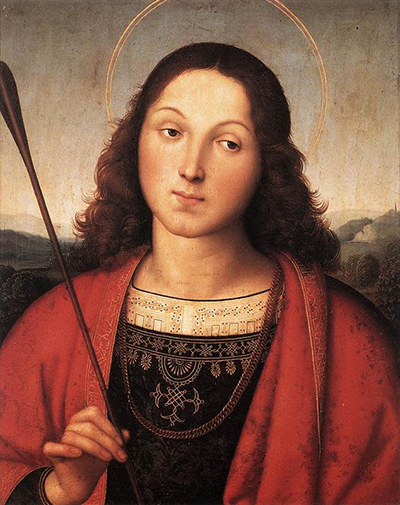
Raphael's Saint Sebastian does not show the martyr tied to a tree, pierced by a volley of arrows and exposed to public violence. It presents an exquisitely dressed young man at half length. He turns gently before a luminous landscape and holds a single arrow between his fingers. Gold and silver embroidery glints against white, blue and red cloth. His distant gaze is calm enough that the weapon can initially be missed.[1][2]
The format changes everything. An instrument of torture becomes a slender attribute, and a scene of bodily suffering becomes a sacred likeness. The Italian cultural-property record calls the panel a work for private devotion, while the Fondazione Zeri catalogue describes it as a “portrait of a young man in the guise of Saint Sebastian.”[1][3] Those formulations need not compete. Raphael makes a saint recognisable through the visual intimacy of portraiture without giving the youth a secure historical name.
Painted when Raphael was still in his late teens or around twenty, the panel belongs to about 1501–03. Its refined surface carries the courtliness of Urbino and the graceful clarity associated with Perugino, yet the projecting hand and arrow show the young painter making a shallow format newly active.
At a Glance
- ArtistRaphael
- TitleSaint Sebastian
- Dateabout 1501–03; sources range from about 1501–02 to 1502–03
- Medium/supporttempera and oil on panel in Accademia Carrara-linked data
- Approximate dimensions45.5 × 36 cm
- Formathalf-length sacred figure resembling a courtly portrait
- Identifying attributea single arrow held between the fingers
- Clothingblue tunic, gold-and-silk-worked white garment, gold chain and red mantle with decorated border
- Probable functionprivate devotion
- Acquired by Guglielmo Lochis1836
- Entered the Accademia Carrara selection1866
- Present collectionAccademia Carrara, Bergamo
- Current national inventory number81LC00207
- Older catalogue number647 (314)
Contents
- Sebastian's martyr story
- The arrow as attribute
- A face of courtly beauty
- Saint, portrait or sacred portrait?
- Blue, white, gold and red
- The gold chain
- The red mantle
- Landscape behind a close figure
- The hand that enters the foreground
- A young artist choosing among models
Sebastian's martyr story
Sebastian was venerated as an early Christian soldier and martyr. Tradition says he served in the Roman imperial guard, secretly aided Christians and was condemned to be shot with arrows when his faith was discovered. He survived that first execution attempt, confronted the emperor again and was finally killed.
Artists commonly chose the arrow episode. A nearly nude Sebastian bound to a post allowed them to join sacred endurance with the study of an exposed male body.
Raphael selects a different moment—or, more accurately, no narrative moment at all. The arrow is present, but no archer, rope, wound or execution ground appears.
The saint exists outside chronological action. He holds the sign through which viewers remember his suffering, but he is not suffering before them.
This transformation suits a small private image. The beholder can contemplate steadfastness through a face and object rather than witnessing violence.
The arrow as attribute
Sebastian's arrow is narrow and delicately held. It rises at an angle from his hand, entering the space beside his shoulder.[1][2]
Because only one arrow appears, it works less like ammunition than a label. It identifies the young man while allowing every other feature to resemble an elegant portrait.
The hand projects toward the picture surface. Fingers curl around the shaft, creating a small but decisive depth cue.
Raphael uses the attribute to animate the close format. Face and shoulders remain composed; hand and arrow move outward and diagonally.
The weapon is also visually paradoxical. Its point evokes injury, yet it is handled with effortless control. The saint has converted an instrument used against him into a sign of identity.
The absence of a wound prevents viewers from locating martyrdom only in damaged flesh. Endurance resides in bearing and memory.
A face of courtly beauty
The youth's oval face, smooth skin and carefully ordered hair create a type of beauty that can appear androgynous. Accademia Carrara-linked interpretation notes that his delicate features may seem feminine and describes his gaze as dreamlike or absorbed in thought.[2]
Such delicacy should not become a claim that Raphael used a woman as model. The painting offers no evidence for the model's sex, identity or biography beyond the represented male saint.
The head inclines and turns slightly, avoiding the fixed frontal challenge of a ruler's portrait. Eyes seem to travel past the immediate viewer.
That distance is devotional. Sebastian is near in scale but mentally elsewhere, inviting contemplation rather than conversation.
His youth also matters. Physical vulnerability and expensive dress coexist, making martyrdom a choice sustained by inward constancy rather than rough heroic age.
Saint, portrait or sacred portrait?
Fondazione Zeri catalogues the subject as a portrait of a young man dressed as Saint Sebastian.[3] The phrase recognises the picture's portrait-like character without identifying a sitter.
At half length, with contemporary clothing, a landscape and a hand-held token, the work resembles court portraits and images in which real people assumed sacred or mythic identities.
Yet the traditional title Saint Sebastian remains appropriate. There is no secure documentation that a named patron sat “as” the martyr, and the arrow performs a devotional rather than heraldic role.
The most productive reading allows both modes. Raphael makes Sebastian present as an ideal young courtier and makes the courtly youth sacred through the arrow.
This ambiguity is not a gap to fill with a guessed name. It is the painting's central achievement: sanctity approaches the beholder through the visual language of individual likeness.
Blue, white, gold and red
The Italian national record describes a blue tunic, a white garment worked with gold and silk, a gold chain and a red mantle edged with decoration.[1]
These textiles occupy much of the panel. Their materials make the saint appear privileged, refined and contemporary.
The white fabric creates a bright field beneath the face, while embroidery rewards close examination. Blue cools the costume; red expands across the shoulder and outer edge.
Gold links clothing, chain and sacred value without requiring a gold background. Preciousness is embodied in wearable objects.
Raphael's cloth does more than demonstrate skill. It creates a social language appropriate to a young court. Sebastian's spiritual nobility becomes visible as elegance, self-command and cultivated surface.
The arrow interrupts that splendour. Without it, the image might be read simply as a beautiful youth. With it, luxury is placed under the sign of sacrifice.
The gold chain
A slender chain rests across the saint's clothing. It helps mark rank and gives a minute metallic counterpoint to embroidery.[1]
Chains in portraits can indicate wealth, favour or office, but no surviving evidence assigns a particular order or title here. Its safest meaning is social and visual rather than institutional.
The chain follows the body's surface, while the arrow cuts across or projects from it. One adorns; the other identifies.
Their conjunction makes the painting's sacred-portrait ambiguity tangible. A courtly ornament and a martyr's instrument occupy the same carefully dressed body.
Light on gold also gives the small panel a changing appearance as viewers move. The work asks for the close attention associated with precious personal possessions.
The red mantle
The mantle wraps the saint's shoulder and creates the strongest colour mass. Its decorated border turns the edge into a controlled curve around his upper body.[1][2]
Red often carries associations of blood and martyrdom, but the sources do not require a single symbolic equation. Here it first acts as fabric: warm, weighty and sumptuous.
Its colour can nevertheless deepen the arrow's religious resonance. The painting keeps suffering indirect, allowing hue and attribute to carry what wounds do not show.
The mantle also distinguishes Sebastian from the pale sky and landscape. It holds the half-length body in the foreground.
Folds are orderly rather than windblown. Unlike Saint George's cape in battle, this cloth confirms stillness and inward control.
Landscape behind a close figure
Sebastian stands before a clear, luminous landscape of trees, water or distant ground and pale sky.[1][2]
The setting gives air around the head and prevents the image from becoming an isolated bust. It connects personal devotion with an ordered world.
Raphael learned the value of serene, receding landscape within the artistic world of Perugino. An official Mantua museum account notes that Perugino's influence remains evident in this early Saint Sebastian.[4]
Influence appears in atmosphere, graceful head and the quiet interval between near body and far land. It is not a reason to deny Raphael's authorship or invention.
The landscape's horizontal calm makes the arrow's diagonal more noticeable. Depth behind and projection before operate on either side of the saint.
Nothing in the setting locates the martyr at Rome or at a known execution site. Its role is contemplative rather than topographical.
The hand that enters the foreground
The hand holding the arrow is one of the painting's most active passages. It emerges against costume and landscape, making fingers, knuckles and shaft readable at close range.
At half length, hands can reveal a painter's ability to turn pose into meaning. Raphael does not let the attribute float independently; it is physically held.
The hand's foreshortening also hints at the spatial ambition that would soon become central to his Florentine work. A calm Peruginesque figure gains a more assertive near plane.
The gesture is delicate enough to match the face. Sebastian neither grips the arrow in anger nor lets it fall. His controlled touch shows possession of the martyr sign.
Viewers are brought close to the object without being threatened by it. The arrow points through space while the saint's bearing neutralises fear.
A young artist choosing among models
Accademia Carrara's 2018 exhibition used the panel to explore Raphael's roots in Urbino, Perugia and Siena. It placed his early work among Giovanni Santi, Pedro Berruguete, Perugino and Pinturicchio, as well as antiquity.[5]
This framework is more useful than searching for one exclusive master. Raphael grew within a network of courtly and workshop models.
From Urbino came the culture of refined likeness, learned patronage and precious small objects. From Perugino's sphere came graceful figures, lucid landscape and devotional sweetness. Other central Italian painters offered colour, ornament and narrative intelligence.
The panel demonstrates selection. Raphael could make a young saint delicate without making him weak, sumptuously dressed without losing sacred purpose, and still without becoming inert.
His early independence lies in coordination. Familiar elements are made to serve a newly concentrated relationship between face, hand and arrow.
Why the date varies
The Italian national catalogue dates the panel about 1501–02.[1] Accademia Carrara's exhibition materials have used 1502–03 or approximately 1503.[5][6] Fondazione Zeri gives a broader 1503–05 range.[3]
These differences reflect stylistic dating. No surviving contract or painted year fixes the panel to one season.
The work's youthful face, Peruginesque clarity and growing spatial confidence can be ordered relative to other paintings, but Raphael developed quickly and did not abandon one manner overnight.
Using about 1501–03 provides an honest public range while keeping the Carrara's preferred early chronology visible. A reader needing a single label can use “about 1502.”
Precision would be misleading if it hid the basis of knowledge. The important historical fact is that the panel belongs before Raphael's mature Florentine and Roman periods.
Medium and measurement differences
Accademia Carrara-linked data describes tempera and oil on a wooden panel and gives 45.5 by 36 centimetres.[2] The Italian national record simplifies the medium to oil on panel.[1]
A recent National Gallery loan list measured the object at 45.1 by 36.5 centimetres.[7] Fondazione Zeri rounds it to 45 by 36.[3]
Small differences can arise from whether cataloguers measure the painted surface, exposed surface, panel or a specific conservation state. They do not indicate multiple paintings.
The most responsible summary is approximately 45.5 by 36 centimetres, tempera and oil on panel, while preserving collection and inventory number as the strongest identity controls.
The mixed-medium description also suits an early period when tempera practice and oil handling could coexist rather than form mutually exclusive systems.
Private devotion
The national catalogue identifies the work as a sacred image intended for private use.[1] Scale, half-length format and detailed costume support that function.
A private owner could approach closely enough to see the arrow point, chain links and textile pattern. Repeated viewing would allow Sebastian's calm to become an ethical model.
The picture does not require a church altar or public narrative sequence. It can stand alone as a focus for prayer or reflection.
Private does not necessarily mean domestic in a modern sense. Such a panel might belong in a palace chamber, study, small chapel or devotional grouping.
Without an early commission record, the precise first room and owner remain unknown. Function can be inferred more confidently than patron identity.
The 1836 Lochis purchase
Guglielmo Lochis acquired the Saint Sebastian from Carlo Francesco Longhi in 1836.[1] The sale was accompanied by written attestations from numerous artists and connoisseurs, including Francesco Hayez and Giuseppe Diotti.[1]
This body of opinion reveals the stakes of attribution in the nineteenth-century market. Buyers sought documentary reassurance when acquiring a small picture under a great name.
The acquisition also coincided with renewed fascination with Raphael after the rediscovery of his remains in the Pantheon in 1833. Accademia Carrara's exhibition has connected the panel's arrival with that wider revival.[5]
Lochis treated the painting as a jewel of his collection. His catalogues and correspondence allow the collection's growth to be followed in unusual detail.[8]
The panel's portrait-like refinement suited nineteenth-century admiration for Raphael as an ideal of grace.
From the Lochis collection to Accademia Carrara
Lochis assembled roughly 550 paintings and displayed them in a neoclassical villa at Crocetta di Mozzo. His will sought a public future for the collection after his death in 1859.[8]
The municipal process was complicated. In 1866, after negotiation with the heirs, 240 selected paintings entered Accademia Carrara. Giovanni Morelli helped guide the selection.[8]
The Saint Sebastian was among them and remains one of the museum's most celebrated works. Its current national inventory number is 81LC00207, while older catalogues record 647 (314).[1][3]
This civic afterlife differs from the royal paths of Raphael's Saint Georges. A private Brescian-area collector's small panel became a defining object of Bergamo's public museum.
The painting's status also shaped later art. Accademia Carrara has used it as the centre of exhibitions examining both the young Raphael and the artist's continuing cultural myth.[5][6]
An image that resists spectacle
Sebastian's legend offered pain, exposure and miraculous survival. Raphael chooses restraint instead.
The arrow is not removed from meaning; it is isolated so that viewers must bring the story to it. The saint's composure becomes more important than the mechanics of execution.
Rich clothing also protects the body from spectacle. Spiritual courage is communicated through the face and hand, not through anatomical display.
This makes the panel unusually intimate. The viewer is not part of a crowd at martyrdom but the recipient of a close, quiet presence.
Raphael's decision demonstrates that devotional intensity need not depend on dramatic violence. Memory can make one slender object sufficient.
How to look at Saint Sebastian
Begin with the arrow. Ask how long it takes to recognise a martyr in what first appears to be a courtly youth.
Move from the projecting hand to the distant gaze. Nearness and inward withdrawal coexist.
Inspect the white-and-gold garment, chain and red border. Material splendour establishes a social world around sacred identity.
Then look into the landscape. Its quiet recession prevents the half-length body from feeling confined.
Finally, consider the Zeri title: a young man “in the guise” of Sebastian. The phrase describes the visual ambiguity without proving a sitter.
Why the painting matters
Raphael's Saint Sebastian is a remarkable early experiment in sacred portraiture. It removes violence while keeping martyrdom legible, replaces exposed flesh with courtly fabric and gives a traditional saint the psychological distance of an individual likeness.
The panel also records the young artist's environment. Urbino's refinement, Perugino's grace and Raphael's own spatial curiosity meet in the arrow-bearing hand.
Its nineteenth-century history adds another layer. Lochis acquired it during a revival of Raphael's fame, and the panel helped shape Accademia Carrara's public identity.
Most importantly, the work teaches slow recognition. Beauty attracts the eye; the arrow changes what that beauty means.
Artist Up Close
Look at the fingertips around the arrow and notice how little force Raphael needs to establish depth.
Follow the gold embroidery across white fabric, then compare its brilliance with the narrow chain.
Study the eyes without assuming they address you. Their distance gives the close-up figure a private mental space.
End with the red mantle's decorated edge. Its still curve contrasts with the arrow's sharper diagonal.
Frequently Asked Questions
Discussion
What detail most changes how you read Saint Sebastian?
Reader Insights
Which source detail gives the page its strongest anchor?
Which visual or historical distinction should readers keep in mind?
How does this page change the wider picture of Raphael's career?
Join the Conversation
Share your reading below.
References
- Catalogo Generale dei Beni Culturali, “San Sebastiano,” catalogue 0302024523, Accademia Carrara. View source.
- Accademia Carrara and Humanitas Gavazzeni, “Raffaello Sanzio: San Sebastiano,” La Carrara in Humanitas. View source.
- Fondazione Federico Zeri, “Sanzio Raffaello, Ritratto di giovane uomo in veste di san Sebastiano,” record 27263. View source.
- Palazzo Ducale di Mantova, “Raffaello in Lombardia,” Italian Ministry of Culture. View source.
- Accademia Carrara, “Raffaello e l'eco del mito,” exhibition record, 2018. View source.
- Accademia Carrara, “Paolini per Raffaello: Custodi del mito in Lombardia,” 2020. View source.
- National Gallery, London, The Credit Suisse Exhibition: Raphael—Immunity from Seizure, object list, 2022. View source.
- Accademia Carrara, “Guglielmo Lochis,” collector history. View source.