 by Tom Gurney
Tom Gurney BSc (Hons) is an art history expert with over 20 years experience
Published on June 19, 2020 / Updated on August 21, 2026
Email: tomgurney1@gmail.com / Phone: +44 7429 011000
Raphael's fame travelled through copper long before most Europeans could see his frescoes or paintings. Engravings turned his designs into portable fields of line, able to circulate through courts, workshops, collections and markets far beyond Rome. The most important early partner in that expansion was Marcantonio Raimondi, whose technical control gave Raphael's figures a persuasive life in black ink.[1][2]
Raphael was not a practising engraver. Works commonly called “Raphael prints” were usually cut by Marcantonio or another printmaker after a composition supplied by Raphael, a drawing prepared for translation, or an existing work. That division is not a minor catalogue detail. It defines a collaborative system in which invention, engraving, printing, publishing and later copying could belong to different people.[2][11]
At a Glance
- Raphael's roledesigner and organiser, not practising engraver
- Principal collaboratorMarcantonio Raimondi
- Main techniqueengraving on copper, printed in ink on paper
- Key wording“Marcantonio Raimondi after Raphael” credits engraver and source designer
- Major subjectsThe Massacre of the Innocents, The Judgment of Paris, Lucretia, The Plague and numerous biblical, mythological and allegorical designs
- Working modeldrawings or designs translated into engraved line, then printed in multiple impressions
- Effectrapid international circulation of Raphael's inventions
- Important distinctionprints made from purpose-designed drawings differ from reproductions of finished paintings or frescoes
- Wider afterlifecopies, variant states, book and collection histories, and translation into media including maiolica
Contents
- An artist who did not cut the plate
- Marcantonio Raimondi
- From drawing to engraved line
- The Massacre of the Innocents
- The Judgment of Paris
- Hercules and Antaeus
- The Seven Virtues and serial thought
- A publishing enterprise
- Copying, ownership and privilege
- Purpose-built designs and reproductive prints
An artist who did not cut the plate
Engraving requires a burin to incise controlled lines into a copper plate. Ink is worked into those recesses, the surface wiped and damp paper pressed against the plate. The print therefore reverses the design on the copper. Repeated impressions can be taken until wear or reworking changes the plate's capacity.[2][11]
No secure evidence makes Raphael a practitioner of that craft. His contribution lay in providing designs and recognising that an accomplished engraver could extend their audience. Marcantonio's name identifies the person who converted form, shadow and texture into systems of line.[11]
“After Raphael” should not be read as “later than Raphael” or “a counterfeit Raphael.” It means the composition derives from his invention. The phrase can cover different relationships: a close translation of a drawing prepared for engraving, a print reproducing another artwork, or a later copy at some remove from the original design.
Precise credit preserves both artists. Naming only Raphael turns the engraver into invisible machinery; naming only Marcantonio can obscure the source of the composition. The collaboration's historical significance lies in their different skills meeting.
Marcantonio Raimondi
Marcantonio trained and worked as an engraver before his Roman association with Raphael. His early career included engagement with northern prints and a famous dispute surrounding copies after Albrecht Dürer, evidence that reproducibility already created questions of authorship and commercial identity.[11]
In Rome, Marcantonio developed a close relation to Raphael's circle. His engravings after Raphael gained exceptional range and authority, translating large figure groups, mythological nudes, biblical violence and subtle drapery into a medium without colour.[1][11]
Raphael included Marcantonio's likeness among the chair bearers in the Expulsion of Heliodorus, according to the Vatican Museums. That portrait records proximity between painter and engraver inside Raphael's papal art, though it does not explain every commercial arrangement between them.[11]
Their work should not be romanticised as effortless unity. Every translation requires decisions. An engraver chooses line direction, density, contour strength and which painterly effects cannot survive. Marcantonio's achievement was to make those choices feel compatible with Raphael's clarity.
From drawing to engraved line
A drawing prepared for engraving can anticipate reversal and the needs of the burin. Clear contours, grouped shadows and differentiated textures help the printmaker distinguish flesh, cloth, stone, foliage and water in monochrome. Raphael's workshop could develop such a design without creating a finished painting first.
The engraver then rebuilds tone through line. Closely spaced hatching darkens a field; crossing lines deepen shadow; swelling and tapering strokes model volume. White paper acts as light. Colour relationships must become contrasts of density and direction.
The plate reverses the supplied design when printed unless preparatory steps compensate. Orientation therefore belongs to object history. A print matching a later painting's direction may have passed through a reversed drawing or counterproof; resemblance alone does not prove a simple direct copy.
This process also makes workshop boundaries porous. A Raphael idea might be clarified by an assistant, engraved by Marcantonio, issued by a publisher and copied by another printmaker. Attribution must describe the chain rather than search for one hand responsible for everything.
The Massacre of the Innocents
Marcantonio's Massacre of the Innocents after Raphael is one of the defining engravings of the partnership. Soldiers attack mothers and children within a frieze-like field of pursuit, resistance, falling bodies and desperate escape. Raphael's design turns biblical horror into an interlocking anatomy of fear and force.[2][3]
The print is known in variants conventionally distinguished by the presence or absence of a small fir tree. Institutional records at the Met and Cleveland help separate impressions and states rather than treating title alone as proof that two sheets are identical.[2][3][12]
The engraving demonstrates what print could do independently of colour. Dense crossings, open flesh, sharp weapons and flowing drapery create violent contrasts. Repetition of diagonals makes the action continuous, yet individual maternal responses remain legible.
Raphael's related study for the composition belongs to drawing history; Marcantonio's plate belongs to print history. The sheet, copper and impressions are distinct objects even when they share an invention. Their relation allows scholars to examine what changed during translation.
The Judgment of Paris
The Judgment of Paris gives mythological breadth to the print enterprise. Paris judges the beauty of Juno, Minerva and Venus, setting in motion the story that leads to the Trojan War. Marcantonio's engraving after Raphael gathers gods, nymphs, river figures and sky into a learned assembly inspired by ancient art.[5][6][8]
The principal decision occupies only part of the field. Surrounding figures create an encyclopaedic pagan world, allowing the print to function as a storehouse of poses. Artists could borrow one reclining body or group without reproducing the entire myth.
This fertility is visible in the design's later afterlife. The British Museum preserves a dish whose decoration derives from Marcantonio's print after Raphael, showing the composition moving from drawing to copper, paper and painted ceramic.[9] Later printmakers also reinterpreted its sources and arrangements.[10]
The chain complicates the word “copy.” A maiolica painter changes scale, colour, curvature and use. The derived object can be creatively significant while its debt remains visible. Raphael's print network generated families rather than a line of identical replicas.
Hercules and Antaeus
The National Gallery of Art records Marcantonio's Hercules and Antaeus after a Raphael design.[4] The subject depends on bodily logic: Hercules defeats the earth-born giant by lifting him away from the ground that renews his strength.
Engraving is well suited to the intertwined anatomy. Contour must distinguish two muscular bodies locked together, while hatching makes pressure and volume legible. The image becomes a compact lesson in force.
Its scale and focus differ from the crowded Massacre or Judgment of Paris. This variety shows that the collaboration was not one formula. A single sculptural knot could circulate as effectively as an elaborate narrative.
Classical subjects also linked Raphael's print activity to his broader study of antiquity. The print did not merely reproduce an ancient object; it renewed ancient narrative through a modern design and a medium capable of multiplying it.[1][4]
The Seven Virtues and serial thought
The Royal Collection preserves Marcantonio's Seven Virtues, a print associated with Raphael's allegorical invention.[7] The subject demonstrates how engraving could organise a family of abstract qualities into a portable visual system. Virtues that occupied architectural or ceremonial settings elsewhere could be studied together on paper.
Allegory tests an engraver differently from violent narrative. Identity depends on attributes, pose and relation rather than a recognisable climax. Line must separate objects clearly enough for a viewer to distinguish qualities while maintaining a coherent group.[7]
Such prints became reservoirs for artists working in other media. A painter, stucco specialist or decorative designer could adapt one figure without copying the complete sheet. Serial and composite imagery encourages selective reuse.
The category also shows why titles and iconography need institutional evidence. A seated woman with an attribute can acquire different labels across catalogues or copies. Exact collection records anchor the particular print, credit and object number before interpretation expands.
Raphael's wider work in the Stanza della Segnatura had already made virtue an architectural programme. In print, allegory loses that fixed wall but gains repeatable proximity. The medium rearranges knowledge as much as it circulates forms.
A publishing enterprise
Engraving becomes influential only when plates are printed and sheets distributed. Copper, paper, ink, labour and sale required organisation. The publisher or dealer could finance production, control a plate, market impressions and keep a design available after designer or engraver moved on.
Raphael's print activity has often been described through the figure of Baviero, a member of his circle associated with managing or publishing plates after the artist's death. Documentary details and the ownership of individual plates remain complex, so the safest public account emphasises the system rather than inventing one modern company structure.[1][11]
That system served Raphael while he was occupied with papal rooms, architecture, paintings, tapestries and antiquarian responsibilities. He did not need to master the burin or personally sell paper in order to guide what kinds of inventions entered print.
Publishers also shaped afterlives. An old plate could receive a new address, inscription or reworking; impressions might be issued in changing contexts. The name printed below an image can therefore document a particular commercial stage rather than the composition's first creation.
The enterprise helps explain scale of influence. A unique drawing may pass among a small circle, but a maintained copper plate can generate impressions over years. Raphael's workshop converted invention into renewable visual capital.
Copying, ownership and privilege
Printing made imitation easier and more visible. A successful engraving could be copied by another engraver, reversed, reduced, recombined or transferred to a different medium. Modern assumptions about copyright do not map neatly onto early sixteenth-century practice.
Privileges could grant limited protection to a person, publication or territory, and inscriptions or monograms asserted identity, but enforcement varied. Dürer's objections to Marcantonio's copies of his woodcut designs belong to this emerging history of marks and commercial reputation.[11]
Raphael's own network benefited from circulation while also having reasons to preserve the value of authorised plates. A copy enlarged fame but could weaken control, alter quality or confuse credit. Reproducibility created the tension it solved.
Museum catalogues make these chains visible by using “after,” “copy after,” “formerly attributed” and related language. Those phrases should not be stripped away for simplicity. They record degrees of mediation that may be the object's most important fact.[9][10]
The Judgment of Paris family demonstrates the result: Raphael's invention, Marcantonio's engraving, later printed adaptations and a painted ceramic object occupy a shared genealogy without becoming the same artwork.[5][9][10]
Purpose-built designs and reproductive prints
A print made from a drawing designed for engraving begins with multiplication in mind. Raphael can simplify, reverse or organise the composition according to the burin's capacities. No lost painting need sit behind the sheet.
A reproductive print after an existing fresco or panel has another task. It translates an already complete object, often reducing scale and removing colour, site and surface. Its success may be measured through fidelity, but fidelity always requires interpretation.
The distinction matters to Raphael because some of his most famous engravings transmit autonomous designs rather than paintings. Searching for an oil original behind every Marcantonio sheet can create objects that never existed.
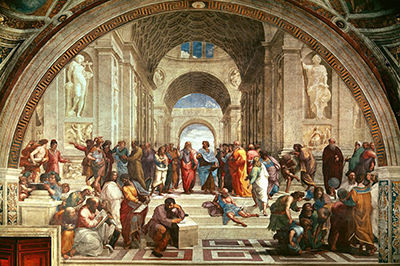
Conversely, later prints after the Vatican frescoes document reception of fixed works. They can clarify architecture and figures, record damaged passages or spread a composition, yet they should not replace the original wall as evidence for colour or exact technique.
Both kinds belong to reproductive culture, but their source relations differ. “After Raphael” identifies invention; a fuller credit and catalogue note reveal whether that invention first existed as drawing, painting, fresco, cartoon or another print.
Plate life and the problem of date
Copper is durable enough for repeated printing but soft enough to wear. Fine lines weaken first; broad passages can lose crispness; scratches accumulate. Recutting restores contrast while changing the plate. An impression's quality and details can therefore indicate relative position within a plate's life.
Inscriptions help establish states, but absence is ambiguous if a sheet has been trimmed. Paper and watermark may support dating; provenance can set limits; comparison with impressions from the same plate reveals wear. No single clue should carry the complete conclusion.
The date of the design, the engraving of the plate and the printing of one impression may all differ. A plate made in Raphael's lifetime can yield a later sheet. Catalogues that give a broad or circa date are often preserving this uncertainty rather than failing to decide.
This is why object number matters. “The Judgment of Paris, about 1515” names a composition loosely; a museum accession identifies one impression with measurable dimensions, material and ownership history.[5][6][8]
Collectors historically prized early, rich impressions, but later sheets also document demand and publishing history. Quality judgements should not erase evidence of prolonged circulation.
Print albums and new contexts
Prints rarely remained in the conceptual isolation of today's object pages. Collectors mounted them in albums beside other artists, subjects or schools. Trimming and binding could remove margins while creating new sequences of comparison.
An album changes reading. A biblical violence might face a mythological nude; a Raphael design might sit beside a copy; inscriptions could be covered or annotated. The collector becomes another organiser of meaning.
Loose sheets also entered workshops, where pinholes, tracing, squaring or paint marks record use. Damage can be evidence that a print mattered as a tool rather than only as a precious object.
Later museums disbound some albums, preserving individual sheets but losing part of their former order. Provenance research attempts to reconstruct these contexts through mounts, numbering and collector stamps.
Raphael's printed afterlife consequently extends beyond the moment of impression. Plate, sheet, album, workshop and museum are successive environments through which one design becomes different kinds of knowledge.
Monochrome and the imagination of colour
Marcantonio's engravings do not simply lack Raphael's colour. They create an alternative visual language in which line carries distinctions that pigment once might have made. A dark garment, a red cloth and a shadowed wall can all become related densities of black.
This compression encourages attention to structure. Grouping, contour and gesture come forward, helping artists understand how a composition works even when they never encounter the associated colours.
Viewers can also imagine colour from other knowledge. A familiar biblical subject, ancient statue or Raphael painting may supply mental hues, but the print does not require them. Its black-and-white world is complete on its own terms.
When a print moves into maiolica, colour returns through another artist's choices.[9] Those choices need not reconstruct Raphael's hypothetical palette. They demonstrate how monochrome reproduction can become a generative intermediate stage.
The burin's abstraction is therefore a strength. It separates design from one material appearance and makes reinvention possible.
Prints after existing works
Not every reproductive print began as a design created expressly for engraving. Raphael's frescoes, cartoons and paintings generated later translations, sometimes during his life and increasingly after his death. A print could make an inaccessible Vatican image available to collectors, but it necessarily changed scale, colour and architectural context.
The tapestry cartoons offer a useful comparison. Like engraving, tapestry reverses and translates a design, but the textile is monumental, coloured and architectural. Prints after cartoons shrink them into portable line and can circulate independently of any weaving.[13][14]
A print after a fresco removes the real wall, light and neighbouring programme. It may clarify figures otherwise difficult to see, but can make one compartment appear autonomous. Reproduction both preserves and detaches.
Titles often stabilise during circulation. A sheet needs a subject by which publishers and collectors can identify it. Those names can later migrate back to preparatory drawings or workshop variants, sometimes creating false certainty if object distinctions are ignored.
Multiples, states and impressions
One engraved plate can yield many impressions, but they are not automatically identical. The plate wears, is cleaned, reworked or damaged; inscriptions may be added; publishers can change; ink, paper and pressure vary. Scholars use “state” for a deliberate stage of the plate and “impression” for an individual print pulled from it.
The fir-tree variants of the Massacre demonstrate why these terms matter.[2][3][12] Two museum records may describe different material witnesses to a changing plate or closely related plates, not duplicate catalogue entries for one interchangeable image.
Paper also carries evidence. Watermarks can help establish date or origin; trimming can remove inscriptions; collector stamps record later ownership. A print's reverse and edges may tell a history absent from the central composition.
Digital reproductions flatten these distinctions. A high-resolution image helps compare line, but cannot replace examination of paper, plate mark, ink and condition. Raphael's print afterlife is an object history as well as an iconographic one.
Circulation and reputation
Fresco kept Raphael's most ambitious Roman inventions in restricted palaces. Engraving multiplied access. Sheets could travel with artists, merchants, diplomats and collectors, enter albums and workshops, and provide models at a fraction of a monumental commission's cost.[1]
This circulation helped define a trans-European Raphael. Viewers who never saw Rome could learn his figure types and compositional habits through Marcantonio's lines. Later artists responded not always to Raphael's painted surface but to a printmaker's interpretation of it.
Reputation consequently became collaborative. Marcantonio's skill made Raphael appear lucid in monochrome; publishers sustained availability; collectors preserved impressions; copyists expanded reach. The “Raphael style” known through print was a mediated construction.
That mediation did not diminish influence. It was the mechanism of influence. Print allowed one design to be studied, challenged, fragmented and reassembled in new works across generations.
Authorship and attribution
Good attribution begins with verbs. Raphael designed; Marcantonio engraved; a printer pulled impressions; a publisher issued them; a later artist copied or adapted. When evidence is uncertain, “after,” “attributed to,” “workshop of” and “school of” describe different degrees or kinds of relation.
The inscription on a print can assist but not settle the matter alone. Names may credit inventor and engraver, assert ownership, advertise a publisher or be added in a later state. Institutional catalogues compare inscriptions with plate and provenance evidence.[2][5][11]
The popular phrase “a print by Raphael” is convenient but incomplete. It should be followed by the actual object credit. Raphael's achievement is no smaller when engraving belongs to Marcantonio; the partnership becomes more historically intelligible.
This literacy also protects Marcantonio from appearing as a technician without invention. His line, pacing and material control shape every impression. Translation is creative responsibility under constraint.
How to look at a Raphael print
Read the credit before the subject. Identify designer, engraver, publisher, date, state and collection number where known. Then ask whether the print follows a drawing, an existing artwork or an earlier print.
Look at line direction and density. Notice how skin differs from drapery, cloud, stone or foliage without colour. Follow hatching around a turning body to see the engraver construct volume.
Check orientation against related drawings or paintings, but expect reversal. Compare complete borders and inscriptions rather than cropped images.
Finally, inspect the object as paper. Plate mark, trimming, watermark, wear and collector marks can distinguish an early impression from a later one carrying the same composition.
Why Raphael's print network matters
Printmaking made Raphael's art mobile. It separated invention from unique location and allowed his Roman language to become common visual property across Europe. The network helped create the international canon of Raphael within his lifetime and after his death.[1]
It also exposes Renaissance authorship as organised collaboration. A design could pass through several hands without losing identity, while each hand altered what audiences received. Raphael's modern fame cannot be separated from Marcantonio's burin.
The prints finally teach precision. “Raphael” can name the inventor without naming the engraver; one title can cover different states and impressions; a later ceramic can descend from a printed intermediary rather than directly from a drawing. Attention to those chains makes influence concrete.
That precision does not make the story dry. It restores human agency at every stage: Raphael imagining, Marcantonio cutting, printers inking, publishers circulating, collectors arranging and later artists transforming. A printed composition is durable because many people keep making consequential decisions around it.
Raphael's print network therefore belongs beside his frescoes, tapestries and architecture as evidence of scale. He built not only large images but systems through which images could outlive place, patron and even the copper plates that first carried them.
Artist Up Close
In the Massacre, watch hatching turn terror into direction. Lines do not merely shade bodies; they accelerate or resist movement.
In the Judgment of Paris, look beyond the central choice to the storehouse of reclining figures. Raphael and Marcantonio made a composition artists could mine for centuries.
Most importantly, read “after Raphael” as a relationship, not an apology. The phrase is the doorway into the object's collaborative history.
Frequently Asked Questions
Discussion
What detail most changes how you read Raphael and Printmaking?
Reader Insights
Which source detail gives the page its strongest anchor?
Which visual or historical distinction should readers keep in mind?
How does this page change the wider picture of Raphael's career?
Join the Conversation
Share your reading below.
References
- National Gallery of Art, “Raphael and His Circle,” exhibition and anniversary resources. View source.
- The Metropolitan Museum of Art, Marcantonio Raimondi after Raphael, The Massacre of the Innocents. View source.
- Cleveland Museum of Art, Marcantonio Raimondi after Raphael, Massacre of the Innocents without the Fir Tree, accession 1937.564. View source.
- National Gallery of Art, Marcantonio Raimondi after Raphael, Hercules and Antaeus. View source.
- British Museum, Marcantonio Raimondi after Raphael, The Judgment of Paris, registration H,2.24. View source.
- Royal Collection Trust, Marcantonio Raimondi after Raphael, The Judgment of Paris, RCIN 851707. View source.
- Royal Collection Trust, Marcantonio Raimondi, The Seven Virtues, RCIN 851946. View source.
- Art Institute of Chicago, Marcantonio Raimondi, The Judgment of Paris. View source.
- British Museum, dish after Marcantonio after Raphael, Judgment of Paris, registration 1901,0717.1. View source.
- British Museum, Jean Mignon after Luca Penni with Marcantonio–Raphael source context, Judgment of Paris, registration 1851,0208.109. View source.
- British Museum, biographical record for Marcantonio Raimondi. View source.
- Cleveland Museum of Art, Marcantonio Raimondi, The Massacre of the Innocents (Without the Fir Tree), accession 1964.23. View source.
- Victoria and Albert Museum, “The Story of the Raphael Cartoons.” View source.
- Royal Collection Trust, “New Testament Subjects,” Prince Albert's Raphael Collection. View source.