by Tom Gurney
Tom Gurney BSc (Hons) is an art history expert with over 20 years experience
Published on June 19, 2020 / Updated on October 14, 2026
Email: tomgurney1@gmail.com / Phone: +44 7429 011000
A figure emerging from a dark landscape
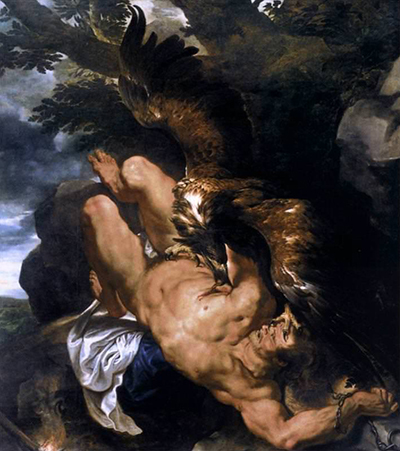
Saint Sebastian stands tied to a tree, his almost naked body pierced by arrows. His face turns upward into shadow while strong light strikes his chest, stomach and legs. A bow and a quiver lie near the tree at lower left. Beyond him, a strip of pale evening sky opens at the right edge of a dark landscape. Rubens has placed a single suffering body so close to the viewer that it nearly fills the canvas.
The Staatliche Museen zu Berlin[2] identifies the work as Saint Sebastian, Gemäldegalerie 798H, by Peter Paul Rubens, painted on canvas and measuring 203.5 × 131.1 centimetres. The museum gives Antwerp as its place of making. Its structured catalogue field says 1618, while the essay on the same page says the painting was made around 1612, soon after Rubens's return from Italy. The conflict should remain visible: the canvas is early in his Antwerp period and was available by 1618, but the museum's two date statements do not support a single uncontested year.
The image here matches the Berlin work's distinctive arrangement: Sebastian alone against the tree, arrows across his body, and the bow and quiver at his feet. That object identity matters because many artists painted Sebastian, and Rubens himself used more than one source for the figure. The page concerns this large Berlin canvas, rather than the saint in general or an image from another collection.
At a Glance
- ArtistPeter Paul Rubens [1]
- SubjectSaint Sebastian after the arrow attack [1]
- DateEarly Antwerp period, by 1618; museum statements differ [1]
- SupportCanvas (museum material field) [1]
- Dimensions203.5 × 131.1 cm [1]
- CollectionBerlin Gemäldegalerie, 798H [1]
Where this work sits in Rubens's career
The Elevation of the Cross
1609–10The Descent from the Cross
1611–14Saint Sebastian
c. 1612 or 1618; by 1618The Garden of Love
1630–35The Three Graces
1630–35Contents
- What happened to Saint Sebastian?
- Why does the body seem so monumental?
- How does Rubens use the landscape?
- What artistic models did the museum identify?
- Was the picture painted in 1612 or 1618?
- What does the bow and quiver add?
- How did it reach Berlin?
- How should the painting be read today?
What happened to Saint Sebastian?
The Berlin museum summarises the Christian story. Sebastian was a Roman officer under Emperor Diocletian. Because of his faith, he was sentenced to be executed by archers. According to the account, he survived that attack and later challenged the emperor's persecution of Christians. He was then killed by clubbing. Rubens chose the arrow martyrdom for this picture: the moment when Sebastian has been bound and wounded, but still appears alive.
This distinction is more than a narrative footnote. Arrows are the most visible signs of the episode in the painting. They cross the body and lie with the discarded bow and quiver, letting the viewer understand what has happened even without soldiers on the scene. The later clubbing is not depicted. It would be inaccurate to call the visible moment Sebastian's final death, even though the story as a whole ends with it.
The absence of executioners makes the picture unusually focused. We see the consequences of their action but not the act of shooting. Sebastian's response fills the space where a crowd might have stood. His raised head and the strain of his body give the viewer one human figure to consider. Rubens uses the saint's posture, rather than a busy narrative, to carry the spiritual and bodily drama.
Sebastian's loincloth identifies him as a saint exposed to violence without turning the scene into an ordinary portrait. The tree holds him in place, and the arrows interrupt the smooth surface of his lit skin. Rubens has made the body beautiful and vulnerable at once. The painting invites attention to anatomical strength, yet the wounds prevent that strength from being read as simple triumph.
Why does the body seem so monumental?
The museum emphasises Rubens's low viewpoint. Looking up at Sebastian makes his figure rise through nearly the entire height of the tall canvas. The saint does not stand at a comfortable distance within a broad landscape. His legs, torso and head occupy the foreground. This gives the body a scale appropriate to a major devotional image, even though the subject is one person tied to a tree.
Rubens also sets the brightly lit figure against surrounding darkness. Light establishes the body as the painting's centre before a viewer notices the bow or distant horizon. It travels over chest and abdomen, then down the thighs and shins. Shadows and the tree make the outline less regular, so the figure appears to emerge from a real environment rather than float before a flat black backdrop.
The pose is not rigidly upright. Sebastian's hips and torso shift, his arms are held behind him and his head turns towards the sky. The result is a long, slightly curving body. Berlin's curator compares this S-shaped movement to the suffering figure of the ancient Laocoön. The comparison helps describe what the eye sees: a powerful torso lifting out of a twist. It is a scholarly visual analogy, not evidence that Rubens copied every detail of the Vatican marble into this painting.
The tall format intensifies that effect. At 203.5 cm high, the painted figure is close to life size. A person standing before it could experience Sebastian's body at a scale related to their own. The portrait-like immediacy of one figure and the elevated viewpoint together make the saint appear larger than an ordinary individual without requiring a supernatural glow or heavenly crowd.
How does Rubens use the landscape?
The setting is dark but not empty. Trees and uneven ground surround Sebastian, and a pale horizon opens at the lower right. That distant light provides a second visual point after the saint's illuminated body. It suggests evening without fixing a precise hour. The Berlin essay describes the cool yellow on the horizon as answering the light falling on the foreground figure.
This relationship matters because the landscape contributes to the mood. The darkness can echo the violence Sebastian has suffered; the lighter distance prevents the scene from becoming completely closed. The viewer's eye can leave the body for a moment and then return to it. Rubens balances intimate attention to the saint with the larger world in which his ordeal takes place.
Berlin's curator associates this treatment of setting with a northern pictorial tradition in which landscape participates in the subject. That does not mean every tree has a separate symbolic message. The broad contrast of dark foreground and evening distance is enough to make the place emotionally active. The land and sky help stage the martyrdom instead of merely filling unused canvas.
The tree itself has two functions. In the story, it is the physical object to which Sebastian is bound. In the composition, it helps hold the upward movement of the body and supports the dark passage behind it. Its rough shape contrasts with the smooth areas of skin. The saint's body therefore reads as both constrained by a real trunk and visually released by the strong light.
What artistic models did the museum identify?
Jan Kelch's essay for the Berlin Gemäldegalerie relates the painting to several artistic traditions. It sees the scale of the male nude in relation to Michelangelo, the balanced shift of the body in relation to Mantegna's Saint Sebastian, and the suffering twist in relation to the antique Laocoön. The face is compared with the Hellenistic Dying Alexander head. These references explain how a specialist reads the picture's forms.
Rubens had spent years in Italy before returning to Antwerp in 1608. The Berlin essay sees the canvas as a work in which he used that experience. A painter could study Italian art and ancient sculpture, then reorganise what he learned for a new subject. The comparison with Mantegna, for example, does not make Rubens's painting a copy of Mantegna's smaller figure. Rubens enlarged the saint and placed him much closer to the viewer.
The essay also points to Caravaggio in the emphatic light and dark and in the painted still life of bow, quiver and arrows. The objects at lower left are carefully made and close to the viewer, while the body rises out of deep shadow. These are similarities in painterly approach. The museum does not claim a documented moment when Rubens stood before a particular Caravaggio canvas while planning this one, and the page need not invent such an encounter.
What makes the Berlin picture Rubens's is the combination. A monumental nude, a martyr's story, forceful light and a responsive landscape work together in one tall canvas. The sources help name the ingredients, but the finished painting is not a checklist of quotations. Rubens uses models to make Sebastian's own plight immediate.
Was the picture painted in 1612 or 1618?
The Berlin record contains both dates. Its structured field gives 1618. The English and German object essay says Rubens painted it around 1612, soon after his return from Rome. One possibility is that the catalogue field is tied to the painting's appearance in a 1618 exchange proposal, while the essay offers a stylistic chronology. The record does not explain the discrepancy, so that possibility cannot be stated as fact.
In 1618, Rubens offered this painting with other works to Sir Dudley Carleton, the English envoy in The Hague, in negotiations over Carleton's collection of antiquities. Berlin's essay makes that connection. An offer in 1618 shows that the picture already existed then; it does not prove that Rubens first painted it in 1618. The earlier date proposed by the essay is therefore not ruled out by the exchange.
The date question affects how we imagine Rubens using his Italian experience. A picture made around 1612 would be close to his return and to the first years of his renewed Antwerp practice. A picture made near 1618 would come after a longer period of development there. The painting itself bears the light, scale and anatomical ambition that invite such comparison, but those qualities alone cannot settle a precise year without additional evidence.
For a reader, the safest formulation is early Antwerp period, by 1618, with the museum's conflicting circa-1612 and 1618 statements explained. This preserves what the source actually tells us. It also prevents the Carleton date, a documented transaction moment, from being turned into an unsupported date of execution.
What does the bow and quiver add?
The bow and quiver at the bottom of the picture provide narrative evidence. If a viewer's first glance goes to the lit torso, the weapons confirm the arrows' origin and Sebastian's ordeal. They are not heroic attributes held by the saint. They belong to the violence directed at him and have been placed on the ground after the attack.
The Berlin curator also notices them as a still life within the larger work. Their surfaces, angles and placement invite close looking at paint as well as at story. A tall devotional picture can contain this small material episode without distracting from the figure. The objects draw the eye downwards, then the tree and body carry it upward again.
Their position at the lower left balances the distant light at lower right. One side records the instruments of harm; the other opens to the landscape. The saint rises between them. This is a visual reading of the composition, not a claim that Rubens wrote an explicit symbolic programme for those corners. It helps explain why the picture feels arranged even though its subject is suffering.
The weapons also remove any need to invent unseen soldiers or a specific group of executioners in the painted scene. Sebastian's story supplies that background, but the canvas shows their traces rather than their faces. Its emphasis stays on his body, expression and continued life after the arrows.
How did it reach Berlin?
The museum records an 1878/79 purchase from the Paris dealer Charles Sedelmeyer. That is a clear later collection event. It does not provide a full account of every owner from Rubens's time to the late nineteenth century. The 1618 Carleton offer is an earlier anchor, but an offer is not itself proof that Carleton finally owned the canvas or kept it for a particular duration.
The work is now in the Gemäldegalerie of the Staatliche Museen zu Berlin, under inventory 798H. This number is the secure way to identify the object when comparing reproductions or catalogue discussions.
The present museum context encourages a different way of looking from a seventeenth-century setting. Viewers can study Rubens's decisions about anatomy, light and landscape alongside other paintings. The saint's narrative still matters, but an art collection also makes the canvas's scale and painterly sources easy to compare. That layered experience is part of its current life.
How should the painting be read today?
First look at Sebastian's upward-turned face, then follow the strong light down his torso and legs. Notice where the arrows interrupt the body and where the tree holds his arms back. The saint is wounded but not shown dead. Rubens has chosen a point in the story that allows suffering and endurance to appear together.
Then move to the edges: the bow and quiver below, the pale horizon to the right, and the dark trees enclosing the foreground. These elements give the body a place and a narrative without crowding it. The low viewpoint makes Sebastian imposing, while the wounds keep him vulnerable. That tension is the painting's strongest effect.
The secure object details are Berlin Gemäldegalerie 798H, Rubens, canvas, 203.5 × 131.1 cm. The museum's own date statements disagree, so a precise year should remain qualified. Its specialist comparisons with Michelangelo, Mantegna, Laocoön, the Dying Alexander and Caravaggio illuminate the painting, but they remain interpretations of its forms. Seen closely, the canvas needs no single borrowed model to make its subject powerful.
Rubens artworks directory
Frequently Asked Questions
He shows the arrow attack: Sebastian is tied to a tree and wounded by arrows. The saint's later death by clubbing is not depicted.
It is in the Gemäldegalerie, Staatliche Museen zu Berlin, inventory 798H.
The museum's structured field says 1618, while its essay argues for around 1612. The painting was offered in a 1618 exchange, so it existed by then; the precise execution year remains disputed in the record.
Berlin records canvas and a painted area of 203.5 × 131.1 cm.
Rubens used a low viewpoint and strong light against dark surroundings. The saint's nearly life-size body occupies almost the full height of the canvas.
Discussion
Start with Sebastian's face, then follow the light down his body.
Share a close observation or a reliable source for Berlin 798H.
Reader Insights
How do the bow, quiver and distant horizon shape the story?
What does the low viewpoint do to the saint's scale?
How should the museum's conflicting date statements be handled?
Join the Conversation
Add your reading below, keeping the arrow attack distinct from Sebastian's later death.
References
- Staatliche Museen zu Berlin, Der heilige Sebastian , object 871193, Gemäldegalerie 798H. View source
- Berlin Gemäldegalerie's English and German object essay by Jan Kelch, on the same record. View source
- Rubens–Carleton correspondence, scholarly edition at the Herzog August Bibliothek. View source