by Tom Gurney
Tom Gurney BSc (Hons) is an art history expert with over 20 years experience
Published on June 19, 2020 / Updated on October 14, 2026
Email: tomgurney1@gmail.com / Phone: +44 7429 011000
A gathering between garden and myth
Men and women in fashionable dress sit and stand together on a terrace in Peter Paul Rubens's The Garden of Love. Some lean toward a partner; others turn to the next person in the group. Above them, small winged children move through the air. A sculpted Venus looks over the gathering from a grotto at the right. At the left, the terrace opens onto trees and a distant view. The picture brings ordinary social gestures and mythological signs of love into the same space.
The Museo Nacional del Prado[1] dates this work 1630–35. It is oil on canvas, measures 199 × 286 centimetres, and carries catalogue number P001690. Those current object fields distinguish it from an older Prado encyclopedia essay that gives slightly different measurements. The reproduction here shows the museum's broad garden composition, with the portico behind the figures and the landscape opening at the left.
At a Glance
- ArtistPeter Paul Rubens [1]
- Date1630–35 [1]
- MediumOil on canvas [1]
- Dimensions199 × 286 cm [1]
- CollectionMuseo Nacional del Prado, P001690 [1]
Where this work sits in Rubens's career
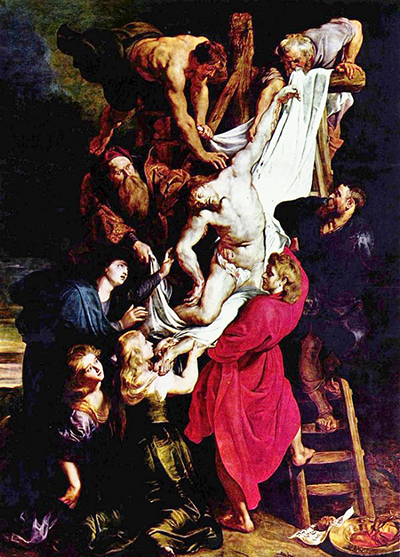
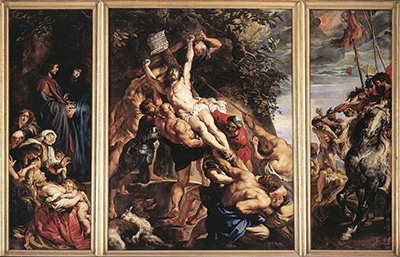
The Elevation of the Cross
1609–10The Descent from the Cross
1611–14The Garden of Love
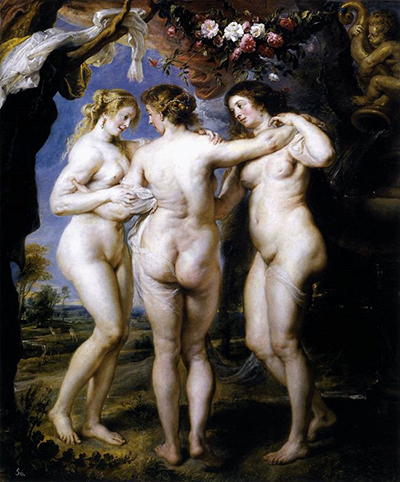
1630–35The Three Graces
1630–35Contents
- How to read the crowd
- Why are there flying children and a Venus statue?
- Is Helena Fourment one of the women?
- Rubens, Titian and a later royal collection
- How did the garden circulate beyond the canvas?
How to read the crowd
Rubens does not arrange the people like sitters in a formal group portrait. Their bodies overlap, and different conversations seem to be happening at once. A woman dressed in dark blue stands close to the centre, while women in lighter silk and men in bright garments gather around her. At the left, a pair turns inward toward one another. Seated figures closer to the middle pull the eye toward the portico; their hands and glances guide it back across the terrace. The scene has no single pair that explains everyone else.
The setting holds the group together. Architecture rises behind the gathering, yet the view remains open to landscape and sky. According to the Prado's object interpretation[1], the portico recalls the late sixteenth-century Italian architecture Rubens studied and published in his Palazzi di Genova of 1622. Related architectural ideas also informed his Antwerp house. This is a connection to Rubens's interests, not proof that the painting depicts a literal party at that house.
Colour moves across the gathering as much as the people do. Deep blue, red, gold and pale fabric recur in different parts of the canvas. Light catches faces and clothes while the wooded distance stays softer. The figures occupy the immediate terrace, but the landscape prevents their social world from feeling confined to a room. Rubens lets viewers move between intimate gestures, the larger architecture and a view beyond it.
The social groups do not all share the same mood. The Prado's full interpretation[10] notices a man playing a lute, a seated woman in green who appears to sing, and a child holding a music book. Music gives the foreground company a common activity even while the glances and invitations among them remain ambiguous. One woman appears to ask the blue-clad figure to sit, or perhaps to touch a nearby Cupid; the museum itself leaves that gesture open. The picture is more interesting when its small social actions are observed without pretending that each is a named step in a documented courtship.
Can the lute mean more than entertainment?
Music makes the group sound imaginable: a lute player, a possible singer and a child with a book seem ready to perform for the others. It also supplies a possible way to read the picture's courtship imagery. In a 2018 study of the painting's musical iconography[9], Ruth Piquer Sanclemente argues that the lute near the centre participates in the early modern idea amor docet musicam—love teaches music. She compares it with Dutch and Flemish emblem books in which Cupid, courting couples and instruments linked affection to learning, harmony and marriage. Her argument draws attention to the instrument as more than a prop in a fashionable gathering.
That is an interpretive connection, not a document showing that Rubens copied a particular emblem. The visible facts are narrower: a musician sits prominently within the group, the Prado identifies a likely singer and music book, and the painting also has marriage symbols. Piquer Sanclemente's reading asks how those things might work together. The lute can suggest a shared activity, the pleasure of listening and an ideal of agreement between people. None of those meanings requires every figure to be celebrating the painter's own wedding.
The study also compares the painting with Rubens's and Jan Brueghel's separate Prado work The Sense of Hearing, where Venus, Cupid and music appear together. The comparison shows how familiar the combination was in Rubens's art, but the two pictures have different subjects and compositions. It is more useful to ask what music contributes specifically to this terrace scene than to transfer a complete allegorical programme from one canvas to another.
Why are there flying children and a Venus statue?
The winged children make this more than a scene of fashionable company. Some carry the familiar bow and arrows of Cupid. The Prado identifies[2] one child flying above the middle with a torch and a flower garland as Hymen, a figure associated with marriage. Another holds a red ribbon joining two doves, birds linked with Venus. These details turn a gathering of apparent contemporaries into a scene about union and desire. The goddess's statue presides over them without becoming a living participant in their conversation.
An older Prado encyclopedia essay by Alejandro Vergara[3] identifies further marriage motifs: a yoke, a peacock associated with Juno, and a sculpted group of the Three Graces. These are useful connections when viewing a high-resolution image. They should not be presented as details that every reader can see clearly in this page's small reproduction. The strongest immediately visible signs remain the flying children, the goddess in the grotto, and the way the company couples and gathers.
The painting's title is therefore more precise than a casual description of a garden party. Love is present in social behaviour, classical sculpture and airborne allegory. The mythic figures do not make the well-dressed visitors into named gods. Instead, they give an imaginative frame to people who look as though they might belong to Rubens's own time.
The distinction between winged figures and carved ones is deliberate. In the Prado's extended account[10], the Graces remain a statue within the portico while the children move as living participants. Some have bird wings and some insect wings, a variety the museum links to forms Rubens had seen in ancient art. The distinction lets him place myth at different distances from the company: Venus oversees the party as an image in stone, but the little figures seem able to intervene in what happens between the people.
This mixture also keeps the social action open. One gesture may be affectionate; another may be hesitant or teasing. The Prado notes sexual suggestion alongside the marriage signs. The painting therefore does not illustrate a single rule about courtship. It stages pleasure, desire and partnership at once, with a setting spacious enough for several encounters to unfold. The musical references that the Prado sees in its comparison with Titian give the gathering another rhythm, as though movement and conversation might continue beyond the instant shown.
Is Helena Fourment one of the women?
The woman in blue bears a strong resemblance to Helena Fourment, Rubens's second wife, according to the Prado. Rubens married Helena in 1630, within the museum's date range for this painting. Vergara sees the marriage imagery and resemblance as evidence that the subject likely resonated with Rubens's own new marriage. The Städel's account of its figure study goes further and reads the man leading her into the group as Rubens himself. This is a museum's interpretation of the scene, not a documented sitter identification. Neither reading turns the picture into a literal wedding portrait or establishes that every man and woman is an identifiable acquaintance.
This distinction makes the painting more interesting. A familiar face can enter an invented scene without making the whole scene a literal report. The resemblance to Helena gives the work a personal charge, while the winged figures and mythological sculpture keep its subject wider: marriage and love as experiences that a viewer can recognise beyond any one couple. The Prado's reading preserves both possibilities instead of requiring us to choose between portrait and allegory.
What do the figure studies show?
The Städel Museum in Frankfurt[6] holds a chalk study it identifies as a study for Helena's figure in the Prado painting. Dated about 1632, the sheet is drawn in black, white and red chalk on laid paper and measures 56.6 × 32 centimetres. The museum draws attention to the woman's tentative forward step and the abundant fabric of her dress. Her face is outlined with comparatively few marks, while rapid strokes and white highlights give the clothing movement and texture. Thus the drawing contributes more than evidence of a possible likeness: it shows Rubens thinking through posture, material and the social hesitation of a figure joining the group.
The Städel places this sheet among several studies connected with the same work process. One is a large Berlin drawing of a seated woman with raised arms[7]. Berlin's Kupferstichkabinett dates it 1631–32, notes an alternative date of 1632–34, and describes black, red and white chalk on brown paper. Its catalogue explains that Rubens could make extensive figure studies and still change a figure as he painted it. The Berlin text even points to a partially indicated second hand and adjustments in the outlines. Those unfinished passages offer a useful contrast with the Prado's apparently effortless social scene: individual poses had to be tested, altered and fitted into the larger company.
These chalk sheets have a different function from the Metropolitan Museum's later drawings for Jegher's woodcut. The Frankfurt and Berlin records connect their figures to preparation for the painting; the Met records a subsequent reworking of the finished design for print. Keeping those phases apart makes Rubens's process clearer. A single title, The Garden of Love, covers a canvas, individual figure experiments, two large print designs and a woodcut, but they are not interchangeable objects.
Rubens's Three Graces offers a useful nearby comparison within the Prado. The figures in that painting are the mythological subject itself. In The Garden of Love, the Graces appear as sculpture within a larger company of contemporary-looking people. Both works relate ancient imagery to Rubens's later life, but they do so through different kinds of scene. The works should not be flattened into a single claim that a specific Grace or garden visitor is a proven portrait of Helena.
Rubens, Titian and a later royal collection
The Prado compares the garden's mood with Titian's Bacchanal of the Andrians and Worship of Venus. It points to music, children in flight, natural setting, Venus imagery and the mingling of mythic and human figures. This is a curatorial comparison of how paintings work, not a claim that Rubens copied every person from a single Titian canvas. The relationship helps explain why the garden feels both sensuous and carefully constructed.
The Prado's current provenance records The Garden of Love in the Spanish royal collection by 1666 and then follows it through later royal settings. That documented history is separate from the question of who first owned or requested it. The 1630–35 date and the personal interpretation do not by themselves identify a first commissioner. The painting's later collection history tells us where it was valued and kept, while its original purpose remains less firmly documented.
The Prado's detailed provenance[10] lets us follow the picture more closely after it entered the royal collection. In the Madrid Alcázar, the 1666 entry places it in a room described as one where His Majesty died; the 1686 and 1701–03 entries place it in a room where the king slept. These are inventory room labels, not evidence that Rubens designed the canvas for a royal bedroom. A 1734 record lists it among paintings taken to the house formerly occupied by the Marquis of Bedmar. The sequence documents movement within and out of the palace rather than a continuous, unchanging installation.
The record next places the work in the Buen Retiro inventory of 1747, then in rooms of Madrid's new Royal Palace in 1772 and 1814–18. By 1834 it appears in the Royal Museum of Paintings. The inventory numbers change across these entries, but the Prado presents them as the provenance of its present canvas, P001690. Following those descriptions gives the painting a history beyond the broad phrase “Spanish royal collection”: a private-looking allegory of love was repeatedly housed, moved and classified in spaces of royal display.
The 1666 Madrid Alcázar inventory called it “un sarao de Rubens,” as Vergara records in the Prado encyclopedia[3]. Sarao evokes a social entertainment. A Metropolitan Museum exhibition account[8] says the painting was known in Rubens's time as a conversatie à la mode, a fashionable conversation scene. These labels notice the clothing, music and group interaction, while the later familiar title draws attention to the Venus and marriage symbols. They need not compete. Each names one part of what viewers can see, and neither proves that the gathering records an actual party.
How did the garden circulate beyond the canvas?
Rubens and his workshop adapted the design for printmaking while the subject was still new. The Metropolitan Museum of Art[4] holds a large drawing for the right portion of a woodcut by Christoffel Jegher, dated about 1633–35. Its black-chalk beginning is attributed to Rubens; the museum assigns much of the subsequent elaboration to a workshop assistant. A companion drawing supplied the other half. This is not a simple tracing of the Prado canvas: the two drawings push the figures forward, crop the architecture and arrange the company like a long frieze.
The Met's account of Jegher's woodcut[5] says the blocks reproduce the drawings in reverse. Once divided into two printed sheets, the garden could be seen in a new format and distributed beyond the circle that could visit or own the painting. The change of medium altered the subject's pace. Broad, contiguous figures and pared-down architecture put more weight on the encounters between people than on the terrace's depth. The existence of these drawings also supports the older Prado essay's statement that Rubens prepared the subject carefully, but they served the later woodcut project and should not all be described as preliminary studies for the original canvas.
The Prado notes one small difference between canvas and print: in the group beneath the portico, the hand of a man touching a woman's breast was shifted downward in Jegher's version. That change is evidence that even a closely supervised print could adjust the social tone of a motif. It is not a reason to label the painting itself a discreet wedding portrait. In both media the garden balances marriage symbols with more direct suggestions of desire; the change shows how readily a viewer's reading can turn on the placement of a hand.
Rubens artworks directory
Frequently Asked Questions
It is in the Museo Nacional del Prado, Madrid, catalogue number P001690.
The Prado dates the canvas 1630–35. It was therefore made during the period after Rubens's marriage to Helena Fourment.
The Prado links its marriage symbols and a figure resembling Helena to Rubens's second marriage. It does not establish the scene as a literal record of the wedding or identify every participant as a portrait.
The Prado identifies the airborne child carrying a torch and flower garland as Hymen, associated with marriage.
No. Both are Prado paintings by Rubens, but The Three Graces centres on three mythological women, while The Garden of Love shows a larger fashionable gathering with mythological figures and statues around it.
Discussion
Look closely at how social gestures and mythological signs share the garden.
Share an observation about the painting or a reliable source that adds to its history.
Reader Insights
Which pair or small group first draws your eye across the terrace?
How do the flying children and Venus statue affect the scene?
Where does the Prado's Helena Fourment reading remain an interpretation?
Join the Conversation
Add your reading below, keeping observations specific and evidence clear.
References
- Museo Nacional del Prado, The Garden of Love , current object record and interpretation. View source
- Museo Nacional del Prado, Spanish object record and provenance. View source
- Alejandro Vergara, Prado encyclopedia essay on The Garden of Love. View source
- Metropolitan Museum of Art, Rubens and workshop drawing for the right portion of The Garden of Love. View source
- Metropolitan Museum of Art, Christoffel Jegher, The Garden of Love woodcut. View source
- Städel Museum, Rubens, figural study for The Garden of Love. View source
- Staatliche Museen zu Berlin, seated woman study for the Prado Garden of Love. View source
- Metropolitan Museum of Art, Rubens: The Drawings exhibition account. View source
- Ruth Piquer Sanclemente, “Amores y Venus enseñan música: a propósito de El Jardín del amor de Rubens,” Eikón / Imago 7 (2018), 123–142. View source
- full interpretation. View source