by Tom Gurney
Tom Gurney BSc (Hons) is an art history expert with over 20 years experience
Published on June 19, 2020 / Updated on October 14, 2026
Email: tomgurney1@gmail.com / Phone: +44 7429 011000
A lion turns his head
The animal lies low, with his forelegs extended and his great mane rising behind the head. His body points across the sheet while his eyes and muzzle turn towards the viewer. The long tail sweeps along the bottom edge. Rubens made the lion's coat with black and yellow chalk, then used wash, touches of watercolour and white heightening to give weight and light to its form. The result is a study of a living animal held briefly in a watchful pose, not an illustration of a fight.
The drawing is commonly called A Seated Lion or Study of a Seated Lion. The legacy page title says “Etude of Lion,” but the depicted creature is identifiable without that unusual wording. The Sotheby's 2021 discussion of Rubens's preparatory drawings[1] credits the sheet to Rubens, dates it about 1612–13, describes its material, and gives 28.1 × 42.7 cm as its size. A Fundación Universitaria Española catalogue record[2] also credits Rubens and the British Museum, London, at 281 × 427 mm, though it offers a wider 1613–17 chronology. These are scholarly and research-catalogue datings, not a verified current British Museum date field.
The image here matches the whole landscape-format sheet reproduced with a historic British Museum collection link in Wikimedia Commons[3]. That file has a serious imported-description error: it calls the image “Samson and the Lion” and describes a man breaking an animal's jaws. No man appears in this drawing. The image shows a single reclining male lion. The error is a reminder to identify an object from the pictured sheet and reliable cataloguing together, not from a stray metadata line alone.
At a Glance
- ArtistPeter Paul Rubens, scholarly attribution [1][2]
- DateEarly 1610s; sources differ [1][2]
- MediumChalk, wash, watercolour and white heightening [1]
- Size28.1 × 42.7 cm [1][2]
- Collection associationBritish Museum, London [1][2][3]
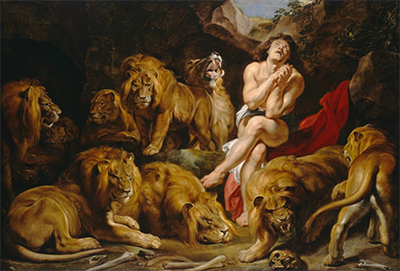
- Related paintingDaniel in the Lions' Den, Washington [4][5]
Where this work sits in Rubens's career
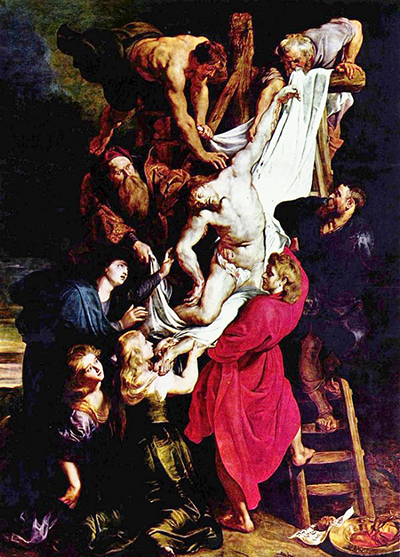
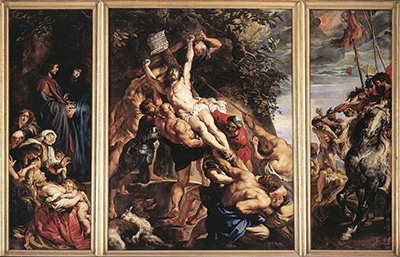
The Elevation of the Cross
1609–10The Descent from the Cross
1611–14A Seated Lion
c. 1612–17The Garden of Love
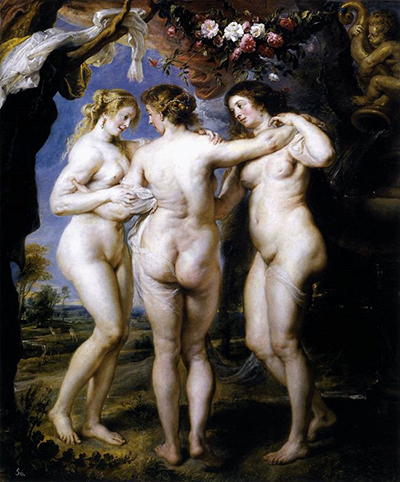
1630–35The Three Graces
1630–35Contents
- What makes the pose convincing?
- Why did Rubens study lions?
- Did Rubens draw a live lion?
- How do the materials build the animal?
- Which lion appears in the Daniel painting?
- How secure is the British Museum identification?
- Why does a single lion study matter?
What makes the pose convincing?
The lion's body is at rest, yet his attention is active. His hindquarters are gathered beneath him; both front paws stretch forward. The head rotates back over the shoulder, so the animal seems aware of something just outside the viewer's space. Rubens catches a moment between ease and alertness. The lion has not sprung up, but the paws, shoulders and gaze make that possibility easy to imagine.
Look first at the broad back and the strong haunch. Chalk strokes follow the curve of the ribcage and the fold near the hind leg. Darker marks define the undersides and joints. The body is not a smooth outline filled with one uniform shade. It has changing surfaces: short fur over muscle, a thick mane, a leaner face and heavy paws. Rubens varies the marks to keep those parts distinct.
The mane gives the animal its greatest visual weight. It rises as a dark mass behind the lighter face and falls around the chest. Fine lines catch individual locks, while wash gathers them into shadow. The white heightening brings a few edges forward. The lion's eyes and muzzle are much smaller than the mane, yet their precise placing makes his turn of attention credible. The viewer notices the face after registering the formidable bulk.
Rubens drew on light buff paper. Its colour supplies a middle tone between the dark chalk and the white highlights. Yellow chalk and wash warm or deepen selected areas. That combination avoids having to fill every part of the body with pigment. The untouched or lightly touched ground can stand for lit fur, while concentrated dark marks make the animal's mass and shadow apparent.
The tail is easy to overlook. It curves along the bottom of the sheet and helps hold the composition within the paper's long horizontal shape. The forepaws extend in the same direction, drawing the eye towards the lower right. The head looks back, reversing that movement. This is why the sketch works as a complete visual study even though it was useful for a later painting: the body's lines and the gaze balance one another on the page.
Why did Rubens study lions?
Rubens needed to depict lions convincingly for his large painting Daniel in the Lions' Den. The National Gallery of Art in Washington[5] dates that canvas about 1614–16 and describes Daniel surrounded by a group of male and female lions in a dark cave. The animals are not an interchangeable pattern. Some face the viewer, some turn away, some rest and some seem capable of movement. Individual drawings let Rubens investigate their bodies and expressions before arranging them in that crowded scene.
The Metropolitan Museum's 2005 Rubens drawings exhibition notice[4] specifically mentions three lion drawings from the British Museum and National Gallery of Art associated with Daniel in the Lions' Den. They were treated as lifelike animal studies within a survey of how Rubens prepared paintings. The seated-lion sheet belongs in that group; it should not be confused with the lioness drawing or the Washington lion head.
Sotheby's[1] identifies this seated animal with a lion at the left of the Daniel composition, turning its head so that the mane is displayed. This is a comparison made by the source, not a document proving that every line of the drawing was mechanically copied into the canvas. The final painting changes scale, position and surrounding light. Rubens could draw an animal closely and then adapt it to the larger story.
The drawings also reveal that the painter cared about individual animal character. A roaring lion produces a different effect from a watchful seated one; a moving lioness differs from a lion at rest. In the Washington painting, those differences build the tension around Daniel. On the British Museum sheet, the drama is quieter. One animal occupies the page, and the viewer can examine the anatomy and attentive expression before thinking about the biblical scene.
Did Rubens draw a live lion?
The directness of the observation has encouraged accounts of Rubens drawing from living animals. Sotheby's[1] says he had an opportunity to see lions at the royal menagerie in Brussels around 1613–15, making sketches that could inform the Daniel painting. The Met's exhibition notice[4] calls the studies lifelike. Together, these sources support a close interest in observed animal form.
They do not establish the precise hour, location or sequence in which this particular sheet was made. A drawing dated circa 1612–13 in one source and 1613–17 in another cannot be given an exact visit to the menagerie without further documentation. Its pose is compatible with observation, and the animal's proportions are treated carefully, but “drawn from life at Brussels on a named day” would exceed the evidence.
Rubens also knew classical sculpture and other representations of powerful animals. Sotheby's contrasts the lions' startling realism with a stately sense of the antique. Both strands matter. Close looking gave him muscles, fur and movement; the grandeur of ancient art helped him stage those features in a painting intended to impress a viewer. The sheet can be appreciated without forcing a choice between nature study and artistic design.
The figure is not posed like a trophy or a heraldic emblem. His legs are folded and extended in a plausible way; his head has weight; the mane is irregular. Such details make the study useful to someone painting a dangerous animal in a biblical den. At the same time, the carefully turned head and horizontal arrangement make the lion unusually legible as an image on its own.
How do the materials build the animal?
The Sotheby's material description[1] is unusually specific: black and yellow chalk, grey-brown wash, watercolour touches, and white heightening on light buff paper. Those are not four separate finished pictures. They are layers of one drawing. Chalk can set contour and texture; a fluid wash gathers shadows; white marks recover light on the tinted sheet.
This technique is particularly suited to a furry animal. A dense mane cannot be described by a single line around its edge. Rubens combines many strokes and larger shaded areas, then brings forward strands with lighter touches. The face has firmer contours than parts of the body, because its direction and expression are essential to the pose. The hindquarters are broad and tonal. The paper itself carries the lighter coat where no heavy mark is necessary.
At 28.1 × 42.7 cm, the drawing is a substantial horizontal sheet, yet far smaller than the Washington canvas. It allowed Rubens to study one animal closely. The dimensions should not be confused with the National Gallery of Art's separate Lion drawing[6], which measures 25.2 × 28.3 cm and is more nearly square. That Washington study has a different viewpoint and its own accession number, 1969.7.1. It is a comparison, not another title for the British Museum sheet.
The Fundación Universitaria Española record[2] reduces the technique to charcoal, yellow chalk and wash in Spanish. That summary is useful for confirming the size and collection association but less detailed than Sotheby's. The two records do not need to be artificially averaged: one gives a broad research index, the other a fuller material account. Neither substitutes for a current conservation examination of the actual paper.
Which lion appears in the Daniel painting?
The Washington painting brings the animals into a single threatening space. The National Gallery of Art[5] describes Daniel praying among lions in a cave, with a narrow opening of sky above and bones on the ground. It dates the picture about 1614–16 and records its large size, 224.2 × 330.5 cm. That scale was meant to make the danger feel near the viewer.
Sotheby's points to the seated lion at the left as the painted relative of this British Museum study. To check the comparison, look for a male lion whose body is low but whose head turns to show the mane. The relation is about a pose and a type of presence, not a claim that the drawing is the only source for the painted beast. Changes in light, placement and anatomy can occur between a working sheet and the finished canvas.
Two other studies make the distinction clearer. The National Gallery of Art's Lion[6] is its own drawing, accession 1969.7.1. Sotheby's relates it to a lion near Daniel with a direct stare. Its museum record gives a different medium description and size. A British Museum lioness also appears in the 2021 comparison, but it is a female animal in a more upright, moving pose. The three studies are companions in a research problem, not interchangeable reproductions.
The Fundación record[2] calls the seated-lion sheet preparatory for the Washington Daniel. The Met's exhibition notice[4] supports the broader group relationship. These sources justify explaining the painting connection; the exact transformation of one drawn animal into painted form remains a matter for close visual comparison rather than a simple one-to-one tracing claim.
How secure is the British Museum identification?
The image matches the landscape-format Study of a Seated Lion reproduced from an older British Museum collection URL preserved on Commons[3]. The Fundación catalogue[2] and Sotheby's article[1] independently name the British Museum, and both give the same 28.1 × 42.7 cm size. That combination is stronger than the erroneous Commons description. It identifies the reproduced object for this page.
A current British Museum object record and registration number have not been recovered. The number 711813 in the historical link is a web database object identifier, not a museum registration number to print as an accession. Public copy therefore names the documented collection association but leaves the current registration field blank. It also treats the circa 1612–13 date as a scholarly proposal rather than a verified institutional field.
This distinction matters because drawings are sometimes relabelled, reattributed or given revised dates. The available sources consistently associate this sheet with Rubens and the British Museum, but the latest holding catalogue would be the appropriate place to check a revised maker line, technical description or accession. The page can still explain the visible work and its documented scholarly context without pretending that missing catalogue fields have been seen.
The strange “Samson and the Lion” phrase in the Commons metadata appears to have been carried from another object. The image has no Samson and shows no struggle. A reader looking at the sheet can see the reclining lion, his sweeping tail and backward gaze. The correction is basic but important: a mistaken subject would make the rest of the article tell the wrong story.
Why does a single lion study matter?
In Daniel in the Lions' Den, the animals test a human figure's faith and make the space feel dangerous. On the drawing sheet, one lion is removed from the crowd. Rubens could attend to his weight, fur, alertness and anatomy before making him serve that larger religious scene. The passage from isolated animal to part of a dramatic painting is the sheet's historical value.
Its visual value is just as clear. The broad haunch, strong forelegs, heavy mane and turn of the eyes form a convincing whole from relatively economical marks. Rubens records an animal at rest while making its attention palpable. A viewer can move between the chalk strokes at close range and the later canvas's theatrical group without losing sight of the specific creature on the paper.
The best-supported identification is Rubens's British Museum-associated A Seated Lion, approximately 28.1 × 42.7 cm, generally dated in scholarship to the early 1610s. It belongs to the group of lion studies connected with Daniel in the Lions' Den, while its current museum registration remains to be verified. The drawing is neither a Samson scene nor the separate Washington lion or British Museum lioness. Its subject is a lion who has turned his head, and that modest action is enough to animate the whole sheet.
Rubens artworks directory
Frequently Asked Questions
No. It is a drawing of one lion. It is associated with Rubens's later, much larger Daniel in the Lions' Den painting in Washington.
Sotheby's dates it about 1612–13; another research catalogue gives 1613–17. An early-1610s date is a useful summary, but an exact year is not established here.
The detailed published description lists black and yellow chalk, grey-brown wash, touches of watercolour and white heightening on light buff paper.
No. The Washington drawing is a different, nearly square sheet, accession 1969.7.1. This British Museum-associated lion is wider and shows the whole reclining body turning its head.
No. An imported image description incorrectly says so. Only a reclining lion appears; there is no human figure or fight.
Discussion
Follow the lion's tail and forepaws to his backward glance.
Share a close observation or a reliable catalogue source for this sheet.
Reader Insights
How do chalk, wash and white heightening give the lion weight?
Which part of the Daniel painting recalls this pose?
How does this sheet differ from the Washington lion and the lioness study?
Join the Conversation
Add your reading below, keeping the current catalogue gap visible.
References
- Sotheby's, How Preparatory Drawings Reveal an Artist's Creative Process , 2021. View source
- Fundación Universitaria Española, León , Rubens drawing record. View source
- Wikimedia Commons image of Study of a Seated Lion , preserving the historical British Museum object link. View source
- Metropolitan Museum of Art, 2005 Rubens drawings exhibition notice. View source
- National Gallery of Art, Washington, Daniel in the Lions' Den. View source
- National Gallery of Art, Washington, separate Lion drawing, 1969.7.1. View source
- University of Maryland dissertation, illustration list of Rubens lion and lioness studies. View source