by Tom Gurney
Tom Gurney BSc (Hons) is an art history expert with over 20 years experience
Published on June 19, 2020 / Updated on October 14, 2026
Email: tomgurney1@gmail.com / Phone: +44 7429 011000
An ox meets the viewer's eye
The animal stands broadside across a low sheet, its body stretching almost from one edge to the other. Its head turns toward us. The weight of the torso is held by slim but firmly placed legs, while the neck and muzzle are described with more concentrated strokes. There is little setting beyond the ground line. This is an encounter with a particular body, not a crowded farm scene.
The ALBERTINA in Vienna identifies the sheet[1] as Ox, or Ochse in German, by Peter Paul Rubens, dated about 1618. It is a drawing in black chalk, red chalk, brown and grey brushwork, with traces of white heightening, measuring 28.6 × 44 centimetres, inventory 8253. The site's inherited address calls it “bull.” The museum's title is the better label for the specific object reproduced here; neither the address nor the word “bull” should turn the sheet into a different animal study or an oil painting.
The ox's direct look gives the study an almost portrait-like force. That is also how the Albertina's catalogue reads it. Rubens paid attention to the folds at the throat, the bony landmarks of the head and the animal's stance. Yet the body remains surrounded by open paper. The result is both an observed animal and a resource that could later be fitted into a painted landscape.
At a Glance
- ArtistPeter Paul Rubens [1]
- Museum titleOx (Ochse) [1]
- DateAbout 1618 [1]
- MediumBlack and red chalk, brushwork, white heightening [1]
- Size28.6 × 44 cm [1]
- CollectionALBERTINA, Vienna, 8253 [1]
Where this work sits in Rubens's career
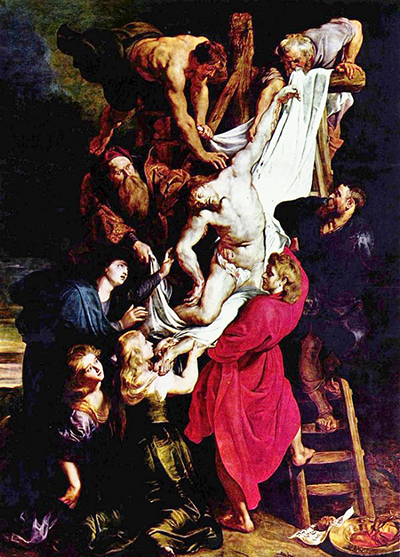
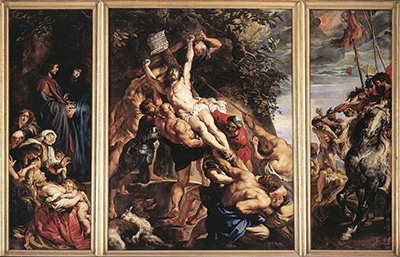
The Elevation of the Cross
1609–10The Descent from the Cross
1611–14Ox
c. 1618The Garden of Love
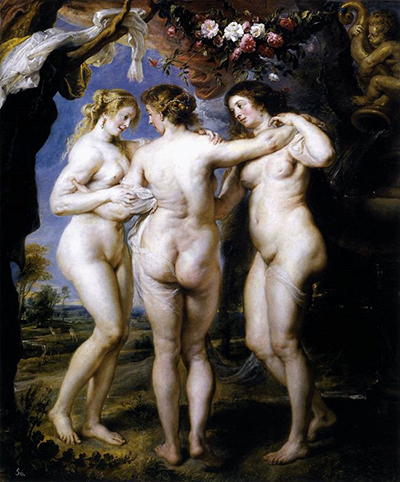
1630–35The Three Graces
1630–35Contents
- A body studied from head to hoof
- Black chalk, red chalk and brushwork
- Why call it portrait-like?
- A working sheet kept for later
- The later landscape with duck hunters
- The mark on the paper is not proof of a signature
- Ox, bull and the exact object
- Looking again at Rubens's ox
A body studied from head to hoof
The drawing's horizontal format follows the ox's long back. A pale contour travels from its shoulders toward the hindquarters. The belly forms a slower lower curve, and the tail hangs at the far left. The head occupies the right end, where the muzzle, horn and eye gather the viewer's attention. The pose is stable, but the turned gaze makes it feel active.
Rubens differentiates parts of the animal without drawing a detailed landscape around it. The torso is modelled broadly; shadows under the body give it weight. The legs are more sharply marked where they meet the ground. Head and neck receive the richest description. This distribution of detail guides our looking: we register the whole animal first, then meet its eye.
The Albertina calls the sheet exceptionally careful among Rubens's studies of domestic animals. It pairs the ox with a saddled horse drawing, inventory 8252, also in its collection. The comparison is about Rubens's close attention to living creatures, not an assertion that the ox and horse once shared a page or were drawn on the same outing. Each is a separate sheet with its own material record.
Because the ox fills the paper, it may look monumental in a small image. The actual drawing is only 28.6 cm high. That physical size matters. Rubens achieved an effect of bodily presence within an object that could be carried, stored and consulted in a workshop. A digital enlargement can reveal strokes but can also make the work seem like a finished wall painting. The medium and dimensions should stay close to the description.
Black chalk, red chalk and brushwork
The museum describes a sequence of making: Rubens probably set down delicate outlines in black chalk while looking at the animal, then added dark red chalk later in the studio. It is a plausible reconstruction drawn from the sheet's materials and handling. The catalogue does not identify an exact farm visit or provide a day-by-day record of the drawing process, so “probably” belongs with that account.
The combination of black and red marks gives the ox both structure and warmth. Black chalk can establish contour, joints and shadow. Red chalk adds volume and tone over a body that might otherwise remain a simple outline. Brown and grey brushwork extends the range of darks, while traces of white heightening pick out limited light. These materials are not interchangeable. Their layers let Rubens emphasize where mass presses, turns or catches illumination.
Looking closely at the retained image, one sees a lightly worked body and a more defined head. Some passages fade into paper; others darken decisively. The open background leaves no fence or stable to compete with the animal. That freedom helps explain how the drawing could remain useful later. Its ox is not locked into one fully described place and time.
The museum's account of an outdoor start and indoor finish is especially instructive because it keeps observation and composition together. A painter could look hard at a live animal, then strengthen the study after returning to the workshop. This does not make the later marks less observational. It makes the sheet a record of how observation was edited into a durable visual resource.
Why call it portrait-like?
A portrait normally makes an individual its principal subject. Here the ox fills the sheet and turns its face toward us. The Albertina explicitly notes the detailed head and confronting gaze and says Rubens described the animal almost as though making a portrait. It is a comparison of effect, not a claim that the drawing was commissioned as a likeness of a named ox.
The gaze matters because it interrupts a purely anatomical reading. We can study hooves, hide and shoulders, but the eye asks us to acknowledge the creature's presence. The animal does not appear as a small piece of rural background. Its face is large enough and carefully enough observed to hold attention on its own.
At the same time, a nearly complete side view makes the body legible for future use. Rubens could understand how the torso sits over the legs and how the neck attaches to the shoulders. The sheet therefore combines two visual jobs: the immediacy of an encounter and the practical clarity of a working study. Its “portrait” quality and its usefulness as a model do not conflict.
The Albertina suggests the animal might have been prize-winning, referring to a Netherlandish practice of representing valuable livestock in this way. It also proposes a possible connection to farms near Antwerp associated with Rubens's family. These are hypotheses, not an identified herd or a proven commission. The drawing cannot tell us the ox's name, owner, market value or precise place of observation.
A working sheet kept for later
Rubens made animal studies at a time when horses, cattle and other creatures could populate landscapes, hunting scenes and histories. The Albertina suggests he kept the ox drawing among his resources and brought it out again when a painting needed this kind of animal. Its catalogue ties the study to The Farm at Laken and a much later Berlin landscape with duck hunters.
That relationship does not mean the same physical ox somehow appears in those paintings. The paintings are separate objects in different collections. The claim is about visual reuse: a pose, form or remembered animal seen first in a drawing could be adapted to a larger composition. Rubens did not need to copy the sheet mechanically for the earlier observation to remain useful.
The Royal Collection Trust records Milkmaids with Cattle in a Landscape, known as The Farm at Laken[2], as a Rubens painting of about 1617–18, inventory RCIN 405333. The Albertina compares a somewhat stockier ox at the centre of that work with the drawing. The difference in build is worth noting: reuse can involve adjustment. A drawing made from a close encounter becomes one component of a pastoral scene with people, cattle and a landscape.
The Royal Collection's own explanatory label describes The Farm at Laken as an ideal composed scene rather than a literal record of a single working farm. That helps keep the comparison in proportion. Even if the ox study was made by observing an animal closely, its painted counterpart belongs to a designed world. The drawing supplies an animal form; the painting creates a social and atmospheric setting around it.
The later landscape with duck hunters
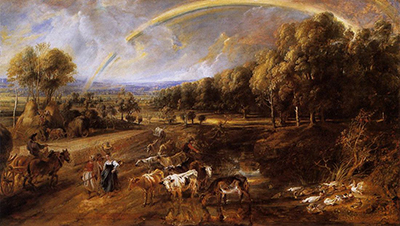
The Albertina also links the ox to Rubens's A Landscape with Cows and Duck Hunters in the Berlin Gemäldegalerie, inventory 2013, dated 1635–38. That is nearly two decades after the drawing's approximate date. If the same design was available for a late landscape, the sheet had a long working life.
The Berlin museum's record for the landscape[3] describes cattle and milkmaids by water, warm evening light and a duck hunter whose shot interrupts the apparent calm. It discusses Rubens's reuse of earlier landscape solutions. The Albertina makes the more specific ox-study connection. Together these institution records support a general picture of Rubens carrying observations and designs between works, while they do not document exactly when he took this particular sheet from a portfolio.
The later painting is much larger, on oak, and organized around a broad landscape. The ox drawing is an isolated animal on paper. Moving between them shows how a study can change scale and role. In the sheet, the ox is the whole subject. In a painted landscape, a cow or ox can become one participant in a wider account of rural labour, weather and light.
The time span also argues against reading the ox study only as a preparatory drawing for a single near-term commission. The Albertina suggests it was probably not tied to one immediate purpose. A stored study could be available to Rubens years later. This is a curatorial reconstruction of workshop practice, not a surviving inventory note naming the exact drawer in which he kept it.
The mark on the paper is not proof of a signature
The Albertina records a “P P R” inscription at the lower centre of the sheet and questions whether it was made by someone other than Rubens. Its essay suggests an early collector may have added the letters. The museum notes similar later Rubens name marks on other drawings. The presence of three initials therefore cannot authenticate this sheet as an autograph signature.
That caution should be kept separate from the museum's overall attribution. The Albertina currently catalogues Ox under Peter Paul Rubens. Its essay mentions a historical challenge to that attribution by Wolfgang Adler and says it gained little support. The label is therefore not “anonymous” or “workshop” in the present institutional record. Rather, the drawing is catalogued as Rubens while the inscription itself is uncertain and not a reliable proof of his hand.
The sheet also bears the collecting mark of Duke Albert of Saxe-Teschen. That mark relates to the object's later collecting history. It does not indicate the ox's owner, the place where it was drawn or the date of its first use. Such marks are valuable because they document how drawings travelled and were valued after their making, but they answer a different question from who drew the original animal.
Attribution is best understood here as a judgment made from materials, style and comparisons, not from the initials alone. The museum's high confidence in Rubens and its doubt about the mark can coexist. A clear page label can use “Peter Paul Rubens” for the drawing while explaining that the “P P R” inscription may be an early collector's addition.
Ox, bull and the exact object
The route /bull/ comes from a broad older label. The Albertina calls the work Ochse, meaning ox. That preferred catalogue title should appear in the page heading, caption and searchable object details. It identifies the museum's specific sheet without claiming knowledge of every biological detail the drawing cannot establish from an online image.
The exact identifier is Albertina inventory 8253. It distinguishes the ox from the museum's related saddled horse, 8252, and from Rubens's many painted cattle in royal and museum collections. Date, support and medium sharpen the identification further: about 1618, chalk and brushwork on paper, 28.6 × 44 cm. A site visitor should not leave thinking this is an oil painting called Bull.
The site image visually matches the Albertina drawing. The collection's object record supplies the identification and details used here.
The route can stay in place for continuity. Readers who arrive through the older English word should be told at once what the holding institution actually catalogues. Correcting the display title is more helpful than silently redirecting them to an apparently unrelated animal.
Looking again at Rubens's ox
Begin with the broad back and follow the body toward the turned head. Notice the front legs and hooves that give it weight, then the eye that meets your look. The drawing holds the animal between study and encounter. Its careful lines make the body useful to a painter; its gaze gives the creature an individuality that resists becoming mere scenery.
The museum's record anchors that experience: Rubens's Ox, about 1618, black and red chalk with brown and grey brushwork and traces of white heightening, 28.6 × 44 cm, ALBERTINA 8253. The catalogue proposes a likely outdoor first observation and later studio strengthening. It compares the animal to figures in The Farm at Laken and a late Berlin landscape, while keeping a prize-winning origin speculative.
The sheet's achievement is economical. It has no elaborate background and no human story to explain why the ox matters. Rubens draws enough to let us sense the animal's scale and attention. That independent force is precisely why the study could be useful later: it was a concentrated observation capable of entering other compositions without losing the life of the original encounter.
Rubens artworks directory
Frequently Asked Questions
The page keeps the inherited /bull/ address, but the Albertina titles the object Ochse—Ox. That is the title used in the article and caption.
No. It is a drawing in black and red chalk with brown and grey brushwork and traces of white heightening on paper.
The Albertina dates the sheet about 1618. Its proposed sequence of black-chalk observation and later studio work is a scholarly interpretation, not a dated work log.
The Albertina compares it with an ox in The Farm at Laken and an animal in a later Berlin landscape with duck hunters. These are separate paintings that adapt or recall the study.
The museum questions that. It suggests the initials may have been added by an early collector. Its current Rubens attribution does not depend on treating the mark as an autograph signature.
It is in the ALBERTINA, Vienna, inventory 8253, measuring 28.6 × 44 cm.
Discussion
Look from the broadside body to the ox's turned head and eye.
Share an observation about the drawing or a reliable source that adds to its history.
Reader Insights
What makes this animal study feel portrait-like?
How might an isolated drawing become useful in a later landscape?
What can the chalk and brushwork suggest about Rubens's process?
Join the Conversation
Add your reading below, keeping observations specific and evidence clear.
References
- ALBERTINA, Peter Paul Rubens, Ochse ( Ox ), inventory 8253. View source
- Royal Collection Trust, Rubens, Milkmaids with Cattle in a Landscape ( The Farm at Laken ), RCIN 405333. View source
- Staatliche Museen zu Berlin, Rubens, A Landscape with Cows and Duck Hunters , inventory 2013. View source