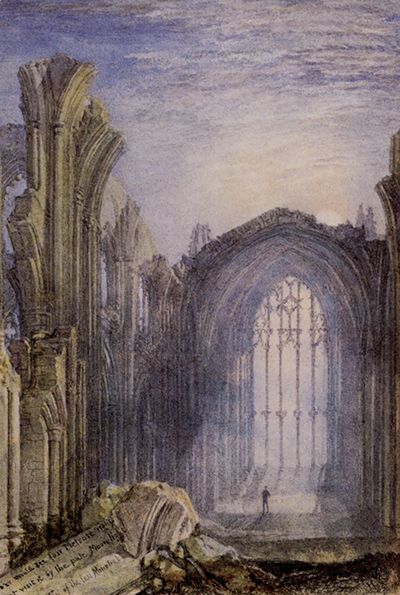
 by Tom Gurney
Tom Gurney BSc (Hons) is an art history expert with over 20 years experience
Published on June 19, 2020 / Updated on August 29, 2026
Email: tomgurney1@gmail.com / Phone: +44 7429 011000
Overview
J. M. W. Turner's watercolours are central to his career, not a side practice beneath the oil paintings. Watercolour gave him speed, transparency, portability, tonal range and a way to study light before it hardened into public exhibition form. It also supported travel, teaching, print design, finished collecting works and late colour experiments. Tate's research publication on Turner's sketchbooks, drawings and watercolours presents the works on paper as one of the richest surviving records of his creative process, and Tate's related project describes the Turner Bequest works on paper as a major cataloguing field of more than 37,000 items. [1][2]
The first discipline is to distinguish kinds of object. A sketchbook sheet is not the same as a finished watercolour. A pencil drawing is not a colour study. A watercolour made as a design for engraving is not identical to an exhibition watercolour. A late colour beginning is not automatically an unfinished oil idea. Turner moved among all these categories, and part of his brilliance lies in that movement. He could use a quick notation to remember a contour, a wash to test atmosphere, bodycolour to strengthen opacity, scratching-out to regain brightness, and finished watercolour to rival the authority of oil.
Watercolour also shaped how Turner painted in oil. The Met's account of his career explains that he carried methods learned in watercolour into oil, using colour as a foundation for evocative form. [3] This exchange matters because it prevents a false hierarchy. Turner did not graduate from watercolour to oil and leave the earlier medium behind. He carried watercolour habits into oil, and he used oil ambition to raise the status of watercolour. The result was a career in which the two media kept speaking to each other.
A useful watercolour overview therefore needs both chronology and material caution. Turner began young, trained through topography and architectural drawing, matured as a Royal Academy artist, travelled through Britain and Europe, developed print projects, produced finished watercolours for patrons and collectors, and ended with late studies in which colour can seem to drive the whole image. The Wallace Collection's technical account stresses that watercolour had a lower status in Turner's youth and that he helped raise it into a creative medium capable of rivalling oil. [4] That statement captures the larger achievement: Turner changed not only what watercolour could look like, but what it could mean.
This means that watercolour should be treated as both a medium and a method. It was a way to make independent works, but also a way to think quickly, to remember travel, to test light, to prepare prints and to extend ideas across media. Turner's watercolours often look immediate, yet the best of them are not casual. They depend on judgement: how much paper to leave open, when to strengthen a passage, where to let an edge blur, how much drawing to retain, and how to make colour carry space.
Watercolour also forces viewers to look closely at scale and surface. A small sheet can contain a wide landscape if tone and recession are handled with precision. A slight touch of bodycolour can change the force of a highlight. A pale wash can create air more persuasively than a heavily described sky. Turner's achievement lies partly in knowing how little could be enough.
At a Glance
- MediumTransparent and opaque watercolour on paper
- Central archiveThe Turner Bequest at Tate [2]
- PracticeSketchbooks, drawings, colour studies and finished sheets
- TrainingArchitectural, topographical and landscape drawing
- TravelBritain, continental Europe, Italy, Venice and Switzerland
- Finished worksCollectors, exhibitions and publication projects
- Print cultureDesigns translated through engraving
- Technical evidenceTate and conservation-led object study [4]
- Late practiceColour beginnings, atmosphere and open-ended studies
- Essential cautionPurpose, finish, title and material must be checked object by object
Contents
- Overview
- Early Watercolour Training
- Sketchbooks, Drawings and Watercolour
- The Turner Bequest and Tate
- Chronological Structure
- Materials and Technique
- Finished Watercolours
- Colour Studies and Late Practice
- Print Culture and Reproduction
- How to Read Turner Watercolours
Turner Watercolours in This Cluster
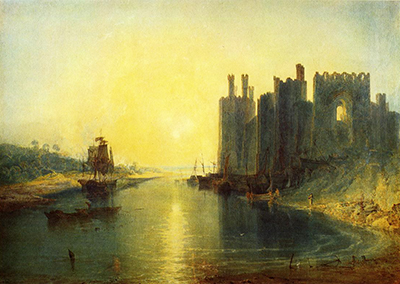
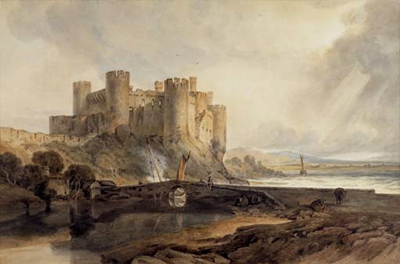
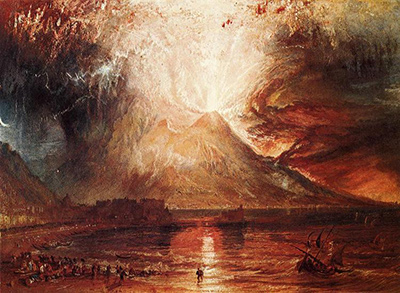
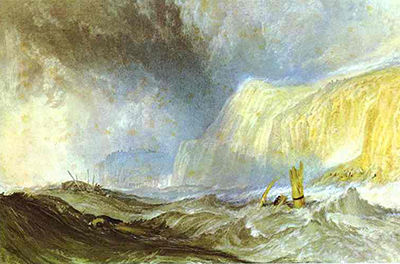
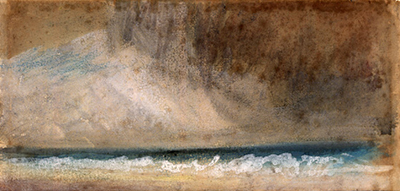
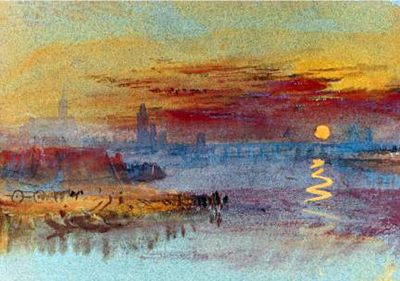


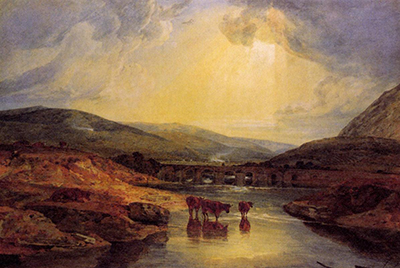
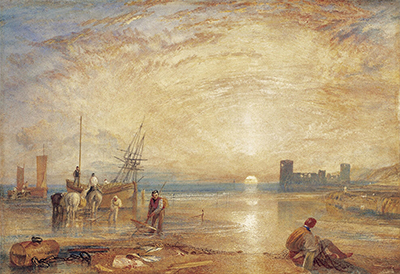
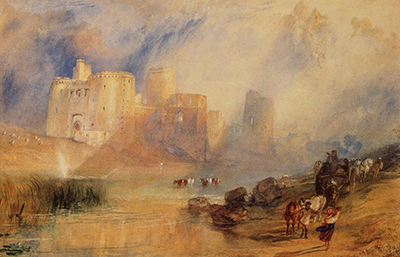
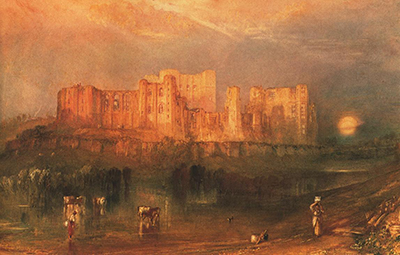
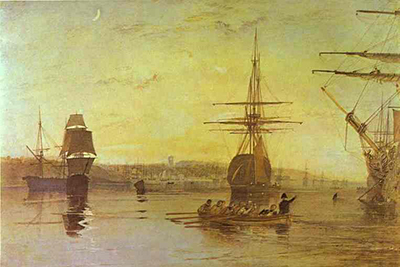
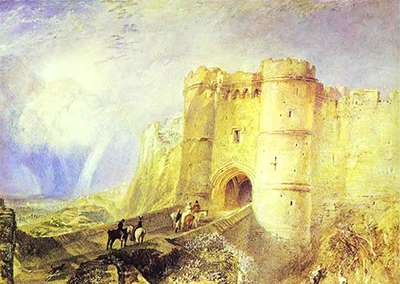
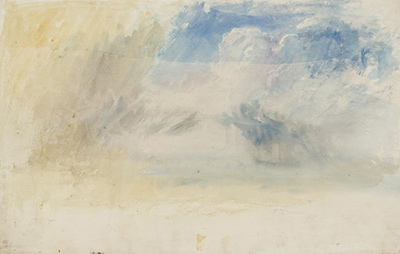
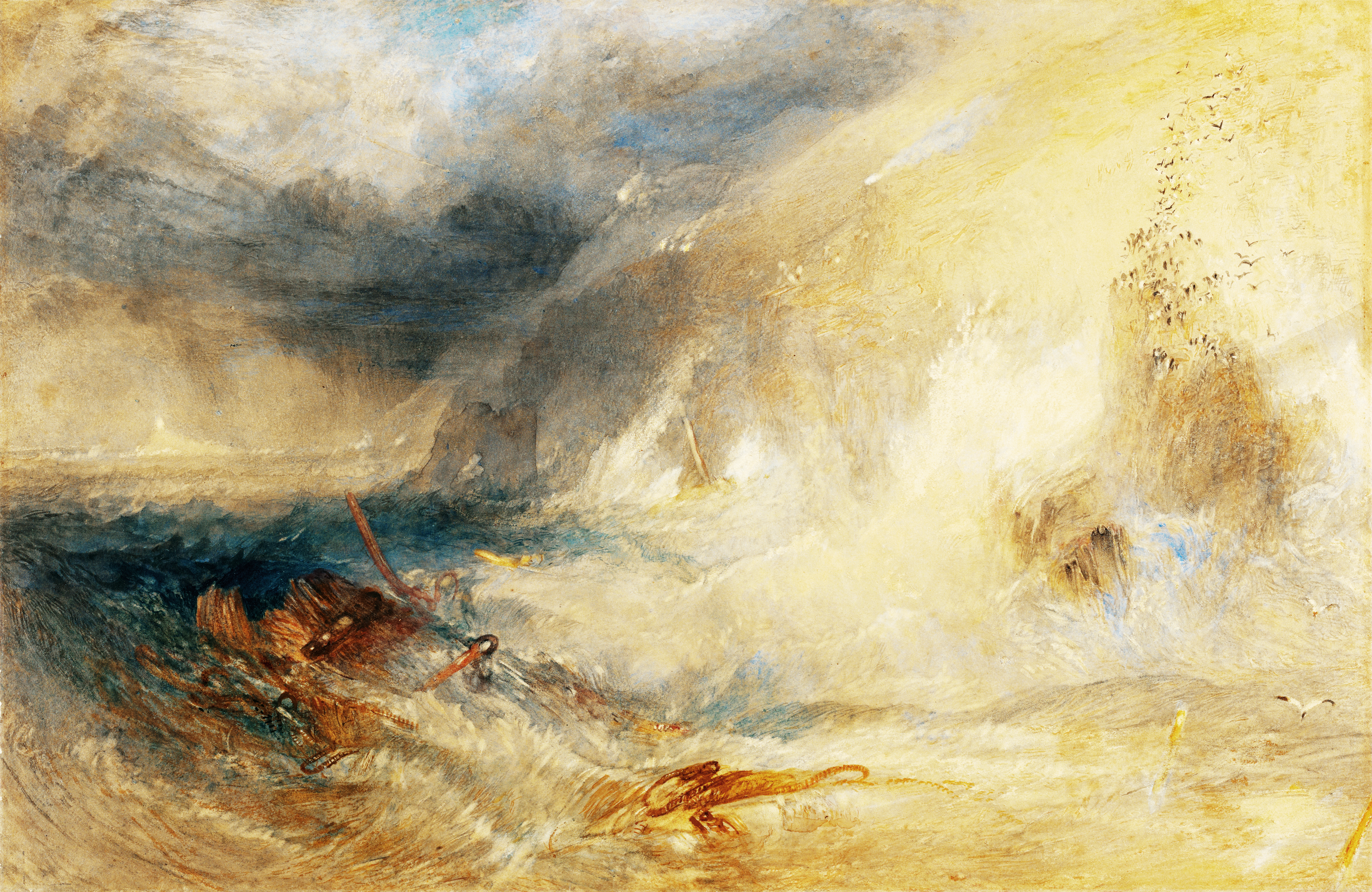
Early Watercolour Training
Turner was a capable watercolourist very early. The Wallace Collection notes that by the age of fourteen he could depict a country house accurately in perspective, with controlled handling of the medium and a sky that already moved beyond formula. [4] This early achievement is important because it shows how watercolour joined accuracy and invention from the start. Turner could draw architecture, organise recession and control tone; he could also begin to treat sky and atmosphere as expressive fields.
The topographical tradition gave young Turner a practical education. He learned to describe buildings, landscapes, ruins, rivers and estates in ways that patrons could recognise. Watercolour suited that world because it was portable, responsive and commercially useful. It could record views, prepare designs and produce finished works for collectors. Yet Turner did not remain a merely descriptive topographer. He used topographical discipline as the base from which light, weather and colour could be made more ambitious.
Training in watercolour also taught Turner to think through sequence. A drawing could begin with graphite structure, then receive washes, darker accents, scratched highlights or bodycolour. Decisions had to be staged because watercolour behaves differently from oil. It does not offer endless correction in the same way. The painter must understand paper, timing, wetness, absorbency and the relation between transparent colour and reserved light. This technical discipline made Turner's later freedom possible.
Watercolour also supported his entry into public life. The National Gallery records that Turner exhibited watercolours at the Royal Academy from 1790, before showing oils from 1796. [5] That sequence is a reminder that his first public identity was strongly tied to works on paper. He became known through a medium that some contemporaries considered lower in status, then helped expand what that medium could do.
The early watercolours also show Turner's relation to architecture. A country house, church, bridge or town view required control of proportion and perspective, not only pleasing colour. The Wallace Collection's example of a young Turner handling a house and sky demonstrates that the medium could join factual description with atmospheric invention. [4] That combination became fundamental to his later career. The accurate structure gave the image authority; the sky and light gave it life.
Young Turner's command of watercolour also gave him a practical advantage. The medium was relatively portable, commercially useful and suited to travel. It could serve the needs of collectors who wanted views and the needs of an ambitious artist who wanted to gather material. The technical economy of watercolour taught him how to make decisions quickly. That speed would remain important even when he worked on larger and more complex subjects.
The point is not that every early watercolour was radical. Many belong to established forms of topographical art. What matters is that Turner learned those forms deeply enough to stretch them. His later freedom with colour was built on early discipline in placement, recession and wash.
Sketchbooks, Drawings and Watercolour
Tate's Turner holdings make clear that sketchbooks, drawings and watercolours form a connected but varied field. Tate describes its research publication as an exploration of the world's largest collection of Turner's sketchbooks, drawings and watercolours. [1] Ian Warrell's Turner's Sketchbooks, published by Tate, is described by Tate as the first single volume devoted to the visual notes Turner made over sixty-two years, from teenage explorations to late colour studies. [6] This range is essential to understanding the watercolours.
Sketchbooks were tools of travel, memory and invention. Turner used them to store profiles of mountains, river bends, buildings, coastlines, boats, cloud forms and quick tonal ideas. Some notations are fragmentary; others are remarkably complete. Their value lies not only in beauty, but in evidence of thought. They show how Turner gathered visual material that could later become watercolour, print design or oil painting.
Drawings and watercolours should also be separated. A graphite or ink drawing may fix structure, outline, perspective or detail. A watercolour may test atmosphere, colour relation or finish. Some works combine drawing and watercolour; others move further toward independent colour. Turner did not treat these categories as sealed compartments, but modern viewers need the distinctions to avoid confusion. A monochrome study, a tinted travel drawing and a finished watercolour belong to different kinds of artistic purpose.
The phrase "works on paper" is useful because it keeps the field broad without making everything the same. Turner's paper-based practice includes sketchbook leaves, individual drawings, colour studies, watercolours intended for collectors, designs for print and unfinished experiments. The shared support does not erase differences of function. A responsible account asks what each object was doing: recording, testing, preparing, selling, exhibiting or experimenting.
This distinction protects watercolour from two opposite errors. One error treats every sheet as a preliminary step toward oil painting. The other treats every mark as a finished work of independent ambition. Turner produced both, along with many things between them. A travel notation may matter because it stores information. A colour study may matter because it tests an effect. A finished watercolour may matter because it is complete in itself. A design for engraving may matter because it entered print culture.
Sketchbooks also changed Turner's relation to time. They let him gather material faster than finished watercolour allowed, then return to it later. A place seen in one season could be transformed under another light in the studio. A rapid pencil note could support a more elaborate watercolour years after the journey. The medium therefore belongs to a long rhythm of observation and memory, not simply to instantaneous response.
Warrell's account, as described by Tate, is useful because it follows this long habit from early years to late colour studies. [6] That range prevents a narrow view of Turner as either a young topographer or a late colourist. The sketchbooks and watercolours show one continuous career, with different degrees of finish and different purposes.
The Turner Bequest and Tate
The Turner Bequest transformed the study of Turner's watercolours. The National Gallery gives the overall legacy as close to three hundred oil paintings and roughly thirty thousand sketches and watercolours, among them three hundred sketchbooks. [7] Tate's works-on-paper project gives a larger accessioned figure, explaining that approximately 37,500 accessioned works came to the nation as part of the Turner Bequest in 1856. [2] These numbers are not identical because they count categories differently, but both make the same point: Turner's surviving paper-based work is immense.
The scale of the bequest matters because it preserves process. Many artists are known mainly through finished works and scattered studies. Turner can be studied through a much fuller record of looking, travelling, testing and revising. A finished oil can be placed beside sketches and watercolours that show how motifs, colours and compositions developed. A travel subject can be traced across drawing, watercolour and print. A late colour study can be considered as part of a long habit, rather than as an isolated surprise.
Tate's cataloguing work is also important. The project overview states that it aims to revise and update A. J. Finberg's inventory of the Turner Bequest, bringing older catalogue structures into a modern institutional framework. [8] That matters because the Turner Bequest is not just a large inheritance; it is a complex body of evidence. Titles, dates, media, sequence, travel context and object status all require continuing review.
For public understanding, the bequest also changes the status of watercolour. Turner did not leave only a few polished works; he left a massive record of paper-based practice. This makes watercolour central to any account of him. The medium was not marginal, and the evidence is not marginal either. It is one of the main ways Turner's career can still be reconstructed.
The bequest also reveals how difficult neat categories can be. A sheet may contain rapid pencil work and colour. A study may look unfinished but still carry a precise experiment. A finished watercolour may be connected to print production. A sketchbook may contain both ordinary notes and remarkable colour. The survival of such variety forces a richer account of Turner than a simple list of masterpieces.
Because Tate's cataloguing work continues older inventory traditions while updating them, the bequest also reminds viewers that evidence changes through scholarship. [8] Object titles, media descriptions, dates and relationships can become more precise. This is particularly important for watercolour, where support, technique and purpose may not be obvious from a reproduction. Institutional cataloguing is part of how the works become understandable.
The Bequest is therefore not only a historical event. It is the condition that allows modern study of Turner's watercolour practice. Without that survival, Turner would still be a major painter, but the scale of his looking and experimenting would be far less visible.
Chronological Structure
Tate's research framework is especially useful because it follows Turner through chronological phases. The broad movement runs from student and early master through Academician and professor, then Italy and after, the repeated touring years, and the late modern painter phase. [1][8] This structure helps avoid treating all watercolours as a single style. Turner's use of the medium changed with age, travel, patronage, publication and technical confidence.
In the early period, watercolour supported topographical skill, architectural record and public entry. Turner learned to control perspective, wash and tone while making subjects that collectors and institutions could understand. These works can look restrained beside the later colour studies, but their restraint is part of their importance. They trained him to build clarity.
The Academician and professor years expanded ambition. Turner increasingly used watercolour not only to record places, but to develop larger ideas about landscape, history and atmosphere. He was also active in print culture, where watercolour designs could become engraved images. That role required him to think about how colour and tone would translate into reproducible form. Watercolour was both a medium of immediacy and a medium that could feed wider circulation.
Italy and the later travel years brought new light, architecture and distance. Rome, Venice, the Alps, Switzerland and river journeys gave Turner subjects that demanded other colour relations. The watercolours from these fields often show how observation could be intensified into memory. In the late years, colour studies could become almost independent events, no longer merely preparations for another object. They ask viewers to treat colour as a form of thinking.
This chronological structure also helps separate watercolour from biography alone. Turner did not become experimental simply because he grew older. Each phase gave him new problems. Youth trained control. Academy life trained ambition. Travel trained memory. Print work trained translation. Late practice concentrated colour. The mature watercolours are therefore best understood as cumulative, not sudden.
Materials and Technique
Any technical account of Turner's watercolours should be tied to conservation evidence rather than romantic generalisation. The Wallace Collection article, drawing on Joyce Townsend's technical expertise, describes watercolour in Turner's youth as a lower-status medium and notes his importance in using newly invented coloured pigments. [4] It also points to his control of perspective, sky and the medium from an early age. [4]
Watercolour depends on paper, pigment, water and timing. Transparent washes allow the support to shine through. Bodycolour can add opacity. Scratching-out or lifting can restore highlights or create bright accents. Blotting, wiping and layering can produce atmospheric transitions. These procedures are not decorative tricks. They determine how light exists in the image. In watercolour, the brightest light may be unpainted paper preserved by control.
Turner's technical range is often described through terms such as wash, bodycolour, scraping or colour study, but those words should be used with care. Not every watercolour uses every method. Not every late work is a finished statement. The safest approach is to connect technique to visible effect and source evidence. If a work shows lifted brightness, opaque passages or transparent layering, the description should remain close to what can be seen or to what a technical authority records.
The material nature of watercolour also affects conservation. Works on paper are vulnerable to light, humidity, handling and fading. This vulnerability shapes display and access. It helps explain why watercolours may be shown differently from oils and why institutional records matter. The medium's beauty depends on fragile material conditions, and Turner's experiments often pushed those conditions hard.
Paper is not a neutral ground in this story. It absorbs, resists, stains, buckles, glows and ages. Turner exploited those qualities. A wash can sink into the fibres and become atmospheric; a reserved highlight can make untouched paper appear brighter than pigment; a roughened surface can catch colour differently from a smooth one. The support participates in the image.
Pigment choice matters too, but it must be handled with evidence. The Wallace Collection points to Turner's engagement with newly invented coloured pigments. [4] That does not mean every bright colour can be identified without analysis. It means Turner was alert to the expanding material possibilities of his time. A careful account can describe the visual effect while leaving exact pigment claims to technical sources.
The practical sequence of working is also important. Watercolour can require planning because light often has to be preserved. It can also reward improvisation because wet pigment behaves in ways that can be guided but not fully controlled. Turner was strong in both modes. He could design a view with architectural clarity, but he could also let fluid colour create atmosphere that no line could produce alone.
Finished Watercolours
Turner made watercolours that were complete works, not merely studies. Finished watercolour could serve collectors, exhibitions and publication culture. Such works might combine drawing, transparent wash, bodycolour, scratching-out and carefully staged tonal contrasts. They could be as ambitious in their own medium as oils were in theirs.
The status of finished watercolour is important because watercolour had often been treated as preparatory or subordinate. The Wallace Collection states that Turner raised the medium so that it rivalled oil. [4] That claim does not mean watercolour became oil in another form. It means Turner demonstrated that watercolour could carry finished artistic ambition through its own properties: transparency, speed, luminosity, delicate surface and the active role of paper.
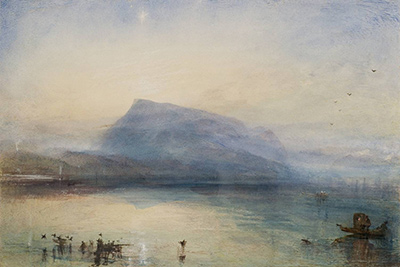
The Blue Rigi, Sunrise is a useful example, though it should not absorb the whole subject. Art Fund identifies the work as an 1842 watercolour on paper at Tate Britain, measuring 29.7 x 45 cm, and calls it one of three finished drawings of the subject regarded among Turner's finest achievements in the medium. [9] The work's importance lies partly in how much it achieves through restraint: mountain, lake, sunrise and atmosphere become a carefully balanced event of tone and colour.
Finished watercolours also challenge modern assumptions about scale. A watercolour does not need large dimensions to be ambitious. It can compress distance, weather and time into a relatively small sheet. Turner understood that intimacy could intensify looking. In a finished watercolour, the viewer often comes close to the surface, where slight shifts of tone or untouched light carry major weight.
Finished watercolours also show Turner's command of restraint. In oil, a painter can build dense surfaces and dramatic impasto. In watercolour, power may come from withholding. A pale sky, a small dark accent, a sliver of untouched support or a delicate gradation can carry the whole composition. Turner's best watercolours often depend on this economy. They ask the viewer to notice relationships rather than simply admire display.
The collector's role matters here. Watercolours could be owned, handled and viewed intimately in ways different from large oils. That does not make them private in a narrow sense, but it changes their address. A finished watercolour can feel close because of scale and medium, even when its subject is a mountain, lake or wide atmospheric distance. Turner understood how to make smallness expansive.
This is also why finished watercolours should not be described as lesser versions of paintings. Their effects are native to the medium. A watercolour sunrise, mist or lake reflection works through transparency, absorbency and reserved light. Those qualities cannot simply be translated into oil without changing the image.
Colour Studies and Late Practice
Turner's late colour studies are among the most compelling parts of his watercolour practice. Warrell's Tate book description links the sketchbooks to a long career that culminated in late colour studies. [6] These works can appear astonishingly open: washes, clouds, light fields, partial forms, remembered places and chromatic experiments may matter more than complete description. They are a major reason Turner's works on paper have been so important for later ideas about modernity.
The late studies should not be treated as simple abstractions. Turner was still working from habits of travel, observation, composition and material control. A colour study may seem free, but it often belongs to a history of looking. It may relate to a place, a weather condition, a memory or a future work. The difficulty is that some late objects are not fully resolved in the same way as finished exhibition works. Their status must remain open where the evidence is open.
Colour studies also reveal Turner's understanding of atmosphere as structure. A pale wash may establish air. A darker band may create horizon or land. A small accent can imply a boat, tower or figure. The viewer may not receive a complete description, but the image can still have order. Turner's late watercolours often make viewers experience perception before certainty.
This late practice also helps explain his oil painting. When late oils seem to dissolve into colour and weather, they are not abandoning a lifetime of watercolour knowledge. They are drawing on it. Turner's watercolours trained him to let light, support, translucency and timing shape the whole field. The late colour studies make that training visible in concentrated form.
Late colour studies also show the difference between incompletion and openness. Some works may be unfinished in a documentary sense, but they can still reveal a coherent experiment. A few washes can establish a weather condition. A bright centre can organise the sheet. A half-indicated form can be enough to create scale. The viewer should be cautious about declaring such objects finished, but equally cautious about dismissing them as failures.
The late studies have influenced later taste partly because they seem close to modern abstraction. That comparison can be useful if kept as later reception, not as a claim that Turner belonged to a later movement. His colour studies came from nineteenth-century materials, travel habits, collection practices and artistic debates. Their modern force is real, but it grew out of his own world.
This balance helps preserve their strangeness. They are not simply modern pictures before modernism, and they are not merely old sketches. They are records of an artist using watercolour to test how little visible information can still hold light, space and memory together.
Print Culture and Reproduction
Watercolour was closely tied to print culture in Turner's career. The Met describes watercolours from tours that served as the basis for mezzotint and engraving series, including Ports of England. [3] This relationship matters because many viewers encountered Turner's imagery through reproductive media. A watercolour could be an independent work, but it could also be a design made to travel through print.
Designing for reproduction required a different kind of intelligence. Colour and wash had to be translated into line, tone and printed contrast. Turner had to think about what could survive the transfer from sheet to plate, from hand-coloured effect to published image. This did not make the watercolour less artistic. It made it part of a wider visual economy.
Print culture also connected watercolour to income and audience. A single collector might own a finished work, but a print series could circulate more broadly. Turner understood the value of that circulation. He used watercolour to supply designs that could reach readers, travellers and collectors who might never see the original sheet or own an oil painting.
The relationship between watercolour and print is another reason to distinguish functions. A watercolour for engraving may be highly finished, but its purpose differs from a private colour study or a topographical sketch. Looking only at medium misses the point. The question is how the object worked in Turner's career.
Print design also created a dialogue between individual touch and collaborative translation. Turner could supply the design, but engravers and mezzotint specialists helped turn it into a reproducible image. That process required trust, correction and adaptation. It also meant that a watercolour could have a life beyond its original sheet. The design might circulate through books, series and illustrated projects, reaching an audience far wider than one collector.
This circulation helped make Turner visible as a national and international artist. Travel subjects, rivers, ports and literary views could move through print culture. Watercolour therefore supported reputation as much as study. It was part of Turner's public career, not just his private practice.
The print connection also shows why tone mattered so much. A watercolour design for reproduction had to be intelligible when translated into tonal media. Strong light-dark organisation, clear masses and memorable silhouettes helped a design survive. Turner's watercolour practice combined fluidity with structure because the works often had to function in more than one visual system.
How to Read Turner Watercolours
The first question is what kind of object is being viewed. Is it a sketchbook leaf, a topographical drawing, a finished watercolour, a colour study, a design for print or an exhibition work? The answer changes how one should describe finish, purpose and evidence. Calling everything a watercolour can hide too much.
The second question is how light is made. In watercolour, brightness may come from untouched paper, thin wash, lifted pigment or opaque accents. Turner used these possibilities with extraordinary flexibility. Instead of asking only what the image depicts, ask how the light has been physically built.
The third question is how much certainty the work offers. Some watercolours name a recognisable place or subject. Others suggest a place through colour and atmosphere. Some are connected to finished works; others remain independent or unresolved. Turner often invites the viewer to move between fact and impression. That movement is part of the medium's power.
The fourth question is whether the work belongs to travel, collection, print or experiment. A Swiss watercolour, a Venice colour study, a British topographical drawing and a publication design may all involve watercolour, but they do not behave in the same way. Turner's achievement lies in making one medium serve many purposes without reducing it to any one of them.
A fifth question is how much the paper itself is doing. Does untouched support create the brightest light? Does a wash create distance by thinning out? Does bodycolour sit on the surface to sharpen an accent? Does scratching-out make a burst of light or spray? These material questions lead to better looking because they keep the viewer close to the object.
A final question is what should be left uncertain. Turner often created works that resist complete explanation, especially among late studies and travel material. Responsible interpretation can describe the visible effect, connect it to reliable evidence and still admit that purpose or subject may remain partly open. That openness is not a weakness in Turner's watercolours. It is one of the reasons they continue to feel alive.
Frequently Asked Questions
Turner's watercolours are important because they shaped his whole career. They supported early training, travel, finished collecting works, print designs, colour studies and late experiments in atmosphere. They also helped raise the status of watercolour from a subordinate medium into one capable of major artistic ambition. [1][4]
Turner used watercolour methods that could include transparent washes, bodycolour, lifting, scratching-out and layered handling, depending on the work. Technical claims should be tied to conservation evidence or close object description rather than assumed for every work. [4]
Yes. The Met explains that Turner brought watercolour practice into oil by using colour as a base for form. This helps explain why some of his oils seem so luminous and why his late paintings often depend on atmosphere as much as outline. [3]
Discussion
Which use of watercolour most changes how you understand Turner's wider practice?
Reader Insights
Is the sheet a sketch, colour study, finished work or design for print?
How do paper, wash, bodycolour or scratching-out construct the light?
What changes when travel, collection or reproduction shaped the work?
Join the Conversation
Share a close observation or a question for other readers.
References
- Tate, "J.M.W. Turner: Sketchbooks, Drawings and Watercolours." https://www.tate.org.uk/art/research-publications/jmw-turner
- Tate, "J.M.W. Turner: Sketchbooks, Drawings, Watercolours," project record. https://www.tate.org.uk/about-us/projects/jmw-turner-sketchbooks-drawings-watercolours
- Elizabeth E. Barker, "Joseph Mallord William Turner (1775-1851)," The Metropolitan Museum of Art, Heilbrunn Timeline of Art History. https://www.metmuseum.org/essays/joseph-mallord-william-turner-1775-1851
- Wallace Collection, "Turner's Watercolour Materials and Techniques." https://www.wallacecollection.org/explore/explore-in-depth/turner/turners-watercolors/turners-watercolour-materials-and-techniques/
- National Gallery, London, "Joseph Mallord William Turner 1775-1851." https://www.nationalgallery.org.uk/artists/joseph-mallord-william-turner
- Tate Shop, Ian Warrell, *Turner's Sketchbooks*. https://shop.tate.org.uk/turners-sketchbooks-paperback/20184.html
- National Gallery, London, "The Turner Bequest." https://www.nationalgallery.org.uk/about-us/history/the-turner-bequest
- Tate, "Project Overview," *J.M.W. Turner: Sketchbooks, Drawings and Watercolours*. https://www.tate.org.uk/art/research-publications/jmw-turner/project-overview-r1109225
- Art Fund, "The Blue Rigi, Sunrise." https://www.artfund.org/our-purpose/art-funded-by-you/the-blue-rigi-sunrise