 by Tom Gurney
Tom Gurney BSc (Hons) is an art history expert with over 20 years experience
Published on June 19, 2020 / Updated on August 29, 2026
Email: tomgurney1@gmail.com / Phone: +44 7429 011000
Overview
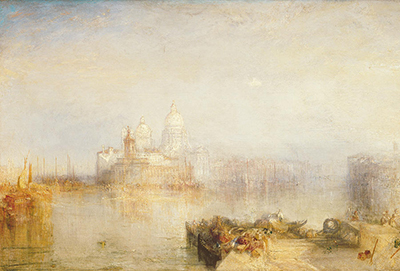
J. M. W. Turner's The Dogana and Santa Maria della Salute, Venice is a late Venetian oil in the collection of the National Gallery of Art, Washington. The National Gallery of Art records the work as by Joseph Mallord William Turner, dated 1843, oil on canvas, with accession number 1961.2.3.[1] The same record gives the size as 62 x 93 cm overall, 86 x 116.5 cm framed, and credits the gift in memory of Governor Alvan T. Fuller by The Fuller Foundation, Inc.[1]
The painting shows Venice through the relationship of water, atmosphere and architecture. The Dogana, the old customs house at the entrance to the Grand Canal, and Santa Maria della Salute, the domed church nearby, are not described as hard-edged monuments. They emerge through luminous haze, reflected colour and a foreground of boats and quayside activity. Turner keeps the title's landmarks legible, but the real subject is the way Venice becomes visible through light.
The object needs careful identification because Turner made several Venice paintings and studies involving the Dogana, the Salute, San Giorgio Maggiore and nearby viewpoints. This work is the 1843 National Gallery of Art painting titled The Dogana and Santa Maria della Salute, Venice, accession 1961.2.3.[1] It should not be merged with the National Gallery of Art's different 1834 painting Venice: The Dogana and San Giorgio Maggiore, accession 1942.9.85.[2]
That distinction matters because the 1843 work has its own scale, composition, history and mood. It is a late Venetian painting of golden haze and softened form, not the earlier 1834 view across a canal toward San Giorgio Maggiore. The two works can be compared, but they should not be treated as the same object.
The 1843 painting is best approached through its balance between clear identification and atmospheric dissolution. The title gives two architectural anchors, while the image makes those anchors unstable in light. Turner invites recognition, then slows it down. The viewer sees Venice, but sees it through water, haze, warm colour and mobile paint.
At a Glance
- ArtistJoseph Mallord William Turner
- TitleThe Dogana and Santa Maria della Salute, Venice
- Date1843
- MediumOil on canvas
- Overall size62 x 93 cm
- CollectionNational Gallery of Art, Washington
- Accession1961.2.3
- CreditGift in memory of Governor Alvan T. Fuller
- ExhibitedRoyal Academy, 1843, no. 144
- Display statusNot on view at source verification
Contents
- Overview
- Object Identity
- Dogana, Salute and Venice
- Light, Water and Reflection
- Boats and Foreground Life
- The 1843 Exhibition Context
- Not the 1834 Dogana and San Giorgio Painting
- Venice Without Tourist Prose
- Late Oil Handling
- How to Look at the Painting
Object Identity
The full title is The Dogana and Santa Maria della Salute, Venice.[1] The date is 1843.[1] The medium is oil on canvas.[1] The accession number is 1961.2.3.[1] These details provide the stable foundation for any interpretation of the painting.
The National Gallery of Art lists the work as not on view in its current record.[1] Display status can change, but the record's not-on-view status is the appropriate object anchor at the time of verification. The holder remains the National Gallery of Art, Washington, and the credit line records the Fuller Foundation gift.[1]
The dimensions, 62 x 93 cm overall, place the painting among Turner's relatively compact late Venice oils.[1] It is horizontal enough to open across water, but not grand in the manner of a large exhibition panorama. This scale helps the painting hold intimacy and breadth together. The viewer is close to the water and boats, yet the view extends toward a luminous Venetian distance.
The lower-right inscription is also recorded by the National Gallery of Art as "JMWT."[1] That mark is one more reason to keep the object distinct. The painting's identity is not based on a generic Venice theme, but on a particular work with a documented title, date, medium, size, accession and provenance.
Butlin and Joll's catalogue remains an important scholarly backbone for Turner's paintings, including title, date, exhibition and provenance contexts for the late oils.[5] The National Gallery of Art record itself also supplies a detailed ownership and exhibition history. Together, those anchors help prevent loose Venice generalization.
The painting's recorded size also matters to the way it works. At 62 x 93 cm, it is broad enough to open a lagoon vista, but compact enough for the paint surface to feel concentrated.[1] Turner does not need monumental scale to make Venice expansive. He creates breadth through the waterway and through the low placement of the distant architecture.
The credit line gives the work a twentieth-century American collection history, but the earliest recorded public context remains the Royal Academy in 1843.[1] That combination of exhibition origin and later museum life gives the painting two kinds of public identity: the Victorian display world in which Turner showed it, and the National Gallery of Art collection in which it is now held.
Warrell's work on Turner and Venice is useful because it treats Venice as a repeated artistic problem rather than a single picturesque episode.[4] The 1843 Dogana and Salute painting should be read within that repeated engagement, but it still needs to remain its own object.
Dogana, Salute and Venice
The Dogana and Santa Maria della Salute are among the most recognizable features of the Venetian lagoon near the entrance to the Grand Canal. Turner uses that recognizability, but he does not build the painting as a dry architectural survey. The buildings matter because they hold the scene in place while light and water transform it.
The Dogana gives the painting a low, horizontal and civic presence. The Salute gives it the rounded force of domes rising into the haze. Together they create a contrast between low waterfront structure and religious architecture. Turner softens both, but he does not erase them.
The National Gallery of Art's visual description identifies a golden haze, an expanse of water with boats, pale buildings along the distant shore, and a domed structure beyond a yellow building with a tower.[1] Those elements correspond to the title's landmarks without requiring crisp outlines. The architecture is present through colour, placement and silhouette.
This is typical of Turner's late Venice work. The city is not reduced to exact masonry. It becomes an arrangement of water, air, building mass and reflected light. Venice suited Turner because its architecture is always doubled and altered by the lagoon. Stone and water meet constantly, and the viewer can never separate form from atmosphere for long.
The painting therefore depends on Venice as a particular place, but it does not behave like a guidebook view. It gives enough topography to establish the Dogana and the Salute, then lets colour dissolve the boundaries between quay, water, building and sky.
This means that the city is both named and unstable. The viewer can identify the subject, yet the painting keeps resisting the satisfaction of fixed architectural inspection. The Dogana and the Salute do not vanish; they remain just firm enough to hold the composition. Around them, the lagoon atmosphere keeps changing the terms of vision.
The Dogana's position at the meeting of waterways is important because it gives the subject a transitional character. The painting is not set in a closed square or a dry street. It faces the lagoon, where movement, trade, ceremony and reflection all meet. Turner chooses a location where Venice already seems to be negotiating between land and water.
Santa Maria della Salute adds a different kind of presence. Its domes are famous, but Turner does not make them merely iconic. They rise through pale air, less as hard architecture than as a volume of light. The church gives the painting vertical lift while the Dogana and boats keep it close to the waterline.
Light, Water and Reflection
The painting's Venetian character is carried by light on water. The National Gallery of Art describes loosely painted yellow water, pale buildings, coloured touches in boats and soft reflections.[1] Turner uses water as an active surface that receives, breaks and redistributes colour.
Reflection is not a decorative afterthought. It is the way the painting thinks. Buildings do not simply stand above the lagoon; they return into it as colour. Boats do not merely occupy the foreground; they interrupt and animate the water. The sky does not sit above the city; its yellow, pink and blue tones affect the whole field.
The golden haze is crucial. It gives the scene warmth without turning it into a hard sunset display. The horizon sits low enough for sky and water to dominate, but the buildings along the distance keep the view anchored. Turner makes Venice appear as a city suspended between substance and reflection.
This is one reason the painting should not be treated as vague. The soft handling is purposeful. Turner can make the city uncertain at the edges because the title and composition preserve the subject. The viewer knows where the painting is, even while the visual evidence remains fluid.
The water also carries time. Lagoon light changes quickly, and Turner's painting feels like a moment when the city is being remade by weather and atmosphere. The 1843 date places the work late in his career, when such effects had become central to his art.
The colour structure is especially important. The scene is warm, but not simply golden. Pink, blue, green, red and grey touches interrupt the dominant warmth. These accents keep the surface alive and prevent the painting from becoming a single wash of light. Turner uses small colour events to animate the whole.
The National Gallery of Art's description notes the artist's use of varied tones in the boats and distant buildings.[1] Those touches matter because they give materiality to a scene that otherwise might drift into pure haze. The viewer senses cargo, figures, cloth, hulls and quayside forms without needing them spelled out.
Reflections also help the architecture become less static. The buildings on the horizon are answered in the water below, but not as mirror copies. The reflections are broken, loose and colouristic. This is Venice as Turner understood it late in his career: a city whose image is constantly altered by the lagoon.
This movement between object and reflection gives the painting its rhythm. Solid forms appear, soften, return as colour in water, and dissolve again into atmosphere. The eye has to keep rebuilding the view.
Boats and Foreground Life
The foreground boats are essential. The National Gallery of Art record notes boats near a dock, touches of varied colour suggesting objects, and small human presences beyond a low structure.[1] These are modest details, but they keep the painting from becoming only distant architecture.
Boats give Venice scale. They tell the viewer that the lagoon is not just reflective surface but working space. They also provide dark and coloured accents against the pale water. Turner uses them to connect the foreground to the distant city.
The figures are small and barely described. That is appropriate to the painting's structure. Turner is not telling an anecdote about individual Venetians. He is using human scale to clarify the scene. The city remains inhabited, but no single figure becomes the story.
The boats also organize the eye. They hold the lower-right area of the canvas and give the viewer a place to enter. From there, the gaze can move outward across water toward the Dogana, the Salute and the sky. Without this foreground activity, the painting might feel too weightless.
This balance between activity and haze is one of the work's strengths. Turner does not choose between urban life and atmospheric vision. He lets boats, colour and architecture share the same unstable light.
The foreground also prevents the painting from becoming a distant dream of Venice. It brings the viewer close to dockside matter. The lower edge has weight because Turner places boats and marks of human activity there. That weight is essential. Without it, the distant Salute might float too freely.
The small human indications are especially characteristic of Turner's late way of handling scale. He does not need detailed faces or narrative poses. A few strokes are enough to suggest human presence. The city is inhabited, but the atmosphere remains dominant.
The boats also give a Venetian kind of motion. They do not rush like trains or steamships. They sit, drift and punctuate the water. Their slower rhythm suits the painting's mood. The scene has activity, but it is activity absorbed into light.
The 1843 Exhibition Context
The National Gallery of Art records that the painting was shown at the Royal Academy of Arts, London, in 1843, as number 144.[1] It also records exhibition at the Birmingham Society of Artists in the same year.[1] This early public history is important because the work was not merely a private Venetian memory. Turner placed it before viewers as a finished oil painting.
The NGA provenance states that the painting was purchased in 1843 from the Royal Academy exhibition by Edwin Bullock of Hawthorn House, Handsworth, Birmingham.[1] That first ownership connects the work directly to its public exhibition moment. It also shows that the painting entered collection history immediately after being shown.
Later ownership included Thomas Agnew & Sons, Sir John Fowler, James Ross of Montreal, Alvan T. Fuller of Boston, The Fuller Foundation and the 1961 gift to the National Gallery of Art.[1] The chain is long, but the key point for a public reading is simple: the painting moved from Turner's 1843 exhibition world into a documented transatlantic collection history.
The 1843 exhibition date also situates the painting among Turner's late Venetian concerns. By this point, Venice had become one of his richest subjects. He had used the city to explore memory, travel, atmosphere and the relation between older architectural grandeur and modern perception.
The work's public exhibition history helps explain its polish. The handling is loose, but the painting was not merely a private studio experiment. Its softness and luminous dissolution were offered as finished artistic choices.
The NGA record also preserves later exhibition history, including shows devoted to Turner, Venice, Ruskin and late seascapes.[1] That later history shows how the painting has been used to explain several aspects of Turner's art: his Venetian subjects, his late handling, his reception, and his treatment of water and light.
The provenance gives another useful lesson. The painting's movement through Bullock, Agnew, Fowler, Ross, Fuller and the Fuller Foundation shows how a British exhibition picture entered a wider collecting network before reaching Washington.[1] The object therefore belongs to both Turner's London exhibition world and to the later international history of British art collecting.
The 1843 Royal Academy context is especially important because Venice was not just a private passion for Turner. It was a subject he repeatedly made public. He sent Venetian works into exhibition spaces where viewers could compare them with other landscape traditions, including more precise vedute and more conventional marine painting.
The painting's loose finish therefore had an audience. It was not hidden away as a study. Turner was prepared to let viewers encounter Venice through softened edges, open paint and atmospheric colour.
Not the 1834 Dogana and San Giorgio Painting
The National Gallery of Art also holds Venice: The Dogana and San Giorgio Maggiore, dated 1834, oil on canvas, accession 1942.9.85.[2] That painting is a different object. It is on view in the National Gallery's West Building, and its record gives overall dimensions of 91.5 x 122 cm.[2]
The 1834 painting looks across a waterway toward San Giorgio Maggiore and includes a different title, date, scale, accession and collection credit.[2] It belongs to Turner's earlier Venice work and has its own commission and provenance history. It should not be used as a substitute for the 1843 Dogana and Santa Maria della Salute painting.
The distinction is not pedantic. Venice subjects repeat landmarks, and Turner often returned to similar views. If titles are blurred, the interpretation becomes unreliable. The 1843 painting is smaller, later and centered on the Dogana and the Salute, not San Giorgio Maggiore.
Comparison can still be useful. The 1834 painting shows how Turner had already treated the Dogana area with brilliant architectural and watery effects. The 1843 painting shows a later, softer transformation of Venice into gold haze, pale buildings and loosely held reflection. The comparison makes sense only if the objects remain separate.
The same caution applies to Tate's Dogana and Salute-related works and Venice studies. Turner made many Venetian images. This article concerns the National Gallery of Art's 1843 oil, accession 1961.2.3.[1]
Tate's works-on-paper research catalogue is useful for seeing how many Venice-related drawings and watercolours surround Turner's painted Venetian output.[3] That broader context confirms how often he returned to the city's motifs, but it also increases the need for precise identification. Repetition is not interchangeability.
The 1834 Dogana and San Giorgio painting can help a viewer understand how Turner developed Venetian light across time. It has a more open, clear canal structure and a different architectural focus.[2] The 1843 Dogana and Salute painting feels later in its looseness and golden dissolution. The difference is one of object, not only mood.
This object separation also protects the historical record. The 1843 painting has an exhibition history beginning at the Royal Academy in 1843 and an ownership chain that differs from the 1834 work.[1][2] Merging them would confuse both interpretation and provenance.
Venice Without Tourist Prose
Venice can easily invite overfamiliar language. It is tempting to write about canals, romance, gondolas and shimmering light in general terms. Turner's painting needs something more precise. The Dogana and the Salute matter because they give the composition its architectural anchors, while the lagoon gives Turner the surface on which light can act.
The city in this painting is not a backdrop. It is a visual problem. How can an artist make stone architecture seem solid enough to identify, yet porous enough to belong to water and air? How can a city be recognizable when its edges dissolve? How can a foreground of boats and a distant skyline belong to the same field of colour?
Turner's answer is not documentary detail. He uses a limited set of forms: dock, boats, water, pale architecture, domes, tower, sky. These forms are enough. Their purpose is not to catalogue Venice, but to make the city appear as an event of light.
This approach keeps the painting distinct from a picturesque souvenir. Turner is not simply reporting that Venice is beautiful. He is testing how painting can make beauty unstable, atmospheric and temporal. The scene looks serene, but its serenity depends on constant visual change.
This also keeps the broader Venice context in proportion. Turner and Venice is a large subject, but the object here is specific. The painting asks for close attention to one National Gallery of Art oil, not a general survey of all Turner's Venetian work.
The painting's specificity is what makes it valuable for understanding Turner's Venice. It shows a single solution to a recurring problem: how to make a famous city new through paint. Turner does not rely on novelty of subject. The Dogana and the Salute were already familiar landmarks. His originality lies in the way he makes them appear unstable, radiant and momentary.
This is also why the painting should not be read only as topography. Topography names the place, but atmosphere gives it meaning. The title tells the viewer what to look for. The paint tells the viewer how unstable looking can be.
A tourist view tends to secure memory: here is the place, here are its monuments. Turner's view unsettles memory. It suggests that Venice is remembered through light and water as much as through architecture. The city is recognizable, but recognition arrives as a process.
Late Oil Handling
The painting is oil on canvas, and its late handling should be discussed as material practice rather than vague atmosphere.[1] Townsend's work on Turner's materials and techniques is useful because it frames his late effects as the result of choices about paint, surface, colour and process.[6]
In The Dogana and Santa Maria della Salute, Venice, the surface appears loose and luminous. Forms are suggested through touches and blends rather than locked outlines. The National Gallery of Art description notes smudges and strokes of varied colour along the horizon, boats, water and foreground.[1] That looseness is not a failure of vision. It is the method by which Venice becomes light-struck.
Oil paint allows Turner to build a different kind of luminosity from watercolour. In a watercolour, paper can serve as light. In an oil painting, light is built through pigment, ground, layering and relation between colours. The 1843 Venice painting depends on warm yellows, pale architecture, pink and blue accents, and water that carries reflection.
The painting's softness also affects meaning. A hard-edged Venice would emphasize architecture as possession: named buildings fixed in a view. Turner's softened Venice emphasizes experience: how the city appears at a particular atmospheric moment. The difference is central to the late work.
The visible brushwork also gives life to the water and sky. The painting does not freeze Venice into a still postcard. It lets the surface remain mobile, as if the scene were shifting under the viewer's eye.
The softness of the late handling should not be mistaken for lack of control. Turner decides where the painting needs weight and where it can open. The lower-right boats are more materially insistent than the distant buildings. The horizon is more dissolved than the foreground. The sky carries breadth while the lower area supplies anchors.
Townsend's technical framework helps keep this discussion grounded.[6] Late Turner effects depend on paint behavior, not only on inspiration. The warm haze, pale architecture and broken reflections are pictorial decisions made through oil paint on canvas.
There is also a discipline in what Turner leaves unresolved. A more literal painter might have sharpened every dome, wall and boat. Turner instead allows degrees of definition. Some things are named by the title, some are suggested by colour, and some remain part of the general light. That hierarchy is the painting's structure.
The result is a city that feels both observed and remembered. It is not an imaginary Venice, but neither is it a simple transcript. It is Venice after Turner has turned sight into late style.
How to Look at the Painting
Begin with the object identity: National Gallery of Art accession 1961.2.3, titled The Dogana and Santa Maria della Salute, Venice, made in 1843 in oil on canvas.[1] That keeps the reading separate from the 1834 Venice: The Dogana and San Giorgio Maggiore and from other Venice works.
Next, locate the foreground. The boats and dock at the lower right are not minor clutter. They are the viewer's entry into the scene. Their darker and warmer accents give weight to the lower edge and lead the eye across the lagoon.
Then follow the water. The lagoon is not empty space between viewer and architecture. It is a reflective field. Its yellow and pale tones gather sky, buildings and boats into one system.
After that, find the Dogana and the Salute. They are visible, but they do not dominate through hard contour. The Dogana's waterfront presence and the Salute's domes rise through atmosphere. Turner lets the title's landmarks emerge slowly.
Finally, look at the sky and haze. The upper part of the painting controls the mood. Warm yellow, touches of pink and a cooler blue area help create a Venetian atmosphere in which the city seems made as much from air as from stone.
It is also useful to compare the painting's zones of clarity. The foreground is tactile; the middle distance is watery; the architecture is pale; the sky is atmospheric. Turner gives each zone a different kind of information. Looking means moving between these degrees of certainty.
The title can guide the search for the landmarks, but it should not make the viewer impatient. The Dogana and the Salute are not hidden, yet they are not presented like diagrams. The painting rewards a slower recognition in which the landmarks gather out of colour.
The viewer should also notice how little black Turner needs. The painting is mostly warm and pale, with darker accents used sparingly. Those accents matter because they prevent the surface from becoming weightless. They hold boats, figures and edges in the world of objects.
The final step is to return to the whole. The painting is not a collection of details; it is an atmospheric system. Boats, water, architecture and sky all belong to one light condition.
Why the Painting Matters
The painting matters because it shows Turner using Venice as a late laboratory of light. The city gives him architecture, water and cultural memory, but he transforms those elements into a study of atmosphere. The Dogana and the Salute are specific landmarks, yet the painting's force lies in how they dissolve into luminous conditions.
It also matters because it corrects the tendency to collapse Turner's Venice paintings into one another. The 1843 NGA painting has its own identity, accession, scale, provenance and exhibition history.[1] It is not the 1834 Dogana and San Giorgio work.[2] Clear object identity makes better interpretation possible.
The work is important within Turner's late oil practice. Its forms are open and hazy, but they remain tied to a named place. Turner does not abandon Venice. He makes it more unstable, more atmospheric and more dependent on the relation between paint and perception.
The painting also matters because its provenance shows international movement. Purchased from the 1843 Royal Academy exhibition, later owned in Britain and North America, and given to the National Gallery of Art in 1961, it has a collection history that extends far beyond Turner's studio.[1]
Finally, the painting matters because it asks for a slower form of recognition. Venice is famous, but Turner does not let fame do the work. The viewer has to let the Dogana, the Salute, the boats, water and sky gather gradually. The painting's beauty depends on that gathering.
The work also matters within Turner's larger late career because it shows how calm subjects could be as radical as storms. The painting has no violent weather, no railway, no shipwreck and no historical catastrophe. Its drama is the transformation of a city by light. Turner makes that enough.
It also matters for the history of Venice in British art. Turner did not simply inherit the tradition of the Venetian view. He changed it by making atmosphere more powerful than architectural inventory. The city remains visible, but it becomes less fixed and more experiential.
For modern viewers, the painting is a reminder that Turner's late art is not only about dissolution. It is about held dissolution: forms loosen, but they do not disappear. The Dogana and the Salute survive the haze, and that survival is what gives the painting its tension.
Frequently Asked Questions
It is an oil painting by J. M. W. Turner, dated 1843 and held by the National Gallery of Art, Washington, under accession number 1961.2.3.[1]
The National Gallery of Art records oil on canvas, 62 x 93 cm overall, and 86 x 116.5 cm framed.[1]
The National Gallery of Art record lists the painting as not on view at the time of verification.[1]
It shows the Dogana and Santa Maria della Salute in Venice through warm haze, water, boats, reflections and softened architectural forms.[1]
No. Venice: The Dogana and San Giorgio Maggiore is a different National Gallery of Art painting from 1834, with accession number 1942.9.85.[2]
Venice gives Turner the meeting of architecture, water and light. The city remains identifiable, but its forms are transformed by reflection and atmosphere.
It is a late Turner Venice oil that combines specific landmarks with atmospheric handling, documented exhibition history and a clear National Gallery of Art object record.
Discussion
How does Turner keep the Dogana and Salute identifiable while allowing lagoon light, reflection and mobile paint to loosen their forms?
Reader Insights
Which features keep the Dogana and Salute legible?
How does water redistribute architecture into colour?
What do boats and quayside marks add to the luminous distance?
Join the Conversation
Share a close observation or a source-based question for other readers.
References
- National Gallery of Art, Washington, "The Dogana and Santa Maria della Salute, Venice." https://www.nga.gov/artworks/46089-dogana-and-santa-maria-della-salute-venice
- National Gallery of Art, Washington, "Venice: The Dogana and San Giorgio Maggiore." https://www.nga.gov/artworks/1224-venice-dogana-and-san-giorgio-maggiore
- Tate Research Publication, "J.M.W. Turner: Sketchbooks, Drawings and Watercolours." https://www.tate.org.uk/art/research-publications/jmw-turner
- Ian Warrell, *Venice with Turner*, Tate Publishing, 2020. ISBN 9781849767033.
- Martin Butlin and Evelyn Joll, *The Paintings of J. M. W. Turner*, revised edition, Yale University Press, 1984.
- Joyce H. Townsend, *How Turner Painted: Materials & Techniques*, Thames & Hudson, 2019.