 by Tom Gurney
Tom Gurney BSc (Hons) is an art history expert with over 20 years experience
Published on June 19, 2020 / Updated on August 29, 2026
Email: tomgurney1@gmail.com / Phone: +44 7429 011000
Overview
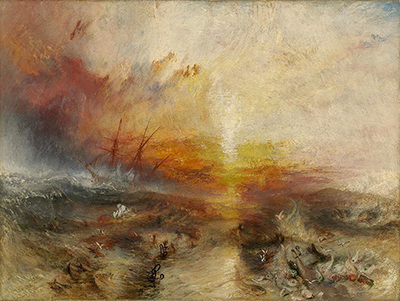
J. M. W. Turner's Slave Ship is one of his most disturbing and ethically difficult paintings; the MFA title continues by naming slavers throwing overboard the dead and dying while a typhoon comes on.[1] The Museum of Fine Arts, Boston lists it as an 1840 oil on canvas, gives its size as 90.8 x 122.6 cm, and identifies the accession number as 99.22.[1] The credit line is the Henry Lillie Pierce Fund, and the MFA record listed the painting on view in The Beal Gallery, Gallery 251, when checked.[1]
The painting must be approached through its subject before its colour. Turner depicts a slave ship connected by the MFA record to the Zong, a British ship whose captain, in 1781, ordered sick and dying enslaved people thrown overboard so that insurance money could be claimed for lives treated as losses at sea.[1] The painting is not only a late Turner storm picture. It is a work about murder, slavery, maritime commerce and the transformation of human beings into insurable property.
The MFA states that Turner based the painting on an eighteenth-century poem about a slave ship in a typhoon and on the true story of the Zong.[1] That dual basis matters. The painting joins literary storm imagery to historical atrocity. It is therefore not a neutral image of weather, and it is not a simple illustration of a legal case. Turner makes sea, sky, ship and human remains part of a scene in which commercial violence and elemental violence converge.
When Turner exhibited the painting at the Royal Academy in 1840, the catalogue paired it with lines attributed to Fallacies of Hope.[1] The closing question, "Where is thy market now?", makes the economic frame explicit.[1] The verse is not a decorative caption. It directs attention to a market in which people had been priced, insured and discarded.
This article treats the painting as a flagship work, but not by admiring its visual drama in isolation. The colour, light and storm matter because Turner used them to confront the violence of slavery. A responsible reading has to keep enslaved people at the center of the interpretation, even when the painting's surface tries to overwhelm the viewer with sea and sky.
At a Glance
- ArtistJoseph Mallord William Turner
- Full titleSlave Ship (Slavers Throwing Overboard the Dead and Dying, Typhoon Coming On)
- Date1840
- MediumOil on canvas
- Dimensions90.8 x 122.6 cm
- CollectionMuseum of Fine Arts, Boston
- Accession99.22
- Credit lineHenry Lillie Pierce Fund
- ExhibitedRoyal Academy, 1840
- Historical contextThe Zong massacre and its abolitionist afterlife
Contents
- Overview
- Object Identity
- The Zong Context
- The Royal Academy and Fallacies of Hope
- Looking Without Evasion
- Sea, Storm and Violence
- Colour and Moral Shock
- Slavery, Insurance and Market Logic
- Ruskin and Reception
- Provenance and Boston Afterlife
Object Identity
The full MFA title is blunt, and it should not be softened.[1] It names the perpetrators as slavers, identifies the action as throwing people overboard, and places that action under the pressure of an approaching typhoon. The shorter title Slave Ship is common, but the complete title carries the painting's moral and narrative charge.
The artist is Joseph Mallord William Turner, the date is 1840, and the medium is oil on canvas.[1] The canvas measures 90.8 x 122.6 cm.[1] These dimensions place the work close in scale to other major late Turner paintings, but its subject sets it apart. It is a maritime picture in which the sea is not only dangerous nature; it is the arena of deliberate human cruelty.
The MFA accession number is 99.22.[1] The object entered the museum in 1899 through the Henry Lillie Pierce Fund.[1] The provenance recorded by the MFA traces the painting from Turner to his dealer Thomas Griffith, to John James Ruskin for John Ruskin, then through later sales and Boston ownership before acquisition by the MFA.[1] That chain matters because Ruskin's reception and the painting's American afterlife strongly shaped how the work was discussed.
Butlin and Joll's catalogue remains important for the broader oil-painting record, and the MFA itself cites Butlin and Joll in its notes for the provenance.[1][4] The painting is famous enough to attract simplified moral summaries and purely formal praise. Object identity keeps the work anchored in title, date, medium, dimensions, collection and recorded history before interpretation widens outward.
The date also matters because 1840 was not remote from anti-slavery debate. The British and Foreign Anti-Slavery Society held an international convention in London from 12 to 24 June, with universal abolition of slavery and the slave trade among its aims.[15] This chronological proximity does not prove that Turner made the painting for the convention or that it achieved a single public outcome. It does establish how urgently slavery remained before a London audience when Turner made maritime violence a Royal Academy subject.
The work's object identity also clarifies its ethical difficulty. The painting has often been admired for colour, atmosphere and expressive handling, but its title and institutional record require a more demanding reading. Its beauty cannot be detached from the deaths it represents. The object is a Turner masterpiece and an image of people murdered within the slave trade; neither fact cancels the other.
That double status is why the MFA's full title is so important. The words in parentheses are not optional explanatory decoration. They name the action that the painting asks viewers to confront. Shortening the title too quickly risks making the subject sound generic, as if any slave ship were meant. The full title holds attention on slavers, victims, storm and violence.
The work also sits outside a purely British collection story. Its present institutional home is Boston, and its accession history belongs to the history of American collecting as well as Turner's British reception.[1] This transatlantic afterlife is significant for a painting about slavery's maritime economy. It reminds viewers that the histories carried by the work exceed national art categories.
The Zong Context
The MFA record connects the painting to the true story of the Zong, whose crew killed enslaved African people at sea in 1781 and whose owners subsequently demanded payment from their insurers.[1] That connection supplies the painting with a specific historical frame, but the history is more extensive, and more contested in its details, than a short museum summary can show.
### What Voyage 84106 Means
The number 84106 is the modern identifier assigned to the Zong voyage in the Trans-Atlantic Slave Trade Database maintained by SlaveVoyages.[5] It is not a number painted on the vessel, used in the eighteenth-century court case or known to Turner. It is a research key that allows the voyage to be found among tens of thousands of reconstructed records. Historian James Walvin identifies the Zong explicitly as "voyage number 84106" in his study of the massacre, while the SlaveVoyages teaching material uses the same voyage to show how database fields and historical interpretation can be read together.[5][6]
That distinction is useful. A database number can make a vast and violent history searchable, but it should not make the people aboard the ship look like entries in a table. The record helps establish dates, itinerary, national flag, captain, numbers embarked and numbers disembarked. It cannot recover the names, voices or individual histories of most of the enslaved people carried on the voyage. The National Archives warns that records of the Middle Passage were generally made by those controlling the trade and often classified enslaved people as goods, recording very little about them as individuals.[9]
The surviving evidence also contains discrepancies. Different summaries give slightly different totals for the number embarked, the crew and the number killed. Walvin's reconstruction states that the vessel left the African coast on 18 August with 442 enslaved Africans and, after a final provisioning call at Sao Tome, began the Atlantic passage on 6 September with about 440.[6] SlaveVoyages teaching material likewise gives approximately 440.[5] Older legal statements and later public accounts sometimes use larger or rounded figures. Precision therefore requires stating which figure belongs to which stage or source rather than forcing every document into a single total.
### The Ship, Its Owners and the Atlantic Passage
The vessel had not begun as an ordinary Liverpool ship. During wartime it was acquired on the West African coast from Dutch ownership by a captain acting for a Liverpool syndicate led by William Gregson, then renamed Zong and entered into British slave-trading service.[6] At about 110 tons, it was very small for the number of people forced aboard. Walvin estimates that a British slave ship of comparable tonnage would ordinarily have carried far fewer than the approximately 440 captives taken on the Zong's Atlantic passage.[6]
Luke Collingwood commanded the ship. He had substantial experience as a surgeon on slave voyages but had not previously served as a ship's master.[6] That combination matters because medical judgment aboard slave ships was entangled with commercial selection. Historian Jeremy Krikler argues that surgeons assessed captives for saleability within a system that attached commodity value to bodily condition. Collingwood's passage from surgeon to captain did not cause the massacre by itself, but it placed medical authority, command and commercial responsibility in the same person.[12]
The Gregson syndicate insured the ship and its human freight for a total of 8,000 pounds sterling, valuing enslaved people at 30 pounds each.[6] Those figures do not measure human worth; they record the financial terms imposed by enslavers and insurers. They explain why the later dispute was framed as a claim for monetary loss even though its real subject was the deliberate killing of people.
The voyage was catastrophically overcrowded and prolonged. Illness spread among captives and crew. Navigation and command deteriorated as Collingwood became seriously ill, the first mate James Kelsall was suspended, and the former governor of Anomabo, Robert Stubbs, temporarily took a commanding role despite uncertain qualifications.[6] The ship sighted Tobago in November but did not stop for water. It later mistook its position, passed the intended Jamaican destination and was forced to work back against winds and currents.[6][8]
By late November, dozens of enslaved people had already died. The later legal report attributed the crisis to a navigational error in which the captain mistook Hispaniola for Jamaica, while fuller reconstructions reveal a more confused sequence of illness, poor command, missed opportunities and conflicting testimony.[6][8] This matters because the crew and owners later tried to present the killings as an unavoidable response to maritime danger. The evidence instead points to a disaster shaped by decisions made before the first person was thrown overboard.
### The Killings of November and December 1781
On 29 November, Kelsall was restored as first mate. The crew calculated that only about four days of water remained while the return to Jamaica might take ten to fourteen days.[6] That estimate became the basis of their claim of necessity. It was not the only possible response. Rationing, seeking land or water, and preserving every life were alternatives. The question before the crew was not simply whether hardship existed, but whose lives they considered expendable within a slave-trading venture.
According to the testimony reconstructed by Walvin, the crew agreed to kill some of the enslaved people. At about eight that evening, 54 women and children were forced one at a time through cabin windows into the sea. On 1 December, 42 men were thrown from the quarterdeck. A third group of 38 was selected later; ten people, understanding what was about to happen, jumped into the sea, and one person managed to climb back aboard.[6] These details should be stated soberly. Their purpose is to recover the sequence and agency hidden by legal terms such as "jettison," not to turn suffering into spectacle.
The commonly accepted total is 132 people killed: 122 forced overboard and ten who entered the sea rather than submit to the crew's violence.[6][7] Royal Museums Greenwich uses 132 in describing the surviving 1783 archive, while some summaries use 130 or 133.[7][10] Kelsall's later calculation produced a possible outer total of 142, and the published legal pleadings contained still other figures.[6][8] The safest conclusion is therefore that approximately 130 people were deliberately killed, with 132 supported by the principal modern reconstruction and archive description, while the exact count remains uncertain.
Rain fell before the final group was killed. This became crucial in court because it damaged the assertion that every killing had been required by a continuing lack of water.[6][8] It also shows why the massacre should not be described as a simple emergency measure. There may have been a serious shortage, but the owners' claim converted that shortage into a story of unavoidable loss. The rain, prior navigational failures and the choice of victims made that story increasingly untenable.
The killings did not end mortality aboard the vessel. The Zong reached Black River, Jamaica, on 22 December with 208 enslaved African survivors, and a notice in January 1782 advertised 200 people from the ship for sale.[6] Subtracting survivors from those embarked produces a terrible overall loss, but not every death can be assigned with certainty to the same cause. Some people died from disease, overcrowding, malnutrition and the length of the passage; approximately 130 were killed in the massacre. The database preserves aggregate outcomes while the historical narrative shows the decisions behind them.
### Insurance, Gregson v Gilbert and the Absence of a Murder Trial
The shipowners claimed against the policy for the people killed. Their legal theory depended on maritime insurance practice: deaths from disease or poor condition would normally fall on the owners, whereas property deliberately sacrificed under genuine necessity to preserve the ship and the rest of its contents could be treated as a shared maritime loss.[6][8] The atrocity was therefore translated into a dispute about whether the killings met the commercial rules governing insured goods.
The insurers refused payment and the owners sued. At the first trial in Guildhall in March 1783, the jury found for the shipowners.[6][10] The later King's Bench proceedings, reported as Gregson v Gilbert, did not put Collingwood or the crew on trial for murder. They considered whether the first verdict should stand under the insurance policy and the facts pleaded.[8] This distinction is central: English law encountered the deaths through a civil claim over money, not through a criminal prosecution on behalf of the people killed.
Lord Mansfield ordered a new trial. Evidence of navigational error challenged the claim that adverse winds and unavoidable perils alone had caused the shortage, and the disclosure that rain had fallen before the final killings further weakened the owners' case.[6][8] No conclusive evidence has been found that the retrial took place, and the ultimate financial settlement remains unknown.[10] The result was not a judicial declaration abolishing slavery, nor was it a murder conviction. It was an unresolved insurance dispute whose language exposed how commercial law had allowed human beings to be discussed as property.
The surviving archive makes that legal framing visible. Royal Museums Greenwich holds a small bound volume, catalogued as REC/19, containing Granville Sharp's letter to the Admiralty, his account of the murder of 132 enslaved people, a transcript of proceedings and related correspondence.[7] The National Archives identifies further Zong records in King's Bench and Exchequer series, including KB 122/479 and E 112/1528 no. 173.[9] The ship's log, which should have provided a day-by-day record, disappeared after arrival in Jamaica. Historians must therefore work from litigation papers, statements and later accounts produced by people with sharply different interests.[6]
### Equiano, Sharp and Abolitionist Memory
Olaudah Equiano brought the case to the attention of Granville Sharp, who tried to have the killings treated as murder and pressed government and Admiralty authorities to act.[10] Their intervention matters because the court case did not publicise itself. A formerly enslaved writer and campaigner recognized its meaning, and an experienced legal activist preserved and circulated the evidence. The archive exists in its present form partly because they refused the narrow commercial terms in which the dispute had been framed.
No member of the crew was prosecuted for murder.[10] That failure became part of the case's abolitionist force. The massacre demonstrated not only individual cruelty but the inability, or unwillingness, of law to recognize enslaved African victims on equal terms. Anti-slavery writers could point to the Zong as evidence that the trade corrupted navigation, medicine, commerce, insurance and justice together.
Thomas Clarkson later recorded that knowledge of the case was spreading and noted its appearance in anti-slavery writing.[11] His 1808 history helped carry the story into the nineteenth century, and a new edition appeared in 1839, the year before Turner exhibited Slave Ship.[11][13] This provides a plausible path by which the episode could have been prominent when Turner chose his subject, but there is no surviving statement from Turner proving that he read Clarkson's new edition or intended a literal reconstruction of voyage 84106.[13]
The massacre helped abolitionists make the trade's brutality publicly legible, but it should not be presented as a single event that directly produced abolition. Organized Black activism, resistance by enslaved people, Quaker and wider abolitionist campaigning, petitions, testimony, political work and changing law all contributed.[10] Parliament first regulated ship capacity in 1788, prohibited British participation in the transatlantic trade in 1807, and legislated to end slavery in most British colonies in 1833, with coerced apprenticeship continuing for years after that.[9][10] The Zong became powerful evidence within that long struggle; it was not its sole cause.
### What the Zong Changes in Turner's Painting
Turner's painting is not a documentary reconstruction of the Zong. It contains no database identifier, portrait of Collingwood, chart of the voyage or courtroom scene. The title does not name the ship. Recent scholarship has shown that the now familiar identification with the Zong became firmly established through twentieth-century art history and that the proposed Clarkson source, though persuasive, cannot be proved from Turner's papers.[13] The MFA nevertheless presents the historical connection as part of the painting's interpretation, and the match between murder at sea, chains, market language and insurance remains powerful.[1]
That measured position is stronger than claiming either certainty or irrelevance. Voyage 84106 gives viewers a documented historical case through which to understand the commercial logic evoked by Turner's title and verse. At the same time, the image can address a wider and continuing practice of enslavers throwing people overboard, including killings that occurred after Britain's 1807 prohibition.[13] The Zong is therefore a central historical lens, not a code that mechanically explains every mark on the canvas.
The painting shifts attention from the legal abstraction of Gregson v Gilbert to bodily consequence. Turner shows no policy, ledger or judgment. He places human remains and chains in the foreground while the vessel recedes. The full title's phrase "Slavers Throwing Overboard" assigns agency: whatever pressure the storm creates, people commit the act. Weather intensifies the crisis but cannot accept responsibility for it.
The absence of individualized portraits remains painful. The people killed aboard the Zong are largely unnamed in the surviving record, and Turner represents victims through fragments amid turbulent water. Historical research cannot repair that loss, but it can prevent the figures from being treated as incidental details in a display of colour. The database number, archive references and court citation matter only when they return attention to people whom the trade reduced to units of property and whom the legal record failed to protect.
Turner's historical distance is therefore essential. Painted 59 years after the massacre, Slave Ship is an act of mediated historical imagination, shaped by poetry, abolitionist memory and the politics of its own time.[1][13] The Zong context prevents the work from dissolving into a generalized storm allegory. It identifies the human system behind the violence while leaving viewers to confront the disturbing gap between what history can document and what the painting makes them feel.
The Royal Academy and Fallacies of Hope
When Turner showed the painting at the Royal Academy in 1840, the MFA records that the catalogue paired it with an extract attributed to Fallacies of Hope.[1] The extract imagines a typhoon coming and commands that the dead and dying be thrown overboard without heed to their chains.[1] Its closing couplet reads:
> Hope, Hope, fallacious Hope! > Where is thy market now?[1]
No continuous completed poem titled Fallacies of Hope is known to survive. The catalogue lines are secure evidence for how the work was presented in 1840, but they should not be treated as a recovered passage from a fully documented epic.[14]
The verse matters because it makes the painting's economic indictment explicit. Turner is not only painting bodies in the sea. He is confronting the market logic that made enslaved people insurable cargo. The question "Where is thy market now?" points to a collapse of commercial confidence in the face of moral and natural judgment.[1]
The poem also affects how the viewer reads the storm. The typhoon is not just weather. It is part of a scene in which slavers try to respond to danger by sacrificing people whose lives have already been commodified. Turner makes the natural world and the moral world collide, but the poem prevents the viewer from forgetting the human decision at the center.
The verse should be used sparingly. Long quotation can make the horror feel literary rather than immediate. The MFA record supplies the text, but the painting itself already shows the consequences. A short phrase is enough to show how Turner linked the image to market violence and false hope.
The Royal Academy setting also matters. Turner placed this subject before a public art audience in 1840. The painting was not hidden in private reflection. It entered a major exhibition culture where viewers had to confront a work that joined brilliant colour to a subject of murder and slavery.
This public context does not make the painting simple propaganda. It remains visually complex and morally difficult. But the Royal Academy exhibition and the accompanying verse show that Turner intended the subject to be read as more than a stormy sea.
The Fallacies of Hope extract also helps explain the title's economy of violence. It links command, chains, storm and market in a compressed sequence.[1] The verse suggests urgency aboard ship, but it does not present the people thrown overboard as anonymous losses. The mention of chains makes the violence inseparable from enslavement.
The final market question is especially forceful because it turns commercial language back against the slavers. It asks what value, hope or calculation remains when the moral horror is exposed. Turner therefore uses poetry to make the painting's economic setting explicit without turning the canvas into a written argument.
The poem should also be read as part of exhibition culture. Viewers at the Royal Academy could encounter painting and text together. The image carried the sensory shock; the verse supplied verbal pressure. Together they framed the work as a scene of crisis in which the slave trade's economic logic was brought before public judgment.
At the same time, the painting should not be reduced to its accompanying words. The verse can guide interpretation, but the canvas does its own work. It forces attention to colour, distance, water and bodily remains in ways language cannot fully control.
Looking Without Evasion
The first impression of Slave Ship may be colour: red, gold, black, blue and turbulent light. That first impression is part of the painting's difficulty. Turner uses overwhelming atmosphere, but a responsible viewer cannot stop at atmosphere. The foreground contains evidence of the people thrown into the sea: limbs, chains and surrounding marine life. The painting asks the viewer to move from visual force to human consequence.
The ship itself is distant. It recedes toward the storm rather than dominating the foreground. This distance can feel disorienting. The perpetrators are not shown as close individual figures, while the victims are fragmented by water and paint. Turner makes the viewer confront the aftermath of action more than the faces of those who acted.
This is ethically troubling, and it should remain troubling. The painting's visual power risks making suffering seem absorbed into a display of colour. To avoid that mistake, the viewer has to keep the full title and MFA account in mind. The painting is not just a sublime marine scene. It is a scene of enslaved people abandoned to die.
The foreground is especially important. Chains mark the victims' condition and the violence of their captivity. The water does not cleanse or redeem the act. It surrounds bodies that have already been treated as property. Turner makes the sea a witness and participant in the horror, but not the origin of the crime.
The receding ship intensifies responsibility rather than reducing it. The distance does not remove the slavers from guilt. It shows separation: the ship moves away while the people it has cast off remain in the water. That spatial arrangement turns abandonment into composition.
Looking without evasion means resisting two temptations. One is to admire the painting only as colour and storm. The other is to dismiss its artistic power because the subject is unbearable. Turner forces both responses into conflict. The painting's force lies in the fact that beauty and violence cannot be neatly separated.
The difficulty of seeing the victims is part of the work's moral problem. Turner does not offer the clarity of a documentary record. He makes the viewer search through water, colour and turbulence. That search can feel inadequate, and it should. The painting confronts the viewer with the gap between visual attraction and moral recognition.
The receding ship should therefore be read with care. It is tempting to focus on the dramatic sky and leave the ship as a small element in the distance. But the title makes clear that the ship's crew have acted. The vessel's movement away from the foreground bodies is not incidental composition. It visualizes separation between perpetrators and victims.
The painting also denies closure. There is no rescue, no courtroom, no abolitionist triumph in the image. The viewer sees a moment in which harm has been done and the sea continues to act. That lack of closure is one reason the painting remains ethically unsettled.
Sea, Storm and Violence
The MFA describes the painting as an example of Turner's fascination with violence, both human and elemental.[1] That phrase is useful because it refuses to separate the two. The storm does not replace slavery as the subject. It intensifies the violence already produced by slavers and the trade they served.
Turner had long painted dangerous seas, shipwrecks and maritime crisis, but Slave Ship changes the terms. In many storm paintings, danger may come from weather, fate or navigation. Here, the danger in the water is joined to deliberate murder. The sea is not only a test of sailors or vessels. It is the setting in which enslaved people are abandoned.
The typhoon in the title gives the scene urgency. The MFA notes that Turner drew on an eighteenth-century poem about a slave ship caught in a typhoon.[1] The approaching storm becomes part of the narrative pressure. Slavers, facing danger, choose to throw people overboard. Weather becomes the condition under which moral violence is exposed.
The sea itself is visually active. It does not function as neutral background. It churns around bodies, chains and marine life, and it merges with the sky through colour and light. Turner makes the environment unstable, as if the natural world has absorbed the violence committed upon it.
Yet the painting should not be read as nature punishing an abstract evil while human victims become secondary. The people in the water are the reason the painting matters. The storm is terrible, but the atrocity is not an atmospheric effect. It is the result of enslavers treating human lives as expendable.
This is why broader sea and storm readings must remain secondary. Turner's marine art provides context, but Slave Ship demands a more specific account. The sea here is inseparable from slavery, insurance and murder.
The painting's storm also complicates responsibility in a deliberate way. Slavers might claim weather as pressure or excuse, but the title and verse do not allow that excuse to stand. The storm may be approaching, but the choice to throw people overboard remains human. Turner makes the natural crisis intensify, not absolve, the moral crisis.
The visual merger of sea and sky reinforces this pressure. The world of the painting seems unstable from top to bottom, as if no safe division remains between weather, water and human action. But the instability does not mean moral confusion. The title keeps the act clear even when the atmosphere becomes chaotic.
Turner therefore uses marine painting against any comfortable maritime romance. The sea is not a field of exploration or picturesque danger here. It is the place where the slave trade's violence becomes visible. The ship does not represent adventure. It represents a system of forced transport and murder.
This reading also changes how one understands the typhoon. It is not merely a picturesque storm device. It is a pressure that exposes the slavers' priorities: cargo, market, insurance and survival of the ship over the lives of enslaved people. Weather reveals an economy of death.
Colour and Moral Shock
The MFA says Turner captures the horror of the event and the grandeur of nature through hot, churning colour and light that merge sea and sky.[1] That description identifies the painting's central tension. Colour is not neutral beauty. It is the means by which Turner makes horror almost unbearable to look at.
The red and gold passages can initially attract the eye. Turner was a master of luminous atmosphere, and the painting's upper field may seem radiant before the subject becomes fully clear. That delay matters. The viewer's attraction to colour is disrupted by recognition of what the scene represents. The painting turns visual pleasure into moral discomfort.
This discomfort has shaped reception for generations. If the viewer attends only to colour, the violence may be missed or aestheticised. If the viewer attends only to the title, the painting's visual strategy may be misunderstood. Turner makes the two inseparable. The colour draws the viewer in, then refuses innocence.
The merging of sea and sky also matters. It makes the whole world of the painting unstable. There is no calm horizon where moral order can be restored. Water, air and light become a field of crisis. The ship, victims and storm are caught inside a single overwhelming environment.
The painting's colour therefore has ethical weight. It does not beautify the murder in order to excuse it. Rather, it implicates the viewer in the difficulty of seeing. The eye is pulled by splendour into a scene that must be judged.
That judgment should not be softened by formal language alone. Words such as "sublime," "radiant" or "atmospheric" are insufficient unless they are tied to the historical violence of slavery. Turner uses the sublime here to confront the viewer with the consequences of an economy built on human suffering.
This is why close looking must be ethically disciplined. It is useful to notice how Turner merges sea and sky, how the hot colour dominates the surface, and how the ship recedes. But those observations must return to the murdered people in the water. Formal analysis is responsible only when it helps clarify the violence rather than displace it.
The colour also has a temporal effect. It makes the scene feel like a moment of crisis rather than a settled historical record. The sky appears charged by an event still unfolding. The ship has not vanished; the storm has not fully broken; the victims remain in the foreground. Turner holds the viewer inside that unbearable interval.
The painting's visual intensity may also explain why reception has often struggled with it. Viewers can be overwhelmed by the power of the surface before they fully register the subject. That sequence is not accidental. Turner uses attraction and shock together, making the viewer confront the danger of looking at suffering as art.
Slavery, Insurance and Market Logic
The MFA's Zong account turns the painting toward one of slavery's central horrors: the reduction of human beings to financial units.[1] The captain's order, as summarized by the MFA, was tied to insurance money available for those considered lost at sea.[1] That fact is not background. It is the core of the painting's economic meaning.
Turner's Fallacies of Hope extract ends with the market question, and that question should be read alongside the Zong context.[1] Market language matters because slavery was not only individual cruelty. It was a system of purchase, transport, insurance, calculation and profit. The painting's violence emerges from that system.
The people thrown overboard were not victims of mere misfortune. They were victims of a commercial order that made murder thinkable as loss management. Turner does not show documents or contracts, but the title and verse bring those invisible systems into the scene.
The ship's distance is significant in this light. It can be read as the visual form of abandonment: the vessel and its operators move away from the human consequences of their decisions. The water holds what the ship has discarded, and the viewer is made to confront what commerce tries to displace.
The market question also prevents the viewer from treating the painting as timeless tragedy. This was a historically specific form of violence. The Zong context, the slave trade, insurance and abolition debates all matter. Turner used the language of storm and colour, but the painting's moral target is human-made.
That specificity is essential for public interpretation. It is not enough to say that the painting condemns cruelty in general. It addresses slavery's maritime economy and the logic by which enslaved lives were priced, transported and destroyed.
The insurance context is particularly important because it shows how legal and financial systems could make violence appear calculable. The MFA's summary states that money was available for people counted as lost at sea.[1] Turner makes that calculation morally obscene by placing its human cost in the foreground.
The painting does not need to show coins, contracts or ledgers because the title and poem already identify the economic structure. The bodies in the water are the ledger's hidden truth. What commerce abstracts, the painting returns to sight.
This is also why the word "market" in the verse is so severe. It refuses to let viewers separate the scene from exchange. Turner does not merely ask whether the slavers will survive the storm. He asks what remains of the commercial hope that made their decision possible.
The work's later movement through art ownership cannot be equated with the slave market, but it does add another layer of unease. The MFA provenance records sale, ownership and acquisition history.[1] A painting about commodified human lives became itself a valuable art object. That fact should encourage careful, not cynical, reflection on how museums frame the work today.
Ruskin and Reception
John Ruskin is part of the painting's history, but he should not become the only lens. The MFA records Ruskin as the first owner of Slave Ship and quotes his later claim that, if he had to rest Turner's immortality on one work, he would choose this.[1] That statement helped shape the painting's reputation, but it does not exhaust the work's meaning.
The National Gallery describes Ruskin as one of the Victorian period's most influential art critics and states that his private collection was dominated by Turner's works.[3] It also notes that the first volume of Modern Painters was primarily written in defence of Turner.[3] This broader context helps explain why Ruskin's response carried weight.
Ruskin's admiration, however, creates an interpretive problem. Praise for the painting's greatness can distract from the enslaved people whose deaths the painting confronts. A responsible reading can acknowledge Ruskin's importance while refusing to let reception history replace the subject.
The MFA provenance shows that Ruskin acquired the painting through his father after its consignment to Thomas Griffith, and that it later passed through sales and collectors before entering the MFA in 1899.[1] This history matters because the painting moved through elite art markets after depicting the horrors of another market: the market in enslaved human beings.
That irony should not be overstated as if it solves the painting. But it is part of the work's afterlife. A painting about the violent commodification of people became a prized object moving through collections and sales. Interpretation has to hold those histories together without collapsing them into each other.
Ruskin's writing can help explain the painting's nineteenth-century fame, but the MFA title and Zong account keep the ethical center elsewhere. The question is not only why Ruskin admired the painting. It is how Turner made viewers face, or risk evading, slavery's violence.
The National Gallery's account of Ruskin also reminds us that his defence of Turner was part of a broader Victorian culture of criticism.[3] Ruskin's language could make paintings vivid for readers who might never see them. That power helped shape Turner's reputation, but it also placed interpretation in the hands of a critic whose priorities were not identical with ours.
For Slave Ship, this matters because Ruskin's praise of Turner's greatness can sit uneasily beside the painting's subject. To say that the painting is great is not enough. The question is what kind of greatness is being claimed, and whether that claim keeps faith with the people represented as victims of slavery.
Ruskin's ownership also demonstrates how the painting moved from public exhibition into private possession and then back toward public display. The work's moral charge did not remain fixed in 1840. It changed as the painting passed through owners, texts, sales and museums. Each stage affected how viewers were invited to see it.
Provenance and Boston Afterlife
The MFA provenance gives a clear outline of the painting's movement after Turner. It was consigned by the artist to Thomas Griffith, sold in December 1843 by Griffith to John James Ruskin for John Ruskin, later offered at Christie's in 1869, sold through William T. Blodgett in 1872 to John Taylor Johnston in New York, then bought at the Johnston sale in 1876 by Alice Sturgis Hooper of Boston.[1]
The painting then passed by descent to William Sturgis Hooper Lothrop and was sold to the MFA in 1899 for 65,000 dollars.[1] Its accession date is February 24, 1899.[1] These details make the painting one of the major Turner works whose institutional life unfolded outside Britain.
The Boston afterlife matters because it shaped the painting's public audience. The work is now encountered through the MFA's collection, not only through British exhibition history or Ruskin's writing. The museum's record foregrounds the Zong context, the Fallacies of Hope extract, and the painting's combination of human and elemental violence.[1]
The move from private ownership to public museum holding also changes the responsibilities of interpretation. Viewers today come to the painting through labels, museum records and scholarship that can name the violence more directly than some earlier aesthetic responses did. That does not remove the painting's difficulty. It gives viewers tools for facing it.
The Henry Lillie Pierce Fund credit line should also be retained because it is part of the painting's object identity.[1] Such acquisition details can seem secondary, but they show how a painting enters public collection and how institutional narratives are formed around it.
The painting's afterlife therefore belongs to both art history and public memory. It is a Turner masterpiece, but it is also a museum object that asks how institutions present slavery, violence, beauty and historical responsibility.
The MFA record's inclusion of the Zong account is therefore significant. It places historical violence at the center of the object description rather than leaving viewers with only title, date and medium.[1] This helps counter the risk that the painting's colour could dominate interpretation at the expense of the enslaved people represented.
The Boston history also underscores the painting's transatlantic resonance. A work by a British artist about a British slave-ship atrocity entered a major American museum at the end of the nineteenth century. Its public meaning cannot be confined to one national tradition, especially given the Atlantic scale of slavery and abolition.
The painting's accession in 1899 also means that many generations of viewers have encountered it far from Turner's original Royal Academy setting.[1] Museum display, catalogue entries, teaching and criticism have all shaped its later life. The work continues to demand not only admiration, but historical accountability.
This afterlife also changes the questions asked of the painting. Nineteenth-century viewers might have argued over Turner's colour, looseness, poetic ambition or moral force. Modern viewers must still consider those issues, but they also confront the museum's responsibility to name slavery directly. The MFA record's emphasis on the Zong helps set that standard.[1]
The painting's Boston location also makes it part of a wider Atlantic memory culture. The Zong was a British slave ship, Turner was a British artist, Ruskin was a British critic and owner, and yet the work is now held in a major American institution. That movement across the Atlantic does not erase the painting's British contexts. It broadens the arena in which its subject must be faced.
For that reason, provenance is not only ownership history. It is a record of how a painting about commodified human life became a valued art object in modern collections. The contrast is uncomfortable, but it should remain visible. It helps viewers understand why interpretation has to address both the represented violence and the institutional life of the object.
Turner and Maritime Painting
Royal Museums Greenwich describes Turner & the Sea as a study of Turner's maritime work across sea painting, naval conflict, changing technology, travel and print culture.[2] That framework helps place Slave Ship within Turner's long engagement with the sea, but it must not dilute the specific subject of slavery.
Turner knew how to make vessels, storms and water carry historical meaning. In earlier and later works, ships could stand for war, commerce, travel, labour, danger or memory. In Slave Ship, the vessel stands for a violent maritime economy. The sea is not merely a setting for drama; it is where the crime becomes visible.
The painting also challenges older marine traditions. A ship at sea could be a subject of national pride, commercial power or technical skill. Turner instead gives a ship associated with slavery, abandonment and approaching storm. Maritime painting becomes a vehicle for moral accusation.
The distant ship is therefore significant. Turner does not glorify its structure or invite admiration of seamanship. The ship is present as the source of violence and as the object moving away from its victims. It recedes toward the storm, marked by the title and verse as morally exposed.
This is different from a shipwreck painting in which disaster overtakes all aboard. Here the violence has already been distributed unequally. The slavers remain with the vessel; enslaved people have been cast into the water. The sea becomes the place where that inequality is made visible.
Turner's maritime art gives him the visual language to paint such a scene, but the subject changes the ethical demand placed on that language. Storm, colour and ship must answer to slavery's history.
Riding and Johns's maritime framework is useful because it shows that Turner repeatedly used sea subjects to address contemporary affairs, not only timeless nature.[2] Slave Ship is one of the sharpest examples of that capacity. It treats maritime space as a place where economics, violence, law, weather and empire meet.
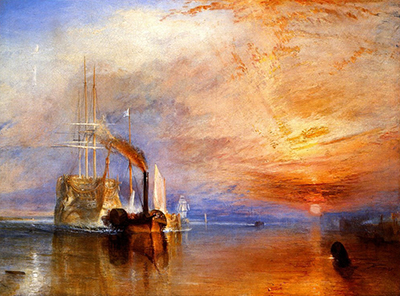
The painting also stands apart from naval commemoration. In The Fighting Temeraire, a ship's memory is tied to service, age and transition. In Slave Ship, the vessel is tied to commerce in human beings and murder. Both are maritime works, but the ethical worlds are radically different.
This distinction protects the painting from being folded too easily into Turner's general love of the sea. The sea here is not a painterly playground. It is a violent historical environment shaped by the slave trade. Turner's mastery of marine atmosphere makes the accusation more powerful, but mastery itself is not the subject.
The comparison also shows why subject categories are not enough. Two Turner sea paintings can both involve ships, weather and historical change while asking entirely different ethical responses from the viewer. Slave Ship requires direct attention to slavery and murder, not only to maritime danger. Its sea is a field of abandonment.
This does not mean that Turner's marine skill is irrelevant. On the contrary, his command of water, storm and light gives the painting much of its force. But the skill has to be read in service of the subject. The more powerful the atmosphere, the more urgently the viewer has to ask what violence that atmosphere contains.
The Painting and Abolition
The painting is often described as anti-slavery, but that shorthand needs care. The MFA record connects it to the Zong atrocity and to Turner's Royal Academy exhibition with Fallacies of Hope lines.[1] Those facts support reading the work as a condemnation of slavery's violence and market logic. They do not require overstating the painting's direct political effect.
Turner exhibited the painting in 1840, decades after the 1781 Zong massacre and after major British abolition legislation. Yet slavery and the slave trade remained urgent international questions. The painting's force lies in bringing an earlier atrocity into a contemporary exhibition space and making viewers confront the moral horror that legal and commercial language could obscure.
The subject also complicates Turner's reputation as a painter of atmosphere. Slave Ship shows that atmosphere could carry political and ethical force. Turner did not separate light from history. He used light to make history harder to evade.
The painting's title and poem prevent it from becoming an all-purpose moral allegory. It is about slavers, victims, chains, a typhoon and a market. Those terms are specific. They connect visual drama to slavery's structures.
At the same time, the painting does not offer a clear narrative of justice. The victims are in the water; the ship recedes; the storm approaches. The viewer is left in a scene of unresolved violence. That unresolved quality may be part of the painting's continuing power.
The work should therefore be described as a painting that confronts slavery and its maritime economy, rather than as a comforting image of abolitionist virtue. Turner gives no easy moral shelter.
The painting's relation to abolition is powerful precisely because it is uncomfortable. It does not present moral reform as completed. It does not place the viewer among virtuous rescuers. Instead, it shows the aftermath of violence and asks viewers to reckon with a system that made such violence possible.
Nor should the painting be used to make Turner into a simple moral hero. The work can be read as a forceful condemnation of slavery's violence, but it also raises hard questions about representing suffering through aesthetic intensity. A responsible account can acknowledge Turner's moral ambition while still asking what the painting does to the people it depicts.
The image's unresolved force may explain its endurance. It does not let viewers settle into admiration, denunciation or historical distance. It remains painful because its beauty is inseparable from a scene of abandonment. That unresolved condition is not a flaw to be smoothed over. It is part of the work's historical seriousness.
The painting also asks how abolitionist feeling could be represented without making suffering consumable. Turner does not provide a stable heroic figure who rescues the enslaved people in the water. He does not give viewers an easy position of moral superiority. Instead, he makes the viewer stand before a scene where harm has already been done and where the painting's beauty itself becomes ethically uncomfortable.
That discomfort is one reason the work should not be described as simply "dramatic." Drama can sound too neutral, as if the painting's purpose were intensity alone. The intensity is there, but it is attached to slavery's violence. Turner makes the sea and sky overwhelming because the human act is overwhelming. The colour cannot be separated from the crime.
The painting's abolitionist force therefore depends on disturbance rather than reassurance. It does not show the slave trade safely defeated in the past. It brings the atrocity into the present tense of viewing. Every encounter with the picture repeats the demand to see what the ship has tried to leave behind.
The work also complicates the idea of witness. Turner was not present at the Zong massacre, and the painting is not eyewitness evidence. Yet it can still bear witness in an artistic sense by making a suppressed or abstracted violence visible. It transforms a historical atrocity into an image that refuses the clean distance of account books and insurance language.
This kind of witness has limits. The enslaved people remain represented through Turner's imagination and through a painting made for exhibition. A responsible viewer has to acknowledge that mediation. The work confronts slavery, but it does so through an artist, a public art institution and later museum histories. Its power and its difficulty are bound together.
That mediation is not a reason to avoid the painting. It is a reason to be exact about what the object record supports, what the title names, and what the viewer can responsibly infer from the image.
How to Read Slave Ship
Begin with the MFA title's action and responsibility.[1] It should guide the looking. The painting is not simply a sea storm, and the human forms in the water are not incidental.
Next, place the painting in relation to the Zong account recorded by the MFA.[1] The point is not to force every visual detail into a courtroom narrative, but to understand the subject as slavery's commercial violence. The insurance context explains why the market question in Turner's verse matters.
Then look at the foreground. The fragments of bodies and chains are difficult to see and harder to discuss, but they are central. A viewer who stops at the sunset has not really read the painting. Turner makes looking itself ethically demanding.
After that, consider the ship's distance. The vessel recedes, leaving human consequences behind. This arrangement visualizes abandonment. It also prevents the ship from becoming an admired maritime object detached from its violence.
Finally, read colour and storm as morally charged. The MFA's description of hot, churning colour and merged sea and sky should be tied to horror, not used as detached praise.[1] The painting's atmospheric power belongs to its indictment of slavery.
It is also worth reading the painting from title to foreground and then back to the ship. The title names the action; the foreground shows its victims; the distant ship indicates abandonment; the storm and colour turn the whole scene into crisis. That sequence keeps responsibility visible.
The painting's difficulty should remain part of the encounter. If the work feels easy to admire, something has been missed. Turner made a painting that attracts and condemns at once. The viewer has to ask why the surface is so compelling and what that attraction does when the subject is murder.
Finally, keep the MFA object facts close: 1840, oil on canvas, 90.8 x 122.6 cm, accession 99.22, Henry Lillie Pierce Fund.[1] These details do not reduce the painting to data. They keep the discussion grounded in the actual object and its institutional history.
The final step is to ask what the painting makes hard to see. The ship is distant, the people in the water are fragmented, and the atmosphere is overwhelming. Those conditions are not reasons to look away. They are reasons to look more carefully. Turner makes the viewer work against the visual forces that threaten to absorb violence into colour.
A careful reading therefore keeps moving between history and surface. The history tells us why the scene matters; the surface shows how Turner makes that history felt. Neither is sufficient alone. Without history, the painting risks becoming a storm picture. Without close looking, it becomes a moral statement detached from the work Turner actually made.
Frequently Asked Questions
The Museum of Fine Arts, Boston uses a title that names a slave ship, slavers throwing people overboard, the dead and dying, and an approaching typhoon.[1]
The Museum of Fine Arts, Boston holds the painting under accession number 99.22. The credit line is the Henry Lillie Pierce Fund.[1]
The MFA connects the painting to the true story of the Zong. In 1781 its crew deliberately killed approximately 130 enslaved African people at sea, after which the shipowners claimed against their insurance policy.[1][6] The painting is not a literal record of the voyage, and Turner's exact source is not documented.[13]
The principal modern reconstruction and the Royal Museums Greenwich archive description use 132.[6][7] Other accounts give about 130 or 133, while conflicting testimony produced an outer estimate of 142. The most responsible concise wording is that approximately 130 people were deliberately killed, with 132 the best-supported specific total.
Turner's accompanying verse connects the typhoon, the command to throw overboard the dead and dying, their chains and the market question.[1] It makes the painting's economic and moral frame explicit.
Yes. The MFA provenance records that John James Ruskin bought the painting for John Ruskin in December 1843.[1] Ruskin later became central to the painting's reception.
It combines extraordinary colour and storm effects with the murder of enslaved people. A responsible reading must not let the painting's visual power obscure the violence it represents.
Discussion
How can viewers attend to Turner's colour and storm without allowing visual force to obscure the enslaved people and market violence represented?
Reader Insights
What changes when the full MFA title remains present during close looking?
How do ship, storm, chains and human remains distribute responsibility within the scene?
How does the Zong context complicate a purely formal reading of colour and atmosphere?
Join the Conversation
Share a careful observation or a source-based question for other readers.
References
- Museum of Fine Arts, Boston, "Slave Ship (Slavers Throwing Overboard the Dead and Dying, Typhoon Coming On)." https://collections.mfa.org/objects/31102/slave-ship-slavers-throwing-overboard-the-dead-and-dying-t
- Royal Museums Greenwich, "Turner & the sea / Christine Riding and Richard Johns." https://www.rmg.co.uk/collections/library/rmgl-152360
- National Gallery, London, "John Ruskin and the National Gallery." https://www.nationalgallery.org.uk/paintings/john-ruskin-and-the-national-gallery
- Martin Butlin and Evelyn Joll, *The Paintings of J. M. W. Turner*, revised edition, Yale University Press, 1984.
- SlaveVoyages, Trans-Atlantic Slave Trade Database, voyage 84106, and "Researching the Transatlantic Slave Trade." https://www.slavevoyages.org/voyage/all-voyages and https://www.slavevoyages.org/documents/lessonplan/research-tast.pdf
- James Walvin, *The Zong: A Massacre, the Law and the End of Slavery*, Yale University Press, 2011. https://yalebooks.co.uk/book/9780300180756/the-zong/
- Royal Museums Greenwich, "Documents relating a case in the Court of King's Bench involving the ship ZONG," REC/19. https://www.rmg.co.uk/collections/objects/rmgc-object-500960
- *Gregson v Gilbert* (1783) 3 Doug. 232, 99 E.R. 629. https://www.commonlii.org/int/cases/EngR/1783/85.pdf
- The National Archives, "Slavery and the British transatlantic slave trade," including *Zong* records KB 122/479, KB 125/168, KB 168/150 f.53, E 112/1528 no. 173 and E 127/47. https://www.nationalarchives.gov.uk/help-with-your-research/research-guides/british-transatlantic-slave-trade-records/
- London Museum, "The Zong Massacre Trial." https://www.londonmuseum.org.uk/collections/london-stories/zong-massacre-trial/
- Thomas Clarkson, *The History of the Rise, Progress, and Accomplishment of the Abolition of the African Slave-Trade by the British Parliament*, vol. 1, 1808. https://www.gutenberg.org/ebooks/12428
- Jeremy Krikler, "A Chain of Murder in the Slave Trade: A Wider Context of the Zong Massacre," *International Review of Social History* 57, no. 3, 2012. https://doi.org/10.1017/S0020859012000491
- Matthew C. Hunter, "The Sun Is God: Turner, Angerstein, and Insurance," *Oxford Art Journal* 47, no. 1, 2024. https://doi.org/10.1093/oxartj/kcae001
- Jerrold Ziff, "John Langhorne and Turner's 'Fallacies of Hope'," *Journal of the Warburg and Courtauld Institutes* 27, 1964. https://doi.org/10.2307/750532
- National Portrait Gallery, London, "The Anti-Slavery Society Convention, 1840," NPG 599. https://www.npg.org.uk/collections/search/portraitExtended/mw00028/The-Anti-Slavery-Society-Convention-1840-includes-Thomas-Binney-Benny-Sir-John-Bowring-Sir-Thomas-Fowell-Buton-1st-Bt-Anne-Isabella-Lady-Byron-Thomas-Clarkson-Samuel-Gurney-Sir-John-Jeremie-Stephen-Lushington-Richard-Robert-Madden-Dani