 by Tom Gurney
Tom Gurney BSc (Hons) is an art history expert with over 20 years experience
Published on June 19, 2020 / Updated on August 29, 2026
Email: tomgurney1@gmail.com / Phone: +44 7429 011000
Overview
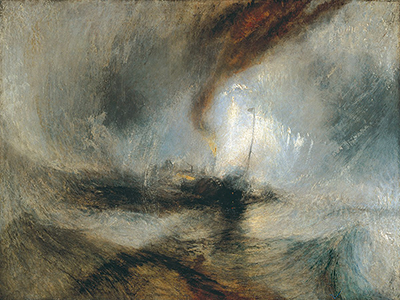
J. M. W. Turner's Snow Storm - Steam-Boat off a Harbour's Mouth is one of the late paintings that made his art seem both daring and difficult to nineteenth-century viewers. Tate records the work as by Joseph Mallord William Turner, exhibited in 1842, with the accession number N00530 and a Tate Britain display anchor when checked.[1] Tate Images gives the medium as oil paint on canvas, the support as 914 x 1219 mm, and the provenance as accepted by the nation as part of the Turner Bequest in 1856.[2]
The painting belongs to Turner's long engagement with sea, storm and modern transport. A steam-boat struggles near a harbour mouth in violent weather, making signals in shallow water and going by the lead, according to the longer exhibited title tradition. The vessel is difficult to isolate because weather and water press against every form. Turner does not simply show a boat in a storm. He makes seeing itself feel like an act performed under pressure.
This late marine subject should be kept distinct from Snow Storm: Hannibal and his Army Crossing the Alps, the 1812 history landscape already treated separately. Both works use storm as a dominant force, but they belong to different subjects, dates and pictorial problems. The 1812 painting sets ancient military ambition beneath Alpine weather. The 1842 painting places a modern steam vessel inside a maritime crisis.
The famous story that Turner had himself tied to a mast during a storm is part of the painting's reception history, but it should be handled cautiously. The source lock requires treating the "Ariel" story as contested rather than verified autobiography. The painting does not need the anecdote to justify its intensity. Its force is already present in the title, subject, paint handling and relation between steam, water and storm.
The work matters because it refuses stable visibility. The viewer searches for the vessel, the signal, the waterline and the direction of movement, but each is interrupted by weather. Turner makes the sea not a background but an active condition that breaks up ordinary description. This is a painting about modern maritime danger seen through instability.
At a Glance
- ArtistJoseph Mallord William Turner
- Full titleSnow Storm - Steam-Boat off a Harbour's Mouth
- Exhibited1842
- MediumOil paint on canvas
- Dimensions91.4 x 121.9 cm
- CollectionTate Britain
- AccessionN00530
- ProvenanceTurner Bequest, 1856
- SubjectA steam-boat in dangerous shallow water
- Ariel storyContested reception tradition
Contents
- Overview
- Object Identity
- A Steam-Boat in Shallow Water
- Seeing Through Storm
- Steam, Weather and Modernity
- The Ariel Story
- Reception and Criticism
- Paint Handling
- Snow Storm and Hannibal
- Why the Painting Matters
Object Identity
The title used here follows Tate's public record: Snow Storm - Steam-Boat off a Harbour's Mouth.[1] The title should be stated before shortening to Snow Storm, because Turner painted more than one major storm subject and because the steam-boat reference is central to this work's identity. The accession number is N00530.[1]
Tate records the painting as exhibited in 1842.[1] Tate Images confirms oil paint on canvas as the medium and gives the support size as 914 x 1219 mm.[2] Those measurements place the work in a broad horizontal format that can hold sea, sky, steam and vessel as a single field of motion. The support is large enough for immersion but not so large that the viewer stands outside the event.
The Turner Bequest provenance matters. Tate Images records that the painting entered the national collection through Turner's bequest in 1856.[2] Like many late works now central to Turner's reputation, it became a public object after his death, where viewers and critics continued to argue about what kind of painting it was.
Butlin and Joll's catalogue remains the broader oil-painting backbone for title, exhibition and provenance questions.[5] The object identity should remain firm because the painting is vulnerable to two kinds of confusion. One is confusion with the earlier Hannibal storm. The other is confusion between documented object facts and later anecdotes about Turner's experience at sea.
The medium and date also help keep interpretation grounded. This is an exhibited oil painting from 1842, not an unfinished colour study and not a late abstraction in the modern sense. Its handling may push visibility toward near dissolution, but it remains attached to a named maritime subject, a steam vessel, and a Royal Academy exhibition context.
The Tate accession also keeps the work separate from generic reproductions and simplified titles. "Snow Storm" alone can sound like a category, while the Tate title anchors the painting to a steam-boat and a harbour mouth.[1] That distinction is useful because Turner repeatedly used storm as a subject. Here the storm is modern, maritime and navigational rather than Alpine, biblical or purely atmospheric.
The support size reinforces the work's physical ambition. At just over 91 by 121 centimetres, it gives the viewer a broad field but not a distant panorama.[2] The scale is large enough to surround the eye with weather while keeping the central vessel close enough to matter. The picture is not a tiny sketch of an effect. It is an exhibited oil painting built to test public looking.
Object identity also helps resist a romantic myth of total spontaneity. The painting may feel like a direct assault of weather, but it was made for exhibition, carried a title, and entered the Turner Bequest. Its turbulence is not accidental. Turner constructed the appearance of near-chaos inside a public work.
A Steam-Boat in Shallow Water
The steam-boat is central to the painting's modernity. Turner had long painted sailing ships, fishing boats, warships and wrecks, but a steam vessel introduced a newer form of maritime power into the storm tradition. The boat in this painting is not a symbol of mastery. It is a vulnerable machine inside weather.
The longer exhibited title associated with the work refers to the vessel making signals in shallow water and going by the lead. This language matters because it gives technical pressure to the image. The boat is not merely tossed by weather in open sea. It is navigating danger near a harbour mouth, where depth, signals and orientation matter.
"Going by the lead" refers to sounding depth with a lead line. The phrase brings practical seamanship into a painting that can otherwise seem almost illegible. Turner gives the viewer not just storm drama but the conditions under which a vessel tries to survive: poor visibility, shallow water, uncertain depth, signals, steam and weather closing in.
The harbour mouth is equally important. A harbour can suggest safety, but the title locates the vessel off that threshold rather than securely inside it. The painting therefore turns approach to shelter into danger. The boat is near safety but not yet safe. That in-between condition gives the scene much of its tension.
The steam-boat also complicates older marine painting. A sailing vessel in a storm depends on wind, rigging and sail. A steam vessel adds engine power, smoke and mechanical effort. Turner does not make that power triumphant. He shows modern machinery subjected to weather that remains larger than human control.
This is why the painting should not be reduced to a generic storm. The steam-boat matters. It places the image in a world of modern transport and technology, while the storm shows that modernity has not escaped elemental risk.
Royal Museums Greenwich describes Turner as an artist whose maritime subjects responded to naval warfare, technological change, travel and the maritime art of the past.[3] That framework fits this painting closely. The steam-boat is a sign of technological change, but the storm connects it to older traditions of sea danger and marine painting. Turner is not choosing between old and new maritime worlds; he is forcing them into one unstable image.
The steam-boat's presence also changes the emotional character of the storm. A sailing ship caught in dangerous weather might suggest an older drama of wind and sail. A steam vessel introduces engine power and smoke, but the power does not resolve the danger. The boat still has to sound, signal and struggle. Turner makes modern technology vulnerable to the sea's conditions.
The lead-line reference gives the viewer a practical clue. Sounding depth is a repetitive, bodily action, not an abstract idea. It implies crew, labour, shouted measures and uncertainty under stress. Even when no crew member is clearly individualized, the title pulls human work into the painting. The vessel's survival depends on knowledge as much as machinery.
The harbour mouth is also a paradox. It promises entry and safety while concentrating risk. Sandbanks, shallows, current, wind and poor visibility can make approach dangerous. Turner makes that threshold into the painting's whole situation: the boat is near order but held in disorder.
Seeing Through Storm
The painting makes visibility unstable. The vessel is not outlined with calm descriptive precision. It is found through dark passages, broken forms and pressure from surrounding weather. The viewer has to work to locate the boat, and that effort is part of the meaning. Turner makes looking resemble navigation.
The sea and sky are not cleanly divided. Weather seems to fill the entire field. The eye moves through greys, whites, browns and darker accents, searching for structure. This is not vagueness for its own sake. It is a pictorial way of representing confusion at sea, where direction, distance and safety can become uncertain.
The storm also changes scale. The steam-boat may be the named subject, but it is not visually sovereign. Weather surrounds it, presses upon it and nearly absorbs it. Turner gives the machine a place in the scene, but he refuses to make the machine dominate the conditions around it.
This instability is one reason the painting has often been discussed as a late Turner experiment in perception. The forms are not absent, but they are hard to secure. The viewer may recognize funnel, hull, water, signal or spray only briefly. Meaning emerges through fragments rather than through a fixed outline.
That fragmentation should not be confused with carelessness. Turner was a practiced marine painter with decades of experience. In this work he chooses to make structure difficult because the subject is difficulty itself: a vessel attempting to survive in weather that damages normal vision.
The painting therefore turns perception into content. It does not merely depict a storm; it makes the viewer feel the problem of seeing in a storm. That is its major achievement.
The central form can seem to appear and disappear as the eye adjusts. This instability should not be rushed past. Turner makes the viewer participate in uncertainty: first registering motion and tone, then searching for the vessel, then losing it again in weather. The experience is closer to trying to understand conditions at sea than to calmly inspecting an object.
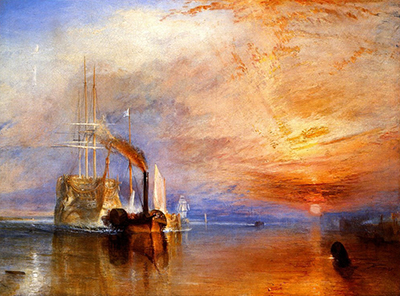
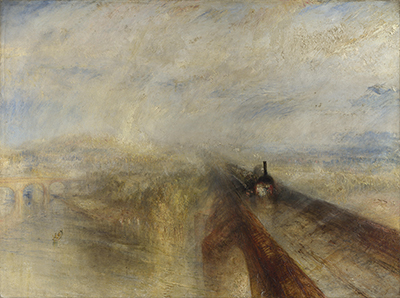
This kind of looking is different from the reading demanded by The Fighting Temeraire or Rain, Steam, and Speed. Those paintings also include steam, but they give the viewer stronger structural anchors: a pale warship, a tug, a railway bridge, a dark locomotive. In Snow Storm, the anchor is far less secure. Steam and storm nearly dissolve the distinction between object and atmosphere.
The painting's difficulty can also be understood as a refusal of distance. A conventional marine painting may let the viewer stand safely outside danger. Turner narrows that distance. Weather fills the field, so the viewer does not merely observe instability; the viewer has to look through it. This is one reason the work remains unsettling.
The eye may want a firm horizon, but Turner weakens it. Sea and sky press into one another, while the vessel occupies a zone of turbulent middle ground. The absence of a secure horizon is not just an optical effect. It denies the viewer the comfort of a stable world.
The storm therefore changes the viewer's role. Instead of asking "What details can I identify?" the painting asks "How much can I understand under these conditions?" That question is modern, experiential and pictorial at once.
Steam, Weather and Modernity
Steam had already become one of Turner's major ways of thinking about modern life. In The Fighting Temeraire, a steam tug pulls an old warship toward dismantling. In Rain, Steam, and Speed - The Great Western Railway, a locomotive crosses Brunel's Maidenhead bridge in rain. Snow Storm - Steam-Boat off a Harbour's Mouth belongs to that same broad modern field, but its specific setting is maritime crisis.
The comparison should be kept controlled. Rain, Steam, and Speed is about railway velocity, bridge engineering and perception under rain. The Fighting Temeraire is about naval memory, transition and the old age of sail being moved by steam. This painting is about steam power under storm pressure at sea. It is not a repeat of either later-famous image.
The steam vessel in Snow Storm does not look like a heroic emblem of progress. It struggles within a system of water, wind, snow, smoke and uncertain depth. Turner does not reject modern technology, but he shows it exposed. Modernity is present as machine power, not as safety.
That ambiguity fits Turner's broader approach to industrial subjects. He did not simply celebrate or condemn steam. He repeatedly placed it in situations where power and vulnerability were visible together. A tug can move a warship; a locomotive can reorganize landscape; a steam-boat can be almost lost in weather.
Here, steam becomes hard to separate from storm. Engine vapour, spray, snow and cloud all participate in the painted atmosphere. The technology does not stand apart from nature. It enters the same unstable field, adding its own smoke and energy to the crisis.
This is why the painting is best read as a sensory modern subject. It is not a technical illustration of a steam-boat. It is a painting about what modern maritime travel can feel like when weather overwhelms ordinary control.
The comparison with the railway painting is useful because both works include modern transport under weather pressure. But Rain, Steam, and Speed uses a diagonal bridge and forward-moving train to make speed visible. Snow Storm uses disrupted orientation to make danger visible. One work pulls the eye along a track; the other deprives the eye of a secure path.
The comparison with The Fighting Temeraire is different again. There, steam is a force of historical transition, pulling an old warship toward dismantling. Here, steam is present in immediate maritime danger. The steam-boat is not a symbol of the future in calm command. It is a vessel caught in conditions that test the limits of its modern power.
This object-centered reading protects the painting from broad claims about Turner and industry. The work does not need to stand for all industrial modernity. It is more precise: a steam-boat, shallow water, signals, a harbour mouth, snow storm and oil paint. From those particulars, Turner makes a modern scene of vulnerability.
Steam also has a visual ambiguity in the painting. It may be hard to distinguish from cloud, spray or snow. That ambiguity matters because modern technology becomes part of the same field as weather. The machine does not impose crisp order on the sea; it adds another kind of vapour to the confusion.
The Ariel Story
The story most often attached to the painting says that Turner was tied to a mast during a storm on the night the "Ariel" left Harwich. The source lock requires caution: this account should not be presented as verified autobiography without strong support. It survives through later testimony and has long been contested.
The story is attractive because it seems to explain the painting's intensity. If Turner really endured such a storm, then the painting can be read as direct experience translated into oil. But that neat explanation is risky. It can turn a complex work of imagination, memory, marine knowledge and studio practice into a simple personal adventure.
The painting does not require the anecdote. Turner had extensive experience of sea subjects, and he knew how to construct storm effects through composition, colour and handling. The object facts are enough: an exhibited 1842 oil painting, now Tate N00530, showing a steam-boat in dangerous weather.[1][2]
Treating the story as contested does not mean ignoring it. It belongs to reception history because viewers and writers have used it to explain the painting's force. But the wording should remain careful: Turner later told or was said to have told a dramatic storm story; the painting itself should not be made dependent on proving it.
This caution also protects the viewer from a false standard of authenticity. A painting can be truthful to storm experience without being a literal record of one event. Turner may have drawn on memory, observation, imagination, technical knowledge and artistic ambition. The work's power lies in the fusion of those resources.
The safest interpretation is therefore to separate evidence from legend. The Tate title, exhibition date, accession and medium are object facts. The "Ariel" account is an interpretive tradition that should be flagged as uncertain.
This distinction is not pedantic. The anecdote can dominate the painting if repeated too confidently. Viewers may begin by asking whether Turner really had himself tied to a mast, instead of asking how the painting works. The story becomes a shortcut through difficulty. A careful reading keeps it in the background until the object has been understood.
The title's reference to the "Ariel" in the longer tradition is still historically important, but it is not the same as proof of lived experience. Titles, exhibition lore and later recollections can all shape reception without functioning as direct documentation. The painting should be allowed to remain a constructed image, not reduced to evidence for a biographical episode.
The uncertainty may even suit the painting. A work about poor visibility and unstable knowledge has a reception history marked by unstable testimony. That parallel should not be overstated, but it is suggestive. The painting asks for careful navigation, and so does its story.
Reception and Criticism
The painting was exhibited in 1842, and its difficulty quickly became part of its reputation. Late Turner often challenged viewers who expected clearer outlines, more stable forms and more conventional finish. A painting in which sea, snow, steam and vessel nearly merge could look radical, confusing or even unacceptable to some critics.
Ruskin is important to this reception field, but direct quotation needs authentication. Since this public account does not need a long Ruskin quotation, it is better to summarize cautiously: Ruskin became Turner's great defender and treated his storm and light effects as serious artistic achievements, not careless obscurity.[6]
The critical dispute matters because it shows how the painting tested accepted standards. If a viewer wanted a ship clearly set against sea and sky, Snow Storm could feel like evasion. If a viewer accepted that storm might destroy stable visibility, the painting could appear profoundly accurate to experience.
Turner's late handling was not universally understood in his own time. That should not surprise us. The painting asks viewers to accept turbulence as structure. It asks them to read uncertainty as pictorial meaning. Such demands could be mistaken for incoherence.
The reception history also reminds us that the painting's modern fame is not the same as its first reception. Works now treated as central to Turner's late art once sat within debates about finish, legibility and excess. Understanding that debate helps us see why the painting mattered: it expanded what a marine painting could do.
The painting's later public life through the Turner Bequest gave those debates a long afterlife. The work became part of the national collection and therefore part of the continuing argument over Turner's late style.
Reception also matters because late Turner criticism often revolved around whether looseness meant profundity or failure. Snow Storm makes that question unavoidable. Its subject gives a reason for looseness: bad weather can break vision apart. But the same handling could still unsettle viewers who thought painting should clarify rather than intensify confusion.
The painting therefore became a test case for what viewers expected from marine art. Was a storm painting supposed to show a vessel in danger with legible drama, or could it make the viewer share the danger of illegibility? Turner's answer is the second. He makes uncertainty not an obstacle to meaning but one of meaning's central forms.
This helps explain why Ruskin's defence mattered. He gave intellectual seriousness to qualities that others could dismiss as disorder. Even without relying on extended quotation, it is fair to recognize that Ruskin's critical project helped later viewers understand Turner's storm and light effects as deliberate achievements.[6]
Paint Handling
Tate Images identifies the medium as oil paint on canvas.[2] That matters because the painting's subject is carried by paint handling as much as by iconography. Turner builds storm from broken visibility, sweeping movement and tonal compression. The surface does not merely describe weather; it behaves like weather.
Joyce Townsend's work on Turner's technique is useful for approaching this kind of late surface because it treats technique as part of the image's construction, not as an afterthought.[4] Turner could adapt watercolour habits, layered colour and expressive handling within oil painting. In Snow Storm, that technical confidence allows the subject to become almost immersive.
The painting is often discussed through terms that approach abstraction, but those terms require care. Turner did not abandon subject. The title identifies a steam-boat, harbour mouth, shallow water and signals. The work becomes difficult because the subject is seen under extreme conditions, not because subject has disappeared.
This distinction is important. Calling the painting abstract can be tempting, but it risks anachronism. A better formulation is that Turner pushed representation toward instability. The viewer sees a maritime event through weather so dense that ordinary description begins to break down.
The brushwork helps produce that instability. Forms are suggested, disrupted and reabsorbed. The boat is not fully lost, but it is never comfortably secure. Turner makes the viewer assemble the scene from visual pressures rather than from clear outlines.
The handling therefore serves the subject. The storm is not painted around the steam-boat; it is the medium through which the steam-boat exists. The paint makes that condition visible.
The surface also resists a simple hierarchy of figure and ground. In many paintings, the main object is clearly separated from its setting. Here, the steam-boat is entangled with the storm that threatens it. That entanglement is central to the work's meaning. The vessel is not placed before weather; it is embedded within weather.
Townsend's technical framework is helpful because it keeps the discussion from becoming purely metaphorical.[4] Turner's effects depend on material practice: paint, layering, tonal adjustment and the physical behavior of colour. The storm may look almost immaterial, but it is made through very material decisions.
Those decisions affect time as well as space. The painting seems to catch a moment that cannot last, yet it also holds that moment in a suspended swirl of looking. The viewer experiences an event that feels immediate and prolonged at once. This temporal tension is one of the strengths of Turner's late handling.
The paint also encourages humility. A viewer cannot master the scene quickly. The surface withholds easy certainty, making the act of interpretation resemble sounding depth: tentative, repeated and dependent on partial evidence.
Snow Storm and Hannibal
The earlier Snow Storm: Hannibal and his Army Crossing the Alps provides a useful contrast, but only if the two paintings remain distinct. The 1812 work is a large history landscape in which an ancient military subject is overwhelmed by Alpine weather. The 1842 work is a late maritime painting in which a modern steam-boat is threatened near a harbour mouth.
Both paintings make storm a principal actor. In both, human or mechanical ambition is reduced by weather. Yet the earlier work still belongs to a history-painting framework, with Hannibal's campaign and ancient warfare as its subject. The later work belongs to a world of steam transport, modern maritime risk and late Turner reception.
The contrast shows Turner's long interest in weather as more than background. In 1812, storm tests a legendary army. In 1842, storm tests a steam vessel. In both, weather becomes a way to think about vulnerability. But the kind of vulnerability changes with the subject.
The comparison should remain short because JMWT014 already carries the full Hannibal treatment. For Snow Storm - Steam-Boat off a Harbour's Mouth, the key point is that Turner returned to storm as a means of reorganizing vision, not that all storm paintings mean the same thing.
The later painting is also more extreme in its challenge to legibility. The Hannibal picture contains many figures and a broad historical landscape. The steam-boat painting concentrates on a more compact scene in which atmosphere nearly overtakes object identity. That difference marks the movement of Turner's late style.
Together the two works show continuity without sameness. Turner used storms repeatedly, but each storm had a different historical, technical and emotional function.
The 1842 painting also differs in its relation to modernity. Hannibal looks back to antiquity while speaking to Turner's own age through analogy and atmosphere. Snow Storm - Steam-Boat off a Harbour's Mouth places a modern vessel directly into the scene. Its danger belongs not to ancient campaign but to contemporary maritime travel.
The difference in scale is also telling. The Hannibal painting is monumental and panoramic, with armies, mountains and broad historical reach. The steam-boat painting is more concentrated, less narrative and more immersive. Its crisis is not spread across a grand landscape; it is compressed into storm, vessel and unstable visibility.
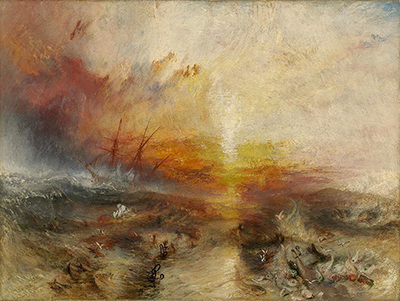
This contrast helps prevent a common Turner shorthand. Not every storm is the same, and not every storm image is a general emblem of the sublime. Turner used storm to think through different subjects: invasion, sea travel, steam power, slavery, shipwreck and perception. JMWT021 belongs specifically to steam-age maritime risk.
Why the Painting Matters
The painting matters because it tests the limits of maritime representation. Turner does not simply add a storm to a boat scene. He makes storm conditions govern how the viewer can see. The painting's difficulty is therefore not incidental; it is the subject.
It also matters as a steam-age sea painting. The steam-boat brings modern technology into a place where weather remains overwhelming. Turner does not make the machine victorious, but neither does he exclude it from high art. He gives the steam vessel a place in the same serious pictorial world as storms, ships, history and light.
The work also matters for understanding late Turner. Its forms are unstable, its atmosphere is dense, and its visual information is partial. Yet it remains anchored by title, date, medium, accession and subject. The painting shows how far Turner could push representation without severing it from the world.
The contested anecdote matters too, but mainly as a warning. It is easy to explain difficult art by attaching it to a dramatic biography. Turner may have encouraged such stories, and later writers certainly repeated them. But the painting's achievement lies in the work itself: the construction of a storm environment in paint.
The painting also challenges the viewer's patience. It cannot be read instantly. The eye circles, searches, hesitates and returns. That slow struggle is not a failure of communication. It is how the painting makes danger visible.
Finally, the work matters because it joins modern transport to sublime weather without making either term simple. Steam is not mastery; storm is not mere chaos. Their encounter produces a new kind of marine image.
The painting also matters because it shows Turner taking modern maritime experience seriously. A steam-boat in shallow water could have been treated as an anecdotal contemporary subject. Turner instead makes it a major statement about vulnerability, technology and perception. The result belongs to his larger late project of making modern subjects carry the force once reserved for myth, battle or ancient history.
It also matters because it asks viewers to accept difficulty as evidence. The painting's obscure forms are not a barrier placed between viewer and subject. They are how the subject is known. In conditions of storm, certainty itself becomes unstable. Turner makes that instability visible.
The work's continued importance lies partly in this refusal of easy mastery. The viewer cannot reduce it to an anecdote, a technical trick, a symbol of steam, or a prehistory of abstraction. Each of those readings touches the painting, but none is sufficient. The work remains strongest when its tensions are held together.
How to Read Snow Storm - Steam-Boat off a Harbour's Mouth
Begin with the Tate identity: Snow Storm - Steam-Boat off a Harbour's Mouth, Joseph Mallord William Turner, exhibited 1842, Tate accession N00530.[1] That keeps the object distinct from the 1812 Hannibal storm and from later myths about the painting.
Then look for the vessel as something partly obscured rather than clearly displayed. The boat's difficulty is the point. Turner makes the viewer experience the instability of storm seeing.
Next, treat steam as a modern element under pressure. The steam-boat is not a tidy emblem of progress. It is a machine inside weather, shallow water and uncertainty.
After that, read the title's practical language. Signals, shallow water and sounding by the lead place maritime knowledge inside the painting. The work is atmospheric, but not vague.
Finally, handle the "Ariel" story with caution. It belongs to the painting's reception tradition, but it should not replace object facts or careful looking. The painting's power does not depend on proving the anecdote.
Frequently Asked Questions
Tate records the public title as Snow Storm - Steam-Boat off a Harbour's Mouth.[1] Longer exhibited-title traditions include the steam-boat making signals in shallow water and going by the lead.
Tate records the painting as exhibited in 1842.[1]
Tate holds the painting with accession number N00530, and its public record anchored the work to Tate Britain display when checked.[1]
Tate Images gives the medium as oil paint on canvas and records the support size as 914 x 1219 mm.[2]
That story should be treated as contested. It belongs to later reception, but it should not be presented as verified autobiography without qualification.
No, not in the modern sense of abandoning subject. The title identifies a steam-boat near a harbour mouth in dangerous conditions. Turner pushes representation toward instability, but the painting remains tied to a maritime subject.
The Hannibal painting is an 1812 history landscape about an ancient army crossing the Alps. Snow Storm - Steam-Boat off a Harbour's Mouth is an 1842 maritime painting about a modern steam vessel in dangerous weather.
Discussion
How does Turner make unstable visibility carry the meaning of a modern steam vessel caught in dangerous weather?
Reader Insights
Where do signals, shallow water and sounding by the lead remain legible within the storm?
Does steam power appear as mastery, vulnerability or another vapour inside the weather?
What changes when the contested Ariel story is separated from the documented object?
Join the Conversation
Share a close observation or a source-based question for other readers.
References
- Tate, "Snow Storm - Steam-Boat off a Harbour's Mouth, Joseph Mallord William Turner, exhibited 1842." https://www.tate.org.uk/art/artworks/turner-snow-storm-steam-boat-off-a-harbours-mouth-n00530
- Tate Images, "Snow Storm - Steam-Boat off a Harbour's Mouth." https://www.tate-images.com/n00530-Snow-Storm-Steam-Boat-off-a-Harbour%27s-Mouth.html
- Royal Museums Greenwich, "Turner & the sea / Christine Riding and Richard Johns." https://www.rmg.co.uk/collections/library/rmgl-152360
- Joyce H. Townsend, *How Turner Painted: Materials & Techniques*, Thames & Hudson, 2019.
- Martin Butlin and Evelyn Joll, *The Paintings of J. M. W. Turner*, revised edition, Yale University Press, 1984.
- John Ruskin, *Modern Painters*, Vol. I. https://www.gutenberg.org/files/29907/29907-h/29907-h.htm