 by Tom Gurney
Tom Gurney BSc (Hons) is an art history expert with over 20 years experience
Published on June 19, 2020 / Updated on August 29, 2026
Email: tomgurney1@gmail.com / Phone: +44 7429 011000
Overview
J. M. W. Turner's Snow Storm: Hannibal and his Army Crossing the Alps is one of the defining British history landscapes of the early nineteenth century. Tate identifies the work as by Joseph Mallord William Turner and records it as exhibited in 1812, with the accession number N00490.[1] Tate's collection metadata gives the medium as oil paint on canvas, the support as 1460 x 2375 mm, and the provenance through the Turner Bequest, accepted for the nation in 1856.[2] These basic facts establish the picture as a large public exhibition work, not a small private fantasy of weather.
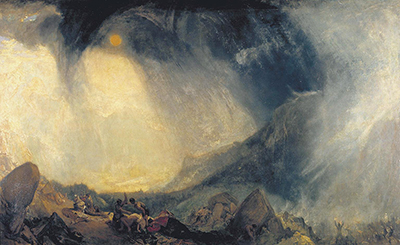
The painting shows Hannibal's army crossing the Alps, but Turner refuses the usual heroic formula. Hannibal himself is hard to locate. The soldiers are vulnerable, scattered and caught low in the composition. The real force of the picture is the storm: a vast, dark, curling mass that seems to rotate across the sky and bear down on the human action below. Turner turns an ancient military episode into a drama of exposure, scale and natural violence.
That choice made the painting more than an illustration of Hannibal. The National Portrait Gallery notes that after Turner's first visit to the Alps in 1802 he began to combine narrative with effects of sublime and violent nature, citing this 1812 painting as a key example.[3] In Snow Storm: Hannibal and his Army Crossing the Alps, landscape does not merely set the scene for history. Landscape becomes the form through which history is felt.
The work also belongs to the age of Napoleon, but its modern resonance needs careful handling. Turner exhibited it during the Napoleonic Wars, and viewers have often read its ancient invasion subject in relation to contemporary anxiety about military ambition. That comparison is plausible as context, but the painting should not be reduced to a coded political cartoon. Its power comes from the way Turner makes military greatness unstable. The storm dwarfs command, reputation and conquest.
This is why the picture remains central to Turner. It brings together Alpine travel, learned history, huge scale, weather, war and experimental composition. The painting is not abstract in the modern sense, but it pushes narrative painting toward an extreme where atmosphere, movement and light carry the emotional weight. Turner gives the viewer a historical subject almost swallowed by the conditions that surround it.
The result is a work that must be read slowly. Its first impact is elemental: black cloud, pale light, diagonal pressure, and a sense of movement that seems to come from outside human intention. Only after that first impact do the historical details begin to settle. This order of experience matters. Turner lets weather arrive before explanation, so the viewer feels the Alpine crossing before sorting its actors. The painting's ambition lies in that reversal.
At a Glance
- ArtistJoseph Mallord William Turner
- TitleSnow Storm: Hannibal and his Army Crossing the Alps
- Exhibited1812
- MediumOil paint on canvas
- Support1460 x 2375 mm
- CollectionTate
- AccessionN00490
- ProvenanceTurner Bequest; accepted for the nation
- SubjectHannibal's Alpine crossing in 218 BCE
- Central forceStorm, scale and military vulnerability
Contents
- Overview
- Object Identity
- Hannibal and the Alpine Subject
- The Storm as Structure
- Human Vulnerability
- The Alps, Travel and Sublime Nature
- Ancient War and Napoleonic Resonance
- Colour, Light and Material Force
- History Painting Reimagined
- Relation to Later Storm Paintings
Object Identity
Tate's preferred title is Snow Storm: Hannibal and his Army Crossing the Alps.[1] The exhibited date is 1812, and the painting is currently connected with Tate Britain in Tate's public object description.[1] Tate's open collection metadata gives the medium as oil paint on canvas and lists the support dimensions as 1460 x 2375 mm.[2] Art UK independently records the measurements as 146 x 237.5 cm, the accession number as N00490, and the acquisition method as accepted by the nation as part of the Turner Bequest.[4]
Those measurements matter. At nearly two and a half metres wide, the painting asks to be read physically as well as iconographically. The viewer is not asked to inspect a neat heroic scene from a comfortable distance. The scale allows the storm to occupy the body of the viewer's attention. The soldiers below seem small not because Turner forgot the subject, but because he designed a work in which the subject is almost overwhelmed by the world around it.
The 1812 exhibition date also matters. Turner was already a Royal Academician and an ambitious public painter. This was a moment when history painting still carried high prestige, yet landscape painting was expanding its claims. By choosing Hannibal, Turner selected a subject with the seriousness expected of history painting. By making the storm the dominant actor, he shifted that seriousness into landscape.
The Turner Bequest provenance adds a later public dimension. Like many works left by Turner, Snow Storm: Hannibal and his Army Crossing the Alps became part of the national inheritance after his death. It therefore belongs to two moments: the Royal Academy culture of 1812 and the later public collection history through which Turner became an artist repeatedly encountered in national galleries.
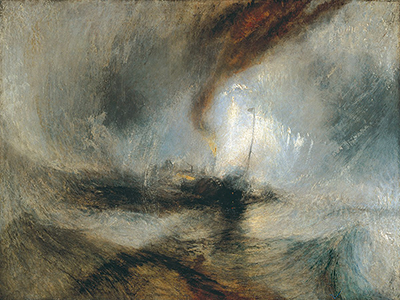
The object identity should stay firm before interpretation begins. The picture is not simply "Hannibal" and not the later Snow Storm - Steam-Boat off a Harbour's Mouth. It is the 1812 exhibited oil painting now recorded by Tate as N00490. Keeping that identity clear prevents two common problems: confusing it with Turner's later maritime storm painting, and turning its ancient subject into a vague emblem of bad weather.
Butlin and Joll's catalogue of Turner's oil paintings provides a standard scholarly backbone for placing the work within Turner's exhibited history pictures and within the larger sequence of paintings that entered the Turner Bequest.[6] That catalogue context is useful because Snow Storm: Hannibal and his Army Crossing the Alps is often discussed through one striking formal idea, the storm vortex. The painting also needs its ordinary catalogue anchors: title, exhibition, ownership history and relation to Turner's broader production in oil. Those anchors keep interpretation from floating away from the object.
There is another reason to stress identity. Turner repeatedly used storms, wars, mountains, seas and classical subjects, and several of his titles can seem similar when reduced in casual memory. This work's distinctiveness lies in the combination of ancient Carthaginian command, Alpine terrain, and a storm form made large enough to dominate a history painting. The title names an army crossing, but the physical record shows an ambitious oil painting designed for public exhibition and later preserved within Turner's national legacy.
Hannibal and the Alpine Subject
Hannibal's crossing of the Alps was one of the most famous military episodes of antiquity. In 218 BCE, during the Second Punic War, the Carthaginian commander led his army into Italy by crossing the mountain barrier that protected Rome from the north. The feat became legendary because it joined audacity, danger, logistics, extreme weather and military surprise.
Turner does not paint Hannibal as an equestrian conqueror dominating the centre. Instead, the commander is remote, uncertain and almost consumed by scale. The army stretches across the lower part of the canvas, broken by terrain, conflict and weather. The viewer has to work to understand where command sits in the scene. That difficulty is the painting's point.
The ancient subject gave Turner a way to challenge heroic convention. A traditional military painting might organise itself around the general, with landscape arranged as theatre for command. Turner reverses that hierarchy. The mountain storm becomes larger than the human will moving through it. Hannibal's achievement is still present, but it is shown under pressure from forces that ignore office and fame.
This does not make the painting anti-historical. On the contrary, Turner deepens the historical subject by making it experiential. The crossing of the Alps was not only a strategic decision; it was a bodily ordeal. Cold, darkness, altitude, falling rock, confused movement and hostile terrain all belonged to the event. Turner's storm gives visual form to that ordeal.
The smallness of the army is therefore not a failure of storytelling. It is a method of historical thinking. Turner asks the viewer to imagine history from below, among those who are dragged through the consequences of grand decisions. Hannibal's name dominates the title, but the picture's emotional life belongs to exposed bodies, strained animals, and a mass of weather that no commander can master.
This approach gives the painting a different moral pressure from a triumphal military image. Hannibal's crossing was a feat of strategy and endurance, yet Turner does not make endurance look clean. The army's passage is full of interruption. Movement across the mountains is broken into fragments: one group advancing, another caught in danger, another swallowed by atmosphere. The painting turns the idea of a single campaign into a set of strained human episodes under one enormous sky.
The historical subject also lets Turner join two scales of time. The title reaches back to antiquity, while the painting's surface belongs to the immediate experience of storm, cold and confusion. Ancient history is not presented as calm distance. It is made urgent through sensation. Turner gives an old event the feeling of something happening now, before the outcome can be known.
The Storm as Structure
The most memorable form in the painting is the dark, sweeping curve of storm cloud. It bends across the sky like a rotating force, enclosing the scene and pulling the eye away from stable recession. This curved structure gives the work its energy. The storm is not simply laid over the landscape; it shapes the viewer's movement through the image.
Turner uses the storm to break the easy clarity of conventional composition. Instead of a balanced arrangement of foreground, middle distance and background, the eye encounters a powerful circular pressure. Light struggles through one area while darkness thickens elsewhere. The viewer senses depth, but not in a calm or orderly way. Space becomes unstable because weather makes it unstable.
That instability is a visual argument. Human plans depend on maps, commands and forward motion, but the mountain environment does not submit to them. The army may be crossing toward Italy, yet the storm bends the scene back on itself. Movement becomes both advance and entrapment. The painting makes progress feel costly.
The storm also gives the work its sublime character. The sublime, in eighteenth- and early nineteenth-century thought, was often connected with experiences of danger, vastness and overwhelming power. Turner does not need to show a viewer standing safely before a mountain prospect. He makes the painting itself the encounter. The storm's scale, darkness and motion create an experience that exceeds ordinary pictorial order.
Yet the picture should not be described as abstraction. Turner still anchors the scene in a title, a military episode, figures, animals, landscape and light. What changes is the balance of authority among those elements. The storm is not a decorative effect added to a story; it is the main form through which the story becomes legible.
The curve of the storm is especially important because it refuses the calm horizon that often organises classical landscape. Viewers can still sense distance, but the storm interrupts their confidence in it. The eye is pulled into the rotating dark mass, then sent back toward the pale opening, then down into the human disorder below. Turner makes looking feel unstable in the same way the crossing is unstable.
This is a disciplined effect, not painterly chaos. The composition gives the viewer just enough structure to remain oriented while withholding the ease of a stable centre. The storm's sweep, the light beyond it and the low human band work together. They create a painting in which the largest form is also the strongest idea: nature has become the pressure under which history must proceed.
Human Vulnerability
The lower edge of the painting contains much of its violence. Figures struggle, fall, fight and press forward beneath the huge atmospheric arc. The small scale of these figures is essential. Turner does not enlarge suffering into melodrama. He lets it flicker across the foreground while the storm dominates the whole.
This handling changes the viewer's relation to history. Instead of celebrating an army's advance, the painting asks us to notice the cost of movement. Soldiers become bodies in danger. Animals become part of the burden of conquest. The forward momentum of Hannibal's campaign is inseparable from disorder at the rear and at the edges.
The viewer may search for the elephant, for Hannibal, or for a single central incident. That search can be frustrating, but it is productive. The famous commander becomes almost incidental when measured against the scale of the storm. The picture does not deny his historical importance; it places that importance within a larger field of risk.
The human drama is also distributed rather than concentrated. There is no single face or gesture that explains the painting. Instead, small incidents accumulate: bodies clustered in tension, forms pressed against rocks, movement broken by weather and conflict. Turner makes history appear as a crowd of partial perceptions.
This is one reason the painting feels modern despite its ancient subject. It distrusts the clean legibility of heroic narrative. The title gives us Hannibal, but the picture gives us uncertainty. That uncertainty is not vague. It is a precisely managed confusion produced by scale, weather and pictorial force.
The foreground violence keeps the scene from becoming merely atmospheric. Without those small struggling forms, the storm might become a grand natural display detached from human consequence. Turner instead binds grandeur to damage. The army's passage carries cost, and that cost is spread across the lower field rather than concentrated in a single martyr-like figure.
The handling of scale is crucial here. A viewer may at first experience the human forms as nearly lost, yet their very smallness makes them morally insistent. They are not monumental, but they persist. The painting asks us to keep looking for them inside conditions that continually threaten to absorb them. That act of looking becomes part of the work's meaning.
The Alps, Travel and Sublime Nature
Turner's Alpine experience is crucial background. The National Portrait Gallery notes that after his first visit to the Alps in 1802 he began combining narrative with sublime and violent natural effects.[3] The Alps gave British artists and viewers a landscape of dramatic verticality, danger and scale. For Turner, they became more than picturesque scenery. They became a testing ground for how landscape could carry historical meaning.
In Snow Storm: Hannibal and his Army Crossing the Alps, mountains are not shown as crisp topographical fact. They appear through weather, shadow and fragments of visibility. This is appropriate to the subject. The point is not to give a clear survey of a pass, but to make the viewer feel how mountain weather alters perception.
The Alpine setting also transforms the idea of heroic passage. A road across mountains can be imagined as triumph: the army overcomes the barrier and descends toward victory. Turner makes passage feel provisional. The landscape resists. Snow, cloud and steep terrain place the army in a state of exposure. The crossing is heroic only because it is nearly disastrous.
The light in the distance intensifies that tension. It suggests a goal beyond the storm, a place toward which the army moves. But that light is not easy comfort. It is remote, partly veiled, and emotionally complicated. The painting holds promise and threat together. Italy may lie beyond, but the present is dominated by weather.
This is Turner's particular contribution to sublime landscape. He does not simply show a vast natural object. He shows human ambition entering conditions that reveal its limits. The Alps become a moral and physical pressure. They do not preach; they bear down.
The Alpine subject also allowed Turner to combine memory, study and invention. The NPG's summary links his 1802 Alpine experience with a turn toward narrative joined to violent natural effects.[3] That does not mean the painting is a literal travel record. It means Turner had encountered mountain scale and could use that experience imaginatively. The canvas turns travel knowledge into historical drama.
This distinction helps keep the painting clear. It is not a topographical report of one exact pass, and it is not a free invention with no relation to place. It works between those poles. Turner uses Alpine experience to give credibility to an ancient crossing, then intensifies that credibility through storm, scale and darkness. The result feels convincing because it is grounded in observed mountain power while serving a larger historical idea.
Ancient War and Napoleonic Resonance
Because Turner exhibited the painting in 1812, viewers inevitably encounter it near the history of the Napoleonic Wars. Britain was engaged in a prolonged struggle with France, and Napoleon's own Alpine imagery was famous in European visual culture. A painting of Hannibal crossing the Alps could therefore carry modern associations even while presenting an ancient subject.
That context should be used carefully. It is tempting to turn the picture into a direct statement about Napoleon, but the evidence needs a lighter touch unless a specific scholarly claim is being made. The safest reading is that Turner's ancient subject had contemporary resonance: conquest, invasion, military ambition and mountain passage all mattered to viewers in the age of Napoleon.
The painting's structure resists simple propaganda in any case. If Hannibal can suggest a great commander, the storm makes greatness precarious. If the army can suggest invasion, the mountain environment makes invasion vulnerable. If the scene can suggest modern anxiety, it does so through an ancient example of ambition exposed to forces beyond control.
This balance is more interesting than a one-to-one analogy. Turner was not painting a newspaper cartoon. He was using history painting to explore how power appears when placed inside a landscape of danger. The result can speak to Napoleon's age without being confined to Napoleon.
The same caution applies to Carthage and Rome. Hannibal's army belongs to Carthaginian history, and Turner returned elsewhere to Carthage as a subject of rise and decline. But Snow Storm: Hannibal and his Army Crossing the Alps does not need a simple moral about empire. Its visual evidence is more specific: an army in motion, a storm in command, and a leader whose fame cannot create safety.
That specificity keeps the political resonance alive without making it crude. A viewer in 1812 could hardly ignore war, invasion and military ambition. Yet Turner's picture does not ask for one fixed response. It can be read as warning, as sublime drama, as historical meditation, and as a challenge to the heroic image of command. Its ancient subject gives it distance; its storm gives it immediacy.
The painting's restraint on direct modern naming is part of its strength. Turner could place contemporary unease inside an older historical container, allowing the work to speak across more than one moment. Hannibal becomes a figure through whom ambition, danger and command can be tested. The storm prevents that test from becoming simple praise.
Colour, Light and Material Force
The drama of the painting depends on contrasts of darkness and light. The storm cloud is heavy, almost material, while areas of brightness cut through the scene with difficult force. The light is not calm illumination. It is a contested presence, struggling against cloud, snow and atmospheric density.
Turner uses colour to keep the painting alive under conditions of near chaos. Warm light appears against cold storm. Dark masses press against pale distances. The lower passages contain small flashes and movements that prevent the army from becoming a single undifferentiated band. Even when forms are hard to separate, the surface remains active.
Technical studies of Turner stress that his handling of paint and colour was central to his pictorial thinking, not a decorative afterthought. Joyce Townsend and Tony Smibert's account of Turner's practice is useful here because it treats technique as part of how Turner built effects of atmosphere, light and movement.[5] In Snow Storm: Hannibal and his Army Crossing the Alps, the handling serves the subject by making visibility unstable.
This matters because viewers often describe Turner by jumping too quickly to late dissolving light. The 1812 Hannibal painting is still a history work with identifiable figures and a named subject. Yet its paint handling already presses against stable description. Edges break. Clouds thicken. Light becomes a force rather than a neutral condition for seeing.
The painting's material power lies in that tension. It gives enough information to support the title, but not enough to make the scene comfortable. The viewer moves between recognition and disorientation. That movement is not a by-product; it is how Turner makes the ancient crossing feel present.
The large support strengthens this effect because the storm can operate at a scale close to bodily encounter. Reproductions often compress the painting into a dramatic image, but the recorded dimensions remind us that Turner worked on a scale that could surround the viewer's attention.[2] The cloud is not merely a motif. It is a field, and the figures below are experienced against that field.
Colour also helps distinguish zones of fear, distance and hope. Darkness does not simply cover the scene; it presses and curls. Light does not simply reveal; it breaks through unevenly. The lower passages do not settle into clean description; they flicker with small acts of violence and survival. Turner uses paint to make vision itself feel weathered.
History Painting Reimagined
Turner was working within a culture that gave high status to history painting. Grand subjects from antiquity, scripture and national history were treated as opportunities for moral seriousness and intellectual ambition. Landscape, by comparison, could be dismissed as lower in the hierarchy if it merely recorded scenery. Snow Storm: Hannibal and his Army Crossing the Alps unsettles that hierarchy.
The painting has a history subject, but its historical meaning is carried by landscape. Weather, scale and light perform the work that a central heroic figure might have performed in another artist's hands. Turner does not abandon history painting. He alters its machinery.
This makes the picture especially important for understanding Turner's career. He repeatedly tested the boundary between landscape and history, showing that atmosphere could carry narrative pressure and that light could organise meaning. The NPG's summary of Turner as one of Britain's most famous and innovative artists fits this transformation: he made landscape do more than viewers expected.[3]
The innovation is not simply formal. It changes the ethics of looking. A centered hero invites admiration; Turner's scattered army invites unease. A clear victory scene invites confidence; Turner's storm suggests that ambition survives only under conditions it cannot command. The landscape does not decorate the story. It judges the story by exposing its fragility.
That is why the painting can feel both ancient and modern. The subject comes from classical military history, but the visual structure belongs to an age increasingly aware of historical upheaval, war, empire and the powers of nature. Turner uses the past to think about the present without narrowing the work to a single topical message.
The painting also expands what a public landscape could be expected to do. It did not have to be a tranquil view, a record of a known place, or a decorative accompaniment to travel. In Turner's hands, landscape could absorb the moral seriousness of history painting and still remain landscape. Weather, light and terrain could become active historical agents.
That achievement explains why Snow Storm: Hannibal and his Army Crossing the Alps still feels difficult. It refuses to give viewers the usual reward of clear command. The title promises a famous general; the image gives a crisis of perception. The viewer must accept that the painting's meaning lies partly in what cannot be easily sorted.
Relation to Later Storm Paintings
Turner would return to storm subjects throughout his career, and viewers naturally compare the 1812 Hannibal with later works such as Snow Storm - Steam-Boat off a Harbour's Mouth. That comparison is useful only if the differences are preserved. The later painting belongs to another moment, another subject and another set of debates about Turner's late style.
In the 1812 work, the storm is tied to ancient history and Alpine passage. It threatens an army and reshapes the conventions of historical landscape. In the later maritime work, storm, sea, steam technology and modern travel create a different problem. Both works show Turner's interest in overwhelming conditions, but they do not make the same argument.
The earlier painting is also more directly connected to the prestige of history painting. Hannibal gives Turner a subject with classical authority. The storm does not remove that authority; it tests it. The result is a history painting in which the central historical agent has been displaced by atmosphere.
This displacement became one of Turner's great resources. He could make weather, water, fire and light bear meanings that other painters might have assigned to gesture or expression. In Snow Storm: Hannibal and his Army Crossing the Alps, that method appears with unusual clarity because the contrast is so bold: a legendary commander beneath a sky that barely acknowledges him.
The painting should therefore be treated as a major early statement, not just a prelude to later storms. It already contains the difficult Turner question: how can painting show forces that exceed human control while still remaining anchored in historical experience?
The answer in 1812 is not the same as the answer in the 1840s. Here, Turner uses a named ancient subject to hold the storm within the frame of history. The figures, army, mountain passage and title keep the work tethered to narrative. The storm then pushes against that tether. Much of the painting's energy comes from the strain between those two needs: to tell a history and to show forces that exceed storytelling.
For that reason, later storm comparisons should be brief. They can show continuity in Turner's fascination with unstable conditions, but they should not make the 1812 painting seem merely immature. Its ambition is already complete. It stages a historical event at the point where history nearly disappears into weather, and it makes that near disappearance the central experience of the work.
How to Read Snow Storm: Hannibal and his Army Crossing the Alps
Begin with the title and date. Tate's title and exhibited 1812 anchor tell us we are looking at a specific historical landscape shown to the public at a charged moment in European history.[1] The title names Hannibal, but the date places the work in Turner's own world of war, exhibition and artistic competition.
Then resist the urge to find a single heroic centre. Let the difficulty of locating Hannibal shape the reading. The picture is organised around displacement: the commander is named, but the storm dominates. That is the painting's strongest visual decision.
Next, follow the curve of the storm. Its sweeping motion controls the eye and changes the emotional temperature of the work. The storm is both atmosphere and structure. It turns the canvas into a field of pressure, not a stage set.
After that, look along the lower edge. The small figures and incidents give the work its human cost. They prevent the storm from becoming empty grandeur. The painting's violence is not only in the cloud; it is in the relation between the cloud and those struggling below it.
Finally, hold ancient and modern meanings together without forcing them into a single code. Hannibal, the Alps, the Napoleonic moment, Turner's travel experience and the sublime all matter. The painting's achievement is that it can contain them without becoming merely illustrative. It is a history painting in which weather becomes the deepest historical actor.
Frequently Asked Questions
Tate records the title as Snow Storm: Hannibal and his Army Crossing the Alps.[1] The title should be kept distinct from Turner's later Snow Storm - Steam-Boat off a Harbour's Mouth.
Tate records the work as exhibited in 1812.[1] That date places it during the Napoleonic Wars and within Turner's mature Royal Academy exhibition career.
The painting is in Tate's collection with the accession number N00490, and Tate's object description currently connects it with Tate Britain.[1]
It is about both, but Turner gives the storm unusual authority. Hannibal supplies the historical subject, while the storm shapes the viewer's experience of vulnerability, scale and historical pressure.
The 1812 exhibition date makes Napoleonic-era resonance plausible, but the picture should not be reduced to a direct Napoleon allegory without specific support. It is safer to say that Turner used an ancient invasion subject that could speak powerfully to viewers living through modern war.
Discussion
How does Turner make weather—not the famous commander—the governing force of a history painting?
Reader Insights
What changes when the army is reduced beneath the storm?
How does the sweeping cloud direct and destabilise your eye?
Does the Napoleonic context alter the ancient subject without defining it?
Join the Conversation
Share a close observation or a question for other readers.
References
- Tate, "Snow Storm: Hannibal and his Army Crossing the Alps, Joseph Mallord William Turner, exhibited 1812." https://www.tate.org.uk/art/artworks/turner-snow-storm-hannibal-and-his-army-crossing-the-alps-n00490
- Tate Gallery, *Tate Collection Metadata*, artwork row N00490. https://github.com/tategallery/collection
- National Portrait Gallery, "J.M.W. Turner." https://www.npg.org.uk/collections/search/person/mp04566/joseph-mallord-william-turner
- Art UK, "Snow Storm: Hannibal and his Army Crossing the Alps." https://artuk.org/discover/artworks/snow-storm-hannibal-and-his-army-crossing-the-alps-117673
- Joyce Townsend and Tony Smibert, *How Turner Painted*, Thames & Hudson. https://www.thamesandhudsonusa.com/books/how-turner-painted-softcover
- Martin Butlin and Evelyn Joll, *The Paintings of J. M. W. Turner*, revised edition, Yale University Press, 1984.