 by Tom Gurney
Tom Gurney BSc (Hons) is an art history expert with over 20 years experience
Published on June 19, 2020 / Updated on August 29, 2026
Email: tomgurney1@gmail.com / Phone: +44 7429 011000
Why Sunset on Rouen Matters
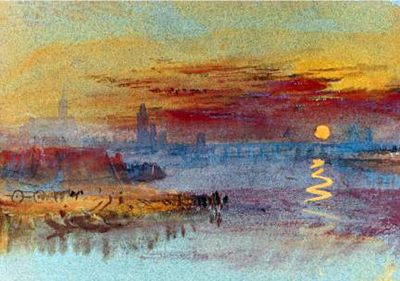
Sunset on Rouen is best approached as a familiar or legacy name for a small Turner watercolour whose firmer Tate-facing identity is The Scarlet Sunset. Tate’s public print record identifies the work as J. M. W. Turner’s The Scarlet Sunset, dated 1830-40, an original watercolour on paper measuring 13.4 by 18.9 centimetres, held by Tate.[1] Another Tate source presents it as a celebrated Turner drawing on blue paper, with a setting sun, river light and a radiant range of reds, golds and yellows.[2] Those facts make the work much more secure than the inherited title might first suggest, but they also require careful naming.
The title Sunset on Rouen should not be treated as the exact current Tate title. A partner record linked to Tate gives a fuller variant, The Scarlet Sunset: A French Town on a River, and places the work in the Tate collection.[4] Wikimedia Commons preserves a Tate-derived metadata trail to the accession D24666, describing The Scarlet Sunset as circa 1830-40, Turner, and connecting it with the 1856 Turner Bequest transfer.[3] These sources point toward one object: not a large oil, not a finished topographical panorama, but a compact watercolour whose colour carries the subject.
The work matters because so much happens in so little space. Tate’s description is plain but revealing: a limited palette of red and yellow, faint grey buildings, a bridge and a horse-drawn cart in the distance.[1] The Tate art-print text adds that the design is on blue paper and that the setting sun casts light across the river.[2] The John Lewis/Tate partner description emphasizes a river reflection caught in a rapid yellow stroke.[4] Together, those details identify the image as a test of colour, water, paper and urban distance. Turner does not need scale to make the sunset feel decisive.
If the Rouen identification is retained, the title places the watercolour within one of the richest French settings for Turner’s later reputation: the Seine, the Norman city, Gothic towers, river commerce and the long afterlife of Rouen as a subject for Monet, Pissarro and other nineteenth-century painters. But the first obligation is still object discipline. The secure title is The Scarlet Sunset; Rouen is the received name through which many viewers meet the work. The best reading keeps those two levels visible rather than smoothing them into a false certainty.
At a Glance
- ArtistJoseph Mallord William Turner
- Secure titleThe Scarlet Sunset
- Legacy route titleSunset on Rouen
- Title variantThe Scarlet Sunset: A French Town on a River
- Date1830–40
- MediumWatercolour on blue paper
- Dimensions13.4 × 18.9 cm
- CollectionTate
- Accession trailD24666; Turner Bequest 1856
- Place boundaryRouen is a received identification, not secured by Tate's title
Contents
- Why Sunset on Rouen Matters
- Object Identity and Title
- A Small Watercolour with Unusual Force
- Blue Paper and Scarlet Light
- The French Town on a River
- Turner and the Seine
- Place, Memory and Topographical Liberty
- Colour as Structure
- Rouen Before Monet
- Reading the Figures and Bridge
Object Identity and Title
The secure object identity begins with Tate. Tate’s shop record identifies the artist as J. M. W. Turner, the artwork as The Scarlet Sunset, the date as 1830-40, and the original as a watercolour on paper, 13.4 by 18.9 centimetres, in Tate.[1] The same record describes a limited red-and-yellow palette, faint grey buildings, a bridge and a horse-drawn cart.[1] This gives the article its essential factual base.
Tate’s separate art-print record deepens that base. It identifies The Scarlet Sunset as a notable blue-paper drawing and describes a vibrantly coloured design in which the setting sun sends light across the river and illuminates the sky in reds, golds and yellows.[2] That source is especially valuable because the blue support changes how the colour should be understood. The red and yellow do not simply sit on a neutral ground; they work against and through a coloured paper field.
The Tate-derived D24666 trail matters as well. Wikimedia Commons records the image as The Scarlet Sunset, circa 1830-40, by Turner, with Tate Gallery London as source and a 1856 Turner Bequest connection.[3] Commons is not the highest authority for the object, but in this case it preserves a useful Tate-linked accession trail where the public Tate collection entry is not easily accessible through ordinary search. It supports D24666, Tate, Turner Bequest and the title The Scarlet Sunset.
The title Sunset on Rouen is therefore best used as a received access title, not the final authority. The John Lewis/Tate partner record gives the fuller wording The Scarlet Sunset: A French Town on a River, c.1830-40, from the Tate collection.[4] That phrase also matters because it does not name Rouen. It names a French town on a river. The local Rouen title may preserve older or commercial circulation, but public interpretation should not pretend that the secure title itself proves the town.
This does not empty the Rouen reading of value. Turner did work repeatedly with Seine subjects, and Rouen was one of the great river cities of Normandy. The title under which viewers search for the work can be honoured, while the object facts remain precise. In practice, that means calling the article Sunset on Rouen for continuity, identifying the secure work as The Scarlet Sunset, and treating Rouen as a historically meaningful but carefully qualified association.
A Small Watercolour with Unusual Force
The physical scale is striking. At 13.4 by 18.9 centimetres, the original is smaller than many viewers imagine when they see reproductions.[1] Yet the image has the visual confidence of a much larger work. Turner concentrates the experience into a sheet small enough to be intimate, then enlarges it through colour. A red and yellow sunset can dominate the eye even when the paper is modest.
That compactness belongs to a much larger Turner practice. Tate Publishing’s watercolour overview stresses Turner’s long use of sketchbooks, pencil and portable colour equipment, and it treats watercolour as a field in which public exhibition ambition and private chromatic experiment could coexist.[12] The Scarlet Sunset sits naturally inside that history. It is not a minor object because it is small. It is a small object in a medium Turner used for discovery, speed, memory, refinement and startling visual compression.
The National Gallery’s account of Turner’s career makes the point from another angle: he moved between watercolour, oil painting, print culture, topographical art and Royal Academy exhibition, while the Turner Bequest later shaped the public afterlife of his studio material.[13] The Tate research publication devoted to his sketchbooks, drawings and watercolours shows how extensive that works-on-paper legacy is, and why individual sheets need to be read as part of a lifelong practice rather than as isolated curiosities.[14] A watercolour such as The Scarlet Sunset condenses that broader career into a single, intense image.
That broader setting also helps protect the work from being treated as a pretty souvenir. Turner’s works on paper were often places where looking, travelling, recollection and invention could meet before a motif became fixed. In this sheet, the modest dimensions and the loose town forms do not reduce ambition. They sharpen it. The image asks how little architecture is needed before a viewer believes in a town, how little reflected yellow is needed before a river feels lit, and how strongly a coloured support can alter the temperature of an evening scene.
That scale changes the kind of attention the work asks for. A large painting can surround the viewer. A small watercolour draws the viewer inward. The eye has to enter the relation between sun, river, town and paper. The faint buildings and bridge are not incidental; they provide the grey counterweight that keeps the reds and yellows from becoming mere colour display.[1] They tell the viewer that this is a town, a river and a moment of evening light, not an abstract experiment detached from place.
Tate’s description of a horse-drawn cart in the distance adds another small but important human element.[1] Turner places life at a scale almost swallowed by atmosphere. The cart does not compete with the sun. It stabilises the lower world: bridge, bank, movement, transport and daily activity. Against that muted human scale, the sunset becomes more expansive. A tiny sign of labour or travel helps make the colour feel cosmological.
The river reflection is central. The John Lewis/Tate partner text describes the reflected sunlight as a rapid curling stroke of brilliant yellow.[4] That detail explains the energy of the work. Turner does not merely place a round sun above a river. He links sun and water through a gesture that feels fast, liquid and optical at once. The reflection is both image and act: the thing seen, and the painter’s movement that makes it appear.
This is why the watercolour still feels fresh. It is not freshness in the casual sense. It is the freshness of a painter who knows exactly how much can be left unresolved. The grey town forms stay faint, the bridge holds the middle distance, the cart remains tiny, and colour carries the emotional load. The work’s force lies in that distribution. Turner allows the sun to do what a public monument or narrative subject might otherwise do: organise the entire image.
Blue Paper and Scarlet Light
The blue paper is one of the keys to the work. Tate’s art-print record places The Scarlet Sunset among Turner’s admired blue-paper drawings.[2] Blue paper is not a background in the passive sense. It contributes an underlying atmosphere before the first strong colour is applied. Red and yellow laid over or beside such a support can become more charged because the cool ground is always present as contrast, reserve or undertone.
Watercolour on coloured paper gives Turner a distinctive economy. The V&A explains watercolour as pigment with a binder such as gum arabic and water, applied to a support such as paper.[11] It also describes Turner and his contemporaries exploiting the luminosity of paper, reserving or recovering light, and using transparent washes to capture effects of nature such as atmosphere.[11] In The Scarlet Sunset, that general context helps explain why the paper matters so much. The support is part of the colour event.
The Wallace Collection’s discussion of Turner’s watercolour techniques adds caution and richness. Joyce Townsend’s account covers paper, wash, lifting, stopping-out, scraping and the difficulty of identifying methods simply from appearance.[10] That caution is important here. It is tempting to make exact claims about every bright mark, but the secure public sources do not require that. What can be said is strong enough: Turner used watercolour on paper, the work is associated with blue paper, and its red/yellow light depends on the interaction between pigment, support and reserve.
The phrase “scarlet sunset” might suggest a simple warm image, but the blue paper complicates it. Scarlet becomes stronger because it is not alone. The cool support gives the warm colours resistance. The town’s grey forms mediate between them. A limited palette can be bold precisely because the ground holds back excess. Turner’s colour is intense, but it is not uncontrolled.
This is one reason the work should not be described as merely “bright.” Brightness is only the surface effect. The deeper achievement is tonal discipline. The sun, river reflection, red sky, faint buildings and blue support each have a job. Turner arranges them so that the image feels almost inevitable: a town reduced to grey signs, a river transformed into a path of colour, and a sky made radiant through restraint.
The French Town on a River
The variant title The Scarlet Sunset: A French Town on a River gives a useful middle ground between certainty and speculation.[4] It tells us the scene belongs to France and to a river setting, but it does not force the exact town into the title. That wording may feel less romantic than Sunset on Rouen, yet it is more disciplined. It reminds the viewer that Turner's small watercolour is both place-related and generalized.
If one retains the Rouen identification, the town’s visual logic fits the work well. Rouen is a river city with a skyline shaped by Gothic architecture, bridges, quays, trade and historical density. Rouen Tourism describes the ancient city as founded by the Romans on the right bank of the river, later becoming capital of the Duchy of Normandy and then a powerful medieval commercial city.[6] Normandy Tourism emphasizes that Rouen lies on the Seine and that the river was central to its development as one of France’s great ports.[7]
Those facts clarify why a river sunset would not be a decorative accessory to Rouen. The Seine was part of the city’s identity. A sunset reflected on the water would fall across a working and historical corridor, not merely a picturesque foreground. Bridge, cart, buildings and river belong to a world of movement, trade and urban memory. Turner’s tiny forms can evoke all of that without spelling it out.
Rouen’s Gothic identity also matters. Rouen Tourism describes the cathedral as one of the world’s best-known Gothic cathedrals, with construction beginning in the twelfth century on earlier foundations and the western facade bearing witness to centuries of architectural evolution.[6] Even if Turner’s watercolour does not depend on a clearly identified cathedral facade, the city’s tall ecclesiastical profile helps explain why Rouen could so easily become a painter’s subject. It offered vertical forms against river light.
The watercolour’s title history therefore carries a tension. “Rouen” supplies a vivid historical setting. “A French Town on a River” supplies caution. The article should preserve both. Turner often worked between observed place and atmospheric transformation. The image may invite a Rouen reading, but its power does not depend only on naming the town. It depends on the way city, river and sunset are compressed into colour.
Turner and the Seine
Turner’s Seine work provides the strongest context for the Rouen title. MuMa Le Havre explains that Turner’s Wanderings by the Seine volumes, published in 1834 and 1835, formed part of a broader travel-book project, with one Seine volume covering locations between Le Havre and Rouen and another continuing between Château Gaillard and the river’s source.[5] That structure places Rouen within a river journey rather than as an isolated postcard view.
MuMa also notes that the designs Turner supplied for Heath’s engravers were gouache and watercolour compositions produced in the studio from sketches selected from his stock.[5] This is important because it prevents a naïve outdoor reading. Turner did travel, sketch and observe, but the finished watercolour design could be a studio transformation. A French river town seen at sunset may therefore be less a literal instant than a composition built from memory, drawing, colour and publication needs.
The same source stresses Turner’s freedom with topography. He did not feel bound to strict literal description, and contemporary critics noticed his distortions while still defending his ability to give a convincing notion of a place.[5] This point is crucial for Sunset on Rouen. If the work is connected to a French river-town tradition, the question is not whether every building is exact. Turner’s aim was to make the place visually persuasive through light.
MuMa’s account of Turner’s Seine designs also connects him to Claude Lorrain through the structuring power of rising or setting suns.[5] That frame helps explain the centrality of sunset here. The sun is not a late embellishment. It is the compositional principle. It gives colour its direction, gives the river its reflection, and gives the town a silhouette-like role. In such a work, time of day is structure.
The Seine context also distinguishes this watercolour from a generic sunset. Turner’s French river subjects belong to travel, publishing, topographical expectation and atmospheric experiment. He was making images that could satisfy a viewer’s desire for place while also transforming place through colour. That balance is what makes the Rouen title plausible and the secure title The Scarlet Sunset powerful. One names a possible setting; the other names the effect that governs everything.
Place, Memory and Topographical Liberty
Turner’s topographical liberty should not be mistaken for indifference. He cared about place, but he did not treat place as a fixed diagram. The Seine material shows an artist willing to alter shapes, emphasise silhouettes and intensify light in order to make a view more convincing as experience.[5] For The Scarlet Sunset, the faint grey buildings and bridge are enough to establish urban geography, while colour gives the place its emotional truth.[1]
This distinction matters for Rouen. The city had a complex identity: Roman origins, Norman power, medieval commerce, Gothic architecture, English and French historical entanglement, Joan of Arc, river traffic and later industrial life.[6][7] A fully topographical picture could try to itemise that history through recognisable monuments. Turner’s small watercolour does something else. It turns the town into a luminous event.
The faintness of the buildings is not a lack of seriousness. It is a way of subordinating stone to light. In a river sunset, architecture can become a set of grey interruptions inside colour. The city is still there, but it is known through silhouette, reflection and distance. Turner lets evening alter the hierarchy of vision. The sun and river become more immediately commanding than the built forms.
The bridge is especially important because it joins visual and social space. It crosses the river within the image, helping the viewer understand the town as a lived environment. It also breaks the field of colour and gives scale to the reflection. Without such a structural element, the watercolour might become too purely atmospheric. With it, Turner keeps the sunset attached to human movement.
The cart works similarly. It is distant and small, but its presence shifts the image from pure optical phenomenon to inhabited place.[1] The town is not a stage set for colour; it is a place in use. That tiny note prevents the sunset from becoming a detached colour experiment. Turner’s radical light is anchored by ordinary life.
Colour as Structure
The most important formal fact about The Scarlet Sunset is that colour organises the picture. Tate’s shop record stresses the limited red and yellow palette.[1] The Tate art-print record describes the setting sun, river light and radiant reds, golds and yellows.[2] These are not secondary effects laid over drawing. They are the architecture of the image.
In many topographical views, line establishes the place and colour fills it. Turner often reverses that expectation. Here, colour tells the viewer how to move through the work. The warm sky pulls the eye first; the yellow reflection drops it toward the water; the faint grey town forms hold it in the middle; the blue paper cools and steadies the field. Each colour relation has spatial consequences.
This is why the river reflection is so decisive. A sunset without reflection can remain a sky effect. A sunset reflected in water becomes a vertical or diagonal link between upper and lower worlds. The John Lewis/Tate partner description of a rapid yellow stroke captures how direct that link feels.[4] Turner’s gesture makes light travel.
The limited palette also intensifies the emotional register. Reds and yellows can easily become theatrical, but Turner avoids heaviness by keeping the town faint and the paper active. The image feels both fiery and airy. The sunset is strong, but it does not crush the forms beneath it. Instead, it causes them to hover at the edge of visibility.
The result is a work in which smallness and intensity reinforce each other. On a large canvas, such colour might become spectacle. On a small sheet, it becomes concentration. The viewer is asked to attend to the exact amount of pigment, reserve, support and gesture needed to make evening happen. That is why the work feels more searching than decorative.
Rouen Before Monet
Later viewers inevitably think of Monet when they hear Rouen. The comparison is useful, but it needs care. The National Gallery of Art explains that Monet made three expeditions to Rouen beginning in 1892 to paint the cathedral, focusing not on the cathedral as a religious subject but on changing weather and time of day across a stable Gothic facade.[9] That is a powerful later parallel to Turner’s interest in light, but it should not be turned into a simple claim of direct influence from this exact watercolour.
The Nelson-Atkins Museum’s 2025 catalogue entry on Guillaumin’s Morning, Rouen gives a broader and better framework. It notes that Rouen, on a bend of the Seine, attracted artists through industrial energy, Gothic architecture and atmospheric light, and that Turner’s watercolours, sketches and later prints profoundly influenced Impressionist painters including Monet and Pissarro.[8] It also records that Monet and Pissarro made repeated visits to Rouen from the 1870s to the 1890s, producing many works of the city and port.[8]
That wider legacy helps position The Scarlet Sunset. Turner’s work predates the Impressionist campaigns, but it already treats light as a subject capable of transforming place. The town is not simply represented under sunset; it is reconstituted by sunset. Architecture, river and human detail all become subordinate to an atmospheric condition. That is one of the reasons later nineteenth-century art could find Turner so suggestive.
The comparison with Monet also clarifies a difference. Monet’s cathedral series returns to one motif repeatedly, using serial variation to track changing light.[9] Turner’s watercolour is not part of such a series in the same way. It is a condensed image in which a French town and river are gathered into one sunset effect. Monet multiplies time through repetition. Turner compresses time into a small sheet.
Both approaches show why Rouen became such a fertile subject. The city offered monuments, river, haze, industry, distance and atmospheric variation. But Turner’s contribution lies in making those conditions available through watercolour colour structure before the later language of Impressionism had fully emerged. He does not paint Rouen as a catalogue of monuments. He paints a moment when place seems to become light.
Reading the Figures and Bridge
The faint grey buildings and bridge should not be overlooked. Tate’s description makes them part of the object’s identity, not background filler.[1] The buildings establish the town; the bridge gives a horizontal structure; the cart adds life and scale. Together they prevent the sunset from floating free of ordinary geography.
The grey is important because it gives the warm colours something to act upon. Scarlet and yellow need a cooler or more neutral register to show their full force. The town forms create that register. They make the sky and river appear brighter by being subdued. Turner understands colour relationally: a red can become more intense because the neighbouring form is quiet.
The bridge also helps measure distance. In a small watercolour, scale can easily become ambiguous. A bridge gives the eye a crossing, a line, a human-made interval. It tells us that the river is not just a band of colour but a space used and traversed. The cart extends that sense of use. The image becomes a working town at evening, not simply a glowing abstraction.
At the same time, Turner refuses to let detail dominate. The cart remains distant. The buildings are faint. The bridge is not a lesson in engineering. This restraint is a painterly decision. The lower world is legible enough to matter, but not so detailed that it competes with the light. Turner lets the town exist as a structure of signs.
That balance is central to the work’s sophistication. Too little detail and the scene dissolves into colour. Too much detail and the sunset becomes an effect added to a view. Turner finds the narrow middle: enough town to establish place, enough river to carry light, enough colour to transform both.
How to Look at the Work
Begin with the sun, but do not stay there. The sun is the most obvious point of attraction, yet its meaning depends on what surrounds it. Follow the yellow from the sky into the river reflection. Notice how the water does not merely mirror the sun; it translates it into movement. The reflected stroke is one of the work’s main acts of painting.[4]
Then move to the grey town. The buildings and bridge are faint, but their restraint is part of the composition’s intelligence.[1] They hold the middle zone between sky and water. They also tell the viewer that the image is a river-town subject, not a pure colour study. The city is quiet because the evening light has taken command.
Next, attend to the blue paper. The Tate art-print source identifies the work as a drawing on blue paper.[2] That support changes the temperature of every warm passage. Reds and yellows do not simply burn; they vibrate against a cooler ground. Look for places where the paper seems to participate in the air, water or shadow rather than disappearing beneath paint.
After that, consider the small human sign. The horse-drawn cart mentioned by Tate gives the image scale and duration.[1] A sunset is transient, but a cart suggests ordinary motion through the town. Turner places everyday life inside an extraordinary colour event. The viewer feels both the passing moment and the continuity of the place.
Finally, hold the title question open. If you know the image as Sunset on Rouen, let Rouen’s Seine, Gothic skyline and historical density inform your reading. If you follow the secure Tate title, The Scarlet Sunset, notice how the colour rather than the town carries the principal meaning. The work is strongest when both responses remain active.
Why the Work Still Feels Modern
The work feels modern because Turner gives colour a structural authority that later painters would continue to explore. The Tate and partner descriptions emphasize not elaborate drawing but limited colour, river reflection, blue paper and the setting sun.[1][2][4] The image’s argument is visual: colour can organise space, mood and place with minimal detail.
It also feels modern because it respects incompletion as a form of concentration. The town is not under-described by accident. It is selectively described so that light can become the main subject. Turner understood that exactness could sometimes weaken an atmospheric image. By leaving the town faint, he makes sunset the active force that reveals and obscures at the same time.
The watercolour also sits between topography and abstraction without belonging wholly to either. It is a French river town, perhaps received as Rouen, with bridge, buildings and cart. Yet its lasting power lies in scarlet, yellow and blue. A viewer can recognise place while also feeling that place has been nearly absorbed into colour. That double identity is central to Turner’s late reputation.
The later Rouen tradition makes this clearer. Monet’s cathedral series and Pissarro’s Rouen subjects were built around repeated urban views, changing light and modern atmospheric experience.[8][9] Turner’s small watercolour anticipates that concern not by doing the same thing, but by showing how a town can be made secondary to a light event. The place remains; the light dominates.
Most of all, The Scarlet Sunset feels modern because it trusts the viewer. Turner does not over-explain the scene. He gives a sun, a river, a faint town, a bridge, a cart and colour of startling force. The viewer completes the experience by moving between evidence and sensation. That is why the legacy title Sunset on Rouen persists: it gives the sensation a place. The secure Tate title gives it its governing colour. Together they reveal one of Turner’s great gifts: making a small sheet feel like an atmosphere one has entered.
Discussion
How does Turner let scarlet and yellow light transform a small French river-town view without erasing its bridge, cart and urban structure?
Reader Insights
What changes when Sunset on Rouen is read through Tate's The Scarlet Sunset?
How does blue paper intensify the warm sunset palette?
How much Rouen can be inferred from a French town, river and received title?
Join the Conversation
Share a close observation or a source-based question for other readers.
References
- Tate Shop, "JMW Turner: The Scarlet Sunset." https://shop.tate.org.uk/jmw-turner-the-scarlet-sunset/turner002.html
- Tate Shop, "JMW Turner The Scarlet Sunset art print." https://shop.tate.org.uk/jmw-turner-the-scarlet-sunset-art-print/347638.html
- Wikimedia Commons, "TUR William Turner Sunset Scarlet D24666 10.jpg." https://commons.wikimedia.org/wiki/File:TUR_William_Turner_Sunset_Scarlet_D24666_10.jpg
- John Lewis / Tate, "Tate + John Lewis JMW Turner 'The Scarlet Sunset' Framed Print." https://www.johnlewis.com/tate-john-lewis-jmw-turner-the-scarlet-sunset-framed-print-52-x-72cm/p113633440
- MuMa Le Havre, "Artists around Monet," *Impression(s), soleil*. https://muma-lehavre.fr/en/exhibitions/impressions-sun/artists-around-monet
- Rouen Tourism, "History." https://en.visiterouen.com/heritages/history/
- Normandy Tourism, "Visit Rouen." https://en.normandie-tourisme.fr/unmissable-sites/rouen/
- Sophia Boosalis, "Armand Guillaumin, Morning, Rouen, November 1904," Nelson-Atkins Museum of Art, *French Paintings and Pastels, 1600-1945*. https://nelson-atkins.org/fpc/impressionism/623/
- National Gallery of Art, "Rouen Cathedral, West Facade, Claude Monet." https://www.nga.gov/node/856116
- Joyce Townsend, "Turner's Watercolour Materials and Techniques," Wallace Collection. https://www.wallacecollection.org/explore/explore-in-depth/turner/turners-watercolors/turners-watercolour-materials-and-techniques/
- Victoria and Albert Museum, "What is watercolour?" https://www.vam.ac.uk/articles/what-is-watercolour
- Tate Shop, David Blayney Brown, *JMW Turner Watercolours*. https://shop.tate.org.uk/jmw-turner-watercolours/23603.html
- National Gallery, London, "Joseph Mallord William Turner." https://www.nationalgallery.org.uk/artists/joseph-mallord-william-turner
- Tate Research Publication, *J.M.W. Turner: Sketchbooks, Drawings and Watercolours*. https://www.tate.org.uk/art/research-publications/jmw-turner