 by Tom Gurney
Tom Gurney BSc (Hons) is an art history expert with over 20 years experience
Published on June 19, 2020 / Updated on August 29, 2026
Email: tomgurney1@gmail.com / Phone: +44 7429 011000
Overview
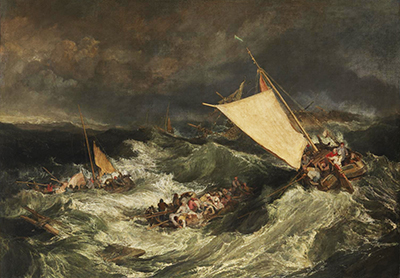
J. M. W. Turner's The Shipwreck is the Tate painting recorded as N00476 and exhibited in 1805.[1] Tate-related metadata gives the medium as oil paint on canvas and the support as 1705 x 2416 mm, or 170.5 x 241.6 cm.[1][2][3] The work entered national care through the Turner Bequest, accepted in 1856.[2][4]
The painting is one of Turner's great early treatments of disaster at sea. It shows wrecked or endangered craft, figures in danger, broken water and a vast dark marine field in which rescue is uncertain. The subject is dramatic, but it should not be treated as simple sensational drama. Turner makes the viewer search through water, foam, wreckage and bodies rather than offering an easy heroic rescue.
The painting has sometimes been linked with a specific recent wreck, and Google Arts & Culture's Tate partner entry states that the exact prompt remains uncertain: it may have involved a real maritime disaster or the renewed availability in 1804 of William Falconer's well-known poem on shipwreck.[4] That uncertainty is important. The public identity of the object is The Shipwreck, N00476, exhibited 1805; a proposed historical incident should remain proposed unless stronger evidence is available.
The canvas matters because it turns shipwreck into a problem of seeing and responsibility. The viewer is placed before human danger, but the scene denies a stable position from which the outcome can be calmly judged. Turner uses scale, darkness, wave movement and scattered figures to make maritime catastrophe visually overwhelming without detaching it from human vulnerability.
At a Glance
- ArtistJoseph Mallord William Turner
- TitleThe Shipwreck
- DateExhibited 1805
- MediumOil paint on canvas
- Support170.5 x 241.6 cm
- CollectionTate
- AccessionN00476
- ProvenanceTurner Bequest, accepted 1856
- ScaleMore than 2.4 metres wide
- Display statusCheck Tate's current listing before visiting
Contents
- Overview
- Object Identity
- A Large Early Sea Disaster
- Uncertain Historical Prompt
- Water, Wreckage and Figures
- Darkness, Foam and Scale
- Rescue Without Certainty
- Shipwreck and the Sublime
- Turner's Own Gallery
- Not Shipwreck off Hastings
Object Identity
The title used here is The Shipwreck.[1] The artist is Joseph Mallord William Turner, and the controlling date formulation is exhibited 1805.[1][2] The accession is Tate N00476.[1] These facts separate the work from later Turner shipwreck subjects and from the distinct watercolour A Shipwreck off Hastings.
The medium is oil paint on canvas.[1][2] Art UK corroborates the format as oil on canvas and gives the measurements as 170.5 x 241.6 cm.[3] Tate Images gives the same support in millimetres and records the Turner Bequest provenance.[2] These details matter because the work is physically large. It is not a compact study of maritime danger; it is a broad canvas that surrounds the eye with sea and broken movement.
The Tate accession also matters. N00476 entered the national collection as part of the Turner Bequest in 1856.[2][4] The bequest context means the painting's modern public role is bound to Turner's posthumous national afterlife. A work exhibited by Turner in 1805 later became part of the enormous body of material through which Britain inherited and reinterpreted his achievement.
Display status should be handled cautiously. Tate's object entry surfaced in search as showing the painting on display at Tate Britain at the time checked, while the more stable facts are title, exhibited date, accession, medium, dimensions and bequest.[1][2] A visitor should check Tate's current listing before relying on a gallery location.
Butlin and Joll remain the catalogue backbone for Turner's oil paintings, including title, exhibition history and the work's place among the early large marines.[7] Their value here is practical: they help keep identification, dating and provenance distinct from later interpretive association. That means keeping the Tate accession clear, preserving the exhibited 1805 wording, and resisting the temptation to fill uncertainty with a confident story.
A Large Early Sea Disaster
The dimensions are central to the experience of the painting. At more than 2.4 metres wide, The Shipwreck gives the sea enough breadth to dominate the viewer. The large format makes wreckage and figures feel dispersed across a force larger than any one human action.
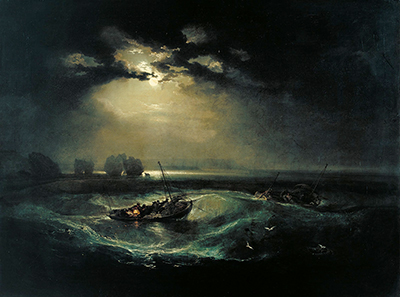
Turner had already used the sea to make ambitious public statements in Fishermen at Sea, Calais Pier and Dutch Boats in a Gale. This 1805 canvas pushes the theme toward a more destructive limit. The problem is no longer a night fishing scene, a chaotic harbour arrival or boats driven in a gale. Here the central condition is wreck itself.
The size also affects interpretation. A small disaster image might concentrate sympathy on one figure or one boat. This canvas makes the viewer confront a whole field of danger. Attention moves from wave to hull, from figure to foam, from dark mass to flashes of broken water. The eye cannot easily master the event.
That difficulty is part of the work's seriousness. Turner does not let shipwreck become a tidy story of danger and rescue. The painting keeps uncertainty active. Some figures may be struggling toward safety; others appear overwhelmed by water; broken forms interrupt the view. The viewer is asked to experience confusion without losing sight of suffering.
The painting's scale also changes the viewer's bodily relation to the subject. A wide canvas can make the sea feel less like a depicted object and more like an environment. The viewer stands before a field of water and darkness that exceeds the reach of any single figure inside the image. This is one way Turner makes shipwreck more than an incident.
The early date should also be stressed. By 1805 Turner had already shown that marine painting could be a field of professional ambition. The Shipwreck makes that ambition more severe. Instead of using sea and weather to show a vessel under pressure, he shows the collapse of ordered navigation. The ship is no longer a controlled machine; it has become a broken human environment.
Uncertain Historical Prompt
The painting should not be tied too confidently to one named maritime incident. Google Arts & Culture's Tate partner entry states that the immediate inspiration is unknown, and gives two possibilities: an actual wreck or the 1804 reissue of Falconer's poem The Shipwreck.[4] That formulation is useful because it marks uncertainty instead of pretending to resolve it.
The possible Falconer connection matters because the poem gave eighteenth- and nineteenth-century readers a powerful literary model of shipwreck. If Turner had it in mind, he was not simply depicting a recent news event; he was entering a literary and pictorial tradition of maritime disaster. But that possibility remains different from proof.
The same caution applies to claims about the Earl of Abergavenny. The loss of that ship in 1805 has often been associated with Turner's painting, but the current working standard for this article is conservative. The association can be mentioned as part of reception history only with qualification; it should not be used as the painting's identity.
This caution is not timid. It keeps the painting stronger. If The Shipwreck is forced into a single incident without secure support, the viewer may begin by checking correspondence rather than looking at the canvas. Tate's title is broader and more powerful. It presents shipwreck as an experience of sea danger, not merely as a record of one wreck.
Uncertainty also suits the painting's structure. The image itself resists easy certainty. It does not provide a calm documentary account. It gives the viewer a violent field of water and human vulnerability. The historical question and the visual experience therefore align: both require careful handling.
This does not mean historical context should be ignored. The early nineteenth century was a culture in which maritime loss could be public news, literary theme and personal fear. Ships carried trade, travellers, military power and family hopes. A wreck could therefore mean more than damage to property. It could expose the dependence of modern life on water that could not be mastered.
Turner's painting belongs to that world of maritime risk, whether or not one incident can be proved as the direct prompt. The safest approach is to say that the canvas condenses the shipwreck theme with unusual force. It need not become a forensic reconstruction to be historically serious.
Water, Wreckage and Figures
The painting's force depends on the way water, wreckage and figures are intertwined. The sea does not sit behind the human drama. It surrounds, interrupts and partially hides it. People and objects are difficult to separate because the storm has turned the scene into a field of broken relations.
This is one reason the work should be discussed without excessive melodrama. The danger is already present in the composition. Turner does not need exaggerated language to make the event grave. The broken water, scattered bodies and unstable boats carry the pressure.
The figures matter because they keep the painting human. Without them, the canvas would become a magnificent storm study. With them, the sea becomes an environment in which people are trying to survive. The viewer has to look for the human scale inside the larger motion.
The wreckage matters for a different reason. It shows that human craft has failed. Masts, hulls, spars and fragments no longer operate as ordered ship structure. They become signs of lost control. Turner turns maritime technology into debris, and that transformation is central to the feeling of disaster.
The waves bind everything together. White crests and dark troughs create an unstable rhythm across the canvas. They carry the eye but also prevent it from settling. The viewer is made to move through the image as if through danger.
The boats and fragments also create competing scales. A spar may be large enough to catch the eye, but small against the surrounding water. A figure may be emotionally central, yet visually hard to hold. Turner keeps shifting the viewer's attention between human urgency and elemental breadth.
That shifting attention prevents the painting from becoming a tableau. The scene does not appear arranged for calm inspection. It feels as if forms have been thrown into relation by force. This is a crucial part of the work's effect: composition has to make disorder intelligible without taming it.
The human figures should therefore be read as more than small accents. They are the reason the painting matters ethically. Their presence makes the viewer ask who can be helped, who is already lost, and how much human effort can achieve under these conditions. Turner does not answer those questions neatly.
Darkness, Foam and Scale
Google Arts & Culture's Tate partner entry emphasizes the dark tonality of Turner's early paintings and describes the white wave crests and swirls as set against that darkness.[4] That observation is important because the painting's drama is tonal as much as narrative.
The dark field gives the sea weight. It makes the white foam appear sharper and more violent. Turner uses contrast to make water visible as force. Foam is not decoration; it is the sign of impact, breaking motion and danger.
Scale deepens that effect. The canvas is wide enough for darkness and foam to spread across the viewer's field. The eye cannot take in the scene as a single calm arrangement. Instead, it has to move through multiple centers of action and disturbance.
The tonal contrast also affects the figures. Bodies and boats emerge briefly from darkness, then seem at risk of being swallowed again. Turner makes visibility itself precarious. To see the endangered people is to feel how easily they may vanish.
This is one of the painting's major achievements. The work does not merely illustrate a shipwreck; it recreates the difficulty of apprehending one. The viewer has to search, and that searching becomes part of the ethical pressure of the image.
The same tonal structure gives the painting its early Turner character. Later Turner could dissolve forms into near-abstract light, but this canvas remains grounded in heavy dark masses and strong contrasts. It belongs to an earlier phase in which drama often depends on dense shadow broken by foam, sail, body or spray.
That does not make the painting conservative. The darkness is active. It refuses the clear outlines that would make rescue easier to follow. It allows the sea to become both visible and obscure. Turner is already asking how much a viewer can know when the world is in violent motion.
Rescue Without Certainty
The painting includes efforts toward survival, but it does not give a clear rescue narrative. That distinction matters. A rescue scene reassures the viewer by directing attention toward help, progress and eventual safety. The Shipwreck keeps those possibilities open but uncertain.
Some figures seem to reach, cling or struggle; others are hard to read amid water and debris. The result is not narrative confusion caused by weak design. It is a deliberate refusal of simple comfort. Turner makes the viewer confront a maritime disaster while withholding a settled outcome.
This approach differs from later dramatic storytelling in which a single rescuer or victim might become the focus. Turner gives no easy central hero. Human action is dispersed. The whole canvas becomes the field of distress.
That dispersal is why the painting feels morally serious. The viewer cannot solve the image by identifying one act of bravery or one tragic body. Instead, the eye must keep moving across many signs of danger. Turner makes attention itself a form of response.
The painting also avoids turning suffering into a neat lesson. It does not say simply that nature is powerful and people are weak. It shows human vulnerability inside a scene where people still act, struggle and hope. The sea dominates, but it does not erase the human effort within it.
This balance is especially important because shipwreck imagery can easily become a display of helplessness. Turner does not deny helplessness, but he does not reduce the figures to symbols. They remain bodies in a crisis, caught between agency and exposure. Their gestures matter even when the outcome remains unresolved.
The absence of a secure rescue center also changes the viewer's role. A picture with a clear rescuer allows admiration to settle on one action. Here, attention is scattered. The viewer has to keep returning to different parts of the canvas, piecing together danger without finding release. That is one reason the work remains unsettling.
Shipwreck and the Sublime
The Tate research publication on the Sublime includes The Shipwreck and identifies the work as by Joseph Mallord William Turner, exhibited 1805, oil paint on canvas, with support dimensions of 1705 x 2416 mm.[1] The inclusion is apt because the painting stages an encounter with force beyond easy control.
The Sublime here is not an abstract label. It appears through scale, darkness, danger and the difficulty of seeing. The viewer faces a scene where human bodies and vessels are dwarfed by weather and sea. The pleasure of the image is inseparable from anxiety.
That combination was central to shipwreck imagery in Turner's period. Maritime disaster allowed artists to show nature's power, human fragility and the limits of control. Turner gives the theme unusual pressure by refusing a clean visual hierarchy. The sea, not a heroic figure, is the dominant field.
Yet the work should not be reduced to a general example of the Sublime. Its object facts matter: Tate N00476, exhibited 1805, oil on canvas, Turner Bequest. Its visual choices matter too: the dark tonality, white foam, broad dimensions and uncertain rescue. The theory helps, but the painting must lead the reading.
Riding and Johns's Turner & the Sea provides the wider maritime framework for understanding why this subject was so central to Turner's career.[5] Shipwreck sits within a larger body of sea pictures involving labour, travel, warfare, weather and modern danger.
Within that wider framework, The Shipwreck occupies a particular position. It is not the moonlit labour of Fishermen at Sea, the harbour pressure of Calais Pier, the Dutch rivalry of Dutch Boats in a Gale, or the moral atrocity of Slave Ship. It is an early, large-scale image of maritime collapse in which the sea itself dominates the question of survival.
This distinction matters because broad sea themes can flatten Turner. Storms are not all the same. A gale that tests boats, a wreck that scatters bodies, a burial that mourns a friend, and a slave ship that exposes deliberate violence carry different ethical pressures. The Shipwreck belongs to the specific pressure of disaster without secure deliverance.
Turner's Own Gallery
Tate's study entry for a related work records that The Shipwreck was exhibited in Turner's own gallery in 1805 and that he was proud enough of the painting to have it engraved.[6] That exhibition context is important because it distinguishes the work from a Royal Academy showing while still marking it as public-facing.
Turner's own gallery gave him a degree of control over presentation. He could place works before viewers in a setting connected directly to his professional identity. For a large shipwreck painting, that control mattered. The canvas was not merely a private experiment; it was a statement about what his marine art could do.
The engraving detail also matters. Having the work engraved extended its reach beyond those who saw the canvas. It suggests that Turner considered the image worth circulating and fixing in another medium. Shipwreck was not a passing subject but an image he wanted to carry forward.
This context should be kept separate from the painting's later Tate identity. In 1805, it belonged to Turner's own exhibition and print ambitions. After 1856, it belonged to the Turner Bequest and the public collection. Both chapters matter, but they answer different questions.
The work's afterlife therefore spans several modes of publicness: display in Turner's own gallery, reproduction through engraving, and later national collection through the bequest. That sequence helps explain why The Shipwreck is more than a dramatic early oil. It is a work Turner actively presented and later Britain inherited.
Turner's own gallery context also helps explain why the painting can feel self-consciously ambitious. A private owner might display a shipwreck as a dramatic possession; Turner used it as part of his own professional presentation. The work declared his command of a difficult subject in a space tied to his name.
Engraving extended that declaration. A print cannot reproduce the scale, surface and tonal density of the oil, but it can circulate the design. The decision to have the work engraved suggests that Turner saw the image as suitable for wider recognition, not only for those who stood before the canvas.
Not Shipwreck off Hastings
This painting must be kept separate from A Shipwreck off Hastings. The latter is a different Turner work: a watercolour associated with Hastings, dated about 1825 and held by the National Gallery of Ireland. It has different medium, date, scale, collection and object identity.
The difference is not just administrative. An oil canvas of 1805 and a later watercolour of about 1825 ask different questions. The Tate work uses large-scale oil painting to confront a broad sea disaster. The Hastings sheet belongs to a more compressed watercolour format and a different coastal context.
The reserve Hastings material should therefore not be used to fill gaps in the Tate painting. Claims about scraping, gum arabic, Henry Vaughan or National Gallery of Ireland inventory belong to the Hastings work, not to N00476.
The same discipline applies to other Turner marine works. Dutch Boats in a Gale, Calais Pier, Slave Ship, Snow Storm - Steam-Boat off a Harbour's Mouth and Peace - Burial at Sea all involve water, danger or death, but each has its own identity. The Shipwreck should be read from its own Tate accession, exhibited date and visual structure.
Clear separation protects the viewer's understanding. Turner returned to maritime danger repeatedly, but repetition of theme does not mean sameness of object. N00476 is the large 1805 Tate oil, and that identity should remain the anchor.
The same caution applies to claims about technique. The Hastings watercolour involves paper, wash and highlight effects; The Shipwreck is oil on canvas. Descriptions of scraping or watercolour handling belong elsewhere. For this canvas, the relevant material facts are oil paint, large support, dark tonality and the Turner Bequest record.
How to Look at The Shipwreck
Begin with the object facts: The Shipwreck, Joseph Mallord William Turner, exhibited 1805, Tate N00476, oil paint on canvas, 1705 x 2416 mm.[1][2] These details give the work its proper scale and collection identity.
Then look for the distribution of danger. Do not search only for one central victim or one heroic rescuer. Turner spreads distress across the canvas. Boats, bodies, foam and wreckage all compete for attention.
Next, study the tonal structure. The dark sea and sky create the field in which white foam and broken forms flare into view. The contrast is not merely attractive. It makes visibility unstable.
After that, consider the uncertain historical prompt. The painting may relate to a real wreck, to Falconer's poem, or to a wider shipwreck tradition.[4] The safest reading begins with what is certain and keeps proposed incidents secondary.
Finally, ask how the painting handles rescue. It does not deny human effort, but it denies easy reassurance. Turner makes the viewer remain with danger rather than escaping into a resolved story.
A useful final step is to move from the largest forces to the smallest signs. Start with the breadth of the sea, then narrow attention to wreckage, hulls, limbs, crests of water and flashes of light. The painting becomes more disturbing as details emerge, because every local discovery confirms the scale of the disaster.
Then step back again. The individual signs of distress return to the larger dark field. Turner makes the viewer oscillate between sympathy for persons and recognition of overwhelming force. That oscillation is the work's central visual experience.
Why the Painting Matters
The Shipwreck matters because it shows Turner turning maritime disaster into a large-scale public image early in his career. It belongs to the period when he was already expanding marine painting beyond topographical description and into difficult experiences of danger, visibility and force.
It matters because it treats the sea as active power. Water does not decorate the scene or merely surround the wreck. It breaks, hides, carries and threatens. Turner makes the sea the dominant condition under which human action occurs.
The painting is also important for its uncertainty. Its possible relation to a specific wreck remains unresolved in the controlling public evidence used here.[4] Rather than weaken the work, that uncertainty keeps the title broad and lets the image stand as a concentrated statement about shipwreck itself.
The Turner Bequest afterlife adds another layer. Accepted by the nation in 1856, the painting became part of the immense body of Turner material through which later viewers have understood his career.[2] Its modern identity is therefore both an 1805 exhibition work and a bequest object.
Finally, The Shipwreck matters because it asks the viewer to look ethically as well as visually. Its beauty is inseparable from distress. Foam, darkness and scale may compel the eye, but the painting's human figures prevent the scene from becoming only a study of storm. Turner makes maritime disaster hard to see and hard to ignore.
The work also matters because it shows a young Turner already able to make uncertainty productive. The unresolved prompt, the dispersed action and the unstable visibility all contribute to the painting's force. Certainty would make it smaller. Turner gives the viewer facts enough to identify the object, then an image difficult enough to resist easy possession.
For the wider Turner project, N00476 is therefore a necessary hinge. It connects early marine ambition with later maritime darkness, while remaining distinct from the later works. Its scale, date and bequest identity make it a cornerstone for understanding how Turner transformed shipwreck from subject into visual ordeal.
Frequently Asked Questions
Joseph Mallord William Turner painted it. Tate identifies the work as by Turner, 1775-1851.[1]
It is held by Tate under accession number N00476.[1]
That connection has been proposed, but the Tate partner text consulted here states that the exact prompt is unknown and also mentions Falconer's poem as a possible stimulus.[4]
No. A Shipwreck off Hastings is a separate Turner watercolour associated with the National Gallery of Ireland, not Tate N00476.
Discussion
How does Turner make the viewer search through water, wreckage and figures without offering a simple heroic rescue?
Reader Insights
Where do foam and darkness reveal or conceal human danger?
How does the wide canvas make the sea dominate the figures?
Which actions suggest hope, and why does certainty remain withheld?
Join the Conversation
Share a close observation or a source-based question for other readers.
References
- Tate Research Publication, "Joseph Mallord William Turner, The Shipwreck." https://www.tate.org.uk/art/research-publications/the-sublime/joseph-mallord-william-turner-the-shipwreck-r1105577
- Tate Images, "The Shipwreck, Joseph Mallord William Turner, exhibited 1805." https://www.tate-images.com/n00476-The-Shipwreck.html
- Art UK, "The Shipwreck." https://artuk.org/discover/artworks/the-shipwreck-202302
- Google Arts & Culture / Tate, "The Shipwreck." https://artsandculture.google.com/asset/LwFch0SXuzBAIw
- Christine Riding and Richard Johns, eds., *Turner & the Sea*, Thames & Hudson / National Maritime Museum, 2013.
- Tate Research Publication, "Study for 'The Shipwreck'." https://www.tate.org.uk/art/research-publications/jmw-turner/joseph-mallord-william-turner-study-for-the-shipwreck-r1178107
- Martin Butlin and Evelyn Joll, *The Paintings of J. M. W. Turner*, revised edition, Yale University Press, 1984.