 by Tom Gurney
Tom Gurney BSc (Hons) is an art history expert with over 20 years experience
Published on June 19, 2020 / Updated on August 29, 2026
Email: tomgurney1@gmail.com / Phone: +44 7429 011000
Overview
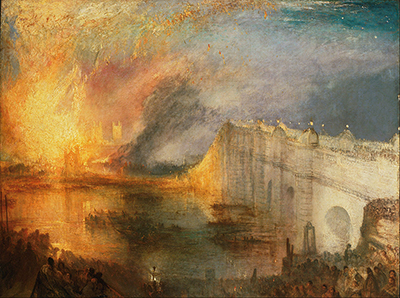
J. M. W. Turner's The Burning of the Houses of Lords and Commons, 16 October 1834 is the Cleveland Museum of Art version of one of the most dramatic modern events he painted. Cleveland dates the oil on canvas to 1835, gives the unframed dimensions as 92 x 123.2 cm, and records the framed dimensions as 123.5 x 153.5 x 12 cm.[1] The painting entered Cleveland through the bequest of John L. Severance and carries the accession number 1942.647.[1] Those details identify the primary work treated here: the Cleveland oil, not the related Philadelphia version.
The subject was the fire that destroyed much of the old Palace of Westminster on 16 October 1834. UK Parliament explains that the disaster began after old Exchequer tally sticks were burned in underfloor stoves below the House of Lords, igniting panelling and spreading through the Palace.[3] Both Houses of Parliament were destroyed, along with most other buildings in the complex, while Westminster Hall, the Jewel Tower, the Undercroft Chapel, the Cloisters and Chapter House of St Stephen's survived.[3]
Turner had a modern subject of extraordinary public visibility. Crowds gathered along the Thames to watch the blaze, and artists recognised the event's pictorial force almost immediately. Cleveland describes people lining the riverbank to gaze at the horrifying scene, while the low tide hampered attempts to pump water and slowed steamers towing firefighting equipment.[1] Turner made the disaster into a painting about light, fear, public watching, civic collapse and the limits of human control.
The Cleveland work should be read against, but not confused with, Philadelphia Museum of Art's related oil, dated 1834-1835.[2] Cleveland states that its canvas looks along the Thames from the southeast bank, while the Philadelphia version looks from directly across Westminster Bridge.[1] The two works are not duplicates. They show Turner testing how the same event changes under different viewpoints, structures and intensities of light.
That distinction is more than curatorial housekeeping. The Parliament fire has often been discussed under shorter descriptive names, and that can blur the identity of individual works. The Cleveland canvas is one painting with its own viewpoint and afterlife. The Philadelphia canvas is another. Turner also made works on paper connected with fire subjects, some of which require careful reassessment. A reliable interpretation starts by naming which object is being discussed and then widening outward to the event, the related works and the later reception.
At a Glance
- ArtistJoseph Mallord William Turner
- Full titleThe Burning of the Houses of Lords and Commons, 16 October 1834
- Date1835
- MediumOil on canvas
- Dimensions92 x 123.2 cm
- CollectionCleveland Museum of Art
- Accession1942.647
- AcquisitionBequest of John L. Severance
- ViewpointDownriver from the southeast bank of the Thames
- Related oilPhiladelphia Museum of Art, object 103831
Contents
- Overview
- Object Identity
- The Fire of 16 October 1834
- Cleveland and Philadelphia: Two Oil Versions
- River, Crowd and Firefighting
- Flame, Smoke and Atmospheric Force
- A Modern Disaster, Not a Myth
- Sketches, Watercolours and Caution
- The Palace, Survival and Aftermath
- Why the Painting Matters
Object Identity
Cleveland's title names the burning of the Houses of Lords and Commons on 16 October 1834.[1] The artist is Joseph Mallord William Turner, the date is 1835, the medium is oil on canvas, and the accession number is 1942.647.[1] The Cleveland record gives its location as 203B British Painting and Decorative Arts at the time checked.[1]
The title fixes the painting to a specific public disaster, while the date places the finished oil in the year after the event. Turner was not painting an ancient myth or a distant historical episode. He was transforming a recent catastrophe into an exhibition-scale image. That immediacy is central to the work's power.
The object also has a documented provenance. Cleveland's print record states that the painting was bought from Turner by John Garth Marshall of Headingley House, Leeds, and later passed through the Marshall family, the Leicester Gallery, Knoedler, and John L. Severance before entering the Cleveland Museum of Art.[6] This history matters because it shows the work's movement from Turner's studio into private ownership and eventually a public museum collection.
Butlin and Joll's catalogue remains important for keeping the two oil versions, exhibition history and provenance straight.[7] The Parliament fire is a subject with many related images and later assumptions around it. A careful reading needs to keep the Cleveland oil, the Philadelphia oil, related watercolours and sketch material in distinct categories.
The primary title used here is therefore not the shorter local label, "Burning of the Houses of Parliament." That label is useful in casual speech, but it is too generic for object identity. The Cleveland painting has a specific institutional title, date, medium, size and accession number, and those anchors should lead interpretation.
The date also helps establish the painting's relation to memory. Turner was working very near the event, but he was not simply standing before the fire and copying what he saw onto canvas. The Cleveland oil belongs to the following year, when the disaster had already become a matter of public discussion, political consequence and artistic ambition. Its authority comes from that combination: firsthand observation and later pictorial construction, not one at the expense of the other.
The medium matters for the same reason. Oil on canvas gave Turner a public scale and material density different from rapid sketching or watercolour study. The surface could carry broad atmospheric passages, blazing colour and the slow adjustment of forms in the studio. A viewer should therefore resist treating the painting as if every mark were a literal minute-by-minute note. It is an exhibition work shaped from observation, knowledge and imagination.
The Fire of 16 October 1834
The old Palace of Westminster was vulnerable long before the night it burned. UK Parliament notes that committees and architects had warned of fire risk, including a late-eighteenth-century committee of MPs and an 1828 warning by John Soane that much of the Palace was timber covered with plaster.[4] The disaster was therefore not only sudden; it exposed a long-recognised weakness in the fabric of government.
UK Parliament's account of the Great Fire explains that the Exchequer needed to dispose of two cartloads of wooden tally sticks, remnants of an obsolete accounting system. The Clerk of Works chose the underfloor stoves in the House of Lords basement as the place to burn them.[3] On 16 October, workmen carried out the task, and visitors later noticed heat and smoke in the House of Lords.[3]
The alarm came in the evening. UK Parliament states that at 6 pm the wife of a doorkeeper screamed that the House of Lords was on fire, and the flames rapidly spread through the Palace.[3] The fire became a public event as well as an institutional disaster. Soldiers held back crowds, and Turner was among the artists who observed and later painted the dramatic event.[3]
The destruction was severe. Both legislative chambers were lost, together with most of the surrounding palace buildings.[3] Westminster Hall survived through firefighting efforts and a change in the wind.[3] That survival matters because the old and new histories of Parliament were divided by the fire. The medieval complex was largely gone, while the modern Palace of Westminster would eventually rise in its place.
Turner's painting does not explain tally sticks, stoves or administrative failure in documentary form. Instead, it gives the fire a visual and emotional shape. Flame, smoke, water, onlookers and firefighting boats become the evidence of a public order under sudden pressure. The viewer sees less of cause than consequence.
The tally sticks are still important because they make the fire painfully ordinary in origin. An outdated method of accounting, retained for centuries and then destroyed by an ill-judged practical decision, helped ignite a national architectural crisis. Turner does not need to narrate that irony directly. The painting gains force from the knowledge that a vast public disaster could begin in an administrative routine.
The timing also matters. By evening the blaze had become visible to Londoners as a city event, not merely an internal emergency at the Palace. The riverfront turned into a viewing ground, while the fire itself became light thrown across water and sky. Turner was especially equipped to understand that change. He could translate a political disaster into a problem of illumination: how flame reveals, blinds, magnifies and consumes.
The survival of Westminster Hall keeps the event from being a total erasure. UK Parliament records both the destruction of the chambers and the endurance of older structures.[3] That mix of loss and survival is one reason the fire became such a symbolic threshold. The old Palace did not vanish without trace, yet the institutions housed within it had to be materially remade.
Cleveland and Philadelphia: Two Oil Versions
Turner painted two major oil versions of the fire. Cleveland sets out the key distinction clearly: its painting uses a downriver view from the southeast bank, while the Philadelphia painting faces the blaze from Westminster Bridge's opposite side.[1] Tate's research also records that the two large oils entered public exhibition in 1835, linking the Philadelphia and Cleveland works to the British Institution and Royal Academy contexts.[5]
The Philadelphia Museum of Art records its canvas under a closely related title and gives the date range 1834-1835.[2] Its description says Turner recorded the evening when fire broke out in the Houses of Parliament, and notes flames consuming Saint Stephen's Hall and the House of Commons while Westminster Abbey's towers were illuminated but spared.[2] It also stresses the exaggerated scale and plunging perspective of Westminster Bridge.[2]
The Cleveland painting presents a different encounter. Its downriver viewpoint gives more space to the Thames, to firefighting boats, and to the fire as an atmospheric event spreading across distance. The bridge is not the same pictorial anchor as in Philadelphia. The Cleveland work is less a confrontation across Westminster Bridge than a scene in which river, flame and sky take over the field.
The two versions show Turner thinking through modern disaster as a problem of viewpoint. One view presses the bridge and the buildings into dramatic perspective; the other sets the fire in a wider river environment. The differences are not minor. They change how the viewer experiences scale, crowd, architecture and human effort.
This is why the Cleveland painting must remain the main object here. The Philadelphia work is essential comparison, but it should not take over the discussion. Cleveland's version is the work identified by accession number 1942.647 and by the museum record used for title, date, dimensions and location.[1]
The exhibition history is also revealing. Tate's account places both large fire paintings before viewers in the year after the disaster, divided between two major London venues.[5] That means the subject was not a private afterthought. Turner carried it into public artistic arenas almost immediately, placing a recent London disaster before audiences who could still remember the smoke, crowds and political shock.
The Philadelphia version, with its strong bridge emphasis, gives the viewer a powerful architectural device. The Cleveland version, by contrast, lets the fire spread more broadly through atmosphere and river space. When the two are compared, Turner appears less interested in a single definitive view than in the visual possibilities opened by the disaster. The same night could be compressed by bridge perspective or opened into a river panorama.
River, Crowd and Firefighting
Cleveland describes people gathering along the banks of the Thames to gaze at the fire, and notes that the low tide made it difficult to pump water to land while hampering steamers towing firefighting equipment.[1] Those details help explain why the river is so important in the painting. It is not merely a reflective surface. It is part of the crisis.
In the Cleveland painting, boats in the lower-right corner head toward the flames.[1] Their movement matters because it gives the scene a human counterforce. The fire is vast, but the response is small, slow and exposed. Turner records effort without making it seem adequate to the scale of the disaster.
This tension between event and response is one of the painting's main subjects. The Palace burns across the river, but the foreground and lower passages keep returning the eye to onlookers and boats. The fire is public because people watch it; it is political because the seat of government is burning; it is elemental because flame and smoke overwhelm human systems.
The crowds also make looking itself part of the event. Turner was one observer among many. Philadelphia says he witnessed the fire with tens of thousands of onlookers and made quick sketches that became the basis for that painting.[2] Tate's research, however, cautions that whether a given composition proves a particular viewpoint on the night can be debatable.[5] The safest reading is that Turner observed the disaster and developed it through drawing, memory and studio transformation.
That caution is important. The painting feels immediate, but immediacy in Turner is not the same as unprocessed report. He could witness, sketch, remember, intensify and reorder. The Cleveland painting turns public observation into an image of overwhelmed civic space.
The low tide detail deepens the scene's drama. Water, normally the fire's natural opponent, is present in abundance but not simply available for use. Cleveland's account of pumping difficulties and hampered steamers shows that the river was both resource and obstacle.[1] Turner could exploit that contradiction visually. The Thames reflects the blaze and carries boats toward it, yet it cannot prevent the Palace from burning.
The people along the banks are important for another reason: they mark the transformation of disaster into shared memory. A private accident inside a government building became a collective urban experience because it could be seen. Turner paints not only flame, but a city watching flame. In that sense, the painting is about the making of historical memory in real time.
The firefighting boats should not be read as heroic decoration alone. Their small scale against the fire gives the painting its harsh measure of human capability. They show action, but not mastery. They suggest courage and urgency while preserving the imbalance between human response and elemental force.
Flame, Smoke and Atmospheric Force
Cleveland's description says Turner magnified the height of the flames and used the disaster as a starting point for expressing human helplessness before destructive natural power.[1] That statement is central to the painting's interpretation. Turner is not merely giving the viewer a news image of a fire. He is enlarging the event until it becomes a drama of elemental force.
The flames rise beyond ordinary scale. They dominate the sky, colour the river and threaten to dissolve the architecture they consume. The painting's fire is historically grounded, but visually intensified. Turner takes a real event and gives it the force of a sublime disaster.
Smoke is just as important as flame. It blurs the boundary between building and atmosphere, between solid architecture and airborne destruction. The Palace of Westminster was a political and physical structure, but Turner's smoke makes it unstable. Government appears not as fixed stone but as something vulnerable to heat, wind and accident.
Colour carries this transformation. Cleveland notes brilliant swathes of colour and variable atmospheric effects, adding that they border on abstraction.[1] That phrase should be tied to the museum's object text rather than used loosely. The painting is not abstract in the sense of abandoning subject. It remains anchored in a dated disaster. But its colour and atmosphere push the viewer toward sensation before description.
This is one reason the work feels modern. Turner makes a contemporary urban event behave like an overwhelming natural phenomenon. The fire is caused by human error and institutional neglect, yet in the painting it takes on the magnitude of storm, eruption and cosmic light.
The architecture is caught between legibility and disappearance. The viewer needs enough structure to understand that Parliament is burning, but Turner does not preserve the building as a stable object. Smoke and glare swallow outline, and the Palace becomes a source of light as much as a subject. That reversal is one of the painting's most unsettling effects. The building that should stand for order becomes the very material of disorder.
The river doubles that instability. Reflections stretch the fire downward, so destruction is not confined to the distant bank. Light moves across the water toward the viewer, implicating the foreground in the catastrophe. The painting's space is therefore not simply divided between safety and danger. Even the watching zone is coloured by the blaze.
Turner's handling of atmosphere lets him join history painting to landscape painting. He does not abandon the historical subject; he makes weather, vapour, light and water carry it. The result is a painting in which civic disaster is understood through environmental sensation. To look at the scene is to feel history as heat, glare and unstable air.
A Modern Disaster, Not a Myth
Many of Turner's great works treat ancient stories, biblical episodes or historical subjects from the more distant past. The Cleveland Parliament fire painting is different. Its subject was recent, urban and public. People living in 1835 could remember the night. Some had watched it with their own eyes.
That modernity changes the stakes. Turner did not need to invent grandeur by borrowing from Homer or Virgil. The grandeur came from a real London disaster: the legislative chambers burning, the Thames crowded with observers, the fire's glow transforming the city, and the old Palace disappearing in a single night.
Yet Turner still treats the event with the ambition of history painting. The work is not a modest city view. It is an image of institutional destruction. Parliament's old home burns before a watching public, and the image asks what it means for the architecture of government to become light, smoke and ruin.
The painting also sits between reportage and imagination. Philadelphia's record includes a contemporary newspaper description from The Times about the sudden breaking out of a terrifying conflagration.[2] Turner knew he was painting an event already mediated by witnesses, newspapers, rumours and crowds. His painting joins that public record while transforming it into something more visual and atmospheric.
This balance keeps the work from becoming either simple documentation or pure fantasy. The fire happened; the Palace burned; crowds watched; boats struggled; two major oil paintings resulted. But Turner's art lies in the way he made those facts feel like a crisis of perception.
The painting also changes the role of the viewer. A conventional record might ask what burned, when and why. Turner's canvas also asks what it is like to see a symbol of government become light in the sky. That question is not only political. It is visual and psychological. The event overwhelms the categories by which it might be neatly explained.
For that reason, the Cleveland painting belongs to Turner's broader interest in moments when human systems meet forces they cannot fully control. The force here is not remote nature alone. It is a fire born from human practice, spreading through an old architectural complex, watched by a modern crowd and transformed by an artist who understood public disaster as a kind of atmospheric shock.
Sketches, Watercolours and Caution
Turner's response to the Parliament fire included more than the Cleveland and Philadelphia oils. Tate's research publication discusses related works on paper and confirms that the subject reached oil-painting scale in the following year's exhibitions.[5] It also makes an important caution: some watercolours once connected with the 1834 Westminster fire have been reassigned to the fire at the Grand Storehouse of the Tower of London on 30 October 1841.[5]
That reassessment matters because Turner fire imagery is easy to over-identify. Flames, smoke and night crowds can look similar across events, especially when Turner is working quickly or atmospherically. Not every work once linked to the Parliament fire should be treated as direct evidence for this painting.
The Cleveland painting should therefore be interpreted from its own record first. The title, date, medium, dimensions, viewpoint distinction and description all come from the Cleveland object record.[1] Philadelphia and Tate help build the broader network, but they do not erase the need to keep each work separate.
This caution also applies to eyewitness claims. Turner almost certainly observed the event, and the Philadelphia record says he witnessed it with a vast public crowd.[2] Tate's discussion is more careful about whether specific compositions prove exact positions on the night.[5] The responsible approach is to say that Turner observed and studied the event, then developed it through studio practice into exhibition works.
That approach makes the painting more interesting, not less. It shows Turner as both witness and maker. His art depends on public experience, but it also depends on selection, amplification and transformation.
It also protects the viewer from a common simplification. A dramatic fire study by Turner may look as if it must belong to the Parliament blaze, but visual similarity is not enough. Tate's reassignment of some works to the later Tower of London storehouse fire shows why subject labels need evidence.[5] For the Cleveland oil, the institutional title and exhibition context give firm ground. For related works on paper, each case has to be handled separately.
The relationship between sketch and oil should therefore be understood as a chain, not a one-to-one transfer. Turner could gather impressions, return to them, combine them with other visual ideas and enlarge them for exhibition. The Cleveland painting's power depends on that process. It preserves the force of witnessed disaster while allowing the image to become more ordered, intense and symbolic than a rapid note could be.
The Palace, Survival and Aftermath
The fire destroyed much of the old Palace of Westminster, but not everything. UK Parliament states that firefighting efforts and a change in the wind saved Westminster Hall, and that several other historic structures also endured.[3] The survival of these structures shaped how the new Palace would be imagined and built.
UK Parliament's destruction account notes that twenty years after the fire, many damaged buildings had been demolished and their materials carted away.[4] The disaster therefore had a long aftermath. It did not end when the flames went out. It changed the physical, architectural and symbolic future of Parliament.
Turner's painting catches the crisis at its most visible moment, before reconstruction and Gothic Revival debates had settled the future. The old world is still burning. The new Palace is not yet built. The viewer stands within an interval between destruction and reinvention.
That interval gives the painting its historical weight. It is not only a fire picture; it is a record of transition. The old parliamentary complex is being lost in public view, and the modern city is watching the loss happen. Turner turns that transition into light on water and smoke over architecture.
The survival of Westminster Hall also complicates the scene. The Palace burns, but continuity is not entirely broken. Some medieval structures endure, and the later Palace would incorporate survival into rebuilding. Turner's painting shows destruction, but history would make that destruction the beginning of another architectural identity.
The aftermath also clarifies why the picture is not just a London view. Parliament was a working institution, a ceremonial complex and a national symbol. Its destruction demanded practical decisions about where government would meet and what architectural language should replace the lost buildings. Turner catches the moment before those answers, when the future is still hidden inside smoke.
That timing gives the painting a special historical suspense. The viewer knows that a new Palace will eventually define the Thames at Westminster, but Turner paints the gap before that resolution. The old structures are being consumed, the crowd is watching, and the city has not yet converted disaster into a new form of order.
Why the Painting Matters
The Cleveland painting matters because it shows Turner confronting a modern public disaster without reducing it to illustration. He uses a witnessed event to explore scale, helplessness, crowd behaviour, firefighting, urban space and atmospheric transformation. It belongs with his larger project of making landscape and light carry historical force.
It also matters because it tests how a contemporary event becomes art. The 1834 fire was already a public drama before Turner painted it. Thousands watched; newspapers reported; artists sketched; political institutions assessed damage. Turner entered that crowded field and made a painting in which the event becomes almost elemental.
The work's relation to the Philadelphia version strengthens its importance. Seeing that Turner made two oil treatments prevents a single-view reading. He was not merely recording one angle. He was reimagining the event through different visual structures, asking how bridge, river, crowd and flame could alter the meaning of the same disaster.
The painting also points toward later Turner subjects in which modern life, technology and historical change are treated through weather, light and atmosphere. It should not be reduced to a preview of those works, but it belongs to the same imaginative territory. Turner makes modernity visible as an experience rather than a diagram.
Finally, the painting matters because it preserves the fire as both fact and sensation. The viewer learns that Parliament burned on 16 October 1834, but also feels how such an event could overwhelm normal measures of scale and order. Turner gives the catastrophe a visual memory that is more intense than ordinary record.
The Cleveland canvas is especially useful because it resists a narrow architectural reading. It includes a specific building and a specific night, but its lasting force comes from how the river, sky, smoke and crowd turn the event into a whole environment. The painting does not leave the fire safely in the background. It makes the viewer inhabit the conditions of watching.
That is why the work remains central to Turner's late public reputation. It shows the qualities often associated with his mature art: blazing colour, unstable form, dramatic atmosphere and a willingness to treat modern life with the seriousness once reserved for classical or biblical subjects. At the same time, it stays attached to a precise event. The painting's grandeur is inseparable from its date.
How to Read The Burning of the Houses of Lords and Commons
Begin with the Cleveland identity: a 1835 oil on canvas at the Cleveland Museum of Art, accession 1942.647.[1] That keeps the primary object distinct from the Philadelphia version.
Then locate the viewpoint. Cleveland states that this version looks downriver from the southeast bank of the Thames.[1] The viewpoint allows river, fire and atmosphere to dominate the scene. The fire is not enclosed by architecture; it spreads across water and sky.
Next, look at the lower-right boats. Cleveland identifies them as moving toward the flames.[1] They provide the painting's most direct sign of human response. Their smallness against the blaze makes the disaster feel almost unmanageable.
After that, compare Philadelphia only briefly. Its Westminster Bridge viewpoint creates a different visual problem, with the bridge's scale and perspective intensifying the drama.[2] The comparison shows Turner testing the event, not repeating himself.
Finally, keep the history in view. The fire began with the burning of old tally sticks, destroyed both Houses of Parliament, and left only key parts of the old Palace standing.[3] Turner's painting transforms those facts into a study of flame, water, public watching and civic vulnerability.
It is also worth reading the painting slowly from foreground to distance. The lower zone gives the eye human scale: boats, water, figures and the edge of the gathered crowd. The middle distance establishes the river as a stage for action and reflection. The upper field lets flame and smoke dominate, so that the event becomes less a view of a building than an experience of atmosphere.
That slow movement guards against treating the work only as an illustration of 16 October 1834. The historical facts are essential, but the painting's visual meaning is built through relations: small boats against high flame, dark crowd against burning sky, river surface against collapsing architecture, observation against helplessness. Turner makes those relations carry the force of the disaster.
Frequently Asked Questions
The painting is in the Cleveland Museum of Art. Cleveland records the credit line as Bequest of John L. Severance and lists the work in British Painting and Decorative Arts at the time checked.[1]
UK Parliament states that Westminster Hall and several other historic structures survived, while both Houses and most of the Palace complex were destroyed.[3]
Discussion
How does Turner transform a witnessed civic disaster into an image of public watching and elemental force?
Reader Insights
How does the Cleveland river view change the relation between fire, water and crowd?
What do the small boats contribute to the painting's sense of human helplessness?
How does a recent political disaster become a history painting?
Join the Conversation
Share a close observation or a question for other readers.
References
- Cleveland Museum of Art, "The Burning of the Houses of Lords and Commons, 16 October 1834." https://www.clevelandart.org/art/1942.647
- Philadelphia Museum of Art, "The Burning of the Houses of Lords and Commons, October 16, 1834." https://www.philamuseum.org/objects/103831
- UK Parliament, "The Great Fire of 1834." https://www.parliament.uk/about/living-heritage/building/palace/architecture/palacestructure/great-fire/
- UK Parliament, "Destruction by fire, 1834." https://www.parliament.uk/about/living-heritage/building/palace/estatehistory/reformation-1834/destruction-by-fire/
- Tate, "Joseph Mallord William Turner, The Burning of the Houses of Parliament c.1834-5." https://www.tate.org.uk/art/research-publications/jmw-turner/joseph-mallord-william-turner-the-burning-of-the-houses-of-parliament-r1184334
- Cleveland Museum of Art, printable object record for "The Burning of the Houses of Lords and Commons, 16 October 1834." https://www.clevelandart.org/print/art/1942.647
- Martin Butlin and Evelyn Joll, *The Paintings of J. M. W. Turner*, revised edition, Yale University Press, 1984.